Week 9 — Advanced Obfuscation and Diversification¶
| Date | 13.11.2026 |
| Learning outcomes | LO.3 |
| Duration | 3 hours |
| Prerequisites | The white-box attacker model from Week 1; compilation, objdump and reverse engineering concepts from Week 4; control flow in C (if, switch, loops) |
| Labs | code/week-09 — 2 demos; build once in the code folder, then run from bin/linux (bin\windows on Windows) |
Lecture notes (PDF) Lecture notes (DOCX) Slides (PDF) Slides (PPTX) Slides (HTML, offline) Download all (ZIP) Open slides full screen
Click inside the slides and use the arrow keys; use the button at the bottom right of the slides or the link above for full screen.
This week's working demo
code/week-09/01-manuel-gizleme — Manual obfuscation + cost measurement: same behaviour, the secret stays hidden, cost measured with objdump. · code/week-09/02-cesitlendirme — Diversification: the same source compiled with two seeds → binaries that are behaviourally equivalent but structurally different.
Run with: sh demo.sh (Linux/WSL), or build with CMake and run from under bin/. Fully synthetic and safe; it does not harm the student's computer.
Run the demo yourself — step by step (copy-paste)
Setup and the first build are in code/README.en.md (Visual Studio or the command line). After cloning the repository and entering the code folder:
# Windows (PowerShell) — 'code' klasöründe
.\build.ps1                                    # tüm demoları bir kez derle
cd week-09\01-manuel-gizleme
.\bin\windows\erisim_temiz.exe CEN429-OK     # korumasız sürüm
.\bin\windows\erisim_gizli.exe CEN429-OK     # gizli sürüm — çıktı AYNI
# WSL / Linux — 'code' klasöründe
./build.sh
cd week-09/01-manuel-gizleme
sh demo.sh                                     # açıklamalı tam akış
Expected output: both versions print the same "access granted" line for CEN429-OK (behaviour preserved). In the strings output, CEN429-OK is visible in the clean build and not visible in the obfuscated build (K-07 string encoding). objdump measurement: erisim_ver goes from ~28 instructions / 3 branches → ~51 instructions / 6 branches (cost increased). The second demo (02-cesitlendirme) compiles the same source with two seeds → same behaviour, different binary.
By the end of this week you will be able to
- Define code obfuscation as a security rule/countermeasure, and write each technique in the form "what does it protect, which requirement does it satisfy, what is its cost, what is its limit."
- Explain the obfuscation taxonomy (layout, data, control flow, anti-analysis, virtualisation) and the white-box / MATE (man-at-the-end) threat model.
- Analyse, at a conceptual level, advanced control-flow and data obfuscation rules (opaque predicates and loops, arithmetic encoding, bogus operations and dead branches, control-flow flattening, random exit, string and constant encoding).
- Explain why diversification is a holistic resilience rule, and what virtualisation-based, compiler-based, and dynamic obfuscation buy you and at what cost.
- Measure the effectiveness of obfuscation using the potency, resilience, stealth, and cost metrics to justify a protection decision, and write a protection table for the S9 section of your own project.
Class schedule (timing plan for the instructor)
| Time | Section | What happens |
|---|---|---|
| 0:00–0:20 | 1 | Why is obfuscation a rule? White-box / MATE threat model; what obfuscation gives and does not give |
| 0:20–0:45 | 2 | Obfuscation taxonomy and the "protection rule" template (what it protects / requirement / cost / limit) |
| 0:45–0:50 | Break | |
| 0:50–1:35 | 3 | Control-flow rules: opaque predicate and loop, arithmetic encoding, bogus operation/dead branch, flattening, random exit |
| 1:35–1:40 | Break | |
| 1:40–2:10 | 4 | Data rules: string/constant encoding, variable splitting/merging; virtualisation, compiler-based, dynamic obfuscation (concept) |
| 2:10–2:40 | 5 | Diversification; measuring obfuscation (potency, resilience, stealth, cost); deobfuscation and resilience |
| 2:40–3:00 | 6+ | Its place in layered defence; project S9; self-check |
About this week's sources
This week draws on two main sources: (1) the secure programming technical guide — which lists the code hardening countermeasures of a certified mobile payment library in a "description / implementation / limit" format; (2) the Secure Programming Cookbook (Viega & Messier), Chapter 12, "Anti-Tampering." The countermeasures in the guide are given here as rules, stripped of the product and of any real values; all code and values are synthetic. Week 4 introduced these techniques (symbol/string hiding, an introduction to flattening); this week treats the same techniques at an advanced level and adds how to measure them. Week 14 shows their automated counterpart (Tigress).
0. Before we start¶
This section prepares you for the week. It first briefly recalls the earlier topics this week builds on; it then defines each of this week's concepts in one sentence and links it to the section where it is explained in full. Background knowledge not covered in earlier weeks is explained from scratch under the "Background" headings.
What we bring from earlier weeks¶
- The white-box / MATE attacker model — the threat model in which the user who holds the device is also a potential attacker, able to read memory and attach a debugger (Week 1, §3). This week, in §1, we reuse this model under the name MATE (Man-At-The-End) as the motivation for code obfuscation.
- Debugger — a tool that runs a program step by step and shows its variables (gdb, lldb); we saw checking at runtime whether a debugger is attached in the context of RASP (Week 6, §4). This week it appears briefly in §1 as one of the MATE attacker's tools.
- Entropy (randomness) — a measure of how disordered/unpredictable a piece of data's bytes look; we met it in week 2 for recognising encrypted/packed content (Week 2, §6), and in week 3 as the foundation of random-number generation (Week 3, §3). This week we deepen the same metric with a numeric example, in the context of an attacker telling apart high-entropy blocks (keys, encrypted data) in a binary (see "Background" below).
- Compiler flag,
strings, and the symbol table — options passed to the compiler (-O2,-Wall,-DGUNLUK_ACIK; the same source can be built with or without logging depending on the flag) and tools that show a binary's readable text/name list; week 4 first defined these and showed the entry-level steps of obfuscation (Week 4, §15). This week K-06/K-07 close off the same hints at a more advanced level. - Decompilation — turning a binary/bytecode back into something close to readable code; we saw this over JVM bytecode in week 5 (Week 5, §10). This week we extend the same idea to native (C/C++) binaries and tools such as Ghidra/IDA.
- XOR — the operation that gives 1 if two bits differ and 0 if they match; thanks to the property
a^b^b=a, it undoes itself. We decoded XOR obfuscation by hand for a Java string in week 5 (Week 5, §12). This week we use the same mechanism as the foundation of rules K-02 and K-07, and retrace it step by step with a bit table (see "Background" below). - Log — the informational messages a program writes while it runs; if sensitive data or internal state ends up in the log, the attacker reads it. We covered what to log, what never to log, and tamper-resistant logs in detail in week 2 (Week 2, §9). This week it comes up only briefly, in §2, as the layout rule of stripping logging from the release binary.
This week's concept map¶
| Concept | In one sentence | Detail |
|---|---|---|
| Obfuscation as a security rule | Code obfuscation is a countermeasure that doesn't make an attack impossible but makes it expensive; its goals are pushing the cost above the asset's value, breaking automation, and buying time for the other layers. | §1 |
| Obfuscation taxonomy (five families) | Obfuscation techniques split into five families by what they hide — layout, data, control flow, anti-analysis, and virtualisation; the closer a family sits to the mechanism that produces the behaviour, the stronger but also the more expensive it is. | §2 |
| The limit of obfuscation | Obfuscation delays static analysis and resists automated attack; it does not give a secret's mathematical secrecy (cryptography) or protection against reading a running program's memory (RASP/whitebox). | §3 |
| The protection rule template | Every obfuscation technique is evaluated with the same six-line standard template: what it protects, against which threat, how, cost, limit, and measurement. | §4 |
| Control-flow rules (K-01–K-06) | Opaque predicate/loop, arithmetic encoding, bogus operation/dead branch, control-flow flattening, random exit, and function/parameter hiding; rules that make the algorithm's CFG unreadable. | §5 |
| Data obfuscation rules (K-07–K-09) | Static string encoding, opaque booleans, and variable splitting/merging; these hide the constants, strings, and variables the program processes. | §6 |
| Whole-program-level rules (K-10–K-12) | Virtualisation-based obfuscation, compiler-based obfuscation (O-LLVM), and self-modifying code; the most expensive and most powerful layer, changing the function's machine code itself or how it is produced. | §7 |
| Diversification | Producing different-but-behaviourally-equivalent binaries from the same source, tied to a seed; it doesn't raise obfuscation's potency but prevents a crack from spreading (scaling) to other copies. | §8 |
| The four metrics of obfuscation | Potency (incomprehensibility to a human), resilience (resistance to automated tools), stealth (not standing out), and cost (size/speed/maintenance); a protection decision balances these four against the protected asset's value. | §9 |
| Deobfuscation | The attacker's automated tools — symbolic execution, expression simplification, pattern recognition; the only way to measure resilience is to actually run these tools and observe the result. | §10 |
| Obfuscation's place in layered defence | Obfuscation does not replace memory safety, RASP, whitebox cryptography, or crypto/key renewal; every layer's "delay time" is counted separately in attack-potential scoring. | §11 |
Background: binaries, reverse engineering, and the basic building blocks¶
This week's subject is code obfuscation; to understand it we first need to know how a binary is produced and how an attacker reads it. None of the concepts below were taught in earlier weeks; the worked examples that follow each definition are tools we will use constantly this week.
From source to binary: compiler, machine code, and assembly¶
Source code is the human-readable program text you write (e.g., a C file): int topla(int a, int b) { return a + b; }. Source code is compiled and turned into the form the machine runs. The compiler is the program that translates source code into machine code (gcc, clang); the binary is the result of compilation, the file the computer runs directly (.exe, .so).
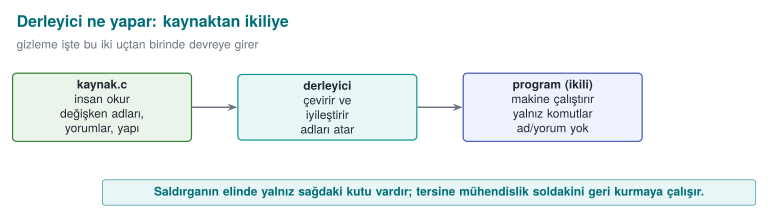
Machine code is the numeric instructions the processor understands; assembly is a somewhat more human-readable form of machine code (mov, cmp, jmp). This is what you see when you open a binary file.
Reverse engineering and the decompiler¶
Reverse engineering is looking at a binary file and trying to work out what the program does — this is the attacker's basic job. A decompiler is a tool that turns a binary file back into a form close to readable code (examples: Ghidra, IDA); its goal is to let someone with no access to the source infer the logic just by looking at the binary. (We saw the JVM-bytecode counterpart of this in week 5 — see "What we bring from earlier weeks" above; here we carry the same idea over to native binaries.)
What does decompiler output look like? Imagine we only have a .exe/.so file and never saw the source code. When we open the function int topla(int a, int b) { return a + b; } in a decompiler, the typical output looks like this (the exact format varies from tool to tool, but the idea is the same):
undefined4 FUN_00401020(int param_1, int param_2)
{
    return param_1 + param_2;
}
Notice: meaningful names such as topla, a, b have been lost (they were in the source file, but simply weren't stored in the binary the compiler produced); the tool falls back on its own generated names, generic ones such as FUN_00401020 (address-based) and param_1, param_2. But the logic is preserved: the addition is still plainly visible. This is concrete proof of why changing only names (the layout family) is not enough for obfuscation — a decompiler already operates having lost the names; the real fight is over making the logic (control flow and data) unreadable, which is what sections 5 and 6 are about.
Bit, byte, hexadecimal¶
A bit is 0 or 1. A byte is 8 bits. Hexadecimal (hex) is written with a 0x prefix; 0x2A = 42. We will see values like 0x5A in the code; these are just numbers.
Let's tie the hex-binary-decimal conversion together in one table. Each hexadecimal digit corresponds to exactly 4 bits (because 2⁴ = 16); that's why a byte (8 bits) is always written with two hexadecimal digits:
| Hex digit | Binary (4 bits) | Decimal |
|---|---|---|
0 | 0000 | 0 |
5 | 0101 | 5 |
A | 1010 | 10 |
F | 1111 | 15 |
Let's use this table to decode 0x5A: digit 5 → 0101, digit A → 1010; written side by side, 0101 1010 (8 bits, 1 byte). To convert to decimal, we sum the place values: 5 × 16 + 10 × 1 = 80 + 10 = 90. So 0x5A = 90 (decimal) = 0101 1010 (binary) — every 0x.. value you will see in this week's code examples is just a different way of writing the same number in these three notations (hex/binary/decimal); none of them is "more hidden" than another, they only differ in how easy they are for a human to read (hex is short, binary shows bit operations explicitly).
XOR: the foundation of reversible obfuscation¶
XOR (^) is the operation that gives 1 if the two bits differ, 0 if they are the same. Property: a ^ b ^ b == a → it undoes itself:
It is heavily used in obfuscation because it is reversible (we decoded XOR obfuscation for a Java string by hand in week 5 — see "What we bring from earlier weeks" above; here we trace the same operation bit by bit).
Let's trace XOR step by step: hiding and recovering the byte 0x41. Let's not leave XOR's "self-undoing" property abstract; let's trace a single byte bit by bit. The letter 'A' has the binary (ASCII) value 0x41 (hex) = 65 (decimal) = 0100 0001 (binary). Let's use 0x5A = 0101 1010 as the key.
Encoding: 0x41 ^ 0x5A
| Bit position | 7 | 6 | 5 | 4 | 3 | 2 | 1 | 0 |
|---|---|---|---|---|---|---|---|---|
0x41 | 0 | 1 | 0 | 0 | 0 | 0 | 0 | 1 |
0x5A | 0 | 1 | 0 | 1 | 1 | 0 | 1 | 0 |
| XOR | 0 | 0 | 0 | 1 | 1 | 0 | 1 | 1 |
Result: 0001 1011 = 0x1B. The rule is simple: matching bits (0^0=0, 1^1=0) give 0, differing bits (0^1=1, 1^0=1) give 1 — exactly the bit-level counterpart of the "XOR" definition above.
Decoding: XOR again with the same key: 0x1B ^ 0x5A
| Bit position | 7 | 6 | 5 | 4 | 3 | 2 | 1 | 0 |
|---|---|---|---|---|---|---|---|---|
0x1B | 0 | 0 | 0 | 1 | 1 | 0 | 1 | 1 |
0x5A | 0 | 1 | 0 | 1 | 1 | 0 | 1 | 0 |
| XOR | 0 | 1 | 0 | 0 | 0 | 0 | 0 | 1 |
Result: 0100 0001 = 0x41 — exactly the byte we started with. The algebraic rule that guarantees this is: a ^ b ^ b = a ^ (b ^ b) = a ^ 0 = a (any value XORed with itself gives 0; a value XORed with 0 is unchanged). In rule K-07 in section 6 we will encode and decode a string using exactly this mechanism; there you will rebuild the same bit table, only for an array of bytes instead of a single byte.
Entropy: how "random" a piece of data looks¶
Entropy is a measure of how "random" a piece of data looks; cryptographic keys look high-entropy (irregular bytes). If an attacker sees a high-entropy block in a binary, they say "there might be a key here." (This is the same metric we met in week 2 for recognising encrypted/packed content and in week 3 for random-number generation — see "What we bring from earlier weeks" above; here we deepen it with a numeric example.)
A numeric entropy example. Let's make the definition above concrete. Shannon entropy, a simple metric, looks at the probability of occurrence of each distinct byte value in a sequence: H = -Σ p(x) · log2 p(x). Let's work through two small examples by hand:
- Sequence A:
[0x41, 0x41, 0x41, 0x41]— all four bytes are identical. The probability of the single value isp = 1,log2(1) = 0, soH = -(1 · 0) = 0bits/symbol. Completely predictable: see the first byte and you know the rest. - Sequence B:
[0x3F, 0xA1, 0x08, 0xC7]— all four bytes differ, each with probabilityp = 1/4.H = -4 · (1/4 · log2(1/4)) = -4 · (1/4 · (-2)) = 2bits/symbol — the highest entropy value reachable in this four-symbol alphabet.
A real cryptographic key, at the scale of hundreds of bytes, looks like "sequence B": there is no repeating pattern among the bytes, and every byte value occurs with almost equal probability. When an attacker scans a binary with a tool, they can statistically tell low-entropy blocks like "sequence A" (fixed text, zero padding, repeating structures) apart from high-entropy blocks like "sequence B" (keys, compressed or encrypted data) — this is precisely the numeric counterpart of the sentence we just met: "if the attacker sees a high-entropy block, they say there might be a key here."
Function, branch, basic block, and the control flow graph (CFG)¶
A function is a block of code that does one job (erisim_ver); a branch is a fork in the road, like an if; a condition is the expression that decides which way the branch goes. A basic block is a sequence of instructions that runs straight through, with no branch — when an if is reached the block ends and two new blocks begin; a program is basic blocks wired together. The CFG (Control Flow Graph) is a diagram that makes basic blocks its nodes and the transitions between them its edges — it is the program's "road map."
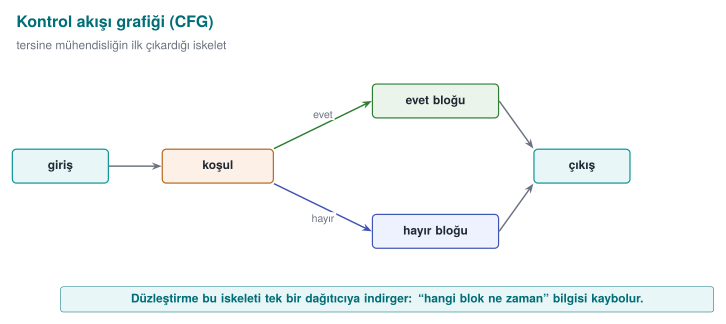
Let's tie the "basic block" and "CFG" ideas together with a concrete example. Take the small function below, which we will meet again in section 5:
int denetim(int girdi) {
    int a = girdi + 1;      /* Block 1 */
    if (a > 10) {            /* Block 2 */
        return HATA;
    }
    return a * 2;             /* Block 3 */
}
Let's split this function into basic blocks: Block 1 (a = girdi + 1 and evaluating the if condition) runs straight through and ends the moment it reaches the if. Block 2, when the condition is true, goes to return HATA — a separate one-line block (Block 2a). When the condition is false, control moves to Block 2b (return a*2). The CFG's nodes are these three blocks (1, 2a, 2b), and its edges are the transitions between them:
| Node (basic block) | Contents | Outgoing edges |
|---|---|---|
| Block 1 | a = girdi+1; evaluate if (a>10) | → Block 2a (condition true) or Block 2b (condition false) |
| Block 2a | return HATA | (exit — no edge) |
| Block 2b | return a*2 | (exit — no edge) |
Total: 3 nodes, 2 edges. When a decompiler draws this graph, it reads the logic — "error if the input is greater than 10, otherwise return double it" — within seconds, because there are few nodes, the edges are direct, and the branching decision is a single comparison. In section 5, when we flatten this exact function with K-04, we will see through this same example how the node/edge count grows and how this readability is destroyed — here you learn the definition, there you learn "why it exhausts the attacker."
Three frequently confused terms: "encoding," "encryption," "obfuscation"¶
These three are used interchangeably in everyday speech, but they are technically different things; mixing them up is one of the most common conceptual mistakes on the exam and in the project:
- Encoding: turning data into another representation (e.g., a simple XOR transform, Base64). The goal is representation, not secrecy; there is no mathematical security claim. If the key (e.g.,
0x5A) is found, it is reversed instantly. - Encryption: a mathematically studied, key-based transformation providing provable security (e.g., the AES-GCM from week 3). Without the correct key it cannot be broken in a reasonable time with today's computers.
- Obfuscation: making code harder for a human to understand. There is no mathematical security claim; it only raises the cost in effort and time ("Rule 1" in section 1).
This distinction matters because the "string encoding" we meet in K-07 is exactly encoding (via XOR), not encryption — the decoding key also sits inside the binary, so no mathematical secrecy is claimed; it only slows down static tools such as strings. We will meet this again in section 3 as the rule "obfuscation does not store keys."
Quick glossary: this week's terms¶
This week's tools (Ghidra, IDA, KLEE, Tigress, Obfuscator-LLVM) and academic sources use a fixed set of English terms. The table below lists the terms that will come up throughout the week, alongside the fuller or acronym-expanded form you will meet in that tool documentation or literature:
| Term (as used this week) | Full form / as seen in tools & papers |
|---|---|
| Obfuscation | Obfuscation |
| Reverse engineering | Reverse engineering |
| Decompiler | Decompiler |
| White-box attacker / attacker-at-the-end | White-box attacker / MATE (Man-At-The-End) |
| Control-flow flattening | Control flow flattening |
| Opaque predicate | Opaque predicate |
| Bogus operation | Bogus (dead) operation |
| Dead branch | (Bogus) death branch |
| Random exit point | Random exit point |
| Virtualisation-based obfuscation | Virtualisation-based obfuscation |
| Diversification | Diversification |
| Symbolic execution | Symbolic execution |
| Potency (metric) | Potency |
| Resilience (metric) | Resilience |
| Stealth (metric) | Stealth |
This week's question in one sentence¶
I've handed the program to the user; the attacker now owns it. How do I make it harder for them to read and modify my code?
Answer: code obfuscation rules. Let's begin.
1. Why is obfuscation a security rule?¶
In the first week of the course (Week 1, §3) we drew a line between attacker models. Against an attacker who sends input over the network, our defence was input validation, memory safety, and cryptography. But once we deliver a mobile app, a desktop program, or an embedded library to the user, the attacker now owns the program itself. In the literature this threat model is called MATE (Man-At-The-End) or the white-box model: the attacker can open the binary in a decompiler, single-step through it, read and modify memory, and try as many times as they like. No server-side security check applies here, because the code runs on the attacker's own machine.
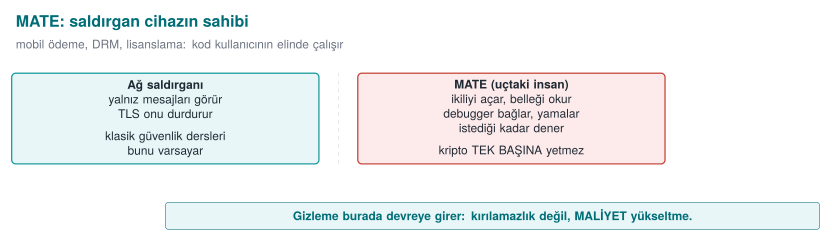
A short history: where does code obfuscation come from?
- 1976 — Diffie & Hellman first discuss the idea of making a program "incomprehensible but working" (protection through effort, not through secrecy).
- 1997 — Collberg, Thomborson, and Low publish the first obfuscation taxonomy (layout · data · control flow · anti-analysis) and the potency–resilience–stealth–cost framework. The five families in this lecture come from here.
- 2001 — Barak et al. prove that "perfect (black-box) obfuscation is impossible in general" → obfuscation is therefore taught not as "unbreakability" but as cost.
- 2002 — Chow et al. launch the idea of embedding a key in software with whitebox AES (week 11).
- 2010s — DRM, mobile banking, and the games industry make obfuscation mainstream; Tigress (Collberg) and Obfuscator-LLVM turn it into tooling (week 14).
So obfuscation is a practical delaying discipline built on top of an academic impossibility result.
What does "impossibility" mean? Understanding the Barak et al. result from scratch¶
Let's unpack the 2001 item in the timeline, because it is the foundation of why every rule we learn this week is never marketed as "unbreakable." "Perfect black-box obfuscation" means: turning a program into such a form that the attacker can learn nothing beyond what they could learn by feeding it inputs and observing its outputs — even if they open up the program and look inside, they gain no more knowledge than someone who only observes the input–output relationship. Barak and colleagues proved mathematically that such a perfect transformation cannot exist for every program: there exist specially constructed programs where looking inside necessarily gives more information than observing them from outside — no matter how good the transformation is.
This has two concrete consequences for our course:
- No K-01–K-12 rule (nor any combination of them) can claim "the attacker can never learn anything" — such a claim has been mathematically disproved.
- That's why this week we write every rule as "what it protects / cost / limit" (the template in section 4): the goal is not perfect secrecy, but the practical goals of the three rules in section 1 (raise the cost, break automation, buy time).
Rule: never use the word 'unbreakable' in a protection description
Describing a protection as "unbreakable" or "impenetrable" in your S9 or in a production document is both academically wrong (the theorem above) and it damages your credibility with an evaluator. Use measurable statements instead: "not measured against symbolic execution," "delays static scanning by X," "cannot be bypassed without modifying two independent points," and so on.
Honesty starts with one fact in this model: an attacker with enough time, skill, and motivation eventually breaks every obfuscation. The Cookbook says this outright (Recipe 12.1): anti-tampering measures are not "unbreakable"; their purpose is to make breaking them uneconomical. That is why we treat obfuscation not as a way of keeping a secret, but as a cost-raising rule:
- Rule 1 — Push the cost above the value. Make the attack more expensive than the value of the asset it protects. Guarding a 10-lira secret with 1000 lira of effort is irrational; so is the reverse.
- Rule 2 — Break automation. Make sure an attack that works on one copy does not automatically work on every copy. This is called diversification (this week's section 5, tooled in week 14).
- Rule 3 — Buy time for the other layers. Obfuscation is not a defence on its own; it is a layer that buys time for RASP (week 6), integrity checks, server-side checks, and key rotation. It only has to hold until the key is renewed or the version is updated.
The source's own language
The technical guide writes every protection measure under three headings: Description (what it protects), Implementation (how it's done), and Example use (where it is used), most often together with a compliance requirement ID (e.g., a payment scheme's "sensitive data is not logged in plaintext" item). We will write every technique this week with the same discipline, as a rule: what it protects · how · cost · limit.
A numeric example: what does "push the cost above the value" mean?¶
Let's not leave Rule 1 hanging in the air; let's make it concrete with a simple cost-benefit calculation. The figures are entirely hypothetical (not a real contract or product number); the point is only to show the reasoning:
- Assume an experienced reverse engineer's "market value" per hour is 500 TL.
- In a binary with no obfuscation applied, finding a function whose name gives it away — such as
lisans_dogrula— and working out its logic takes 10 minutes (⅙ of an hour). The attacker's cost:500 × (1/6) ≈ 83 TL. - When we apply the three rules we'll learn this week together (control-flow flattening K-04 + opaque predicate K-01 + string encoding K-07), the same analysis now takes 40 hours (times like this are measured in real projects, not guessed — section 9). The attacker's cost:
500 × 40 = 20,000 TL. - Now let's compare two scenarios:
- If the protected asset (e.g., preventing a license key from being copied) is worth avoiding an annual revenue loss of 5,000 TL:
20,000 TL > 5,000 TL— the attack is economically pointless, the rule has achieved its purpose. - If the protected asset is worth 100,000 TL a year:
20,000 TL < 100,000 TL— the attack is still profitable; these three rules alone are not enough, additional layers are needed (RASP — week 6, whitebox — week 11).
- If the protected asset (e.g., preventing a license key from being copied) is worth avoiding an annual revenue loss of 5,000 TL:
Common mistake: treating this calculation as a one-off, exact formula
The numbers above are meant to illustrate a decision framework, not to serve as real security proof. Concluding "the attacker's hour costs 500 TL, so we're safe" is wrong: a real attacker's skill, motivation (e.g., a competing company or a curious student), and available automated tools (section 10) radically change this time. Rule: use this calculation only to start the conversation about "which layers are worth adding"; never present it as a firm security guarantee. Week 13's attack-potential scoring turns this kind of estimate into something systematic.
This reasoning also lines up with the risk = probability × impact framework from week 1: here, "raising the cost" is a way of lowering the probability — the likelihood that a rational attacker bothers to try.
2. Obfuscation taxonomy: five families¶
The classification we bring into this course from Collberg and colleagues' software-protection body of work divides obfuscation into five families by what it hides. This map was introduced in week 4; here we make clear when each family "becomes a rule."
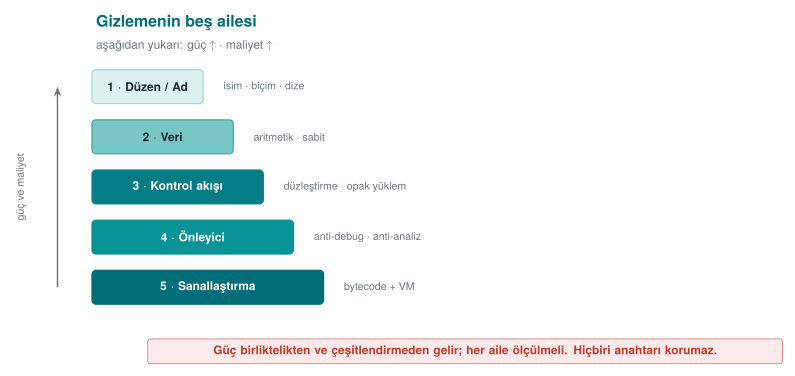
| Family | What it hides | Example rules | Its place in this course |
|---|---|---|---|
| Layout | Names, format, metadata | Hide symbols, obfuscate function/file names, strip logging from release | Week 4 (introduction), this week (depth) |
| Data | Constants, strings, variables | String encoding, constant transforms, variable splitting/merging, opaque booleans | This week, section 6 |
| Control flow | The algorithm's structure | Control-flow flattening, opaque predicates, bogus/dead branches, random exit | This week, section 5 |
| Anti-analysis | The analysis tools' own work | Structures that mislead a decompiler, runtime code decoding | This week (concept), week 6 (RASP) |
| Virtualisation | The machine code itself | Turning a function into a custom virtual machine's bytecode | This week (concept), week 14 (Tigress) |
In the field these families are used together
The code-hardening section of the source guide lists almost all of the families above inside a single product: switching off symbol visibility in a shared library; manually obfuscating function, file, and parameter names (the real names kept in internal documentation); transforming arithmetic instructions; encoding static strings before build and decoding them only at the moment of use, then wiping them immediately; opaque booleans that return only "success/failure"; bogus operations that don't change the result and dead branches that never run; control-flow flattening and a random exit point on failure; stripping logging from the release build. None of these is strong on its own; their strength comes from being used together, and together with RASP. The Cookbook's recommendation is the same (Recipe 12.1): rather than perfecting a single advanced technique, it's more effective to combine several simple techniques together with data hiding.
Worked example: seeing all five families in one function¶
Let's not leave the taxonomy abstract. In the small (synthetic) function below, let's mark which line belongs to which family with comments:
/* LAYOUT: the function name isn't 'esik_hesapla' but the meaningless 'f7' */
int f7(int x) {
    /* DATA: the 0x2A constant isn't written directly, it's produced from two parts (K-02, section 6) */
    uint8_t esik = (uint8_t)(0x37 ^ 0x1D);

    /* CONTROL FLOW: branching via an opaque predicate (K-01, section 5) */
    if (((x * (x + 1)) & 1u) == 0u) {
        return esik;          /* real path: since x*(x+1) is always even, this is ALWAYS entered */
    }
    return 0;                 /* ANTI-ANALYSIS dead branch: never runs, just distracts the analyst */
}
The fifth family — virtualisation — is absent from this small example, because virtualisation is applied not to a single line but to an entire function's machine code (section 7, K-10). This example exists to show one thing: in real code the five families live intertwined; being able to ask, while reading a line, "whose job is this?" is what makes the source's "they should all be used together" warning concrete.
Common mistake: applying one family and thinking you've 'obfuscated' the code
A beginner developer typically applies only the layout family (obfuscating names) and considers the job done. But even with symbol names hidden, the function's logic (control flow and data) is still plainly readable — even if you don't see the name f7 in a decompiler's output, you'll understand its if/return structure within seconds. Rule: a protection decision must cover at least control flow + data together; the layout family alone was taught in week 4 as an "entry-level" measure — this week is where you learn that it is insufficient on its own.
Why this order? Why do potency and cost rise from bottom to top?¶
Let's unpack the "potency and cost rise from bottom to top" note on the diagram (h09-01) — this is not an arbitrary ordering, it is tied directly to what each family changes:
- Layout changes only names/metadata; it touches nothing that produces the program's behaviour. That's why it's cheap to apply (a compiler flag or a name list) but also low in potency — as we just saw, the logic stays exactly the same.
- Data and control flow change what the program processes and in what order; that requires both more engineering effort (reworking every constant, every branch) and more runtime cost (extra instructions) — their potency rises accordingly.
- Anti-analysis techniques (such as the function substitution in K-06) target the analysis tools themselves; this is more laborious than just hiding data/flow, because you have to guess which tool will be used.
- Virtualisation changes the program's machine code itself — the original instructions no longer exist at all, replaced by an entirely different instruction set (VM bytecode). This is the most radical change; that's why it is both the strongest and (as we'll see in K-10, an increase too large to state in percentages, more a multiplier) the most expensive option.
In short: the closer a family sits to the mechanism that produces the behaviour, the stronger — and the more expensive — hiding it becomes. Recall the four metrics from section 9: this ordering is really the taxonomy's reflection of the potency ↔ cost trade-off.
3. What does obfuscation give, and what does it not give?¶
Applying a rule correctly requires knowing its limits. Week 4 touched on this briefly; here we deepen it with the table and a timeline of an attacker's first ten minutes. Here is what obfuscation gives, and what it does not give:
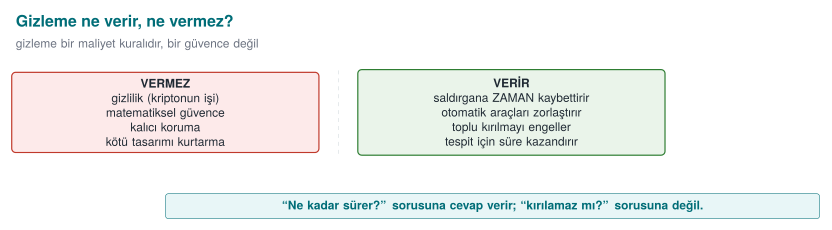
| What obfuscation gives | What obfuscation does not give |
|---|---|
A delay against static analysis (strings, symbol table, decompilation) | The mathematical secrecy of a secret — a key needs cryptography |
| Resistance against automated attack (via diversification) | Protection against reading a running program's memory — that needs RASP and whitebox (week 11) |
| Time for the other layers | Permanent security — there is no such thing as "unbreakable" |
| A measurable increase in cost | Free protection — every obfuscation comes with a maintenance and performance cost |
The most common mistake: mistaking obfuscation for storing a key
A key embedded or "hidden" in code — hidden or not — is still there. The program has to use the key while it runs; at that moment it is exposed in memory, and the decoding logic is inside the program too. Obfuscation slows down static searches like strings; real key protection needs whitebox cryptography (week 11) or hardware (an HSM, a secure element). We stressed this same distinction in weeks 3 and 10: secrecy is cryptography's job, not obfuscation's.
Step by step: an attacker's first 10 minutes — before and after obfuscation¶
Let's turn the "gives/does not give" table into a timeline. Consider both versions: unprotected and protected with this week's rules.
An attacker's first 10 minutes with an unprotected binary:
- They run
strings program.exe→ strings such as"CEN429-OK","Erisim reddedildi"are directly visible (minute 0). - They open a decompiler and see names like
erisim_ver,lisans_dogrulain the symbol table (minute 2). - They read the function's CFG: a single
if/else, and it is obvious at a glance which branch means "allow" and which means "deny" (minute 5). - They find the comparison value (
"CEN429-OK"), test it with their own input, and confirm it (minute 10). Job done.
The same 10 minutes with a binary protected by this week's rules:
- They run
strings→ thanks to K-07 the strings are invisible; they come away with no clue (minute 0). - They look at the symbol table → thanks to K-06 and the layout family there is no recognisable name (minute 2).
- They open the CFG → because of the K-04 flattening they see a single
switchdispatcher; it is not clear whichcasemeans "allow"; K-01's opaque predicates hide which branch is real and which is dead (minute 10, still unsolved). - At this point the attacker either switches to an automated tool such as symbolic execution (section 10 — this takes not minutes but hours) or gives up.
These two timelines are the time-spread version of the table's four rows: obfuscation doesn't say "never breakable," it says "hours or days instead of 10 minutes."
Common mistake: treating obfuscation as a substitute for a penetration test
A team might say "we obfuscated our code, so we no longer need security testing." This is wrong: obfuscation only makes static reading harder; dynamic analysis that examines a running program's behaviour (input/output, network traffic, memory) and an independent penetration test/assessment (weeks 12–13) are still required. Rule: obfuscation is planned not as a replacement for security testing, but as a layer that delays the weaknesses testing will find.
4. The "protection rule" template¶
We will evaluate every technique this week with the same four questions. We expect you to write the S9 section of your own project with this same template:
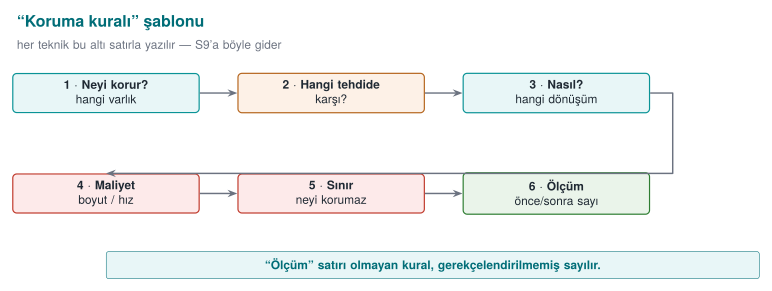
RULE K-xx: <name of the technique>
  What does it protect? : which asset / which code section (e.g. licence check, key derivation)
  Against which threat? : static analysis / dynamic analysis / automated attack / tampering
  How?                  : concept-level application (one sentence)
  Cost                  : size, speed, maintenance, debugging difficulty
  Limit                 : what it doesn't protect, which attack it doesn't withstand
  Measurement           : how we verify its effectiveness (see section 5)
The value of this template is this: obfuscation is not a "yes/no" attribute. An evaluator (week 13, attack potential scoring) asks how much each layer delays the attack. Without the "Measurement" line above, you cannot defend a protection decision.
Worked example: let's fill the template with this week's demo¶
So this doesn't stay abstract, let's fill the template exactly, using the real measurement numbers given in the "This week's working demo" box at the start of this section (K-04 as applied in the demo):
RULE K-04-applied: control-flow flattening applied to the erisim_ver function
  What does it protect? : access-check flow order (where/how the CEN429-OK comparison is done)
  Against which threat? : static analysis (reading the CFG in a decompiler), single-byte/single-branch patch attack
  How?                  : switch-based dispatcher (K-04) + opaque predicate (K-01) + random exit (K-05)
  Cost                  : instruction count 28 → 51 (+82%), branch count 3 → 6 (+100%) — measured with objdump
  Limit                 : flattening only; can be undone via symbolic execution (section 10); data still needs K-07
  Measurement           : instruction/branch count comparison in objdump output (this week's demo, in the step-by-step guide)
Let's verify the percentages in the cost line: the increase in instruction count is (51 − 28) / 28 × 100 ≈ 82.1%; the increase in branch count is (6 − 3) / 3 × 100 = 100% (exactly doubled). This is concrete proof that the "Measurement" line must be a number, not a claim — we will reuse these figures again in section 9.
Common mistake: filling in only the template's 'How' line and leaving 'Measurement' blank
Students typically write which technique they applied (How) but skip the cost and measurement lines. The evaluator's note in section 12 says this explicitly: an unmeasured protection counts as a "claim," not evidence. Rule: a protection is not considered written into S9 until all six lines are filled in; at least one line, "Measurement," must contain a concrete number or observation (e.g., "string X no longer appears in strings output").
A second worked example: let's fill the template for a different asset¶
To see that the template fits any kind of asset, let's fill it this time for a data protection rule we'll meet in section 6 (a string, not a function):
RULE K-07-applied: string encoding applied to the error-message string
  What does it protect? : readable text sitting in the binary, such as "Erisim reddedildi"
  Against which threat? : strings scanning (section 3's "attacker's first 10 minutes")
  How?                  : encode with XOR 0x5A, decode at the moment of use, wipe immediately with memset_s (section 6)
  Cost                  : low — a few extra instructions, no measurable speed loss
  Limit                 : the decoding key sits in the binary; not real key protection (section 3's rule)
  Measurement           : count of the relevant string in strings output: 1 before encoding, 0 after
Placing the two examples (K-04-uygulama and K-07-uygulama) side by side makes the difference clear: control-flow rules are usually measured with "instruction/branch count," data rules are usually measured with "visible string/constant count" — but in both cases the template's six lines are filled with the same discipline. In your S9 you are expected to fill out this template separately for at least one control-flow rule and one data rule.
5. Control-flow rules (advanced)¶
A compiled function's control flow graph (CFG) shows the skeleton of the algorithm: which check happens in what order, which branch leads to success. The white-box attacker's first job is to extract this skeleton. Control-flow obfuscation rules make this skeleton unreadable. Week 4 introduced flattening; here we add the rules that strengthen it. All examples are synthetic and are told through a single small check (erisim_ver).
RULE K-01 — Opaque predicates and opaque loops¶
What does it protect? Which condition a branch is taken under; how many times a loop runs. How? Branching is done on a value that the programmer knows but that an analysis tool cannot easily resolve (an opaque predicate). A classic example is an arithmetic identity that is always true but hard to prove statically:
/* x*(x+1) is always even → (x*(x+1)) % 2 == 0 is always true. */
static int opak_dogru(unsigned x) { return ((x * (x + 1)) & 1u) == 0; }

if (opak_dogru(sayac)) {          /* real path: this is ALWAYS entered */
    durum = gercek_adim(durum);
} else {
    durum = sahte_adim(durum);    /* dead path: never runs, but looks real under analysis */
}
Why is x*(x+1) always even? (let's see it step by step)
Of two consecutive integers, one is always even; anything multiplied by an even number is even. In numbers:
x | x + 1 | x * (x+1) | Even? |
|---|---|---|---|
| 0 | 1 | 0 | yes |
| 1 | 2 | 2 | yes |
| 2 | 3 | 6 | yes |
| 3 | 4 | 12 | yes |
| 4 | 5 | 20 | yes |
| 7 | 8 | 56 | yes |
So (x * (x+1)) & 1 is always 0, which means opak_dogru(x) returns true for every x. While the program runs it always takes the "real path."
So why do we call it 'opaque'? Because we know it; the static analysis tool doesn't. When the tool looks at the code without running it, it has to prove for every value of x that this product is even — that can't be solved by a simple constant-folding step. So the tool has to treat both branches as possible and is forced to analyse the bogus branch too. The analyst's work doubles, while the program's behaviour never changes.
Know its limit too
This is a classic pattern; modern tools recognise it in their libraries. That's why in week 14 we generate opaque predicates that are seed-diversified with Tigress and harder to crack — repeating the same pattern in every build reduces resilience.
The guide writes opaque loops as a separate rule: loops (for, while) are never shown directly; they are hidden inside control-flow flattening, the body is split into small blocks, and iteration is driven by a state variable. That way, the information "this loop runs N times" cannot be read off the CFG.
Cost: low–medium (extra arithmetic and a branch). Limit: well-known opaque predicate patterns (libraries) can be recognised automatically; hence they need to be diversified. Measurement: basic block count before/after flattening.
Worked example: let's trace an opaque loop bound by hand. Let's verify the guide's claim that "the loop bound cannot be read off the CFG" with numbers. Let our real iteration bound be 3, but instead of writing it directly, let's wrap it in a second always-true opaque predicate:
static int hep_dogru(unsigned y) { return ((y * y + y) & 1u) == 0u; }  /* y*(y+1) is always even — see above */

unsigned i = 0;
while (hep_dogru(i) && i < GERCEK_SINIR) {   /* GERCEK_SINIR = 3, defined in a separate constant (can be encoded with K-02) */
    isle(i);
    i++;
}
Let's trace it by hand (GERCEK_SINIR = 3):
| Step | i | hep_dogru(i) calculation | Result | i < 3? | Does the loop body run? |
|---|---|---|---|---|---|
| 1 | 0 | 0*0+0=0, 0 & 1 = 0 | true | yes | yes → isle(0), i=1 |
| 2 | 1 | 1*1+1=2, 2 & 1 = 0 | true | yes | yes → isle(1), i=2 |
| 3 | 2 | 2*2+2=6, 6 & 1 = 0 | true | yes | yes → isle(2), i=3 |
| 4 | 3 | 3*3+3=12, 12 & 1 = 0 | true | no (3 < 3 is false) | no, the loop ends |
Result: the loop runs exactly 3 times (i = 0, 1, 2), exactly as expected. But notice: hep_dogru(i) always returns true — so an analysis tool, to understand when the loop terminates, has to track not hep_dogru but the comparison i < GERCEK_SINIR; and to prove that hep_dogru is always true, it also has to solve the integer identity above. Two separate analysis burdens land on the same line.
RULE K-02 — Encoding arithmetic instructions¶
What does it protect? Constants and simple computations; directly readable hints such as "this number is 0x1F, this operation is an XOR." How? An operation is replaced with an equivalent expression that produces the same result but looks more complex (mixed boolean-arithmetic, MBA). For example, a + b is equal to (a ^ b) + 2*(a & b); x * 2 equals x << 1. Constants are never written directly; they are produced at runtime by a small computation:
/* Produce it from two parts instead of 0x2A; a '0x2A' search in the binary returns nothing. */
static uint8_t esik(void) { uint8_t a = 0x37, b = 0x1D; return (uint8_t)(a ^ b); } /* = 0x2A */
Cost: low. Limit: modern decompilers and tools like arybo/msynth can simplify many MBA expressions; it is weak on its own and gains meaning together with control-flow obfuscation. Measurement: a strings/byte search for the constant should return nothing.
Worked example: let's verify two MBA identities by hand. Let's confirm the rule's claim that a + b ↔ (a ^ b) + 2·(a & b) with numbers (a = 5, b = 3):
| Expression | Calculation | Result |
|---|---|---|
a + b | 5 + 3 | 8 |
a ^ b | 0101 ^ 0011 = 0110 | 6 |
a & b | 0101 & 0011 = 0001 | 1 |
(a ^ b) + 2·(a & b) | 6 + 2·1 = 6 + 2 | 8 |
Both give 8 — the identity is confirmed. This is a valid algebraic identity for every 4-bit a,b pair (the 2·(a&b) term compensates for the carry bit); if the compiler produces this instead of a+b, the binary shows no plain "addition" — it shows three separate instructions (XOR, AND, shift+add).
Using the same logic, let's also verify the 0x2A constant produced by the rule's esik() function (a = 0x37, b = 0x1D):
| Bit | 0x37 | 0x1D | XOR |
|---|---|---|---|
| 7–4 | 0011 | 0001 | 0010 |
| 3–0 | 0111 | 1101 | 1010 |
Result: 0010 1010 = 0x2A — exactly matching the code block's comment. Inside the binary, the 0x2A value never sits anywhere as a single byte; only 0x37 and 0x1D sit there, so a strings/byte search for 0x2A returns nothing.
Common mistake: applying the transform only to compile-time constants
If you write the esik() example as a preprocessor macro like #define ESIK ((0x37) ^ (0x1D)), the compiler will constant-fold this expression at compile time and embed 0x2A directly into the binary — the MBA transform exists in the source, but not in the binary. Rule: verify in the compiled binary (objdump/strings) that the transform is really computed at runtime, not simplified away at compile time; the "compiler flag" distinction from section 0 applies here too — test with optimisation turned on.
RULE K-03 — Bogus operations and dead branches (the two are different)¶
The guide writes these two as separate rules, and the difference matters:
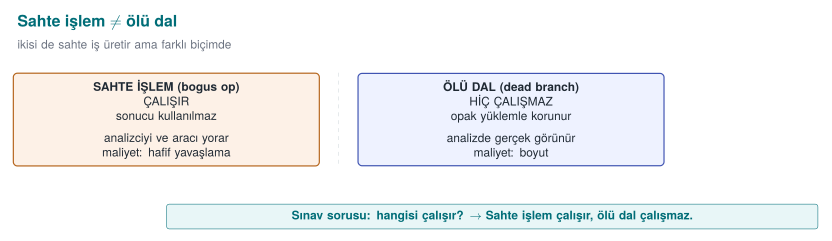
| Bogus operation | Dead (death) branch | |
|---|---|---|
| Does it run? | Yes, it runs but doesn't change the result | No, it never runs (protected by an opaque predicate) |
| Purpose | Hide real operations in a crowd | Show the analyst a fake execution path |
| Example | Adding x ^ x to a CRC computation (result unchanged) | The code inside if (opak_yanlis()) { ... } |
crc = crc32_guncelle(crc, veri, n);
crc ^= (sabit ^ sabit);   /* = crc; bogus operation, result unchanged */
What does it protect? The real logic, by surrounding it with meaningless-but-plausible-looking code. Cost: low (bogus operation)–medium (dead branches grow the CFG). Limit: an analysis tool that performs dead code elimination can drop a dead branch once the opaque predicate protecting it is solved; so it depends on the predicate's quality. Measurement: how long it takes to tell dead branches apart from real ones.
Worked example: does the bogus operation really leave the result unchanged? Let's verify the crc ^= (sabit ^ sabit) line above with a number (let sabit = 0x11): sabit ^ sabit = 0x11 ^ 0x11 = 0x00 (any value XORed with itself always gives 0 — the same XOR identity from section 0). The operation crc ^= 0x00 leaves crc unchanged (x ^ 0 = x). So no matter what sabit is, this line is mathematically a no-op every time; its crowding effect lives only in the compiled instruction count, not in crc's value.
Common mistake: letting the compiler silently delete the bogus operation
An optimising compiler (-O2, -O3) may spot an operation whose result is used nowhere and can be proven mathematically to have no effect, classify it as dead code, and remove it entirely. A line such as crc ^= (sabit ^ sabit) — if the compiler constant-folds it — becomes crc ^= 0, which it then sees does nothing and deletes — the obfuscation vanishes without you noticing. Rule: values used in bogus operations must be determined at runtime (e.g., tied to an input or an opaque predicate), never fixed at compile time; also always verify obfuscation on a binary compiled with optimisation on (using the compiler flag defined in section 0) — "present in the source, gone from the binary" is a common surprise.
RULE K-04 — Control-flow flattening (in depth)¶
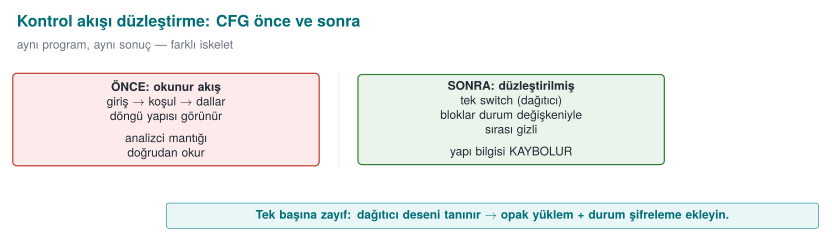
What does it protect? The algorithm's structure: which blocks naturally neighbour each other and "which block leads to which." How? In the guide's words, vertical control flow is turned horizontal: all basic blocks are moved into a switch dispatcher inside a single loop; the sequence is read only from a state variable.
int durum = BASLA;
for (;;) {
    switch (durum) {
    case BASLA:  durum = ADIM1; break;
    case ADIM1:  durum = kosul ? ADIM2 : HATA; break;
    case ADIM2:  durum = BITIR; break;
    case HATA:   return RED;
    case BITIR:  return IZIN;
    default:     return RED;          /* random exit lands here (K-05) */
    }
}
We said back in week 4 that this template alone can be worked out fairly quickly by an experienced analyst. The "on the native side this flattening is strengthened with several security features" the guide talks about is exactly the other rules:
- State values are hidden (K-02): instead of
case 1, 2, 3, scattered, arithmetically produced values; no visible sequence. - Bogus and dead blocks are added (K-03): telling which
caseis real becomes harder. - Random exit (K-05): failure exits through the
defaultbranch, with an unpredictable state. - Branching on opaque predicates (K-01):
casetransitions depend on opaque conditions, not fixed values.
Cost: medium–high (block and branch counts grow a lot, performance drops). Limit: flattening alone can be undone by symbolic execution (section 5); its strength comes from the reinforcements. Measurement: CFG node/edge count in a decompiler, time required to trace a single check.
Worked example: let's flatten a three-block function by hand. Let's start with the following ordinary (unflattened) function:
int denetim(int girdi) {
    int a = girdi + 1;      /* Block 1 */
    if (a > 10) {            /* Block 2 */
        return HATA;
    }
    return a * 2;             /* Block 3 */
}
Let's move these three blocks by hand into the flattened form using K-04's template:
int denetim(int girdi) {
    int durum = B1, a = 0;
    for (;;) {
        switch (durum) {
        case B1: a = girdi + 1; durum = B2; break;
        case B2: durum = (a > 10) ? B_HATA : B3; break;
        case B3: return a * 2;
        case B_HATA: return HATA;
        default: return HATA;      /* random exit lands here (K-05) */
        }
    }
}
Let's trace girdi = 4 by hand: durum=B1 → a = 4+1 = 5, durum=B2. durum=B2 → a(5) > 10 is false, durum=B3. durum=B3 → return 5*2 = 10. Both versions return the same 10 for the same girdi — the behaviour is preserved, only the shape of the flow has changed: in the natural version the three blocks read one after another, while in the flattened version they all look like equal-distance branches of a single switch, and the natural adjacency information between them (B1 is always followed by B2) has been erased from the CFG; it can now only be read from durum's value at runtime.
Common mistake: leaving state values sequential
Using sequential constants like B1=1, B2=2, B3=3, B_HATA=4 makes the flattening look present but actually weak: an analyst can read the case order and easily guess the original flow. Rule: state values should be produced with K-02 (arithmetic encoding) or with random, scattered constants; they must not be consecutive integers — otherwise the flattening has only added visual noise, not real protection.
RULE K-05 — Random exit from control flow¶
What does it protect? Where a check fails. Attackers often look for the "failure branch" and try to turn it into the "success branch." How? As the guide describes it: when a check fails, the program does not go straight to a return RED line; instead the state variable is set to an unpredictable, large value and the function exits through the default branch. Successful exit can use the same trick, so success and failure look alike in the flow.
if (!imza_gecerli(p)) {
    durum = kararsiz_deger();   /* a value not defined in the switch → default */
    break;
}
Cost: low. Limit: meaningful only together with flattening, not on its own. Measurement: time needed for a "find and flip the failure branch" attack; ideally a single byte patch should not be enough to bypass the check.
Common mistake: using the same sentinel value for every failure state
If kararsiz_deger() always returns the same constant (e.g., always 0xDEADBEEF), an attacker can grep for that constant once in the binary and find all the failure points at once — the random exit's purpose is defeated. Rule: the sentinel value must be different at every call site (either generated from a seed as in K-11, or a separate constant per call site); otherwise a "random exit" is really just one fixed signature, violating the diversification principle from section 8.
RULE K-06 — Hiding function calls and external library dependencies¶
Week 4 briefly touched on hiding function names and memory-allocation hiding; here we deepen it with external library dependencies and bogus parameters.
What does it protect? Hints like "this function calls memcmp, so it must be doing a comparison." Standard library calls tell the attacker directly what a function does. How? On critical paths, standard library functions are replaced with your own internal versions (e.g., your own constant-time esit_mi function), so the linker never shows a recognisable name. The guide also lists hiding function parameters and adding bogus parameters as separate rules: unused fake parameters are placed alongside the real ones, making the signature misleading to an attacker.
Cost: low–medium (your own versions need maintenance). Limit: behavioural analysis can still reveal what it does; this is a delaying rule. Measurement: count of recognisable library calls in the binary.
Worked example: your own constant-time comparison instead of memcmp. The rule tells us to replace the standard memcmp because it is recognisable; but the real payoff is closing a familiar side channel from week 3:
static int sabit_zamanli_esit_mi(const uint8_t *a, const uint8_t *b, size_t n) {
    uint8_t fark = 0;
    for (size_t i = 0; i < n; i++) {
        fark |= (uint8_t)(a[i] ^ b[i]);   /* every byte is processed, does NOT stop at the first mismatch */
    }
    return fark == 0;                      /* a single comparison, at the end of the array */
}
Let's trace it for a = {0x41,0x42,0x43}, b = {0x41,0x00,0x43}: i=0: 0x41^0x41=0x00, fark = 0x00. i=1: 0x42^0x00=0x42, fark = 0x00 | 0x42 = 0x42. i=2: 0x43^0x43=0x00, fark = 0x42 | 0x00 = 0x42. The loop always runs all three steps, never returning early even though the mismatch is found at i=1; at the end fark = 0x42 ≠ 0, and esit_mi returns 0 (false). A standard memcmp or a hand-written for (...) if (a[i]!=b[i]) return 0; would return early at i=1 — a classic timing channel that can leak where the mismatch occurred through runtime (the same CRYPTO_memcmp rule from week 3). K-06's payoff is twofold: the memcmp name no longer appears in the binary, and the comparison is constant-time.
A bogus parameter example. The rule's second part — bogus parameters — makes the signature misleading:
/* Real signature: int erisim_kontrol(const char *kod); */
int erisim_kontrol(const char *kod, int gunluk_seviyesi, void *ayarlar) {
    (void)gunluk_seviyesi;   /* unused — bogus parameter */
    (void)ayarlar;           /* unused — bogus parameter */
    return sabit_zamanli_esit_mi((const uint8_t *)kod, GERCEK_KOD, GERCEK_KOD_UZUNLUK);
}
A decompiler will show this function as taking three parameters; the attacker wastes time asking "is the second parameter really a log level, is the third really a settings pointer used?" — when in fact neither is ever used. The (void)parametre lines silence the compiler's "unused parameter" warning; in real projects, unless someone searches for them, these lines don't give away that they're bogus.
Rule: don't break constant-timeness
When you write your own comparison/crypto version, make sure it stays constant-time (week 3). Writing an early-exit comparison for the sake of obfuscation opens up a side channel; don't create a new hole while adding a protection.
6. Data obfuscation rules¶
Control flow hides the algorithm's structure; data obfuscation hides the values the program processes: strings, constants, tables, and variables. The Cookbook's anti-tampering chapter and the technical guide list the same rules here.
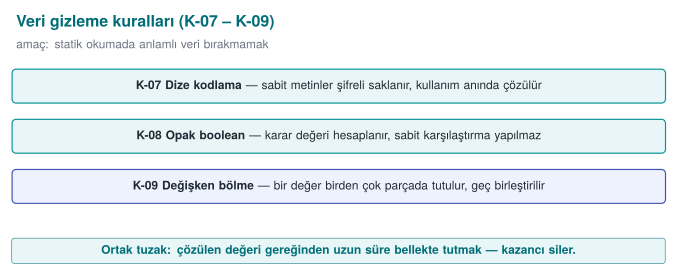
RULE K-07 — Encoding static strings¶
Week 4 introduced string hiding, and week 5 decoded it by hand with XOR on the Java side; here we deepen the same idea on the C/C++ side.
What does it protect? The readable text inside a binary. The cheapest first step of reverse engineering is running strings; "Lisans gecersiz" or a URL tells the attacker exactly where to look. How? Sensitive strings are encoded before compilation (e.g., encrypted with an XOR key or a generation script), sit encoded in the binary, are decoded only at the moment of use, and are wiped from memory the instant the job is done.
static const uint8_t GIZLI[] = { 0x3B,0x2A,0x2E,0x2E,0x2D };   /* not "merhaba"; synthetic */
void kullan(void) {
    char tmp[sizeof GIZLI];
    for (size_t i = 0; i < sizeof GIZLI; i++) tmp[i] = GIZLI[i] ^ 0x5A;  /* decode */
    isle(tmp, sizeof GIZLI);
    memset_s_benzeri(tmp, sizeof tmp);   /* wipe immediately after use (week 3) */
}
Cost: low. Limit: once the program is running, the decoded string is visible in memory; this is a static-scan countermeasure. The decoding key also lives in the binary — that's why in the field the key is split and distributed, and the decoding function is protected with additional checks. Measurement: the sensitive string must not be found in strings output.
Worked example: let's decode the GIZLI array above by hand. Let's decode the array GIZLI = {0x3B, 0x2A, 0x2E, 0x2E, 0x2D} from the code block one byte at a time, XORing each byte with 0x5A (the same method as the bit table in section 0):
| Index | GIZLI[i] | ^ 0x5A (bit computation) | Result (hex) | ASCII |
|---|---|---|---|---|
| 0 | 0x3B = 0011 1011 | 0011 1011 ^ 0101 1010 | 0110 0001 = 0x61 | 'a' |
| 1 | 0x2A = 0010 1010 | 0010 1010 ^ 0101 1010 | 0111 0000 = 0x70 | 'p' |
| 2 | 0x2E = 0010 1110 | 0010 1110 ^ 0101 1010 | 0111 0100 = 0x74 | 't' |
| 3 | 0x2E = 0010 1110 | (same computation) | 0x74 | 't' |
| 4 | 0x2D = 0010 1101 | 0010 1101 ^ 0101 1010 | 0111 0111 = 0x77 | 'w' |
The decoded byte sequence is "apttw" — consistent with the code comment "not merhaba; synthetic": we're showing the mechanism, not a real string. What matters is this: the bytes sitting in the binary are {0x3B, 0x2A, 0x2E, 0x2E, 0x2D}; strings never runs XOR on these bytes, it just tries to read them as-is and finds no readable text (these five bytes may fall outside the printable ASCII range, or simply look meaningless) — the attacker's first and cheapest step (the "first 10 minutes" from section 3) comes up empty here.
Common mistake: assuming memset 'wiped' the secret
The code example's memset_s_benzeri(tmp, sizeof tmp) line specifically calls a non-ordinary function, not a plain memset; the reason is compiler optimisations. If a variable goes out of scope right after it's used (the function ends), an optimising compiler may perform dead store elimination, deciding "this memset call has no observable effect" and deleting it — the decoded secret stays unwiped in memory. Rule: use a call the compiler cannot delete when clearing sensitive memory (memset_s, SecureZeroMemory, explicit_bzero, or a hand-written loop over a volatile pointer); using plain memset and assuming "I wiped it" is as real a mistake as the obfuscation itself.
Rule: don't confuse string obfuscation with storing a key
String obfuscation stops static scans like strings; it is not meant to protect a key. This is the concrete form of the "obfuscation does not store keys" rule from section 1. For real keys, use whitebox (week 11) or hardware.
RULE K-08 — Constant transforms, opaque booleans, and function boolean returns¶
The guide makes a separate rule out of how security results are represented. Returning a check's result as a plain 0/1 is dangerous: an attacker can flip a single byte and turn "failure" into "success." The opaque boolean rule keeps a true/false value tied to multiple values in a way that cannot be flipped by patching a single byte. Functions likewise return this kind of opaque return code instead of a plain boolean.
/* The "allow" value isn't a single constant; it's derived from two states, and the caller verifies both. */
typedef struct { uint32_t a, b; } Karar;
static Karar izin_ver(void)  { return (Karar){ 0xA3C1u, 0x5C3Eu }; } /* a ^ b == 0xFFFF */
static int  karar_izin_mi(Karar k) { return (k.a ^ k.b) == 0xFFFFu; }
Cost: low. Limit: it can be solved given enough scrutiny; its purpose is to block a single-byte patch and crude branch-flipping. Measurement: number of independent points that must be changed together in a "flip the result" attack, > 1.
Worked example: is 0xA3C1 ^ 0x5C3E really 0xFFFF? Let's verify the code example's claim nibble by nibble:
| Nibble | 0xA3C1 | 0x5C3E | XOR |
|---|---|---|---|
| 15–12 | A = 1010 | 5 = 0101 | 1111 = F |
| 11–8 | 3 = 0011 | C = 1100 | 1111 = F |
| 7–4 | C = 1100 | 3 = 0011 | 1111 = F |
| 3–0 | 1 = 0001 | E = 1110 | 1111 = F |
All four nibbles come out F → a ^ b = 0xFFFF, the claim is confirmed. Every nibble is F for a simple reason: the two values were chosen to be each other's bitwise complement (A=1010 ↔ 5=0101, 3=0011 ↔ C=1100, etc.).
Now let's test the rule's claim that "it cannot be flipped by a single-byte patch": suppose an attacker changes only the low byte of a from 0xC1 to 0x00 (a becomes 0xA300). New result: 0xA300 ^ 0x5C3E:
| Nibble | 0xA300 | 0x5C3E | XOR |
|---|---|---|---|
| 15–12 | A=1010 | 5=0101 | F |
| 11–8 | 3=0011 | C=1100 | F |
| 7–4 | 0=0000 | 3=0011 | 3 |
| 3–0 | 0=0000 | E=1110 | E |
Result: 0xFF3E — not equal to 0xFFFF. The karar_izin_mi function's (k.a ^ k.b) == 0xFFFFu check now returns false: a crude single-byte patch fails to trigger "allow." For the attack to work, both a and b must be changed consistently with each other — meaning the attacker has to find and change at least two independent points at once, not one; this is exactly the numeric meaning of the "Measurement" line's "number of independent points > 1."
Common mistake: leaving the comparison constant (0xFFFF) the same everywhere
Strong as this mechanism looks on its own, if every opaque boolean check in the project compares against the same 0xFFFFu constant, an attacker can find that constant once in the binary and get a sense of the pattern behind all the allow points — the same mistake as "using the same sentinel everywhere" in K-05. Rule: use a different target constant for each function/check (e.g., 0xA5C3, 0x3D71, ...); the constant itself can also be encoded with K-02.
RULE K-09 — Variable splitting, merging, and array restructuring¶
What does it protect? The recognisable footprint of a sensitive variable in memory. Patterns like "a 32-byte block = an AES key" point the attacker straight at it. How? A variable is split into two parts (e.g., computing a 32-bit value from two 16-bit shares), several variables are merged into a single word, arrays are rearranged; buffer sizes, order, and layout are changed, bogus padding is inserted between them, and buffers are filled with random values after use.
Cost: low–medium. Limit: it only slows down static/pattern analysis. Measurement: how long it takes to recognise the sensitive buffer from its memory pattern.
Worked example: let's split a 32-bit value and merge it back. Say the value we want to store is 0x1234ABCD (32-bit). Instead of keeping it as a single 4-byte block, let's split it into two separate 16-bit shares:
uint16_t yuksek = 0x1234;   /* upper 16 bits — in a separate variable, perhaps a separate struct */
uint16_t dusuk  = 0xABCD;   /* lower 16 bits — kept somewhere else in the code */

uint32_t deger = ((uint32_t)yuksek << 16) | dusuk;   /* re-merged at the moment of use */
Let's verify: yuksek << 16 shifts 0x1234 left by 16 bits → 0x12340000. OR-ing this with dusuk = 0x0000ABCD gives: 0x12340000 | 0x0000ABCD = 0x1234ABCD — exactly the original value, recovered.
Let's think about why this works from the point of view of a memory-scanning tool: such a tool usually looks for "a contiguous, high-entropy block of 4 (or 16/32) bytes" — this is where the entropy definition from section 0 gets used in practice (e.g., an AES key looking like "sequence B" in memory). yuksek and dusuk sit in separate variables, and depending on the compiler's choices may even end up at non-adjacent addresses in memory; the scanned block is no longer 4 bytes but two separate 2-byte pieces, and the information "these two combine to form a key" is never written explicitly in the code, it hides only in the merge expression.
Common mistake: producing the merged value early and keeping it in memory for a long time
Splitting/merging only pays off as long as merging happens at the moment of use. If the deger variable is computed once at the start of the function and kept around for the rest of the function (or stored permanently in a struct), you again end up with a single, whole, recognisable 32-bit block — K-09's benefit is lost. Rule: merge only at the exact moment it's needed, then wipe it immediately after use (as in K-07, with memset_s); keeping the parts (yuksek, dusuk) separate is always safer than keeping the merged form around.
7. Whole-program-level rules¶
RULE K-10 — Virtualisation-based obfuscation (concept)¶
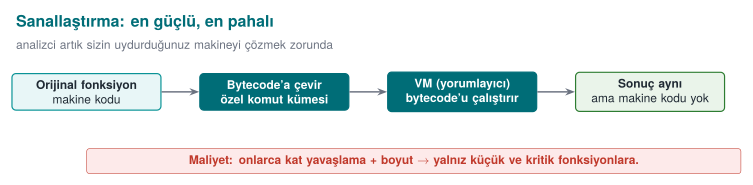
What does it protect? A function's machine code itself. How? The function is turned into a custom virtual machine's (VM) bytecode instead of real machine instructions; a small interpreter that reads this bytecode is embedded in the binary alongside it. The attacker no longer sees familiar machine code — they see a custom instruction set they first have to solve.
Cost: high — expensive both in performance (interpreted code is slow) and in maintenance; so it is only applied to the most critical, small, and rarely-changing functions. Limit: once the VM itself is solved, all the functions it protects can be unlocked; and if a single VM design is identical across every copy, there is no diversification. Measurement: the protected function's size/speed cost; how long it takes an analyst to work out the VM's instruction set. We'll see this conceptually in week 14 with Tigress's Virtualize transform.
Worked example: a small, conceptual bytecode and its interpreter. Real virtualisation tools are far more complex; but to see the mechanism, let's build a tiny three-instruction "virtual machine" — our goal is to compute 5 + 7 without a real addition instruction:
enum { OP_PUSH, OP_ADD, OP_RET };
uint8_t kod[] = { OP_PUSH, 5, OP_PUSH, 7, OP_ADD, OP_RET };   /* bytecode for 'compute 5 + 7' */

int yorumla(const uint8_t *kod, size_t n) {
    int yigin[8], sp = 0, pc = 0;
    for (;;) {
        switch (kod[pc++]) {
        case OP_PUSH: yigin[sp++] = kod[pc++]; break;
        case OP_ADD:  { int b = yigin[--sp], a = yigin[--sp]; yigin[sp++] = a + b; } break;
        case OP_RET:  return yigin[--sp];
        }
    }
}
Let's trace it by hand (stack sp, program counter pc):
| Step | pc before | Instruction | Operation | Stack (after) | sp |
|---|---|---|---|---|---|
| 1 | 0 | OP_PUSH | push 5 | [5] | 1 |
| 2 | 2 | OP_PUSH | push 7 | [5, 7] | 2 |
| 3 | 4 | OP_ADD | pop b=7, a=5, push a+b=12 | [12] | 1 |
| 4 | 5 | OP_RET | return 12 | — | — |
Result 12 = 5 + 7 — correct. Now let's look at what a reverse engineer actually sees: in the binary they find a generic, switch-driven loop called yorumla, and somewhere separate a byte array like {0, 5, 0, 7, 1, 2}. There is nowhere an instruction that says "5 plus 7"; the addition is a side effect produced by yorumla processing these six bytes in a particular order. To understand the real logic, the analyst first has to solve yorumla itself (the VM), then interpret each bytecode sequence separately — this is exactly where K-10's limit, "cost is high but once the VM is solved everything opens up," comes from: yorumla itself is a single place, and once it is solved every bytecode sequence becomes readable.
Let's see the cost, roughly, as an order of magnitude. Look again at the yorumla function above: a single addition like 5 + 7 needs just one instruction (add) in real machine code, but in the interpreted version every step requires: reading the bytecode (kod[pc++]), deciding which operation it is with switch, popping value(s) off the stack, doing the operation, pushing the result, advancing the program counter. A single "addition" ends up costing at least 5–6 real machine instructions; if the addition is called repeatedly inside a loop, this multiplier repeats too. In the literature, bytecode interpretation causing up to a 10x slowdown (sometimes more, in some designs) is a common order of magnitude — the exact ratio depends on the VM's design (how many stack operations, how many indirections) and must be measured in your own project; the number given here is only a rough answer to "why is it this expensive." That's why K-10's "Cost: high" line isn't just rhetoric; it means every instruction can cost 5-10x more, which is why it is only applied to small, critical functions that aren't called thousands of times per second (e.g., a license key derivation step, a check called once a second) — it is not applied to an image processing loop or a frequently called helper function.
Two frequently confused ideas: 'virtualisation-based obfuscation' is not the same thing as a Java/CLR virtual machine
In week 5 you saw that Java/Kotlin applications run on a virtual machine (JVM/ART), and that ProGuard/R8 shrinks DEX bytecode. K-10's "virtualisation-based obfuscation" is an entirely different thing: - JVM/ART: a general-purpose, universally known virtual machine that the whole application runs on; its bytecode format (DEX) is standard and can be decoded by anyone with a public tool (baksmali, jadx). - The VM in K-10: a project-specific, non-standard bytecode and interpreter, built only for a handful of selected critical functions; no general-purpose tool can read it directly, because you design the instruction set. So K-10 does not mean "I wrote my app in Java, it already runs in a VM, so it counts as obfuscated" — quite the opposite: a standard bytecode format like DEX is easily read by standard tools; K-10's strength comes precisely from the VM design being non-standard.
RULE K-11 — Compiler-based obfuscation (the O-LLVM family)¶
What does it protect? The control/data rules above — applied automatically by the compiler rather than by hand. How? LLVM-based obfuscators (Obfuscator-LLVM and its derivatives) automatically apply flattening, bogus control flow, and instruction substitution passes at compile time. Advantage: the source code stays readable, the protection is a compile option; diversifying by giving a different seed (seed) per build is easy. Cost: medium; the performance impact depends on which passes are selected. Limit: the patterns well-known passes produce are recognisable; you need to stay current with the tool's version. Measurement: the difference between binaries produced by the same passes with different seeds (the diversification metric, section 5).
Conceptual example: same source, two seeds, two different binaries. Suppose we compile the same erisim_ver source twice with an O-LLVM-based compiler, changing only the --Seed value. The source code is byte-for-byte identical; what changes is the compiler's random choices:
| What changes? | Seed A | Seed B |
|---|---|---|
| Flattening's state constants (K-04) | e.g. {0x7A1, 0x3F0, ...} | e.g. {0x22C, 0x9E4, ...} (completely different) |
| Which opaque predicate pattern is chosen (K-01) | one from the x*(x+1) family | a different identity from the same family |
Order of basic blocks inside the switch | one permutation | another permutation |
What doesn't change? When erisim_ver("CEN429-OK") is called, both binaries return the same result — the source code and the behaviour are identical, only the compiled shape differs. This is exactly the phenomenon we'll see under "diversification" in section 8; O-LLVM just produces it automatically at compile time instead of by hand.
Common mistake: treating a single O-LLVM flag as 'secure' without measuring it
Adding a flag like -mllvm -fla (flattening) and calling it "obfuscated now" is a common mistake. How many instructions/branches the pass really adds, how much it slows execution down, and which sub-passes (opaque predicate, bogus control flow) got enabled together cannot be known without measuring it. Rule: evaluate every O-LLVM configuration with the protection rule template from section 4 too (especially the "Cost" and "Measurement" lines); "I added a flag" is not evidence.
RULE K-12 — Self-modifying code and dynamic encryption (concept, handle with care)¶
What does it protect? The most sensitive code sections, by keeping them encrypted in the binary. How? The section sits encrypted in the binary; it is only decoded into memory right when it's about to run, runs, and is then re-encrypted or wiped. Cost: high and risky: it directly conflicts with modern operating systems' memory protections (DEP/NX, the separation of writable-and-executable pages, W^X); done wrong it both crashes and opens a new hole. Limit: at some point while running, the code sits exposed in memory; a memory dump can catch it. Measurement: how short the exposure window is.
Worked example: a timeline of the decode-run-re-encrypt cycle. The conceptual flow has these steps:
- t₀: The function is called; the relevant memory page is still encrypted.
- t₁: The page is decoded (exposed in memory), page permissions are temporarily made writable+executable.
- t₂: The code runs (the real work happens here) — this is the window where an attacker taking a memory dump could catch the code exposed.
- t₃: The work is done; the page is re-encrypted and permissions return to their original state (execute-only, not writable).
Critical point: step t₃ must run on every exit path — not only on a successful return, but also on error, on an exception, or on an early return. Otherwise the code stays exposed indefinitely in memory, and the "exposure window" is no longer short as defined, but infinite.
Common mistake: re-encrypting only on the success path
A developer will usually add the t₃ step only to the function's normal (successful) exit; it gets skipped on early returns in error paths or when an exception is thrown. Result: if an attacker deliberately triggers an error (e.g., by giving invalid input), the code stays decoded permanently and is exposed in the next memory dump. Rule: tie the re-encryption step to the language's "always runs" construct (a goto cleanup: label in C, RAII/a destructor in C++, finally in Java/Kotlin); don't handle success and error paths separately and forget one of them.
Rule: don't blindly disable a technique that conflicts with OS protections just for the sake of security
Self-modifying code requires making executable memory writable; this weakens the DEP/NX and W^X principles from week 4. If adding one protection means turning off another, measure the net gain and record the trade-off. In practice this technique is used very selectively, on small sections only.
The Java/managed side: ProGuard/R8 and DEX (a bridge from week 5)
This week's rules are for the native (C/C++) side. In managed languages (Java/Kotlin, Android) the equivalent is name obfuscation, dead code elimination, and shrinking with ProGuard/R8; -keep rules and APIs called via reflection were covered in week 5. The two sides are used together: the Java side is obfuscated with R8, the native side with this week's rules; the native side checks the Java side's integrity, the Java side checks the native library's (cross-checking — week 6, RASP).
Sections 5–7 summary table: twelve rules at a glance¶
One weak point is holding this many rules together at once. The table below is not a copy-paste list, it is a reminder; behind every row is a full explanation above, a worked example, and a common-mistake/rule box:
| Rule | Family | What it protects (summary) | Cost | Its biggest limit |
|---|---|---|---|---|
| K-01 Opaque predicate/loop | Control flow | Branch/loop condition | Low–medium | Known patterns are exposed to symbolic execution |
| K-02 Arithmetic encoding | Data | Constants, simple computations | Low | Can be undone by MBA simplifiers |
| K-03 Bogus operation/dead branch | Control flow | Hides real logic in a crowd | Low–medium | Can be deleted by compiler optimisation |
| K-04 Flattening | Control flow | Block adjacency/order | Medium–high | Symbolic execution + pattern recognition |
| K-05 Random exit | Control flow | Success/failure point | Low | Weak alone, meaningful with flattening |
| K-06 Function/parameter hiding | Layout | Library call hints | Low–medium | Behavioural analysis can still show what it does |
| K-07 String encoding | Data | Readable text | Low | Exposed in memory while running |
| K-08 Opaque boolean | Data | Decision result (allow/deny) | Low | Can be solved with enough scrutiny |
| K-09 Variable splitting/merging | Data | Memory pattern/footprint | Low–medium | Only slows pattern/static analysis |
| K-10 Virtualisation | Virtualisation | The machine code itself | High | Once the VM is solved, everything it protects opens |
| K-11 Compiler-based (O-LLVM) | Mixed | Applies the above automatically | Medium | Known pass patterns are recognisable |
| K-12 Self-modifying code | Anti-analysis | Critical code section | High, risky | Conflicts with OS memory protections (DEP/NX, W^X) |
For a quick answer to "which rule do I pick when?" when preparing for the exam or S9: for low-value, frequently changing code, pick from the rows near the top (K-01, K-02, K-05, K-07 — the low-cost ones); for high-value, rarely changing, small code sections, pick from the rows near the bottom (K-10, K-12) — exactly what the "Decision rule" in section 9 says.
8. Diversification: one crack should not open every door¶
"Rule 2 — break automation" from section 1 becomes concrete here. If an attacker breaks one copy, and the patch or script they produce can be distributed to all users, then a single crack opens every door. Diversification means producing different-but-behaviourally-equivalent binaries from the same source; that way an automated attack developed against one copy does not work against the others.
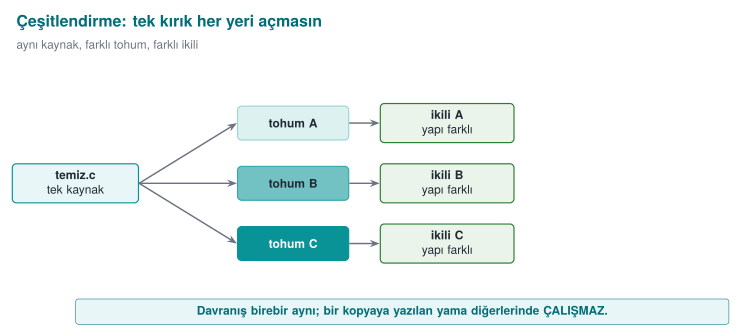
- Diversification in space: each build or each distribution is obfuscated with a different seed; opaque predicates, bogus blocks, and state values change from copy to copy.
- Diversification in time: every release comes with a new arrangement; an attack found against an old release breaks in the new one. This works together with your key/version renewal policy (week 10).
Diversification does not raise obfuscation's potency — a single copy can still be broken — but it prevents scaling. In week 14 we'll produce this with tooling using Tigress's RandomFuns, --Seed, and transform-combination features.
A simple metric for diversification effectiveness
Compile the same source with two different seeds. Compare the protected functions of the two binaries: the higher the byte-level difference ratio, the lower the odds that an attack written against one copy works against the other. Write this metric into your S9.
Worked example: let's compute the difference ratio numerically. Let's turn the metric above into a concrete number. Say the flattened version of the protected erisim_ver function takes up 512 bytes in the binary. Comparing this function byte-by-byte between binaries produced with two different seeds, we measured 340 bytes coming out different (a hypothetical but realistic demo result):
Interpretation: 66.4% of the two copies are different; only 33.6% stays common (likely fixed parts the compiler couldn't change, such as the function's prologue/epilogue). If an attacker applies a byte patch found in Copy A (e.g., "write this value at this offset, so the check always allows") directly to Copy B, that offset now holds a different instruction, so the patch either does nothing or crashes the program. This is the numeric proof of "Rule 2 — break automation" from section 1.
Common mistake: mistaking a change in compiler optimisation level for diversification
Saying "I compiled with -O3 instead of -O2, so now I have two different binaries" is not diversification. Changing the optimisation level (a) produces the same result on every compile (it isn't tied to a seed, so it's a repeatable, predictable single "version B," not many different copies) and (b) even though it strongly guarantees the behaviour stays the same, that isn't the goal here. Rule: real diversification must be produced with a different and unpredictable seed on every build (K-11's --Seed); switching between just two fixed configurations (-O2 and -O3) gives you at most two fixed variants, which does not reach section 1's "break automation" goal.
The diversification decision is thought about together with RASP (week 6) and key/version renewal (week 10): even if one copy is broken and a bypass script spreads, that script doesn't work on the other copies (diversification), and the old script also stops working in the next release (diversification in time + key renewal).
A dynamic known from the field: why is diversification a continuous race, not a one-off?
Digital rights management (DRM) and anti-cheat systems in games are a well-known, publicly visible field that shows why diversification has to be continuous, not one-off: when a version of a protection is broken (a "crack" or bypass spreads), the vendor usually releases a different protection arrangement in the next version, and the old crack stops working. This is the concrete way of working behind the sentence "2010s — DRM, mobile banking, and the games industry make obfuscation mainstream" in the history box in section 1: the defence is not one single "unbreakable" version, but a series of continuously renewed versions. The takeaway for the course: in your S9 writeup in section 12, describe diversification not as "I applied it once" but as "a process reapplied in every release."
9. Measuring obfuscation¶
Defending a protection decision requires measuring it. Collberg's framework evaluates obfuscation along four dimensions; these same four metrics are also the foundation of week 13's attack potential scoring ("time required," "expertise required").
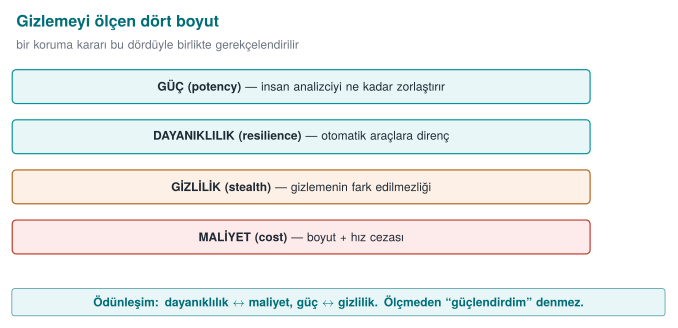
| Metric | Its question | How it's measured (concept) |
|---|---|---|
| Potency | How incomprehensible is it to a human? | Complexity metrics: CFG node/edge count, cyclomatic complexity, nesting depth — before/after obfuscation |
| Resilience | How much does it withstand an automated tool? | How long/successfully a deobfuscation tool (symbolic execution, a simplifier) takes to undo the protection |
| Stealth | Does the obfuscation give itself away? | How statistically distinguishable the obfuscated code is from normal code (if it's distinguishable, the attacker knows where to look) |
| Cost | How much does it cost us? | Size increase, runtime increase, memory, maintenance, and debugging difficulty |
These four metrics form a trade-off: raising potency and resilience raises cost, and stealth usually drops (more complex code draws more attention). A good engineering decision balances these four against the value of the protected asset.
Worked example: filling in the four metrics with numbers for erisim_ver¶
Let's spread the real demo measurements we met in section 4 (28 → 51 instructions, 3 → 6 branches) across the four metrics here:
Potency. Let's use McCabe's cyclomatic complexity idea as a rough approximate metric: for a function with one entry/one exit, complexity ≈ number_of_branches + 1.
Complexity rises from 4 to 7, i.e. by 75%: a human analyst tracing the function by hand now has to follow 75% more "paths."
Cost. Let's compute the rise in instruction count the same way:
So applying this one rule (K-04 + K-01 + K-05) has made the function 82% bigger and probably a little slower — this is the concrete number to write into the "Cost" line of the protection rule template from section 4.
Resilience and stealth. These two cannot be measured just by counting instructions/branches; resilience requires actually running a real deobfuscation tool (section 10) and measuring how long/successfully it "undoes" the protection, and stealth requires checking whether the obfuscated code is statistically distinguishable from "normal" code (e.g., does an abnormally high branch density draw attention). This week's demo directly measures only potency and cost; measuring resilience is the subject of the next section.
Common mistake: measuring only cost and calling it 'strong'
The conclusion "the binary grew 82%, so it must be well protected" is wrong — growth only shows cost, not resilience against being broken (as we'll see in section 10, a weak opaque predicate can add a lot of instructions and still be solved by a solver in seconds). Rule: report the four metrics separately; don't single out just one (usually "cost," the easiest to measure) and skip the others.
Decision rule (write this into S9):
- Asset value is low → light, cheap obfuscation (K-01, K-02, K-07) is enough.
- Asset value is high → layered protection (K-04 + K-05 + K-08 + diversification); the cost is accepted.
- For every layer, the potency/resilience gain is measured against the size/speed cost, and written down.
Worked example: applying the decision rule to two different assets. Suppose the same application has two different code sections:
- Asset A — a helper function that picks the text of a "welcome" screen. Its value is low (even if it leaks, it causes no major loss). Decision: K-07 (string encoding) alone is enough; an expensive transform like K-04 is unnecessary — here section 9's "cost" metric also works in the direction of "don't add unnecessary cost."
- Asset B — the
lisans_dogrulafunction where the license key is verified. Its value is high (tied to 100,000 TL/year of revenue in the numeric example in section 1). Decision: K-04 + K-01 + K-05 + K-08 + diversification applied together; the total cost (the 82% instruction increase we measured in section 9) is accepted because the value of the protected asset justifies it.
This comparison shows that "applying the same level of obfuscation to every function" can be both needlessly expensive and insufficiently protective: applying K-04 to Asset A wastes performance for nothing; applying only K-07 to Asset B leaves the CFG completely open. Make a separate decision for each code section in your S9.
10. Deobfuscation: the other side's tools, and the resilience rule¶
Measuring resilience correctly requires knowing the attacker's automated tools at a conceptual level. We learn these in order to test our own defence:
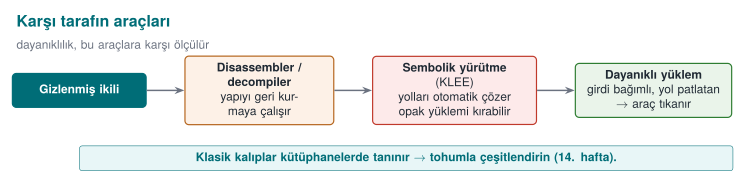
- Symbolic / concolic execution (tools like KLEE): program paths are solved as mathematical constraints; opaque predicates and flattening can be undone this way. Resilience rule: to defeat the solver, tie opaque predicates to structures that are expensive to solve (e.g., based on factorization or hash values), and grow the state space; but measure the cost.
- Expression simplification (MBA solvers): undoes arithmetic encoding (K-02). Rule: don't treat arithmetic encoding as a secrecy layer on its own; combine it with control-flow obfuscation.
- Pattern recognition: recognises known library/pass patterns. Rule: diversify; don't rely on a single opaque predicate pattern or a single VM design.
Banescu and colleagues' work (Tigress + KLEE) does exactly this: it measures how much each transform withstands symbolic execution. The takeaway for the course is clear: resilience is not a claim, it's a measured quantity. Instead of saying a protection is "strong," you need to say "it withstood this much against this tool."
How does symbolic execution break the opaque predicate in K-01? Step by step¶
Let's return to the opak_dogru(x) = ((x*(x+1)) & 1) == 0 predicate from section 5; the warning box there said it is "a classic pattern, recognised in modern tools' libraries." Now let's see why.
A symbolic execution tool (like KLEE) runs the program not with concrete values (like x = 5) but by keeping x as an unknown symbol. When it reaches the line if (opak_dogru(x)), the question it needs to ask is:
"Is
((x*(x+1)) & 1) == 0true for every value ofx, or is there anxthat makes it false?"
It hands this question to a constraint solver (an SMT solver). The solver splits x into two cases, odd and even (a standard solving strategy in integer arithmetic), and quickly proves both:
- If
xis even:x = 2k→x*(x+1) = 2k*(2k+1)→ the expression is a multiple of2→& 1 = 0. ✅ - If
xis odd:x = 2k+1→x+1 = 2k+2 = 2(k+1)is even →x*(x+1)is again a multiple of2→& 1 = 0. ✅
In both cases the result is 0; the solver reaches, within seconds, the conclusion "this predicate is always true, the second (bogus) branch never runs," and automatically eliminates the dead branch. That's why the warning box for K-01 doesn't consider this particular identity strong enough on its own, and recommends seed-diversified predicates in week 14 that tire the solver out more (e.g., based on factorization or on inverting a hash function) — now we've also seen why that recommendation makes sense.
How do MBA simplifiers undo K-02?¶
An expression like K-02's (a ^ b) + 2·(a & b) = a + b, complex as it looks to a human, can be mechanically checked with a finite truth table (2⁴ × 2⁴ = 256 rows for every 4-bit a,b pair, 65,536 for the 8-bit case). Tools like arybo/msynth do exactly this: they brute-force the expression at small bit widths, find the shortest standard expression producing the same truth table (a+b), and report the two as equivalent. That's why K-02's limit line said "weak on its own": if arithmetic encoding stays a single layer, this simplification step can undo it in a few seconds; but if you embed the result inside K-04's flattened switch, the simplifier first has to solve the flattening just to find which expression to simplify — two weak layers together are stronger than one.
How does pattern recognition target K-04/K-11?¶
A "pattern recognition" tool scans a binary looking for known structural signatures: a large switch inside a single loop, non-sequential state values drawn from a fixed set, an error path exiting through default — exactly K-04's template. The flattening shape produced by popular tools like O-LLVM has itself become a "recognisable" signature over time (there are even academic studies that guess which obfuscation tool a piece of software was compiled with). This is the source of the "known passes' patterns are recognisable" warning in K-11's limit line.
Common mistake: assuming every technique withstands every tool equally
Before declaring a protection "strong," you need to state which class of tool it was measured against. The table below summarizes which deobfuscation tool this week's rules mainly threaten; a rule measured only against the tool in its own column may still be weak against the tools in the other columns:
| Rule | The tool it mainly threatens | This week's countermeasure |
|---|---|---|
| K-01 (classic opaque predicate) | Symbolic/constrained execution (KLEE) | Solver-resistant predicates in week 14 |
| K-02 (MBA) | Expression simplifier (arybo/msynth) | Combine with control-flow obfuscation |
| K-04/K-11 (flattening) | Pattern recognition, CFG signature matching | Diversification (section 8), reinforcement (K-01/K-03/K-05) |
Rule: also write "which tool it was measured against" into the protection rule template from section 4 (implicitly, into the "Which threat?" line); a claim of being "generally strong" means it hasn't been measured against any tool.
Resilience and cost are not the same thing — don't mix them up¶
In section 9 we defined "resilience" and "cost" as two separate metrics; after this section the difference should be clearer. Cost is how much applying the protection costs us (instruction count, speed, memory) — we measure this directly in our own build process (the objdump examples in sections 4 and 9). Resilience is how much the protection withstands the attacker's tool — measuring this requires actually running the attacker's tool (symbolic execution, an MBA simplifier, pattern recognition) and observing the result; just saying "I added a lot of instructions" does not prove resilience. Recall the "82% cost increase" example from section 9: that number alone does not say how much K-04 withstands symbolic execution — that question can only be answered by actually trying a deobfuscation tool, as in this section. Report these two metrics separately, without mixing them up, in your S9.
11. Obfuscation's place in layered defence¶
Obfuscation is not a fortress on its own, it is one layer of defence in depth. Its relationship to the other weeks:
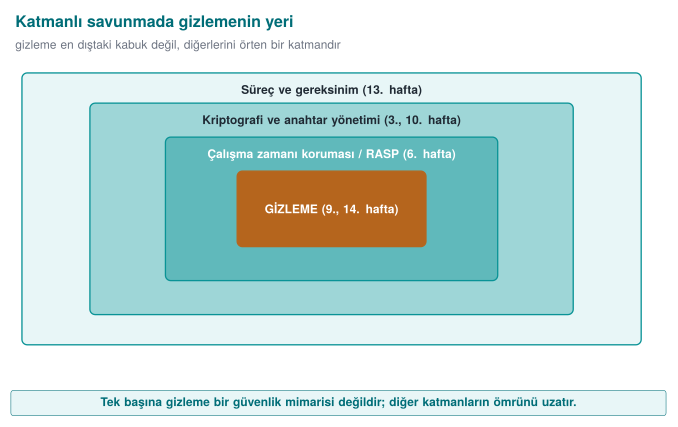
| Layer | Its week | Relationship to obfuscation |
|---|---|---|
| Memory safety, secure compilation | 4 | Obfuscation doesn't replace these; the two work together |
| RASP (tamper/debugger detection) | 6 | Obfuscation also hides RASP's own checks; RASP protects obfuscation while it runs |
| Whitebox cryptography | 11 | The real protection for the key; obfuscation makes the shell around it harder |
| Crypto and key renewal | 10 | Obfuscation buys time "until the key is renewed" |
| Certification / attack potential | 12–13 | Every layer's "delay time" feeds into the scoring |
Tying the whole term together through one example: a mobile payment app's license check¶
To make the connections between weeks concrete, let's follow the same imaginary function — a mobile payment app's lisans_dogrula function — through the eyes of different weeks across the term:
- Week 1: the threat model is drawn up;
lisans_dogrulais flagged as an asset that needs protecting against a MATE attacker (the user who holds the app). - Week 3: the keys the function uses are encrypted with AEAD, random numbers come from a CSPRNG; but this is the security of storing the data, not the security of reading the code.
- Week 4: the first obfuscation steps are taken: symbols are hidden, a basic flattening is tried.
- Week 6: RASP is added; whether a debugger is attached is checked at runtime.
- Week 9 (this week): K-01–K-12 are applied: control flow is flattened and reinforced (K-01, K-03, K-05), data is encoded (K-07, K-08, K-09), diversification is added (section 8), effectiveness is measured (section 9).
- Week 10: the lifecycle (generation, distribution, renewal) of the keys the function uses is managed with PKI — obfuscation does not store the key, it only makes its surroundings harder (the rule from section 3).
- Week 11: the most critical key-derivation step is protected with whitebox cryptography — the cryptographic counterpart of K-10's (virtualisation) "only apply it to the most critical small function" principle.
- Weeks 12–13: an independent evaluator scores all of these layers with the attack potential framework; the "Measurement" lines from the protection rule template in section 4 are presented here as evidence.
- Week 14: all this hand-done work is automated with Tigress; the same source is regenerated with a different seed on every release, with a single command.
This chain shows which different threat a single function is protected against in each week of the term: no week replaces another, each one closes the gap the previous one left behind.
An observation from the field
The native protection measures listed in a certified product cover almost all of this week's rules; but the document attaches a "not strong on its own" note next to every one of them. What convinces an evaluator is not a single technique, but the rules being used together, being diversified, and each one being presented with a measured delay value.
In practice, what do you look at to estimate "delay time"?¶
The attack potential assessments we'll meet in weeks 12–13 generally look at how many factors an attack is made harder by; the rules we learned this week affect those factors as follows (exact scores vary by certification scheme, here we only show the direction):
| Factor | Its question | Which of this week's rules affects it? |
|---|---|---|
| Time required | How many hours/days does the attack take? | All of them — especially K-04 (grows the CFG) and K-10 (solving the VM takes time) |
| Expertise required | Does it need general skill or specialist knowledge? | K-01/K-02 (MBA, opaque predicate knowledge), K-10 (VM reverse engineering) |
| Knowledge of the target | How familiar is the attacker with the source code/design? | K-06 (hiding internal function names/signatures lowers "target knowledge") |
| Window of opportunity | How long can the attacker access the binary? | Diversification (section 8) + K-12 (short exposure window) narrow this |
| Equipment needed | Does it need a general tool or a special/expensive one? | Solver-resistant predicates (section 10) push it toward "a general tool isn't enough" |
These five questions are the common skeleton of the attack potential assessment approaches widely used in the certification world. For example, if you apply only string encoding (K-07), you raise the required time by a few minutes but barely change the required expertise (anyone can search for a string in a decompiler instead of using strings). If control-flow flattening + opaque predicate + diversification are applied together, the required time (solving the CFG by hand takes hours), the required expertise (a generic tool isn't enough, a custom script/analysis has to be written), and the window of opportunity (a script has to be rewritten for every copy since each is different) all rise together — this is the technical explanation for why layers, not a single rule, score higher in an assessment.
Short summary of this section¶
Obfuscation's place in layered defence can be summed up in three sentences: (1) obfuscation does not replace memory safety (week 4), cryptography (week 3), or RASP (week 6) — it makes their surroundings harder; (2) every layer is counted as a separate "delay" in the attack potential assessment (weeks 12–13), none is sufficient alone; (3) every protection line you write in the next section (S9) should be traceable back to this table and to the template in section 4 — if you cannot answer "which layer does this protection belong to, which other layer does it work with," that protection has probably ended up isolated and insufficient.
12. Term project: this week (S9 — advanced hardening)¶
Take the S9 section of your post-midterm project to an advanced level:
- Protection table: for the two–three most critical code sections (e.g., licensing, key derivation, integrity check), fill in the "protection rule" template from section 1: what it protects, against which threat, how, cost, limit, measurement.
- Measurement: for at least one technique, give a before/after obfuscation metric (e.g., the count of sensitive strings in
stringsoutput; CFG node count; binary size and an operation's duration). - Diversification decision: will you apply diversification? If not, why not (a justification is also an answer).
- Limit and remaining risk: for every protection, state explicitly what it does not protect. Something like "this string obfuscation does not protect the key; the key uses the whitebox/hardware from S8."
Worked example: an S9 draft from start to finish¶
Let's combine this week's examples into a short S9 draft (replace the function names and numbers with your own measurements in your own project):
S9 — Advanced hardening (example draft)

1) Protection table
   RULE: K-04 (flattening) + K-01 (opaque predicate) + K-05 (random exit) applied to the lisans_dogrula function
     What does it protect? : the order in which the licence key is verified
     Against which threat? : static CFG reading, single-byte patch
     How?                  : switch dispatcher + x*(x+1)-based opaque predicate + unpredictable failure exit
     Cost                  : instructions 28→51 (+%82), branches 3→6 (+%100) [measured with objdump]
     Limit                 : weak against symbolic execution (section 10); data still needs K-07 protection
     Measurement           : objdump output (appendix A), CFG node/edge count

   RULE: K-07 (string encoding) applied to the key string
     What does it protect? : sensitive strings in the binary
     Against which threat? : strings scanning (section 3's "first 10 minutes" attack)
     How?                  : encode with XOR 0x5A, decode at the moment of use and wipe with memset_s
     Cost                  : low (a few extra instructions)
     Limit                 : the decoding key sits in the binary; real key protection is S8/whitebox's job
     Measurement           : count of sensitive strings in strings output: 3 → 0

2) Measurement: the "Measurement" field is filled in on both lines above (objdump + strings)

3) Diversification decision: YES — a random --seed parameter was added to the build script;
   every release is compiled with different state constants (section 8, with K-11).

4) Limit and remaining risk: this layer doesn't protect the key (it only delays static scanning);
   it hasn't been measured against symbolic execution (future work); permanent protection of the key is left to S10/S11.
This draft combines the template from section 4 with the four metrics from section 9 and the diversification decision from section 8; you are expected to replace every line with numbers you measured yourself — the numbers above come from this week's demo and should not be copy-pasted directly into another project.
Checklist before submitting S9
- For at least two code sections (one control-flow rule, one data rule), is the six-line template from section 4 filled in completely?
- Does every "Measurement" line contain a concrete number or observation (not just an adjective like "strengthened")?
- Is it stated which family (layout/data/control flow/anti-analysis/virtualisation — section 2) each technique belongs to, or was only a single family used (section 2's "common mistake" applies here again)?
- Is the diversification decision (applied/not applied) written down together with its justification (section 8)?
- Does the "Limit" line for every protection clearly state what it does not protect — in particular, hasn't the core warning from section 3, "this does not protect the key," been forgotten?
- Has an absolute claim like "unbreakable" or "impenetrable" been avoided everywhere (the Barak et al. warning from section 1)?
- Was it tested on a binary compiled with optimisation on (
-O2/-O3) (against the "the compiler silently deletes it" mistake from K-02/K-03)?
Through an evaluator's eyes
What S9 is graded on is not "I used a lot of techniques" but the justification and measurement of every technique. An unmeasured protection counts, in an assessment, as a "claim," not as evidence.
13. Self-check¶
1. What is source-to-source obfuscation? In what way does the MATE threat model differ from a network attacker, and why does that not leave cryptography sufficient on its own but make obfuscation necessary?
MATE (Man-At-The-End) has full possession of the device the app runs on: they can read memory, attach a debugger, modify code; a network attacker only connects from outside. Cryptography is still necessary but not sufficient on its own, because the key/data is exposed in memory while running. That's why obfuscation is needed: it delays and raises the cost of extracting the key and understanding the logic.
2. 'Obfuscation doesn't make something unbreakable, it makes it expensive.' Explain this with an asset-value example.
Obfuscation doesn't make an attack impossible, it makes it require more time/skill/tools. If breaking content worth 100 TL takes 10,000 TL of effort, a rational attacker gives up. That's why protection strength is measured relative to the value of the protected asset.
3. What is the difference between a bogus operation and a death (dead) branch? Which one runs?
A bogus operation really runs, but its result is never used (it wears out the analyst and the tool). A dead branch is protected by an opaque predicate and never runs at all. So a bogus operation is code that runs but has no effect, while a dead branch is code that never runs.
4. Why is control-flow flattening weak on its own? Name at least three rules that strengthen it.
Flattening leaves behind a dispatcher (switch) pattern; this pattern is recognisable, and the flow can be reconstructed by tracking the state variable. Reinforcements: opaque predicates, encrypting the state variable, bogus states/blocks + random exit (also name/string obfuscation).
5. Which attack does a random exit point make harder? Why does a single-byte patch stop being enough?
It makes pattern-matching, automated scripting, and symbolic execution attacks harder (there is no single fixed exit pattern). Because there is no single fixed exit, a single byte patch cannot close off every path; the attacker has to deal with every path separately.
6. Does string obfuscation protect a key? Why or why not? Which weeks should you look at for protecting a key?
No. String/table obfuscation only makes static strings scanning harder; the key is exposed in memory while running. Real key protection requires the methods from week 10 (PKI, HSM/PKCS#11) and week 11 (whitebox cryptography).
7. What are the two biggest costs of virtualisation-based obfuscation? Why is it applied only to small, critical functions?
A large performance penalty (a virtual machine interpreting bytecode is slow) and a size increase (VM + bytecode). Because of this cost it is applied only to functions that are high-value, small, and critical; it cannot be applied to the entire codebase.
8. Which operating system protection does self-modifying code conflict with? Why can this create a new risk?
W^X / DEP-NX: a memory page cannot be writable and executable at the same time. Modifying code requires temporarily making the page writable-and-executable; this is blocked or suspicious in most environments, and it can also open a window for code injection by an attacker (a new risk).
9. Define the four dimensions that measure obfuscation (potency, resilience, stealth, cost). Which of them trade off against each other?
Potency: how much it hinders a human analyst. Resilience: resistance to automated deobfuscation tools. Stealth: how unnoticeable the obfuscation is (looking normal). Cost: the performance/size penalty. The main trade-offs: resilience ↔ cost, and potency ↔ stealth (strong obfuscation usually looks more 'abnormal').
10. Does diversification prevent obfuscation's potency, or its ability to scale? Propose a simple effectiveness metric.
It prevents scaling: it doesn't raise a single copy's potency, but it prevents a crack from spreading to all copies/users. Metric: the difference ratio (percentage of different bytes/instructions) between binaries produced from the same source with two seeds, plus a behaviour test showing both binaries give the same output for the same input.
11. Which obfuscation rules does symbolic execution (like KLEE) challenge? What do you do to raise resilience, and how do you keep the cost in check?
KLEE can break simple opaque predicates and flattening by automatically solving paths. For resilience, you make predicates resistant to symbolic execution (input-dependent, cryptographic, causing path explosion). You control the cost by applying these expensive transforms only to critical functions and measuring before/after.
12. Fill in the 'protection rule' template (six lines) for a code section in your own project.
Example — Asset: the license verification function. Threat: a MATE attacker bypassing verification with a patch. Rule: control-flow flattening + opaque predicate. How: Tigress Flatten + AddOpaque, applied only to this function. Measurement: size +X%, speed −Y%, instruction count N→M. Remaining risk: strong but not virtualised; diversify with a seed per release.
13. If you XOR the byte 0x41 with 0x5A, and XOR the result with 0x5A again, what do you get? Which algebraic rule guarantees this?
0x41 ^ 0x5A = 0x1B, then 0x1B ^ 0x5A = 0x41 — you're back to the byte you started with. The rule that guarantees this is a ^ b ^ b = a ^ (b ^ b) = a ^ 0 = a: any value XORed with itself gives 0, and a value XORed with 0 stays unchanged. This is the mathematical basis of K-07's string encoding/decoding and of the general claim that "XOR is reversible."
14. Why is the Shannon entropy of [0x41,0x41,0x41,0x41] 0 bits/symbol, while [0x3F,0xA1,0x08,0xC7]'s is 2 bits/symbol? What is the practical meaning of this for an attacker?
In the first sequence, a single value has probability p=1, log2(1)=0, so H=0 — completely predictable. In the second sequence, four distinct values each occur with equal probability (p=1/4): H = -4·(1/4·log2(1/4)) = -4·(1/4·(-2)) = 2 bits/symbol, the highest value reachable in this four-symbol alphabet. In practice: when scanning a binary, an attacker can statistically distinguish low-entropy (repeating) blocks from high-entropy blocks (potentially keys/encrypted data); high entropy is a clue that "there might be a secret here."
15. Verify that (a ^ b) + 2·(a & b) equals a + b for a=5, b=3. What are expressions of this kind called, and why aren't they strong enough on their own?
a+b = 5+3 = 8. a^b = 0101^0011 = 0110 = 6; a&b = 0101&0011 = 0001 = 1; (a^b)+2·(a&b) = 6+2 = 8. The two are equal — the identity is confirmed. Expressions of this kind are called mixed boolean-arithmetic (MBA) (K-02). They aren't strong enough alone because expression simplifiers like arybo/msynth can reduce expressions like this back to their original form (a+b) quickly by building a truth table at small bit widths; they only gain strength combined with control-flow obfuscation (K-04).
16. In K-08's opaque boolean example, with a=0xA3C1, b=0x5C3E, why is a^b equal to 0xFFFF? If the attacker only changes the low byte of a (0xC1→0x00), what does karar_izin_mi return?
Because all four nibbles are each other's bitwise complement (A=1010↔5=0101, 3=0011↔C=1100, C=1100↔3=0011, 1=0001↔E=1110), their XORs always give 1111=F, totalling 0xFFFF. If a's low byte is set to 0x00, the new a=0xA300; 0xA300^0x5C3E = 0xFF3E ≠ 0xFFFF, so karar_izin_mi returns false (deny) — the single-byte patch fails to trigger the attack, because a and b must change together, consistently.
17. How is the value 0x1234ABCD split into two 16-bit shares and merged back as in K-09? Why does this technique work against memory scanning?
Splitting: yuksek=0x1234, dusuk=0xABCD. Merging: (yuksek<<16)|dusuk; 0x1234<<16 = 0x12340000, OR-ing this with 0x0000ABCD gives 0x1234ABCD — the original value comes back. Why it works: memory-scanning tools usually look for "a contiguous, fixed-size, high-entropy block" (e.g., a 16/32-byte key pattern); once the value is split into two separate, non-adjacent variables, this "single block" pattern disappears.
18. In section 7's small bytecode example, how does the stack change when {OP_PUSH,5,OP_PUSH,7,OP_ADD,OP_RET} runs, and what is the result? Why can't an analyst see this result directly 'in the source code'?
In order: OP_PUSH 5 → stack [5]; OP_PUSH 7 → stack [5,7]; OP_ADD → pops 7 and 5, pushes 5+7=12 → [12]; OP_RET → returns 12. Result: 12. The analyst can't see this in the source because there is no "addition" instruction anywhere — the addition is a side effect of the yorumla function processing these six bytes in a particular order; the interpreter (the VM) itself has to be solved first.
19. Why can a bogus operation in K-03 (crc ^= sabit^sabit) be completely deleted by an optimising compiler (-O2)? What do you do to prevent this?
sabit^sabit is always 0 (the XOR identity from section 0: a value XORed with itself gives 0), and crc^=0 leaves crc unchanged. The compiler can spot this by constant folding and remove it via dead code elimination, saying "this has no observable effect"; the obfuscation vanishes without you noticing. Prevention: decide the values used in the bogus operation at runtime (tied to an input/opaque predicate), never fix them at compile time; always verify obfuscation on a binary compiled with optimisation on.
20. In section 8's example, if a 512-byte function's binaries produced with two seeds differ by 340 bytes, what is the difference ratio as a percentage? What does this ratio show, and what does it not show?
fark_orani = 340/512×100 ≈ %66.4. This shows how different the two copies look at the code level — it implies a high likelihood that a byte-level patch written for one copy will not work at the same offset in the other. What it does not show: it does not raise a single copy's potency/resilience; it only makes a crack harder to scale (section 8's main claim).
21. In this week's demo, erisim_ver goes from 28→51 instructions, 3→6 branches after flattening. What is the simple cyclomatic complexity (branches+1) before/after, and by what percentage does it increase? Which metric (section 9) does this represent?
Before: 3+1=4. After: 6+1=7. Increase: (7-4)/4×100=%75. This represents potency among section 9's four metrics — a rough indicator of how many paths a human analyst has to trace to understand the function; the %82 increase in instruction count in the same example represents the cost metric.
22. Why does symbolic execution make K-01's ((x*(x+1))&1)==0 opaque predicate 'classic and weak'? How does a solver prove it?
Symbolic execution keeps x symbolic rather than concrete and asks a constraint solver "is this expression true for every x?" The solver splits x into even/odd (if even, x=2k; if odd, x=2k+1) and proves in both cases that x*(x+1) is a multiple of 2, so &1=0. Because the proof takes seconds, the dead branch is eliminated automatically; that's why week 14 recommends predicates more resistant to solvers (based on factorization/hash values).
23. In attack potential frameworks, which five factors are generally evaluated? Which of these does applying only string obfuscation (K-07) affect, and by how much?
Generally: time required, expertise required, knowledge of the target, window of opportunity, and equipment required. Applying only K-07 (string obfuscation) raises the required time by only a few minutes (searching for the string by hand in a decompiler instead of running strings), but barely changes the required expertise — it's a step anyone can do. Layers like control-flow flattening + opaque predicate + diversification raise time, expertise, and window of opportunity together.
24. In K-12, what happens if the re-encryption step is skipped on an error/exception exit? What is the rule?
If the code falls into an error outside the normal (successful) path, it stays permanently exposed (decoded) in memory; the "exposure window" is no longer short as defined, it becomes infinite, and a memory dump can catch it at any time. Rule: tie the re-encryption step to the language's "always runs" construct (goto cleanup: in C, RAII/a destructor in C++, finally in Java/Kotlin); don't handle success and error paths separately and forget one.
25. What is the difference between 'encoding,' 'encryption,' and 'obfuscation'? Which of these is K-07's 'string encoding'?
Encoding: converts data into another representation, with no mathematical secrecy claim (e.g., XOR). Encryption: key-based, provides provable security (e.g., AES-GCM, week 3); cannot be broken without the correct key. Obfuscation: makes code harder for a human to understand, carries no mathematical security claim. K-07's "string encoding" is an encoding (via XOR); since the decoding key also sits in the binary, it is not encryption, it only slows down static scans like strings.
26. Why are the five families in the taxonomy ordered 'potency and cost rise from bottom to top'? Why is the layout family the weakest?
A family's potency is proportional to how close it sits to the mechanism that produces the program's behaviour. The layout family only changes names/metadata, touching nothing that produces the behaviour — that's why it's the cheapest but weakest layer (as we saw in section 0's decompiler example, names are already lost but the logic remains). Virtualisation, at the other end, changes the machine code itself, making it both the strongest and the most expensive.
27. Why is K-10's 'virtualisation-based obfuscation' not the same thing as the JVM/ART virtual machine that Java/Kotlin applications run on?
JVM/ART is a general-purpose, standard virtual machine that the whole application runs on; its bytecode format (DEX) is known and easily read by general tools like jadx. The VM in K-10 is a project-specific, non-standard bytecode and interpreter designed only for a handful of selected critical functions; no general tool can decode it directly. An application being written in Java does not mean it is "virtualised" in K-10's sense.
28. Why is diversification in DRM and game anti-cheat systems described as a 'continuous process' rather than a 'one-off'?
When a version of a protection is cracked (a bypass spreads), that crack is specific to that version only; the vendor usually releases a different protection arrangement (a new seed, new opaque predicates) in a new version, and the old crack stops working. That's why diversification in S9 should be described not as "I applied it once" but as "a process reapplied in every release" — the version-level concrete form of "Rule 3: buy time for the other layers" from section 1.
29. What does Barak et al.'s 2001 'perfect black-box obfuscation is impossible' result mean? Does this mean this week's rules are useless?
The result mathematically proves that for every program there cannot exist a perfect transformation under which an attacker looking inside the code learns nothing extra beyond observing input-output behaviour. This does not mean the rules are useless; it only means that no protection can be marketed as "absolute/unbreakable secrecy." This is the academic reason why we write every rule this week not as "unbreakable" but as "this is the cost it imposes, this is its limit, this is how much it withstands" (the template in section 4).
30. In section 9's two-asset example, why is it the wrong decision to apply an expensive transform like K-04 to Asset A (low-value text)?
K-04 (flattening) carries a significant cost (an 82% instruction increase, 100% branch increase in this week's demo). Paying this cost for a low-value asset does exactly the opposite of Rule 1 in section 1 ("push the cost above the value"): you needlessly raise the defender's cost, not the attacker's. The right decision is to settle for a low-cost rule like K-07.
31. In K-06's bogus parameter example, what is the purpose of the line (void)gunluk_seviyesi;?
The gunluk_seviyesi and ayarlar parameters are never used inside the function (they were added only to make the signature misleading); most compilers issue an "unused parameter" warning. The (void)parametre line silences this warning and signals that the parameter is intentionally unused (a design choice, not a bug); this way the bogus parameter escapes notice even under real code review.
14. Sources and further reading¶
- Secure Programming Cookbook for C and C++ (Viega & Messier) — Chapter 12, Anti-Tampering: the purpose and limit of obfuscation, a recommendation to combine several simple techniques.
- Secure programming technical guide (course source) — native code hardening countermeasures: opaque loop, arithmetic/string/parameter obfuscation, opaque boolean, bogus operation/dead branch, control-flow flattening, and random exit.
- C. Collberg, J. Nagra, Surreptitious Software — the obfuscation taxonomy and the potency/resilience/stealth/cost framework.
- S. Schrittwieser et al., "Protecting Software through Obfuscation: Can It Keep Pace with Progress in Code Analysis?" (ACM Computing Surveys, 2016) — an overview and deobfuscation tools.
- S. Banescu et al., measuring transform resilience with Tigress + KLEE — a bridge to week 14.
- Obfuscator-LLVM (O-LLVM) — an example of compiler-based obfuscation.
Which source should you open, and when?¶
These sources don't replace each other; each answers a different question:
- While writing your S9, if you get stuck on "what is this technique called, how is it defined" → look at the technical guide and Cookbook Chapter 12; these two are the direct source of this week's K-01–K-12 rules.
- "Who proposed this taxonomy, when, and why these five families?" → look at Collberg & Nagra (the detailed version of the short history box in section 1).
- "How resilient is this protection really, and against which tool is it measured?" → look at Schrittwieser et al. (a general survey) and Banescu et al. (a concrete measurement with Tigress+KLEE); this is the academic foundation of the deobfuscation discussion in section 10.
- "How do I apply these rules with a tool instead of by hand?" → look at the Obfuscator-LLVM documentation; week 14 will show this applied in practice through Tigress.
Next week
Week 10 — Certificates and cryptographic methods. This week we said "obfuscation does not protect the key"; week 10 covers choosing keys correctly, their lifecycle, and protecting them with PKI. Week 11 covers whitebox cryptography, and week 14 covers this week's rules' automated counterpart (Tigress).