Week 10 — Certificates and Cryptographic Methods¶
| Date | 20.11.2026 |
| Learning outcomes | LO.2, 4 |
| Duration | 3 hours |
| Prerequisites | AES-GCM, HMAC, key derivation and what TLS does, from Week 3; being able to run the openssl command in a terminal |
| Labs | code/week-10 — 2 demos; requires OpenSSL 3; sh demo.sh in each demo folder |
Lecture notes (PDF) Lecture notes (DOCX) Slides (PDF) Slides (PPTX) Slides (HTML, offline) Download all (ZIP) Open slides full screen
Click inside the slides and use the arrow keys; use the button at the bottom right of the slides or the link above for full screen.
This week's working demo
code/week-10/01-pki-zincir — root->intermediate->server chain with OpenSSL; verify errors without the intermediate certificate, OK once it's added. · code/week-10/02-imza-dogrulama — Ed25519 signature/verification: the correct signature is accepted, a tampered one is rejected; the ==1 trap.
To run: sh demo.sh (Linux/WSL) or build with CMake and run from bin/. Entirely synthetic and safe; it does not harm the student's computer.
Run the demo yourself — step by step (copy-paste)
These two demos use OpenSSL and a shell script; on Windows open WSL or Git Bash. From the code folder:
# WSL / Linux / Git Bash
cd week-10/01-pki-zincir
sh demo.sh            # kök CA → ara CA → sunucu sertifikası üretir ve zinciri doğrular

cd ../02-imza-dogrulama
sh demo.sh            # Ed25519 ile imzala → doğrula → tek bayt kurcala → doğrulama reddetsin
Expected output: The first demo builds a three-link chain; openssl verify finds the chain valid, and verification fails once the intermediate certificate is removed (this week's "missing intermediate certificate" rule). The second demo signs a file and verifies it (OK), then changes a single byte, and verification rejects it — this is how signature integrity catches tampering.
By the end of this week you will be able to
- Choose an algorithm, key length, and mode for an application and base the choice on current standards (NIST SP 800-57, SP 800-131A).
- Compare block cipher modes (ECB, CBC, CTR, GCM) and padding; explain why the padding oracle attack is possible.
- Use HMAC correctly; combine encryption and the MAC in the right order and protect against replay.
- Perform encryption, signing, and key exchange with RSA (OAEP, PSS) and elliptic-curve (Ed25519, X25519) algorithms; show why signed Diffie–Hellman is necessary.
- Explain PKI components (CA, RA, chain, trust store); build and validate a root → intermediate → leaf certificate chain with OpenSSL.
- Explain certificate revocation (CRL, OCSP, OCSP stapling) and know the rationale for storing keys in a software HSM (SoftHSM, PKCS#11).
Class schedule (timing plan for the instructor)
| Time | Section | What happens |
|---|---|---|
| 0:00–0:15 | 1 | Map of cryptography; algorithm and key-length selection |
| 0:15–0:50 | 2–3 | Block cipher modes and padding; MAC, HMAC, encrypt-then-MAC, replay |
| 0:50–1:00 | Break | |
| 1:00–1:30 | 4–5 | RSA (OAEP, PSS) and elliptic curves; creating and verifying digital signatures (OpenSSL) |
| 1:30–1:50 | 6 | Key exchange: Diffie–Hellman, man-in-the-middle, signed DH |
| 1:50–2:00 | Break | |
| 2:00–2:40 | 7–9 | PKI components; X.509 structure; building a certificate chain with OpenSSL — class activity |
| 2:40–2:55 | 10–11 | Revocation (CRL, OCSP); key storage (PKCS#11, SoftHSM, HSM) |
| 2:55–3:00 | 12+ | Look at post-quantum cryptography, project step, self-check |
Prepare the lab in advance
This week's commands require OpenSSL 3 (the openssl that ships with Git for Windows, or your package manager on WSL/Linux). Produce all files in an empty working folder; the keys you generate are for the course only and must never be used on any real system. The SoftHSM section is optional.
Ethics rule — applies every week in this course
All of this week's keys and certificates are ones we generate ourselves, synthetic, and for the lab only. Adding a root certificate you generated to the trust store of someone else's computer, or producing a fake certificate carrying the name of a real certificate authority, is unacceptable. Man-in-the-middle examples are only ever done on your own computer, on localhost.
0. Basic concepts (from scratch)¶
This section prepares you for the week. It first briefly recalls the earlier topics this week builds on; it then defines each of this week's concepts in one sentence and links it to the section where it is explained in full.
What we bring from earlier weeks¶
- Symmetric and asymmetric encryption — symmetric encryption runs fast with a single key shared by both parties; asymmetric encryption uses a public/private key pair, which makes key distribution easy but is slow (Week 3, §2.2). This week we go deeper into the asymmetric side's mathematics (RSA, ECC — §4) and the symmetric side's correct choice of mode and padding (§2).
- AEAD — authenticated encryption gives confidentiality and integrity together, in a single call, by producing a tag that also proves the data has not changed (Week 3, §2.1). This week we show why the mode inside AEAD (GCM) and the alternatives you should stay away from (ECB, CBC) give such different security (§2).
- Digest (hash), MAC, and digital signature — a digest is a one-way fingerprint computed from data; a MAC proves a message has not changed using a shared key, and a digital signature does the same with a public/private key pair (Week 3, §2.4). This week we cover HMAC's internal construction and the correct order for combining it with encryption (§3), and the practical pitfalls of signature verification (§5).
- Forward secrecy — deleting a session's derived key right after use, so that even if today's key leaks, past sessions cannot be decrypted (Week 3, §7.1). This week we build the Diffie–Hellman key exchange and its authentication — the mechanism underneath forward secrecy — from scratch (§6).
- TLS certificate validation — the client checking a server certificate's chain, validity dates, intended usage, and name (Week 3, §9.2). This week we build the PKI, X.509, and revocation (CRL/OCSP) machinery this validation rests on, from the ground up (§7–10).
This week's concept map¶
| Concept | In one sentence | Detail |
|---|---|---|
| Block cipher modes and padding | A block cipher encrypts a fixed-size block; the way we apply it to a longer message is called a mode, and if the message isn't a multiple of the block size it is completed with padding; the choice of mode and padding matters as much as the algorithm itself. | §2 |
| MAC and HMAC | A MAC is a function that produces a short tag from a secret key and a message, proving the message hasn't changed; HMAC is the standard way to build one from a hash function using two nested calls. | §3 |
| Asymmetric cryptography: RSA and ECC | RSA relies on the difficulty of factoring large integers, while elliptic curve cryptography (ECC) relies on the difficulty of the discrete logarithm problem on a curve; ECC gives the same security with a much shorter key. | §4 |
| Digital signature | A mechanism proving a message was created by the holder of a specific private key and has not been altered, verifiable by anyone with the public key; unlike a MAC, it also provides non-repudiation. | §5 |
| Diffie–Hellman (DH) | A key-exchange method that lets two parties agree on a shared secret over an insecure channel without ever sharing a prior secret; without authentication it is open to a man-in-the-middle attack. | §6 |
| PKI and CA | Public key infrastructure (PKI) is the set of rules, roles, and documents that lets you verify, through certificate authorities (CAs), that a public key really belongs to the party who claims it. | §7 |
| Certificate and X.509 | X.509 is the standard format for certificates that bind a public key to an identity and carry a CA's signature; it contains the subject, public key, validity dates, and extensions (SAN, key usage). | §8 |
| CRL and OCSP | A CRL is a CA-signed list of revoked certificates; OCSP is a protocol for querying a certificate's revocation status on the spot. | §10 |
| HSM, PKCS#11, SoftHSM | An HSM is a tamper-resistant hardware module that generates and operates on keys without ever releasing them; PKCS#11 is the standard interface for talking to such modules, and SoftHSM is a software simulation of one for testing. | §11 |
| Post-quantum cryptography (PQC) | New algorithms built on different mathematical problems, such as lattices, as a hedge against the assumption that a sufficiently large quantum computer could efficiently solve the problems RSA and elliptic curves rely on. | §12 |
How do the concepts connect?¶
The terms above are not a random list; each one sits on top of the previous ones. The table below shows the relationship "to understand this, I first need to know that" — if you forget a term, go back to the "prerequisite" column in the table.
| Term | Prerequisite | Covered in depth in |
|---|---|---|
| Block cipher / mode | Symmetric cryptography | Section 2 |
| Padding | Block cipher / mode | Section 2 |
| AEAD | Block cipher, MAC | Sections 2–3 |
| MAC / HMAC | Digest (hash), symmetric key | Section 3 |
| Digital signature | Asymmetric cryptography, digest | Sections 4–5 |
| RSA / ECC | Asymmetric cryptography | Section 4 |
| Diffie–Hellman | Asymmetric cryptography, signature | Section 6 |
| PKI / CA | Digital signature, trust | Section 7 |
| Certificate / X.509 | PKI, signature, digest | Sections 8–9 |
| CRL / OCSP | Certificate, CA | Section 10 |
| HSM / PKCS#11 | The concept of a private key | Section 11 |
| PQC | The math problems RSA/ECC rely on | Section 12 |
The direction in which this table is read matters: to understand the term at the start of a row, you must first know the term in the "prerequisite" column. For example, before reading the "certificate revocation" (CRL/OCSP) section, the concepts of "certificate" and "CA" need to already be settled; otherwise the question "why does the CA sign the revocation list?" is left hanging.
How should you read this week?
Sections build on each other in order: 1 → 2 → 3 (symmetric tools), 4 → 5 → 6 (asymmetric tools), 7 → 8 → 9 → 10 (fitting these into PKI), 11 (storing the key), 12 (a look ahead). If you skip a section and move on, sentences in a later section like "recall X from Week 3" or "Y from the previous section" will be meaningless. Re-read a section that feels hard a second time, then move on.
1. The map of cryptography and algorithm selection¶
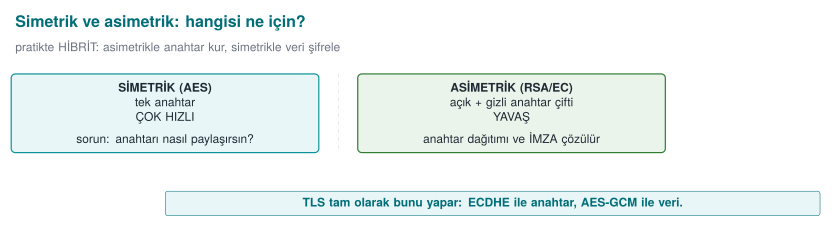
We ended Week 9 with a warning: obfuscating code does not store a key, it only makes the surroundings harder to work with (Week 9, §3). This week we move on to the actual fix — instead of hiding keys, we protect them for real with the right algorithm choice, the right protocol, and, where needed, hardware-backed storage (PKI, HSM). In Week 3 we used cryptography as a tool to protect data in transit, at rest, and in use (Week 3, §1); this week we look inside those same tools: which algorithm does which job, why some were abandoned, how to choose, and how a certificate authority (CA) fits into this structure. The book's Chapters 4–8 and 10–11 cover these topics in more than 55 recipes; since most of the algorithms have changed since 2003, we give each one its current equivalent.
A brief history: keys, certificates, and PKI
- 1976–77 — Diffie–Hellman and RSA: public-key cryptography solves the problem of "talking securely with someone you've never met."
- 1988 — the X.509 certificate format is standardized; identity is carried by a CA signature.
- 1995 — the first commercial CAs (VeriSign) and PKI become widespread; the revocation mechanisms CRL and OCSP follow.
- 2014 — Heartbleed and POODLE tighten the TLS ecosystem; 2015 Let's Encrypt makes HTTPS widespread with free certificates; 2018 TLS 1.3.
- 2022–2024 — NIST selects the post-quantum algorithms (Kyber/ML-KEM, Dilithium/ML-DSA).
All of this week's rules (the right mode, the right padding, chain validation, revocation) come from the painful lessons of this timeline.
Five basic jobs, five tool families¶
| Job | Tool | Current choice | Abandoned |
|---|---|---|---|
| Confidentiality (symmetric) | Block and stream ciphers | AES-256-GCM, ChaCha20-Poly1305 | DES, 3DES, RC4, Blowfish |
| Integrity + identity (symmetric) | MAC | HMAC-SHA-256, CMAC, GCM's tag | CBC-MAC (variable-length), MD5-based MACs |
| Fingerprint | Hash function | SHA-256, SHA-384, SHA-3 | MD5, SHA-1 |
| Key exchange | Diffie–Hellman, RSA key transport | X25519, ECDHE (P-256) | 1024-bit DH, RSA key transport (removed in TLS 1.3) |
| Signature (asymmetric) | Digital signature | Ed25519, ECDSA P-256, RSA-PSS ≥ 3072 | DSA, RSA PKCS#1 v1.5 signature (in new designs) |
Key length: security level¶
The key lengths of different algorithms cannot be compared directly. NIST SP 800-57 compares them at an equivalent security level (in bits):
| Security level | Symmetric | Digest (collision resistance) | RSA / DH | Elliptic curve |
|---|---|---|---|---|
| 112 bit | 3DES (legacy systems only) | SHA-224 | 2048 | 224 |
| 128 bit | AES-128 | SHA-256 | 3072 | 256 (P-256, Ed25519/X25519) |
| 192 bit | AES-192 | SHA-384 | 7680 | 384 |
| 256 bit | AES-256 | SHA-512 | 15360 | 512 |
Today, the floor for a new design is the 128-bit security level. This means 3072 bits for RSA, 256 bits for elliptic curve; 2048-bit RSA is not considered sufficient for new use after 2030 in NIST's transition timeline. The table's most important lesson is that elliptic curves provide the same security with much shorter keys; that is why they are preferred on mobile and embedded systems.
Its counterpart in the book
The book covers algorithm and key-length selection in Recipes 5.2 and 5.3, digest and MAC selection in 6.3 and 6.4, and public-key algorithm and length selection in 7.2 and 7.3. The principle it recommends still holds today: choose a well-studied, standard algorithm and use it through a high-level, error-resistant API (Recipe 5.16). Only the algorithms themselves have changed.
The weakest-link rule¶
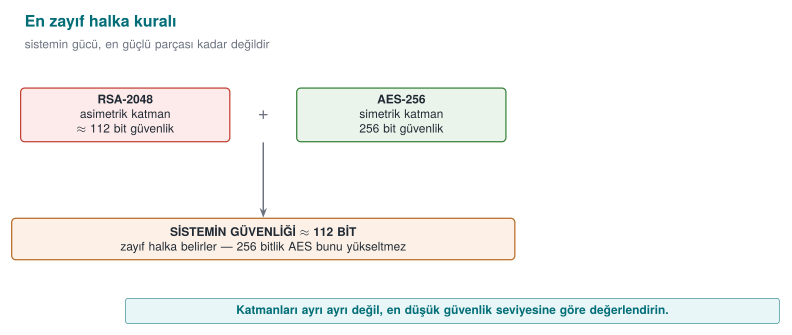
A system uses more than one cryptographic layer: key exchange with one algorithm, data encryption with another. The system's security level equals the lowest of these layers — not the strongest. If you transport a key with RSA-2048 and encrypt the data with AES-256, the attacker doesn't try to break 256-bit AES; they target the ≈112-bit RSA layer. So evaluate the layers together, by the lowest level, not one at a time.
One rule: don't write your own crypto — or your own protocol¶
Even if every algorithm is correct, combining them (choosing what order to encrypt and MAC in, where to get the nonce from, how to separate the keys) requires a separate kind of expertise. All of this week's examples will show that almost all real-world mistakes are in the combination, not the algorithm. Wherever possible, use ready-made, proven constructions (TLS 1.3, AEAD, HPKE, Noise).
Worked example: how big is the difference between "128 bit" and "112 bit"?¶
The bit counts in the table can stay abstract; let's make them concrete. A security level of "n bits" means the attacker needs, on average, 2ⁿ⁻¹ attempted operations (2ⁿ is used as the upper bound). The difference between RSA-2048 (112 bit) and AES-128 (128 bit) is far larger than it looks:
2^112 ≈ 5,19 × 10^33   (RSA-2048's equivalent difficulty)
2^128 ≈ 3,40 × 10^38   (AES-128's key space)
2^128 / 2^112 = 2^16 = 65.536   → breaking AES-128 is 65.536 TIMES harder than breaking RSA-2048 at "equivalent" difficulty
Let's convert this into time. Let's take, as an optimistic upper bound, 10¹⁸ (quintillion; exascale supercomputer) operations per second for today's fastest supercomputers — in real attacks this number is much lower, because breaking a cipher is not a single arithmetic operation but a far more costly one. Still, let's calculate with the upper bound:
2^112 operations ÷ 10^18 operations/second ≈ 1,6 × 10^8 years  (≈ 165 million years)
Comparison: recorded human history ≈ 5.000 years → 165 million years is ~33.000 times that
2^128 operations ÷ 10^18 operations/second ≈ 1,08 × 10^13 years
Comparison: the age of the universe ≈ 1,38 × 10^10 years → 2^128 takes ~780 times the age of the universe
The lesson to draw has two parts. First, even 112 bits cannot practically be brute-forced today; the reason RSA-2048 is considered "insufficient" for use after 2030 is not brute force, but (a) hardware getting cheaper over time, (b) the need to protect data that must be kept for a long time with a margin against future attacks, and © the fact that quantum computers will be able to break RSA far faster than brute force (see Section 12). Second, the seemingly small difference between 112 bits and 128 bits (16 bits) cuts the attacker's work down to one in 65,536 — you must read bit counts exponentially, not linearly.
Common mistake: thinking it's enough to say 'we use AES'
Writing only the algorithm's name (AES) in an algorithm inventory says nothing. AES-128-ECB and AES-256-GCM are members of the same family but worlds apart in terms of security: one (ECB) leaks patterns (Section 2), the other (GCM) also provides integrity. In an algorithm inventory, algorithm + mode + key length + the standard it rests on must be written together (the book's Recipe 5.16 and this week's "S8" template in Section 13).
Rule
Document a cryptographic choice not just by the algorithm's name, but by the (algorithm, key length, mode, library, standard) quintuple. "We use AES" is not an answer; "AES-256-GCM, OpenSSL EVP, NIST SP 800-38D" is.
In Week 3 we only saw the "which tool do I use when" part of this map (AEAD, the hybrid scheme, random numbers). This week we see why the same map is drawn this way — which mathematical problem gives which security, why each algorithm was abandoned. The next two sections look inside the symmetric tools (mode, padding, MAC); Sections 4–6 look inside the asymmetric tools (RSA, ECC, DH); Sections 7–10 will look at how these come together in PKI.
2. Block cipher modes and padding (Recipe 5.4, 5.11)¶
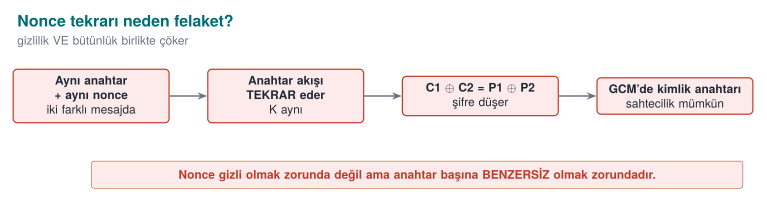
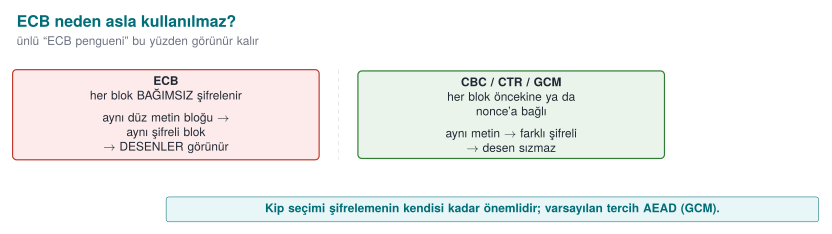
AES is a block cipher: it turns exactly a 16-byte block into another 16-byte block. To encrypt a longer message you need a mode of operation that chains the blocks together. The choice of mode is as important as the choice of algorithm; recall the ECB penguin from Week 3.
| Mode | How it works | Confidentiality | Integrity | Parallel | Padding | Assessment |
|---|---|---|---|---|---|---|
| ECB | Each block is encrypted independently | ✗ (leaks patterns) | ✗ | ✓ | Required | Do not use |
| CBC | Each block is XORed with the previous ciphertext block | ✓ (if the IV is unpredictable) | ✗ | Decryption only | Required | With a separate MAC; watch for the padding oracle |
| CTR | A counter is encrypted to produce a keystream | ✓ (if the nonce is unique) | ✗ | ✓ | Not required | With a separate MAC |
| GCM | CTR + multiplication-based authentication | ✓ | ✓ | ✓ | Not required | Recommended (AEAD) |
| ChaCha20-Poly1305 | Stream cipher + Poly1305 MAC | ✓ | ✓ | ✓ | Not required | Recommended; fast on devices without AES hardware support |
Padding and the padding oracle¶
ECB and CBC require the message length to be a multiple of the block size; the missing part is filled in with padding. The most common padding is PKCS#7: if the number of missing bytes is n, n bytes each with the value n are appended (e.g., if 3 bytes are missing, 03 03 03). The decrypting party reads the last byte and drops that many bytes; but first it checks whether the padding is valid.
This is where the problem begins: if a decryption failure is distinguishable as "invalid padding" versus "invalid MAC" (a different error message, a different response time), an attacker can change bytes of the ciphertext and, by observing the server's reaction, decrypt the message byte by byte. This is called the padding oracle attack; it was described in 2002, and it kept reappearing in the following years in web frameworks and in TLS (POODLE, Lucky Thirteen).
Defences:
- Use AEAD (GCM, ChaCha20-Poly1305): there is no padding; if the tag doesn't match, nothing is decrypted.
- If CBC is mandatory, encrypt first, then MAC (next section) and verify the MAC before checking the padding.
- Return all decryption errors as a single, identical error, in the same amount of time.
How it's done in the field
In the algorithm inventory of a certified mobile payment library, AES is seen used in CBC and CTR modes with a separate SHA-256-based MAC; for the cryptogram computation of the payment schemes, a DES-based MAC algorithm resting on ISO/IEC 9797-1 (with the padding methods the schemes specify) is used. These choices come from scheme specifications that must be complied with. For internal communication that the scheme does not specify, AEAD is preferred today (the critical reading from Week 3).
Worked example: tracing PKCS#7 padding by hand¶
Let's not leave the rule "if 3 bytes are missing, 03 03 03 is appended" abstract; let's trace it step by step with a real OpenSSL run. Let's encrypt the 13-byte text "MERHABA DUNYA" with AES-128-CBC using a fixed 16-byte key and an IV that counts up from zero (only for this example; in a real system the IV is generated randomly for every message):
K=00112233445566778899aabbccddeeff   # 16 bytes (32 hex characters) — fixed only for this demonstration
IV=000102030405060708090a0b0c0d0e0f  # 16 bytes — fixed only for this demonstration
printf 'MERHABA DUNYA' | openssl enc -aes-128-cbc -K "$K" -iv "$IV" -out cikti.bin
xxd -p cikti.bin
Output (the actually produced value):
The input was 13 bytes; AES's block size is 16 bytes; the output is also exactly 16 bytes (32 hex characters) — so a 3-byte padding was added. To see the padding's content, let's decrypt with -nopad (we would normally never do this; here only for teaching purposes):
The last three bytes are 03 03 03 — exactly as the PKCS#7 rule says: as many bytes as the missing count (16 − 13 = 3) were added, each with that value. A normal openssl enc -d (without the no-padding flag) automatically reads and drops these three bytes and returns exactly "MERHABA DUNYA" to you — verify this too:
The padding oracle attack kicks in exactly at this point: the attacker changes the last bytes of the ciphertext and sends it to the server; if the server returns "invalid padding" (e.g., the last byte is 07 but the preceding 7 bytes are not 07) and "padding valid but MAC invalid" as different errors, the attacker can distinguish these two cases and reconstruct the plaintext byte by byte — without ever needing the key.
Worked example: seeing why ECB leaks patterns¶
In ECB, every 16-byte block is encrypted independently; the same plaintext block always produces the same ciphertext block. Let's encrypt a plaintext that repeats over 48 bytes ("AAAAAAAAAAAAAAAA" three times) with AES-128-ECB:
K2=$(openssl rand -hex 16)
printf 'AAAAAAAAAAAAAAAAAAAAAAAAAAAAAAAAAAAAAAAAAAAAAAAA' | head -c 48 > duz.txt   # 48 bytes = 3 blocks, all the same
openssl enc -aes-128-ecb -K "$K2" -in duz.txt -out cikti_ecb.bin -nopad
xxd cikti_ecb.bin
The output of an example run (since the key is random, you will see different byte values, but the pattern will stay the same):
00000000: f5cf 4879 d8fe 9c90 1975 2de6 eb9f 59a1  ..Hy.....u-...Y.
00000010: f5cf 4879 d8fe 9c90 1975 2de6 eb9f 59a1  ..Hy.....u-...Y.
00000020: f5cf 4879 d8fe 9c90 1975 2de6 eb9f 59a1  ..Hy.....u-...Y.
All three blocks are identical. Even an observer who doesn't know the key learns the information "these three blocks contain the same plaintext" — which is often a leak in its own right (e.g., an image's background, a form's fixed fields, a repeating record structure). If you repeat the same experiment with AES-128-CBC (with a random IV), all three blocks come out different; because each block is chained by being XORed with the previous one.
Common mistake: saying 'we used AES, so we're secure'
A call made in a codebase without specifying the mode (e.g., Cipher.getInstance("AES") in Java) can silently fall back to ECB depending on the library (in Java, the "AES" shorthand means "AES/ECB/PKCS5Padding"). This is a mistake that is easy to miss in code review but leaks real data in production. Rule: the mode must always be written explicitly, and calls using ECB must be rejected at the static-analysis/build stage.
Rule
Never leave the mode name to the default; write it out with its full name, like AES-256-GCM. Never use ECB under any circumstances (file encryption, a DB field, even for "unimportant" data) — it always leaks the pattern. If CBC is mandatory, protect the padding with the encrypt-then-MAC rule from Section 3.
In Week 2's threat modelling, "integrity" was an asset-protection goal; this section made concrete why that goal cannot be achieved by encryption alone. The next section covers the tool that correctly provides integrity — MAC/HMAC — and the right order for combining it.
3. MAC, HMAC, and combining integrity with encryption (Recipe 6.4, 6.10, 6.18, 6.21)¶
How does HMAC work?¶
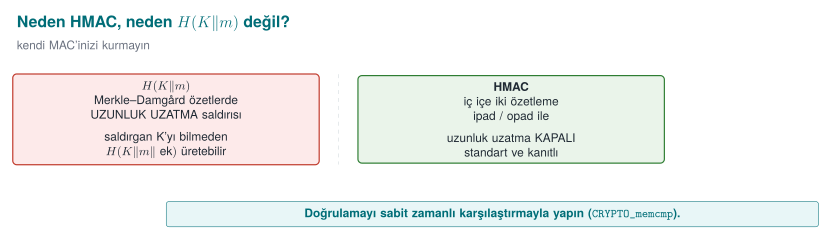
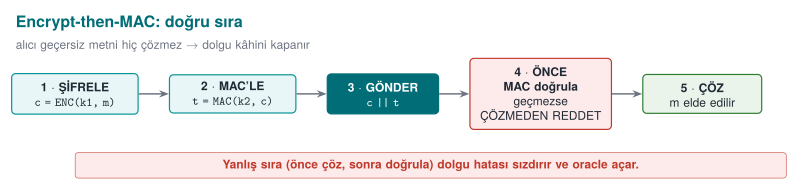
Encrypt-then-MAC: because the receiver never decrypts invalid ciphertext, the "error leak" that a padding oracle needs never arises. AES-GCM does these two steps in a single operation.
A MAC (message authentication code) produces a short tag from a secret key and a message; someone who doesn't know the key cannot produce a valid tag. HMAC is the standard way of building a MAC from a hash function (SHA-256) (RFC 2104):
The two nested digests remove the length-extension weakness of the plain H(K ‖ m) construction: in Merkle–Damgård-structured digests like SHA-256, if H(K ‖ m) is known, H(K ‖ m ‖ extra) can be computed without knowing the key. So don't derive your own MAC from a digest; use HMAC (the warning in Recipe 6.19).
printf 'tutar=100;alici=TR00' | openssl dgst -sha256 -mac HMAC -macopt hexkey:$(openssl rand -hex 32)
Three ways to combine encryption with a MAC¶
| Method | How? | Example | Assessment |
|---|---|---|---|
| Encrypt-then-MAC | Encrypt first, then take the MAC of the ciphertext | IPsec ESP, TLS's EtM extension | The correct way: the MAC is verified first; if invalid, the ciphertext is never decrypted |
| MAC-then-Encrypt | Take the MAC of the plaintext, encrypt both together | Old TLS (CBC modes) | Exposed to the padding oracle; avoid |
| Encrypt-and-MAC | Encrypt the plaintext, separately attach the MAC of the plaintext | Old SSH | The MAC can leak information about the plaintext; avoid |
AEAD modes make this choice correctly on your behalf. If you must do your own combination (Recipe 6.18): use two separate keys (one for encryption, one for the MAC; both can be derived from a single secret with HKDF), follow the encrypt-then-MAC order, include the IV and context information in the MAC as well, and make the comparison constant-time.
Replay: a valid but old message¶
A MAC proves that a message has not been changed, but not that it is new. An attacker can record a valid "send 100 TL" message and resend it ten times; the MAC is valid every time. The defences the book describes in Recipe 6.21:
| Method | How? | Note |
|---|---|---|
| Counter | Every message carries a number larger than the previous counter; the receiver stores the last counter | Simplest and most reliable; the counter must be inside the MAC |
| Timestamp | The message must fall within a short validity window | Requires clock synchronization; needs an extra measure against repeats within the window |
| Nonce (one-time value) | The server gives a new value for every request, the client includes it in the MAC | The server remembers the values used |
The counter in payments
In contactless card transactions, every transaction is signed with a cryptogram that contains the card's transaction counter (ATC); the server does not accept the same counter a second time. In mobile payment libraries, each one-time key is also used in only one transaction, and the counter is kept in a database. This is why the "rollback of the usage counter" threat has the asset-protection class I+ in Week 2's threat table.
Worked example: computing HMAC by hand and seeing the avalanche effect¶
Without leaving the rules abstract, let's trace a real HMAC-SHA-256 computation end to end. Let's use a fixed (only for this example) 32-byte key and compute the HMAC of a payment instruction:
ANAHTAR=0000000000000000000000000000000000000000000000000000000000000001   # 32 bytes, fixed only for this demonstration
printf 'tutar=100;alici=TR00' | openssl dgst -sha256 -mac HMAC -macopt hexkey:$ANAHTAR
Now let the attacker change the amount from 100 to 900; with the real key, the original message's HMAC changes as follows:
A single-character change (1→9) produced completely different 32 bytes for the tag — this is a good hash function's "avalanche effect": a single-bit change in the input changes roughly half of the output. Since the attacker doesn't know the key, they cannot change the message and produce a valid new tag; the receiver compares the tags and catches the mismatch.
Constant-time comparison: why memcmp is not enough¶
On the receiving side, HMAC verification requires comparing the computed tag with the tag that arrived. An ordinary memcmp(a, b, 32) compares bytes left to right and stops at the first differing byte; this means the function's running time varies depending on how many bytes matched. An attacker who can make enough attempts over a network can guess the correct tag byte by byte from microsecond differences in response times (a timing attack).
/* WRONG: an early exit creates a timing difference */
if (memcmp(hesaplanan, gelen, 32) == 0) { /* accept */ }

/* CORRECT: constant-time, always walks through all 32 bytes */
if (CRYPTO_memcmp(hesaplanan, gelen, 32) == 0) { /* accept */ }   /* OpenSSL */
/* or: sodium_memcmp (libsodium), hmac.compare_digest (Python) */
Common mistake: comparing a MAC/tag with == or memcmp
If a comparison like strcmp(hesaplanan_imza, gelen_imza) == 0 is seen in a web service's API signature verification code, this is not a theoretical but a usable timing-attack risk: with enough requests (thousands to tens of thousands), an attacker can discover the correct signature byte by byte. Rule: no secret-value comparison is ever done with an early-exit function.
Rule
Always compare secret values such as a MAC, a signature, or a password hash with a constant-time function (CRYPTO_memcmp, sodium_memcmp, the language's own "constant-time compare" function). Don't write your own comparison function; this is another appearance of this week's "don't write your own crypto" rule (Section 1).
In Week 3 we introduced AEAD as "the tool that gives confidentiality + integrity in a single package"; this section showed the correct order and the correct comparison for when you are forced to provide integrity separately (an old protocol where you can't use AEAD, a hardware constraint, etc.). The next section moves on to the asymmetric tools that give what a MAC cannot — non-repudiation.
4. Asymmetric cryptography: RSA and elliptic curves (Recipe 7.1–7.3)¶
Symmetric cryptography's only difficulty is that the two parties must share the same key in advance. In asymmetric (public-key) cryptography, each party has a key pair: a public key given to everyone, and a private key known only to its owner. What is encrypted with the public key can only be decrypted with the private key; what is signed with the private key can be verified by everyone with the public key.
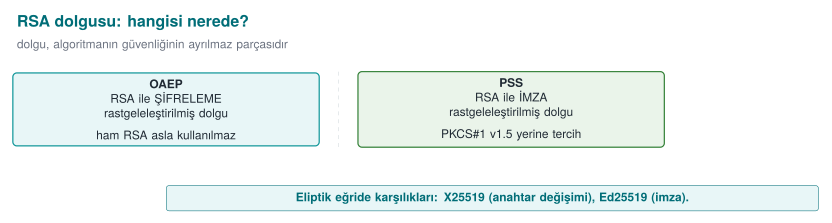
Asymmetric operations are hundreds, thousands of times slower than symmetric ones. This is why asymmetric cryptography is used for only two jobs (Recipe 7.1): carrying or agreeing on a short symmetric key and signing. The data itself is always protected with a symmetric cipher (the hybrid scheme from Week 3).
RSA: with the right padding¶
RSA's mathematics in its plain form ("textbook RSA") is insecure: the same message always gives the same ciphertext, and its mathematical structure is open to attacks. Secure use depends on the correct padding scheme:
| Job | Correct scheme | Obsolete scheme | Why? |
|---|---|---|---|
| Encryption | RSA-OAEP (SHA-256) | PKCS#1 v1.5 encryption | Padding-oracle attacks against v1.5 encryption (since 1998, with recurring variants) |
| Signature | RSA-PSS | PKCS#1 v1.5 signature | v1.5 signing is still widespread and not broken, but PSS is the scheme with a security proof |
The book's "raw" RSA operations in Recipes 7.10–7.13 are there to help you understand how unpadded RSA works; they are not used in production. The warning in Recipe 7.14 still matters, though: combining sign-and-encrypt needs care; if the signature is not bound to the recipient and context of the encrypted content, the recipient can re-encrypt the signed message and forward it to someone else.
openssl genpkey -algorithm RSA -pkeyopt rsa_keygen_bits:3072 -out rsa_ozel.pem
openssl pkey -in rsa_ozel.pem -pubout -out rsa_acik.pem

# Encrypt a short session key with OAEP (SHA-256)
openssl rand -out oturum.key 32
openssl pkeyutl -encrypt -pubin -inkey rsa_acik.pem -in oturum.key -out oturum.enc \
    -pkeyopt rsa_padding_mode:oaep -pkeyopt rsa_oaep_md:sha256

# Sign and verify with PSS
openssl dgst -sha256 -sign rsa_ozel.pem -sigopt rsa_padding_mode:pss -out belge.sig belge.txt
openssl dgst -sha256 -verify rsa_acik.pem -sigopt rsa_padding_mode:pss -signature belge.sig belge.txt
Elliptic curves: the same security, a shorter key¶
Elliptic-curve cryptography (ECC) provides the security level of 3072-bit RSA with a 256-bit key; its operations are faster, and its keys and signatures are much shorter.
| Algorithm | Job | Note |
|---|---|---|
| Ed25519 | Signature | Deterministic (does not require a random number), fast, carefully designed against side channels |
| X25519 | Key agreement | The default for protocols like TLS 1.3, SSH, Signal |
| ECDSA (P-256) | Signature | Widespread and standard; but requires a unique and secret random value on every signature |
| ECDH (P-256) | Key agreement | Widespread on FIPS-approved systems |
ECDSA and the random number
ECDSA uses a secret random value (k) on every signature. If the same k is used in two different signatures, or if it can be predicted, the private key can be computed from the two signatures. In 2010, a game console's signing key was exposed exactly this way because the manufacturer used the same k on every signature; in 2013, some mobile crypto wallets suffered the same kind of loss because of a weak random generator. This is the most striking proof of Week 3's sentence "random numbers are the invisible foundation of cryptography." Ed25519 and the deterministic ECDSA in RFC 6979 remove this risk.
openssl genpkey -algorithm ED25519 -out ed_ozel.pem
openssl pkey -in ed_ozel.pem -pubout -out ed_acik.pem
openssl pkeyutl -sign   -inkey ed_ozel.pem -rawin -in belge.txt -out belge.ed.sig
openssl pkeyutl -verify -pubin -inkey ed_acik.pem -rawin -in belge.txt -sigfile belge.ed.sig
Worked example: measuring RSA-3072 against Ed25519¶
Let's confirm the sentence "ECC gives the same security with a smaller key" with real bytes. Both are at ~128-bit security level (see the table in Section 1):
wc -c rsa_acik.pem ed_acik.pem
openssl dgst -sha256 -sign rsa_ozel.pem -sigopt rsa_padding_mode:pss -out belge.rsa.sig belge.txt
openssl pkeyutl -sign -inkey ed_ozel.pem -rawin -in belge.txt -out belge.ed.sig
wc -c belge.rsa.sig belge.ed.sig
The public key file (PEM, Base64-encoded) is 636 bytes for RSA, 116 bytes for Ed25519 — roughly 5.5 times smaller. The signature is 384 bytes for RSA (3072 bits = 384 bytes; an RSA signature is exactly the size of the modulus), 64 bytes for Ed25519 — 6 times smaller. When you consider the data an IoT device sends on every handshake, the number of certificates an embedded system stores in flash, or the number of signatures carried by every transaction on a blockchain, this difference accumulates and grows; this is why ECC is the default in mobile/embedded systems and in new protocols (TLS 1.3, SSH, Signal).
Worked example: why is OAEP's randomness necessary?¶
In Section 2 we saw that ECB produces the same ciphertext for the same plaintext block, and that this is a pattern leak. "Textbook RSA" (raw, unpadded) carries the same disease: the same message always produces the same ciphertext. OAEP fixes this by mixing a random value into the message before encryption. Let's encrypt the same message twice with OAEP:
echo MERHABA > kisa.txt
openssl pkeyutl -encrypt -pubin -inkey rsa_acik.pem -in kisa.txt -out c1.bin \
    -pkeyopt rsa_padding_mode:oaep -pkeyopt rsa_oaep_md:sha256
openssl pkeyutl -encrypt -pubin -inkey rsa_acik.pem -in kisa.txt -out c2.bin \
    -pkeyopt rsa_padding_mode:oaep -pkeyopt rsa_oaep_md:sha256
cmp c1.bin c2.bin && echo "AYNI" || echo "FARKLI"
Same public key, same plaintext, but different ciphertext — because OAEP uses a new random value on every encryption (the RSA counterpart of Section 1's "random numbers are the invisible foundation of cryptography" principle). If you run the same experiment with unpadded ("raw") RSA, the two outputs come out byte-for-byte identical; mathematically, c = m^e mod n is a deterministic operation. This is why raw RSA is never used directly for encryption.
Common mistake: using an RSA key for both encryption and signing
Using the same RSA key pair for both "encrypt the data" and "sign the data" overloads two different mathematical operations onto the same key; in some attack scenarios (e.g., a signing request being turned into a decryption request by appearing to sign a carefully chosen "plaintext") this sharing can be abused. Rule: a key's usage purpose is singular — the certificate's keyUsage field (Section 8) enforces this too: keyEncipherment and digitalSignature are separate bits, and a single key should not carry both.
Rule
Always use OAEP for encryption and PSS for signing; PKCS#1 v1.5 is only considered when compatibility with an old system is mandatory, and even then only for signing (never for new encryption designs). In a new design, prefer Ed25519/X25519 over RSA where possible.
In Week 3 we used asymmetric cryptography (RSA or ECDHE back then) as a black box in TLS's key setup. This section opened up that black box: which padding, which curve, which size. The next section goes deeper into the signature leg of these tools; then in Section 6 we move on to the key exchange leg.
5. Digital signature: creation, verification, and where it's used¶
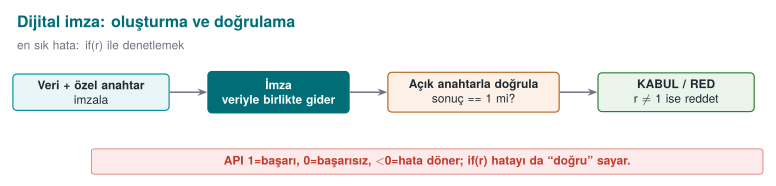
A digital signature proves that a message (1) was created by the owner of a specific private key, and (2) has not been altered afterward. Unlike a MAC, verification is done with the public key: anyone can verify, but only the owner of the private key can sign. This is why a signature provides non-repudiation (the R in STRIDE), a MAC does not.
Where are signatures used?¶
| Use | What is signed? | Where it appears in this course |
|---|---|---|
| Software update | The update package | Week 1's "Vault" example, threat T6 |
| Code signing | Executable file, mobile app package | Week 6 signature verification |
| Certificate | Public key + identity information (the CA signs) | PKI, this week |
| TLS handshake | Handshake digest (the server signs) | Week 3's CertificateVerify |
| Document and transaction | Contract, payment approval | Electronic-signature regulation |
Verifying a signature in code: OpenSSL EVP¶
#include <openssl/evp.h>
#include <openssl/pem.h>

/* 1: valid, 0: invalid, -1: error. Called BEFORE running the update package. */
int imza_dogrula(EVP_PKEY *acik, const unsigned char *veri, size_t n,
                 const unsigned char *imza, size_t imza_n)
{
    EVP_MD_CTX *ctx = EVP_MD_CTX_new();
    int sonuc = -1;
    if (ctx == NULL) return -1;
    if (EVP_DigestVerifyInit(ctx, NULL, NULL, NULL, acik) == 1)   /* Ed25519: digest is NULL */
        sonuc = EVP_DigestVerify(ctx, imza, imza_n, veri, n);      /* 1 or 0 */
    EVP_MD_CTX_free(ctx);
    return sonuc == 1 ? 1 : (sonuc == 0 ? 0 : -1);
}
The three traps of signature verification
- The return value:
EVP_DigestVerifyreturns 1 on success, 0 if the signature is invalid, and a negative value on error. A check likeif (sonuc)treats a negative error value as "valid." The check must always be== 1. - What is signed: If the signature only covers the package's content, an attacker can restore an old and vulnerable but validly signed package (a rollback). The version number and the target product must also be part of the signed content, and the client must reject an older version.
- Which key: Verifying the signature with a public key that comes bundled inside the package itself proves nothing. The verification key must be embedded in the application beforehand (with its own integrity protected) or come from a trusted chain.
Worked example: tracing signature verification in three cases from the command line¶
You can see the logic of the C code above with openssl pkeyutl -verify too, without needing to compile — the CLI produces the same three outcomes (valid / invalid / error):
openssl pkeyutl -verify -pubin -inkey ed_acik.pem -rawin -in belge.txt -sigfile belge.ed.sig
echo "cikis kodu: $?"
echo "MERHABA DEGISTI" > belge2.txt
openssl pkeyutl -verify -pubin -inkey ed_acik.pem -rawin -in belge2.txt -sigfile belge.ed.sig
echo "cikis kodu: $?"
The moment a single byte of the document changed, verification failed and the exit code went from 0 to 1 — if your update mechanism doesn't check this code (or if the C code interprets EVP_DigestVerify's return with if (sonuc)), you have made a tampered package executable.
Rollback: the signature is valid but the content is old¶
Let's make the "scope of the signature" trap concrete. Suppose an application update server signs each version separately:
| Version | Content | Signature |
|---|---|---|
| v1.0 | (contains a known vulnerability) | imza_v1 — still mathematically valid |
| v2.0 | closes the vulnerability | imza_v2 — valid |
After the server publishes v2.0, v1.0's signature is not revoked — signatures do not have a revocation mechanism like CRL/OCSP (the mechanism we will see for certificates in Section 10). If an attacker who has obtained the v1.0 package presents it along with imza_v1 to the client, the client only asks "is the signature valid?", gets the answer yes, and installs the vulnerable version. This is why the signed data must not be only the file's content, but the version number + target product name, and the client must additionally enforce, on its own, the rule "do not accept a version older than the highest one I have seen" — the signature does not do this for you.
Common mistake: only asking 'is it signed or not'
A client asking only a binary question like is_signed(package) (without asking which key, for which version, for which target it was signed) leaves the door open to rollback and target confusion attacks (a package signed for one product being presented for another).
Rule
Signed data should always carry its context: version, target product/device, timestamp, or validity window. A client must ask not just "is this signature valid," but "is this signature valid for this context and for the most current version."
In Week 1's "Vault" example we saw that accepting an update package without a signature leads to the T6 threat; this section showed that even the existence of a signature alone is not enough — its scope must also be designed correctly. The next section covers how we use signatures and asymmetric cryptography in key exchange — and what goes wrong if we don't.
6. Key exchange: Diffie–Hellman and man-in-the-middle (Recipe 8.16–8.18)¶
Diffie–Hellman (DH) lets two parties agree on a shared secret over an insecure channel, with no previously shared secret at all. Each party picks a private value and sends the public value derived from it; both parties compute the same shared secret from the other party's public value and their own private value. An eavesdropper sees the public values but cannot compute the shared secret. Today's form of this is ECDH over an elliptic curve (X25519).
The weakness of unauthenticated DH: man-in-the-middle¶
DH does not say who you agreed with. An attacker in the middle of the channel performs DH separately with each of the two parties:
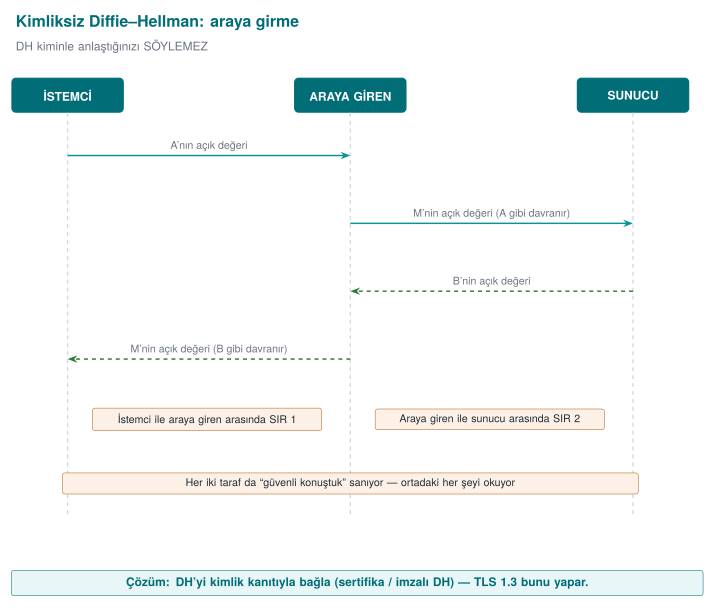
Both parties think "I have a secure channel"; in reality every message passes through the attacker's hands.
The fix: authenticated key exchange¶
The public values are signed with a key whose identity is known in advance (the current version of Recipe 8.18's "DH and DSA together" idea: ECDHE + Ed25519/ECDSA/RSA-PSS). In TLS 1.3, the server signs the handshake digest — which also includes the ephemeral ECDHE public value — with the private key in its certificate (CertificateVerify); the client verifies the certificate by chain and by name (Week 3). This way:
- Identity: The signature proves that whoever sent the public value really is the certificate's owner.
- Forward secrecy: DH values are freshly generated and discarded for every session; even if the long-lived signing key is stolen later, past sessions' keys cannot be computed (Week 3).
Identity without PKI
Not every scenario has a certificate authority. The "authentication without PKI" paths the book describes in Recipe 8.19 are still used today: learning the key on first connection and warning if it later changes (TOFU, SSH), verifying the key's fingerprint over a separate channel (the "safety number" comparison in secure messaging), or password-authenticated key exchange from a secret both parties shared in advance (PAKE, Recipe 8.15; today protocols like OPAQUE, SPAKE2).
Worked example: two parties reaching the same secret with X25519¶
Let's confirm Diffie–Hellman's sentence "two parties reach the same shared value, without a previously shared secret" with real keys. Alice and Bob each independently generate an X25519 key pair and exchange only their public keys:
openssl genpkey -algorithm X25519 -out alice.key
openssl genpkey -algorithm X25519 -out bob.key
openssl pkey -in alice.key -pubout -out alice.pub
openssl pkey -in bob.key -pubout -out bob.pub

# Alice: her own private key + Bob's public key
openssl pkeyutl -derive -inkey alice.key -peerkey bob.pub -out alice_sir.bin
# Bob: his own private key + Alice's public key
openssl pkeyutl -derive -inkey bob.key -peerkey alice.pub -out bob_sir.bin

xxd -p alice_sir.bin
xxd -p bob_sir.bin
cmp alice_sir.bin bob_sir.bin && echo "AYNI" || echo "FARKLI"
8c53744a000c1a6ffc2183a0c134c2cf8167110314e8a06dd3d453080bbc1376
8c53744a000c1a6ffc2183a0c134c2cf8167110314e8a06dd3d453080bbc1376
AYNI
The two parties, without ever knowing each other's private key, reached the same 32-byte shared secret, passing only public keys over the network. This shared secret is not used directly for data encryption; it is passed through a KDF (HKDF, the key-derivation topic from Week 3) and session keys are derived from it. A third-party eavesdropper sees only alice.pub and bob.pub; computing the shared secret from these (without solving the elliptic-curve discrete logarithm problem) is not possible.
Worked example: how many steps does a man-in-the-middle take to set up?¶
Man-in-the-middle against unauthenticated DH requires two separate DH agreements — the attacker's computational load is no different from the victims', just twice the operations:
- The attacker (M) connects to Alice and sends their own public value as
pub_M1; Alice thinks this is Bob's public value. - M connects to Bob and sends
pub_M2; Bob thinks this is Alice's public value. - M computes
sir_A = DH(özel_M1, pub_Alice)with Alice andsir_B = DH(özel_M2, pub_Bob)with Bob — obtaining two different shared secrets. - Alice sends an encrypted message with
sir_Ato "Bob" (actually M); M decrypts it, reads it, re-encrypts it withsir_B, and forwards it to the real Bob. Both parties believe the secret they computed is shared with the correct other party.
The attacker's extra cost is only twice the X25519 operations (on the order of microseconds) — without authentication, this attack is essentially free computationally. This is why unsigned DH is never used alone in any modern protocol such as TLS 1.3.
Common mistake: using DH output directly as a key
Using the raw bytes produced by pkeyutl -derive (alice_sir.bin in the example above) directly as an AES key is a common mistake. Raw DH output is not uniformly random (it carries biases coming from the curve's mathematical structure) and produces a single key; whereas encryption and the MAC generally need separate keys (Section 3). Rule: always pass DH output through a KDF (HKDF-SHA-256) and derive as many keys as you need.
Rule
Never trust an unauthenticated DH/ECDH result; public values must always be signed or must be part of a previously validated certificate (TLS 1.3's CertificateVerify). Never use raw DH output directly as an encryption key; pass it through HKDF.
In Week 3's TLS 1.3 handshake we asked "what would happen if someone in the middle could swap the keys"; this section answered that question with concrete steps. The next three sections (7–9) build, from scratch, the identity infrastructure — PKI — that signed DH rests on.
7. Public key infrastructure (PKI): who trusts whom? (Recipe 10.1)¶
The previous section showed that public keys need to be bound to an identity through a signature. But this raises a question: how do we know that a server's public key really belongs to that server? Public key infrastructure (PKI) is the set of rules, roles, and documents that answers this question through trusted third parties.
Components¶
| Component | Role | Example |
|---|---|---|
| Certificate authority (CA) | Issues a certificate by signing the public key of an identity-verified entity | Commercial and public CAs, an in-house CA |
| Registration authority (RA) | Verifies the identity of a certificate requester; tells the CA "issue a certificate to this person" | An organisation's HR department, an automated system that checks ownership of a domain (ACME) |
| Root CA | The self-signed CA at the top of the chain; usually kept offline | The roots in the operating system's and browsers' trust stores |
| Intermediate CA | A CA signed by the root that issues day-to-day certificates | So the root can stay offline |
| Leaf certificate | A certificate belonging to a server, a person, or a device | A TLS certificate for sunucu.ornek |
| Trust store | The list of trusted root certificates | The operating system's store, a store embedded in the application |
| Revocation services | Announce revoked certificates | CRL distribution point, OCSP responder |
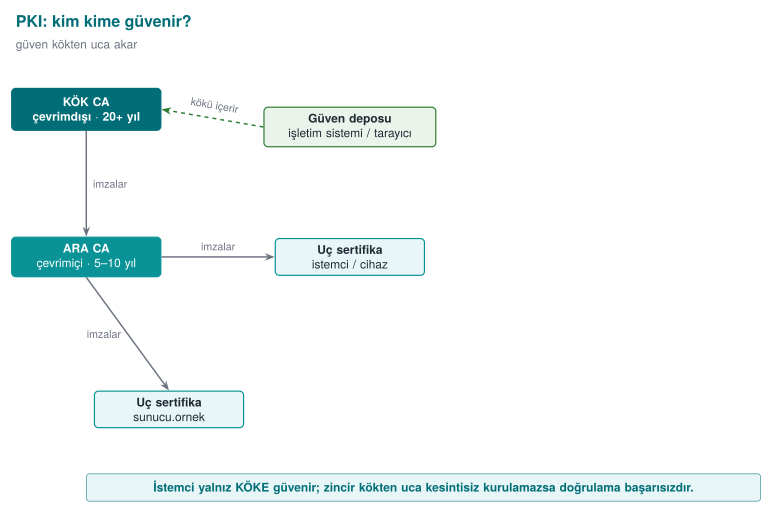
Why an intermediate CA? If the root CA's private key is compromised, the entire chain becomes untrusted, and removing the root from every trust store in the world takes years. This is why the root key sits in an HSM, offline, in a physically protected location, and is used only to sign intermediate CA certificates, in controlled meetings called a key ceremony. The intermediate CA does the day-to-day work; if it is compromised, only that intermediate CA is revoked.
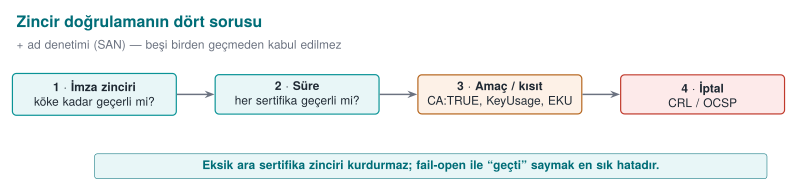
Validating a certificate: four questions (Recipe 10.4)¶
Before a client accepts a certificate, it asks the following:
- Chain: Starting from the leaf certificate, is every certificate's signature verified with the one above it's public key, and does the chain reach a root in the trust store?
- Validity: Are we within the validity dates of every certificate in the chain?
- Usage: Was this certificate issued for this job? (The key usage and extended key usage fields; the
CA:TRUEbasic constraint on an intermediate CA.) - Name and revocation: Is the certificate for this server (SAN)? Has it been revoked?
In Week 3 we saw how the first and fourth questions are asked in code (SSL_CTX_set_verify, SSL_set1_host). In this section we build the same chain ourselves.
Worked example: asking the "four questions" from the command line¶
Let's see how a client asks the "four questions" concretely, using the root → intermediate → server chain we will build in Section 9 (if you don't have these three files yet, run Section 9 first; here we are only reading the same files from different angles).
Question 1 — Chain: every certificate's issuer field must match, exactly, the subject field of the one above it:
openssl x509 -in sunucu.crt -noout -issuer -subject
openssl x509 -in ara.crt    -noout -issuer -subject
openssl x509 -in kok.crt    -noout -issuer -subject
issuer=CN=CEN429 Lab Ara CA     subject=CN=localhost
issuer=CN=CEN429 Lab Kok CA     subject=CN=CEN429 Lab Ara CA
issuer=CN=CEN429 Lab Kok CA     subject=CN=CEN429 Lab Kok CA
The chain reads: sunucu's issuer = ara's subject; ara's issuer = kok's subject; kok's issuer is itself (the root signs itself — which is why the chain stops here).
Question 2 — Validity:
-checkend 0 asks "will this expire within 0 seconds from now?"; TLS clients perform this check automatically on every connection.
Question 3 — Usage:
openssl x509 -in sunucu.crt -noout -ext basicConstraints,keyUsage,extendedKeyUsage
openssl x509 -in ara.crt    -noout -ext basicConstraints,keyUsage
X509v3 Basic Constraints: CA:FALSE
X509v3 Key Usage: critical / Digital Signature
X509v3 Extended Key Usage: TLS Web Server Authentication
---
X509v3 Basic Constraints: critical / CA:TRUE, pathlen:0
X509v3 Key Usage: critical / Certificate Sign, CRL Sign
sunucu.crt having CA:FALSE guarantees that this certificate cannot sign another certificate — even if an attacker obtains this certificate's private key, they cannot use it to produce and sign a new certificate. ara.crt is the opposite: CA:TRUE and pathlen:0 (there can be no other intermediate CA below it, it can only sign leaf certificates).
Question 4 — Name: the SAN field is already visible above via -ext subjectAltName (DNS:localhost, IP Address:127.0.0.1); the client compares the name it connected to against this list (covered in detail in Section 8).
A client library (OpenSSL, Windows CryptoAPI, Java's X509TrustManager) asks these four questions on your behalf; disabling the verify functions (Week 3's SSL_CTX_set_verify) or swallowing errors means these four questions are never asked at all.
Common mistake: assuming 'it connected, so it must be secure'
A developer's assumption that "the TLS connection was established, so the certificate must have been validated" is wrong. The connection is also established when validation has been turned off (Week 3's SSL_VERIFY_NONE / InsecureSkipVerify mistake). A successful connection is not proof that the four questions were asked; you must separately check in the code that validation is turned on.
Rule
Explicitly set the validation mode (SSL_VERIFY_PEER, CERT_REQUIRED, etc.) when setting up a client library, and in a test, deliberately present an invalid certificate and verify that the connection is rejected — a test of "I can connect with a valid certificate" alone is not enough; you also need a test of "I cannot connect with an invalid certificate."
In the previous section we saw that signed DH proves "who I'm talking to" with a signature; this section explained how we trust whose signature that is (PKI, the CA hierarchy). The next two sections look at the document itself that carries this trust (the X.509 certificate) and at building it by hand.
8. The structure of an X.509 certificate¶
An X.509 v3 certificate consists of the signed part (TBSCertificate) and the CA's signature over that part:
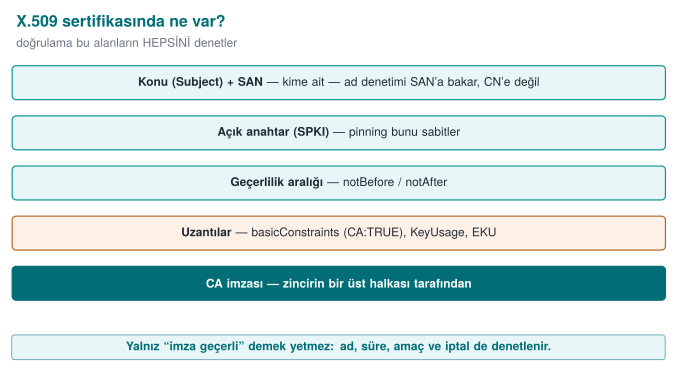
| Field | Meaning |
|---|---|
| Version | v3 (required for extensions) |
| Serial number | Unique within the CA; revocation lists use this number |
| Signature algorithm | e.g., ecdsa-with-SHA256, sha256WithRSAEncryption |
| Issuer | The name of the CA that signed the certificate |
| Validity | notBefore – notAfter |
| Subject | The certificate's owner |
| Subject public key info (SPKI) | Algorithm + public key; the pinning from Week 3 uses the digest of this |
| Extensions | Basic constraints (CA:TRUE/FALSE, path length), key usage, extended key usage (server/client authentication, code signing), SAN (alternative names: DNS names, IP), CRL distribution point, OCSP address (AIA) |
Certificates are stored in binary DER encoding, or in PEM, its Base64-wrapped text form (Recipe 7.16, 7.17): files starting with -----BEGIN CERTIFICATE----- are PEM.
Name checking is done against the SAN, not the CN
Older applications used to look for the server name in the subject's CN (Common Name) field. Today browsers and RFC 6125 look only at the SAN extension; a server certificate without a SAN is rejected by modern clients. Don't forget to add a SAN when generating your own certificates.
Worked example: reading a real certificate field by field¶
Let's read the openssl x509 -text output of the sunucu.crt we will generate in Section 9, matching it against every field in the table above (this is exactly the real output of the command openssl x509 -in sunucu.crt -noout -text):
Certificate:
    Data:
        Version: 3 (0x2)
        Serial Number:
            35:e2:f6:8d:d2:e3:90:f3:74:ff:16:a9:ec:5f:07:e9:21:69:76:e7
        Signature Algorithm: ecdsa-with-SHA256
        Issuer: CN=CEN429 Lab Ara CA
        Validity
            Not Before: Sep 23 06:01:46 2026 GMT
            Not After : Dec 22 06:01:46 2026 GMT
        Subject: CN=localhost
        Subject Public Key Info:
            Public Key Algorithm: id-ecPublicKey
                Public-Key: (256 bit)
                ASN1 OID: prime256v1
                NIST CURVE: P-256
        X509v3 extensions:
            X509v3 Basic Constraints:
                CA:FALSE
            X509v3 Key Usage: critical
                Digital Signature
            X509v3 Extended Key Usage:
                TLS Web Server Authentication
            X509v3 Subject Alternative Name:
                DNS:localhost, IP Address:127.0.0.1
            X509v3 Subject Key Identifier:
                EA:59:FF:05:1B:BA:D2:ED:D3:B8:2D:CF:12:32:F6:52:27:CD:98:87
            X509v3 Authority Key Identifier:
                F5:BA:39:86:1F:A1:D0:79:C8:DA:83:7D:AE:2C:87:9D:56:45:CE:25
    Signature Algorithm: ecdsa-with-SHA256
    Signature Value:
        30:46:02:21:00:8e:a3:91:48:0a:d5:8a:9d:a7:ee:08:ae:27:...
Line by line: Version 3 shows we can use the extension fields (the X509v3 block). The Serial Number is unique among the certificates this CA has issued — when a certificate is revoked, this number is listed in the CRL (Section 10). The Issuer (CN=CEN429 Lab Ara CA) tells you who signed this certificate — this is where the answer to Section 7's "Question 1" lives. Validity is Section 7's "Question 2." The Subject (CN=localhost) is the identity the certificate claims to belong to — but you must check the SAN before trusting this claim (see above). Subject Public Key Info is the public key this certificate validates itself (a point on the 256-bit P-256 curve). Basic Constraints: CA:FALSE is the answer to Section 7's "Question 3": this certificate cannot sign another certificate. Subject Alternative Name is the answer to Section 7's "Question 4." Authority Key Identifier is the fingerprint of the public key of the CA that signed this certificate; the client uses it, while building the chain, to avoid the confusion of "a fake intermediate certificate with the same issuer name but signed with a different key." At the bottom, Signature Value is the signature produced over all these fields (the TBSCertificate) with the CA's private key — exactly the signing mechanism we learned in Section 5.
Worked example: how many bytes is a certificate?¶
The DER (binary) form is generally around 500–900 bytes (since curve-based keys are smaller than RSA); the PEM form is roughly 33% larger than this because of Base64 encoding (Base64 turns every 3 binary bytes into 4 text characters). In a TLS handshake, the certificate chain the server sends (leaf + intermediate) is the sum of these sizes; this is why a chain using RSA-3072 certificates can be many times larger than an ECC (P-256/Ed25519) chain — the reflection, in PKI, of Section 4's size comparison.
Common mistake: trusting the CN in Subject
The Subject: CN=localhost field is only a claim; the CA signed the certificate because it verified this claim, but the client must perform name checking against the SAN, not this field (see the warning box above). Old code samples and some teaching materials still show code that looks at the CN; this is an approach abandoned with RFC 6125.
Rule
When inspecting a certificate by hand, always use openssl x509 -noout -text (or -ext subjectAltName) and read the SAN, validity, basicConstraints, and issuer/subject chain quartet (Section 7) together; don't look at a single field and decide.
Section 7 explained the trust a certificate carries; this section showed in which bytes that trust is encoded. The next section switches to the CA's role and builds this document by hand.
9. Building a certificate chain with OpenSSL¶
The steps below build a three-layer chain in your own lab. All files are created in the working folder; never add the root certificate to any trust store.
openssl genpkey -algorithm EC -pkeyopt ec_paramgen_curve:P-256 -out kok.key
openssl req -x509 -new -key kok.key -sha256 -days 3650 -out kok.crt \
  -subj "/CN=CEN429 Lab Kok CA" \
  -addext "basicConstraints=critical,CA:TRUE" \
  -addext "keyUsage=critical,keyCertSign,cRLSign"
openssl genpkey -algorithm EC -pkeyopt ec_paramgen_curve:P-256 -out ara.key
openssl req -new -key ara.key -out ara.csr -subj "/CN=CEN429 Lab Ara CA"
openssl x509 -req -in ara.csr -CA kok.crt -CAkey kok.key -CAcreateserial -days 1825 -sha256 \
  -out ara.crt -extfile <(printf "basicConstraints=critical,CA:TRUE,pathlen:0\nkeyUsage=critical,keyCertSign,cRLSign")
openssl genpkey -algorithm EC -pkeyopt ec_paramgen_curve:P-256 -out sunucu.key
openssl req -new -key sunucu.key -out sunucu.csr -subj "/CN=localhost"
openssl x509 -req -in sunucu.csr -CA ara.crt -CAkey ara.key -CAcreateserial -days 90 -sha256 \
  -out sunucu.crt -extfile <(printf "basicConstraints=CA:FALSE\nkeyUsage=critical,digitalSignature\nextendedKeyUsage=serverAuth\nsubjectAltName=DNS:localhost,IP:127.0.0.1")
openssl verify -CAfile kok.crt -untrusted ara.crt sunucu.crt      # sunucu.crt: OK
openssl x509 -in sunucu.crt -noout -text | less                    # inspect the fields
openssl verify -CAfile kok.crt sunucu.crt                          # without the intermediate: ERROR (chain incomplete)
On Windows
The <( ... ) process-substitution syntax is specific to Bash. On Windows PowerShell, write the extensions to a file (ara.ext, sunucu.ext) and pass it as -extfile ara.ext; the rest of the commands are the same.
The last command producing an error is instructive: a client can only build the chain if the intermediate certificate is also presented. Servers sending only the leaf certificate and forgetting the intermediate is a configuration mistake commonly seen in the field.
Class activity: breaking the chain¶
Note the openssl verify output at every step:
- Sign the server certificate with the root but leave the intermediate CA in the chain. What changes?
- Produce the intermediate CA with
CA:FALSEand sign the server certificate with it. What does validation say? - Produce a certificate that expires immediately with
-days 0. - Set the SAN to
DNS:baska.ornekand try it withopenssl s_client -verify_hostname localhost.
Worked example: solving two scenarios of the class activity from start to finish¶
Let's solve the first two of the four scenarios above together; you will complete scenarios 3 and 4 yourself.
Scenario 1 — Signing the server certificate directly with the root (skipping the intermediate CA):
openssl x509 -req -in sunucu.csr -CA kok.crt -CAkey kok.key -CAcreateserial -days 90 -sha256 \
  -out sunucu_kok.crt -extfile sunucu.ext
openssl verify -CAfile kok.crt -untrusted ara.crt sunucu_kok.crt
This may be surprising: even though we also supplied ara.crt, validation passed, because OpenSSL could build the chain from sunucu_kok.crt directly to kok.crt; ara.crt was never used on this path, it just sat in the pool as an available candidate. The lesson here is operational, not cryptographic: mathematically, the root CA can directly sign any certificate it wants. But we must not do this, because if the root CA's private key sits on a system used every day (the "why an intermediate CA" explanation in Section 7), the risk of compromise increases and the whole chain collapses.
Scenario 2 — Producing the intermediate CA with CA:FALSE:
printf "basicConstraints=critical,CA:FALSE\nkeyUsage=critical,keyCertSign,cRLSign\n" > ara_yanlis.ext
openssl x509 -req -in ara.csr -CA kok.crt -CAkey kok.key -CAcreateserial -days 1825 -sha256 \
  -out ara_yanlis.crt -extfile ara_yanlis.ext

openssl x509 -req -in sunucu.csr -CA ara_yanlis.crt -CAkey ara.key -CAcreateserial -days 90 -sha256 \
  -out sunucu_yanlis.crt -extfile sunucu.ext

openssl verify -CAfile kok.crt -untrusted ara_yanlis.crt sunucu_yanlis.crt
CN=CEN429 Lab Ara CA
error 79 at 1 depth lookup: invalid CA certificate
error sunucu_yanlis.crt: verification failed
This time validation was rejected — because ara_yanlis.crt's basicConstraints is CA:FALSE, even though the mathematical signature is correct, OpenSSL sees that this certificate has no authority to sign another certificate and treats the chain as invalid at "depth 1" (the middle layer). This is proof that the Basic Constraints field from Section 8 is an extension that actually changes behaviour — not a fancy text field.
Compare Scenario 1 with Scenario 2: both build a "wrong" chain, but one (signing directly with the root) is cryptographically valid and only an operational mistake; the other (signing with CA:FALSE) is rejected at the protocol level. When an evaluator inspects your PKI setup, this is exactly the distinction they look for: "does the chain technically work" and "does the chain follow the design rules" are two separate questions.
10. Certificate revocation: CRL, OCSP, and stapling (Recipe 10.10–10.12)¶
If a certificate's private key is stolen, or the certificate was issued incorrectly, it must be revoked before its validity period expires. There are three ways for the client to learn this:
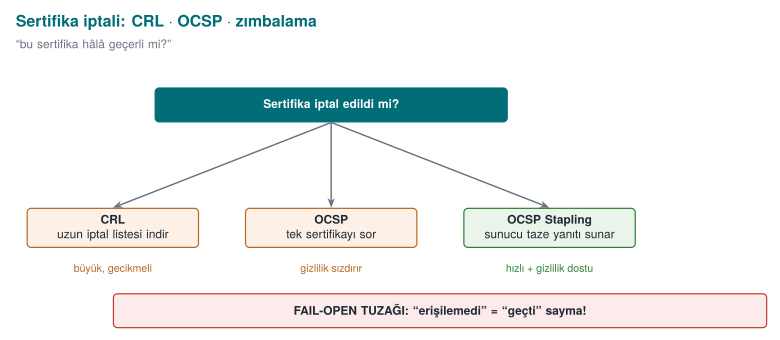
| Method | How? | Pro | Con |
|---|---|---|---|
| CRL (revocation list) | The CA regularly publishes a signed list of revoked serial numbers | Simple, can be cached offline | The list grows; a revocation is not noticed within the update interval |
| OCSP | The client asks the CA's responder "is this serial number valid?" | Instant | Latency, privacy (the CA learns which site was visited), what happens if the responder is unreachable? |
| OCSP stapling | The server attaches a fresh OCSP response for its own certificate to the handshake | Privacy and speed | Requires server configuration |
# producing a CRL with the intermediate CA requires 'openssl ca' configuration; then:
openssl ca -config ara.cnf -revoke sunucu.crt
openssl ca -config ara.cnf -gencrl -out ara.crl
openssl verify -crl_check -CAfile kok.crt -untrusted ara.crt -CRLfile ara.crl sunucu.crt   # "certificate revoked"
Soft-fail
Most browsers accept a certificate when they cannot reach the OCSP responder; otherwise a brief outage of the responder would make every site unreachable. But this means an attacker in the middle can bypass revocation checking simply by blocking the OCSP request: the PKI counterpart of Week 3's fail-open pattern. In critical applications, "a stapled response is mandatory" (OCSP Must-Staple) or short-lived certificates (days, weeks) reduce this problem; this is why certificate lifetimes are getting shorter and shorter.
Worked example: revoking a certificate and validating it against a CRL (end to end)¶
Let's trace the full version of the "summary" commands above, actually run, step by step. First, the minimal database and configuration file that openssl ca needs is set up (this is a heavily scaled-down version of a real CA):
mkdir -p demoCA/newcerts
touch demoCA/index.txt          # the "ledger" where every issued/revoked certificate is recorded
echo 1000 > demoCA/crlnumber    # the next CRL's version number
echo 1000 > demoCA/serial       # the next certificate's serial number
[ ca ]
default_ca = ara_ca

[ ara_ca ]
dir              = demoCA
database         = $dir/index.txt
new_certs_dir    = $dir/newcerts
certificate      = ara.crt
private_key      = ara.key
serial           = $dir/serial
crlnumber        = $dir/crlnumber
default_md       = sha256
default_days     = 90
default_crl_days = 30
policy           = policy_any
email_in_dn      = no

[ policy_any ]
commonName = supplied
Using configuration from ara.cnf
Adding Entry with serial number 35E2F68D...76E7 to DB for /CN=localhost
Revoking Certificate 35E2F68D...76E7.
Database updated
openssl ca -config ara.cnf -gencrl -out ara.crl
openssl verify -crl_check -CAfile kok.crt -untrusted ara.crt -CRLfile ara.crl sunucu.crt
Step by step, what happened: (1) -revoke recorded the certificate's serial number (Section 8's Serial Number field — here 35E2F68D...76E7) as "revoked" in the index.txt ledger; the certificate itself was not changed or deleted in any way — only a record was added. (2) -gencrl collected all the revocation records in this ledger and produced a list (ara.crl) signed with the intermediate CA's own private key — the CRL itself is also a signed document, protected against forgery by the same mechanism from Section 5. (3) With -crl_check, validation now checked not only the chain but also the CRL, saw that the serial number was on the list, and rejected it with the "certificate revoked" error — even though the certificate's validity date has not yet expired.
This is the complete solution to Exercise 6; repeat the same steps in your own lab and inspect the contents of index.txt (cat demoCA/index.txt) — every line carries a certificate's record (status, date, serial number, subject name).
Worked example: how big does a CRL get?¶
If a CA issues 10,000 certificates a year and 1% of them (100) are revoked, since every CRL entry carries ~40–60 bytes (serial number + revocation date + reason code), the CRL size is ~4–6 KB — that looks small. But for a large public CA (millions of certificates, hundreds of thousands of revocations), the CRL can reach tens of megabytes; every client downloading this periodically is not practical. OCSP solves this scaling problem by "asking a single question" instead of "downloading the entire list" — but then the privacy and availability trade-off above reappears.
Common mistake: testing revocation checking only in a development environment and taking it to production as-is
A client written without -crl_check (or the OCSP equivalent) turned on accepts, without any problem, a certificate that has not expired but has been revoked. Because a CRL/OCSP server is usually not set up in a test environment, this mistake is easy to overlook, and it is carried into production "with revocation checking off." Rule: make revocation checking an explicit configuration option, and confirm on your deployment checklist that it is turned on.
Rule
The shorter a certificate's lifetime, the less you need a revocation mechanism — this is why the industry (Let's Encrypt and similar) is moving toward shortening certificate lifetimes. If you use long-lived certificates, make sure to enable and test CRL or OCSP stapling.
In Section 9 we learned to build a chain; in this section we learned to invalidate one link in a chain. The next section covers how we protect the most valuable piece of this chain — the private keys themselves.
11. Storing the key in hardware: HSM, PKCS#11, and SoftHSM¶
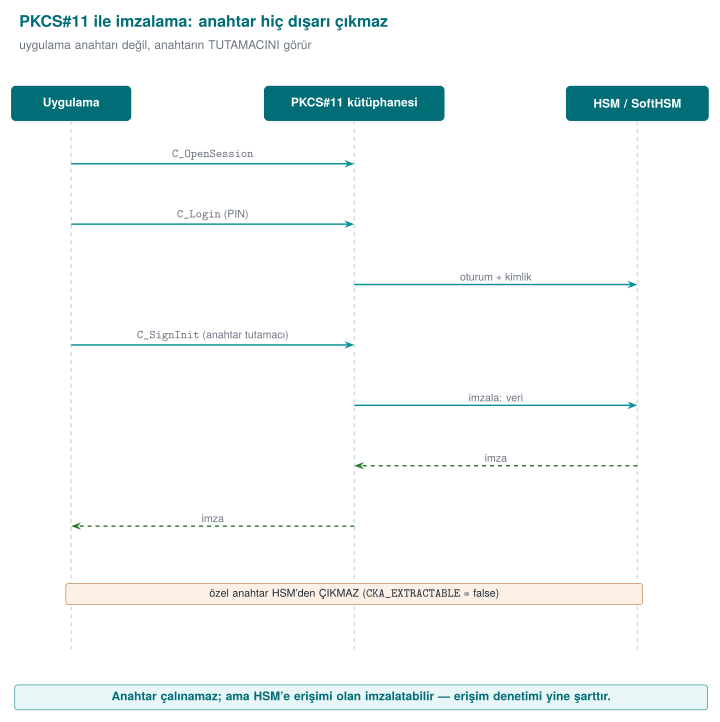
A stolen private key destroys all of PKI's guarantees. This is why valuable keys (CA keys, payment keys, code signing keys) are generated inside hardware security modules (HSM) and never leave them. The application never sees the key; it tells the HSM "sign this with that key."
| Concept | Explanation |
|---|---|
| HSM | Tamper-resistant, certified (FIPS 140-3, Common Criteria) hardware; does not export the key |
| PKCS#11 (Cryptoki) | The standard C API for accessing HSMs, smart cards, and cryptographic tokens |
| Object and attributes | Keys are marked "not exportable" with attributes such as CKA_SENSITIVE, CKA_EXTRACTABLE=false |
| Session and PIN | The application opens a session to a slot and authenticates with the user's PIN |
| SoftHSM | An open-source HSM simulation that provides the PKCS#11 interface in software; for development and testing |
export SOFTHSM2_CONF=$PWD/softhsm2.conf
mkdir -p belirtecler && echo "directories.tokendir = $PWD/belirtecler" > softhsm2.conf
softhsm2-util --init-token --free --label "cen429" --pin 1234 --so-pin 5678
pkcs11-tool --module /usr/lib/softhsm/libsofthsm2.so --login --pin 1234 \
            --keypairgen --key-type EC:prime256v1 --label imza-anahtari
pkcs11-tool --module /usr/lib/softhsm/libsofthsm2.so --login --pin 1234 --list-objects
SoftHSM is not an HSM
SoftHSM stores keys on disk, in a file; there is no hardware protection. Its value is that it lets you write your application against the PKCS#11 interface: the same code connects, in production, to a real HSM or smart card just by changing the module path. We will look at software-based security modules again from this angle in Week 11.
How it's done in the field
In payment systems, the keys at the top of the key hierarchy (the card issuer's master keys, the keys that generate device keys) sit in HSMs on the server side; in the mobile payment platform's back end, the HSM appears as a separate component in the architecture diagram (the example architecture from Week 1). The keys that land on the phone are generated on the server with an HSM, encrypted for binding to the device, and the library itself never generates an account key. The guide contains an algorithm inventory that lists every algorithm it uses together with the standard it rests on (NIST FIPS, ISO/IEC 9797-1, EMV specifications).
End to end: how is a signing request processed inside an HSM?¶
Let's make the sentence "the key never leaves" concrete. The PKCS#11 standard (OASIS Cryptoki v3) defines the following steps for an application to have an HSM sign something without ever sending or receiving a raw key byte:
- Open a session: The application connects to a "slot" in the HSM with
C_OpenSession. - Authenticate: The PIN is sent with
C_Login; if the PIN is wrong, the HSM locks itself after a certain number of attempts (hardware-level protection against brute force — an easy safeguard to forget in software). - Find the key: The handle of a previously generated key object (a reference number inside the HSM, not the key itself) is obtained with
C_FindObjectsInit/C_FindObjects. - Sign: The call
C_SignInit+C_Sign(handle, data, …)sends the data to the HSM; the HSM processes the data with the key inside itself and returns only the signature. The private key's bytes never enter the application code's memory at any point. - Close the session:
C_Logout/C_CloseSession.
CK_RV C_Sign(
    CK_SESSION_HANDLE hSession,   /* open session */
    CK_BYTE_PTR       pData,      /* data to be signed */
    CK_ULONG          ulDataLen,
    CK_BYTE_PTR       pSignature, /* output buffer filled by the HSM: only the signature, not the key */
    CK_ULONG_PTR      pulSignatureLen
);
Compare this flow with an ordinary OpenSSL call (EVP_DigestSign, Section 5): both interfaces carry the same idea ("give the data, get the signature"), but in OpenSSL the key (if read from a file) sits in process memory; in PKCS#11 the key never enters the application's address space. Moving Section 5's imza_dogrula function to an HSM only means routing the signing side to a C_Sign call — the verification side already only needs the public key, so it does not need the HSM.
Why is CKA_EXTRACTABLE the most critical attribute?¶
When a PKCS#11 key object is generated (C_GenerateKeyPair), the attributes CKA_EXTRACTABLE=false and CKA_SENSITIVE=true are given at key-generation time and cannot be changed afterward. These two flags prevent, at the hardware level, the HSM from ever giving out the key in plaintext, even if a function like C_WrapKey is called.
Common mistake: generating a key with default attributes
Some PKCS#11 libraries and tools leave CKA_EXTRACTABLE as true unless explicitly specified (for compatibility). In this case, even though the key is technically generated in an HSM, someone with the right permissions can export it — the assurance "we use an HSM" becomes an empty sentence. In code review, look for CKA_EXTRACTABLE = CK_FALSE being given explicitly in the attribute template of the C_GenerateKeyPair call.
Rule
When generating a valuable key (a CA root key, a code-signing key, a payment master key), CKA_EXTRACTABLE=false and CKA_SENSITIVE=true must be explicitly set, and right after generation you must verify with pkcs11-tool --list-objects (or its equivalent) that these attributes were actually applied — don't trust the default.
We will look again, in Week 11, at software-based security modules (structures like the Secure Enclave/TEE on mobile devices) through the PKCS#11 logic of this section; the principle you learned here — "work through a handle, never move the raw key" — is the foundation of that entire discussion. The next and final technical section looks at why the RSA/ECC we consider secure today needs to change in the future.
12. A look at post-quantum cryptography¶
A sufficiently large quantum computer can efficiently solve the mathematical problems RSA and elliptic curves rest on (factoring, discrete logarithm). Such a computer does not exist yet; but the idea that encrypted traffic recorded today could be decrypted years from now ("harvest now, decrypt later") puts the transition on the agenda starting today.
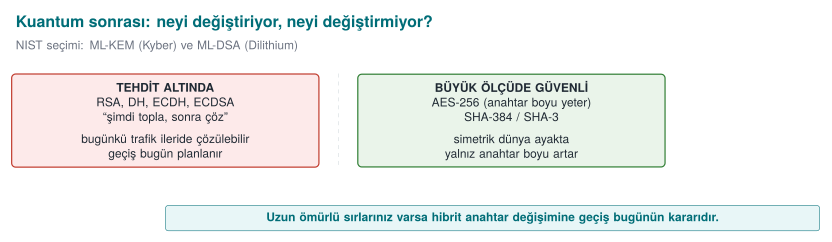
| Item | What's changing? |
|---|---|
| Symmetric ciphers and digests | Limited impact: AES-256 and SHA-384/512 are considered sufficient |
| Key agreement | NIST standardized ML-KEM (FIPS 203) in 2024; hybrid use alongside X25519 is becoming widespread in TLS |
| Signature | The ML-DSA (FIPS 204) and SLH-DSA (FIPS 205) standards have been published |
| Timeline | NIST's transition plan foresees phasing out RSA and elliptic-curve algorithms after 2030 |
For this course's project, the practical outcome is a single sentence: crypto agility. Don't hard-code algorithm names everywhere in your code; use formats that carry a key version and algorithm identifier (the key version field from Week 3), so that when the algorithm changes, only configuration and re-encryption are needed.
Worked example: generating post-quantum keys today¶
OpenSSL 3.5 supports the standardized post-quantum algorithms directly; you can generate them today, on your own machine, and compare their sizes with classical algorithms:
openssl genpkey -algorithm ML-KEM-768 -out mlkem.pem
openssl pkey -in mlkem.pem -pubout -out mlkem_pub.pem
wc -c mlkem_pub.pem

openssl genpkey -algorithm ML-DSA-65 -out mldsa.pem
openssl pkey -in mldsa.pem -pubout -out mldsa_pub.pem
echo hello > belge.txt
openssl pkeyutl -sign -inkey mldsa.pem -rawin -in belge.txt -out belge.mldsa.sig
wc -c mldsa_pub.pem belge.mldsa.sig
openssl pkeyutl -verify -pubin -inkey mldsa_pub.pem -rawin -in belge.txt -sigfile belge.mldsa.sig
Compare with the table in Section 4:
| Algorithm | Public key (PEM, bytes) | Signature (bytes) | Security basis |
|---|---|---|---|
| Ed25519 (classical) | 116 | 64 | Elliptic-curve discrete logarithm |
| RSA-3072 (classical) | 636 | 384 | Factoring |
| ML-DSA-65 (PQC) | 2,770 | 3,309 | Lattice-based problem (Module-LWE) |
| ML-KEM-768 (PQC, key agreement) | 1,714 | — | Lattice-based problem (Module-LWE) |
The difference is striking: ML-DSA-65's public key is ~24 times larger than Ed25519's, and its signature is ~52 times larger. This shows that the move to PQC is not just "changing an algorithm name" — many places, such as the TLS handshake, certificate size, and the number of network packets, must account for this growth. NIST's recommended hybrid approach for TLS (like X25519MLKEM768, the version of Section 6's X25519 agreement run together with PQC) exists precisely to manage this transition cost: classical and PQC keys are used at the same time; if the classical side is broken, PQC still protects; if the PQC side (new, not-yet-proven math) is broken, the classical side keeps protecting.
Why lattice problems? A short intuition¶
RSA's security rests on "the difficulty of factoring a large number," ECC's security rests on "the difficulty of taking a discrete logarithm on a curve" — Shor's algorithm efficiently solves both on a sufficiently large quantum computer. ML-KEM and ML-DSA instead rest on lattice problems: in a multi-dimensional space, in a structure formed by regularly spaced points (a lattice), "finding the lattice point closest to a given point" or "solving a system of equations with small error terms" (Learning With Errors, LWE) is computationally very hard at high dimensions, and so far, no efficient solution has been found for either classical or quantum computers. "Not having been found so far" does not mean "will never be found" — which is why the hybrid approach is recommended.
Common mistake: saying 'there's no quantum computer yet, no rush'
Traffic encrypted and recorded today with RSA/ECC (e.g., an intelligence record, a long-term medical record, a government document that must stay confidential for 20–30 years) can be recorded today and decrypted once a quantum computer matures, under the "harvest now, decrypt later" strategy. For a system with a confidentiality window of 10–20 years, the transition decision must be made today, not once a quantum computer exists.
Rule
If you are designing a new protocol, support a hybrid (classical + PQC) key agreement from now on where possible, or at least, with the crypto-agility principle from Section 1 (formats carrying an algorithm identifier/version), make a future transition to PQC possible without a rewrite.
This section was the final stop on the map we drew in Section 1: which algorithm, which problem, how secure, until when. From Section 13 onward you pour this knowledge into your own project's algorithm inventory.
13. Term project: this week¶
Draft the S8 and S11 sections expected at the final checkpoint:
- S8 — Algorithm inventory: for every algorithm used in your project, its purpose, key length, mode, the standard it rests on, and the library. If the table contains an obsolete algorithm, give its justification and a migration plan.
- S8 — Key lifecycle table: for every key, where it is generated, where it is stored, its crypto-period, and its renewal and destruction (Week 3).
- S11 — Secure communication: TLS version and validation; if pinning is used, the SPKI and backup pin; message-level protection.
- If your project has an update or configuration file, add signature verification (Ed25519 recommended) and reject rollbacks.
- Optional: use this week's root → intermediate → leaf chain for your project's test certificates; do not put the root key in the repository.
Worked example: filling in the S8 table for a sample component¶
Facing a blank table, it can be unclear what to write; let's see how S8 would be filled in for a sample project component ("user session token generation") — replace the rows with your own components in your own project:
| Job | Algorithm | Key length | Mode/Padding | Library | Standard it rests on | Note |
|---|---|---|---|---|---|---|
| Session data encryption | AES-256 | 256 bit | GCM (AEAD) | OpenSSL EVP 3.x | NIST SP 800-38D | Section 2 |
| Session integrity | — (GCM tag) | — | — | OpenSSL EVP | SP 800-38D | Inside AEAD, no separate MAC |
| Key agreement | X25519 | 128-bit level | ECDH | OpenSSL EVP | RFC 7748 | Section 6 |
| Server authentication | ECDSA P-256 | 128-bit level | — | OpenSSL/TLS | FIPS 186-5 | TLS certificate, Sections 7–9 |
| Update package signature | Ed25519 | 128-bit level | — | OpenSSL EVP | RFC 8032 | Section 5, version field signed |
The key lifecycle table (this week's counterpart to Week 3's key management topic) for the same component:
| Key | Where generated | Where stored | Crypto-period | Renewal | Destruction |
|---|---|---|---|---|---|
| Session key (AES-256) | Server, on every session | In memory only | Single session | New on every session | Erased from memory when the session closes |
| TLS server private key | Server, HSM/SoftHSM | HSM (Section 11) | 90 days (certificate lifetime) | Automatic renewal (ACME) | Never leaves the HSM, via CKA_EXTRACTABLE=false |
| Update signing key | Offline, via a ceremony | HSM, offline backup | For the life of the product | Annual review | Per organizational policy |
These two tables bring together, in a single place, every concept you've seen in Sections 1–12 of this week ("which mode," "which standard," "where it's stored," "when it's renewed") — an evaluator, at the final checkpoint, looks for exactly these two tables.
When adapting the table to your own project
Tie every row to a real call in your own codebase (you can even give the file name and line number); write a traceable reference like "auth.c:142, EVP_EncryptInit_ex with AES-256-GCM" instead of a generic sentence like "we use AES." This is the final-checkpoint counterpart of Section 1's rule that "the algorithm name alone is not enough."
14. Work on your own¶
Exercise 1 — Easy: HMAC and length extension
For the same message and key, compute an HMAC with openssl dgst -sha256 -mac HMAC and a plain digest with printf 'anahtar+mesaj' | openssl dgst -sha256. Explain why the plain H(K ‖ m) construction is insecure, using the concept of length extension.
Exercise 2 — Easy: comparing RSA and Ed25519
Generate a 3072-bit RSA key and an Ed25519 key. Compare the sizes of the public key files, the signatures, and the time it takes to perform 100 signing operations (openssl speed rsa3072 ed25519 can also be used).
Exercise 3 — Medium: the return value of signature verification
Run the imza_dogrula function from the "Digital signature" section. Try it first with a correct signature, then with a signature with one byte changed, then with an invalid key object. Show under which condition the difference between if (sonuc) and if (sonuc == 1) turns into a security vulnerability.
Exercise 4 — Medium: breaking the chain
Carry out the four scenarios from the "Class activity" section and record the openssl verify and openssl s_client error messages for each one in a table.
Exercise 5 — Medium: TLS server and the chain
Start a local TLS server with the server certificate you produced (openssl s_server -cert sunucu.crt -key sunucu.key -cert_chain ara.crt -accept 8443) and connect with openssl s_client -connect localhost:8443 -CAfile kok.crt -verify_return_error. What happens if the server does not send the intermediate certificate?
Exercise 6 — Medium: revocation
Prepare an openssl ca configuration for your lab's intermediate CA, revoke the server certificate, produce a CRL, and show, with openssl verify -crl_check, that the revocation is detected.
Exercise 7 — Hard: a replay-resistant message
Write two programs: one encrypts a message in the form counter ‖ data with AES-GCM (let the counter be the AAD) and sends it, the other receives it and rejects a counter it has seen before or one that is smaller. Resend a recorded message and show that it is rejected.
Exercise 8 — Hard: signing with PKCS#11
Sign a file with pkcs11-tool --sign using the key you generated in SoftHSM, and verify the signature with OpenSSL from the public key. Try to export the private key from SoftHSM; how does the CKA_EXTRACTABLE attribute prevent this?
15. Self-check¶
1. What is the key length for RSA and for elliptic curve at the 128-bit security level?
RSA 3072 bits, elliptic curve 256 bits (P-256, Ed25519/X25519).
2. Under what condition is the padding oracle attack possible? Give two defences.
When the decoder reports "invalid padding" in a way distinguishable from other errors (a different message or timing). Using AEAD; if CBC is mandatory, encrypt-then-MAC and verifying the MAC before the padding, and returning all errors in the same form.
3. Why is HMAC used instead of H(K ‖ m)?
In Merkle–Damgård-structured digests, H(K ‖ m) is exposed to length-extension attacks; HMAC's nested construction prevents this.
4. Why is encrypt-then-MAC the correct order?
The MAC is computed over the ciphertext and verified before decryption; an invalid message is never decrypted, so no padding oracle or plaintext leak occurs.
5. Why doesn't a MAC alone prevent replay? How is it prevented?
A MAC proves the message was not altered, not that it is new. A counter, timestamp, or a server-issued one-time value is included in the MAC, and the receiver rejects repeats.
6. Which padding schemes are recommended for RSA encryption and signing?
OAEP (SHA-256) for encryption, PSS for signing.
7. Why is reusing the same random value in two ECDSA signatures a disaster?
The private key can be computed from the two signatures. Ed25519 or deterministic ECDSA (RFC 6979) removes this risk.
8. Why is checking the result of EVP_DigestVerify with if (sonuc) incorrect?
Negative error values are also counted as true; on an error the signature is treated as valid. The check must be == 1.
9. Why is unauthenticated Diffie–Hellman open to man-in-the-middle? How does TLS 1.3 fix it?
DH does not say who you agreed with; someone in the middle can perform DH separately with each party. In TLS 1.3, the server signs the handshake digest — which also includes the ephemeral DH values — with the key in its certificate; the client validates the certificate.
10. Why is the root CA kept offline, and why does an intermediate CA exist?
Compromise of the root key collapses the entire chain, and removing the root from trust stores takes years. The intermediate CA does the day-to-day work; if it is compromised, only that one is revoked.
11. Why is name checking done against the SAN, not the CN?
Current standards and clients consider only the SAN extension; looking at the CN is an old and ambiguous method.
12. What is 'soft-fail' in OCSP, and why is it dangerous?
Accepting the certificate when the responder cannot be reached. An attacker in the middle can bypass revocation checking by blocking the OCSP request (fail-open). Mandatory stapling or short-lived certificates reduce this.
13. How does SoftHSM differ from a real HSM? Why is it used anyway?
It stores keys on disk, with no hardware protection. It lets you write your application against the PKCS#11 interface; in production, the same code connects to a real HSM.
14. What is crypto agility, and how does it relate to the post-quantum transition?
Keeping algorithms replaceable through formats that carry a version and algorithm identifier, instead of hard-coding them everywhere in the code. Moving to new algorithms like ML-KEM and ML-DSA can then be done with only configuration and re-encryption.
15. Explain why brute-forcing an AES key at the 128-bit security level is impractical, even with a hypothetical computer capable of 10¹⁸ operations per second.
2^128 operations are required (≈3.40 × 10^38). Even at this speed it takes ≈1.08 × 10^13 years — about 780 times the age of the universe (≈1.38 × 10^10 years). This is why AES-128 is considered secure against brute force today and for the foreseeable future.
16. If a 13-byte message is encrypted in a 16-byte block under PKCS#7 padding, how many bytes is the padding and what is its value?
3 bytes; each with the value 03 (16 − 13 = 3, as many bytes as are missing, each with that value).
17. Why do repeating plaintext blocks in ECB mode produce repeating ciphertext blocks? How does CBC prevent this?
ECB encrypts every block independently with the same key; the same input always gives the same output. CBC chains each block by XORing it with the previous one (the IV for the first block); so identical plaintext blocks produce different ciphertext depending on the different preceding blocks.
18. How much of the tag does a single-character change alter in HMAC? What is this property called?
Roughly half. This is called the avalanche effect.
19. Why is a constant-time function used instead of memcmp when comparing a MAC/signature?
memcmp stops at the first differing byte; this makes the comparison time proportional to the number of correct bytes. An attacker who can make enough attempts can discover the correct value byte by byte from the difference in response time (a timing attack). A constant-time function (like CRYPTO_memcmp) always walks through all the bytes.
20. Why do you get different ciphertexts when you encrypt the same plaintext twice with RSA-OAEP?
OAEP mixes a random value into the padding on every encryption. Raw/unpadded RSA is deterministic (c = m^e mod n) and always gives the same output for the same input; this is why raw RSA is never used directly for encryption.
21. How do you verify that Alice and Bob reach the same shared secret with X25519? Should this secret be used directly as an AES key?
pkeyutl -derive is run separately on both sides and the output files are compared (cmp); both reach the same secret. No — raw DH output is not uniformly random and is generally a single value; it must first be passed through a KDF (HKDF) to derive as many keys as needed.
22. What happens when openssl verify is given both a correct and an irrelevant intermediate certificate?
OpenSSL builds the chain along any valid path it can (e.g., directly to the root); the irrelevant certificate just remains an unused candidate, and validation can still succeed. This is an operational, not a cryptographic, situation.
23. What happens if an intermediate CA certificate's basicConstraints field is CA:FALSE?
This certificate no longer has the authority to sign other certificates; validation of any certificate signed with it is rejected with an "invalid CA certificate" error.
24. Does openssl ca -revoke delete a certificate from disk?
No. The certificate file does not change; only a revocation record is added to the CA's index.txt ledger. This record is later turned into a signed CRL with -gencrl.
25. What does the CKA_EXTRACTABLE=false attribute do, and when must it be set?
It prevents an HSM/PKCS#11 key from being exported in plaintext, at the hardware level. It must be set explicitly when the key is generated (C_GenerateKeyPair); it cannot be changed afterward.
26. State how many times larger the ML-DSA-65 signature is than the Ed25519 signature (in this week's measurement), and explain the practical consequence.
About 52 times larger (3,309 bytes / 64 bytes). The TLS handshake, certificate size, and network traffic all grow; this is why hybrid approaches and crypto agility matter during the transition.
16. Resources and further reading¶
Course textbook — J. Viega, M. Messier, Secure Programming Cookbook for C and C++, O'Reilly, 2003:
- Recipe 5.2–5.4 (algorithm, key length, and mode selection), 5.11 (padding), 5.16 (an error-resistant API)
- Recipe 6.3–6.4 (digest and MAC selection), 6.10 (HMAC), 6.18 (combining encryption and integrity), 6.19 (rolling your own MAC — a warning), 6.21 (a MAC against replay)
- Recipe 7.1–7.3 (public-key usage and selection), 7.10–7.14 (RSA encryption, signing, and secure combination), 7.16–7.17 (DER and PEM)
- Recipe 8.15–8.19 (password-based key exchange, authenticated key exchange with RSA, Diffie–Hellman, DH + signature, authentication without PKI)
- Recipe 10.1, 10.4–10.5 (PKI and X.509 validation), 10.10–10.12 (CRL and OCSP)
Open standards and resources
- NIST SP 800-57 Part 1 (key management and security levels), SP 800-131A (algorithm transitions), SP 800-38A/D (modes, GCM), FIPS 186-5 (digital signature), FIPS 203/204/205 (post-quantum).
- RFC 2104 (HMAC), RFC 8017 (PKCS#1 v2.2: OAEP, PSS), RFC 8032 (Ed25519), RFC 7748 (X25519), RFC 5280 (X.509 and CRL), RFC 6960 (OCSP), RFC 6979 (deterministic ECDSA), RFC 8446 (TLS 1.3).
- OASIS PKCS#11 v3; SoftHSM documentation; OpenSSL 3 man pages (
genpkey,req,x509,verify,ca,pkeyutl). - MITRE CWE: CWE-327 (broken algorithm), CWE-326 (insufficient key length), CWE-295 (improper certificate validation), CWE-299 (missing revocation check), CWE-347 (improper verification of a signature), CWE-294 (authentication bypass by replay).
Glossary
| Term | Turkish | Short definition |
|---|---|---|
| Mode of operation | Çalışma kipi | How a block cipher is applied to long messages |
| Padding oracle | Dolgu kâhini | Decrypting by distinguishing the padding error |
| Encrypt-then-MAC | Şifrele-sonra-MAC | Encrypting first, then taking the MAC of the ciphertext |
| Replay | Yeniden oynatma | Resending a valid old message |
| OAEP / PSS | — | RSA's secure encryption and signature paddings |
| Key agreement | Anahtar anlaşması | Two parties producing a shared secret (DH, ECDH) |
| CA / RA | Sertifika / kayıt otoritesi | The party that issues certificates / verifies identity |
| SAN | Konu alternatif adı | The domain names and IPs a certificate is valid for |
| CRL / OCSP | İptal listesi / çevrimiçi durum protokolü | Ways of announcing certificate revocation |
| Stapling | Zımbalama | The server attaching its OCSP response to the handshake |
| HSM | Donanım güvenlik modülü | Tamper-resistant hardware that never gives out the key |
| PKCS#11 | — | The standard API for accessing cryptographic tokens |
| Crypto agility | Kripto çevikliği | Being able to swap out algorithms easily |
Next week
Week 11 — Whitebox cryptography. This week we saw the "entrust it to hardware" path for protecting a key (HSM, PKCS#11, CKA_EXTRACTABLE=false, §11). Week 11 asks the same question with no hardware available: how do you protect a key inside an application that is pure software, with no access to any HSM? Table-based whitebox AES and the attacks built against it (BGE, DCA, DFA) are the software-side counterpart of this week's "the key must never be exposed" principle.