Week 9 — Graph Algorithms
CEN207 Data Structures (formerly CE205) · Fall 2026–2027 · 13.11.2026
Lecture notes (PDF) Lecture notes (DOCX) Slides (PDF) Slides (PPTX) Slides (HTML, offline) Download all (ZIP) Open slides full screen
Click inside the slides and use the arrow keys; use the button at the bottom right of the slides, or the "Open slides full screen" link above, for full screen.
This week
Learning outcomes. Week 5 taught you how to represent a graph and how to walk it (BFS, DFS, connected components, unweighted shortest paths). This week asks a sharper question for each walk: in what order must the vertices be processed so every dependency comes first (topological sort, two ways); how do we know, without staring at the picture, that a directed graph has no cycle at all; how do we track "who is in the same group as whom" as a graph is built edge by edge, in almost constant time (union-find); given weighted edges, what is the cheapest way to connect every vertex (minimum spanning tree, two ways) and what is the cheapest way to get from one vertex to another, or to every other vertex at once (shortest paths, three ways, including graphs with negative weights); which groups of vertices can all reach each other and back (strongly connected components); can a graph's vertices be split into two teams with no teammate ever adjacent (bipartite check); how much "stuff" can flow through a network of pipes at once (maximum flow); and, when a problem has no formula at all, how do you search the space of possible answers systematically and give up on a bad guess as early as possible (backtracking). These outcomes map to LO.1 (explain fundamental data structures), LO.2 (analyze algorithmic complexity), and LO.7 (choose the right structure for a problem) of the course syllabus.
What you need already. Everything here builds directly on Week 5: the adjacency-list Graph representation, the alphabetical-neighbour-order convention that makes every animation and every program's output reproducible, and the BFS/DFS machinery itself (topological sort by DFS is literally DFS with one extra array; Kosaraju's algorithm below runs DFS twice; the bipartite check below is BFS with a two-colour twist). If BFS and DFS are not fresh in your memory, revisit Week 5 first — this chapter will not re-explain them from scratch, only extend them.
Time plan for a 3-hour session. Recap and the map of the week (~10 min) · topological sort, Kahn's and DFS (~25 min) · cycle detection (~15 min) · union-find (~20 min) · short break · minimum spanning trees, Kruskal and Prim (~30 min) · shortest paths, Dijkstra and Bellman-Ford (~30 min) · all-pairs shortest paths, Floyd-Warshall (~15 min) · strongly connected components (~15 min) · bipartite graphs (~10 min) · maximum flow (~20 min) · backtracking (~15 min) · wrap-up and self-check (~10 min).
0. Before we start
0.1 What you already know
From Week 5. A graph is a set of vertices and a set of edges between them, directed or undirected, weighted or not. You represent it as an adjacency list: an array indexed by vertex, each cell the head of a linked list of that vertex's neighbours, kept in alphabetical order so that every traversal — and therefore every program's printed output — is reproducible. BFS explores level by level with a queue, giving the fewest edges to every reachable vertex. DFS explores as deep as possible before backtracking, using either true recursion (the call stack is the "current path") or an explicit stack. Connected components are the pieces a graph falls into when you run BFS or DFS from every still-unvisited vertex. All of that is unweighted and undirected-or-directed but never asks "in what order", "is there a cycle", or "at what cost" — this week's seven questions.
A genuinely new ingredient: weights. Six of the eleven algorithms below (Kruskal, Prim, Dijkstra, Bellman-Ford, Floyd-Warshall, Edmonds-Karp) attach a number to every edge — a distance, a cost, a capacity — and ask for the cheapest or largest total, not just "reachable or not". Weights are the one idea Week 5 did not need and this week cannot do without.
0.2 The map of this week
flowchart TD
    W9["Week 9: Graph Algorithms"]
    W9 --> O["Order and structure (no weights)"]
    O --> O1["Topological sort: Kahn's (in-degree + queue)"]
    O --> O2["Topological sort: DFS finish order, reversed"]
    O --> O3["Cycle detection: 3-colour DFS + path extraction"]
    O --> O4["Union-find: union by rank + path compression"]
    O --> O5["Strongly connected components: Kosaraju (DFS twice)"]
    O --> O6["Bipartite check: BFS + 2-colouring"]
    W9 --> P["Weighted: cheapest connections and paths"]
    P --> P1["Kruskal's MST: sort edges, union-find rejects cycles"]
    P --> P2["Prim's MST: grow one tree, cheapest edge out wins"]
    P --> P3["Dijkstra: single source, non-negative weights"]
    P --> P4["Bellman-Ford: single source, negative weights OK"]
    P --> P5["Floyd-Warshall: every pair at once, an N x N matrix"]
    W9 --> F["Beyond shortest paths"]
    F --> F1["Max flow (Edmonds-Karp): augmenting paths in the residual graph"]
    F --> F2["Backtracking: try, recurse, undo -- graph colouring"]
Every box gets its own section below, most with a step-by-step animation, a complete C and Java program, and a note on complexity and common mistakes. All thirteen animations use the same edge-list notation as Week 5's bfs.js: A-B for an undirected edge, A>B for a directed one, :WEIGHT appended where a weight applies (A>B:4), and vertices laid out in the same circle you already know.
1. Topological sort
1.1 A question to start
You are getting dressed: socks before shoes, shirt before jacket, but socks and shirt have no order between them. If every "must come before" rule is a directed edge in a graph, is there always some single order that obeys every rule at once? And if two people give you contradictory rules ("put on your shoes before your socks"), how would the algorithm even notice?
1.2 A short history
The problem is exactly the one build systems and package managers still solve today: compile a.c before main.c because main.c #includes it; install library X before the package that depends on it. A. B. Kahn published the in-degree-and-queue algorithm below in 1962 ("Topological sorting of large networks", Communications of the ACM), for exactly this kind of dependency scheduling. The DFS-based alternative is older still, falling directly out of the depth-first search framework Robert Tarjan formalised in the early 1970s.
1.3 The idea, two ways
A topological order of a directed graph is an ordering of its vertices such that every edge u -> v has u appearing before v. It only exists when the graph has no cycle (a DAG, directed acyclic graph) — if A must come before B and B must come before A, no order satisfies both.
Kahn's algorithm thinks about it as "what can go first?": a vertex with in-degree 0 (nothing points to it) has no unmet prerequisite, so it can be placed right now. Place it, and this removes its outgoing edges from consideration — so every neighbour's in-degree drops by one, and any neighbour that just reached in-degree 0 becomes newly eligible. A queue holds the currently-eligible vertices; each round, dequeue one, output it, relax its edges. If the queue empties before every vertex is placed, the leftover vertices are locked in a cycle with each other — proof that no topological order exists at all.
The DFS-based algorithm thinks about it from the other end: run recursive DFS (exactly Week 5's DfsRecursive, one array added) and record every vertex's finish time — the moment its for loop over its neighbours completes and it returns. Read the finish times from largest to smallest and you get a valid topological order. Why does this work? When u finishes after every vertex reachable from it has already finished (that is what "finish" means for a DFS tree — a vertex cannot finish before its descendants), so u's finish time is greater than every vertex it points to, directly or indirectly; sorting by decreasing finish time therefore places every u before everything it points to. The same DFS also catches cycles for free: a back edge — an edge to a vertex that is still grey (on the current path, not yet finished) — is only possible when there is a cycle.
1.4 In memory, and the code
Kahn's algorithm keeps two arrays and a queue: indeg[] (one entry per vertex), the queue itself, and the growing order[]. Below is the whole algorithm; construction and printing are the same Graph/AdjNode boilerplate as Week 5, shown in full in the collapsible program below.
int indeg[MAX_V];
int queue_data[MAX_V], front, rear;
int order[MAX_V], order_len;

void enqueue(int v) { queue_data[rear] = v; rear++; }
int  dequeue(void)  { int v = queue_data[front]; front++; return v; }

int topo_sort_kahn(Graph *g) {
    for (int i = 0; i < g->vertex_count; i++) indeg[i] = 0;
    for (int u = 0; u < g->vertex_count; u++)
        for (AdjNode *n = g->adj[u]; n != NULL; n = n->next)
            indeg[n->to]++;
    front = rear = 0; order_len = 0;
    for (int v = 0; v < g->vertex_count; v++)          /* alphabetical order */
        if (indeg[v] == 0) enqueue(v);
    while (front < rear) {
        int u = dequeue();
        order[order_len] = u; order_len++;
        for (AdjNode *n = g->adj[u]; n != NULL; n = n->next) {  /* alphabetical order */
            indeg[n->to]--;
            if (indeg[n->to] == 0) enqueue(n->to);
        }
    }
    return order_len == g->vertex_count;               /* 0 -> a cycle exists */
}
int[] indeg = new int[MAX_V];
int[] queueData = new int[MAX_V]; int front, rear;
int[] order = new int[MAX_V]; int orderLen;

void enqueue(int v) { queueData[rear] = v; rear++; }
int  dequeue()      { int v = queueData[front]; front++; return v; }

boolean topoSortKahn(Graph g) {
    for (int i = 0; i < g.vertexCount; i++) indeg[i] = 0;
    for (int u = 0; u < g.vertexCount; u++)
        for (AdjNode n = g.adj[u]; n != null; n = n.next)
            indeg[n.to]++;
    front = rear = 0; orderLen = 0;
    for (int v = 0; v < g.vertexCount; v++)             // alphabetical order
        if (indeg[v] == 0) enqueue(v);
    while (front < rear) {
        int u = dequeue();
        order[orderLen] = u; orderLen++;
        for (AdjNode n = g.adj[u]; n != null; n = n.next) {  // alphabetical order
            indeg[n.to]--;
            if (indeg[n.to] == 0) enqueue(n.to);
        }
    }
    return orderLen == g.vertexCount;                   // false -> a cycle exists
}

In the picker, try the ready examples "8 vertices, 10 edges, a valid DAG", "10 vertices, 14 edges, a DAG with several sources", and the edge case "10 edges but a cycle exists, no full order" (watch the queue empty early); then roll the 🎲 dice or type your own A>B B>C ... edges.
The DFS-based version reuses dfs_visit almost unchanged from Week 5, adding only the finish[] array:
int color_of[MAX_V];        /* 0 white, 1 gray, 2 black */
int finish[MAX_V], finish_len;
int has_cycle;

void dfs_visit(int u) {
    color_of[u] = 1;                                /* gray: in progress */
    for (AdjNode *n = cur_g->adj[u]; n != NULL; n = n->next) {  /* alphabetical order */
        if (color_of[n->to] == 0) dfs_visit(n->to);      /* tree edge */
        else if (color_of[n->to] == 1) has_cycle = 1;       /* back edge -> a cycle */
    }
    color_of[u] = 2;                                /* black: done */
    finish[finish_len] = u; finish_len++;
}
int[] colorOf = new int[MAX_V];        // 0 white, 1 gray, 2 black
int[] finish = new int[MAX_V]; int finishLen;
boolean hasCycle;

void dfsVisit(int u) {
    colorOf[u] = 1;                                 // gray: in progress
    for (AdjNode n = curG.adj[u]; n != null; n = n.next) {  // alphabetical order
        if (colorOf[n.to] == 0) dfsVisit(n.to);            // tree edge
        else if (colorOf[n.to] == 1) hasCycle = true;      // back edge -> a cycle
    }
    colorOf[u] = 2;                                 // black: done
    finish[finishLen] = u; finishLen++;
}

Same ready examples as Kahn's (the two algorithms run on identical graphs so you can compare their orders directly), plus 🎲 random and your own values.
1.5 Try it
Full program: topological_sort_kahn.c / TopologicalSortKahn.java
/* Week 9 -- Graph Algorithms
 * Topological sort by KAHN's algorithm: count every vertex's in-degree, seed
 * a queue with the vertices that have in-degree 0, then repeatedly dequeue
 * one, print it, and decrement its neighbours' in-degree. If a cycle exists,
 * the queue empties before every vertex is placed.
 * CEN207 Data Structures (formerly CE205)
 */
#include <stdio.h>
#include <string.h>
#include <stdlib.h>

#define MAX_V   32
#define MAX_LBL 4

typedef struct AdjNode { int to; struct AdjNode *next; } AdjNode;
typedef struct Graph {
    char label[MAX_V][MAX_LBL];
    AdjNode *adj[MAX_V];
    int vertex_count;
} Graph;

int indeg[MAX_V];
int queue_data[MAX_V], front, rear;
int order[MAX_V], order_len;

void enqueue(int v) { queue_data[rear] = v; rear++; }
int  dequeue(void)  { int v = queue_data[front]; front++; return v; }

int topo_sort_kahn(Graph *g) {
    for (int i = 0; i < g->vertex_count; i++) indeg[i] = 0;
    for (int u = 0; u < g->vertex_count; u++)
        for (AdjNode *n = g->adj[u]; n != NULL; n = n->next)
            indeg[n->to]++;
    front = rear = 0; order_len = 0;
    for (int v = 0; v < g->vertex_count; v++)          /* alphabetical order */
        if (indeg[v] == 0) enqueue(v);
    while (front < rear) {
        int u = dequeue();
        order[order_len] = u; order_len++;
        for (AdjNode *n = g->adj[u]; n != NULL; n = n->next) {  /* alphabetical order */
            indeg[n->to]--;
            if (indeg[n->to] == 0) enqueue(n->to);
        }
    }
    return order_len == g->vertex_count;               /* 0 -> a cycle exists */
}

/* ---- construction: build Graph from a (label, label) DIRECTED edge list. ---- */

typedef struct { const char *a, *b; } EdgeIn;

static int find_or_add_vertex(Graph *g, const char *lbl) {
    for (int i = 0; i < g->vertex_count; i++)
        if (strcmp(g->label[i], lbl) == 0) return i;
    strncpy(g->label[g->vertex_count], lbl, MAX_LBL - 1);
    g->label[g->vertex_count][MAX_LBL - 1] = '\0';
    g->adj[g->vertex_count] = NULL;
    return g->vertex_count++;
}

static AdjNode *new_node(int to) {
    AdjNode *n = malloc(sizeof(AdjNode));
    n->to = to;
    n->next = NULL;
    return n;
}

static void add_neighbour_sorted(Graph *g, int v, int neighbour) {
    AdjNode *n = new_node(neighbour);
    if (g->adj[v] == NULL || strcmp(g->label[g->adj[v]->to], g->label[neighbour]) > 0) {
        n->next = g->adj[v];
        g->adj[v] = n;
        return;
    }
    AdjNode *cur = g->adj[v];
    while (cur->next != NULL && strcmp(g->label[cur->next->to], g->label[neighbour]) <= 0)
        cur = cur->next;
    n->next = cur->next;
    cur->next = n;
}

static void build_graph(Graph *g, EdgeIn edges[], int n) {
    g->vertex_count = 0;
    for (int i = 0; i < MAX_V; i++) g->adj[i] = NULL;
    for (int i = 0; i < n; i++) {
        int a = find_or_add_vertex(g, edges[i].a), b = find_or_add_vertex(g, edges[i].b);
        if (a == b) continue;                       /* self-loop: only used to seed a lone vertex */
        add_neighbour_sorted(g, a, b);
    }
}

static void free_graph(Graph *g) {
    for (int i = 0; i < g->vertex_count; i++) {
        AdjNode *cur = g->adj[i];
        while (cur) { AdjNode *nx = cur->next; free(cur); cur = nx; }
        g->adj[i] = NULL;
    }
}

static void run_scenario(const char *label, EdgeIn edges[], int n) {
    printf("-- %s --\n", label);
    Graph g;
    build_graph(&g, edges, n);

    int ok = topo_sort_kahn(&g);
    printf("order:");
    for (int i = 0; i < order_len; i++) printf(" %s", g.label[order[i]]);
    printf("\n");
    if (ok) {
        printf("all %d vertices placed: a valid topological order\n", g.vertex_count);
    } else {
        printf("only %d of %d vertices placed -- a cycle exists, unplaced:", order_len, g.vertex_count);
        for (int i = 0; i < g.vertex_count; i++) {
            int placed = 0;
            for (int j = 0; j < order_len; j++) if (order[j] == i) placed = 1;
            if (!placed) printf(" %s", g.label[i]);
        }
        printf("\n");
    }

    free_graph(&g);
    printf("\n");
}

int main(void) {
    EdgeIn normal[] = {
        {"A", "B"}, {"A", "C"}, {"B", "D"}, {"C", "D"}, {"D", "E"},
        {"C", "F"}, {"E", "G"}, {"F", "G"}, {"G", "H"}, {"B", "E"}
    };
    run_scenario("normal: 8 vertices, 10 edges, a valid DAG", normal, 10);

    EdgeIn hard[] = {
        {"A", "D"}, {"B", "D"}, {"C", "E"}, {"D", "F"}, {"E", "F"},
        {"D", "G"}, {"F", "H"}, {"G", "H"}, {"H", "I"}, {"I", "J"},
        {"G", "J"}, {"B", "E"}, {"A", "G"}, {"C", "F"}
    };
    run_scenario("hard: 10 vertices, 14 edges, a DAG with several sources", hard, 14);

    EdgeIn cycle[] = {
        {"A", "B"}, {"B", "C"}, {"C", "A"}, {"C", "D"}, {"D", "E"},
        {"E", "F"}, {"A", "D"}, {"F", "G"}, {"D", "F"}, {"B", "D"}
    };
    run_scenario("edge: 10 edges but a cycle exists, no full order", cycle, 10);

    EdgeIn single[] = { {"A", "A"} };
    run_scenario("edge: a single vertex, no edges (self-loop is ignored)", single, 1);

    return 0;
}
/* Week 9 -- Graph Algorithms
 * Topological sort by KAHN's algorithm: count every vertex's in-degree, seed
 * a queue with the vertices that have in-degree 0, then repeatedly dequeue
 * one, print it, and decrement its neighbours' in-degree. If a cycle exists,
 * the queue empties before every vertex is placed.
 * CEN207 Data Structures (formerly CE205)
 */
public class TopologicalSortKahn {
    static final int MAX_V = 32;

    static class AdjNode { int to; AdjNode next; AdjNode(int to) { this.to = to; } }
    static class Graph {
        String[] label = new String[MAX_V];
        AdjNode[] adj = new AdjNode[MAX_V];
        int vertexCount;
    }

    static int[] indeg = new int[MAX_V];
    static int[] queueData = new int[MAX_V]; static int front, rear;
    static int[] order = new int[MAX_V]; static int orderLen;

    static void enqueue(int v) { queueData[rear] = v; rear++; }
    static int  dequeue()      { int v = queueData[front]; front++; return v; }

    static boolean topoSortKahn(Graph g) {
        for (int i = 0; i < g.vertexCount; i++) indeg[i] = 0;
        for (int u = 0; u < g.vertexCount; u++)
            for (AdjNode n = g.adj[u]; n != null; n = n.next)
                indeg[n.to]++;
        front = rear = 0; orderLen = 0;
        for (int v = 0; v < g.vertexCount; v++)           // alphabetical order
            if (indeg[v] == 0) enqueue(v);
        while (front < rear) {
            int u = dequeue();
            order[orderLen] = u; orderLen++;
            for (AdjNode n = g.adj[u]; n != null; n = n.next) {  // alphabetical order
                indeg[n.to]--;
                if (indeg[n.to] == 0) enqueue(n.to);
            }
        }
        return orderLen == g.vertexCount;                 // false -> a cycle exists
    }

    // ---- construction: build Graph from a (label, label) DIRECTED edge list. ----

    static class EdgeIn {
        String a, b;
        EdgeIn(String a, String b) { this.a = a; this.b = b; }
    }

    static int findOrAddVertex(Graph g, String lbl) {
        for (int i = 0; i < g.vertexCount; i++)
            if (g.label[i].equals(lbl)) return i;
        g.label[g.vertexCount] = lbl;
        g.adj[g.vertexCount] = null;
        return g.vertexCount++;
    }

    static void addNeighbourSorted(Graph g, int v, int neighbour) {
        AdjNode n = new AdjNode(neighbour);
        if (g.adj[v] == null || g.label[g.adj[v].to].compareTo(g.label[neighbour]) > 0) {
            n.next = g.adj[v];
            g.adj[v] = n;
            return;
        }
        AdjNode cur = g.adj[v];
        while (cur.next != null && g.label[cur.next.to].compareTo(g.label[neighbour]) <= 0)
            cur = cur.next;
        n.next = cur.next;
        cur.next = n;
    }

    static void buildGraph(Graph g, EdgeIn[] edges) {
        g.vertexCount = 0;
        for (int i = 0; i < MAX_V; i++) g.adj[i] = null;
        for (EdgeIn e : edges) {
            int a = findOrAddVertex(g, e.a), b = findOrAddVertex(g, e.b);
            if (a == b) continue;                       // self-loop: only used to seed a lone vertex
            addNeighbourSorted(g, a, b);
        }
    }

    static void runScenario(String label, EdgeIn[] edges) {
        System.out.println("-- " + label + " --");
        Graph g = new Graph();
        buildGraph(g, edges);

        boolean ok = topoSortKahn(g);
        StringBuilder sb = new StringBuilder("order:");
        for (int i = 0; i < orderLen; i++) sb.append(' ').append(g.label[order[i]]);
        System.out.println(sb);
        if (ok) {
            System.out.println("all " + g.vertexCount + " vertices placed: a valid topological order");
        } else {
            StringBuilder ub = new StringBuilder("only " + orderLen + " of " + g.vertexCount + " vertices placed -- a cycle exists, unplaced:");
            for (int i = 0; i < g.vertexCount; i++) {
                boolean placed = false;
                for (int j = 0; j < orderLen; j++) if (order[j] == i) placed = true;
                if (!placed) ub.append(' ').append(g.label[i]);
            }
            System.out.println(ub);
        }

        System.out.println();
    }

    public static void main(String[] args) {
        EdgeIn[] normal = {
            new EdgeIn("A", "B"), new EdgeIn("A", "C"), new EdgeIn("B", "D"), new EdgeIn("C", "D"), new EdgeIn("D", "E"),
            new EdgeIn("C", "F"), new EdgeIn("E", "G"), new EdgeIn("F", "G"), new EdgeIn("G", "H"), new EdgeIn("B", "E")
        };
        runScenario("normal: 8 vertices, 10 edges, a valid DAG", normal);

        EdgeIn[] hard = {
            new EdgeIn("A", "D"), new EdgeIn("B", "D"), new EdgeIn("C", "E"), new EdgeIn("D", "F"), new EdgeIn("E", "F"),
            new EdgeIn("D", "G"), new EdgeIn("F", "H"), new EdgeIn("G", "H"), new EdgeIn("H", "I"), new EdgeIn("I", "J"),
            new EdgeIn("G", "J"), new EdgeIn("B", "E"), new EdgeIn("A", "G"), new EdgeIn("C", "F")
        };
        runScenario("hard: 10 vertices, 14 edges, a DAG with several sources", hard);

        EdgeIn[] cycle = {
            new EdgeIn("A", "B"), new EdgeIn("B", "C"), new EdgeIn("C", "A"), new EdgeIn("C", "D"), new EdgeIn("D", "E"),
            new EdgeIn("E", "F"), new EdgeIn("A", "D"), new EdgeIn("F", "G"), new EdgeIn("D", "F"), new EdgeIn("B", "D")
        };
        runScenario("edge: 10 edges but a cycle exists, no full order", cycle);

        EdgeIn[] single = { new EdgeIn("A", "A") };
        runScenario("edge: a single vertex, no edges (self-loop is ignored)", single);
    }
}
Full program: topological_sort_dfs.c / TopologicalSortDfs.java
/* Week 9 -- Graph Algorithms
 * Topological sort by DFS: run recursive DFS, record every vertex's FINISH
 * time, then read the finish order back to front. A back edge (to a grey,
 * still-open ancestor) means the graph has a cycle, so no topological order
 * exists.
 * CEN207 Data Structures (formerly CE205)
 */
#include <stdio.h>
#include <string.h>
#include <stdlib.h>

#define MAX_V   32
#define MAX_LBL 4

typedef struct AdjNode { int to; struct AdjNode *next; } AdjNode;
typedef struct Graph {
    char label[MAX_V][MAX_LBL];
    AdjNode *adj[MAX_V];
    int vertex_count;
} Graph;

int color_of[MAX_V];        /* 0 white, 1 gray, 2 black */
int finish[MAX_V], finish_len;
int has_cycle;
Graph *cur_g;

void dfs_visit(int u) {
    color_of[u] = 1;                                /* gray: in progress */
    for (AdjNode *n = cur_g->adj[u]; n != NULL; n = n->next) {  /* alphabetical order */
        if (color_of[n->to] == 0) dfs_visit(n->to);      /* tree edge */
        else if (color_of[n->to] == 1) has_cycle = 1;       /* back edge -> a cycle */
    }
    color_of[u] = 2;                                /* black: done */
    finish[finish_len] = u; finish_len++;
}

void topo_sort_dfs(Graph *g) {
    cur_g = g;
    for (int i = 0; i < g->vertex_count; i++) color_of[i] = 0;
    finish_len = 0; has_cycle = 0;
    for (int v = 0; v < g->vertex_count; v++)         /* alphabetical order */
        if (color_of[v] == 0) dfs_visit(v);
    /* topological order = finish[] read back to front */
}

/* ---- construction: build Graph from a (label, label) DIRECTED edge list. ---- */

typedef struct { const char *a, *b; } EdgeIn;

static int find_or_add_vertex(Graph *g, const char *lbl) {
    for (int i = 0; i < g->vertex_count; i++)
        if (strcmp(g->label[i], lbl) == 0) return i;
    strncpy(g->label[g->vertex_count], lbl, MAX_LBL - 1);
    g->label[g->vertex_count][MAX_LBL - 1] = '\0';
    g->adj[g->vertex_count] = NULL;
    return g->vertex_count++;
}

static AdjNode *new_node(int to) {
    AdjNode *n = malloc(sizeof(AdjNode));
    n->to = to;
    n->next = NULL;
    return n;
}

static void add_neighbour_sorted(Graph *g, int v, int neighbour) {
    AdjNode *n = new_node(neighbour);
    if (g->adj[v] == NULL || strcmp(g->label[g->adj[v]->to], g->label[neighbour]) > 0) {
        n->next = g->adj[v];
        g->adj[v] = n;
        return;
    }
    AdjNode *cur = g->adj[v];
    while (cur->next != NULL && strcmp(g->label[cur->next->to], g->label[neighbour]) <= 0)
        cur = cur->next;
    n->next = cur->next;
    cur->next = n;
}

static void build_graph(Graph *g, EdgeIn edges[], int n) {
    g->vertex_count = 0;
    for (int i = 0; i < MAX_V; i++) g->adj[i] = NULL;
    for (int i = 0; i < n; i++) {
        int a = find_or_add_vertex(g, edges[i].a), b = find_or_add_vertex(g, edges[i].b);
        if (a == b) continue;
        add_neighbour_sorted(g, a, b);
    }
}

static void free_graph(Graph *g) {
    for (int i = 0; i < g->vertex_count; i++) {
        AdjNode *cur = g->adj[i];
        while (cur) { AdjNode *nx = cur->next; free(cur); cur = nx; }
        g->adj[i] = NULL;
    }
}

static void run_scenario(const char *label, EdgeIn edges[], int n) {
    printf("-- %s --\n", label);
    Graph g;
    build_graph(&g, edges, n);

    topo_sort_dfs(&g);
    printf("finish order:");
    for (int i = 0; i < finish_len; i++) printf(" %s", g.label[finish[i]]);
    printf("\n");
    if (has_cycle) {
        printf("a back edge was found: NOT a valid topological order (the graph has a cycle)\n");
    } else {
        printf("topo order:");
        for (int i = finish_len - 1; i >= 0; i--) printf(" %s", g.label[finish[i]]);
        printf("\n");
    }

    free_graph(&g);
    printf("\n");
}

int main(void) {
    EdgeIn normal[] = {
        {"A", "B"}, {"A", "C"}, {"B", "D"}, {"C", "D"}, {"D", "E"},
        {"C", "F"}, {"E", "G"}, {"F", "G"}, {"G", "H"}, {"B", "E"}
    };
    run_scenario("normal: 8 vertices, 10 edges, a valid DAG", normal, 10);

    EdgeIn hard[] = {
        {"A", "D"}, {"B", "D"}, {"C", "E"}, {"D", "F"}, {"E", "F"},
        {"D", "G"}, {"F", "H"}, {"G", "H"}, {"H", "I"}, {"I", "J"},
        {"G", "J"}, {"B", "E"}, {"A", "G"}, {"C", "F"}
    };
    run_scenario("hard: 10 vertices, 14 edges, a DAG with several sources", hard, 14);

    EdgeIn cycle[] = {
        {"A", "B"}, {"B", "C"}, {"C", "A"}, {"C", "D"}, {"D", "E"},
        {"E", "F"}, {"A", "D"}, {"F", "G"}, {"D", "F"}, {"B", "D"}
    };
    run_scenario("edge: 10 edges but a cycle exists, a back edge is found", cycle, 10);

    EdgeIn single[] = { {"A", "A"} };
    run_scenario("edge: a single vertex, no edges (self-loop is ignored)", single, 1);

    return 0;
}
/* Week 9 -- Graph Algorithms
 * Topological sort by DFS: run recursive DFS, record every vertex's FINISH
 * time, then read the finish order back to front. A back edge (to a grey,
 * still-open ancestor) means the graph has a cycle, so no topological order
 * exists.
 * CEN207 Data Structures (formerly CE205)
 */
public class TopologicalSortDfs {
    static final int MAX_V = 32;

    static class AdjNode { int to; AdjNode next; AdjNode(int to) { this.to = to; } }
    static class Graph {
        String[] label = new String[MAX_V];
        AdjNode[] adj = new AdjNode[MAX_V];
        int vertexCount;
    }

    static int[] colorOf = new int[MAX_V];        // 0 white, 1 gray, 2 black
    static int[] finish = new int[MAX_V]; static int finishLen;
    static boolean hasCycle;
    static Graph curG;

    static void dfsVisit(int u) {
        colorOf[u] = 1;                                 // gray: in progress
        for (AdjNode n = curG.adj[u]; n != null; n = n.next) {  // alphabetical order
            if (colorOf[n.to] == 0) dfsVisit(n.to);            // tree edge
            else if (colorOf[n.to] == 1) hasCycle = true;      // back edge -> a cycle
        }
        colorOf[u] = 2;                                 // black: done
        finish[finishLen] = u; finishLen++;
    }

    static void topoSortDfs(Graph g) {
        curG = g;
        for (int i = 0; i < g.vertexCount; i++) colorOf[i] = 0;
        finishLen = 0; hasCycle = false;
        for (int v = 0; v < g.vertexCount; v++)           // alphabetical order
            if (colorOf[v] == 0) dfsVisit(v);
    }

    // ---- construction: build Graph from a (label, label) DIRECTED edge list. ----

    static class EdgeIn {
        String a, b;
        EdgeIn(String a, String b) { this.a = a; this.b = b; }
    }

    static int findOrAddVertex(Graph g, String lbl) {
        for (int i = 0; i < g.vertexCount; i++)
            if (g.label[i].equals(lbl)) return i;
        g.label[g.vertexCount] = lbl;
        g.adj[g.vertexCount] = null;
        return g.vertexCount++;
    }

    static void addNeighbourSorted(Graph g, int v, int neighbour) {
        AdjNode n = new AdjNode(neighbour);
        if (g.adj[v] == null || g.label[g.adj[v].to].compareTo(g.label[neighbour]) > 0) {
            n.next = g.adj[v];
            g.adj[v] = n;
            return;
        }
        AdjNode cur = g.adj[v];
        while (cur.next != null && g.label[cur.next.to].compareTo(g.label[neighbour]) <= 0)
            cur = cur.next;
        n.next = cur.next;
        cur.next = n;
    }

    static void buildGraph(Graph g, EdgeIn[] edges) {
        g.vertexCount = 0;
        for (int i = 0; i < MAX_V; i++) g.adj[i] = null;
        for (EdgeIn e : edges) {
            int a = findOrAddVertex(g, e.a), b = findOrAddVertex(g, e.b);
            if (a == b) continue;
            addNeighbourSorted(g, a, b);
        }
    }

    static void runScenario(String label, EdgeIn[] edges) {
        System.out.println("-- " + label + " --");
        Graph g = new Graph();
        buildGraph(g, edges);

        topoSortDfs(g);
        StringBuilder sb = new StringBuilder("finish order:");
        for (int i = 0; i < finishLen; i++) sb.append(' ').append(g.label[finish[i]]);
        System.out.println(sb);
        if (hasCycle) {
            System.out.println("a back edge was found: NOT a valid topological order (the graph has a cycle)");
        } else {
            StringBuilder ob = new StringBuilder("topo order:");
            for (int i = finishLen - 1; i >= 0; i--) ob.append(' ').append(g.label[finish[i]]);
            System.out.println(ob);
        }

        System.out.println();
    }

    public static void main(String[] args) {
        EdgeIn[] normal = {
            new EdgeIn("A", "B"), new EdgeIn("A", "C"), new EdgeIn("B", "D"), new EdgeIn("C", "D"), new EdgeIn("D", "E"),
            new EdgeIn("C", "F"), new EdgeIn("E", "G"), new EdgeIn("F", "G"), new EdgeIn("G", "H"), new EdgeIn("B", "E")
        };
        runScenario("normal: 8 vertices, 10 edges, a valid DAG", normal);

        EdgeIn[] hard = {
            new EdgeIn("A", "D"), new EdgeIn("B", "D"), new EdgeIn("C", "E"), new EdgeIn("D", "F"), new EdgeIn("E", "F"),
            new EdgeIn("D", "G"), new EdgeIn("F", "H"), new EdgeIn("G", "H"), new EdgeIn("H", "I"), new EdgeIn("I", "J"),
            new EdgeIn("G", "J"), new EdgeIn("B", "E"), new EdgeIn("A", "G"), new EdgeIn("C", "F")
        };
        runScenario("hard: 10 vertices, 14 edges, a DAG with several sources", hard);

        EdgeIn[] cycle = {
            new EdgeIn("A", "B"), new EdgeIn("B", "C"), new EdgeIn("C", "A"), new EdgeIn("C", "D"), new EdgeIn("D", "E"),
            new EdgeIn("E", "F"), new EdgeIn("A", "D"), new EdgeIn("F", "G"), new EdgeIn("D", "F"), new EdgeIn("B", "D")
        };
        runScenario("edge: 10 edges but a cycle exists, a back edge is found", cycle);

        EdgeIn[] single = { new EdgeIn("A", "A") };
        runScenario("edge: a single vertex, no edges (self-loop is ignored)", single);
    }
}
Try it
-- normal: 8 vertices, 10 edges, a valid DAG --
order: A B C D F E G H
all 8 vertices placed: a valid topological order

-- hard: 10 vertices, 14 edges, a DAG with several sources --
order: A B C D E G F H I J
all 10 vertices placed: a valid topological order

-- edge: 10 edges but a cycle exists, no full order --
order:
only 0 of 7 vertices placed -- a cycle exists, unplaced: A B C D E F G

-- edge: a single vertex, no edges (self-loop is ignored) --
order: A
all 1 vertices placed: a valid topological order
The DFS version (gcc ... topological_sort_dfs.c && ./a.out, or javac/java TopologicalSortDfs) prints:
-- normal: 8 vertices, 10 edges, a valid DAG --
finish order: H G E D B F C A
topo order: A C F B D E G H

-- hard: 10 vertices, 14 edges, a DAG with several sources --
finish order: J I H F G D A E B C
topo order: C B E A D G F H I J

-- edge: 10 edges but a cycle exists, a back edge is found --
finish order: G F E D C B A
a back edge was found: NOT a valid topological order (the graph has a cycle)

-- edge: a single vertex, no edges (self-loop is ignored) --
finish order: A
topo order: A
Notice the two algorithms find different but equally valid orders for the same "normal" graph (A B C D F E G H versus A C F B D E G H) — a DAG generally has more than one correct topological order; neither algorithm is "more right" than the other.
1.6 Complexity, mistakes, self-check
Complexity. Both algorithms are O(V + E): Kahn's does one pass to count in-degrees and one pass where every edge is relaxed exactly once across the whole run; DFS visits every vertex once and follows every edge once. Space is O(V + E) for the adjacency list plus O(V) for the extra arrays.
Common mistakes
- Forgetting that a topological order is not unique: do not hard-code "the" expected answer in a test — compare positions (
pos[a] < pos[b]), never the exact sequence, unless the DAG genuinely has only one valid order (a single chain). - In Kahn's algorithm, decrementing
indeg[]for an edge twice (e.g. by also walking the reverse adjacency list by mistake) silently produces a wrong, shorter order with no error at all. - In the DFS version, a forward or cross edge (common in directed graphs) is not a cycle — only a back edge to a grey (still-open, not-yet-finished) vertex is. Confusing "already visited" (which includes finished, black vertices) with "grey" is the single most common bug here.
- Running either algorithm on a graph that turns out to have a cycle and then trusting the partial
order[]it produced: Kahn'sorder_len < vertex_countand DFS'shas_cyclemust both be checked before the order is used for anything.
Self-check: why does Kahn's algorithm start over the WHOLE queue, not just one branch?
Because a DAG can have several independent sources at once (several vertices with in-degree 0 to begin with, like the "hard" example above). All of them are eligible immediately; the queue lets the algorithm interleave them in a single pass instead of needing to finish one branch before starting another — which is also exactly why more than one correct topological order usually exists.
2. Cycle detection in directed graphs
2.1 A question to start
Section 1's DFS-based topological sort quietly detects a cycle as a side effect (a back edge). But where is the cycle — which vertices, in what order? Kahn's algorithm can tell you that a cycle exists (some vertices never reach in-degree 0) but not which vertices form it. This section answers that directly.
2.2 The idea: 3-colour DFS with an explicit path
Colour every vertex white (unvisited), gray (on the current DFS path, not yet finished) or black (finished, and provably cycle-free through it). Keep the current path itself in an explicit array, on_path[], pushed when a vertex turns gray and popped when it turns black. A back edge — an edge to a gray vertex — means that vertex is still an open ancestor on the path: the slice of on_path[] from that ancestor to here, plus the edge itself, is the cycle, and can be read off directly from the array.
2.3 In memory, and the code
int color_of[MAX_V];        /* 0 white, 1 gray, 2 black */
int on_path[MAX_V], path_top;
int cycle[MAX_V], cycle_len;

int dfs_cycle(int u) {
    color_of[u] = 1;                                 /* gray: on the current path */
    on_path[path_top] = u; path_top++;
    for (AdjNode *n = cur_g->adj[u]; n != NULL; n = n->next) {  /* alphabetical order */
        if (color_of[n->to] == 0) {
            if (dfs_cycle(n->to)) return 1;
        } else if (color_of[n->to] == 1) {
            int i = path_top - 1;                     /* n->to is a grey ancestor: extract the cycle */
            while (on_path[i] != n->to) i--;
            cycle_len = 0;
            for (; i < path_top; i++) { cycle[cycle_len] = on_path[i]; cycle_len++; }
            return 1;
        }
    }
    path_top--;                                       /* leaving the path: no cycle through u */
    color_of[u] = 2;
    return 0;
}
int[] colorOf = new int[MAX_V];        // 0 white, 1 gray, 2 black
int[] onPath = new int[MAX_V]; int pathTop;
int[] cycle = new int[MAX_V]; int cycleLen;

boolean dfsCycle(int u) {
    colorOf[u] = 1;                                  // gray: on the current path
    onPath[pathTop] = u; pathTop++;
    for (AdjNode n = curG.adj[u]; n != null; n = n.next) {  // alphabetical order
        if (colorOf[n.to] == 0) {
            if (dfsCycle(n.to)) return true;
        } else if (colorOf[n.to] == 1) {
            int i = pathTop - 1;                      // n.to is a grey ancestor: extract the cycle
            while (onPath[i] != n.to) i--;
            cycleLen = 0;
            for (; i < pathTop; i++) { cycle[cycleLen] = onPath[i]; cycleLen++; }
            return true;
        }
    }
    pathTop--;                                        // leaving the path: no cycle through u
    colorOf[u] = 2;
    return false;
}

Try "one cycle: C-D-F-C", "two overlapping cycles", the edge cases "entirely cycle-free (a DAG)" and "the smallest cycle, A-B-A" (2 edges), then 🎲 random or your own A>B B>C ....
2.4 Try it
Full program: cycle_detection_directed.c / CycleDetectionDirected.java
/* Week 9 -- Graph Algorithms
 * Cycle detection in a DIRECTED graph: 3-colour DFS (white/gray/black) with
 * an explicit "on the current path" stack. A back edge to a GREY vertex
 * means that vertex is still an open ancestor -- the path from it down to
 * here, plus the back edge, IS the cycle.
 * CEN207 Data Structures (formerly CE205)
 */
#include <stdio.h>
#include <string.h>
#include <stdlib.h>

#define MAX_V   32
#define MAX_LBL 4

typedef struct AdjNode { int to; struct AdjNode *next; } AdjNode;
typedef struct Graph {
    char label[MAX_V][MAX_LBL];
    AdjNode *adj[MAX_V];
    int vertex_count;
} Graph;

int color_of[MAX_V];        /* 0 white, 1 gray, 2 black */
int on_path[MAX_V], path_top;
int cycle[MAX_V], cycle_len;
Graph *cur_g;

int dfs_cycle(int u) {
    color_of[u] = 1;                                 /* gray: on the current path */
    on_path[path_top] = u; path_top++;
    for (AdjNode *n = cur_g->adj[u]; n != NULL; n = n->next) {  /* alphabetical order */
        if (color_of[n->to] == 0) {
            if (dfs_cycle(n->to)) return 1;
        } else if (color_of[n->to] == 1) {
            int i = path_top - 1;                     /* n->to is a grey ancestor: extract the cycle */
            while (on_path[i] != n->to) i--;
            cycle_len = 0;
            for (; i < path_top; i++) { cycle[cycle_len] = on_path[i]; cycle_len++; }
            return 1;
        }
    }
    path_top--;                                       /* leaving the path: no cycle through u */
    color_of[u] = 2;
    return 0;
}

int has_cycle_directed(Graph *g) {
    cur_g = g;
    for (int i = 0; i < g->vertex_count; i++) color_of[i] = 0;
    path_top = 0; cycle_len = 0;
    for (int v = 0; v < g->vertex_count; v++)          /* alphabetical order */
        if (color_of[v] == 0 && dfs_cycle(v)) return 1;
    return 0;
}

/* ---- construction: build Graph from a (label, label) DIRECTED edge list. ---- */

typedef struct { const char *a, *b; } EdgeIn;

static int find_or_add_vertex(Graph *g, const char *lbl) {
    for (int i = 0; i < g->vertex_count; i++)
        if (strcmp(g->label[i], lbl) == 0) return i;
    strncpy(g->label[g->vertex_count], lbl, MAX_LBL - 1);
    g->label[g->vertex_count][MAX_LBL - 1] = '\0';
    g->adj[g->vertex_count] = NULL;
    return g->vertex_count++;
}

static AdjNode *new_node(int to) {
    AdjNode *n = malloc(sizeof(AdjNode));
    n->to = to;
    n->next = NULL;
    return n;
}

static void add_neighbour_sorted(Graph *g, int v, int neighbour) {
    AdjNode *n = new_node(neighbour);
    if (g->adj[v] == NULL || strcmp(g->label[g->adj[v]->to], g->label[neighbour]) > 0) {
        n->next = g->adj[v];
        g->adj[v] = n;
        return;
    }
    AdjNode *cur = g->adj[v];
    while (cur->next != NULL && strcmp(g->label[cur->next->to], g->label[neighbour]) <= 0)
        cur = cur->next;
    n->next = cur->next;
    cur->next = n;
}

static void build_graph(Graph *g, EdgeIn edges[], int n) {
    g->vertex_count = 0;
    for (int i = 0; i < MAX_V; i++) g->adj[i] = NULL;
    for (int i = 0; i < n; i++) {
        int a = find_or_add_vertex(g, edges[i].a), b = find_or_add_vertex(g, edges[i].b);
        add_neighbour_sorted(g, a, b);
    }
}

static void free_graph(Graph *g) {
    for (int i = 0; i < g->vertex_count; i++) {
        AdjNode *cur = g->adj[i];
        while (cur) { AdjNode *nx = cur->next; free(cur); cur = nx; }
        g->adj[i] = NULL;
    }
}

static void run_scenario(const char *label, EdgeIn edges[], int n) {
    printf("-- %s --\n", label);
    Graph g;
    build_graph(&g, edges, n);

    int found = has_cycle_directed(&g);
    if (found) {
        printf("cycle found:");
        for (int i = 0; i < cycle_len; i++) printf(" %s", g.label[cycle[i]]);
        printf(" -> %s\n", g.label[cycle[0]]);
    } else {
        printf("no cycle found\n");
    }

    free_graph(&g);
    printf("\n");
}

int main(void) {
    EdgeIn normal[] = {
        {"A", "B"}, {"A", "C"}, {"B", "D"}, {"C", "D"}, {"D", "F"},
        {"F", "C"}, {"D", "E"}, {"F", "G"}, {"E", "G"}, {"G", "H"}
    };
    run_scenario("normal: 8 vertices, 10 edges, one cycle: C-D-F-C", normal, 10);

    EdgeIn hard[] = {
        {"A", "B"}, {"B", "C"}, {"C", "D"}, {"D", "B"}, {"D", "E"},
        {"E", "F"}, {"F", "D"}, {"F", "G"}, {"G", "H"}, {"H", "I"},
        {"I", "J"}, {"A", "E"}, {"C", "F"}, {"B", "G"}
    };
    run_scenario("hard: 10 vertices, 14 edges, two overlapping cycles", hard, 14);

    EdgeIn acyclic[] = {
        {"A", "B"}, {"A", "C"}, {"B", "D"}, {"C", "D"}, {"D", "E"},
        {"C", "F"}, {"E", "G"}, {"F", "G"}, {"G", "H"}, {"B", "E"}
    };
    run_scenario("edge: 10 edges, entirely cycle-free (a DAG)", acyclic, 10);

    EdgeIn min_cycle[] = {
        {"A", "B"}, {"B", "A"}, {"C", "D"}, {"D", "E"}, {"E", "F"},
        {"C", "E"}, {"F", "G"}, {"G", "H"}, {"D", "G"}, {"H", "I"}
    };
    run_scenario("edge: the smallest cycle, A-B-A (2 edges), among 10 edges", min_cycle, 10);

    return 0;
}
/* Week 9 -- Graph Algorithms
 * Cycle detection in a DIRECTED graph: 3-colour DFS (white/gray/black) with
 * an explicit "on the current path" stack. A back edge to a GREY vertex
 * means that vertex is still an open ancestor -- the path from it down to
 * here, plus the back edge, IS the cycle.
 * CEN207 Data Structures (formerly CE205)
 */
public class CycleDetectionDirected {
    static final int MAX_V = 32;

    static class AdjNode { int to; AdjNode next; AdjNode(int to) { this.to = to; } }
    static class Graph {
        String[] label = new String[MAX_V];
        AdjNode[] adj = new AdjNode[MAX_V];
        int vertexCount;
    }

    static int[] colorOf = new int[MAX_V];        // 0 white, 1 gray, 2 black
    static int[] onPath = new int[MAX_V]; static int pathTop;
    static int[] cycle = new int[MAX_V]; static int cycleLen;
    static Graph curG;

    static boolean dfsCycle(int u) {
        colorOf[u] = 1;                                  // gray: on the current path
        onPath[pathTop] = u; pathTop++;
        for (AdjNode n = curG.adj[u]; n != null; n = n.next) {  // alphabetical order
            if (colorOf[n.to] == 0) {
                if (dfsCycle(n.to)) return true;
            } else if (colorOf[n.to] == 1) {
                int i = pathTop - 1;                      // n.to is a grey ancestor: extract the cycle
                while (onPath[i] != n.to) i--;
                cycleLen = 0;
                for (; i < pathTop; i++) { cycle[cycleLen] = onPath[i]; cycleLen++; }
                return true;
            }
        }
        pathTop--;                                        // leaving the path: no cycle through u
        colorOf[u] = 2;
        return false;
    }

    static boolean hasCycleDirected(Graph g) {
        curG = g;
        for (int i = 0; i < g.vertexCount; i++) colorOf[i] = 0;
        pathTop = 0; cycleLen = 0;
        for (int v = 0; v < g.vertexCount; v++)            // alphabetical order
            if (colorOf[v] == 0 && dfsCycle(v)) return true;
        return false;
    }

    // ---- construction: build Graph from a (label, label) DIRECTED edge list. ----

    static class EdgeIn {
        String a, b;
        EdgeIn(String a, String b) { this.a = a; this.b = b; }
    }

    static int findOrAddVertex(Graph g, String lbl) {
        for (int i = 0; i < g.vertexCount; i++)
            if (g.label[i].equals(lbl)) return i;
        g.label[g.vertexCount] = lbl;
        g.adj[g.vertexCount] = null;
        return g.vertexCount++;
    }

    static void addNeighbourSorted(Graph g, int v, int neighbour) {
        AdjNode n = new AdjNode(neighbour);
        if (g.adj[v] == null || g.label[g.adj[v].to].compareTo(g.label[neighbour]) > 0) {
            n.next = g.adj[v];
            g.adj[v] = n;
            return;
        }
        AdjNode cur = g.adj[v];
        while (cur.next != null && g.label[cur.next.to].compareTo(g.label[neighbour]) <= 0)
            cur = cur.next;
        n.next = cur.next;
        cur.next = n;
    }

    static void buildGraph(Graph g, EdgeIn[] edges) {
        g.vertexCount = 0;
        for (int i = 0; i < MAX_V; i++) g.adj[i] = null;
        for (EdgeIn e : edges) {
            int a = findOrAddVertex(g, e.a), b = findOrAddVertex(g, e.b);
            addNeighbourSorted(g, a, b);
        }
    }

    static void runScenario(String label, EdgeIn[] edges) {
        System.out.println("-- " + label + " --");
        Graph g = new Graph();
        buildGraph(g, edges);

        boolean found = hasCycleDirected(g);
        if (found) {
            StringBuilder sb = new StringBuilder("cycle found:");
            for (int i = 0; i < cycleLen; i++) sb.append(' ').append(g.label[cycle[i]]);
            sb.append(" -> ").append(g.label[cycle[0]]);
            System.out.println(sb);
        } else {
            System.out.println("no cycle found");
        }

        System.out.println();
    }

    public static void main(String[] args) {
        EdgeIn[] normal = {
            new EdgeIn("A", "B"), new EdgeIn("A", "C"), new EdgeIn("B", "D"), new EdgeIn("C", "D"), new EdgeIn("D", "F"),
            new EdgeIn("F", "C"), new EdgeIn("D", "E"), new EdgeIn("F", "G"), new EdgeIn("E", "G"), new EdgeIn("G", "H")
        };
        runScenario("normal: 8 vertices, 10 edges, one cycle: C-D-F-C", normal);

        EdgeIn[] hard = {
            new EdgeIn("A", "B"), new EdgeIn("B", "C"), new EdgeIn("C", "D"), new EdgeIn("D", "B"), new EdgeIn("D", "E"),
            new EdgeIn("E", "F"), new EdgeIn("F", "D"), new EdgeIn("F", "G"), new EdgeIn("G", "H"), new EdgeIn("H", "I"),
            new EdgeIn("I", "J"), new EdgeIn("A", "E"), new EdgeIn("C", "F"), new EdgeIn("B", "G")
        };
        runScenario("hard: 10 vertices, 14 edges, two overlapping cycles", hard);

        EdgeIn[] acyclic = {
            new EdgeIn("A", "B"), new EdgeIn("A", "C"), new EdgeIn("B", "D"), new EdgeIn("C", "D"), new EdgeIn("D", "E"),
            new EdgeIn("C", "F"), new EdgeIn("E", "G"), new EdgeIn("F", "G"), new EdgeIn("G", "H"), new EdgeIn("B", "E")
        };
        runScenario("edge: 10 edges, entirely cycle-free (a DAG)", acyclic);

        EdgeIn[] minCycle = {
            new EdgeIn("A", "B"), new EdgeIn("B", "A"), new EdgeIn("C", "D"), new EdgeIn("D", "E"), new EdgeIn("E", "F"),
            new EdgeIn("C", "E"), new EdgeIn("F", "G"), new EdgeIn("G", "H"), new EdgeIn("D", "G"), new EdgeIn("H", "I")
        };
        runScenario("edge: the smallest cycle, A-B-A (2 edges), among 10 edges", minCycle);
    }
}
Try it
gcc -std=c11 -Wall -Wextra -o cycle_detection_directed cycle_detection_directed.c && ./cycle_detection_directed
javac -Xlint:all CycleDetectionDirected.java && java CycleDetectionDirected
-- normal: 8 vertices, 10 edges, one cycle: C-D-F-C --
cycle found: D F C -> D

-- hard: 10 vertices, 14 edges, two overlapping cycles --
cycle found: B C D -> B

-- edge: 10 edges, entirely cycle-free (a DAG) --
no cycle found

-- edge: the smallest cycle, A-B-A (2 edges), among 10 edges --
cycle found: A B -> A
2.5 Complexity, mistakes, self-check
Complexity. O(V + E) — the same single DFS as always, plus at most one O(V) scan of on_path[] to extract the cycle when one is found (and that happens at most once). Space O(V) for the three arrays.
Common mistakes
- Checking
color_of[n->to] != 0(i.e. "not white") instead of== 1(specifically gray) to decide "is this a back edge": a black neighbour is already fully explored and safe, not a cycle. This is the exact same trap as section 1's DFS topological sort. - Extracting the cycle from
on_path[]after popping instead of before: oncepath_top--has run, the slice no longer contains the vertex that just finished. - Assuming an undirected edge is never a "cycle" in this sense: this algorithm is for directed graphs only — in an undirected graph, walking back along the edge you just came from would always look like a back edge. (Detecting cycles in undirected graphs needs to remember and skip the parent edge — a different, simpler check, not covered here.)
Self-check: does a self-loop (A>A) count as a cycle?
Yes, mathematically — but this animation's input format does not allow writing one (parse_dag rejects A>A), the way it does for the other two topological-sort animations, precisely to keep this lesson focused on cycles you actually have to search for. If your own program allows self-loops, a single if (n->to == u) check before the gray/black test catches them immediately, in O(1), without needing the DFS at all.
3. Disjoint-set union-find
3.1 A question to start
Kruskal's algorithm, two sections from now, needs to answer one question over and over while building a spanning tree: "are these two vertices already connected (directly or indirectly) by edges I have already picked?" Checking that with a fresh BFS or DFS every time would be correct but slow. Is there a data structure built specifically for "which group is X in, and are X and Y in the same group", that answers both in almost constant time?
3.2 The idea: a forest of parent pointers, with two tricks
A disjoint-set (or union-find) structure holds a partition of elements into groups. Each group is a tiny tree: every element has a parent, and the group's root is the one element that is its own parent. find(v) walks parent pointers up to the root — the root is the group's identity, so two elements are in the same group exactly when find returns the same root for both. union(a, b) merges two groups by making one root point to the other.
Two small tricks make this fast. Union by rank: always hang the shorter tree under the taller one (a rank[] estimate of height), so trees stay shallow instead of degenerating into a long chain. Path compression: while find(v) walks up to the root, re-point every node it passed through directly at that root, so the next find on any of them is instant. Together, a sequence of m operations on n elements costs O(m * alpha(n)), where alpha is the inverse Ackermann function — for every n a human will ever use, alpha(n) <= 4, so this is, for all practical purposes, O(1) per operation.
3.3 In memory, and the code
int parent_of[MAX_V], rank_of[MAX_V];

void make_set(int v) { parent_of[v] = v; rank_of[v] = 0; }

int find(int v) {
    int root = v;
    while (parent_of[root] != root) root = parent_of[root];  /* walk up to the root */
    while (parent_of[v] != root) {           /* path compression: relink every node on the way */
        int next = parent_of[v];
        parent_of[v] = root;
        v = next;
    }
    return root;
}

void union_sets(int a, int b) {
    int ra = find(a), rb = find(b);
    if (ra == rb) return;                    /* already in the same set */
    if (rank_of[ra] < rank_of[rb]) {          /* union by rank: shorter tree hangs under the taller one */
        parent_of[ra] = rb;
    } else if (rank_of[ra] > rank_of[rb]) {
        parent_of[rb] = ra;
    } else {
        parent_of[rb] = ra;
        rank_of[ra]++;
    }
}
int[] parentOf = new int[MAX_V], rankOf = new int[MAX_V];

void makeSet(int v) { parentOf[v] = v; rankOf[v] = 0; }

int find(int v) {
    int root = v;
    while (parentOf[root] != root) root = parentOf[root];  // walk up to the root
    while (parentOf[v] != root) {            // path compression: relink every node on the way
        int next = parentOf[v];
        parentOf[v] = root;
        v = next;
    }
    return root;
}

void unionSets(int a, int b) {
    int ra = find(a), rb = find(b);
    if (ra == rb) return;                    // already in the same set
    if (rankOf[ra] < rankOf[rb]) {            // union by rank: shorter tree hangs under the taller one
        parentOf[ra] = rb;
    } else if (rankOf[ra] > rankOf[rb]) {
        parentOf[rb] = ra;
    } else {
        parentOf[rb] = ra;
        rankOf[ra]++;
    }
}

Elements sit in a ring, exactly like a graph's vertices; a non-root element has an arrow to its current parent, a root has none. Try "merges two rank-1 trees into a deeper chain, then flattens it with find" (watch a genuine depth-2 chain get compressed to depth 1 in one step), "nested merges and some already-same-set unions", and the edge case "repeatedly unioning the same set with itself"; input is a sequence of A-B (union) and find:A tokens.
3.4 Try it
Full program: union_find.c / UnionFind.java
/* Week 9 -- Graph Algorithms
 * Disjoint-set union-find with UNION BY RANK and PATH COMPRESSION. A
 * sequence of operations is replayed: "union A B" merges the sets
 * containing A and B; "find A" finds A's root and compresses the path from
 * A to it.
 * CEN207 Data Structures (formerly CE205)
 */
#include <stdio.h>
#include <string.h>

#define MAX_V   32
#define MAX_LBL 4

char label[MAX_V][MAX_LBL];
int vertex_count;
int parent_of[MAX_V], rank_of[MAX_V];

static int find_or_add_vertex(const char *lbl) {
    for (int i = 0; i < vertex_count; i++)
        if (strcmp(label[i], lbl) == 0) return i;
    strncpy(label[vertex_count], lbl, MAX_LBL - 1);
    label[vertex_count][MAX_LBL - 1] = '\0';
    return vertex_count++;
}

void make_set(int v) { parent_of[v] = v; rank_of[v] = 0; }

int find(int v) {
    int root = v;
    while (parent_of[root] != root) root = parent_of[root];  /* walk up to the root */
    while (parent_of[v] != root) {           /* path compression: relink every node on the way */
        int next = parent_of[v];
        parent_of[v] = root;
        v = next;
    }
    return root;
}

void union_sets(int a, int b) {
    int ra = find(a), rb = find(b);
    if (ra == rb) return;                    /* already in the same set */
    if (rank_of[ra] < rank_of[rb]) {          /* union by rank: shorter tree hangs under the taller one */
        parent_of[ra] = rb;
    } else if (rank_of[ra] > rank_of[rb]) {
        parent_of[rb] = ra;
    } else {
        parent_of[rb] = ra;
        rank_of[ra]++;
    }
}

typedef struct { int is_find; const char *a, *b; } Op;

static void run_scenario(const char *label_txt, Op ops[], int n) {
    printf("-- %s --\n", label_txt);
    vertex_count = 0;

    /* discover every vertex mentioned, then make_set each one */
    for (int i = 0; i < n; i++) {
        find_or_add_vertex(ops[i].a);
        if (ops[i].b) find_or_add_vertex(ops[i].b);
    }
    for (int i = 0; i < vertex_count; i++) make_set(i);

    for (int i = 0; i < n; i++) {
        if (ops[i].is_find) {
            int a = find_or_add_vertex(ops[i].a);
            int root = find(a);
            printf("find(%s) = %s\n", ops[i].a, label[root]);
        } else {
            int a = find_or_add_vertex(ops[i].a), b = find_or_add_vertex(ops[i].b);
            int ra = find(a), rb = find(b);
            union_sets(a, b);
            if (ra == rb) printf("union(%s, %s): already the same set (%s)\n", ops[i].a, ops[i].b, label[ra]);
            else printf("union(%s, %s): merged, new root = %s\n", ops[i].a, ops[i].b, label[find(a)]);
        }
    }

    printf("final sets:");
    for (int i = 0; i < vertex_count; i++) printf(" %s->%s", label[i], label[find(i)]);
    printf("\n\n");
}

int main(void) {
    Op normal[] = {
        {0, "A", "B"}, {0, "C", "D"}, {0, "A", "C"},
        {0, "E", "F"}, {0, "G", "H"}, {0, "E", "G"},
        {1, "D", NULL}, {0, "A", "E"}, {1, "D", NULL}, {1, "H", NULL}, {0, "B", "H"}
    };
    run_scenario("normal: 8 elements, merges two rank-1 trees into a deeper chain, then flattens it with find (11 ops)", normal, 11);

    Op hard[] = {
        {0, "A", "B"}, {0, "C", "D"}, {0, "E", "F"}, {0, "G", "H"},
        {0, "A", "C"}, {0, "E", "G"}, {1, "F", NULL}, {0, "I", "J"},
        {0, "A", "E"}, {0, "B", "D"}, {1, "H", NULL}, {0, "A", "I"},
        {1, "J", NULL}, {0, "C", "F"}, {1, "B", NULL}
    };
    run_scenario("hard: 10 elements, nested merges and some already-same-set unions (15 ops)", hard, 15);

    Op noop[] = {
        {0, "A", "B"}, {0, "A", "B"}, {0, "B", "A"},
        {0, "C", "D"}, {0, "A", "C"}, {0, "D", "B"},
        {0, "A", "D"}, {1, "D", NULL}, {0, "C", "A"}, {1, "B", NULL}
    };
    run_scenario("edge: repeatedly unioning the same set with itself (10 ops)", noop, 10);

    Op single[] = { {1, "A", NULL} };
    run_scenario("edge: a single element, no unions, only a find", single, 1);

    return 0;
}
/* Week 9 -- Graph Algorithms
 * Disjoint-set union-find with UNION BY RANK and PATH COMPRESSION. A
 * sequence of operations is replayed: "union A B" merges the sets
 * containing A and B; "find A" finds A's root and compresses the path from
 * A to it.
 * CEN207 Data Structures (formerly CE205)
 */
public class UnionFind {
    static final int MAX_V = 32;

    static String[] label = new String[MAX_V];
    static int vertexCount;
    static int[] parentOf = new int[MAX_V], rankOf = new int[MAX_V];

    static int findOrAddVertex(String lbl) {
        for (int i = 0; i < vertexCount; i++)
            if (label[i].equals(lbl)) return i;
        label[vertexCount] = lbl;
        return vertexCount++;
    }

    static void makeSet(int v) { parentOf[v] = v; rankOf[v] = 0; }

    static int find(int v) {
        int root = v;
        while (parentOf[root] != root) root = parentOf[root];  // walk up to the root
        while (parentOf[v] != root) {            // path compression: relink every node on the way
            int next = parentOf[v];
            parentOf[v] = root;
            v = next;
        }
        return root;
    }

    static void unionSets(int a, int b) {
        int ra = find(a), rb = find(b);
        if (ra == rb) return;                    // already in the same set
        if (rankOf[ra] < rankOf[rb]) {            // union by rank: shorter tree hangs under the taller one
            parentOf[ra] = rb;
        } else if (rankOf[ra] > rankOf[rb]) {
            parentOf[rb] = ra;
        } else {
            parentOf[rb] = ra;
            rankOf[ra]++;
        }
    }

    static class Op {
        boolean isFind; String a, b;
        Op(boolean isFind, String a, String b) { this.isFind = isFind; this.a = a; this.b = b; }
    }

    static void runScenario(String labelTxt, Op[] ops) {
        System.out.println("-- " + labelTxt + " --");
        vertexCount = 0;

        // discover every vertex mentioned, then makeSet each one
        for (Op op : ops) {
            findOrAddVertex(op.a);
            if (op.b != null) findOrAddVertex(op.b);
        }
        for (int i = 0; i < vertexCount; i++) makeSet(i);

        for (Op op : ops) {
            if (op.isFind) {
                int a = findOrAddVertex(op.a);
                int root = find(a);
                System.out.println("find(" + op.a + ") = " + label[root]);
            } else {
                int a = findOrAddVertex(op.a), b = findOrAddVertex(op.b);
                int ra = find(a), rb = find(b);
                unionSets(a, b);
                if (ra == rb) System.out.println("union(" + op.a + ", " + op.b + "): already the same set (" + label[ra] + ")");
                else System.out.println("union(" + op.a + ", " + op.b + "): merged, new root = " + label[find(a)]);
            }
        }

        StringBuilder sb = new StringBuilder("final sets:");
        for (int i = 0; i < vertexCount; i++) sb.append(' ').append(label[i]).append("->").append(label[find(i)]);
        System.out.println(sb);
        System.out.println();
    }

    public static void main(String[] args) {
        Op[] normal = {
            new Op(false, "A", "B"), new Op(false, "C", "D"), new Op(false, "A", "C"),
            new Op(false, "E", "F"), new Op(false, "G", "H"), new Op(false, "E", "G"),
            new Op(true, "D", null), new Op(false, "A", "E"), new Op(true, "D", null), new Op(true, "H", null), new Op(false, "B", "H")
        };
        runScenario("normal: 8 elements, merges two rank-1 trees into a deeper chain, then flattens it with find (11 ops)", normal);

        Op[] hard = {
            new Op(false, "A", "B"), new Op(false, "C", "D"), new Op(false, "E", "F"), new Op(false, "G", "H"),
            new Op(false, "A", "C"), new Op(false, "E", "G"), new Op(true, "F", null), new Op(false, "I", "J"),
            new Op(false, "A", "E"), new Op(false, "B", "D"), new Op(true, "H", null), new Op(false, "A", "I"),
            new Op(true, "J", null), new Op(false, "C", "F"), new Op(true, "B", null)
        };
        runScenario("hard: 10 elements, nested merges and some already-same-set unions (15 ops)", hard);

        Op[] noop = {
            new Op(false, "A", "B"), new Op(false, "A", "B"), new Op(false, "B", "A"),
            new Op(false, "C", "D"), new Op(false, "A", "C"), new Op(false, "D", "B"),
            new Op(false, "A", "D"), new Op(true, "D", null), new Op(false, "C", "A"), new Op(true, "B", null)
        };
        runScenario("edge: repeatedly unioning the same set with itself (10 ops)", noop);

        Op[] single = { new Op(true, "A", null) };
        runScenario("edge: a single element, no unions, only a find", single);
    }
}
Try it
gcc -std=c11 -Wall -Wextra -o union_find union_find.c && ./union_find
javac -Xlint:all UnionFind.java && java UnionFind
-- normal: 8 elements, merges two rank-1 trees into a deeper chain, then flattens it with find (11 ops) --
union(A, B): merged, new root = A
union(C, D): merged, new root = C
union(A, C): merged, new root = A
union(E, F): merged, new root = E
union(G, H): merged, new root = G
union(E, G): merged, new root = E
find(D) = A
union(A, E): merged, new root = A
find(D) = A
find(H) = A
union(B, H): already the same set (A)
final sets: A->A B->A C->A D->A E->A F->A G->A H->A
(the hard and edge-case scenarios print the same way — every element ends up pointing straight at its group's root; run the program yourself for the full transcript).
3.5 Complexity, mistakes, self-check
Complexity. With both union by rank and path compression, a sequence of m find/union operations on n elements costs O(m * α(n)), where α is the inverse Ackermann function — under 5 for any n you could ever construct, so this is treated as O(1) amortised per operation in practice. With only one of the two tricks it is O(log n) per operation; with neither, a pathological union order degrades to O(n) per operation (a straight chain).
Common mistakes
union(a, b)comparingaandbdirectly instead offind(a)andfind(b): you must merge roots, never the raw arguments, or you can create a node with two parents.- Implementing path compression but calling it "the" optimisation and skipping union by rank (or vice versa): each independently gives a good bound, but the combination is what gives the (near-)constant guarantee this section claims.
- Forgetting
make_setbefore the first use of an element:parent_of[v]starts as whatever was in memory before, notvitself, andfindwill walk into garbage.
Self-check: after path compression, can rank_of[] become 'wrong'?
Yes, in the sense that rank_of[] stops being an exact tree height once compression flattens paths — but that is fine, because rank is only ever used as a relative ordering to decide which tree hangs under which during a union, never read as an exact height elsewhere. It remains a valid upper bound on height, which is all the union-by-rank argument actually needs.
4. Minimum spanning trees
4.1 A question to start
An electric utility must connect n towns with power lines. Any two towns could be linked directly, at a cost proportional to the distance between them, but the utility only needs every town to be reachable from every other — not a direct line between every pair. What is the cheapest possible set of lines that still connects everything?
4.2 A short history, and the idea
A spanning tree of a connected, undirected, weighted graph is a subset of its edges that touches every vertex and contains no cycle (exactly V - 1 edges for V vertices). A minimum spanning tree (MST) is one whose edges sum to the smallest total possible. Both algorithms below are greedy — at every step they make the locally cheapest choice and never reconsider it — and a classical proof (the "cut property": the cheapest edge crossing any partition of the vertices into two non-empty sets must belong to some MST) shows the greedy choice is always safe. Joseph Kruskal published his algorithm in 1956; Robert Prim published his (rediscovering an idea already used by Vojtěch Jarník in 1930) in 1957 — both in the same short window, solving the same problem two structurally different ways.
Kruskal's algorithm sorts all edges by weight once, then scans them cheapest-first, adding an edge unless its two endpoints are already connected by edges already picked (checked with this week's union-find in close to O(1)) — adding such an edge would only close a cycle, never help. It naturally handles a disconnected graph: it simply produces one tree per component, a spanning forest.
Prim's algorithm instead grows one tree outward from a chosen start vertex: at every step, add the cheapest edge that connects a vertex already in the tree to a vertex not yet in the tree (a key[] array tracks, for every outside vertex, the cheapest such edge found so far — exactly Dijkstra's dist[] idea below, but "cheapest edge in" instead of "cheapest path so far"). Because it only ever grows from start, Prim can never reach a different connected component: those vertices' keys stay "infinite" forever, and the loop simply stops early.
4.3 In memory, and the code
int cmp_weight(const void *x, const void *y) {
    const Edge *ex = x, *ey = y;
    if (ex->w != ey->w) return ex->w - ey->w;
    return ex->idx - ey->idx;               /* explicit tie-break: qsort is not guaranteed stable */
}

int kruskal_mst(Edge *sorted, int edge_count, Edge *mst_out, int *total_out) {
    for (int v = 0; v < vertex_count; v++) { parent_of[v] = v; rank_of[v] = 0; }
    qsort(sorted, (size_t) edge_count, sizeof(Edge), cmp_weight);   /* ascending by weight, stable ties */
    int mst_len = 0, total = 0;
    for (int i = 0; i < edge_count; i++) {
        if (find(sorted[i].a) == find(sorted[i].b)) continue;    /* would close a cycle */
        union_sets(sorted[i].a, sorted[i].b);
        mst_out[mst_len] = sorted[i]; mst_len++;
        total += sorted[i].w;
    }
    *total_out = total;
    return mst_len;
}
static int cmpWeight(Edge x, Edge y) { return x.w != y.w ? x.w - y.w : x.idx - y.idx; }

static int kruskalMst(Edge[] sorted, Edge[] mstOut, int[] totalOut) {
    for (int v = 0; v < vertexCount; v++) { parentOf[v] = v; rankOf[v] = 0; }
    Arrays.sort(sorted, Comparator.comparingInt((Edge e) -> e.w).thenComparingInt(e -> e.idx));
    int mstLen = 0, total = 0;
    for (Edge e : sorted) {
        if (find(e.a) == find(e.b)) continue;      // would close a cycle
        unionSets(e.a, e.b);
        mstOut[mstLen] = e; mstLen++;
        total += e.w;
    }
    totalOut[0] = total;
    return mstLen;
}
find, union_sets and label[]/vertex_count are exactly section 3's union-find, reused unchanged — this is the payoff for having built it as a separate, general tool.
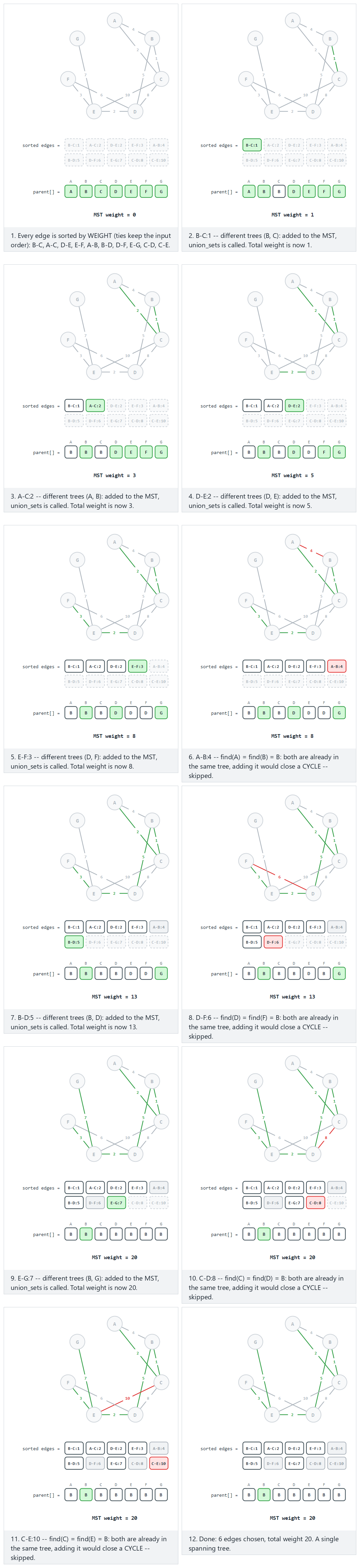
Try "7 vertices, 10 edges, one component", "9 vertices, 14 edges, many tied weights (input order breaks ties)", and the edge case "10 edges, 2 components -- the result is a spanning FOREST"; edges are A-B:WEIGHT, undirected.
Prim's algorithm keeps a key[]/parent[] pair per vertex and picks the cheapest outside key each round:
int min_key_vertex(int vertex_count) {
    int best = -1, best_key = INF;
    for (int v = 0; v < vertex_count; v++)
        if (!in_mst[v] && key_of[v] < best_key) { best_key = key_of[v]; best = v; }
    return best;
}

int prim_mst(Graph *g, int start, Edge *mst_out, int *total_out) {
    for (int v = 0; v < g->vertex_count; v++) { key_of[v] = INF; in_mst[v] = 0; parent_of[v] = -1; }
    key_of[start] = 0;
    int mst_len = 0, total = 0;
    for (int count = 0; count < g->vertex_count; count++) {
        int u = min_key_vertex(g->vertex_count);
        if (u == -1 || key_of[u] == INF) break;         /* nothing left reachable */
        in_mst[u] = 1;
        if (parent_of[u] != -1) {
            mst_out[mst_len].a = parent_of[u]; mst_out[mst_len].b = u; mst_out[mst_len].w = key_of[u];
            mst_len++; total += key_of[u];
        }
        for (AdjNode *n = g->adj[u]; n != NULL; n = n->next)      /* alphabetical order */
            if (!in_mst[n->to] && n->weight < key_of[n->to]) { key_of[n->to] = n->weight; parent_of[n->to] = u; }
    }
    *total_out = total;
    return mst_len;
}
static int minKeyVertex(int vertexCount) {
    int best = -1, bestKey = INF;
    for (int v = 0; v < vertexCount; v++)
        if (!inMst[v] && keyOf[v] < bestKey) { bestKey = keyOf[v]; best = v; }
    return best;
}

static int primMst(Graph g, int start, Edge[] mstOut, int[] totalOut) {
    for (int v = 0; v < g.vertexCount; v++) { keyOf[v] = INF; inMst[v] = false; parentOf[v] = -1; }
    keyOf[start] = 0;
    int mstLen = 0, total = 0;
    for (int count = 0; count < g.vertexCount; count++) {
        int u = minKeyVertex(g.vertexCount);
        if (u == -1 || keyOf[u] == INF) break;           // nothing left reachable
        inMst[u] = true;
        if (parentOf[u] != -1) {
            mstOut[mstLen] = new Edge(); mstOut[mstLen].a = parentOf[u]; mstOut[mstLen].b = u; mstOut[mstLen].w = keyOf[u];
            mstLen++; total += keyOf[u];
        }
        for (AdjNode n = g.adj[u]; n != null; n = n.next)         // alphabetical order
            if (!inMst[n.to] && n.weight < keyOf[n.to]) { keyOf[n.to] = n.weight; parentOf[n.to] = u; }
    }
    totalOut[0] = total;
    return mstLen;
}

The "priority queue" row is a simple sorted array here, not a heap — try "7 vertices, 10 edges, starts at A" (the same graph as Kruskal's normal example: compare the two MSTs — same total weight, possibly different edges when weights tie) and the edge case "2 components, starts at A -- F..J are never reached"; input is start=A A-B:4 ....
4.4 Try it
Full program: kruskal_mst.c / KruskalMst.java
/* Week 9 -- Graph Algorithms
 * Kruskal's minimum spanning tree: sort every edge by weight, then scan it
 * in that order and add it to the tree with UNION-FIND (union by rank +
 * path compression) unless it would close a cycle. Ties keep the input
 * order (a stable sort). If the graph is disconnected, Kruskal still
 * finishes and produces a minimum spanning FOREST.
 * CEN207 Data Structures (formerly CE205)
 */
#include <stdio.h>
#include <string.h>
#include <stdlib.h>

#define MAX_V 32
#define MAX_E 64
#define MAX_LBL 4

typedef struct { int a, b, w, idx; } Edge;   /* idx = original input position, an explicit tie-break */

char label[MAX_V][MAX_LBL];
int vertex_count;
int parent_of[MAX_V], rank_of[MAX_V];

static int find_or_add_vertex(const char *lbl) {
    for (int i = 0; i < vertex_count; i++)
        if (strcmp(label[i], lbl) == 0) return i;
    strncpy(label[vertex_count], lbl, MAX_LBL - 1);
    label[vertex_count][MAX_LBL - 1] = '\0';
    return vertex_count++;
}

int find(int v) {
    int root = v;
    while (parent_of[root] != root) root = parent_of[root];
    while (parent_of[v] != root) { int next = parent_of[v]; parent_of[v] = root; v = next; }
    return root;
}

void union_sets(int a, int b) {
    int ra = find(a), rb = find(b);
    if (rank_of[ra] < rank_of[rb]) parent_of[ra] = rb;
    else if (rank_of[ra] > rank_of[rb]) parent_of[rb] = ra;
    else { parent_of[rb] = ra; rank_of[ra]++; }
}

int cmp_weight(const void *x, const void *y) {
    const Edge *ex = x, *ey = y;
    if (ex->w != ey->w) return ex->w - ey->w;
    return ex->idx - ey->idx;               /* explicit tie-break: qsort is not guaranteed stable */
}

int kruskal_mst(Edge *sorted, int edge_count, Edge *mst_out, int *total_out) {
    for (int v = 0; v < vertex_count; v++) { parent_of[v] = v; rank_of[v] = 0; }
    qsort(sorted, (size_t) edge_count, sizeof(Edge), cmp_weight);   /* ascending by weight, stable ties */
    int mst_len = 0, total = 0;
    for (int i = 0; i < edge_count; i++) {
        if (find(sorted[i].a) == find(sorted[i].b)) continue;    /* would close a cycle */
        union_sets(sorted[i].a, sorted[i].b);
        mst_out[mst_len] = sorted[i]; mst_len++;
        total += sorted[i].w;
    }
    *total_out = total;
    return mst_len;
}

typedef struct { const char *a, *b; int w; } EdgeIn;

static void run_scenario(const char *label_txt, EdgeIn edges[], int n) {
    printf("-- %s --\n", label_txt);
    vertex_count = 0;
    Edge sorted[MAX_E];
    for (int i = 0; i < n; i++) sorted[i] = (Edge) { find_or_add_vertex(edges[i].a), find_or_add_vertex(edges[i].b), edges[i].w, i };

    Edge mst[MAX_E]; int total = 0;
    int mst_len = kruskal_mst(sorted, n, mst, &total);

    printf("MST edges:");
    for (int i = 0; i < mst_len; i++) printf(" %s-%s:%d", label[mst[i].a], label[mst[i].b], mst[i].w);
    printf("\ntotal weight = %d\n", total);

    int roots = 0;
    for (int i = 0; i < vertex_count; i++) if (find(i) == i) roots++;
    printf("components = %d%s\n\n", roots, roots > 1 ? " (a spanning forest)" : "");
}

int main(void) {
    EdgeIn normal[] = {
        {"A", "B", 4}, {"A", "C", 2}, {"B", "C", 1}, {"B", "D", 5},
        {"C", "D", 8}, {"C", "E", 10}, {"D", "E", 2}, {"D", "F", 6},
        {"E", "F", 3}, {"E", "G", 7}
    };
    run_scenario("normal: 7 vertices, 10 edges, one component", normal, 10);

    EdgeIn hard[] = {
        {"A", "B", 3}, {"A", "C", 3}, {"B", "C", 3}, {"B", "D", 5},
        {"C", "D", 3}, {"C", "E", 6}, {"D", "E", 3}, {"D", "F", 4},
        {"E", "F", 3}, {"F", "G", 2}, {"F", "H", 3}, {"G", "H", 1},
        {"H", "I", 3}, {"G", "I", 5}
    };
    run_scenario("hard: 9 vertices, 14 edges, many tied weights (input order breaks ties)", hard, 14);

    EdgeIn disconnected[] = {
        {"A", "B", 2}, {"B", "C", 4}, {"A", "C", 5}, {"C", "D", 1}, {"D", "E", 3},
        {"F", "G", 2}, {"G", "H", 6}, {"F", "H", 7}, {"H", "I", 3}, {"I", "J", 4}
    };
    run_scenario("edge: 10 edges, 2 components -- the result is a spanning FOREST", disconnected, 10);

    EdgeIn two_vertices[] = { {"A", "B", 9} };
    run_scenario("edge: 2 vertices, 1 edge", two_vertices, 1);

    return 0;
}
/* Week 9 -- Graph Algorithms
 * Kruskal's minimum spanning tree: sort every edge by weight, then scan it
 * in that order and add it to the tree with UNION-FIND (union by rank +
 * path compression) unless it would close a cycle. Ties keep the input
 * order (an explicit tie-break by original index). If the graph is
 * disconnected, Kruskal still finishes and produces a minimum spanning
 * FOREST.
 * CEN207 Data Structures (formerly CE205)
 */
import java.util.Arrays;
import java.util.Comparator;

public class KruskalMst {
    static final int MAX_V = 32;

    static class Edge { int a, b, w, idx; Edge(int a, int b, int w, int idx) { this.a = a; this.b = b; this.w = w; this.idx = idx; } }

    static String[] label = new String[MAX_V];
    static int vertexCount;
    static int[] parentOf = new int[MAX_V], rankOf = new int[MAX_V];

    static int findOrAddVertex(String lbl) {
        for (int i = 0; i < vertexCount; i++)
            if (label[i].equals(lbl)) return i;
        label[vertexCount] = lbl;
        return vertexCount++;
    }

    static int find(int v) {
        int root = v;
        while (parentOf[root] != root) root = parentOf[root];
        while (parentOf[v] != root) { int next = parentOf[v]; parentOf[v] = root; v = next; }
        return root;
    }

    static void unionSets(int a, int b) {
        int ra = find(a), rb = find(b);
        if (rankOf[ra] < rankOf[rb]) parentOf[ra] = rb;
        else if (rankOf[ra] > rankOf[rb]) parentOf[rb] = ra;
        else { parentOf[rb] = ra; rankOf[ra]++; }
    }

    static int cmpWeight(Edge x, Edge y) { return x.w != y.w ? x.w - y.w : x.idx - y.idx; }

    static int kruskalMst(Edge[] sorted, Edge[] mstOut, int[] totalOut) {
        for (int v = 0; v < vertexCount; v++) { parentOf[v] = v; rankOf[v] = 0; }
        Arrays.sort(sorted, Comparator.comparingInt((Edge e) -> e.w).thenComparingInt(e -> e.idx));
        int mstLen = 0, total = 0;
        for (Edge e : sorted) {
            if (find(e.a) == find(e.b)) continue;      // would close a cycle
            unionSets(e.a, e.b);
            mstOut[mstLen] = e; mstLen++;
            total += e.w;
        }
        totalOut[0] = total;
        return mstLen;
    }

    static class EdgeIn { String a, b; int w; EdgeIn(String a, String b, int w) { this.a = a; this.b = b; this.w = w; } }

    static void runScenario(String labelTxt, EdgeIn[] edges) {
        System.out.println("-- " + labelTxt + " --");
        vertexCount = 0;
        Edge[] sorted = new Edge[edges.length];
        for (int i = 0; i < edges.length; i++) sorted[i] = new Edge(findOrAddVertex(edges[i].a), findOrAddVertex(edges[i].b), edges[i].w, i);

        Edge[] mst = new Edge[edges.length]; int[] total = new int[1];
        int mstLen = kruskalMst(sorted, mst, total);

        StringBuilder sb = new StringBuilder("MST edges:");
        for (int i = 0; i < mstLen; i++) sb.append(' ').append(label[mst[i].a]).append('-').append(label[mst[i].b]).append(':').append(mst[i].w);
        System.out.println(sb);
        System.out.println("total weight = " + total[0]);

        int roots = 0;
        for (int i = 0; i < vertexCount; i++) if (find(i) == i) roots++;
        System.out.println("components = " + roots + (roots > 1 ? " (a spanning forest)" : ""));
        System.out.println();
    }

    public static void main(String[] args) {
        EdgeIn[] normal = {
            new EdgeIn("A", "B", 4), new EdgeIn("A", "C", 2), new EdgeIn("B", "C", 1), new EdgeIn("B", "D", 5),
            new EdgeIn("C", "D", 8), new EdgeIn("C", "E", 10), new EdgeIn("D", "E", 2), new EdgeIn("D", "F", 6),
            new EdgeIn("E", "F", 3), new EdgeIn("E", "G", 7)
        };
        runScenario("normal: 7 vertices, 10 edges, one component", normal);

        EdgeIn[] hard = {
            new EdgeIn("A", "B", 3), new EdgeIn("A", "C", 3), new EdgeIn("B", "C", 3), new EdgeIn("B", "D", 5),
            new EdgeIn("C", "D", 3), new EdgeIn("C", "E", 6), new EdgeIn("D", "E", 3), new EdgeIn("D", "F", 4),
            new EdgeIn("E", "F", 3), new EdgeIn("F", "G", 2), new EdgeIn("F", "H", 3), new EdgeIn("G", "H", 1),
            new EdgeIn("H", "I", 3), new EdgeIn("G", "I", 5)
        };
        runScenario("hard: 9 vertices, 14 edges, many tied weights (input order breaks ties)", hard);

        EdgeIn[] disconnected = {
            new EdgeIn("A", "B", 2), new EdgeIn("B", "C", 4), new EdgeIn("A", "C", 5), new EdgeIn("C", "D", 1), new EdgeIn("D", "E", 3),
            new EdgeIn("F", "G", 2), new EdgeIn("G", "H", 6), new EdgeIn("F", "H", 7), new EdgeIn("H", "I", 3), new EdgeIn("I", "J", 4)
        };
        runScenario("edge: 10 edges, 2 components -- the result is a spanning FOREST", disconnected);

        EdgeIn[] twoVertices = { new EdgeIn("A", "B", 9) };
        runScenario("edge: 2 vertices, 1 edge", twoVertices);
    }
}
Full program: prim_mst.c / PrimMst.java
/* Week 9 -- Graph Algorithms
 * Prim's minimum spanning tree: grow ONE tree from a start vertex. Every
 * vertex not yet in the tree keeps a "key" (the cheapest edge weight
 * connecting it to the tree so far); each round the smallest key is picked
 * and its neighbours' keys are relaxed. Unlike Kruskal, Prim only grows
 * from `start`: a vertex in another component is never reached (key stays
 * "infinite").
 * CEN207 Data Structures (formerly CE205)
 */
#include <stdio.h>
#include <string.h>
#include <stdlib.h>

#define MAX_V   32
#define MAX_LBL 4
#define INF 1000000000

typedef struct AdjNode { int to, weight; struct AdjNode *next; } AdjNode;
typedef struct Graph {
    char label[MAX_V][MAX_LBL];
    AdjNode *adj[MAX_V];
    int vertex_count;
} Graph;

int key_of[MAX_V], parent_of[MAX_V], in_mst[MAX_V];

int min_key_vertex(int vertex_count) {
    int best = -1, best_key = INF;
    for (int v = 0; v < vertex_count; v++)
        if (!in_mst[v] && key_of[v] < best_key) { best_key = key_of[v]; best = v; }
    return best;
}

typedef struct { int a, b, w; } Edge;

int prim_mst(Graph *g, int start, Edge *mst_out, int *total_out) {
    for (int v = 0; v < g->vertex_count; v++) { key_of[v] = INF; in_mst[v] = 0; parent_of[v] = -1; }
    key_of[start] = 0;
    int mst_len = 0, total = 0;
    for (int count = 0; count < g->vertex_count; count++) {
        int u = min_key_vertex(g->vertex_count);
        if (u == -1 || key_of[u] == INF) break;         /* nothing left reachable */
        in_mst[u] = 1;
        if (parent_of[u] != -1) {
            mst_out[mst_len].a = parent_of[u]; mst_out[mst_len].b = u; mst_out[mst_len].w = key_of[u];
            mst_len++; total += key_of[u];
        }
        for (AdjNode *n = g->adj[u]; n != NULL; n = n->next)      /* alphabetical order */
            if (!in_mst[n->to] && n->weight < key_of[n->to]) { key_of[n->to] = n->weight; parent_of[n->to] = u; }
    }
    *total_out = total;
    return mst_len;
}

/* ---- construction: build Graph from a (label, label, weight) UNDIRECTED edge list. ---- */

typedef struct { const char *a, *b; int w; } EdgeIn;

static int find_or_add_vertex(Graph *g, const char *lbl) {
    for (int i = 0; i < g->vertex_count; i++)
        if (strcmp(g->label[i], lbl) == 0) return i;
    strncpy(g->label[g->vertex_count], lbl, MAX_LBL - 1);
    g->label[g->vertex_count][MAX_LBL - 1] = '\0';
    g->adj[g->vertex_count] = NULL;
    return g->vertex_count++;
}

static AdjNode *new_node(int to, int w) {
    AdjNode *n = malloc(sizeof(AdjNode));
    n->to = to; n->weight = w; n->next = NULL;
    return n;
}

static void add_neighbour_sorted(Graph *g, int v, int neighbour, int w) {
    AdjNode *n = new_node(neighbour, w);
    if (g->adj[v] == NULL || strcmp(g->label[g->adj[v]->to], g->label[neighbour]) > 0) {
        n->next = g->adj[v];
        g->adj[v] = n;
        return;
    }
    AdjNode *cur = g->adj[v];
    while (cur->next != NULL && strcmp(g->label[cur->next->to], g->label[neighbour]) <= 0)
        cur = cur->next;
    n->next = cur->next;
    cur->next = n;
}

static void build_graph(Graph *g, EdgeIn edges[], int n) {
    g->vertex_count = 0;
    for (int i = 0; i < MAX_V; i++) g->adj[i] = NULL;
    for (int i = 0; i < n; i++) {
        int a = find_or_add_vertex(g, edges[i].a), b = find_or_add_vertex(g, edges[i].b);
        add_neighbour_sorted(g, a, b, edges[i].w);
        add_neighbour_sorted(g, b, a, edges[i].w);
    }
}

static void free_graph(Graph *g) {
    for (int i = 0; i < g->vertex_count; i++) {
        AdjNode *cur = g->adj[i];
        while (cur) { AdjNode *nx = cur->next; free(cur); cur = nx; }
        g->adj[i] = NULL;
    }
}

static void run_scenario(const char *label_txt, const char *start_label, EdgeIn edges[], int n) {
    printf("-- %s --\n", label_txt);
    Graph g;
    build_graph(&g, edges, n);
    int start = find_or_add_vertex(&g, start_label);

    Edge mst[MAX_V]; int total = 0;
    int mst_len = prim_mst(&g, start, mst, &total);

    printf("MST edges:");
    for (int i = 0; i < mst_len; i++) printf(" %s-%s:%d", g.label[mst[i].a], g.label[mst[i].b], mst[i].w);
    printf("\ntotal weight = %d\n", total);

    int unreached = 0;
    for (int v = 0; v < g.vertex_count; v++) if (!in_mst[v]) unreached = 1;
    if (unreached) {
        printf("unreached:");
        for (int v = 0; v < g.vertex_count; v++) if (!in_mst[v]) printf(" %s", g.label[v]);
        printf("\n");
    }

    free_graph(&g);
    printf("\n");
}

int main(void) {
    EdgeIn normal[] = {
        {"A", "B", 4}, {"A", "C", 2}, {"B", "C", 1}, {"B", "D", 5},
        {"C", "D", 8}, {"C", "E", 10}, {"D", "E", 2}, {"D", "F", 6},
        {"E", "F", 3}, {"E", "G", 7}
    };
    run_scenario("normal: 7 vertices, 10 edges, starts at A", "A", normal, 10);

    EdgeIn hard[] = {
        {"A", "B", 3}, {"A", "C", 3}, {"B", "C", 3}, {"B", "D", 5},
        {"C", "D", 3}, {"C", "E", 6}, {"D", "E", 3}, {"D", "F", 4},
        {"E", "F", 3}, {"F", "G", 2}, {"F", "H", 3}, {"G", "H", 1},
        {"H", "I", 3}, {"G", "I", 5}
    };
    run_scenario("hard: 9 vertices, 14 edges, starts at E, many tied weights", "E", hard, 14);

    EdgeIn disconnected[] = {
        {"A", "B", 2}, {"B", "C", 4}, {"A", "C", 5}, {"C", "D", 1}, {"D", "E", 3},
        {"F", "G", 2}, {"G", "H", 6}, {"F", "H", 7}, {"H", "I", 3}, {"I", "J", 4}
    };
    run_scenario("edge: 2 components, starts at A -- F..J are never reached", "A", disconnected, 10);

    EdgeIn two_vertices[] = { {"A", "B", 9} };
    run_scenario("edge: 2 vertices, 1 edge", "A", two_vertices, 1);

    return 0;
}
/* Week 9 -- Graph Algorithms
 * Prim's minimum spanning tree: grow ONE tree from a start vertex. Every
 * vertex not yet in the tree keeps a "key" (the cheapest edge weight
 * connecting it to the tree so far); each round the smallest key is picked
 * and its neighbours' keys are relaxed. Unlike Kruskal, Prim only grows
 * from `start`: a vertex in another component is never reached (key stays
 * "infinite").
 * CEN207 Data Structures (formerly CE205)
 */
public class PrimMst {
    static final int MAX_V = 32, INF = 1000000000;

    static class AdjNode { int to, weight; AdjNode next; AdjNode(int to, int w) { this.to = to; this.weight = w; } }
    static class Graph {
        String[] label = new String[MAX_V];
        AdjNode[] adj = new AdjNode[MAX_V];
        int vertexCount;
    }

    static int[] keyOf = new int[MAX_V], parentOf = new int[MAX_V]; static boolean[] inMst = new boolean[MAX_V];

    static int minKeyVertex(int vertexCount) {
        int best = -1, bestKey = INF;
        for (int v = 0; v < vertexCount; v++)
            if (!inMst[v] && keyOf[v] < bestKey) { bestKey = keyOf[v]; best = v; }
        return best;
    }

    static class Edge { int a, b, w; }

    static int primMst(Graph g, int start, Edge[] mstOut, int[] totalOut) {
        for (int v = 0; v < g.vertexCount; v++) { keyOf[v] = INF; inMst[v] = false; parentOf[v] = -1; }
        keyOf[start] = 0;
        int mstLen = 0, total = 0;
        for (int count = 0; count < g.vertexCount; count++) {
            int u = minKeyVertex(g.vertexCount);
            if (u == -1 || keyOf[u] == INF) break;           // nothing left reachable
            inMst[u] = true;
            if (parentOf[u] != -1) {
                mstOut[mstLen] = new Edge(); mstOut[mstLen].a = parentOf[u]; mstOut[mstLen].b = u; mstOut[mstLen].w = keyOf[u];
                mstLen++; total += keyOf[u];
            }
            for (AdjNode n = g.adj[u]; n != null; n = n.next)         // alphabetical order
                if (!inMst[n.to] && n.weight < keyOf[n.to]) { keyOf[n.to] = n.weight; parentOf[n.to] = u; }
        }
        totalOut[0] = total;
        return mstLen;
    }

    // ---- construction: build Graph from a (label, label, weight) UNDIRECTED edge list. ----

    static class EdgeIn { String a, b; int w; EdgeIn(String a, String b, int w) { this.a = a; this.b = b; this.w = w; } }

    static int findOrAddVertex(Graph g, String lbl) {
        for (int i = 0; i < g.vertexCount; i++)
            if (g.label[i].equals(lbl)) return i;
        g.label[g.vertexCount] = lbl;
        g.adj[g.vertexCount] = null;
        return g.vertexCount++;
    }

    static void addNeighbourSorted(Graph g, int v, int neighbour, int w) {
        AdjNode n = new AdjNode(neighbour, w);
        if (g.adj[v] == null || g.label[g.adj[v].to].compareTo(g.label[neighbour]) > 0) {
            n.next = g.adj[v];
            g.adj[v] = n;
            return;
        }
        AdjNode cur = g.adj[v];
        while (cur.next != null && g.label[cur.next.to].compareTo(g.label[neighbour]) <= 0)
            cur = cur.next;
        n.next = cur.next;
        cur.next = n;
    }

    static void buildGraph(Graph g, EdgeIn[] edges) {
        g.vertexCount = 0;
        for (int i = 0; i < MAX_V; i++) g.adj[i] = null;
        for (EdgeIn e : edges) {
            int a = findOrAddVertex(g, e.a), b = findOrAddVertex(g, e.b);
            addNeighbourSorted(g, a, b, e.w);
            addNeighbourSorted(g, b, a, e.w);
        }
    }

    static void runScenario(String labelTxt, String startLabel, EdgeIn[] edges) {
        System.out.println("-- " + labelTxt + " --");
        Graph g = new Graph();
        buildGraph(g, edges);
        int start = findOrAddVertex(g, startLabel);

        Edge[] mst = new Edge[MAX_V]; int[] total = new int[1];
        int mstLen = primMst(g, start, mst, total);

        StringBuilder sb = new StringBuilder("MST edges:");
        for (int i = 0; i < mstLen; i++) sb.append(' ').append(g.label[mst[i].a]).append('-').append(g.label[mst[i].b]).append(':').append(mst[i].w);
        System.out.println(sb);
        System.out.println("total weight = " + total[0]);

        boolean unreached = false;
        for (int v = 0; v < g.vertexCount; v++) if (!inMst[v]) unreached = true;
        if (unreached) {
            StringBuilder ub = new StringBuilder("unreached:");
            for (int v = 0; v < g.vertexCount; v++) if (!inMst[v]) ub.append(' ').append(g.label[v]);
            System.out.println(ub);
        }

        System.out.println();
    }

    public static void main(String[] args) {
        EdgeIn[] normal = {
            new EdgeIn("A", "B", 4), new EdgeIn("A", "C", 2), new EdgeIn("B", "C", 1), new EdgeIn("B", "D", 5),
            new EdgeIn("C", "D", 8), new EdgeIn("C", "E", 10), new EdgeIn("D", "E", 2), new EdgeIn("D", "F", 6),
            new EdgeIn("E", "F", 3), new EdgeIn("E", "G", 7)
        };
        runScenario("normal: 7 vertices, 10 edges, starts at A", "A", normal);

        EdgeIn[] hard = {
            new EdgeIn("A", "B", 3), new EdgeIn("A", "C", 3), new EdgeIn("B", "C", 3), new EdgeIn("B", "D", 5),
            new EdgeIn("C", "D", 3), new EdgeIn("C", "E", 6), new EdgeIn("D", "E", 3), new EdgeIn("D", "F", 4),
            new EdgeIn("E", "F", 3), new EdgeIn("F", "G", 2), new EdgeIn("F", "H", 3), new EdgeIn("G", "H", 1),
            new EdgeIn("H", "I", 3), new EdgeIn("G", "I", 5)
        };
        runScenario("hard: 9 vertices, 14 edges, starts at E, many tied weights", "E", hard);

        EdgeIn[] disconnected = {
            new EdgeIn("A", "B", 2), new EdgeIn("B", "C", 4), new EdgeIn("A", "C", 5), new EdgeIn("C", "D", 1), new EdgeIn("D", "E", 3),
            new EdgeIn("F", "G", 2), new EdgeIn("G", "H", 6), new EdgeIn("F", "H", 7), new EdgeIn("H", "I", 3), new EdgeIn("I", "J", 4)
        };
        runScenario("edge: 2 components, starts at A -- F..J are never reached", "A", disconnected);

        EdgeIn[] twoVertices = { new EdgeIn("A", "B", 9) };
        runScenario("edge: 2 vertices, 1 edge", "A", twoVertices);
    }
}
Try it
gcc -std=c11 -Wall -Wextra -o kruskal_mst kruskal_mst.c && ./kruskal_mst
javac -Xlint:all KruskalMst.java && java KruskalMst
-- normal: 7 vertices, 10 edges, one component --
MST edges: B-C:1 A-C:2 D-E:2 E-F:3 B-D:5 E-G:7
total weight = 20
components = 1

-- hard: 9 vertices, 14 edges, many tied weights (input order breaks ties) --
MST edges: G-H:1 F-G:2 A-B:3 A-C:3 C-D:3 D-E:3 E-F:3 H-I:3
total weight = 21
components = 1

-- edge: 10 edges, 2 components -- the result is a spanning FOREST --
MST edges: C-D:1 A-B:2 F-G:2 D-E:3 H-I:3 B-C:4 I-J:4 G-H:6
total weight = 25
components = 2 (a spanning forest)

-- edge: 2 vertices, 1 edge --
MST edges: A-B:9
total weight = 9
components = 1
Prim's program (gcc ... prim_mst.c, javac/java PrimMst) on the same "normal" graph:
-- normal: 7 vertices, 10 edges, starts at A --
MST edges: A-C:2 C-B:1 B-D:5 D-E:2 E-F:3 E-G:7
total weight = 20
Same total weight (20), same set of edges, found in a completely different order — exactly what the cut-property proof guarantees.
4.5 Complexity, mistakes, self-check
Complexity. Kruskal: O(E log E) to sort the edges (the dominant cost), plus O(E * α(V)) for the union-find operations — effectively O(E log E). Prim (this array-scan version, matching how the animation and program are built): O(V^2) — V rounds, each doing an O(V) scan for the minimum key. With a binary heap for the priority queue, Prim drops to O(E log V), better than Kruskal on dense graphs; this course uses the simpler array version so the priority queue's idea is visible as a plain sorted row, matching Dijkstra's priority queue below — the heap version is the natural next step once heaps (Week 4) and this row are both familiar.
Common mistakes
- Running Kruskal without sorting first (or sorting by the wrong field): the greedy proof only holds when edges are considered strictly cheapest-first.
- Checking
find(a) == find(b)using the raw parent pointers instead of callingfind(which compresses the path): this still gives the right yes/no answer but throws away the whole point of union-find's near-O(1) guarantee. - Calling Prim's algorithm on a graph and being surprised the MST does not include a vertex: check
in_mst[]— that vertex was never reachable fromstart, and Prim (unlike Kruskal) never discovers a second component on its own. - Assuming the MST is unique: with tied weights, several different edge sets can share the same minimum total (see "hard" above) — only the total weight is guaranteed unique, not the edge set.
Self-check: could Prim's algorithm ever pick a MORE expensive edge than Kruskal would, for the same graph?
No — both are provably optimal (the cut property holds regardless of which greedy strategy is used), so both always produce some MST, and every MST of a given graph has the same total weight. They can differ in which edges they pick when weights tie, never in the total.
5. Single-source shortest paths
5.1 A question to start
A minimum spanning tree connects everything as cheaply as possible in total — it says nothing about the cheapest way to get from one particular vertex to one particular other vertex. Given a starting city and a road network with distances (or tolls, or travel times) on every road, what is the cheapest way to reach every other city from it?
5.2 A short history, and the idea
Edsger Dijkstra devised his algorithm in 1956 (published 1959) as, in his own later account, a 20-minute exercise to demonstrate a new computer to the public — and it remains the standard answer whenever every weight is non-negative. It is Prim's algorithm with one crucial change of bookkeeping: instead of key[v] = "the cheapest single edge connecting v to the tree", track dist[v] = "the cheapest total path from start to v found so far". Each round, pick the not-yet-finished vertex with the smallest dist — once picked, that distance is final and can never shrink again, precisely because every other edge weight is non-negative (no edge anywhere in the graph could ever make a longer path suddenly cheaper). Relax its outgoing edges (dist[u] + weight < dist[v]?) and repeat.
Negative weights break that final-once-popped guarantee directly: a vertex popped early with a "final" distance could later be beaten by a path through a very negative edge discovered afterwards. Richard Bellman and Lester Ford (independently, late 1950s) gave an algorithm that tolerates negative weights by giving up Dijkstra's greedy "pop the minimum" step entirely: instead, relax every edge, in a fixed order, for up to V - 1 rounds — enough rounds for the cheapest path to any vertex (which uses at most V - 1 edges, since a shortest path never repeats a vertex) to have propagated all the way through. A V-th round that still finds an improvement is proof of a negative cycle — a loop whose weights sum below zero, around which "distance" can be shrunk forever, making shortest path undefined.
5.3 In memory, and the code
int min_dist_vertex(int vertex_count) {
    int best = -1, best_dist = INF;
    for (int v = 0; v < vertex_count; v++)
        if (!done[v] && dist_of[v] < best_dist) { best_dist = dist_of[v]; best = v; }
    return best;
}

void dijkstra(Graph *g, int start) {
    for (int v = 0; v < g->vertex_count; v++) { dist_of[v] = INF; done[v] = 0; parent_of[v] = -1; }
    dist_of[start] = 0;
    for (int count = 0; count < g->vertex_count; count++) {
        int u = min_dist_vertex(g->vertex_count);
        if (u == -1 || dist_of[u] == INF) break;      /* nothing left reachable */
        done[u] = 1;
        for (AdjNode *n = g->adj[u]; n != NULL; n = n->next) {   /* alphabetical order */
            int cand = dist_of[u] + n->weight;
            if (!done[n->to] && cand < dist_of[n->to]) { dist_of[n->to] = cand; parent_of[n->to] = u; }
        }
    }
}
int minDistVertex(int vertexCount) {
    int best = -1, bestDist = INF;
    for (int v = 0; v < vertexCount; v++)
        if (!done[v] && distOf[v] < bestDist) { bestDist = distOf[v]; best = v; }
    return best;
}

void dijkstra(Graph g, int start) {
    for (int v = 0; v < g.vertexCount; v++) { distOf[v] = INF; done[v] = false; parentOf[v] = -1; }
    distOf[start] = 0;
    for (int count = 0; count < g.vertexCount; count++) {
        int u = minDistVertex(g.vertexCount);
        if (u == -1 || distOf[u] == INF) break;       // nothing left reachable
        done[u] = true;
        for (AdjNode n = g.adj[u]; n != null; n = n.next) {    // alphabetical order
            int cand = distOf[u] + n.weight;
            if (!done[n.to] && cand < distOf[n.to]) { distOf[n.to] = cand; parentOf[n.to] = u; }
        }
    }
}

Directed, weighted, start-vertex input, start=A A>B:4 ... — the parser rejects a negative weight outright ("Dijkstra does not accept a negative weight: see Bellman-Ford for negative edges"), so you cannot accidentally build a case Dijkstra cannot handle. Try "8 vertices, 10 edges, starts at A", "10 vertices, 14 edges, starts at A, many tied distances", and the edge case "starts at A, F..J are never reachable via the directed edges".
Bellman-Ford relaxes every edge, V - 1 times, in a fixed vertex order, then checks once more for an improvement:
int bellman_ford(Graph *g, int start) {
    for (int v = 0; v < g->vertex_count; v++) { dist_of[v] = INF; parent_of[v] = -1; }
    dist_of[start] = 0;
    for (int pass = 1; pass <= g->vertex_count - 1; pass++) {
        int changed = 0;
        for (int u = 0; u < g->vertex_count; u++) {           /* alphabetical order */
            if (dist_of[u] == INF) continue;
            for (AdjNode *n = g->adj[u]; n != NULL; n = n->next) {
                int cand = dist_of[u] + n->weight;
                if (cand < dist_of[n->to]) { dist_of[n->to] = cand; parent_of[n->to] = u; changed = 1; }
            }
        }
        if (!changed) break;                                  /* nothing changed: done early */
    }
    int neg_cycle = 0;
    for (int u = 0; u < g->vertex_count; u++) {                /* one more pass: detect a negative cycle */
        if (dist_of[u] == INF) continue;
        for (AdjNode *n = g->adj[u]; n != NULL; n = n->next)
            if (dist_of[u] + n->weight < dist_of[n->to]) neg_cycle = 1;
    }
    return neg_cycle;
}
boolean bellmanFord(Graph g, int start) {
    for (int v = 0; v < g.vertexCount; v++) { distOf[v] = INF; parentOf[v] = -1; }
    distOf[start] = 0;
    for (int pass = 1; pass <= g.vertexCount - 1; pass++) {
        boolean changed = false;
        for (int u = 0; u < g.vertexCount; u++) {              // alphabetical order
            if (distOf[u] == INF) continue;
            for (AdjNode n = g.adj[u]; n != null; n = n.next) {
                int cand = distOf[u] + n.weight;
                if (cand < distOf[n.to]) { distOf[n.to] = cand; parentOf[n.to] = u; changed = true; }
            }
        }
        if (!changed) break;                                   // nothing changed: done early
    }
    boolean negCycle = false;
    for (int u = 0; u < g.vertexCount; u++) {                   // one more pass: detect a negative cycle
        if (distOf[u] == INF) continue;
        for (AdjNode n = g.adj[u]; n != null; n = n.next)
            if (distOf[u] + n.weight < distOf[n.to]) negCycle = true;
    }
    return negCycle;
}

Same start=A A>B:4 ... notation, but the weight may be negative. Try "7 vertices, 10 edges, all positive" (compare its output to Dijkstra's identical graph — same distances, as they must be), "8 vertices, 11 edges, negative edges present but no cycle (a DAG)", and the required edge case "A-B-C-A is a negative cycle (total -1), starts at A" — watch the detection round find a still-relaxable edge.
5.4 Try it
Full program: dijkstra.c / Dijkstra.java
/* Week 9 -- Graph Algorithms
 * Dijkstra's shortest path: single source, non-negative weights only. Every
 * not-yet-finished vertex keeps a "dist" (its current best distance from
 * the start); each round the smallest is picked (it is now final) and its
 * outgoing edges are relaxed.
 * CEN207 Data Structures (formerly CE205)
 */
#include <stdio.h>
#include <string.h>
#include <stdlib.h>

#define MAX_V   32
#define MAX_LBL 4
#define INF 1000000000

typedef struct AdjNode { int to, weight; struct AdjNode *next; } AdjNode;
typedef struct Graph {
    char label[MAX_V][MAX_LBL];
    AdjNode *adj[MAX_V];
    int vertex_count;
} Graph;

int dist_of[MAX_V], parent_of[MAX_V], done[MAX_V];

int min_dist_vertex(int vertex_count) {
    int best = -1, best_dist = INF;
    for (int v = 0; v < vertex_count; v++)
        if (!done[v] && dist_of[v] < best_dist) { best_dist = dist_of[v]; best = v; }
    return best;
}

void dijkstra(Graph *g, int start) {
    for (int v = 0; v < g->vertex_count; v++) { dist_of[v] = INF; done[v] = 0; parent_of[v] = -1; }
    dist_of[start] = 0;
    for (int count = 0; count < g->vertex_count; count++) {
        int u = min_dist_vertex(g->vertex_count);
        if (u == -1 || dist_of[u] == INF) break;      /* nothing left reachable */
        done[u] = 1;
        for (AdjNode *n = g->adj[u]; n != NULL; n = n->next) {   /* alphabetical order */
            int cand = dist_of[u] + n->weight;
            if (!done[n->to] && cand < dist_of[n->to]) { dist_of[n->to] = cand; parent_of[n->to] = u; }
        }
    }
}

/* ---- construction: build Graph from a (label, label, weight) DIRECTED edge list. ---- */

typedef struct { const char *a, *b; int w; } EdgeIn;

static int find_or_add_vertex(Graph *g, const char *lbl) {
    for (int i = 0; i < g->vertex_count; i++)
        if (strcmp(g->label[i], lbl) == 0) return i;
    strncpy(g->label[g->vertex_count], lbl, MAX_LBL - 1);
    g->label[g->vertex_count][MAX_LBL - 1] = '\0';
    g->adj[g->vertex_count] = NULL;
    return g->vertex_count++;
}

static AdjNode *new_node(int to, int w) {
    AdjNode *n = malloc(sizeof(AdjNode));
    n->to = to; n->weight = w; n->next = NULL;
    return n;
}

static void add_neighbour_sorted(Graph *g, int v, int neighbour, int w) {
    AdjNode *n = new_node(neighbour, w);
    if (g->adj[v] == NULL || strcmp(g->label[g->adj[v]->to], g->label[neighbour]) > 0) {
        n->next = g->adj[v];
        g->adj[v] = n;
        return;
    }
    AdjNode *cur = g->adj[v];
    while (cur->next != NULL && strcmp(g->label[cur->next->to], g->label[neighbour]) <= 0)
        cur = cur->next;
    n->next = cur->next;
    cur->next = n;
}

static void build_graph(Graph *g, EdgeIn edges[], int n) {
    g->vertex_count = 0;
    for (int i = 0; i < MAX_V; i++) g->adj[i] = NULL;
    for (int i = 0; i < n; i++) {
        int a = find_or_add_vertex(g, edges[i].a), b = find_or_add_vertex(g, edges[i].b);
        add_neighbour_sorted(g, a, b, edges[i].w);
    }
}

static void free_graph(Graph *g) {
    for (int i = 0; i < g->vertex_count; i++) {
        AdjNode *cur = g->adj[i];
        while (cur) { AdjNode *nx = cur->next; free(cur); cur = nx; }
        g->adj[i] = NULL;
    }
}

static void run_scenario(const char *label_txt, const char *start_label, EdgeIn edges[], int n) {
    printf("-- %s --\n", label_txt);
    Graph g;
    build_graph(&g, edges, n);
    int start = find_or_add_vertex(&g, start_label);

    dijkstra(&g, start);

    printf("distances:");
    for (int v = 0; v < g.vertex_count; v++) {
        if (dist_of[v] == INF) printf(" %s=inf", g.label[v]);
        else printf(" %s=%d", g.label[v], dist_of[v]);
    }
    printf("\n");

    free_graph(&g);
    printf("\n");
}

int main(void) {
    EdgeIn normal[] = {
        {"A", "B", 4}, {"A", "C", 2}, {"C", "B", 1}, {"B", "D", 5},
        {"C", "D", 8}, {"C", "E", 10}, {"D", "E", 2}, {"D", "F", 6},
        {"E", "F", 3}, {"E", "G", 7}
    };
    run_scenario("normal: 8 vertices, 10 edges, starts at A", "A", normal, 10);

    EdgeIn hard[] = {
        {"A", "B", 2}, {"A", "C", 2}, {"B", "D", 3}, {"C", "D", 3},
        {"B", "E", 6}, {"C", "F", 6}, {"D", "G", 2}, {"E", "G", 3},
        {"F", "G", 3}, {"G", "H", 1}, {"H", "I", 4}, {"H", "J", 4},
        {"E", "H", 2}, {"F", "H", 2}
    };
    run_scenario("hard: 10 vertices, 14 edges, starts at A, many tied distances", "A", hard, 14);

    EdgeIn unreachable[] = {
        {"A", "B", 2}, {"B", "C", 4}, {"A", "C", 5}, {"C", "D", 1}, {"D", "E", 3},
        {"F", "G", 2}, {"G", "H", 6}, {"H", "F", 7}, {"H", "I", 3}, {"I", "J", 4}
    };
    run_scenario("edge: starts at A, F..J are never reachable via the directed edges", "A", unreachable, 10);

    EdgeIn two_vertices[] = { {"A", "B", 9} };
    run_scenario("edge: 2 vertices, 1 edge", "A", two_vertices, 1);

    return 0;
}
/* Week 9 -- Graph Algorithms
 * Dijkstra's shortest path: single source, non-negative weights only. Every
 * not-yet-finished vertex keeps a "dist" (its current best distance from
 * the start); each round the smallest is picked (it is now final) and its
 * outgoing edges are relaxed.
 * CEN207 Data Structures (formerly CE205)
 */
public class Dijkstra {
    static final int MAX_V = 32, INF = 1000000000;

    static class AdjNode { int to, weight; AdjNode next; AdjNode(int to, int w) { this.to = to; this.weight = w; } }
    static class Graph {
        String[] label = new String[MAX_V];
        AdjNode[] adj = new AdjNode[MAX_V];
        int vertexCount;
    }

    static int[] distOf = new int[MAX_V], parentOf = new int[MAX_V]; static boolean[] done = new boolean[MAX_V];

    static int minDistVertex(int vertexCount) {
        int best = -1, bestDist = INF;
        for (int v = 0; v < vertexCount; v++)
            if (!done[v] && distOf[v] < bestDist) { bestDist = distOf[v]; best = v; }
        return best;
    }

    static void dijkstra(Graph g, int start) {
        for (int v = 0; v < g.vertexCount; v++) { distOf[v] = INF; done[v] = false; parentOf[v] = -1; }
        distOf[start] = 0;
        for (int count = 0; count < g.vertexCount; count++) {
            int u = minDistVertex(g.vertexCount);
            if (u == -1 || distOf[u] == INF) break;       // nothing left reachable
            done[u] = true;
            for (AdjNode n = g.adj[u]; n != null; n = n.next) {    // alphabetical order
                int cand = distOf[u] + n.weight;
                if (!done[n.to] && cand < distOf[n.to]) { distOf[n.to] = cand; parentOf[n.to] = u; }
            }
        }
    }

    // ---- construction: build Graph from a (label, label, weight) DIRECTED edge list. ----

    static class EdgeIn { String a, b; int w; EdgeIn(String a, String b, int w) { this.a = a; this.b = b; this.w = w; } }

    static int findOrAddVertex(Graph g, String lbl) {
        for (int i = 0; i < g.vertexCount; i++)
            if (g.label[i].equals(lbl)) return i;
        g.label[g.vertexCount] = lbl;
        g.adj[g.vertexCount] = null;
        return g.vertexCount++;
    }

    static void addNeighbourSorted(Graph g, int v, int neighbour, int w) {
        AdjNode n = new AdjNode(neighbour, w);
        if (g.adj[v] == null || g.label[g.adj[v].to].compareTo(g.label[neighbour]) > 0) {
            n.next = g.adj[v];
            g.adj[v] = n;
            return;
        }
        AdjNode cur = g.adj[v];
        while (cur.next != null && g.label[cur.next.to].compareTo(g.label[neighbour]) <= 0)
            cur = cur.next;
        n.next = cur.next;
        cur.next = n;
    }

    static void buildGraph(Graph g, EdgeIn[] edges) {
        g.vertexCount = 0;
        for (int i = 0; i < MAX_V; i++) g.adj[i] = null;
        for (EdgeIn e : edges) {
            int a = findOrAddVertex(g, e.a), b = findOrAddVertex(g, e.b);
            addNeighbourSorted(g, a, b, e.w);
        }
    }

    static void runScenario(String labelTxt, String startLabel, EdgeIn[] edges) {
        System.out.println("-- " + labelTxt + " --");
        Graph g = new Graph();
        buildGraph(g, edges);
        int start = findOrAddVertex(g, startLabel);

        dijkstra(g, start);

        StringBuilder sb = new StringBuilder("distances:");
        for (int v = 0; v < g.vertexCount; v++) {
            if (distOf[v] == INF) sb.append(' ').append(g.label[v]).append("=inf");
            else sb.append(' ').append(g.label[v]).append('=').append(distOf[v]);
        }
        System.out.println(sb);

        System.out.println();
    }

    public static void main(String[] args) {
        EdgeIn[] normal = {
            new EdgeIn("A", "B", 4), new EdgeIn("A", "C", 2), new EdgeIn("C", "B", 1), new EdgeIn("B", "D", 5),
            new EdgeIn("C", "D", 8), new EdgeIn("C", "E", 10), new EdgeIn("D", "E", 2), new EdgeIn("D", "F", 6),
            new EdgeIn("E", "F", 3), new EdgeIn("E", "G", 7)
        };
        runScenario("normal: 8 vertices, 10 edges, starts at A", "A", normal);

        EdgeIn[] hard = {
            new EdgeIn("A", "B", 2), new EdgeIn("A", "C", 2), new EdgeIn("B", "D", 3), new EdgeIn("C", "D", 3),
            new EdgeIn("B", "E", 6), new EdgeIn("C", "F", 6), new EdgeIn("D", "G", 2), new EdgeIn("E", "G", 3),
            new EdgeIn("F", "G", 3), new EdgeIn("G", "H", 1), new EdgeIn("H", "I", 4), new EdgeIn("H", "J", 4),
            new EdgeIn("E", "H", 2), new EdgeIn("F", "H", 2)
        };
        runScenario("hard: 10 vertices, 14 edges, starts at A, many tied distances", "A", hard);

        EdgeIn[] unreachable = {
            new EdgeIn("A", "B", 2), new EdgeIn("B", "C", 4), new EdgeIn("A", "C", 5), new EdgeIn("C", "D", 1), new EdgeIn("D", "E", 3),
            new EdgeIn("F", "G", 2), new EdgeIn("G", "H", 6), new EdgeIn("H", "F", 7), new EdgeIn("H", "I", 3), new EdgeIn("I", "J", 4)
        };
        runScenario("edge: starts at A, F..J are never reachable via the directed edges", "A", unreachable);

        EdgeIn[] twoVertices = { new EdgeIn("A", "B", 9) };
        runScenario("edge: 2 vertices, 1 edge", "A", twoVertices);
    }
}
Full program: bellman_ford.c / BellmanFord.java
/* Week 9 -- Graph Algorithms
 * Bellman-Ford shortest path: single source, NEGATIVE weights allowed. Relax
 * every edge, in a fixed alphabetical vertex order, for up to V-1 rounds
 * (stopping early once a round changes nothing). A final extra round that
 * still finds an improvement means a NEGATIVE CYCLE reaches that vertex --
 * its distance is not well defined.
 * CEN207 Data Structures (formerly CE205)
 */
#include <stdio.h>
#include <string.h>
#include <stdlib.h>

#define MAX_V   32
#define MAX_LBL 4
#define INF 1000000000

typedef struct AdjNode { int to, weight; struct AdjNode *next; } AdjNode;
typedef struct Graph {
    char label[MAX_V][MAX_LBL];
    AdjNode *adj[MAX_V];
    int vertex_count;
} Graph;

int dist_of[MAX_V], parent_of[MAX_V];

int bellman_ford(Graph *g, int start) {
    for (int v = 0; v < g->vertex_count; v++) { dist_of[v] = INF; parent_of[v] = -1; }
    dist_of[start] = 0;
    for (int pass = 1; pass <= g->vertex_count - 1; pass++) {
        int changed = 0;
        for (int u = 0; u < g->vertex_count; u++) {           /* alphabetical order */
            if (dist_of[u] == INF) continue;
            for (AdjNode *n = g->adj[u]; n != NULL; n = n->next) {
                int cand = dist_of[u] + n->weight;
                if (cand < dist_of[n->to]) { dist_of[n->to] = cand; parent_of[n->to] = u; changed = 1; }
            }
        }
        if (!changed) break;                                  /* nothing changed: done early */
    }
    int neg_cycle = 0;
    for (int u = 0; u < g->vertex_count; u++) {                /* one more pass: detect a negative cycle */
        if (dist_of[u] == INF) continue;
        for (AdjNode *n = g->adj[u]; n != NULL; n = n->next)
            if (dist_of[u] + n->weight < dist_of[n->to]) neg_cycle = 1;
    }
    return neg_cycle;
}

/* ---- construction: build Graph from a (label, label, weight) DIRECTED edge list. ---- */

typedef struct { const char *a, *b; int w; } EdgeIn;

static int find_or_add_vertex(Graph *g, const char *lbl) {
    for (int i = 0; i < g->vertex_count; i++)
        if (strcmp(g->label[i], lbl) == 0) return i;
    strncpy(g->label[g->vertex_count], lbl, MAX_LBL - 1);
    g->label[g->vertex_count][MAX_LBL - 1] = '\0';
    g->adj[g->vertex_count] = NULL;
    return g->vertex_count++;
}

static AdjNode *new_node(int to, int w) {
    AdjNode *n = malloc(sizeof(AdjNode));
    n->to = to; n->weight = w; n->next = NULL;
    return n;
}

static void add_neighbour_sorted(Graph *g, int v, int neighbour, int w) {
    AdjNode *n = new_node(neighbour, w);
    if (g->adj[v] == NULL || strcmp(g->label[g->adj[v]->to], g->label[neighbour]) > 0) {
        n->next = g->adj[v];
        g->adj[v] = n;
        return;
    }
    AdjNode *cur = g->adj[v];
    while (cur->next != NULL && strcmp(g->label[cur->next->to], g->label[neighbour]) <= 0)
        cur = cur->next;
    n->next = cur->next;
    cur->next = n;
}

static void build_graph(Graph *g, EdgeIn edges[], int n) {
    g->vertex_count = 0;
    for (int i = 0; i < MAX_V; i++) g->adj[i] = NULL;
    for (int i = 0; i < n; i++) {
        int a = find_or_add_vertex(g, edges[i].a), b = find_or_add_vertex(g, edges[i].b);
        add_neighbour_sorted(g, a, b, edges[i].w);
    }
}

static void free_graph(Graph *g) {
    for (int i = 0; i < g->vertex_count; i++) {
        AdjNode *cur = g->adj[i];
        while (cur) { AdjNode *nx = cur->next; free(cur); cur = nx; }
        g->adj[i] = NULL;
    }
}

static void run_scenario(const char *label_txt, const char *start_label, EdgeIn edges[], int n) {
    printf("-- %s --\n", label_txt);
    Graph g;
    build_graph(&g, edges, n);
    int start = find_or_add_vertex(&g, start_label);

    int neg_cycle = bellman_ford(&g, start);

    printf("distances:");
    for (int v = 0; v < g.vertex_count; v++) {
        if (dist_of[v] == INF) printf(" %s=inf", g.label[v]);
        else printf(" %s=%d", g.label[v], dist_of[v]);
    }
    printf("\n%s\n", neg_cycle ? "negative cycle detected" : "no negative cycle");

    free_graph(&g);
    printf("\n");
}

int main(void) {
    EdgeIn normal[] = {
        {"A", "B", 4}, {"A", "C", 2}, {"C", "B", 1}, {"B", "D", 5},
        {"C", "D", 8}, {"C", "E", 10}, {"D", "E", 2}, {"D", "F", 6},
        {"E", "F", 3}, {"E", "G", 7}
    };
    run_scenario("normal: 7 vertices, 10 edges, all positive, starts at A", "A", normal, 10);

    EdgeIn hard[] = {
        {"A", "B", 6}, {"A", "C", 4}, {"B", "D", -3}, {"C", "D", 2},
        {"C", "E", 5}, {"D", "E", -2}, {"D", "F", 4}, {"E", "F", 1},
        {"E", "G", -4}, {"F", "G", 2}, {"F", "H", 3}
    };
    run_scenario("hard: 8 vertices, 11 edges, negative edges present but no cycle (a DAG), starts at A", "A", hard, 11);

    EdgeIn negative_cycle[] = {
        {"A", "B", 1}, {"B", "C", 2}, {"C", "A", -4},
        {"A", "D", 3}, {"D", "E", 2}, {"B", "D", 5}, {"C", "E", 1}, {"D", "A", 6},
        {"E", "B", 2}, {"E", "C", 3}
    };
    run_scenario("edge: A-B-C-A is a negative cycle (total -1), starts at A", "A", negative_cycle, 10);

    EdgeIn two_vertices[] = { {"A", "B", -5} };
    run_scenario("edge: 2 vertices, 1 negative edge", "A", two_vertices, 1);

    return 0;
}
/* Week 9 -- Graph Algorithms
 * Bellman-Ford shortest path: single source, NEGATIVE weights allowed. Relax
 * every edge, in a fixed alphabetical vertex order, for up to V-1 rounds
 * (stopping early once a round changes nothing). A final extra round that
 * still finds an improvement means a NEGATIVE CYCLE reaches that vertex --
 * its distance is not well defined.
 * CEN207 Data Structures (formerly CE205)
 */
public class BellmanFord {
    static final int MAX_V = 32, INF = 1000000000;

    static class AdjNode { int to, weight; AdjNode next; AdjNode(int to, int w) { this.to = to; this.weight = w; } }
    static class Graph {
        String[] label = new String[MAX_V];
        AdjNode[] adj = new AdjNode[MAX_V];
        int vertexCount;
    }

    static int[] distOf = new int[MAX_V], parentOf = new int[MAX_V];

    static boolean bellmanFord(Graph g, int start) {
        for (int v = 0; v < g.vertexCount; v++) { distOf[v] = INF; parentOf[v] = -1; }
        distOf[start] = 0;
        for (int pass = 1; pass <= g.vertexCount - 1; pass++) {
            boolean changed = false;
            for (int u = 0; u < g.vertexCount; u++) {              // alphabetical order
                if (distOf[u] == INF) continue;
                for (AdjNode n = g.adj[u]; n != null; n = n.next) {
                    int cand = distOf[u] + n.weight;
                    if (cand < distOf[n.to]) { distOf[n.to] = cand; parentOf[n.to] = u; changed = true; }
                }
            }
            if (!changed) break;                                   // nothing changed: done early
        }
        boolean negCycle = false;
        for (int u = 0; u < g.vertexCount; u++) {                   // one more pass: detect a negative cycle
            if (distOf[u] == INF) continue;
            for (AdjNode n = g.adj[u]; n != null; n = n.next)
                if (distOf[u] + n.weight < distOf[n.to]) negCycle = true;
        }
        return negCycle;
    }

    // ---- construction: build Graph from a (label, label, weight) DIRECTED edge list. ----

    static class EdgeIn { String a, b; int w; EdgeIn(String a, String b, int w) { this.a = a; this.b = b; this.w = w; } }

    static int findOrAddVertex(Graph g, String lbl) {
        for (int i = 0; i < g.vertexCount; i++)
            if (g.label[i].equals(lbl)) return i;
        g.label[g.vertexCount] = lbl;
        g.adj[g.vertexCount] = null;
        return g.vertexCount++;
    }

    static void addNeighbourSorted(Graph g, int v, int neighbour, int w) {
        AdjNode n = new AdjNode(neighbour, w);
        if (g.adj[v] == null || g.label[g.adj[v].to].compareTo(g.label[neighbour]) > 0) {
            n.next = g.adj[v];
            g.adj[v] = n;
            return;
        }
        AdjNode cur = g.adj[v];
        while (cur.next != null && g.label[cur.next.to].compareTo(g.label[neighbour]) <= 0)
            cur = cur.next;
        n.next = cur.next;
        cur.next = n;
    }

    static void buildGraph(Graph g, EdgeIn[] edges) {
        g.vertexCount = 0;
        for (int i = 0; i < MAX_V; i++) g.adj[i] = null;
        for (EdgeIn e : edges) {
            int a = findOrAddVertex(g, e.a), b = findOrAddVertex(g, e.b);
            addNeighbourSorted(g, a, b, e.w);
        }
    }

    static void runScenario(String labelTxt, String startLabel, EdgeIn[] edges) {
        System.out.println("-- " + labelTxt + " --");
        Graph g = new Graph();
        buildGraph(g, edges);
        int start = findOrAddVertex(g, startLabel);

        boolean negCycle = bellmanFord(g, start);

        StringBuilder sb = new StringBuilder("distances:");
        for (int v = 0; v < g.vertexCount; v++) {
            if (distOf[v] == INF) sb.append(' ').append(g.label[v]).append("=inf");
            else sb.append(' ').append(g.label[v]).append('=').append(distOf[v]);
        }
        System.out.println(sb);
        System.out.println(negCycle ? "negative cycle detected" : "no negative cycle");

        System.out.println();
    }

    public static void main(String[] args) {
        EdgeIn[] normal = {
            new EdgeIn("A", "B", 4), new EdgeIn("A", "C", 2), new EdgeIn("C", "B", 1), new EdgeIn("B", "D", 5),
            new EdgeIn("C", "D", 8), new EdgeIn("C", "E", 10), new EdgeIn("D", "E", 2), new EdgeIn("D", "F", 6),
            new EdgeIn("E", "F", 3), new EdgeIn("E", "G", 7)
        };
        runScenario("normal: 7 vertices, 10 edges, all positive, starts at A", "A", normal);

        EdgeIn[] hard = {
            new EdgeIn("A", "B", 6), new EdgeIn("A", "C", 4), new EdgeIn("B", "D", -3), new EdgeIn("C", "D", 2),
            new EdgeIn("C", "E", 5), new EdgeIn("D", "E", -2), new EdgeIn("D", "F", 4), new EdgeIn("E", "F", 1),
            new EdgeIn("E", "G", -4), new EdgeIn("F", "G", 2), new EdgeIn("F", "H", 3)
        };
        runScenario("hard: 8 vertices, 11 edges, negative edges present but no cycle (a DAG), starts at A", "A", hard);

        EdgeIn[] negativeCycle = {
            new EdgeIn("A", "B", 1), new EdgeIn("B", "C", 2), new EdgeIn("C", "A", -4),
            new EdgeIn("A", "D", 3), new EdgeIn("D", "E", 2), new EdgeIn("B", "D", 5), new EdgeIn("C", "E", 1), new EdgeIn("D", "A", 6),
            new EdgeIn("E", "B", 2), new EdgeIn("E", "C", 3)
        };
        runScenario("edge: A-B-C-A is a negative cycle (total -1), starts at A", "A", negativeCycle);

        EdgeIn[] twoVertices = { new EdgeIn("A", "B", -5) };
        runScenario("edge: 2 vertices, 1 negative edge", "A", twoVertices);
    }
}
Try it
gcc -std=c11 -Wall -Wextra -o dijkstra dijkstra.c && ./dijkstra
javac -Xlint:all Dijkstra.java && java Dijkstra
-- normal: 8 vertices, 10 edges, starts at A --
distances: A=0 B=3 C=2 D=8 E=10 F=13 G=17

-- hard: 10 vertices, 14 edges, starts at A, many tied distances --
distances: A=0 B=2 C=2 D=5 E=8 F=8 G=7 H=8 I=12 J=12

-- edge: starts at A, F..J are never reachable via the directed edges --
distances: A=0 B=2 C=5 D=6 E=9 F=inf G=inf H=inf I=inf J=inf

-- edge: 2 vertices, 1 edge --
distances: A=0 B=9
Bellman-Ford (gcc ... bellman_ford.c, javac/java BellmanFord), on a graph with the same shape as Dijkstra's "normal" example, gives the same distances — Bellman-Ford always agrees with Dijkstra when there is nothing negative to disagree about:
-- normal: 7 vertices, 10 edges, all positive, starts at A --
distances: A=0 B=3 C=2 D=8 E=10 F=13 G=17
no negative cycle

-- hard: 8 vertices, 11 edges, negative edges present but no cycle (a DAG), starts at A --
distances: A=0 B=6 C=4 D=3 E=1 F=2 G=-3 H=5
no negative cycle

-- edge: A-B-C-A is a negative cycle (total -1), starts at A --
distances: A=-4 B=-2 C=0 D=0 E=1
negative cycle detected

-- edge: 2 vertices, 1 negative edge --
distances: A=0 B=-5
no negative cycle
5.5 Complexity, mistakes, self-check
Complexity. Dijkstra (array-scan version): O(V^2), the same shape as Prim's algorithm above, for the same reason (V rounds, each an O(V) scan) — a binary heap brings it to O(E log V). Bellman-Ford: O(V * E) — up to V - 1 rounds, each relaxing every one of the E edges — markedly slower than Dijkstra, the price paid for tolerating negative weights.
Common mistakes
- Running Dijkstra on a graph with a negative edge: it will terminate and print something, silently wrong, because the "once popped, final" argument no longer holds. The program in this section refuses negative weights specifically so this cannot happen by accident; a hand-written Dijkstra usually will not refuse anything.
- In Bellman-Ford, checking for a negative cycle during the main
V - 1rounds instead of in a dedicated extra pass: the main rounds are exactly enough to propagate a normal shortest path, no more — a still-relaxable edge is only meaningful as a cycle signal in the round after they are done. - Reporting a single "distance" for a vertex reachable only through a negative cycle: that distance is not well defined (it can be shrunk indefinitely by looping the cycle more times) — Bellman-Ford can tell you a negative cycle exists, but the
dist[]values for vertices affected by it are meaningless, not merely "large". - Forgetting that Bellman-Ford's negative-cycle detection, exactly like Dijkstra's and Prim's reachability, only examines vertices with a finite
dist_of[]— a negative cycle the source cannot reach at all is invisible to this algorithm (Floyd-Warshall'sdist[v][v] < 0check, next section, catches that case instead).
Self-check: why is V - 1 exactly the right number of rounds for Bellman-Ford, not V or V / 2?
A shortest path in a graph with no negative cycle never needs to repeat a vertex (repeating one would mean looping back through zero-or-positive extra weight, which can only make the path worse or equal, never better) — so it uses at most V - 1 edges. Each full round of relaxation extends the "confirmed correct so far" prefix of every shortest path by at least one edge, so V - 1 rounds are enough to confirm every shortest path completely, however many edges long it is, up to the maximum possible.
6. All-pairs shortest paths
6.1 A question to start
Dijkstra and Bellman-Ford both answer "shortest paths from one source". A flight-booking system needs the cheapest fare between every pair of the 20 or so cities it serves at once — running Dijkstra 20 separate times would work (20 * O(V^2)), but is there a way to fill in every pair's answer together, sharing the work?
6.2 The idea: try every vertex as a stop, one at a time
Robert Floyd and Stephen Warshall independently published closely related matrix algorithms in 1962 (Warshall's for reachability, Floyd's for shortest distances — the combined algorithm carries both names). Keep an N x N matrix dist[i][j], initialised to the direct edge weight (or inf if none, 0 on the diagonal). Then, for every vertex k in turn, ask of every pair (i, j): is going i -> k -> j shorter than the current dist[i][j]? If so, update it. After trying every vertex as a possible intermediate stop, dist[i][j] holds the true shortest distance between every pair.
Why is updating the matrix in place safe? During the pass for a fixed k, dist[i][k] and dist[k][j] — the two values every update in that pass reads — are never themselves the target of an update in that same pass (that would require k to be an intermediate stop on a path from i to k, or from k to j, which is never shorter than going directly). So the matrix can be one single, shared array, no separate "previous round" copy needed — a rare and pleasant simplification.
6.3 In memory, and the code
void floyd_warshall(int vertex_cnt) {
    for (int k = 0; k < vertex_cnt; k++) {          /* try every vertex as an intermediate stop */
        for (int i = 0; i < vertex_cnt; i++) {
            for (int j = 0; j < vertex_cnt; j++) {
                if (dist[i][k] == INF || dist[k][j] == INF) continue;   /* no path through k */
                int through = dist[i][k] + dist[k][j];
                if (through < dist[i][j]) dist[i][j] = through;
            }
        }
    }
}

int has_negative_cycle(int vertex_cnt) {
    for (int v = 0; v < vertex_cnt; v++)
        if (dist[v][v] < 0) return 1;               /* a path from v back to v got shorter than 0 */
    return 0;
}
static void floydWarshall(int vertexCnt) {
    for (int k = 0; k < vertexCnt; k++) {            // try every vertex as an intermediate stop
        for (int i = 0; i < vertexCnt; i++) {
            for (int j = 0; j < vertexCnt; j++) {
                if (dist[i][k] == INF || dist[k][j] == INF) continue;    // no path through k
                int through = dist[i][k] + dist[k][j];
                if (through < dist[i][j]) dist[i][j] = through;
            }
        }
    }
}

static boolean hasNegativeCycle(int vertexCnt) {
    for (int v = 0; v < vertexCnt; v++)
        if (dist[v][v] < 0) return true;              // a path from v back to v got shorter than 0
    return false;
}
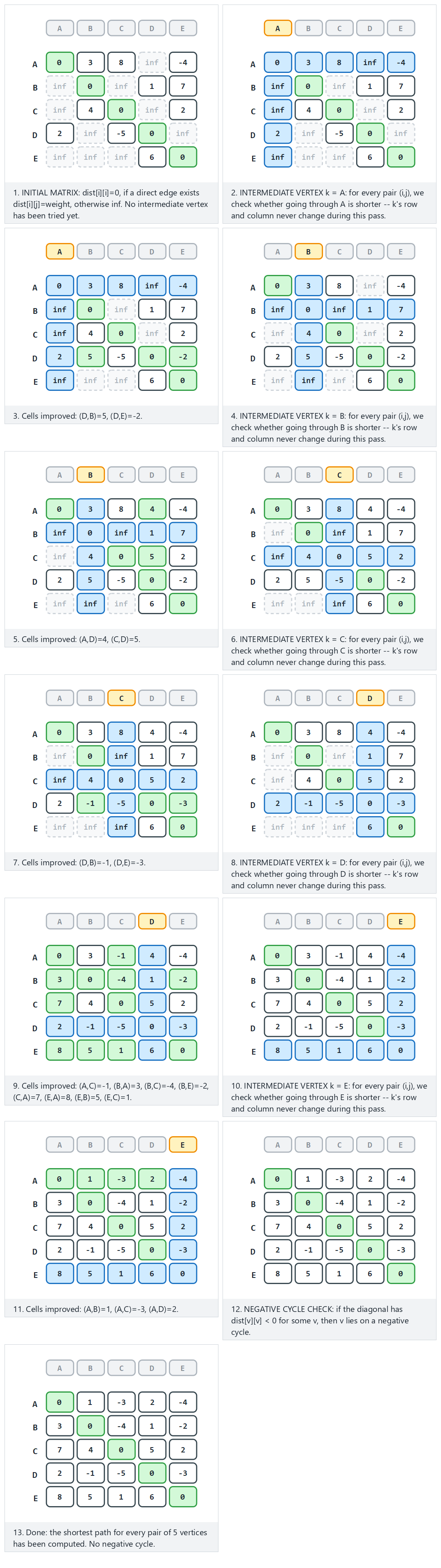
The whole matrix is redrawn once per intermediate vertex k (not once per (i, j) pair — that would be far too many steps to watch), with k's row and column highlighted since they do not change during that pass. Try "5 vertices, 10 edges, negative edges but no negative cycle", the edge case "6 vertices, 11 edges, some pairs stay disconnected (distance remains inf)", and "A-B-C-A is a negative cycle" (watch the diagonal turn negative); input is a plain A>B:4 ... edge list, capped at 7 vertices so the matrix stays readable.
6.4 Try it
Full program: floyd_warshall.c / FloydWarshall.java
/* Week 9 -- Graph Algorithms
 * Floyd-Warshall all-pairs shortest paths: an N x N distance matrix, tried
 * as an intermediate stop vertex by vertex. For a fixed k, dist[i][k] and
 * dist[k][j] never change during that pass, so the matrix can be updated in
 * place. A negative diagonal entry dist[v][v] < 0 means v lies on a
 * negative cycle.
 * CEN207 Data Structures (formerly CE205)
 */
#include <stdio.h>
#include <string.h>

#define MAX_V 32
#define MAX_LBL 4
#define INF 1000000000

char label[MAX_V][MAX_LBL];
int vertex_count;
int dist[MAX_V][MAX_V];

void floyd_warshall(int vertex_cnt) {
    for (int k = 0; k < vertex_cnt; k++) {          /* try every vertex as an intermediate stop */
        for (int i = 0; i < vertex_cnt; i++) {
            for (int j = 0; j < vertex_cnt; j++) {
                if (dist[i][k] == INF || dist[k][j] == INF) continue;   /* no path through k */
                int through = dist[i][k] + dist[k][j];
                if (through < dist[i][j]) dist[i][j] = through;
            }
        }
    }
}

int has_negative_cycle(int vertex_cnt) {
    for (int v = 0; v < vertex_cnt; v++)
        if (dist[v][v] < 0) return 1;               /* a path from v back to v got shorter than 0 */
    return 0;
}

static int find_or_add_vertex(const char *lbl) {
    for (int i = 0; i < vertex_count; i++)
        if (strcmp(label[i], lbl) == 0) return i;
    strncpy(label[vertex_count], lbl, MAX_LBL - 1);
    label[vertex_count][MAX_LBL - 1] = '\0';
    return vertex_count++;
}

typedef struct { const char *a, *b; int w; } EdgeIn;

static void run_scenario(const char *label_txt, EdgeIn edges[], int n) {
    printf("-- %s --\n", label_txt);
    vertex_count = 0;
    for (int i = 0; i < n; i++) { find_or_add_vertex(edges[i].a); find_or_add_vertex(edges[i].b); }

    for (int i = 0; i < vertex_count; i++)
        for (int j = 0; j < vertex_count; j++)
            dist[i][j] = (i == j) ? 0 : INF;
    for (int i = 0; i < n; i++) {
        int a = find_or_add_vertex(edges[i].a), b = find_or_add_vertex(edges[i].b);
        if (edges[i].w < dist[a][b]) dist[a][b] = edges[i].w;
    }

    floyd_warshall(vertex_count);

    printf("distance matrix:\n");
    printf("   ");
    for (int j = 0; j < vertex_count; j++) printf(" %3s", label[j]);
    printf("\n");
    for (int i = 0; i < vertex_count; i++) {
        printf("%3s", label[i]);
        for (int j = 0; j < vertex_count; j++) {
            if (dist[i][j] == INF) printf(" inf");
            else printf(" %3d", dist[i][j]);
        }
        printf("\n");
    }

    int neg = has_negative_cycle(vertex_count);
    if (neg) {
        printf("negative cycle at:");
        for (int v = 0; v < vertex_count; v++) if (dist[v][v] < 0) printf(" %s", label[v]);
        printf("\n");
    } else {
        printf("no negative cycle\n");
    }
    printf("\n");
}

int main(void) {
    EdgeIn normal[] = {
        {"A", "B", 3}, {"A", "C", 8}, {"A", "E", -4}, {"B", "D", 1},
        {"B", "E", 7}, {"C", "B", 4}, {"D", "A", 2}, {"D", "C", -5},
        {"E", "D", 6}, {"C", "E", 2}
    };
    run_scenario("normal: 5 vertices, 10 edges, negative edges but no negative cycle", normal, 10);

    EdgeIn hard[] = {
        {"A", "B", 2}, {"B", "C", 3}, {"A", "C", 8}, {"C", "D", 1},
        {"D", "B", -2},
        {"X", "Y", 4}, {"Y", "Z", 2}, {"Z", "X", 1}, {"X", "Z", 9},
        {"Y", "X", 5}, {"Z", "Y", 3}
    };
    run_scenario("hard: 6 vertices, 11 edges, some pairs stay disconnected (distance remains inf)", hard, 11);

    EdgeIn negative_cycle[] = {
        {"A", "B", 1}, {"B", "C", 2}, {"C", "A", -4}, {"A", "D", 3},
        {"D", "E", 2}, {"B", "D", 5}, {"C", "E", 1}, {"D", "A", 6},
        {"E", "B", 2}, {"E", "C", 3}
    };
    run_scenario("edge: A-B-C-A is a negative cycle, 10 edges", negative_cycle, 10);

    EdgeIn two_vertices[] = { {"A", "B", 5} };
    run_scenario("edge: 2 vertices, 1 edge", two_vertices, 1);

    return 0;
}
/* Week 9 -- Graph Algorithms
 * Floyd-Warshall all-pairs shortest paths: an N x N distance matrix, tried
 * as an intermediate stop vertex by vertex. For a fixed k, dist[i][k] and
 * dist[k][j] never change during that pass, so the matrix can be updated in
 * place. A negative diagonal entry dist[v][v] < 0 means v lies on a
 * negative cycle.
 * CEN207 Data Structures (formerly CE205)
 */
public class FloydWarshall {
    static final int MAX_V = 32, INF = 1000000000;

    static String[] label = new String[MAX_V];
    static int vertexCount;
    static int[][] dist = new int[MAX_V][MAX_V];

    static void floydWarshall(int vertexCnt) {
        for (int k = 0; k < vertexCnt; k++) {            // try every vertex as an intermediate stop
            for (int i = 0; i < vertexCnt; i++) {
                for (int j = 0; j < vertexCnt; j++) {
                    if (dist[i][k] == INF || dist[k][j] == INF) continue;    // no path through k
                    int through = dist[i][k] + dist[k][j];
                    if (through < dist[i][j]) dist[i][j] = through;
                }
            }
        }
    }

    static boolean hasNegativeCycle(int vertexCnt) {
        for (int v = 0; v < vertexCnt; v++)
            if (dist[v][v] < 0) return true;              // a path from v back to v got shorter than 0
        return false;
    }

    static int findOrAddVertex(String lbl) {
        for (int i = 0; i < vertexCount; i++)
            if (label[i].equals(lbl)) return i;
        label[vertexCount] = lbl;
        return vertexCount++;
    }

    static class EdgeIn { String a, b; int w; EdgeIn(String a, String b, int w) { this.a = a; this.b = b; this.w = w; } }

    static void runScenario(String labelTxt, EdgeIn[] edges) {
        System.out.println("-- " + labelTxt + " --");
        vertexCount = 0;
        for (EdgeIn e : edges) { findOrAddVertex(e.a); findOrAddVertex(e.b); }

        for (int i = 0; i < vertexCount; i++)
            for (int j = 0; j < vertexCount; j++)
                dist[i][j] = (i == j) ? 0 : INF;
        for (EdgeIn e : edges) {
            int a = findOrAddVertex(e.a), b = findOrAddVertex(e.b);
            if (e.w < dist[a][b]) dist[a][b] = e.w;
        }

        floydWarshall(vertexCount);

        System.out.println("distance matrix:");
        StringBuilder head = new StringBuilder("   ");
        for (int j = 0; j < vertexCount; j++) head.append(String.format(" %3s", label[j]));
        System.out.println(head);
        for (int i = 0; i < vertexCount; i++) {
            StringBuilder row = new StringBuilder(String.format("%3s", label[i]));
            for (int j = 0; j < vertexCount; j++) {
                if (dist[i][j] == INF) row.append(" inf");
                else row.append(String.format(" %3d", dist[i][j]));
            }
            System.out.println(row);
        }

        boolean neg = hasNegativeCycle(vertexCount);
        if (neg) {
            StringBuilder nb = new StringBuilder("negative cycle at:");
            for (int v = 0; v < vertexCount; v++) if (dist[v][v] < 0) nb.append(' ').append(label[v]);
            System.out.println(nb);
        } else {
            System.out.println("no negative cycle");
        }
        System.out.println();
    }

    public static void main(String[] args) {
        EdgeIn[] normal = {
            new EdgeIn("A", "B", 3), new EdgeIn("A", "C", 8), new EdgeIn("A", "E", -4), new EdgeIn("B", "D", 1),
            new EdgeIn("B", "E", 7), new EdgeIn("C", "B", 4), new EdgeIn("D", "A", 2), new EdgeIn("D", "C", -5),
            new EdgeIn("E", "D", 6), new EdgeIn("C", "E", 2)
        };
        runScenario("normal: 5 vertices, 10 edges, negative edges but no negative cycle", normal);

        EdgeIn[] hard = {
            new EdgeIn("A", "B", 2), new EdgeIn("B", "C", 3), new EdgeIn("A", "C", 8), new EdgeIn("C", "D", 1),
            new EdgeIn("D", "B", -2),
            new EdgeIn("X", "Y", 4), new EdgeIn("Y", "Z", 2), new EdgeIn("Z", "X", 1), new EdgeIn("X", "Z", 9),
            new EdgeIn("Y", "X", 5), new EdgeIn("Z", "Y", 3)
        };
        runScenario("hard: 6 vertices, 11 edges, some pairs stay disconnected (distance remains inf)", hard);

        EdgeIn[] negativeCycle = {
            new EdgeIn("A", "B", 1), new EdgeIn("B", "C", 2), new EdgeIn("C", "A", -4), new EdgeIn("A", "D", 3),
            new EdgeIn("D", "E", 2), new EdgeIn("B", "D", 5), new EdgeIn("C", "E", 1), new EdgeIn("D", "A", 6),
            new EdgeIn("E", "B", 2), new EdgeIn("E", "C", 3)
        };
        runScenario("edge: A-B-C-A is a negative cycle, 10 edges", negativeCycle);

        EdgeIn[] twoVertices = { new EdgeIn("A", "B", 5) };
        runScenario("edge: 2 vertices, 1 edge", twoVertices);
    }
}
Try it
gcc -std=c11 -Wall -Wextra -o floyd_warshall floyd_warshall.c && ./floyd_warshall
javac -Xlint:all FloydWarshall.java && java FloydWarshall
-- normal: 5 vertices, 10 edges, negative edges but no negative cycle --
distance matrix:
      A   B   C   E   D
  A   0   1  -3  -4   2
  B   3   0  -4  -2   1
  C   7   4   0   2   5
  E   8   5   1   0   6
  D   2  -1  -5  -3   0
no negative cycle

-- hard: 6 vertices, 11 edges, some pairs stay disconnected (distance remains inf) --
distance matrix:
      A   B   C   D   X   Y   Z
  A   0   2   5   6 inf inf inf
  B inf   0   3   4 inf inf inf
  C inf  -1   0   1 inf inf inf
  D inf  -2   1   0 inf inf inf
  X inf inf inf inf   0   4   6
  Y inf inf inf inf   3   0   2
  Z inf inf inf inf   1   3   0
no negative cycle

-- edge: A-B-C-A is a negative cycle, 10 edges --
distance matrix:
      A   B   C   D   E
  A  -1   0   2   1   3
  B  -2  -1   1   0   2
  C  -5  -4  -2  -3  -1
  D   0   1   3   0   2
  E  -2  -1   1  -2   0
negative cycle at: A B C

-- edge: 2 vertices, 1 edge --
distance matrix:
      A   B
  A   0   5
  B inf   0
no negative cycle
Notice the column order in the "normal" run is A B C E D, not alphabetical — vertices are numbered in the order they are first seen while scanning the edge list ({"A","B",3} sees A then B; the third edge {"A","E",-4} is the first to mention E, so E is numbered before D, first seen in the fourth edge). The matrix is still correct; only the printed column order looks surprising.
6.5 Complexity, mistakes, self-check
Complexity. O(V^3) time (three nested loops over every vertex) and O(V^2) space for the matrix — straightforward, but the cubic time means Floyd-Warshall is only practical for a few hundred vertices at most, unlike Dijkstra or Bellman-Ford run from every source (which can be faster on sparse graphs, where E << V^2).
Common mistakes
- Looping
i,j,kwithkas the innermost loop instead of the outermost: the in-place-update argument in section 6.2 depends entirely onkbeing fixed for an entire pass over all(i, j)— get the loop order wrong and the algorithm silently computes wrong distances. - Forgetting the
dist[i][k] == INFguard before adding:INF + INF(orINFplus any weight) can overflow a 32-bitintand wrap around to a large negative number, which then looks like a fantastic shortcut and corrupts the whole matrix. This is exactly why the code checks== INFandcontinues before computingthrough. - Reading
dist[v][v]as "0 means no cycle, positive means a positive cycle": the diagonal starts at exactly 0 for every vertex by definition and should stay 0 unless a negative cycle pulls it down — it can never usefully go above 0 (the empty path of length 0 is always available and costs 0).
Self-check: what does Floyd-Warshall compute for two vertices in different disconnected components?
inf, unchanged from initialisation — every intermediate vertex k is checked, but dist[i][k] or dist[k][j] stays inf for every k if no path connects the components at all, so the continue guard skips every possible update. Compare this to Dijkstra and Prim, whose dist/key arrays behave the same way: "infinite" is not a special case handled separately, it just falls out of the same relaxation rule.
7. Strongly connected components
7.1 A question to start
Section 1's connected components (from Week 5) answer "which vertices can reach each other, ignoring edge direction". In a directed graph a stronger, more useful question arises: which vertices can reach each other and get back, respecting direction — A can reach B and B can reach A? Web pages that link to each other in a cycle, mutually-recursive functions, and gridlocked traffic intersections are all naturally described this way.
7.2 The idea: two depth-first searches
A strongly connected component (SCC) is a maximal set of vertices where every vertex can reach every other vertex by a directed path. Sergei Kosaraju described the algorithm below around 1978 (unpublished by him; it reached print via S. Micali and V. Vazirani's 1981 paper and is universally credited to Kosaraju); an alternative, one-pass algorithm was published by Robert Tarjan in 1972. This course teaches Kosaraju's version because it reuses the exact two-colour DFS from section 1 (finish times), adding only ONE new idea — searching the graph's transpose — instead of introducing Tarjan's separate low-link/on-stack bookkeeping.
Phase 1: run DFS on the graph exactly as in section 1.3, recording every vertex's finish time — the order does not matter for correctness here, only that every vertex gets a finish time. Phase 2: build the transpose graph (every edge reversed — A>B becomes B>A), then run DFS on the transpose, but choosing unvisited roots in decreasing finish-time order from phase 1. Each resulting DFS tree in phase 2 is exactly one SCC. The intuition: phase 1's last-finishing vertex sits "highest" in the graph's dependency structure; starting phase 2 from it, on the reversed graph, can only reach vertices that could also reach it in the original graph — which is precisely the definition of "same SCC".
7.3 In memory, and the code
void dfs1(int u) {                                     /* phase 1: order by finish time */
    visited[u] = 1;
    for (AdjNode *n = cur_g->adj[u]; n != NULL; n = n->next)   /* alphabetical order */
        if (!visited[n->to]) dfs1(n->to);
    finish[finish_len] = u; finish_len++;
}

void dfs2(int u, int id) {                              /* phase 2: collect one component */
    visited[u] = 1;
    comp_of[u] = id;
    for (AdjNode *n = cur_g->adjT[u]; n != NULL; n = n->next)  /* alphabetical order, on the TRANSPOSE */
        if (!visited[n->to]) dfs2(n->to, id);
}

int kosaraju(Graph *g) {
    cur_g = g;
    for (int i = 0; i < g->vertex_count; i++) visited[i] = 0;
    finish_len = 0;
    for (int v = 0; v < g->vertex_count; v++)          /* alphabetical order */
        if (!visited[v]) dfs1(v);
    for (int i = 0; i < g->vertex_count; i++) visited[i] = 0;
    comp_count = 0;
    for (int i = finish_len - 1; i >= 0; i--) {         /* decreasing finish time */
        int v = finish[i];
        if (!visited[v]) { dfs2(v, comp_count); comp_count++; }
    }
    return comp_count;
}
static void dfs1(int u) {                              // phase 1: order by finish time
    visited[u] = 1;
    for (AdjNode n = curG.adj[u]; n != null; n = n.next)     // alphabetical order
        if (visited[n.to] == 0) dfs1(n.to);
    finish[finishLen] = u; finishLen++;
}

static void dfs2(int u, int id) {                      // phase 2: collect one component
    visited[u] = 1;
    compOf[u] = id;
    for (AdjNode n = curG.adjT[u]; n != null; n = n.next)    // alphabetical order, on the TRANSPOSE
        if (visited[n.to] == 0) dfs2(n.to, id);
}

static int kosaraju(Graph g) {
    curG = g;
    for (int i = 0; i < g.vertexCount; i++) visited[i] = 0;
    finishLen = 0;
    for (int v = 0; v < g.vertexCount; v++)             // alphabetical order
        if (visited[v] == 0) dfs1(v);
    for (int i = 0; i < g.vertexCount; i++) visited[i] = 0;
    compCount = 0;
    for (int i = finishLen - 1; i >= 0; i--) {           // decreasing finish time
        int v = finish[i];
        if (visited[v] == 0) { dfs2(v, compCount); compCount++; }
    }
    return compCount;
}

Watch both phases side by side: the call stack and finish-order rows for phase 1, then the same graph with every edge shown reversed for phase 2. Try "8 vertices, 10 edges, 2 cyclic components + 2 singletons", and the two required edge cases "everything is one big cycle, the whole graph is one component" and "a cycle-free graph (a DAG), every vertex is its own component"; input is A>B B>C ....
7.4 Try it
Full program: strongly_connected_components.c / StronglyConnectedComponents.java
/* Week 9 -- Graph Algorithms
 * Strongly connected components by KOSARAJU's algorithm: (1) DFS on the
 * graph, recording every vertex's FINISH time; (2) DFS again on the
 * TRANSPOSE graph, visiting unvisited roots in DECREASING finish-time
 * order -- each resulting DFS tree is exactly one strongly connected
 * component.
 * CEN207 Data Structures (formerly CE205)
 */
#include <stdio.h>
#include <string.h>
#include <stdlib.h>

#define MAX_V   32
#define MAX_LBL 4

typedef struct AdjNode { int to; struct AdjNode *next; } AdjNode;
typedef struct Graph {
    char label[MAX_V][MAX_LBL];
    AdjNode *adj[MAX_V];
    AdjNode *adjT[MAX_V];          /* transpose: every edge reversed */
    int vertex_count;
} Graph;

int visited[MAX_V];
int finish[MAX_V], finish_len;
int comp_of[MAX_V], comp_count;
Graph *cur_g;

void dfs1(int u) {                                     /* phase 1: order by finish time */
    visited[u] = 1;
    for (AdjNode *n = cur_g->adj[u]; n != NULL; n = n->next)   /* alphabetical order */
        if (!visited[n->to]) dfs1(n->to);
    finish[finish_len] = u; finish_len++;
}

void dfs2(int u, int id) {                              /* phase 2: collect one component */
    visited[u] = 1;
    comp_of[u] = id;
    for (AdjNode *n = cur_g->adjT[u]; n != NULL; n = n->next)  /* alphabetical order, on the TRANSPOSE */
        if (!visited[n->to]) dfs2(n->to, id);
}

int kosaraju(Graph *g) {
    cur_g = g;
    for (int i = 0; i < g->vertex_count; i++) visited[i] = 0;
    finish_len = 0;
    for (int v = 0; v < g->vertex_count; v++)          /* alphabetical order */
        if (!visited[v]) dfs1(v);
    for (int i = 0; i < g->vertex_count; i++) visited[i] = 0;
    comp_count = 0;
    for (int i = finish_len - 1; i >= 0; i--) {         /* decreasing finish time */
        int v = finish[i];
        if (!visited[v]) { dfs2(v, comp_count); comp_count++; }
    }
    return comp_count;
}

/* ---- construction: build Graph (and its transpose) from a DIRECTED edge list. ---- */

typedef struct { const char *a, *b; } EdgeIn;

static int find_or_add_vertex(Graph *g, const char *lbl) {
    for (int i = 0; i < g->vertex_count; i++)
        if (strcmp(g->label[i], lbl) == 0) return i;
    strncpy(g->label[g->vertex_count], lbl, MAX_LBL - 1);
    g->label[g->vertex_count][MAX_LBL - 1] = '\0';
    g->adj[g->vertex_count] = NULL;
    g->adjT[g->vertex_count] = NULL;
    return g->vertex_count++;
}

static AdjNode *new_node(int to) { AdjNode *n = malloc(sizeof(AdjNode)); n->to = to; n->next = NULL; return n; }

static void add_sorted(Graph *g, AdjNode *adj[], int v, int neighbour) {
    AdjNode *n = new_node(neighbour);
    if (adj[v] == NULL || strcmp(g->label[adj[v]->to], g->label[neighbour]) > 0) {
        n->next = adj[v]; adj[v] = n; return;
    }
    AdjNode *cur = adj[v];
    while (cur->next != NULL && strcmp(g->label[cur->next->to], g->label[neighbour]) <= 0) cur = cur->next;
    n->next = cur->next; cur->next = n;
}

static void build_graph(Graph *g, EdgeIn edges[], int n) {
    g->vertex_count = 0;
    for (int i = 0; i < MAX_V; i++) { g->adj[i] = NULL; g->adjT[i] = NULL; }
    for (int i = 0; i < n; i++) {
        int a = find_or_add_vertex(g, edges[i].a), b = find_or_add_vertex(g, edges[i].b);
        if (a == b) continue;
        add_sorted(g, g->adj, a, b);
        add_sorted(g, g->adjT, b, a);
    }
}

static void free_graph(Graph *g) {
    for (int i = 0; i < g->vertex_count; i++) {
        AdjNode *cur = g->adj[i]; while (cur) { AdjNode *nx = cur->next; free(cur); cur = nx; } g->adj[i] = NULL;
        cur = g->adjT[i]; while (cur) { AdjNode *nx = cur->next; free(cur); cur = nx; } g->adjT[i] = NULL;
    }
}

static void run_scenario(const char *label_txt, EdgeIn edges[], int n) {
    printf("-- %s --\n", label_txt);
    Graph g;
    build_graph(&g, edges, n);

    int cc = kosaraju(&g);
    printf("%d component%s:\n", cc, cc == 1 ? "" : "s");
    for (int id = 0; id < cc; id++) {
        printf(" ");
        for (int v = 0; v < g.vertex_count; v++) if (comp_of[v] == id) printf(" %s", g.label[v]);
        printf("\n");
    }

    free_graph(&g);
    printf("\n");
}

int main(void) {
    EdgeIn normal[] = {
        {"A", "B"}, {"B", "C"}, {"C", "A"}, {"C", "D"}, {"D", "E"},
        {"E", "F"}, {"F", "D"}, {"F", "G"}, {"G", "H"}, {"E", "G"}
    };
    run_scenario("normal: 8 vertices, 10 edges, 2 cyclic components + 2 singletons", normal, 10);

    EdgeIn hard[] = {
        {"A", "B"}, {"B", "C"}, {"C", "D"}, {"D", "A"}, {"B", "D"},
        {"C", "B"}, {"D", "E"}, {"E", "F"}, {"F", "E"}, {"F", "G"},
        {"G", "H"}, {"H", "I"}, {"I", "G"}, {"I", "J"}
    };
    run_scenario("hard: 10 vertices, 14 edges, 3 components (one large)", hard, 14);

    EdgeIn one_big_scc[] = {
        {"A", "B"}, {"B", "C"}, {"C", "D"}, {"D", "E"}, {"E", "F"},
        {"F", "G"}, {"G", "H"}, {"H", "A"}, {"C", "A"}, {"F", "D"}
    };
    run_scenario("edge: everything is one big cycle, the whole graph is one component", one_big_scc, 10);

    EdgeIn dag[] = {
        {"A", "B"}, {"A", "C"}, {"B", "D"}, {"C", "D"}, {"D", "E"},
        {"C", "F"}, {"E", "G"}, {"F", "G"}, {"G", "H"}, {"B", "E"}
    };
    run_scenario("edge: a cycle-free graph (a DAG), every vertex is its own component", dag, 10);

    return 0;
}
/* Week 9 -- Graph Algorithms
 * Strongly connected components by KOSARAJU's algorithm: (1) DFS on the
 * graph, recording every vertex's FINISH time; (2) DFS again on the
 * TRANSPOSE graph, visiting unvisited roots in DECREASING finish-time
 * order -- each resulting DFS tree is exactly one strongly connected
 * component.
 * CEN207 Data Structures (formerly CE205)
 */
public class StronglyConnectedComponents {
    static final int MAX_V = 32;

    static class AdjNode { int to; AdjNode next; AdjNode(int to) { this.to = to; } }
    static class Graph {
        String[] label = new String[MAX_V];
        AdjNode[] adj = new AdjNode[MAX_V];
        AdjNode[] adjT = new AdjNode[MAX_V];   // transpose: every edge reversed
        int vertexCount;
    }

    static int[] visited = new int[MAX_V];
    static int[] finish = new int[MAX_V]; static int finishLen;
    static int[] compOf = new int[MAX_V]; static int compCount;
    static Graph curG;

    static void dfs1(int u) {                              // phase 1: order by finish time
        visited[u] = 1;
        for (AdjNode n = curG.adj[u]; n != null; n = n.next)     // alphabetical order
            if (visited[n.to] == 0) dfs1(n.to);
        finish[finishLen] = u; finishLen++;
    }

    static void dfs2(int u, int id) {                      // phase 2: collect one component
        visited[u] = 1;
        compOf[u] = id;
        for (AdjNode n = curG.adjT[u]; n != null; n = n.next)    // alphabetical order, on the TRANSPOSE
            if (visited[n.to] == 0) dfs2(n.to, id);
    }

    static int kosaraju(Graph g) {
        curG = g;
        for (int i = 0; i < g.vertexCount; i++) visited[i] = 0;
        finishLen = 0;
        for (int v = 0; v < g.vertexCount; v++)             // alphabetical order
            if (visited[v] == 0) dfs1(v);
        for (int i = 0; i < g.vertexCount; i++) visited[i] = 0;
        compCount = 0;
        for (int i = finishLen - 1; i >= 0; i--) {           // decreasing finish time
            int v = finish[i];
            if (visited[v] == 0) { dfs2(v, compCount); compCount++; }
        }
        return compCount;
    }

    // ---- construction: build Graph (and its transpose) from a DIRECTED edge list. ----

    static class EdgeIn { String a, b; EdgeIn(String a, String b) { this.a = a; this.b = b; } }

    static int findOrAddVertex(Graph g, String lbl) {
        for (int i = 0; i < g.vertexCount; i++)
            if (g.label[i].equals(lbl)) return i;
        g.label[g.vertexCount] = lbl;
        g.adj[g.vertexCount] = null;
        g.adjT[g.vertexCount] = null;
        return g.vertexCount++;
    }

    static void addSorted(Graph g, AdjNode[] adj, int v, int neighbour) {
        AdjNode n = new AdjNode(neighbour);
        if (adj[v] == null || g.label[adj[v].to].compareTo(g.label[neighbour]) > 0) {
            n.next = adj[v]; adj[v] = n; return;
        }
        AdjNode cur = adj[v];
        while (cur.next != null && g.label[cur.next.to].compareTo(g.label[neighbour]) <= 0) cur = cur.next;
        n.next = cur.next; cur.next = n;
    }

    static void buildGraph(Graph g, EdgeIn[] edges) {
        g.vertexCount = 0;
        for (int i = 0; i < MAX_V; i++) { g.adj[i] = null; g.adjT[i] = null; }
        for (EdgeIn e : edges) {
            int a = findOrAddVertex(g, e.a), b = findOrAddVertex(g, e.b);
            if (a == b) continue;
            addSorted(g, g.adj, a, b);
            addSorted(g, g.adjT, b, a);
        }
    }

    static void runScenario(String labelTxt, EdgeIn[] edges) {
        System.out.println("-- " + labelTxt + " --");
        Graph g = new Graph();
        buildGraph(g, edges);

        int cc = kosaraju(g);
        System.out.println(cc + " component" + (cc == 1 ? "" : "s") + ":");
        for (int id = 0; id < cc; id++) {
            StringBuilder sb = new StringBuilder(" ");
            for (int v = 0; v < g.vertexCount; v++) if (compOf[v] == id) sb.append(' ').append(g.label[v]);
            System.out.println(sb);
        }

        System.out.println();
    }

    public static void main(String[] args) {
        EdgeIn[] normal = {
            new EdgeIn("A", "B"), new EdgeIn("B", "C"), new EdgeIn("C", "A"), new EdgeIn("C", "D"), new EdgeIn("D", "E"),
            new EdgeIn("E", "F"), new EdgeIn("F", "D"), new EdgeIn("F", "G"), new EdgeIn("G", "H"), new EdgeIn("E", "G")
        };
        runScenario("normal: 8 vertices, 10 edges, 2 cyclic components + 2 singletons", normal);

        EdgeIn[] hard = {
            new EdgeIn("A", "B"), new EdgeIn("B", "C"), new EdgeIn("C", "D"), new EdgeIn("D", "A"), new EdgeIn("B", "D"),
            new EdgeIn("C", "B"), new EdgeIn("D", "E"), new EdgeIn("E", "F"), new EdgeIn("F", "E"), new EdgeIn("F", "G"),
            new EdgeIn("G", "H"), new EdgeIn("H", "I"), new EdgeIn("I", "G"), new EdgeIn("I", "J")
        };
        runScenario("hard: 10 vertices, 14 edges, 3 components (one large)", hard);

        EdgeIn[] oneBigScc = {
            new EdgeIn("A", "B"), new EdgeIn("B", "C"), new EdgeIn("C", "D"), new EdgeIn("D", "E"), new EdgeIn("E", "F"),
            new EdgeIn("F", "G"), new EdgeIn("G", "H"), new EdgeIn("H", "A"), new EdgeIn("C", "A"), new EdgeIn("F", "D")
        };
        runScenario("edge: everything is one big cycle, the whole graph is one component", oneBigScc);

        EdgeIn[] dag = {
            new EdgeIn("A", "B"), new EdgeIn("A", "C"), new EdgeIn("B", "D"), new EdgeIn("C", "D"), new EdgeIn("D", "E"),
            new EdgeIn("C", "F"), new EdgeIn("E", "G"), new EdgeIn("F", "G"), new EdgeIn("G", "H"), new EdgeIn("B", "E")
        };
        runScenario("edge: a cycle-free graph (a DAG), every vertex is its own component", dag);
    }
}
Try it
gcc -std=c11 -Wall -Wextra -o strongly_connected_components strongly_connected_components.c && ./strongly_connected_components
javac -Xlint:all StronglyConnectedComponents.java && java StronglyConnectedComponents
-- normal: 8 vertices, 10 edges, 2 cyclic components + 2 singletons --
4 components:
  A B C
  D E F
  G
  H

-- hard: 10 vertices, 14 edges, 3 components (one large) --
4 components:
  A B C D
  E F
  G H I
  J

-- edge: everything is one big cycle, the whole graph is one component --
1 component:
  A B C D E F G H

-- edge: a cycle-free graph (a DAG), every vertex is its own component --
8 components:
  A
  C
  F
  B
  D
  E
  G
  H
7.5 Complexity, mistakes, self-check
Complexity. O(V + E) — two full DFS passes (phase 1 on the graph, phase 2 on the transpose), each O(V + E), plus O(V + E) to build the transpose adjacency list itself.
Common mistakes
- Running phase 2 in the same finish-time order as phase 1, instead of reversed: this is the single most common bug, and it silently produces wrong groupings on any graph with more than one component.
- Forgetting to reset
visited[]between phase 1 and phase 2: phase 2 needs every vertex white again before it starts, even though phase 1 just finished them all. - Building the transpose by re-walking the original adjacency lists inside phase 2 instead of a genuinely separate
adjT[]built once, up front, during construction: it works but re-does O(V + E) work on every one of phase 2's DFS calls instead of once total.
Self-check: why does Kosaraju's algorithm need the graph's TRANSPOSE at all — why not just re-run DFS on the same graph in phase 2?
Because reachability in a directed graph is not symmetric: A being able to reach B in phase 1's graph says nothing about whether B can reach A. Running phase 2 on the reversed edges turns "does the phase-2 root have an edge IN from X" into "does X have a path OUT to the phase-2 root", which is exactly the missing half of the "can reach each other" definition of an SCC.
8. Bipartite graphs
8.1 A question to start
A school needs to schedule final exams so that no student has two exams at the same time. Build a graph where courses are vertices and an edge joins two courses that share a student; colouring that graph so no edge joins two same-coloured vertices gives a valid timetable, one colour per time slot. The simplest version of that question — can the graph be coloured with only two colours at all — has a name of its own, and a much faster test than general graph colouring (section 10).
8.2 The idea: BFS with two colours
A graph is bipartite if its vertices split into two groups such that every edge joins a vertex in one group to a vertex in the other group — never two vertices in the same group. Run BFS (Week 5) from any vertex, colouring it 0; colour every neighbour the opposite colour of whatever just queued it, and enqueue it. If BFS ever reaches an already-coloured neighbour that has the same colour as the vertex being processed, that edge joins two same-coloured vertices — the graph is not bipartite, and that edge is exactly why. A graph can have several components, so this needs one BFS per still-uncoloured vertex, exactly like Week 5's connected-components loop.
A useful equivalent fact, provable from the BFS argument above: a graph is bipartite if and only if it contains no cycle of odd length. An even cycle alternates colours perfectly all the way around and closes up consistently; an odd cycle cannot — walking it, the colour you are forced to assign the last vertex always clashes with the first.
8.3 In memory, and the code
int is_bipartite(Graph *g) {
    for (int i = 0; i < g->vertex_count; i++) color_of[i] = -1;
    for (int s = 0; s < g->vertex_count; s++) {          /* alphabetical: one BFS per component */
        if (color_of[s] != -1) continue;
        color_of[s] = 0; front = rear = 0; enqueue(s);
        while (front < rear) {
            int u = dequeue();
            for (AdjNode *n = g->adj[u]; n != NULL; n = n->next) {  /* alphabetical order */
                if (color_of[n->to] == -1) { color_of[n->to] = 1 - color_of[u]; enqueue(n->to); }
                else if (color_of[n->to] == color_of[u]) return 0;  /* same colour -> an odd cycle */
            }
        }
    }
    return 1;
}
boolean isBipartite(Graph g) {
    for (int i = 0; i < g.vertexCount; i++) colorOf[i] = -1;
    for (int s = 0; s < g.vertexCount; s++) {             // alphabetical: one BFS per component
        if (colorOf[s] != -1) continue;
        colorOf[s] = 0; front = rear = 0; enqueue(s);
        while (front < rear) {
            int u = dequeue();
            for (AdjNode n = g.adj[u]; n != null; n = n.next) {  // alphabetical order
                if (colorOf[n.to] == -1) { colorOf[n.to] = 1 - colorOf[u]; enqueue(n.to); }
                else if (colorOf[n.to] == colorOf[u]) return false; // same colour -> an odd cycle
            }
        }
    }
    return true;
}

Try "8 vertices, an even cycle plus 2 safe diagonals, bipartite", "10 vertices, 2 components, both bipartite", and the required edge case "A-B-C-D-E-A is a 5-cycle (odd), NOT bipartite" — watch the conflicting edge turn red the instant BFS reaches it; input is A-B B-C ..., undirected.
8.4 Try it
Full program: bipartite_check.c / BipartiteCheck.java
/* Week 9 -- Graph Algorithms
 * Bipartite check by 2-colouring: BFS colours the start vertex 0, every
 * neighbour the OPPOSITE colour, and queues it. If an already-coloured
 * neighbour has the SAME colour, that edge closes an odd cycle -- the graph
 * is not bipartite. One BFS per component.
 * CEN207 Data Structures (formerly CE205)
 */
#include <stdio.h>
#include <string.h>
#include <stdlib.h>

#define MAX_V   32
#define MAX_LBL 4

typedef struct AdjNode { int to; struct AdjNode *next; } AdjNode;
typedef struct Graph {
    char label[MAX_V][MAX_LBL];
    AdjNode *adj[MAX_V];
    int vertex_count;
} Graph;

int color_of[MAX_V];        /* -1 = uncoloured, 0/1 = the two sides */
int queue_data[MAX_V], front, rear;

void enqueue(int v) { queue_data[rear] = v; rear++; }
int  dequeue(void)  { int v = queue_data[front]; front++; return v; }

int is_bipartite(Graph *g) {
    for (int i = 0; i < g->vertex_count; i++) color_of[i] = -1;
    for (int s = 0; s < g->vertex_count; s++) {          /* alphabetical: one BFS per component */
        if (color_of[s] != -1) continue;
        color_of[s] = 0; front = rear = 0; enqueue(s);
        while (front < rear) {
            int u = dequeue();
            for (AdjNode *n = g->adj[u]; n != NULL; n = n->next) {  /* alphabetical order */
                if (color_of[n->to] == -1) { color_of[n->to] = 1 - color_of[u]; enqueue(n->to); }
                else if (color_of[n->to] == color_of[u]) return 0;  /* same colour -> an odd cycle */
            }
        }
    }
    return 1;
}

/* ---- construction: build Graph from a (label, label) UNDIRECTED edge list. ---- */

typedef struct { const char *a, *b; } EdgeIn;

static int find_or_add_vertex(Graph *g, const char *lbl) {
    for (int i = 0; i < g->vertex_count; i++)
        if (strcmp(g->label[i], lbl) == 0) return i;
    strncpy(g->label[g->vertex_count], lbl, MAX_LBL - 1);
    g->label[g->vertex_count][MAX_LBL - 1] = '\0';
    g->adj[g->vertex_count] = NULL;
    return g->vertex_count++;
}

static AdjNode *new_node(int to) { AdjNode *n = malloc(sizeof(AdjNode)); n->to = to; n->next = NULL; return n; }

static void add_neighbour_sorted(Graph *g, int v, int neighbour) {
    AdjNode *n = new_node(neighbour);
    if (g->adj[v] == NULL || strcmp(g->label[g->adj[v]->to], g->label[neighbour]) > 0) {
        n->next = g->adj[v]; g->adj[v] = n; return;
    }
    AdjNode *cur = g->adj[v];
    while (cur->next != NULL && strcmp(g->label[cur->next->to], g->label[neighbour]) <= 0) cur = cur->next;
    n->next = cur->next; cur->next = n;
}

static void build_graph(Graph *g, EdgeIn edges[], int n) {
    g->vertex_count = 0;
    for (int i = 0; i < MAX_V; i++) g->adj[i] = NULL;
    for (int i = 0; i < n; i++) {
        int a = find_or_add_vertex(g, edges[i].a), b = find_or_add_vertex(g, edges[i].b);
        if (a == b) continue;
        add_neighbour_sorted(g, a, b);
        add_neighbour_sorted(g, b, a);
    }
}

static void free_graph(Graph *g) {
    for (int i = 0; i < g->vertex_count; i++) {
        AdjNode *cur = g->adj[i];
        while (cur) { AdjNode *nx = cur->next; free(cur); cur = nx; }
        g->adj[i] = NULL;
    }
}

static void run_scenario(const char *label_txt, EdgeIn edges[], int n) {
    printf("-- %s --\n", label_txt);
    Graph g;
    build_graph(&g, edges, n);

    int ok = is_bipartite(&g);
    printf("colors:");
    for (int v = 0; v < g.vertex_count; v++) printf(" %s=%d", g.label[v], color_of[v]);
    printf("\n%s\n", ok ? "bipartite" : "NOT bipartite");

    free_graph(&g);
    printf("\n");
}

int main(void) {
    EdgeIn normal[] = {
        {"A", "B"}, {"B", "C"}, {"C", "D"}, {"D", "E"}, {"E", "F"},
        {"F", "G"}, {"G", "H"}, {"H", "A"}, {"A", "D"}, {"C", "F"}
    };
    run_scenario("normal: 8 vertices, an even cycle plus 2 safe diagonals, bipartite", normal, 10);

    EdgeIn hard[] = {
        {"A", "B"}, {"B", "C"}, {"C", "D"}, {"D", "E"}, {"E", "F"}, {"F", "A"}, {"A", "D"},
        {"G", "H"}, {"H", "I"}, {"I", "J"}, {"J", "G"}
    };
    run_scenario("hard: 10 vertices, 2 components, both bipartite", hard, 11);

    EdgeIn odd_cycle[] = {
        {"A", "B"}, {"B", "C"}, {"C", "D"}, {"D", "E"}, {"E", "A"},
        {"A", "F"}, {"F", "G"}, {"G", "H"}, {"H", "F"}, {"B", "F"}
    };
    run_scenario("edge: A-B-C-D-E-A is a 5-cycle (odd), NOT bipartite", odd_cycle, 10);

    EdgeIn two_vertices[] = { {"A", "B"} };
    run_scenario("edge: 2 vertices, 1 edge", two_vertices, 1);

    return 0;
}
/* Week 9 -- Graph Algorithms
 * Bipartite check by 2-colouring: BFS colours the start vertex 0, every
 * neighbour the OPPOSITE colour, and queues it. If an already-coloured
 * neighbour has the SAME colour, that edge closes an odd cycle -- the graph
 * is not bipartite. One BFS per component.
 * CEN207 Data Structures (formerly CE205)
 */
public class BipartiteCheck {
    static final int MAX_V = 32;

    static class AdjNode { int to; AdjNode next; AdjNode(int to) { this.to = to; } }
    static class Graph {
        String[] label = new String[MAX_V];
        AdjNode[] adj = new AdjNode[MAX_V];
        int vertexCount;
    }

    static int[] colorOf = new int[MAX_V];         // -1 = uncoloured, 0/1 = the two sides
    static int[] queueData = new int[MAX_V]; static int front, rear;

    static void enqueue(int v) { queueData[rear] = v; rear++; }
    static int  dequeue()      { int v = queueData[front]; front++; return v; }

    static boolean isBipartite(Graph g) {
        for (int i = 0; i < g.vertexCount; i++) colorOf[i] = -1;
        for (int s = 0; s < g.vertexCount; s++) {             // alphabetical: one BFS per component
            if (colorOf[s] != -1) continue;
            colorOf[s] = 0; front = rear = 0; enqueue(s);
            while (front < rear) {
                int u = dequeue();
                for (AdjNode n = g.adj[u]; n != null; n = n.next) {  // alphabetical order
                    if (colorOf[n.to] == -1) { colorOf[n.to] = 1 - colorOf[u]; enqueue(n.to); }
                    else if (colorOf[n.to] == colorOf[u]) return false; // same colour -> an odd cycle
                }
            }
        }
        return true;
    }

    // ---- construction: build Graph from a (label, label) UNDIRECTED edge list. ----

    static class EdgeIn { String a, b; EdgeIn(String a, String b) { this.a = a; this.b = b; } }

    static int findOrAddVertex(Graph g, String lbl) {
        for (int i = 0; i < g.vertexCount; i++)
            if (g.label[i].equals(lbl)) return i;
        g.label[g.vertexCount] = lbl;
        g.adj[g.vertexCount] = null;
        return g.vertexCount++;
    }

    static void addNeighbourSorted(Graph g, int v, int neighbour) {
        AdjNode n = new AdjNode(neighbour);
        if (g.adj[v] == null || g.label[g.adj[v].to].compareTo(g.label[neighbour]) > 0) {
            n.next = g.adj[v]; g.adj[v] = n; return;
        }
        AdjNode cur = g.adj[v];
        while (cur.next != null && g.label[cur.next.to].compareTo(g.label[neighbour]) <= 0) cur = cur.next;
        n.next = cur.next; cur.next = n;
    }

    static void buildGraph(Graph g, EdgeIn[] edges) {
        g.vertexCount = 0;
        for (int i = 0; i < MAX_V; i++) g.adj[i] = null;
        for (EdgeIn e : edges) {
            int a = findOrAddVertex(g, e.a), b = findOrAddVertex(g, e.b);
            if (a == b) continue;
            addNeighbourSorted(g, a, b);
            addNeighbourSorted(g, b, a);
        }
    }

    static void runScenario(String labelTxt, EdgeIn[] edges) {
        System.out.println("-- " + labelTxt + " --");
        Graph g = new Graph();
        buildGraph(g, edges);

        boolean ok = isBipartite(g);
        StringBuilder sb = new StringBuilder("colors:");
        for (int v = 0; v < g.vertexCount; v++) sb.append(' ').append(g.label[v]).append('=').append(colorOf[v]);
        System.out.println(sb);
        System.out.println(ok ? "bipartite" : "NOT bipartite");

        System.out.println();
    }

    public static void main(String[] args) {
        EdgeIn[] normal = {
            new EdgeIn("A", "B"), new EdgeIn("B", "C"), new EdgeIn("C", "D"), new EdgeIn("D", "E"), new EdgeIn("E", "F"),
            new EdgeIn("F", "G"), new EdgeIn("G", "H"), new EdgeIn("H", "A"), new EdgeIn("A", "D"), new EdgeIn("C", "F")
        };
        runScenario("normal: 8 vertices, an even cycle plus 2 safe diagonals, bipartite", normal);

        EdgeIn[] hard = {
            new EdgeIn("A", "B"), new EdgeIn("B", "C"), new EdgeIn("C", "D"), new EdgeIn("D", "E"), new EdgeIn("E", "F"), new EdgeIn("F", "A"), new EdgeIn("A", "D"),
            new EdgeIn("G", "H"), new EdgeIn("H", "I"), new EdgeIn("I", "J"), new EdgeIn("J", "G")
        };
        runScenario("hard: 10 vertices, 2 components, both bipartite", hard);

        EdgeIn[] oddCycle = {
            new EdgeIn("A", "B"), new EdgeIn("B", "C"), new EdgeIn("C", "D"), new EdgeIn("D", "E"), new EdgeIn("E", "A"),
            new EdgeIn("A", "F"), new EdgeIn("F", "G"), new EdgeIn("G", "H"), new EdgeIn("H", "F"), new EdgeIn("B", "F")
        };
        runScenario("edge: A-B-C-D-E-A is a 5-cycle (odd), NOT bipartite", oddCycle);

        EdgeIn[] twoVertices = { new EdgeIn("A", "B") };
        runScenario("edge: 2 vertices, 1 edge", twoVertices);
    }
}
Try it
gcc -std=c11 -Wall -Wextra -o bipartite_check bipartite_check.c && ./bipartite_check
javac -Xlint:all BipartiteCheck.java && java BipartiteCheck
-- normal: 8 vertices, an even cycle plus 2 safe diagonals, bipartite --
colors: A=0 B=1 C=0 D=1 E=0 F=1 G=0 H=1
bipartite

-- hard: 10 vertices, 2 components, both bipartite --
colors: A=0 B=1 C=0 D=1 E=0 F=1 G=0 H=1 I=0 J=1
bipartite

-- edge: A-B-C-D-E-A is a 5-cycle (odd), NOT bipartite --
colors: A=0 B=1 C=0 D=-1 E=1 F=1 G=-1 H=-1
NOT bipartite

-- edge: 2 vertices, 1 edge --
colors: A=0 B=1
bipartite
The 5-cycle's colours stop partway through (D, G and H stay -1, uncoloured). BFS from A colours B=1, E=1, F=1 first; dequeuing B, its neighbours are A (already 0, no conflict), C (uncoloured, becomes 0), then F — already coloured 1, the same colour as B. That is the conflict: edge B-F joins two same-coloured vertices, so is_bipartite returns immediately, false. C's own neighbour D, and F's neighbours G/H, were never reached because the function returned before their turn — leaving them at -1 forever. That is expected, not a bug: once any conflict is found, the answer is already "not bipartite" and there is nothing more useful to compute.
8.5 Complexity, mistakes, self-check
Complexity. O(V + E) — one BFS, exactly Week 5's complexity, with O(1) extra work (one colour check and possibly one assignment) per edge.
Common mistakes
- Colouring a vertex only when it is dequeued instead of when it is enqueued: with the enqueue-time colouring used here, two neighbours of the same vertex, both still waiting in the queue, can never be compared against each other by accident (they get compared against the vertex that enqueued them, which is correct) — colouring at dequeue time makes the same-component-BFS argument more fragile to get right.
- Treating a disconnected graph as a single check: without one BFS per uncoloured vertex, an isolated odd cycle in a second component would never be visited at all, wrongly reporting "bipartite".
- Assuming a tree always needs checking: a tree has no cycles at all (odd or even) by definition, so it is always bipartite — useful as a quick sanity check, not as a shortcut to skip the algorithm (the algorithm handles it correctly and quickly regardless).
Self-check: if a graph is bipartite, is its 2-colouring UNIQUE?
Only up to swapping the two colours as a whole, and only within each connected component separately: which side is called "0" and which is "1" is an arbitrary choice made when BFS colours the very first vertex of each component, and different components have no constraint linking their colourings to each other at all.
9. Maximum flow
9.1 A question to start
A water network has a source reservoir, a destination town, and a maze of pipes between them, each pipe with a maximum capacity (litres per second). What is the largest total flow rate the network can deliver from source to destination, all at once, without any pipe exceeding its capacity?
9.2 A short history, and the idea
Lester Ford and Delbert Fulkerson described the general method in 1956: repeatedly find any path from source s to sink t along which every edge still has spare capacity — an augmenting path — push as much flow along it as its tightest edge allows (the bottleneck), and repeat until no augmenting path remains. Pushing flow forward on an edge also creates the option to undo part of that decision later: a reverse edge opens up, with capacity equal to the flow just sent, letting a later augmenting path effectively "push back" through an edge a previous path used, redirecting flow more cleverly than either path alone could. The graph of "what is still usable, forward or backward" is the residual graph. Ford and Fulkerson's method does not specify which augmenting path to use each time, and a careless choice can be slow; Jack Edmonds and Richard Karp proved in 1972 that always choosing the shortest augmenting path (fewest edges, found by BFS on the residual graph) guarantees the whole process finishes in polynomial time — the algorithm below.
Why does running out of augmenting paths mean the flow found is truly maximum? That is the max-flow min-cut theorem (Ford and Fulkerson again): the maximum possible flow always equals the capacity of the cheapest "cut" — the smallest total capacity of edges that, if removed, would separate s from t entirely. When no augmenting path remains, the set of vertices BFS can still reach from s in the residual graph, versus the rest, is such a cut, with capacity exactly equal to the flow already found — so no more flow could possibly fit.
9.3 In memory, and the code
int bfs_augmenting_path(int vertex_cnt, int s, int t) {   /* shortest path using cap_of > 0 only */
    int visited[MAX_V] = {0}, queue_data[MAX_V], front = 0, rear = 0;
    visited[s] = 1; queue_data[rear] = s; rear++;
    while (front < rear) {
        int u = queue_data[front]; front++;
        for (int v = 0; v < vertex_cnt; v++)              /* alphabetical order */
            if (!visited[v] && cap_of[u][v] > 0) { visited[v] = 1; parent_of[v] = u; queue_data[rear] = v; rear++; }
    }
    return visited[t];
}

int edmonds_karp(int vertex_cnt, int s, int t) {
    int max_flow = 0;
    while (bfs_augmenting_path(vertex_cnt, s, t)) {
        int bottleneck = INF;
        for (int v = t; v != s; v = parent_of[v]) {
            int u = parent_of[v];
            if (cap_of[u][v] < bottleneck) bottleneck = cap_of[u][v];
        }
        for (int v = t; v != s; v = parent_of[v]) {
            int u = parent_of[v];
            cap_of[u][v] -= bottleneck;                      /* use up forward capacity */
            cap_of[v][u] += bottleneck;                      /* open up backward (undo) capacity */
        }
        max_flow += bottleneck;
    }
    return max_flow;
}
static boolean bfsAugmentingPath(int vertexCnt, int s, int t) {  // shortest path using capOf > 0 only
    boolean[] visited = new boolean[MAX_V]; int[] queueData = new int[MAX_V]; int front = 0, rear = 0;
    visited[s] = true; queueData[rear] = s; rear++;
    while (front < rear) {
        int u = queueData[front]; front++;
        for (int v = 0; v < vertexCnt; v++)                // alphabetical order
            if (!visited[v] && capOf[u][v] > 0) { visited[v] = true; parentOf[v] = u; queueData[rear] = v; rear++; }
    }
    return visited[t];
}

static int edmondsKarp(int vertexCnt, int s, int t) {
    int maxFlow = 0;
    while (bfsAugmentingPath(vertexCnt, s, t)) {
        int bottleneck = INF;
        for (int v = t; v != s; v = parentOf[v]) {
            int u = parentOf[v];
            if (capOf[u][v] < bottleneck) bottleneck = capOf[u][v];
        }
        for (int v = t; v != s; v = parentOf[v]) {
            int u = parentOf[v];
            capOf[u][v] -= bottleneck;                        // use up forward capacity
            capOf[v][u] += bottleneck;                        // open up backward (undo) capacity
        }
        maxFlow += bottleneck;
    }
    return maxFlow;
}

Every edge shows flow/capacity; a "residual" row lists every directed pair whose residual capacity is currently positive — forward AND backward. Try "6 vertices, 10 edges, A to F", "8 vertices, 14 edges, A to H, needs several augmenting paths" (watch a later path partly reuse an earlier one's reverse edge), and the edge case "A and J are in two separate components -- max flow is 0"; input is s=A t=F A>B:5 ..., one capacity per ordered pair.
9.4 Try it
Full program: max_flow_edmonds_karp.c / MaxFlowEdmondsKarp.java
/* Week 9 -- Graph Algorithms
 * Maximum flow by EDMONDS-KARP: repeatedly BFS the RESIDUAL graph (an edge
 * may still be used if capacity minus flow already sent is positive) for
 * the SHORTEST augmenting path from s to t, push the bottleneck, and repeat
 * until no path remains. Pushing flow forward on an edge also opens
 * capacity on its REVERSE edge.
 * CEN207 Data Structures (formerly CE205)
 */
#include <stdio.h>
#include <string.h>

#define MAX_V 32
#define MAX_LBL 4
#define INF 1000000000

char label[MAX_V][MAX_LBL];
int vertex_count;
int cap_of[MAX_V][MAX_V];    /* residual capacity; reverse pairs start at 0 unless also a given edge */
int parent_of[MAX_V];

int bfs_augmenting_path(int vertex_cnt, int s, int t) {   /* shortest path using cap_of > 0 only */
    int visited[MAX_V] = {0}, queue_data[MAX_V], front = 0, rear = 0;
    visited[s] = 1; queue_data[rear] = s; rear++;
    while (front < rear) {
        int u = queue_data[front]; front++;
        for (int v = 0; v < vertex_cnt; v++)              /* alphabetical order */
            if (!visited[v] && cap_of[u][v] > 0) { visited[v] = 1; parent_of[v] = u; queue_data[rear] = v; rear++; }
    }
    return visited[t];
}

int edmonds_karp(int vertex_cnt, int s, int t) {
    int max_flow = 0;
    while (bfs_augmenting_path(vertex_cnt, s, t)) {
        int bottleneck = INF;
        for (int v = t; v != s; v = parent_of[v]) {
            int u = parent_of[v];
            if (cap_of[u][v] < bottleneck) bottleneck = cap_of[u][v];
        }
        for (int v = t; v != s; v = parent_of[v]) {
            int u = parent_of[v];
            cap_of[u][v] -= bottleneck;                      /* use up forward capacity */
            cap_of[v][u] += bottleneck;                      /* open up backward (undo) capacity */
        }
        max_flow += bottleneck;
    }
    return max_flow;
}

static int find_or_add_vertex(const char *lbl) {
    for (int i = 0; i < vertex_count; i++)
        if (strcmp(label[i], lbl) == 0) return i;
    strncpy(label[vertex_count], lbl, MAX_LBL - 1);
    label[vertex_count][MAX_LBL - 1] = '\0';
    return vertex_count++;
}

typedef struct { const char *a, *b; int cap; } EdgeIn;

static void run_scenario(const char *label_txt, const char *s_label, const char *t_label, EdgeIn edges[], int n) {
    printf("-- %s --\n", label_txt);
    vertex_count = 0;
    for (int i = 0; i < MAX_V; i++) for (int j = 0; j < MAX_V; j++) cap_of[i][j] = 0;
    for (int i = 0; i < n; i++) {
        int a = find_or_add_vertex(edges[i].a), b = find_or_add_vertex(edges[i].b);
        cap_of[a][b] = edges[i].cap;
    }
    int s = find_or_add_vertex(s_label), t = find_or_add_vertex(t_label);

    int max_flow = edmonds_karp(vertex_count, s, t);
    printf("max flow from %s to %s = %d\n\n", label[s], label[t], max_flow);
}

int main(void) {
    EdgeIn normal[] = {
        {"A", "B", 6}, {"A", "C", 4}, {"B", "C", 2}, {"B", "D", 5},
        {"C", "E", 4}, {"D", "E", 1}, {"D", "F", 4}, {"E", "F", 6},
        {"C", "D", 3}, {"A", "D", 2}
    };
    run_scenario("normal: 6 vertices, 10 edges, A to F", "A", "F", normal, 10);

    EdgeIn hard[] = {
        {"A", "B", 10}, {"A", "C", 8}, {"B", "C", 5}, {"B", "D", 5},
        {"C", "D", 3}, {"C", "E", 6}, {"D", "E", 2}, {"D", "F", 8},
        {"E", "F", 4}, {"E", "G", 6}, {"F", "H", 9}, {"G", "H", 7},
        {"F", "G", 3}, {"B", "E", 4}
    };
    run_scenario("hard: 8 vertices, 14 edges, A to H, needs several augmenting paths", "A", "H", hard, 14);

    EdgeIn no_path[] = {
        {"A", "B", 3}, {"B", "C", 4}, {"A", "C", 2}, {"C", "D", 5}, {"D", "E", 1},
        {"F", "G", 2}, {"G", "H", 6}, {"H", "I", 3}, {"I", "J", 4}, {"F", "J", 1}
    };
    run_scenario("edge: A and J are in two separate components -- max flow is 0", "A", "J", no_path, 10);

    EdgeIn two_vertices[] = { {"A", "B", 7} };
    run_scenario("edge: 2 vertices, 1 edge", "A", "B", two_vertices, 1);

    return 0;
}
/* Week 9 -- Graph Algorithms
 * Maximum flow by EDMONDS-KARP: repeatedly BFS the RESIDUAL graph (an edge
 * may still be used if capacity minus flow already sent is positive) for
 * the SHORTEST augmenting path from s to t, push the bottleneck, and repeat
 * until no path remains. Pushing flow forward on an edge also opens
 * capacity on its REVERSE edge.
 * CEN207 Data Structures (formerly CE205)
 */
public class MaxFlowEdmondsKarp {
    static final int MAX_V = 32, INF = 1000000000;

    static String[] label = new String[MAX_V];
    static int vertexCount;
    static int[][] capOf = new int[MAX_V][MAX_V];   // residual capacity; reverse pairs start at 0 unless also a given edge
    static int[] parentOf = new int[MAX_V];

    static boolean bfsAugmentingPath(int vertexCnt, int s, int t) {  // shortest path using capOf > 0 only
        boolean[] visited = new boolean[MAX_V]; int[] queueData = new int[MAX_V]; int front = 0, rear = 0;
        visited[s] = true; queueData[rear] = s; rear++;
        while (front < rear) {
            int u = queueData[front]; front++;
            for (int v = 0; v < vertexCnt; v++)                // alphabetical order
                if (!visited[v] && capOf[u][v] > 0) { visited[v] = true; parentOf[v] = u; queueData[rear] = v; rear++; }
        }
        return visited[t];
    }

    static int edmondsKarp(int vertexCnt, int s, int t) {
        int maxFlow = 0;
        while (bfsAugmentingPath(vertexCnt, s, t)) {
            int bottleneck = INF;
            for (int v = t; v != s; v = parentOf[v]) {
                int u = parentOf[v];
                if (capOf[u][v] < bottleneck) bottleneck = capOf[u][v];
            }
            for (int v = t; v != s; v = parentOf[v]) {
                int u = parentOf[v];
                capOf[u][v] -= bottleneck;                        // use up forward capacity
                capOf[v][u] += bottleneck;                        // open up backward (undo) capacity
            }
            maxFlow += bottleneck;
        }
        return maxFlow;
    }

    static int findOrAddVertex(String lbl) {
        for (int i = 0; i < vertexCount; i++)
            if (label[i].equals(lbl)) return i;
        label[vertexCount] = lbl;
        return vertexCount++;
    }

    static class EdgeIn { String a, b; int cap; EdgeIn(String a, String b, int cap) { this.a = a; this.b = b; this.cap = cap; } }

    static void runScenario(String labelTxt, String sLabel, String tLabel, EdgeIn[] edges) {
        System.out.println("-- " + labelTxt + " --");
        vertexCount = 0;
        for (int i = 0; i < MAX_V; i++) for (int j = 0; j < MAX_V; j++) capOf[i][j] = 0;
        for (EdgeIn e : edges) {
            int a = findOrAddVertex(e.a), b = findOrAddVertex(e.b);
            capOf[a][b] = e.cap;
        }
        int s = findOrAddVertex(sLabel), t = findOrAddVertex(tLabel);

        int maxFlow = edmondsKarp(vertexCount, s, t);
        System.out.println("max flow from " + label[s] + " to " + label[t] + " = " + maxFlow);
        System.out.println();
    }

    public static void main(String[] args) {
        EdgeIn[] normal = {
            new EdgeIn("A", "B", 6), new EdgeIn("A", "C", 4), new EdgeIn("B", "C", 2), new EdgeIn("B", "D", 5),
            new EdgeIn("C", "E", 4), new EdgeIn("D", "E", 1), new EdgeIn("D", "F", 4), new EdgeIn("E", "F", 6),
            new EdgeIn("C", "D", 3), new EdgeIn("A", "D", 2)
        };
        runScenario("normal: 6 vertices, 10 edges, A to F", "A", "F", normal);

        EdgeIn[] hard = {
            new EdgeIn("A", "B", 10), new EdgeIn("A", "C", 8), new EdgeIn("B", "C", 5), new EdgeIn("B", "D", 5),
            new EdgeIn("C", "D", 3), new EdgeIn("C", "E", 6), new EdgeIn("D", "E", 2), new EdgeIn("D", "F", 8),
            new EdgeIn("E", "F", 4), new EdgeIn("E", "G", 6), new EdgeIn("F", "H", 9), new EdgeIn("G", "H", 7),
            new EdgeIn("F", "G", 3), new EdgeIn("B", "E", 4)
        };
        runScenario("hard: 8 vertices, 14 edges, A to H, needs several augmenting paths", "A", "H", hard);

        EdgeIn[] noPath = {
            new EdgeIn("A", "B", 3), new EdgeIn("B", "C", 4), new EdgeIn("A", "C", 2), new EdgeIn("C", "D", 5), new EdgeIn("D", "E", 1),
            new EdgeIn("F", "G", 2), new EdgeIn("G", "H", 6), new EdgeIn("H", "I", 3), new EdgeIn("I", "J", 4), new EdgeIn("F", "J", 1)
        };
        runScenario("edge: A and J are in two separate components -- max flow is 0", "A", "J", noPath);

        EdgeIn[] twoVertices = { new EdgeIn("A", "B", 7) };
        runScenario("edge: 2 vertices, 1 edge", "A", "B", twoVertices);
    }
}
Try it
gcc -std=c11 -Wall -Wextra -o max_flow_edmonds_karp max_flow_edmonds_karp.c && ./max_flow_edmonds_karp
javac -Xlint:all MaxFlowEdmondsKarp.java && java MaxFlowEdmondsKarp
-- normal: 6 vertices, 10 edges, A to F --
max flow from A to F = 9

-- hard: 8 vertices, 14 edges, A to H, needs several augmenting paths --
max flow from A to H = 16

-- edge: A and J are in two separate components -- max flow is 0 --
max flow from A to J = 0

-- edge: 2 vertices, 1 edge --
max flow from A to B = 7
9.5 Complexity, mistakes, self-check
Complexity. O(V * E^2) for Edmonds-Karp specifically (a classical, non-obvious bound: the number of augmenting-path phases is O(V * E), each found by one O(E) BFS) — polynomial, unlike a careless implementation of the generic Ford-Fulkerson idea, which can take arbitrarily many augmentations on adversarial, large-integer-capacity graphs. The BFS here is written as an O(V^2) adjacency-matrix scan (fine for the small graphs used to teach the idea); a real adjacency-list residual graph brings each BFS down to O(E).
Common mistakes
- Forgetting to update the reverse edge (
cap_of[v][u] += bottleneck) alongside the forward one: without it, the algorithm degenerates into plain Ford-Fulkerson-without-undo, which can get stuck short of the true maximum on graphs where an earlier greedy choice needs to be partly reversed later. - Using DFS instead of BFS to find an augmenting path: Ford-Fulkerson with any path-finding strategy is still correct, but only the shortest-path choice (BFS) is what Edmonds and Karp proved polynomial — a DFS-based version can, in principle, take far longer on some graphs.
- Confusing capacity with flow:
cap_of[][]in this program already is the residual capacity (capacity minus flow sent), updated in place — there is no separateflow[][]array, which is a common point of confusion when comparing this code to a textbook presentation that keeps the two separate.
Self-check: after Edmonds-Karp finishes, is EVERY edge's residual capacity meaningful on its own?
Only in combination with the original capacities: cap_of[a][b] alone, after the algorithm finishes, mixes "capacity never used" and "capacity opened up purely to allow an undo" (the reverse-edge mechanism), so recovering the actual flow on a real edge a -> b requires the original capacity too: flow = original_capacity - cap_of[a][b].
10. Backtracking
10.1 A question to start
Every algorithm so far has had a formula or a clear greedy rule. Some problems have neither: colour a map so no two neighbouring countries share a colour, using as few colours as possible; seat guests so no feuding pair is adjacent; place N queens on a chessboard so none attacks another. There is no known shortcut formula for any of these — how do you search systematically through a space of possible answers, without either missing the solution or checking every possibility one absurdly slow guess at a time?
10.2 The idea: try, recurse, undo
Backtracking is depth-first search over a space of partial solutions: extend a partial solution by one more decision; if that decision is still consistent with every rule, recurse into it and keep extending; if it is inconsistent, or every way of extending it eventually fails, undo the decision (that is the "backtracking" part) and try the next option at that same point. This section applies it to graph colouring: assign every vertex one of k colours so that no edge joins two same-coloured vertices, trying vertices in a fixed order and colours 1..k in order at each vertex, undoing (colour 0) and trying the next colour whenever a choice turns out unsafe.
Backtracking was chosen over an alternative classic example, the Hamiltonian path (visit every vertex exactly once along edges), specifically because graph colouring's decision — one colour per vertex, checked against already-coloured neighbours — reuses the exact color[] row and neighbour-conflict check section 8's bipartite test already taught; a Hamiltonian path would need an entirely new "path so far" / visited-stack convention introduced this late in the course, for comparatively little additional insight into what backtracking itself contributes.
10.3 In memory, and the code
int color_of[MAX_V];        /* 0 = uncoloured */

int safe(int v, int c) {
    for (AdjNode *n = cur_g->adj[v]; n != NULL; n = n->next)   /* alphabetical order */
        if (color_of[n->to] == c) return 0;      /* a neighbour already has this colour */
    return 1;
}

int color_graph(int v, int k) {                    /* try to colour v, v+1, ... with k colours */
    if (v == cur_g->vertex_count) return 1;         /* every vertex coloured: success */
    for (int c = 1; c <= k; c++) {
        if (safe(v, c)) {
            color_of[v] = c;                         /* try colour c */
            if (color_graph(v + 1, k)) return 1;
            color_of[v] = 0;                          /* backtrack: undo, try the next colour */
        }
    }
    return 0;                                        /* no colour works for v: fail, backtrack further */
}
int[] colorOf = new int[MAX_V];         // 0 = uncoloured

boolean safe(int v, int c) {
    for (AdjNode n = curG.adj[v]; n != null; n = n.next)    // alphabetical order
        if (colorOf[n.to] == c) return false;    // a neighbour already has this colour
    return true;
}

boolean colorGraph(int v, int k) {           // try to colour v, v+1, ... with k colours
    if (v == curG.vertexCount) return true;          // every vertex coloured: success
    for (int c = 1; c <= k; c++) {
        if (safe(v, c)) {
            colorOf[v] = c;                            // try colour c
            if (colorGraph(v + 1, k)) return true;
            colorOf[v] = 0;                             // backtrack: undo, try the next colour
        }
    }
    return false;                                     // no colour works for v: fail, backtrack further
}

Watch a rejected colour flash red (a conflict with an already-coloured neighbour) and an undone colour clear back to empty (an actual backtrack, after every later vertex failed). Try "6 vertices, 10 edges, solvable with k=3 colours", "7 vertices, 12 edges, k=3, needs a fair amount of backtracking", and the required edge case "K4 (4 mutually connected vertices) is UNSOLVABLE with k=3" — watch it exhaust every possibility and correctly report failure; input is k=3 A-B A-C ....
10.4 Try it
Full program: backtracking_graph_coloring.c / BacktrackingGraphColoring.java
/* Week 9 -- Graph Algorithms
 * Backtracking: colour every vertex with one of k colours so that no edge
 * joins two same-coloured vertices. Vertices are tried in alphabetical
 * order, colours 1..k in order; when no colour works, we UNDO (colour 0)
 * and let the caller try its next colour.
 * CEN207 Data Structures (formerly CE205)
 */
#include <stdio.h>
#include <string.h>
#include <stdlib.h>

#define MAX_V   32
#define MAX_LBL 4

typedef struct AdjNode { int to; struct AdjNode *next; } AdjNode;
typedef struct Graph {
    char label[MAX_V][MAX_LBL];
    AdjNode *adj[MAX_V];
    int vertex_count;
} Graph;

int color_of[MAX_V];        /* 0 = uncoloured */
Graph *cur_g;

int safe(int v, int c) {
    for (AdjNode *n = cur_g->adj[v]; n != NULL; n = n->next)   /* alphabetical order */
        if (color_of[n->to] == c) return 0;      /* a neighbour already has this colour */
    return 1;
}

int color_graph(int v, int k) {                    /* try to colour v, v+1, ... with k colours */
    if (v == cur_g->vertex_count) return 1;         /* every vertex coloured: success */
    for (int c = 1; c <= k; c++) {
        if (safe(v, c)) {
            color_of[v] = c;                         /* try colour c */
            if (color_graph(v + 1, k)) return 1;
            color_of[v] = 0;                          /* backtrack: undo, try the next colour */
        }
    }
    return 0;                                        /* no colour works for v: fail, backtrack further */
}

/* ---- construction: build Graph from a (label, label) UNDIRECTED edge list. ---- */

typedef struct { const char *a, *b; } EdgeIn;

static int find_or_add_vertex(Graph *g, const char *lbl) {
    for (int i = 0; i < g->vertex_count; i++)
        if (strcmp(g->label[i], lbl) == 0) return i;
    strncpy(g->label[g->vertex_count], lbl, MAX_LBL - 1);
    g->label[g->vertex_count][MAX_LBL - 1] = '\0';
    g->adj[g->vertex_count] = NULL;
    return g->vertex_count++;
}

static AdjNode *new_node(int to) { AdjNode *n = malloc(sizeof(AdjNode)); n->to = to; n->next = NULL; return n; }

static void add_neighbour_sorted(Graph *g, int v, int neighbour) {
    AdjNode *n = new_node(neighbour);
    if (g->adj[v] == NULL || strcmp(g->label[g->adj[v]->to], g->label[neighbour]) > 0) {
        n->next = g->adj[v]; g->adj[v] = n; return;
    }
    AdjNode *cur = g->adj[v];
    while (cur->next != NULL && strcmp(g->label[cur->next->to], g->label[neighbour]) <= 0) cur = cur->next;
    n->next = cur->next; cur->next = n;
}

static void build_graph(Graph *g, EdgeIn edges[], int n) {
    g->vertex_count = 0;
    for (int i = 0; i < MAX_V; i++) g->adj[i] = NULL;
    for (int i = 0; i < n; i++) {
        int a = find_or_add_vertex(g, edges[i].a), b = find_or_add_vertex(g, edges[i].b);
        if (a == b) continue;
        add_neighbour_sorted(g, a, b);
        add_neighbour_sorted(g, b, a);
    }
}

static void free_graph(Graph *g) {
    for (int i = 0; i < g->vertex_count; i++) {
        AdjNode *cur = g->adj[i];
        while (cur) { AdjNode *nx = cur->next; free(cur); cur = nx; }
        g->adj[i] = NULL;
    }
}

static void run_scenario(const char *label_txt, int k, EdgeIn edges[], int n) {
    printf("-- %s --\n", label_txt);
    Graph g;
    build_graph(&g, edges, n);
    cur_g = &g;
    for (int i = 0; i < g.vertex_count; i++) color_of[i] = 0;

    int ok = color_graph(0, k);
    if (ok) {
        printf("colouring:");
        for (int v = 0; v < g.vertex_count; v++) printf(" %s=%d", g.label[v], color_of[v]);
        printf("\n");
    } else {
        printf("no valid colouring with k=%d\n", k);
    }

    free_graph(&g);
    printf("\n");
}

int main(void) {
    EdgeIn normal[] = {
        {"A", "B"}, {"A", "C"}, {"B", "C"}, {"B", "D"}, {"C", "D"},
        {"C", "E"}, {"D", "E"}, {"D", "F"}, {"E", "F"}, {"A", "F"}
    };
    run_scenario("normal: 6 vertices, 10 edges, solvable with k=3 colours", 3, normal, 10);

    EdgeIn hard[] = {
        {"A", "B"}, {"A", "C"}, {"A", "E"}, {"A", "G"}, {"B", "C"},
        {"B", "E"}, {"B", "F"}, {"C", "D"}, {"C", "F"}, {"D", "E"},
        {"E", "F"}, {"F", "G"}
    };
    run_scenario("hard: 7 vertices, 12 edges, k=3, needs a fair amount of backtracking", 3, hard, 12);

    EdgeIn impossible[] = {
        {"A", "B"}, {"A", "C"}, {"A", "D"}, {"B", "C"}, {"B", "D"}, {"C", "D"},
        {"D", "E"}, {"E", "F"}, {"F", "D"}, {"E", "A"}
    };
    run_scenario("edge: K4 (4 mutually connected vertices) is UNSOLVABLE with k=3 (10 edges)", 3, impossible, 10);

    EdgeIn trivial[] = { {"A", "B"} };
    run_scenario("edge: 2 vertices, 1 edge, k=2 (the minimum needed)", 2, trivial, 1);

    return 0;
}
/* Week 9 -- Graph Algorithms
 * Backtracking: colour every vertex with one of k colours so that no edge
 * joins two same-coloured vertices. Vertices are tried in alphabetical
 * order, colours 1..k in order; when no colour works, we UNDO (colour 0)
 * and let the caller try its next colour.
 * CEN207 Data Structures (formerly CE205)
 */
public class BacktrackingGraphColoring {
    static final int MAX_V = 32;

    static class AdjNode { int to; AdjNode next; AdjNode(int to) { this.to = to; } }
    static class Graph {
        String[] label = new String[MAX_V];
        AdjNode[] adj = new AdjNode[MAX_V];
        int vertexCount;
    }

    static int[] colorOf = new int[MAX_V];         // 0 = uncoloured
    static Graph curG;

    static boolean safe(int v, int c) {
        for (AdjNode n = curG.adj[v]; n != null; n = n.next)    // alphabetical order
            if (colorOf[n.to] == c) return false;    // a neighbour already has this colour
        return true;
    }

    static boolean colorGraph(int v, int k) {           // try to colour v, v+1, ... with k colours
        if (v == curG.vertexCount) return true;          // every vertex coloured: success
        for (int c = 1; c <= k; c++) {
            if (safe(v, c)) {
                colorOf[v] = c;                            // try colour c
                if (colorGraph(v + 1, k)) return true;
                colorOf[v] = 0;                             // backtrack: undo, try the next colour
            }
        }
        return false;                                     // no colour works for v: fail, backtrack further
    }

    // ---- construction: build Graph from a (label, label) UNDIRECTED edge list. ----

    static class EdgeIn { String a, b; EdgeIn(String a, String b) { this.a = a; this.b = b; } }

    static int findOrAddVertex(Graph g, String lbl) {
        for (int i = 0; i < g.vertexCount; i++)
            if (g.label[i].equals(lbl)) return i;
        g.label[g.vertexCount] = lbl;
        g.adj[g.vertexCount] = null;
        return g.vertexCount++;
    }

    static void addNeighbourSorted(Graph g, int v, int neighbour) {
        AdjNode n = new AdjNode(neighbour);
        if (g.adj[v] == null || g.label[g.adj[v].to].compareTo(g.label[neighbour]) > 0) {
            n.next = g.adj[v]; g.adj[v] = n; return;
        }
        AdjNode cur = g.adj[v];
        while (cur.next != null && g.label[cur.next.to].compareTo(g.label[neighbour]) <= 0) cur = cur.next;
        n.next = cur.next; cur.next = n;
    }

    static void buildGraph(Graph g, EdgeIn[] edges) {
        g.vertexCount = 0;
        for (int i = 0; i < MAX_V; i++) g.adj[i] = null;
        for (EdgeIn e : edges) {
            int a = findOrAddVertex(g, e.a), b = findOrAddVertex(g, e.b);
            if (a == b) continue;
            addNeighbourSorted(g, a, b);
            addNeighbourSorted(g, b, a);
        }
    }

    static void runScenario(String labelTxt, int k, EdgeIn[] edges) {
        System.out.println("-- " + labelTxt + " --");
        Graph g = new Graph();
        buildGraph(g, edges);
        curG = g;
        for (int i = 0; i < g.vertexCount; i++) colorOf[i] = 0;

        boolean ok = colorGraph(0, k);
        if (ok) {
            StringBuilder sb = new StringBuilder("colouring:");
            for (int v = 0; v < g.vertexCount; v++) sb.append(' ').append(g.label[v]).append('=').append(colorOf[v]);
            System.out.println(sb);
        } else {
            System.out.println("no valid colouring with k=" + k);
        }

        System.out.println();
    }

    public static void main(String[] args) {
        EdgeIn[] normal = {
            new EdgeIn("A", "B"), new EdgeIn("A", "C"), new EdgeIn("B", "C"), new EdgeIn("B", "D"), new EdgeIn("C", "D"),
            new EdgeIn("C", "E"), new EdgeIn("D", "E"), new EdgeIn("D", "F"), new EdgeIn("E", "F"), new EdgeIn("A", "F")
        };
        runScenario("normal: 6 vertices, 10 edges, solvable with k=3 colours", 3, normal);

        EdgeIn[] hard = {
            new EdgeIn("A", "B"), new EdgeIn("A", "C"), new EdgeIn("A", "E"), new EdgeIn("A", "G"), new EdgeIn("B", "C"),
            new EdgeIn("B", "E"), new EdgeIn("B", "F"), new EdgeIn("C", "D"), new EdgeIn("C", "F"), new EdgeIn("D", "E"),
            new EdgeIn("E", "F"), new EdgeIn("F", "G")
        };
        runScenario("hard: 7 vertices, 12 edges, k=3, needs a fair amount of backtracking", 3, hard);

        EdgeIn[] impossible = {
            new EdgeIn("A", "B"), new EdgeIn("A", "C"), new EdgeIn("A", "D"), new EdgeIn("B", "C"), new EdgeIn("B", "D"), new EdgeIn("C", "D"),
            new EdgeIn("D", "E"), new EdgeIn("E", "F"), new EdgeIn("F", "D"), new EdgeIn("E", "A")
        };
        runScenario("edge: K4 (4 mutually connected vertices) is UNSOLVABLE with k=3 (10 edges)", 3, impossible);

        EdgeIn[] trivial = { new EdgeIn("A", "B") };
        runScenario("edge: 2 vertices, 1 edge, k=2 (the minimum needed)", 2, trivial);
    }
}
Try it
gcc -std=c11 -Wall -Wextra -o backtracking_graph_coloring backtracking_graph_coloring.c && ./backtracking_graph_coloring
javac -Xlint:all BacktrackingGraphColoring.java && java BacktrackingGraphColoring
-- normal: 6 vertices, 10 edges, solvable with k=3 colours --
colouring: A=1 B=2 C=3 D=1 E=2 F=3

-- hard: 7 vertices, 12 edges, k=3, needs a fair amount of backtracking --
colouring: A=1 B=2 C=3 E=3 G=2 F=1 D=1

-- edge: K4 (4 mutually connected vertices) is UNSOLVABLE with k=3 (10 edges) --
no valid colouring with k=3

-- edge: 2 vertices, 1 edge, k=2 (the minimum needed) --
colouring: A=1 B=2
The hard colouring is printed A B C E G F D — again the vertex discovery order from scanning the edge list, not alphabetical (compare section 6.4's note about the same effect in Floyd-Warshall's matrix). What color_graph actually guarantees is only that every edge in the input joins two differently-coloured vertices — check any edge from the "hard" scenario's list against these colours (A=1,B=2,C=3,D=1,E=3,F=1,G=2) and that property holds throughout, even though the order the vertices print in looks unrelated to it.
10.5 Complexity, mistakes, self-check
Complexity. Worst case O(k^V) — at every one of V vertices, up to k colours are tried, and a failure can only be discovered after descending arbitrarily deep first; this is why backtracking is a last-resort technique, used exactly when no faster structure (a greedy rule, a DP table, a direct formula) is known for the problem. In practice, the safe() check prunes enormous swaths of the search space early — an unsafe colour is rejected in O(1)-per-neighbour before ever recursing into it — which is why backtracking is usable at all despite the exponential worst case.
Common mistakes
- Forgetting the undo step (
color_of[v] = 0) after a recursive call fails: without it, a later, unrelated branch of the search can see a stale colour left over from an abandoned attempt and make a wrong safety decision. - Checking
safe()after recursing instead of before: backtracking's entire efficiency argument rests on rejecting a bad choice as early as possible, before wasting any time exploring beneath it. - Confusing "no colour worked for this ONE vertex" with "the whole problem is unsolvable": the correct response to the former is to return failure to the caller, which then backtracks its own most recent choice and tries again — only when the very first vertex (
v == 0) exhausts every colour is the whole problem actually proven unsolvable. - Assuming backtracking always finds the colouring using the fewest colours overall: this program finds a valid colouring with the
kcolours it is given, or proves none exists — finding the true minimum number of colours needed (the chromatic number) requires calling this with increasingkuntil it first succeeds, which this program does not do automatically.
Self-check: why is K4 with k=3 colours a good required edge case, rather than just a bigger 'hard' example?
Because it demonstrates the other half of what backtracking must do correctly: exhaust every possibility and correctly report failure, not just eventually find a lucky success. K4 (every vertex adjacent to every other) provably needs 4 colours — with only 3 available, color_graph explores every combination, finds every single one unsafe, and returns 0 all the way back up to the caller. Watching that full, correct exhaustion happen (rather than just watching a fast success) is the point of the edge case.
Summary
This week added weights, order, and cycles to Week 5's toolkit, and introduced backtracking as a genuinely different way to attack a problem:
| Problem | Algorithm(s) | Complexity | Key idea |
|---|---|---|---|
| Order respecting dependencies | Kahn's / DFS topological sort | O(V+E) | in-degree 0 first / finish time reversed |
| Is there a cycle? | 3-colour DFS | O(V+E) | a back edge to a GREY vertex |
| Track connected groups | Union-find | ~O(1) amortised/op | union by rank + path compression |
| Cheapest way to connect everything | Kruskal / Prim | O(E log E) / O(V^2) | greedy edge choice, provably safe |
| Cheapest path from one source | Dijkstra / Bellman-Ford | O(V^2) / O(V*E) | relax edges; Bellman-Ford tolerates negatives |
| Cheapest path between every pair | Floyd-Warshall | O(V^3) | every vertex tried as an intermediate stop |
| Mutually reachable groups | Kosaraju's SCC | O(V+E) | DFS twice, second pass on the transpose |
| Two-team split, no clash | Bipartite check | O(V+E) | BFS with 2 colours, odd cycle = impossible |
| Largest flow through a network | Edmonds-Karp | O(V*E^2) | shortest augmenting path, residual graph |
| Search when there is no formula | Backtracking | O(k^V) worst case | try, recurse, undo, prune early |
Exercises
- Trace Kahn's algorithm by hand on the edges
A>B A>C B>D C>D D>E, showing the queue's contents after every dequeue. - Trace the DFS-based topological sort on the same graph and confirm it produces a valid (possibly different) order.
- Modify the cycle-detection program to print the length of the cycle it finds, not just the vertices.
- Given the union-find sequence
union(A,B) union(C,D) union(A,C) union(E,B), draw the resulting forest and statefind(E). - On a graph where every edge has the same weight, will Kruskal's and Prim's algorithms always choose the exact same set of edges? Justify your answer.
- Run Dijkstra by hand on a small graph with 5 vertices and 7 edges of your own design; verify your answer with the program.
- Construct a 4-vertex graph with a negative edge but no negative cycle, and confirm Bellman-Ford and Floyd-Warshall agree on every pairwise distance.
- Extend the strongly-connected-components program to also print, for each component, whether it is a single vertex with no self-loop (a "trivial" SCC) or a genuine cycle.
- Prove, using the odd-cycle characterisation from section 8.2, that every tree is bipartite.
- Modify the backtracking program to count and print the total number of colourings tried (safe or not), for the "hard" and "K4" scenarios, and compare the two counts.
Self-check quiz
1. What does a topological order guarantee about every edge u -> v?
That u appears before v in the order — every prerequisite comes before what depends on it.
2. Why can't Kahn's algorithm produce a full order for a graph with a cycle?
Every vertex on the cycle depends on another vertex on the cycle, so none of them ever reaches in-degree 0; the queue empties with those vertices never placed.
3. In the 3-colour DFS cycle check, what specifically identifies a back edge?
An edge to a vertex that is currently gray — still on the current DFS path, not yet finished (black) and not unvisited (white).
4. What do union by rank and path compression each contribute to union-find's near-O(1) speed?
Union by rank keeps every tree shallow to begin with (never more than O(log n) deep); path compression flattens a tree further every time it is searched, so later operations get faster too.
5. Why does Kruskal's algorithm need to sort the edges first, but Prim's algorithm does not?
Kruskal considers edges strictly in increasing weight order, globally, to guarantee the greedy choice is safe; Prim instead repeatedly picks the single cheapest edge leaving the current tree, which only requires comparing the (small) set of candidate edges at each step, not a full global sort.
6. Why does Dijkstra fail on a graph with a negative edge, but Bellman-Ford does not?
Dijkstra treats a vertex's distance as final the moment it is popped with the smallest tentative distance — an argument that only holds when every remaining edge weight is non-negative; Bellman-Ford never assumes any distance is final until all V - 1 rounds are done, so a later negative edge can still correct an earlier estimate.
??? success "7. In Floyd-Warshall, why is it safe to update the distance matrix in place during the pass for a fixed intermediate vertex k?" Because dist[i][k] and dist[k][j] — the two values every update in that pass reads — are never themselves updated during that same pass; going through k to reach k is never shorter than being at k already.
8. What is the one new idea Kosaraju's algorithm adds on top of a topological-sort-style DFS?
Running the second DFS pass on the graph's transpose (every edge reversed), so that vertices grouped together are provably reachable from each other in both directions, not just one.
9. What is the exact relationship between "bipartite" and "no odd cycle"?
They are equivalent: a graph is bipartite if and only if it contains no cycle of odd length.
10. In Edmonds-Karp, what specifically does a reverse residual edge let a later augmenting path do?
Partially "undo" flow an earlier path sent along the corresponding forward edge, effectively rerouting flow more cleverly than either path could achieve alone — without this, the algorithm could get stuck at a flow lower than the true maximum.
Looking ahead
Weeks 1–9 have now covered arrays, linked lists, stacks and queues, trees and heaps, graphs and their traversals, searching and hashing, and — this week — the graph algorithms that put weights, order and cycles to work. Week 10 turns to advanced tree structures (AVL trees, red-black trees, B-trees) — the self-balancing machinery that keeps a binary search tree's O(log n) guarantee from collapsing to O(n) on unlucky insertion orders, a concern this week's algorithms mostly sidestepped by working on arrays and adjacency lists rather than balanced trees. The midterm project (RAP1, due before Week 7) already asked you to justify a structure's choice with Big-O; from here on, expect that justification to increasingly involve the balance guarantees Week 10 introduces.
References
- Kahn, A. B. (1962). "Topological sorting of large networks." Communications of the ACM, 5(11), 558–562.
- Cormen, T. H., Leiserson, C. E., Rivest, R. L., & Stein, C. Introduction to Algorithms (CLRS) — chapters on topological sort, strongly connected components, minimum spanning trees, single-source and all-pairs shortest paths, and maximum flow (syllabus textbook).
- Sedgewick, R., & Wayne, K. Algorithms, 4th edition — chapters 4 (graphs) and on minimum spanning trees and shortest paths (syllabus textbook).
- Kruskal, J. B. (1956). "On the shortest spanning subtree of a graph and the traveling salesman problem." Proceedings of the American Mathematical Society, 7(1), 48–50.
- Prim, R. C. (1957). "Shortest connection networks and some generalizations." Bell System Technical Journal, 36(6), 1389–1401.
- Dijkstra, E. W. (1959). "A note on two problems in connexion with graphs." Numerische Mathematik, 1, 269–271.
- Bellman, R. (1958). "On a routing problem." Quarterly of Applied Mathematics, 16(1), 87–90.
- Floyd, R. W. (1962). "Algorithm 97: Shortest path." Communications of the ACM, 5(6), 345.
- Warshall, S. (1962). "A theorem on Boolean matrices." Journal of the ACM, 9(1), 11–12.
- Ford, L. R., & Fulkerson, D. R. (1956). "Maximal flow through a network." Canadian Journal of Mathematics, 8, 399–404.
- Edmonds, J., & Karp, R. M. (1972). "Theoretical improvements in algorithmic efficiency for network flow problems." Journal of the ACM, 19(2), 248–264.
- williamfiset/Algorithms (MIT License) — https://github.com/williamfiset/Algorithms — used for ideas and cross-checking the Java implementation style of several algorithms above.
- Programiz DSA — https://www.programiz.com/dsa — an inspiration for this note's step-by-step, small-drawing explanatory style (no text or drawings copied).