Week 4 — Trees, Heaps and Huffman Coding
CEN207 Data Structures (formerly CE205) · Fall 2026–2027
Lecture notes (PDF) Lecture notes (DOCX) Slides (PDF) Slides (PPTX) Slides (HTML, offline) Download all (ZIP) Open slides full screen
Click inside the slides and use the arrow keys; use the button at the bottom right of the slides, or the "Open slides full screen" link above, for full screen.
This week
Learning outcomes. By the end of this week you will be able to explain, draw, and implement the tree — the data structure that finally lets us model branching relationships (file systems, family trees, org charts) instead of the purely linear ones from the last three weeks. You will walk a tree three different ways (preorder, inorder, postorder) using recursion, walk it a fourth way (level order) using a queue, and walk it inorder a fifth time using your own explicit stack instead of recursion. You will meet the binary heap, the array-backed tree that keeps the best value always within reach in O(log n), build one from scratch in O(n), and use it to sort (heap sort) and to run a priority queue. You will see three heap variants — d-ary, binomial, leftist — each trading one property for another. Finally you will build Huffman coding, the 1952 algorithm that compresses text by giving common symbols short codes and rare symbols long ones, using nothing but a heap of trees. These outcomes map to LO.1 (explain fundamental data structures), LO.2 (analyze algorithmic complexity), and LO.7 (choose the right structure for a problem) of the course syllabus.
What you need already. Week 1 gave you pointers and a picture of memory as numbered boxes. Week 2 gave you the linked list — nodes connected by pointers. Week 3 gave you the stack, the queue, and recursion, and showed you that recursion is a stack running behind the scenes. This week reuses all four ideas at once: a tree node is a struct with pointers, exactly like a linked-list node, except it points to two or more other nodes instead of one; walking a tree recursively is exactly the call-stack idea from the Tower of Hanoi; walking it level by level needs the queue from Week 3, unchanged. If any of that feels shaky, the short recap in section 0 just below is for you.
Time plan for a 3-hour session. Trees, vocabulary, and shapes (~35 min) · traversals: preorder, inorder, postorder, iterative inorder, level order (~55 min) · short break · the array representation and the binary heap: insert, extract, build-heap, heap sort (~50 min) · priority queues and heap variants (~30 min) · Huffman coding (~25 min) · wrap-up and self-check (~10 min).
0. Before we start
0.1 What you already know
Three ideas from the last three weeks carry almost all of this week's weight. Let's make sure they are solid.
From Week 1 — pointers and memory. A struct can hold more than one pointer field at once. Nothing stops us from writing:
This is the same idea as a linked-list node — a value plus pointers to other nodes — except a linked-list node has one next pointer and this one has two, left and right. That one change, two pointers instead of one, is the entire jump from "list" to "tree": a node can now have more than one node hanging off it, so the structure can branch.
From Week 2 — linked lists and NULL. A linked list ends when a next pointer is NULL. A tree ends the same way: a node with left == NULL has no left child, one with right == NULL has no right child, and a node with both NULL is called a leaf — the tree's equivalent of the list's "last node". Building a tree is still just malloc and pointer assignment; nothing new there.
From Week 3 — the stack, the queue, and recursion. This is the big one. Recursion is a stack: every recursive call pushes a new stack frame (its parameters, its local variables, the point to return to), and returning pops it back off. When we write a recursive tree function, we are quite literally asking the compiler's call stack to do the bookkeeping that we did by hand for the Tower of Hanoi. Later this week we will also write the same traversal without recursion, using an explicit array-based stack of our own — the exact stack from Week 3, just holding tree nodes instead of numbers, to make that connection completely concrete. The queue, too, returns unchanged: level-order traversal of a tree uses precisely the array/circular queue you built in Week 3, just enqueuing and dequeuing tree nodes instead of ints.
If any of this feels new rather than "oh right, I remember", five minutes with the Week 1–3 notes before continuing will pay for itself many times over — everything below assumes it.
0.2 The map of this week
flowchart TD
W4["Week 4: Trees, Heaps, and Huffman Coding"]
W4 --> T["Trees: vocabulary and shapes"]
T --> T1["General tree: root, parent, child, sibling, leaf, depth, height, degree"]
T --> T2["Binary tree shapes: full, complete, perfect, degenerate, balanced"]
W4 --> TR["Traversals: visiting every node exactly once"]
TR --> TR1["Preorder (recursive): visit, left, right"]
TR --> TR2["Inorder (recursive): left, visit, right"]
TR --> TR3["Postorder (recursive): left, right, visit"]
TR --> TR4["Inorder with our own stack (no recursion)"]
TR --> TR5["Level order (BFS) with a queue"]
W4 --> ARR["A complete tree stored in a plain array"]
W4 --> H["Binary heap: the best value always at the root"]
H --> H1["insert: sift-up"]
H --> H2["extract: sift-down"]
H --> H3["build-heap: O(n)"]
H --> H4["heap sort"]
W4 --> PQ["Priority queue ADT, built on a heap"]
W4 --> V["Heap variants"]
V --> V1["d-ary heap"]
V --> V2["Binomial heap"]
V --> V3["Leftist heap"]
W4 --> HUF["Huffman coding"]
HUF --> HUF1["Build the tree with a min-heap"]
HUF --> HUF2["Encode and decode"]Every box gets its own section below, most with a short step-by-step animation, a complete C and Java program, and a note on complexity and common mistakes.
1. Why trees? Inception, history, and vocabulary
1.1 A question to start
Open a file manager. Documents contains CEN207 which contains Week4 which contains three files. Documents also contains Photos, which contains 2026 which contains twelve month folders. There is exactly one starting point — your home folder — and from there, every single file and folder is reachable by picking a path down through a chain of containers, and no folder is ever its own ancestor. Draw that structure on paper and you get branches, forks, and leaves — not a straight line like a stack or a queue, and not a simple back-and-forth like a doubly linked list. What kind of structure captures "one root, unlimited branching, no cycles"? That structure is a tree, and the next several weeks build almost everything else in this course on top of it (search trees in later weeks, heaps and priority queues starting today).
1.2 A short history
The word "tree" for this shape is older than computing itself. In 1857, the mathematician Arthur Cayley published a paper counting the number of distinct trees with a given number of nodes — motivated, as it happens, by counting chemical isomers of hydrocarbons, whose branching structure is literally a tree. Cayley's paper is one of the first places the mathematical vocabulary of trees — nodes, branches, degree — was written down precisely. When computer scientists needed a name, decades later, for the branching pointer structures that kept turning up (parse trees for expressions, directory structures, binary search trees), "tree" was already sitting there, ready-made. Donald Knuth, in The Art of Computer Programming, Volume 1 (1968), fixed much of the vocabulary this section teaches — root, leaf, degree, level, height — into the standard form still used today.
1.3 Intuition and vocabulary
A tree is a collection of nodes connected by edges such that: there is exactly one special node called the root, every other node has exactly one parent, and there are no cycles — you can never walk from a node back to itself by following edges downward. Picture an upside-down real tree: the root is the trunk, drawn at the top by convention (yes, upside down — everyone in computer science draws trees this way), and everything branches downward from it.
| Term | Meaning |
|---|---|
| Root | The one node with no parent; every tree has exactly one. |
| Parent / child | If there is an edge from A down to B, A is B's parent and B is A's child. |
| Sibling | Two nodes that share the same parent. |
| Leaf | A node with no children — degree 0. |
| Internal node | A node with at least one child. |
| Edge | The connection between a parent and a child. A tree with n nodes always has exactly n − 1 edges — every node except the root has exactly one edge, to its parent. |
| Degree (of a node) | Its number of children. |
| Depth (of a node) | The number of edges from the root down to that node. The root's depth is 0. |
| Height (of a node) | The number of edges on the longest downward path from that node to a leaf. A leaf's height is 0. |
| Height (of the tree) | The height of the root — equivalently, the depth of the deepest leaf. |
| Subtree | A node together with everything below it — itself a complete, smaller tree. |
Play the animation to see every one of these terms pointed at on an actual tree, one at a time.
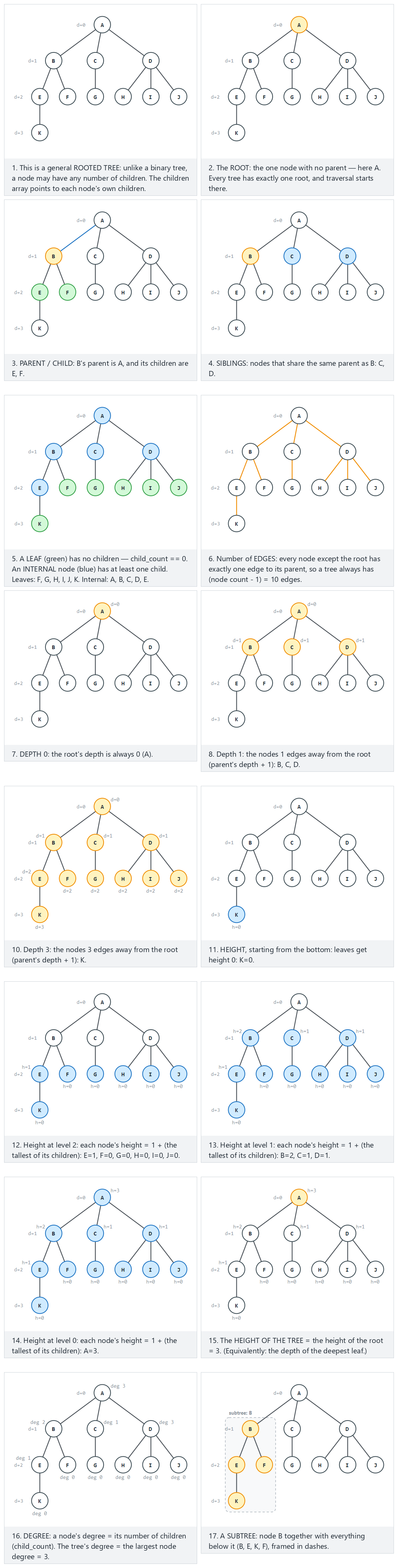
In the picker, also try 18 nodes, uneven depths (down to level 5) (hard) and the edge cases a chain (degenerate): 10 nodes, each with one child and a star: the root has 10 children — or press 🎲 for random data at four difficulty levels, or type your own tree as a list of LABEL:PARENT pairs.
Note that this first tree is a general rooted tree: a node may have any number of children, not just two. Section 2 narrows the focus to trees where every node has at most two children — binary trees — because that restriction is what makes the array tricks, the heap, and Huffman coding in the rest of this week work.
1.4 The tree in memory, and the code
The code below builds a general tree from a flat list of (label, parent) pairs — exactly the input format the animation uses — then computes each node's height (bottom-up, recursively: a leaf's height is 0, an internal node's height is 1 + the tallest of its children) and each node's depth (top-down, breadth-first, with a queue: the root's depth is 0, and a child's depth is always its parent's depth + 1).
/* Week 4 -- Trees, Heaps, and Huffman Coding
* Tree vocabulary on a GENERAL rooted tree (any number of children per
* node): root, parent, child, sibling, leaf, internal node, edge, depth,
* height, degree, subtree.
* CEN207 Data Structures (CS50-style lecture notes)
*/
#include <stdio.h>
#include <string.h>
#define MAX_CHILDREN 12
#define MAX_NODES 32
typedef struct Node {
char label[4];
struct Node *children[MAX_CHILDREN];
int child_count; /* degree of this node */
int depth; /* filled in by compute_depths() */
struct Node *parent; /* convenience only -- not shown in the lecture code panel */
} Node;
int height(Node *n) {
if (n->child_count == 0)
return 0; /* a leaf: height 0 */
int best = -1;
for (int i = 0; i < n->child_count; i++) {
int h = height(n->children[i]);
if (h > best) best = h;
}
return best + 1; /* 1 + tallest child */
}
void compute_depths(Node *root) {
Node *queue[MAX_NODES];
int front = 0, rear = 0;
root->depth = 0;
queue[rear++] = root;
while (front < rear) {
Node *cur = queue[front++];
for (int i = 0; i < cur->child_count; i++) {
Node *ch = cur->children[i];
ch->depth = cur->depth + 1;
queue[rear++] = ch;
}
}
}
static int height(Node n) {
if (n.children.isEmpty())
return 0; // a leaf: height 0
int best = -1;
for (Node c : n.children) {
int h = height(c);
if (h > best) best = h;
}
return best + 1; // 1 + tallest child
}
static void computeDepths(Node root) {
Node[] queue = new Node[MAX_NODES];
int front = 0, rear = 0;
root.depth = 0;
queue[rear++] = root;
while (front < rear) {
Node cur = queue[front++];
for (Node ch : cur.children) {
ch.depth = cur.depth + 1;
queue[rear++] = ch;
}
}
}
The full programs (code/week-04/c/tree_basics.c, code/week-04/java/TreeBasics.java) build four scenarios — the bushy 11-node tree above, the 18-node uneven tree, a 10-node degenerate chain, and an 11-node "star" — and for one probe node in each, print its depth, its degree, its children, its parent, its siblings, and the size of its own subtree.
Full program: tree_basics.c / TreeBasics.java
/* Week 4 -- Trees, Heaps, and Huffman Coding
* Tree vocabulary on a GENERAL rooted tree (any number of children per
* node): root, parent, child, sibling, leaf, internal node, edge, depth,
* height, degree, subtree.
* CEN207 Data Structures (CS50-style lecture notes)
*/
#include <stdio.h>
#include <string.h>
#define MAX_CHILDREN 12
#define MAX_NODES 32
typedef struct Node {
char label[4];
struct Node *children[MAX_CHILDREN];
int child_count; /* degree of this node */
int depth; /* filled in by compute_depths() */
struct Node *parent; /* convenience only -- not shown in the lecture code panel */
} Node;
int height(Node *n) {
if (n->child_count == 0)
return 0; /* a leaf: height 0 */
int best = -1;
for (int i = 0; i < n->child_count; i++) {
int h = height(n->children[i]);
if (h > best) best = h;
}
return best + 1; /* 1 + tallest child */
}
void compute_depths(Node *root) {
Node *queue[MAX_NODES];
int front = 0, rear = 0;
root->depth = 0;
queue[rear++] = root;
while (front < rear) {
Node *cur = queue[front++];
for (int i = 0; i < cur->child_count; i++) {
Node *ch = cur->children[i];
ch->depth = cur->depth + 1;
queue[rear++] = ch;
}
}
}
/* --- building a tree from a flat "LABEL:PARENT" list, exactly like the animation's input --- */
typedef struct {
const char *label;
const char *parent; /* NULL for the root */
} Spec;
static Node pool[MAX_NODES];
static int pool_count;
static Node *find_by_label(const char *label) {
for (int i = 0; i < pool_count; i++)
if (strcmp(pool[i].label, label) == 0) return &pool[i];
return NULL;
}
static Node *build_tree(const Spec specs[], int n) {
pool_count = 0;
for (int i = 0; i < n; i++) {
Node *node = &pool[pool_count++];
strcpy(node->label, specs[i].label);
node->child_count = 0;
node->depth = 0;
node->parent = NULL;
}
Node *root = NULL;
for (int i = 0; i < n; i++) {
Node *node = find_by_label(specs[i].label);
if (specs[i].parent == NULL) { root = node; continue; }
Node *parent = find_by_label(specs[i].parent);
parent->children[parent->child_count++] = node;
node->parent = parent;
}
return root;
}
static int subtree_size(Node *node) {
int total = 1;
for (int i = 0; i < node->child_count; i++)
total += subtree_size(node->children[i]);
return total;
}
static void print_leaves_internal(Node *node, int internal, int first_call) {
static int any_printed;
if (first_call) any_printed = 0;
if ((node->child_count == 0) == !internal) {
printf(any_printed ? " %s" : "%s", node->label);
any_printed = 1;
}
for (int i = 0; i < node->child_count; i++)
print_leaves_internal(node->children[i], internal, 0);
}
static void describe(const char *label, Node *root, int n, const char *probe_label) {
printf("-- %s --\n", label);
printf("nodes = %d, edges = %d\n", n, n - 1);
compute_depths(root);
printf("height (of the root) = %d\n", height(root));
printf("leaves:");
print_leaves_internal(root, 0, 1);
printf("\n");
printf("internal nodes:");
print_leaves_internal(root, 1, 1);
printf("\n");
Node *probe = find_by_label(probe_label);
printf("probe node %s: depth = %d, degree (child count) = %d, subtree size = %d\n",
probe->label, probe->depth, probe->child_count, subtree_size(probe));
printf(" children of %s:", probe->label);
for (int i = 0; i < probe->child_count; i++) printf(" %s", probe->children[i]->label);
if (probe->child_count == 0) printf(" (none, it is a leaf)");
printf("\n");
if (probe->parent == NULL) {
printf(" %s is the root: no parent, no siblings\n", probe->label);
} else {
printf(" parent of %s: %s\n", probe->label, probe->parent->label);
printf(" siblings of %s:", probe->label);
int any = 0;
for (int i = 0; i < probe->parent->child_count; i++) {
Node *sib = probe->parent->children[i];
if (sib != probe) { printf(" %s", sib->label); any = 1; }
}
if (!any) printf(" (none, only child)");
printf("\n");
}
printf("\n");
}
int main(void) {
/* normal: 11 nodes, a bushy tree */
Spec normal[] = {
{"A", NULL}, {"B", "A"}, {"C", "A"}, {"D", "A"},
{"E", "B"}, {"F", "B"}, {"G", "C"}, {"H", "D"},
{"I", "D"}, {"J", "D"}, {"K", "E"}
};
describe("normal: 11 nodes, a bushy tree", build_tree(normal, 11), 11, "D");
/* hard: 18 nodes, uneven depths (down to level 5) */
Spec hard[] = {
{"R", NULL},
{"P1", "R"}, {"P2", "P1"}, {"P3", "P2"}, {"P4", "P3"}, {"P5", "P4"},
{"Q1", "R"}, {"Q2", "R"}, {"Q3", "R"},
{"S1", "Q1"}, {"S2", "Q1"}, {"S3", "Q2"}, {"S4", "Q3"},
{"U1", "S1"}, {"U2", "S3"}, {"U3", "S3"},
{"V1", "U1"}, {"W1", "V1"}
};
describe("hard: 18 nodes, uneven depths", build_tree(hard, 18), 18, "S3");
/* edge: a chain (degenerate), 10 nodes, each with one child */
Spec chain[] = {
{"R", NULL}, {"C1", "R"}, {"C2", "C1"}, {"C3", "C2"}, {"C4", "C3"},
{"C5", "C4"}, {"C6", "C5"}, {"C7", "C6"}, {"C8", "C7"}, {"C9", "C8"}
};
describe("edge: a chain (degenerate), 10 nodes", build_tree(chain, 10), 10, "C9");
/* edge: a star -- the root has 10 children */
Spec star[] = {
{"R", NULL}, {"L1", "R"}, {"L2", "R"}, {"L3", "R"}, {"L4", "R"}, {"L5", "R"},
{"L6", "R"}, {"L7", "R"}, {"L8", "R"}, {"L9", "R"}, {"L10", "R"}
};
describe("edge: a star, the root has 10 children", build_tree(star, 11), 11, "R");
return 0;
}
/* Week 4 -- Trees, Heaps, and Huffman Coding
* Tree vocabulary on a GENERAL rooted tree (any number of children per
* node): root, parent, child, sibling, leaf, internal node, edge, depth,
* height, degree, subtree.
* CEN207 Data Structures (CS50-style lecture notes)
*/
import java.util.ArrayList;
import java.util.List;
public class TreeBasics {
static final int MAX_NODES = 32;
static class Node {
String label;
List<Node> children = new ArrayList<>(); // degree of this node = children.size()
int depth; // filled in by computeDepths()
Node parent; // convenience only -- not shown in the lecture code panel
Node(String label) { this.label = label; }
}
static int height(Node n) {
if (n.children.isEmpty())
return 0; // a leaf: height 0
int best = -1;
for (Node c : n.children) {
int h = height(c);
if (h > best) best = h;
}
return best + 1; // 1 + tallest child
}
static void computeDepths(Node root) {
Node[] queue = new Node[MAX_NODES];
int front = 0, rear = 0;
root.depth = 0;
queue[rear++] = root;
while (front < rear) {
Node cur = queue[front++];
for (Node ch : cur.children) {
ch.depth = cur.depth + 1;
queue[rear++] = ch;
}
}
}
// --- building a tree from a flat "LABEL:PARENT" list, exactly like the animation's input ---
static class Spec {
String label, parent; // parent == null for the root
Spec(String label, String parent) { this.label = label; this.parent = parent; }
}
static java.util.Map<String, Node> byLabel = new java.util.HashMap<>();
static Node buildTree(Spec[] specs) {
byLabel.clear();
for (Spec s : specs) byLabel.put(s.label, new Node(s.label));
Node root = null;
for (Spec s : specs) {
Node node = byLabel.get(s.label);
if (s.parent == null) { root = node; continue; }
Node parent = byLabel.get(s.parent);
parent.children.add(node);
node.parent = parent;
}
return root;
}
static int subtreeSize(Node node) {
int total = 1;
for (Node c : node.children) total += subtreeSize(c);
return total;
}
static void collectLeaves(Node node, boolean internal, List<String> out) {
if (node.children.isEmpty() == !internal) out.add(node.label);
for (Node c : node.children) collectLeaves(c, internal, out);
}
static void printLabelList(String prefix, List<String> labels) {
StringBuilder sb = new StringBuilder(prefix);
for (int i = 0; i < labels.size(); i++) sb.append(i == 0 ? "" : " ").append(labels.get(i));
System.out.println(sb);
}
static void describe(String label, Node root, int n, String probeLabel) {
System.out.println("-- " + label + " --");
System.out.println("nodes = " + n + ", edges = " + (n - 1));
computeDepths(root);
System.out.println("height (of the root) = " + height(root));
List<String> leaves = new ArrayList<>();
collectLeaves(root, false, leaves);
printLabelList("leaves:", leaves);
List<String> internal = new ArrayList<>();
collectLeaves(root, true, internal);
printLabelList("internal nodes:", internal);
Node probe = byLabel.get(probeLabel);
System.out.println("probe node " + probe.label + ": depth = " + probe.depth +
", degree (child count) = " + probe.children.size() +
", subtree size = " + subtreeSize(probe));
StringBuilder kids = new StringBuilder(" children of " + probe.label + ":");
for (Node c : probe.children) kids.append(' ').append(c.label);
if (probe.children.isEmpty()) kids.append(" (none, it is a leaf)");
System.out.println(kids);
if (probe.parent == null) {
System.out.println(" " + probe.label + " is the root: no parent, no siblings");
} else {
System.out.println(" parent of " + probe.label + ": " + probe.parent.label);
StringBuilder sibs = new StringBuilder(" siblings of " + probe.label + ":");
boolean any = false;
for (Node sib : probe.parent.children) {
if (sib != probe) { sibs.append(' ').append(sib.label); any = true; }
}
if (!any) sibs.append(" (none, only child)");
System.out.println(sibs);
}
System.out.println();
}
public static void main(String[] args) {
// normal: 11 nodes, a bushy tree
Spec[] normal = {
new Spec("A", null), new Spec("B", "A"), new Spec("C", "A"), new Spec("D", "A"),
new Spec("E", "B"), new Spec("F", "B"), new Spec("G", "C"), new Spec("H", "D"),
new Spec("I", "D"), new Spec("J", "D"), new Spec("K", "E")
};
describe("normal: 11 nodes, a bushy tree", buildTree(normal), 11, "D");
// hard: 18 nodes, uneven depths (down to level 5)
Spec[] hard = {
new Spec("R", null),
new Spec("P1", "R"), new Spec("P2", "P1"), new Spec("P3", "P2"), new Spec("P4", "P3"), new Spec("P5", "P4"),
new Spec("Q1", "R"), new Spec("Q2", "R"), new Spec("Q3", "R"),
new Spec("S1", "Q1"), new Spec("S2", "Q1"), new Spec("S3", "Q2"), new Spec("S4", "Q3"),
new Spec("U1", "S1"), new Spec("U2", "S3"), new Spec("U3", "S3"),
new Spec("V1", "U1"), new Spec("W1", "V1")
};
describe("hard: 18 nodes, uneven depths", buildTree(hard), 18, "S3");
// edge: a chain (degenerate), 10 nodes, each with one child
Spec[] chain = {
new Spec("R", null), new Spec("C1", "R"), new Spec("C2", "C1"), new Spec("C3", "C2"), new Spec("C4", "C3"),
new Spec("C5", "C4"), new Spec("C6", "C5"), new Spec("C7", "C6"), new Spec("C8", "C7"), new Spec("C9", "C8")
};
describe("edge: a chain (degenerate), 10 nodes", buildTree(chain), 10, "C9");
// edge: a star -- the root has 10 children
Spec[] star = {
new Spec("R", null), new Spec("L1", "R"), new Spec("L2", "R"), new Spec("L3", "R"), new Spec("L4", "R"), new Spec("L5", "R"),
new Spec("L6", "R"), new Spec("L7", "R"), new Spec("L8", "R"), new Spec("L9", "R"), new Spec("L10", "R")
};
describe("edge: a star, the root has 10 children", buildTree(star), 11, "R");
}
}
Try it
Expected output:
-- normal: 11 nodes, a bushy tree --
nodes = 11, edges = 10
height (of the root) = 3
leaves:K F G H I J
internal nodes:A B E C D
probe node D: depth = 1, degree (child count) = 3, subtree size = 4
children of D: H I J
parent of D: A
siblings of D: B C
-- hard: 18 nodes, uneven depths --
nodes = 18, edges = 17
height (of the root) = 5
leaves:P5 W1 S2 U2 U3 S4
internal nodes:R P1 P2 P3 P4 Q1 S1 U1 V1 Q2 S3 Q3
probe node S3: depth = 2, degree (child count) = 2, subtree size = 3
children of S3: U2 U3
parent of S3: Q2
siblings of S3: (none, only child)
-- edge: a chain (degenerate), 10 nodes --
nodes = 10, edges = 9
height (of the root) = 9
leaves:C9
internal nodes:R C1 C2 C3 C4 C5 C6 C7 C8
probe node C9: depth = 9, degree (child count) = 0, subtree size = 1
children of C9: (none, it is a leaf)
parent of C9: C8
siblings of C9: (none, only child)
-- edge: a star, the root has 10 children --
nodes = 11, edges = 10
height (of the root) = 1
leaves:L1 L2 L3 L4 L5 L6 L7 L8 L9 L10
internal nodes:R
probe node R: depth = 0, degree (child count) = 10, subtree size = 11
children of R: L1 L2 L3 L4 L5 L6 L7 L8 L9 L10
R is the root: no parent, no siblings
Complexity. height visits every node exactly once, so it is O(n). compute_depths is a breadth-first scan that also visits every node exactly once, so it too is O(n). Neither depends on the shape of the tree — a long thin chain and a short bushy tree of the same node count cost the same to measure.
Common mistakes
- Confusing depth and height. Depth is measured from the root down to a node; height is measured from a node down to its deepest leaf. The root's depth is always 0; the root's height is the height of the whole tree. They agree only for the root exactly when you ask "how deep is the deepest leaf" — that number is both the root's height and the deepest leaf's depth, which is a common source of the confusion.
- Forgetting that height starts at −1 (or 0) for the base case, not 1. If a single node counted as height 1, an empty tree would have to count as height 0, and the neat formula "leaf height = 0" would break. Pick one convention (this note uses "a leaf has height 0") and apply it consistently.
- Assuming every tree is a binary tree. A general tree's node can have any number of children; nothing about "root, parent, child, leaf, depth, height" requires exactly two. The binary restriction is a choice we make starting in the very next section, because it unlocks specific tricks (the array representation, the heap), not because it is somehow more fundamental.
Self-check: vocabulary
In the "hard" tree above, node Q1 has children S1 and S2. What is Q1's degree, and what is the depth of S1?
Answer. Q1's degree is 2 (it has two children). Q1's own depth is 1 (child of the root R), so S1, being a child of Q1, has depth 2.
2. Binary trees: node struct, shapes, and node counts
2.1 A question to start
A binary tree is a tree where every node has at most two children, conventionally called left and right. That single restriction — at most two, and the two are distinguishable — turns out to unlock an enormous amount: binary search trees (next semester's topic), the heap you will build in section 5, and the Huffman tree in section 8 are all binary trees. But not every binary tree is created equal: a binary tree that is packed tight, level by level, behaves completely differently — in memory and in speed — from one that degenerates into a straight chain. This section gives you the vocabulary to tell them apart at a glance, and the arithmetic to know exactly how many nodes a binary tree of a given height can hold.
2.2 The binary tree node
This is the struct every program in the rest of this week builds on. left and right are each either NULL (no child on that side) or a pointer to another Node. Compare it to the linked-list node from Week 2 — same idea, one more pointer field.
2.3 Five shapes, precisely defined
| Shape | Definition |
|---|---|
| Full | Every node has either 0 or 2 children — never exactly 1. |
| Complete | Every level is completely filled, except possibly the last, which is filled left to right with no gaps. |
| Perfect | Every internal node has exactly 2 children and every leaf is at the same depth. (A perfect tree is automatically full and complete.) |
| Degenerate | No node has 2 children — every node has 0 or 1, so the "tree" is really a chain. |
| Height-balanced | At every node, the heights of its left and right subtrees differ by at most 1. |
These are five independent yes/no questions you can ask about the same tree — a tree can be complete without being full, full without being complete, balanced without being complete, and so on. The animation below asks all five questions, one at a time, on the same tree, and shows exactly which node (if any) breaks each rule.
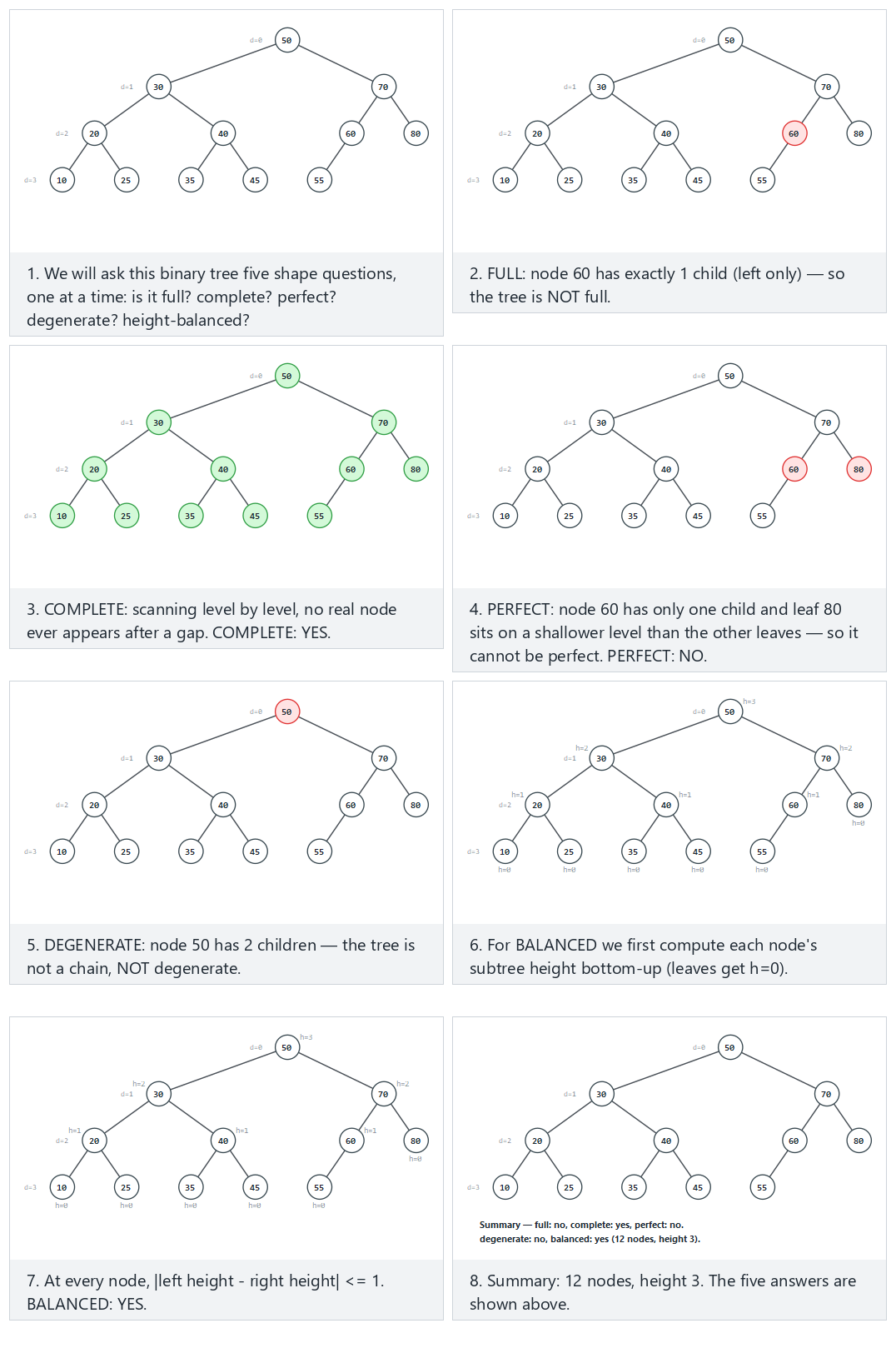
In the picker, also try 17 nodes, full but not complete, and unbalanced — a "caterpillar" tree (hard) and the edge cases a perfect tree: 15 nodes, 4 full levels, a left-leaning chain (degenerate): 10 nodes, complete but NOT full: 10 nodes, and balanced but NOT complete: 11 nodes — or press 🎲 for random data at four difficulty levels, or type your own level-order list.
2.4 How many nodes can fit?
Two formulas are worth memorizing, because they come back constantly (the heap in section 5 depends on both):
- Maximum nodes at height h. A perfect binary tree of height h has exactly 2h+1 − 1 nodes: level 0 (the root) holds 1 node, level 1 holds 2, level 2 holds 4, and in general level k holds 2k nodes, so the total through level h is 1 + 2 + 4 + ... + 2h = 2h+1 − 1.
- Minimum height for n nodes. Turning the formula around: the shortest possible binary tree holding n nodes has height ⌊log₂ n⌋ — you cannot pack n nodes into fewer levels than that, no matter how you arrange them, because each level can hold at most twice as many nodes as the one above it.
This is exactly why a balanced binary tree is desirable: it keeps the height close to log₂ n, so any operation that walks from the root to a leaf costs O(log n) instead of, in the worst (degenerate) case, O(n).
/* full: every node has 0 or 2 children (never exactly 1) */
static bool is_full(Node *n) {
if (n == NULL) return true;
bool has_l = n->left != NULL, has_r = n->right != NULL;
if (has_l != has_r) return false; /* exactly one child: not full */
return is_full(n->left) && is_full(n->right);
}
/* complete: walking level by level, once a NULL is seen no real node may follow it */
static bool is_complete(Node *root) {
Node *queue[MAX_NODES]; int front = 0, rear = 0;
queue[rear++] = root;
bool seen_gap = false;
while (front < rear) {
Node *n = queue[front++];
if (n == NULL) { seen_gap = true; continue; }
if (seen_gap) return false; /* a real node after a gap */
queue[rear++] = n->left;
queue[rear++] = n->right;
}
return true;
}
/* perfect: full AND every leaf on the same level */
static bool is_perfect(Node *n, int depth, int *leaf_depth) {
if (n == NULL) return true;
if (n->left == NULL && n->right == NULL) {
if (*leaf_depth == -1) *leaf_depth = depth;
return depth == *leaf_depth;
}
if (n->left == NULL || n->right == NULL) return false; /* not full */
return is_perfect(n->left, depth + 1, leaf_depth) && is_perfect(n->right, depth + 1, leaf_depth);
}
/* degenerate: no node has two children (every node has 0 or 1) */
static bool is_degenerate(Node *n) {
if (n == NULL) return true;
if (n->left != NULL && n->right != NULL) return false; /* two children: not degenerate */
return is_degenerate(n->left) && is_degenerate(n->right);
}
/* balanced: |height(left) - height(right)| <= 1 at every node; -1 means "unbalanced already found" */
static int check_balance(Node *n) {
if (n == NULL) return 0;
int hl = check_balance(n->left);
if (hl == -1) return -1;
int hr = check_balance(n->right);
if (hr == -1) return -1;
if (abs(hl - hr) > 1) return -1; /* found an unbalanced node */
return 1 + (hl > hr ? hl : hr);
}
// full: every node has 0 or 2 children (never exactly 1)
static boolean isFull(Node n) {
if (n == null) return true;
boolean hasL = n.left != null, hasR = n.right != null;
if (hasL != hasR) return false; // exactly one child: not full
return isFull(n.left) && isFull(n.right);
}
// complete: walking level by level, once a null is seen no real node may follow it
static boolean isComplete(Node root) {
java.util.LinkedList<Node> queue = new java.util.LinkedList<>(); // ArrayDeque rejects null elements
queue.add(root);
boolean seenGap = false;
while (!queue.isEmpty()) {
Node n = queue.poll();
if (n == null) { seenGap = true; continue; }
if (seenGap) return false; // a real node after a gap
queue.add(n.left);
queue.add(n.right);
}
return true;
}
// perfect: full AND every leaf on the same level
static boolean isPerfect(Node n, int depth, int[] leafDepth) {
if (n == null) return true;
if (n.left == null && n.right == null) {
if (leafDepth[0] == -1) leafDepth[0] = depth;
return depth == leafDepth[0];
}
if (n.left == null || n.right == null) return false; // not full
return isPerfect(n.left, depth + 1, leafDepth) && isPerfect(n.right, depth + 1, leafDepth);
}
// degenerate: no node has two children (every node has 0 or 1)
static boolean isDegenerate(Node n) {
if (n == null) return true;
if (n.left != null && n.right != null) return false; // two children: not degenerate
return isDegenerate(n.left) && isDegenerate(n.right);
}
// balanced: |height(left) - height(right)| <= 1 at every node; -1 means "unbalanced already found"
static int checkBalance(Node n) {
if (n == null) return 0;
int hl = checkBalance(n.left);
if (hl == -1) return -1;
int hr = checkBalance(n.right);
if (hr == -1) return -1;
if (Math.abs(hl - hr) > 1) return -1; // found an unbalanced node
return 1 + Math.max(hl, hr);
}
The full programs (code/week-04/c/tree_shape.c, code/week-04/java/TreeShape.java) run all five checks on six trees: a 12-node complete-but-not-perfect tree, a 17-node full "caterpillar" (unbalanced and not complete), a 15-node perfect tree, a 10-node degenerate chain, a 10-node complete-but-not-full tree, and an 11-node balanced-but-not-complete tree.
Full program: tree_shape.c / TreeShape.java
/* Week 4 -- Trees, Heaps, and Huffman Coding
* Binary tree shapes: full, complete, perfect, degenerate, height-balanced.
* CEN207 Data Structures (CS50-style lecture notes)
*/
#include <limits.h>
#include <stdbool.h>
#include <stdio.h>
#include <stdlib.h>
#define SLOT_NONE INT_MIN
#define MAX_NODES 32
typedef struct Node {
    int value;
    struct Node *left, *right;
} Node;
static Node *new_node(int value) {
Node *n = malloc(sizeof(Node));
n->value = value;
n->left = NULL;
n->right = NULL;
return n;
}
static Node *build_tree(const int arr[], int n, int i) {
if (i >= n || arr[i] == SLOT_NONE) return NULL;
Node *node = new_node(arr[i]);
node->left = build_tree(arr, n, 2 * i + 1);
node->right = build_tree(arr, n, 2 * i + 2);
return node;
}
static Node *build_left_chain(const int values[], int n) {
Node *root = NULL, *tail = NULL;
for (int i = 0; i < n; i++) {
Node *node = new_node(values[i]);
if (root == NULL) root = node; else tail->left = node;
tail = node;
}
return root;
}
/* A full binary tree (every node 0 or 2 children) shaped like a caterpillar: at each spine level one
* child is a leaf and the other continues the spine -- maximally unbalanced and far from complete.
* Always has an ODD node count: 2*spine + 1. */
static Node *build_full_caterpillar(int spine, int start, int step) {
int val = start;
Node *root = new_node(val); val += step;
Node *cur = root;
for (int i = 0; i < spine; i++) {
cur->left = new_node(val); val += step; /* one child is always a leaf */
cur->right = new_node(val); val += step;
if (i != spine - 1) cur = cur->right; /* continue the spine, except on the last step */
}
return root;
}
/* full: every node has 0 or 2 children (never exactly 1) */
static bool is_full(Node *n) {
if (n == NULL) return true;
bool has_l = n->left != NULL, has_r = n->right != NULL;
if (has_l != has_r) return false; /* exactly one child: not full */
return is_full(n->left) && is_full(n->right);
}
/* complete: walking level by level, once a NULL is seen no real node may follow it */
static bool is_complete(Node *root) {
Node *queue[MAX_NODES]; int front = 0, rear = 0;
queue[rear++] = root;
bool seen_gap = false;
while (front < rear) {
Node *n = queue[front++];
if (n == NULL) { seen_gap = true; continue; }
if (seen_gap) return false; /* a real node after a gap */
queue[rear++] = n->left;
queue[rear++] = n->right;
}
return true;
}
/* perfect: full AND every leaf on the same level */
static bool is_perfect(Node *n, int depth, int *leaf_depth) {
if (n == NULL) return true;
if (n->left == NULL && n->right == NULL) {
if (*leaf_depth == -1) *leaf_depth = depth;
return depth == *leaf_depth;
}
if (n->left == NULL || n->right == NULL) return false; /* not full */
return is_perfect(n->left, depth + 1, leaf_depth) && is_perfect(n->right, depth + 1, leaf_depth);
}
/* degenerate: no node has two children (every node has 0 or 1) */
static bool is_degenerate(Node *n) {
if (n == NULL) return true;
if (n->left != NULL && n->right != NULL) return false; /* two children: not degenerate */
return is_degenerate(n->left) && is_degenerate(n->right);
}
/* balanced: |height(left) - height(right)| <= 1 at every node; -1 means "unbalanced already found" */
static int check_balance(Node *n) {
if (n == NULL) return 0;
int hl = check_balance(n->left);
if (hl == -1) return -1;
int hr = check_balance(n->right);
if (hr == -1) return -1;
if (abs(hl - hr) > 1) return -1; /* found an unbalanced node */
return 1 + (hl > hr ? hl : hr);
}
static void classify(const char *label, Node *root) {
printf("-- %s --\n", label);
int leaf_depth = -1;
bool full = is_full(root);
bool complete = is_complete(root);
bool perfect = is_perfect(root, 0, &leaf_depth);
bool degenerate = is_degenerate(root);
int balance = check_balance(root);
printf("full=%s, complete=%s, perfect=%s, degenerate=%s, balanced=%s\n",
full ? "true" : "false",
complete ? "true" : "false",
perfect ? "true" : "false",
degenerate ? "true" : "false",
balance != -1 ? "true" : "false");
printf("\n");
}
static void free_tree(Node *node) {
if (node == NULL) return;
free_tree(node->left);
free_tree(node->right);
free(node);
}
int main(void) {
/* normal: 12 nodes, complete but not perfect */
int normal_arr[] = {50, 30, 70, 20, 40, 60, 80, 10, 25, 35, 45, 55};
Node *normal_root = build_tree(normal_arr, 12, 0);
classify("normal: 12 nodes, complete but not perfect", normal_root);
free_tree(normal_root);
/* hard: 17 nodes, full but not complete and unbalanced -- a "caterpillar" tree */
Node *caterpillar_root = build_full_caterpillar(8, 100, 5);
classify("hard: 17 nodes, full but not complete -- a caterpillar tree", caterpillar_root);
free_tree(caterpillar_root);
/* edge: a perfect tree, 15 nodes, 4 full levels */
int perfect_arr[] = {1, 2, 3, 4, 5, 6, 7, 8, 9, 10, 11, 12, 13, 14, 15};
Node *perfect_root = build_tree(perfect_arr, 15, 0);
classify("edge: perfect tree, 15 nodes", perfect_root);
free_tree(perfect_root);
/* edge: a left-leaning chain (degenerate), 10 nodes */
int chain_values[] = {90, 84, 78, 72, 66, 60, 54, 48, 42, 36};
Node *chain_root = build_left_chain(chain_values, 10);
classify("edge: left-leaning chain (degenerate), 10 nodes", chain_root);
free_tree(chain_root);
/* edge: complete but NOT full, 10 nodes */
int complete_not_full_arr[] = {1, 2, 3, 4, 5, 6, 7, 8, 9, 10};
Node *complete_not_full_root = build_tree(complete_not_full_arr, 10, 0);
classify("edge: complete but NOT full, 10 nodes", complete_not_full_root);
free_tree(complete_not_full_root);
/* edge: balanced but NOT complete, 11 nodes */
int balanced_not_complete_arr[] = {1, 2, 3, 4, 5, 6, 7, 8, SLOT_NONE, 9, SLOT_NONE, 10, SLOT_NONE, 11};
Node *balanced_not_complete_root = build_tree(balanced_not_complete_arr, 14, 0);
classify("edge: balanced but NOT complete, 11 nodes", balanced_not_complete_root);
free_tree(balanced_not_complete_root);
return 0;
}
/* Week 4 -- Trees, Heaps, and Huffman Coding
* Binary tree shapes: full, complete, perfect, degenerate, height-balanced.
* CEN207 Data Structures (CS50-style lecture notes)
*/
public class TreeShape {
static final int SLOT_NONE = Integer.MIN_VALUE;
static class Node {
int value;
Node left, right;
Node(int value) { this.value = value; }
}
static Node buildTree(int[] arr, int n, int i) {
if (i >= n || arr[i] == SLOT_NONE) return null;
Node node = new Node(arr[i]);
node.left = buildTree(arr, n, 2 * i + 1);
node.right = buildTree(arr, n, 2 * i + 2);
return node;
}
static Node buildLeftChain(int[] values) {
Node root = null, tail = null;
for (int v : values) {
Node node = new Node(v);
if (root == null) root = node; else tail.left = node;
tail = node;
}
return root;
}
// A full binary tree (every node 0 or 2 children) shaped like a caterpillar: at each spine level
// one child is a leaf and the other continues the spine -- maximally unbalanced and far from
// complete. Always has an ODD node count: 2*spine + 1.
static Node buildFullCaterpillar(int spine, int start, int step) {
int val = start;
Node root = new Node(val); val += step;
Node cur = root;
for (int i = 0; i < spine; i++) {
cur.left = new Node(val); val += step; // one child is always a leaf
cur.right = new Node(val); val += step;
if (i != spine - 1) cur = cur.right; // continue the spine, except on the last step
}
return root;
}
// full: every node has 0 or 2 children (never exactly 1)
static boolean isFull(Node n) {
if (n == null) return true;
boolean hasL = n.left != null, hasR = n.right != null;
if (hasL != hasR) return false; // exactly one child: not full
return isFull(n.left) && isFull(n.right);
}
// complete: walking level by level, once a null is seen no real node may follow it
static boolean isComplete(Node root) {
java.util.LinkedList<Node> queue = new java.util.LinkedList<>(); // ArrayDeque rejects null elements
queue.add(root);
boolean seenGap = false;
while (!queue.isEmpty()) {
Node n = queue.poll();
if (n == null) { seenGap = true; continue; }
if (seenGap) return false; // a real node after a gap
queue.add(n.left);
queue.add(n.right);
}
return true;
}
// perfect: full AND every leaf on the same level
static boolean isPerfect(Node n, int depth, int[] leafDepth) {
if (n == null) return true;
if (n.left == null && n.right == null) {
if (leafDepth[0] == -1) leafDepth[0] = depth;
return depth == leafDepth[0];
}
if (n.left == null || n.right == null) return false; // not full
return isPerfect(n.left, depth + 1, leafDepth) && isPerfect(n.right, depth + 1, leafDepth);
}
// degenerate: no node has two children (every node has 0 or 1)
static boolean isDegenerate(Node n) {
if (n == null) return true;
if (n.left != null && n.right != null) return false; // two children: not degenerate
return isDegenerate(n.left) && isDegenerate(n.right);
}
// balanced: |height(left) - height(right)| <= 1 at every node; -1 means "unbalanced already found"
static int checkBalance(Node n) {
if (n == null) return 0;
int hl = checkBalance(n.left);
if (hl == -1) return -1;
int hr = checkBalance(n.right);
if (hr == -1) return -1;
if (Math.abs(hl - hr) > 1) return -1; // found an unbalanced node
return 1 + Math.max(hl, hr);
}
static void classify(String label, Node root) {
System.out.println("-- " + label + " --");
int[] leafDepth = {-1};
boolean full = isFull(root);
boolean complete = isComplete(root);
boolean perfect = isPerfect(root, 0, leafDepth);
boolean degenerate = isDegenerate(root);
int balance = checkBalance(root);
System.out.println("full=" + full + ", complete=" + complete + ", perfect=" + perfect +
", degenerate=" + degenerate + ", balanced=" + (balance != -1));
System.out.println();
}
public static void main(String[] args) {
// normal: 12 nodes, complete but not perfect
int[] normalArr = {50, 30, 70, 20, 40, 60, 80, 10, 25, 35, 45, 55};
classify("normal: 12 nodes, complete but not perfect", buildTree(normalArr, 12, 0));
// hard: 17 nodes, full but not complete and unbalanced -- a "caterpillar" tree
classify("hard: 17 nodes, full but not complete -- a caterpillar tree", buildFullCaterpillar(8, 100, 5));
// edge: a perfect tree, 15 nodes, 4 full levels
int[] perfectArr = {1, 2, 3, 4, 5, 6, 7, 8, 9, 10, 11, 12, 13, 14, 15};
classify("edge: perfect tree, 15 nodes", buildTree(perfectArr, 15, 0));
// edge: a left-leaning chain (degenerate), 10 nodes
int[] chainValues = {90, 84, 78, 72, 66, 60, 54, 48, 42, 36};
classify("edge: left-leaning chain (degenerate), 10 nodes", buildLeftChain(chainValues));
// edge: complete but NOT full, 10 nodes
int[] completeNotFullArr = {1, 2, 3, 4, 5, 6, 7, 8, 9, 10};
classify("edge: complete but NOT full, 10 nodes", buildTree(completeNotFullArr, 10, 0));
// edge: balanced but NOT complete, 11 nodes
int[] balancedNotCompleteArr = {1, 2, 3, 4, 5, 6, 7, 8, SLOT_NONE, 9, SLOT_NONE, 10, SLOT_NONE, 11};
classify("edge: balanced but NOT complete, 11 nodes", buildTree(balancedNotCompleteArr, 14, 0));
}
}
Try it
Expected output:
-- normal: 12 nodes, complete but not perfect --
full=false, complete=true, perfect=false, degenerate=false, balanced=true
-- hard: 17 nodes, full but not complete -- a caterpillar tree --
full=true, complete=false, perfect=false, degenerate=false, balanced=false
-- edge: perfect tree, 15 nodes --
full=true, complete=true, perfect=true, degenerate=false, balanced=true
-- edge: left-leaning chain (degenerate), 10 nodes --
full=false, complete=false, perfect=false, degenerate=true, balanced=false
-- edge: complete but NOT full, 10 nodes --
full=false, complete=true, perfect=false, degenerate=false, balanced=true
-- edge: balanced but NOT complete, 11 nodes --
full=false, complete=false, perfect=false, degenerate=false, balanced=true
Complexity. All five checks visit every node at most once, so each is O(n). is_complete needs a queue (O(n) extra space in the worst case); the other four are plain recursion, needing only O(h) stack space where h is the tree's height.
Common mistakes
- Assuming "complete" means "every level full". It does not — only the last level is allowed to be partial, and only if it is filled from the left with no gaps. A tree where the last level has a gap before a filled slot (like the "gap" example in section 4) is not complete, even though every other level is completely full.
- Confusing "perfect" with "complete". Every perfect tree is complete, but not every complete tree is perfect — a complete tree's last level is merely allowed to be partial, while a perfect tree requires every leaf, including on the last level, to be at the same depth.
- Checking balance node-by-node with two separate height() calls instead of one combined pass. Calling
height(n->left)andheight(n->right)separately at every node re-walks large parts of the tree over and over, turning an O(n) check into O(n²) in the worst case (a degenerate chain).check_balanceabove avoids this by computing height and detecting imbalance in the same bottom-up pass, propagating a single sentinel value (−1) up the recursion the moment an imbalance is found anywhere below.
Self-check: shapes
A binary tree has height 3 and is perfect. How many nodes does it have, and how many of them are leaves?
Answer. A perfect tree of height h has 2h+1 − 1 nodes total, so height 3 gives 24 − 1 = 15 nodes. Its leaves are exactly the nodes on the last level, level 3, which holds 23 = 8 nodes — so 8 of the 15 nodes are leaves (and the other 7 are internal).
3. Traversals: visiting every node exactly once
A traversal visits every node of a tree exactly once, in some defined order. Unlike an array or a linked list, a tree has no single "natural" order — a node has (up to) two children, and there is a genuine choice about which to visit first, and when to visit the node itself relative to them. That choice gives us three classic recursive orders, plus two more that reach every node without recursion at all. All five, run on the same tree, will generally produce five different sequences — and each one turns out to be exactly the right order for a different real task (rebuilding a tree, printing it sorted, deleting it safely, printing it level by level).
Throughout this section, our example trees are stored as a level-order array — index i's children live at indices 2*i + 1 and 2*i + 2, with null marking a missing child (you will meet the formula behind this in section 4). All four traversal programs below share the same three example trees:
- normal: 10 nodes, a balanced BST:
[50, 30, 70, 20, 40, 60, 80, 10, null, null, 45, 55] - hard: 16 nodes, uneven depths:
[44, 22, 77, 11, 33, 60, 90, null, 5, 17, 28, 39, 55, 65, 85, null, null, 95, null, 99] - edge: a left-skewed (degenerate) chain of 10 nodes, and a right-skewed (degenerate) chain of 10 nodes
3.1 Preorder: visit, left, right
Preorder visits a node before either of its children: visit the node itself, then recurse left, then recurse right. The root is always the very first thing visited. This is exactly the order you would need to rebuild a copy of the tree from scratch: reading the sequence back in, the first value is always the root of whatever subtree comes next.
Play the animation to watch the call path light up as preorder recurses; the highlighted (blue) edges trace the path from the root down to whichever call is currently active.
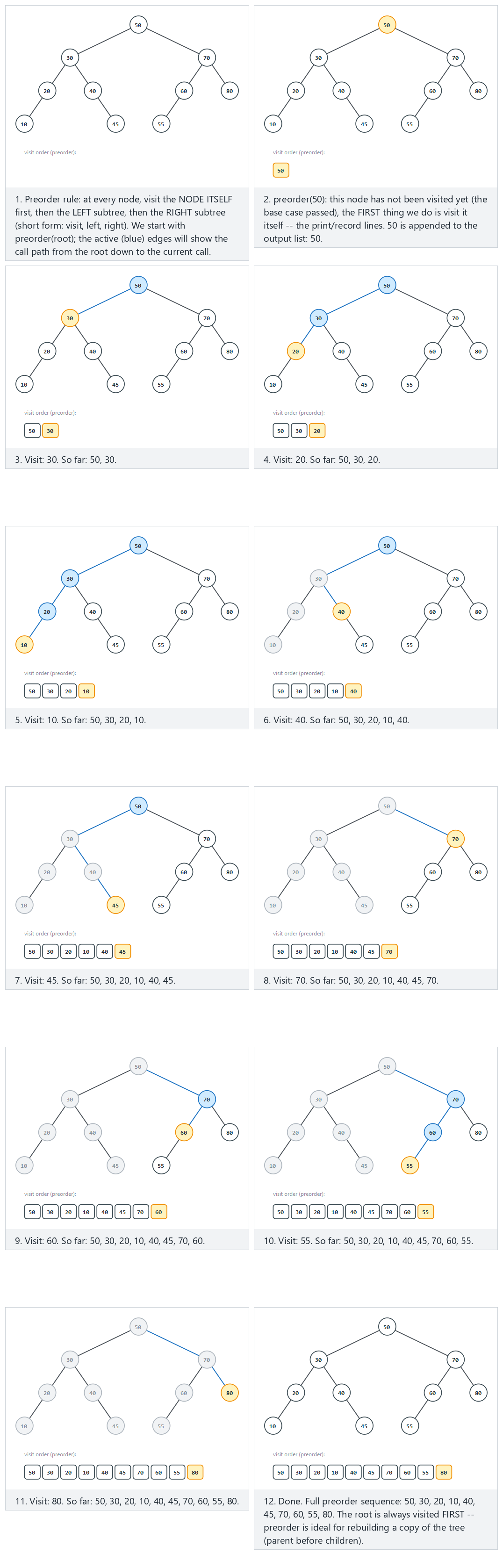
In the picker, also try 16 nodes, uneven depths (hard) and the edge cases left-skewed (degenerate) chain, 10 nodes and right-skewed (degenerate) chain, 10 nodes — or press 🎲 for random data at four difficulty levels, or type your own level-order list.
/* Week 4 -- Trees, Heaps, and Huffman Coding
* Recursive preorder traversal: visit, left, right.
* CEN207 Data Structures (CS50-style lecture notes)
*/
#include <limits.h>
#include <stdio.h>
#include <stdlib.h>
#define SLOT_NONE INT_MIN
#define MAX_VISITED 32
typedef struct Node {
    int value;
    struct Node *left, *right;
} Node;
static int visited[MAX_VISITED];
static int visited_count;
static Node *new_node(int value) {
Node *n = malloc(sizeof(Node));
n->value = value;
n->left = NULL;
n->right = NULL;
return n;
}
static Node *build_tree(const int arr[], int n, int i) {
if (i >= n || arr[i] == SLOT_NONE) return NULL;
Node *node = new_node(arr[i]);
node->left = build_tree(arr, n, 2 * i + 1);
node->right = build_tree(arr, n, 2 * i + 2);
return node;
}
static Node *build_left_chain(const int values[], int n) {
Node *root = NULL, *tail = NULL;
for (int i = 0; i < n; i++) {
Node *node = new_node(values[i]);
if (root == NULL) root = node; else tail->left = node;
tail = node;
}
return root;
}
static Node *build_right_chain(const int values[], int n) {
Node *root = NULL, *tail = NULL;
for (int i = 0; i < n; i++) {
Node *node = new_node(values[i]);
if (root == NULL) root = node; else tail->right = node;
tail = node;
}
return root;
}
static void preorder(Node *node) {
if (node == NULL) return;
printf("visit %d\n", node->value);
visited[visited_count++] = node->value;
preorder(node->left);
preorder(node->right);
}
static void free_tree(Node *node) {
if (node == NULL) return;
free_tree(node->left);
free_tree(node->right);
free(node);
}
static void run_scenario(const char *label, Node *root) {
printf("-- %s --\n", label);
visited_count = 0;
preorder(root);
printf("preorder sequence:");
for (int i = 0; i < visited_count; i++)
printf(" %d", visited[i]);
printf("\n\n");
free_tree(root);
}
int main(void) {
/* normal: 10 nodes, a balanced BST */
int normal_arr[] = {50, 30, 70, 20, 40, 60, 80, 10, SLOT_NONE, SLOT_NONE, 45, 55};
run_scenario("normal: 10 nodes, a balanced BST", build_tree(normal_arr, 12, 0));
/* hard: 16 nodes, uneven depths */
int hard_arr[] = {
44, 22, 77, 11, 33, 60, 90, SLOT_NONE, 5, 17, 28, 39, 55, 65, 85,
SLOT_NONE, SLOT_NONE, 95, SLOT_NONE, 99
};
run_scenario("hard: 16 nodes, uneven depths", build_tree(hard_arr, 20, 0));
/* edge: left-skewed (degenerate) chain, 10 nodes */
int left_values[] = {88, 81, 74, 67, 60, 53, 46, 39, 32, 25};
run_scenario("edge: left-skewed (degenerate) chain, 10 nodes", build_left_chain(left_values, 10));
/* edge: right-skewed (degenerate) chain, 10 nodes */
int right_values[] = {5, 13, 21, 29, 37, 45, 53, 61, 69, 77};
run_scenario("edge: right-skewed (degenerate) chain, 10 nodes", build_right_chain(right_values, 10));
return 0;
}
static void preorder(Node node) {
if (node == null) return;
System.out.println("visit " + node.value);
visited[visitedCount++] = node.value;
preorder(node.left);
preorder(node.right);
}
The full class (code/week-04/java/PreorderRecursive.java) mirrors the C program above line for line — same four scenarios, same helper methods, camelCase names.
Full program: preorder_recursive.c / PreorderRecursive.java
/* Week 4 -- Trees, Heaps, and Huffman Coding
 * Recursive preorder traversal: visit, left, right.
 * CEN207 Data Structures (CS50-style lecture notes)
 */
#include <limits.h>
#include <stdio.h>
#include <stdlib.h>

#define SLOT_NONE INT_MIN
#define MAX_VISITED 32

typedef struct Node {
    int value;
    struct Node *left, *right;
} Node;

static int visited[MAX_VISITED];
static int visited_count;

static Node *new_node(int value) {
    Node *n = malloc(sizeof(Node));
    n->value = value;
    n->left = NULL;
    n->right = NULL;
    return n;
}

static Node *build_tree(const int arr[], int n, int i) {
    if (i >= n || arr[i] == SLOT_NONE) return NULL;
    Node *node = new_node(arr[i]);
    node->left = build_tree(arr, n, 2 * i + 1);
    node->right = build_tree(arr, n, 2 * i + 2);
    return node;
}

static Node *build_left_chain(const int values[], int n) {
    Node *root = NULL, *tail = NULL;
    for (int i = 0; i < n; i++) {
        Node *node = new_node(values[i]);
        if (root == NULL) root = node; else tail->left = node;
        tail = node;
    }
    return root;
}

static Node *build_right_chain(const int values[], int n) {
    Node *root = NULL, *tail = NULL;
    for (int i = 0; i < n; i++) {
        Node *node = new_node(values[i]);
        if (root == NULL) root = node; else tail->right = node;
        tail = node;
    }
    return root;
}

static void preorder(Node *node) {
    if (node == NULL) return;
    printf("visit %d\n", node->value);
    visited[visited_count++] = node->value;
    preorder(node->left);
    preorder(node->right);
}

static void free_tree(Node *node) {
    if (node == NULL) return;
    free_tree(node->left);
    free_tree(node->right);
    free(node);
}

static void run_scenario(const char *label, Node *root) {
    printf("-- %s --\n", label);
    visited_count = 0;
    preorder(root);
    printf("preorder sequence:");
    for (int i = 0; i < visited_count; i++)
        printf(" %d", visited[i]);
    printf("\n\n");
    free_tree(root);
}

int main(void) {
    /* normal: 10 nodes, a balanced BST */
    int normal_arr[] = {50, 30, 70, 20, 40, 60, 80, 10, SLOT_NONE, SLOT_NONE, 45, 55};
    run_scenario("normal: 10 nodes, a balanced BST", build_tree(normal_arr, 12, 0));

    /* hard: 16 nodes, uneven depths */
    int hard_arr[] = {
        44, 22, 77, 11, 33, 60, 90, SLOT_NONE, 5, 17, 28, 39, 55, 65, 85,
        SLOT_NONE, SLOT_NONE, 95, SLOT_NONE, 99
    };
    run_scenario("hard: 16 nodes, uneven depths", build_tree(hard_arr, 20, 0));

    /* edge: left-skewed (degenerate) chain, 10 nodes */
    int left_values[] = {88, 81, 74, 67, 60, 53, 46, 39, 32, 25};
    run_scenario("edge: left-skewed (degenerate) chain, 10 nodes", build_left_chain(left_values, 10));

    /* edge: right-skewed (degenerate) chain, 10 nodes */
    int right_values[] = {5, 13, 21, 29, 37, 45, 53, 61, 69, 77};
    run_scenario("edge: right-skewed (degenerate) chain, 10 nodes", build_right_chain(right_values, 10));

    return 0;
}
/* Week 4 -- Trees, Heaps, and Huffman Coding
* Recursive preorder traversal: visit, left, right.
* CEN207 Data Structures (CS50-style lecture notes)
*/
public class PreorderRecursive {
static final int SLOT_NONE = Integer.MIN_VALUE;
static final int MAX_VISITED = 32;
static class Node {
int value;
Node left, right;
Node(int value) { this.value = value; }
}
static int[] visited = new int[MAX_VISITED];
static int visitedCount;
static Node buildTree(int[] arr, int n, int i) {
if (i >= n || arr[i] == SLOT_NONE) return null;
Node node = new Node(arr[i]);
node.left = buildTree(arr, n, 2 * i + 1);
node.right = buildTree(arr, n, 2 * i + 2);
return node;
}
static Node buildLeftChain(int[] values) {
Node root = null, tail = null;
for (int v : values) {
Node node = new Node(v);
if (root == null) root = node; else tail.left = node;
tail = node;
}
return root;
}
static Node buildRightChain(int[] values) {
Node root = null, tail = null;
for (int v : values) {
Node node = new Node(v);
if (root == null) root = node; else tail.right = node;
tail = node;
}
return root;
}
static void preorder(Node node) {
    if (node == null) return;
    System.out.println("visit " + node.value);
    visited[visitedCount++] = node.value;
    preorder(node.left);
    preorder(node.right);
}
static void runScenario(String label, Node root) {
System.out.println("-- " + label + " --");
visitedCount = 0;
preorder(root);
StringBuilder sb = new StringBuilder("preorder sequence:");
for (int i = 0; i < visitedCount; i++) sb.append(' ').append(visited[i]);
System.out.println(sb);
System.out.println();
}
public static void main(String[] args) {
// normal: 10 nodes, a balanced BST
int[] normalArr = {50, 30, 70, 20, 40, 60, 80, 10, SLOT_NONE, SLOT_NONE, 45, 55};
runScenario("normal: 10 nodes, a balanced BST", buildTree(normalArr, 12, 0));
// hard: 16 nodes, uneven depths
int[] hardArr = {
44, 22, 77, 11, 33, 60, 90, SLOT_NONE, 5, 17, 28, 39, 55, 65, 85,
SLOT_NONE, SLOT_NONE, 95, SLOT_NONE, 99
};
runScenario("hard: 16 nodes, uneven depths", buildTree(hardArr, 20, 0));
// edge: left-skewed (degenerate) chain, 10 nodes
int[] leftValues = {88, 81, 74, 67, 60, 53, 46, 39, 32, 25};
runScenario("edge: left-skewed (degenerate) chain, 10 nodes", buildLeftChain(leftValues));
// edge: right-skewed (degenerate) chain, 10 nodes
int[] rightValues = {5, 13, 21, 29, 37, 45, 53, 61, 69, 77};
runScenario("edge: right-skewed (degenerate) chain, 10 nodes", buildRightChain(rightValues));
}
}
Try it
Expected output:
-- normal: 10 nodes, a balanced BST --
visit 50
visit 30
visit 20
visit 10
visit 40
visit 45
visit 70
visit 60
visit 55
visit 80
preorder sequence: 50 30 20 10 40 45 70 60 55 80

-- hard: 16 nodes, uneven depths --
visit 44
visit 22
visit 11
visit 5
visit 95
visit 33
visit 17
visit 99
visit 28
visit 77
visit 60
visit 39
visit 55
visit 90
visit 65
visit 85
preorder sequence: 44 22 11 5 95 33 17 99 28 77 60 39 55 90 65 85

-- edge: left-skewed (degenerate) chain, 10 nodes --
visit 88
visit 81
visit 74
visit 67
visit 60
visit 53
visit 46
visit 39
visit 32
visit 25
preorder sequence: 88 81 74 67 60 53 46 39 32 25

-- edge: right-skewed (degenerate) chain, 10 nodes --
visit 5
visit 13
visit 21
visit 29
visit 37
visit 45
visit 53
visit 61
visit 69
visit 77
preorder sequence: 5 13 21 29 37 45 53 61 69 77
Notice the two degenerate chains: on the left-skewed chain, preorder visits 88, 81, 74, ... — the exact order the values were chained, since every node's only child is a left child and preorder visits left before right. On the right-skewed chain, preorder also visits in chained order 5, 13, 21, ... — because "visit, then left, then right" degenerates to "visit, then whichever single child exists" either way. Compare this with inorder and postorder below, where the two chains behave very differently from each other.
Complexity. Every node is visited exactly once, and the work done at each node (the print, the array write) is O(1), so preorder traversal is O(n) overall. The recursion depth equals the tree's height, so it uses O(h) stack space — O(log n) for a balanced tree, but O(n) in the worst case of a degenerate chain (which is exactly why section 3.4 shows how to do this without recursion, and hence without a risk of stack overflow on a very deep, very unbalanced tree).
3.2 Inorder: left, visit, right
Inorder visits a node between its two children: recurse left, then visit the node itself, then recurse right. On a binary search tree specifically (where every left descendant is smaller and every right descendant is larger than the node itself — next semester's topic), inorder traversal visits every value in sorted order. On the trees in this section, which are simply arranged for demonstration and not built by BST-insertion rules, inorder still visits left-before-self-before-right; it just does not happen to come out numerically sorted.
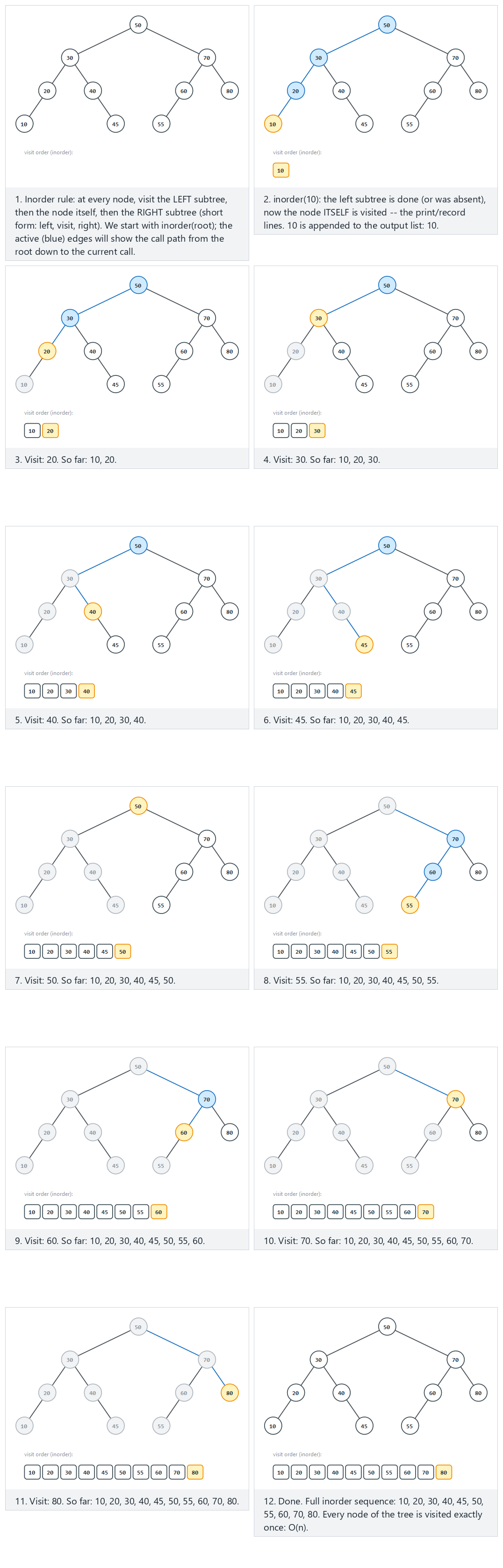
In the picker, also try 16 nodes, uneven depths (hard) and the edge cases left-skewed (degenerate) chain, 10 nodes, right-skewed (degenerate) chain, 10 nodes, and duplicate keys: every value is 7 — or press 🎲 for random data at four difficulty levels, or type your own level-order list.
The rest of the program (code/week-04/c/inorder_recursive.c, code/week-04/java/InorderRecursive.java) is identical in structure to preorder's: the same build_tree / build_left_chain / build_right_chain helpers, the same four scenarios.
Full program: inorder_recursive.c / InorderRecursive.java
/* Week 4 -- Trees, Heaps, and Huffman Coding
* Recursive inorder traversal: left, visit, right.
* CEN207 Data Structures (CS50-style lecture notes)
*/
#include <limits.h>
#include <stdio.h>
#include <stdlib.h>
#define SLOT_NONE INT_MIN
#define MAX_VISITED 32
typedef struct Node {
int value;
struct Node *left, *right;
} Node;
static int visited[MAX_VISITED];
static int visited_count;
static Node *new_node(int value) {
Node *n = malloc(sizeof(Node));
n->value = value;
n->left = NULL;
n->right = NULL;
return n;
}
static Node *build_tree(const int arr[], int n, int i) {
if (i >= n || arr[i] == SLOT_NONE) return NULL;
Node *node = new_node(arr[i]);
node->left = build_tree(arr, n, 2 * i + 1);
node->right = build_tree(arr, n, 2 * i + 2);
return node;
}
static Node *build_left_chain(const int values[], int n) {
Node *root = NULL, *tail = NULL;
for (int i = 0; i < n; i++) {
Node *node = new_node(values[i]);
if (root == NULL) root = node; else tail->left = node;
tail = node;
}
return root;
}
static Node *build_right_chain(const int values[], int n) {
Node *root = NULL, *tail = NULL;
for (int i = 0; i < n; i++) {
Node *node = new_node(values[i]);
if (root == NULL) root = node; else tail->right = node;
tail = node;
}
return root;
}
static void inorder(Node *node) {
    if (node == NULL) return;
    inorder(node->left);
    printf("visit %d\n", node->value);
    visited[visited_count++] = node->value;
    inorder(node->right);
}
static void free_tree(Node *node) {
if (node == NULL) return;
free_tree(node->left);
free_tree(node->right);
free(node);
}
static void run_scenario(const char *label, Node *root) {
printf("-- %s --\n", label);
visited_count = 0;
inorder(root);
printf("inorder sequence:");
for (int i = 0; i < visited_count; i++)
printf(" %d", visited[i]);
printf("\n\n");
free_tree(root);
}
int main(void) {
/* normal: 10 nodes, a balanced BST */
int normal_arr[] = {50, 30, 70, 20, 40, 60, 80, 10, SLOT_NONE, SLOT_NONE, 45, 55};
run_scenario("normal: 10 nodes, a balanced BST", build_tree(normal_arr, 12, 0));
/* hard: 16 nodes, uneven depths */
int hard_arr[] = {
44, 22, 77, 11, 33, 60, 90, SLOT_NONE, 5, 17, 28, 39, 55, 65, 85,
SLOT_NONE, SLOT_NONE, 95, SLOT_NONE, 99
};
run_scenario("hard: 16 nodes, uneven depths", build_tree(hard_arr, 20, 0));
/* edge: left-skewed (degenerate) chain, 10 nodes */
int left_values[] = {88, 81, 74, 67, 60, 53, 46, 39, 32, 25};
run_scenario("edge: left-skewed (degenerate) chain, 10 nodes", build_left_chain(left_values, 10));
/* edge: right-skewed (degenerate) chain, 10 nodes */
int right_values[] = {5, 13, 21, 29, 37, 45, 53, 61, 69, 77};
run_scenario("edge: right-skewed (degenerate) chain, 10 nodes", build_right_chain(right_values, 10));
return 0;
}
/* Week 4 -- Trees, Heaps, and Huffman Coding
* Recursive inorder traversal: left, visit, right.
* CEN207 Data Structures (CS50-style lecture notes)
*/
public class InorderRecursive {
static final int SLOT_NONE = Integer.MIN_VALUE;
static final int MAX_VISITED = 32;
static class Node {
int value;
Node left, right;
Node(int value) { this.value = value; }
}
static int[] visited = new int[MAX_VISITED];
static int visitedCount;
static Node buildTree(int[] arr, int n, int i) {
if (i >= n || arr[i] == SLOT_NONE) return null;
Node node = new Node(arr[i]);
node.left = buildTree(arr, n, 2 * i + 1);
node.right = buildTree(arr, n, 2 * i + 2);
return node;
}
static Node buildLeftChain(int[] values) {
Node root = null, tail = null;
for (int v : values) {
Node node = new Node(v);
if (root == null) root = node; else tail.left = node;
tail = node;
}
return root;
}
static Node buildRightChain(int[] values) {
Node root = null, tail = null;
for (int v : values) {
Node node = new Node(v);
if (root == null) root = node; else tail.right = node;
tail = node;
}
return root;
}
static void inorder(Node node) {
    if (node == null) return;
    inorder(node.left);
    System.out.println("visit " + node.value);
    visited[visitedCount++] = node.value;
    inorder(node.right);
}
static void runScenario(String label, Node root) {
System.out.println("-- " + label + " --");
visitedCount = 0;
inorder(root);
StringBuilder sb = new StringBuilder("inorder sequence:");
for (int i = 0; i < visitedCount; i++) sb.append(' ').append(visited[i]);
System.out.println(sb);
System.out.println();
}
public static void main(String[] args) {
// normal: 10 nodes, a balanced BST
int[] normalArr = {50, 30, 70, 20, 40, 60, 80, 10, SLOT_NONE, SLOT_NONE, 45, 55};
runScenario("normal: 10 nodes, a balanced BST", buildTree(normalArr, 12, 0));
// hard: 16 nodes, uneven depths
int[] hardArr = {
44, 22, 77, 11, 33, 60, 90, SLOT_NONE, 5, 17, 28, 39, 55, 65, 85,
SLOT_NONE, SLOT_NONE, 95, SLOT_NONE, 99
};
runScenario("hard: 16 nodes, uneven depths", buildTree(hardArr, 20, 0));
// edge: left-skewed (degenerate) chain, 10 nodes
int[] leftValues = {88, 81, 74, 67, 60, 53, 46, 39, 32, 25};
runScenario("edge: left-skewed (degenerate) chain, 10 nodes", buildLeftChain(leftValues));
// edge: right-skewed (degenerate) chain, 10 nodes
int[] rightValues = {5, 13, 21, 29, 37, 45, 53, 61, 69, 77};
runScenario("edge: right-skewed (degenerate) chain, 10 nodes", buildRightChain(rightValues));
}
}
Try it
Expected output:
-- normal: 10 nodes, a balanced BST --
visit 10
visit 20
visit 30
visit 40
visit 45
visit 50
visit 55
visit 60
visit 70
visit 80
inorder sequence: 10 20 30 40 45 50 55 60 70 80

-- hard: 16 nodes, uneven depths --
visit 11
visit 95
visit 5
visit 22
visit 99
visit 17
visit 33
visit 28
visit 44
visit 39
visit 60
visit 55
visit 77
visit 65
visit 90
visit 85
inorder sequence: 11 95 5 22 99 17 33 28 44 39 60 55 77 65 90 85

-- edge: left-skewed (degenerate) chain, 10 nodes --
visit 25
visit 32
visit 39
visit 46
visit 53
visit 60
visit 67
visit 74
visit 81
visit 88
inorder sequence: 25 32 39 46 53 60 67 74 81 88

-- edge: right-skewed (degenerate) chain, 10 nodes --
visit 5
visit 13
visit 21
visit 29
visit 37
visit 45
visit 53
visit 61
visit 69
visit 77
inorder sequence: 5 13 21 29 37 45 53 61 69 77
Look closely at the normal (balanced BST) scenario: 10 20 30 40 45 50 55 60 70 80 — perfectly sorted ascending order. That is no accident; it is precisely because that particular array was built to satisfy the binary-search-tree ordering rule (left < node < right, everywhere), and it previews exactly why inorder traversal matters so much once you meet binary search trees. Compare the two degenerate chains: the left-skewed chain comes out ascending (25, 32, ..., 88, the reverse of how it was chained) because inorder visits "the deepest left descendant" first, while the right-skewed chain comes out in the exact chained order (5, 13, ..., 77) because there is no left subtree ever to visit first.
Complexity. Exactly like preorder: O(n) time (every node visited once, O(1) work each), O(h) recursion-stack space.
3.3 Postorder: left, right, visit
Postorder visits a node after both of its children: recurse left, then recurse right, then visit the node itself. The root is always the very last thing visited. This ordering is exactly what you need to delete a tree safely: you must free a node's children before freeing the node itself (once a node is freed, you have lost the only pointers to its children), and postorder guarantees precisely that.
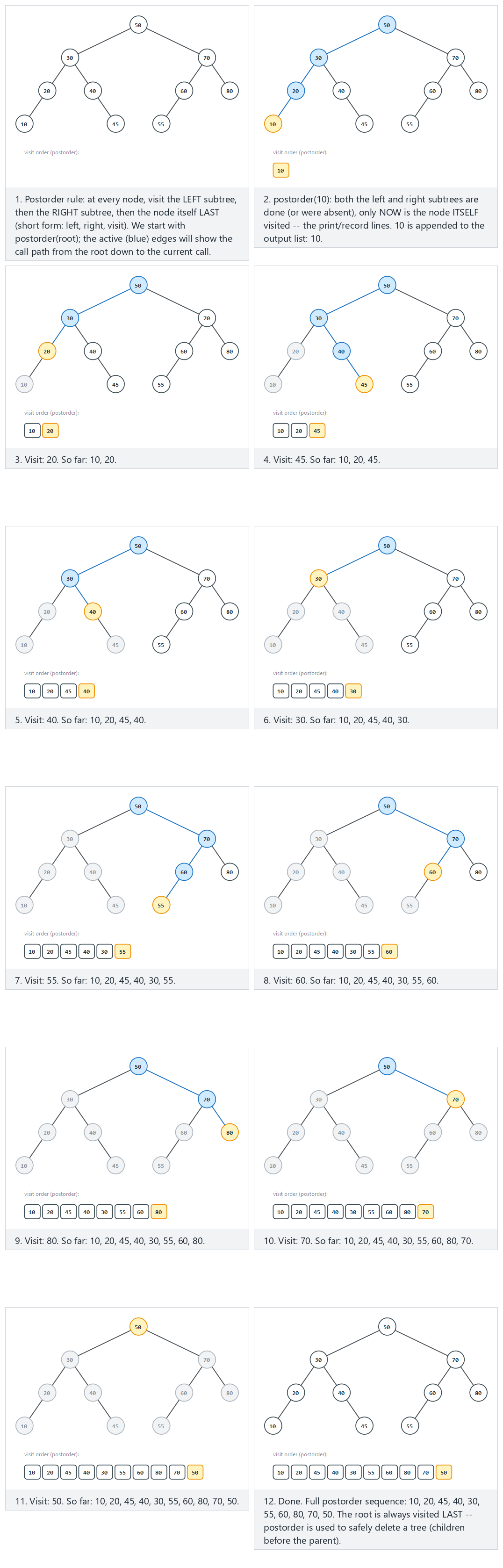
In the picker, also try 16 nodes, uneven depths (hard) and the edge cases left-skewed (degenerate) chain, 10 nodes and right-skewed (degenerate) chain, 10 nodes — or press 🎲 for random data at four difficulty levels, or type your own level-order list.
Again, the rest of the program (code/week-04/c/postorder_recursive.c, code/week-04/java/PostorderRecursive.java) reuses the same tree builders and the same four scenarios.
Full program: postorder_recursive.c / PostorderRecursive.java
/* Week 4 -- Trees, Heaps, and Huffman Coding
* Recursive postorder traversal: left, right, visit.
* CEN207 Data Structures (CS50-style lecture notes)
*/
#include <limits.h>
#include <stdio.h>
#include <stdlib.h>
#define SLOT_NONE INT_MIN
#define MAX_VISITED 32
typedef struct Node {
int value;
struct Node *left, *right;
} Node;
static int visited[MAX_VISITED];
static int visited_count;
static Node *new_node(int value) {
Node *n = malloc(sizeof(Node));
n->value = value;
n->left = NULL;
n->right = NULL;
return n;
}
static Node *build_tree(const int arr[], int n, int i) {
if (i >= n || arr[i] == SLOT_NONE) return NULL;
Node *node = new_node(arr[i]);
node->left = build_tree(arr, n, 2 * i + 1);
node->right = build_tree(arr, n, 2 * i + 2);
return node;
}
static Node *build_left_chain(const int values[], int n) {
Node *root = NULL, *tail = NULL;
for (int i = 0; i < n; i++) {
Node *node = new_node(values[i]);
if (root == NULL) root = node; else tail->left = node;
tail = node;
}
return root;
}
static Node *build_right_chain(const int values[], int n) {
Node *root = NULL, *tail = NULL;
for (int i = 0; i < n; i++) {
Node *node = new_node(values[i]);
if (root == NULL) root = node; else tail->right = node;
tail = node;
}
return root;
}
static void postorder(Node *node) {
    if (node == NULL) return;
    postorder(node->left);
    postorder(node->right);
    printf("visit %d\n", node->value);
    visited[visited_count++] = node->value;
}
static void free_tree(Node *node) {
if (node == NULL) return;
free_tree(node->left);
free_tree(node->right);
free(node);
}
static void run_scenario(const char *label, Node *root) {
printf("-- %s --\n", label);
visited_count = 0;
postorder(root);
printf("postorder sequence:");
for (int i = 0; i < visited_count; i++)
printf(" %d", visited[i]);
printf("\n\n");
free_tree(root);
}
int main(void) {
/* normal: 10 nodes, a balanced BST */
int normal_arr[] = {50, 30, 70, 20, 40, 60, 80, 10, SLOT_NONE, SLOT_NONE, 45, 55};
run_scenario("normal: 10 nodes, a balanced BST", build_tree(normal_arr, 12, 0));
/* hard: 16 nodes, uneven depths */
int hard_arr[] = {
44, 22, 77, 11, 33, 60, 90, SLOT_NONE, 5, 17, 28, 39, 55, 65, 85,
SLOT_NONE, SLOT_NONE, 95, SLOT_NONE, 99
};
run_scenario("hard: 16 nodes, uneven depths", build_tree(hard_arr, 20, 0));
/* edge: left-skewed (degenerate) chain, 10 nodes */
int left_values[] = {88, 81, 74, 67, 60, 53, 46, 39, 32, 25};
run_scenario("edge: left-skewed (degenerate) chain, 10 nodes", build_left_chain(left_values, 10));
/* edge: right-skewed (degenerate) chain, 10 nodes */
int right_values[] = {5, 13, 21, 29, 37, 45, 53, 61, 69, 77};
run_scenario("edge: right-skewed (degenerate) chain, 10 nodes", build_right_chain(right_values, 10));
return 0;
}
/* Week 4 -- Trees, Heaps, and Huffman Coding
* Recursive postorder traversal: left, right, visit.
* CEN207 Data Structures (CS50-style lecture notes)
*/
public class PostorderRecursive {
static final int SLOT_NONE = Integer.MIN_VALUE;
static final int MAX_VISITED = 32;
static class Node {
int value;
Node left, right;
Node(int value) { this.value = value; }
}
static int[] visited = new int[MAX_VISITED];
static int visitedCount;
static Node buildTree(int[] arr, int n, int i) {
if (i >= n || arr[i] == SLOT_NONE) return null;
Node node = new Node(arr[i]);
node.left = buildTree(arr, n, 2 * i + 1);
node.right = buildTree(arr, n, 2 * i + 2);
return node;
}
static Node buildLeftChain(int[] values) {
Node root = null, tail = null;
for (int v : values) {
Node node = new Node(v);
if (root == null) root = node; else tail.left = node;
tail = node;
}
return root;
}
static Node buildRightChain(int[] values) {
Node root = null, tail = null;
for (int v : values) {
Node node = new Node(v);
if (root == null) root = node; else tail.right = node;
tail = node;
}
return root;
}
static void postorder(Node node) {
    if (node == null) return;
    postorder(node.left);
    postorder(node.right);
    System.out.println("visit " + node.value);
    visited[visitedCount++] = node.value;
}
static void runScenario(String label, Node root) {
System.out.println("-- " + label + " --");
visitedCount = 0;
postorder(root);
StringBuilder sb = new StringBuilder("postorder sequence:");
for (int i = 0; i < visitedCount; i++) sb.append(' ').append(visited[i]);
System.out.println(sb);
System.out.println();
}
public static void main(String[] args) {
// normal: 10 nodes, a balanced BST
int[] normalArr = {50, 30, 70, 20, 40, 60, 80, 10, SLOT_NONE, SLOT_NONE, 45, 55};
runScenario("normal: 10 nodes, a balanced BST", buildTree(normalArr, 12, 0));
// hard: 16 nodes, uneven depths
int[] hardArr = {
44, 22, 77, 11, 33, 60, 90, SLOT_NONE, 5, 17, 28, 39, 55, 65, 85,
SLOT_NONE, SLOT_NONE, 95, SLOT_NONE, 99
};
runScenario("hard: 16 nodes, uneven depths", buildTree(hardArr, 20, 0));
// edge: left-skewed (degenerate) chain, 10 nodes
int[] leftValues = {88, 81, 74, 67, 60, 53, 46, 39, 32, 25};
runScenario("edge: left-skewed (degenerate) chain, 10 nodes", buildLeftChain(leftValues));
// edge: right-skewed (degenerate) chain, 10 nodes
int[] rightValues = {5, 13, 21, 29, 37, 45, 53, 61, 69, 77};
runScenario("edge: right-skewed (degenerate) chain, 10 nodes", buildRightChain(rightValues));
}
}
Try it
Expected output:
-- normal: 10 nodes, a balanced BST --
visit 10
visit 20
visit 45
visit 40
visit 30
visit 55
visit 60
visit 80
visit 70
visit 50
postorder sequence: 10 20 45 40 30 55 60 80 70 50

-- hard: 16 nodes, uneven depths --
visit 95
visit 5
visit 11
visit 99
visit 17
visit 28
visit 33
visit 22
visit 39
visit 55
visit 60
visit 65
visit 85
visit 90
visit 77
visit 44
postorder sequence: 95 5 11 99 17 28 33 22 39 55 60 65 85 90 77 44

-- edge: left-skewed (degenerate) chain, 10 nodes --
visit 25
visit 32
visit 39
visit 46
visit 53
visit 60
visit 67
visit 74
visit 81
visit 88
postorder sequence: 25 32 39 46 53 60 67 74 81 88

-- edge: right-skewed (degenerate) chain, 10 nodes --
visit 77
visit 69
visit 61
visit 53
visit 45
visit 37
visit 29
visit 21
visit 13
visit 5
postorder sequence: 77 69 61 53 45 37 29 21 13 5
Notice that in the normal scenario, the root 50 is printed last, as postorder always guarantees — compare this to preorder, where 50 was printed first. Also notice that the right-skewed chain now comes out in reverse chained order (77, 69, ..., 5): with no left subtree to visit, postorder still saves "visit the node itself" for last, so it visits the whole right chain recursively (bottoming out at the deepest node first) before ever printing the shallower nodes above it.
Complexity. O(n) time, O(h) recursion-stack space — identical profile to preorder and inorder; only the order of the three steps (visit, left, right) changes, never the total amount of work.
Common mistakes (all three recursive traversals)
- Forgetting the base case. Every one of these three functions must return immediately when
node == NULL. Skip it, and the very first call on an empty subtree dereferences a null pointer. - Reusing a "visited" array or counter across scenarios without resetting it. All three programs above reset
visited_count = 0at the start ofrun_scenario; forgetting that would silently append one scenario's output onto the previous scenario's, corrupting both. - Assuming all three orders agree "most of the time". They agree only in trivial cases (an empty tree, or a single node). Even one extra node is enough for preorder, inorder, and postorder to diverge, as the three outputs above make clear on every scenario.
- Picking the wrong traversal for the job. Rebuilding a tree from a saved sequence needs preorder (the root always comes first). Deleting a tree node-by-node needs postorder (children before parent). Printing a binary search tree in sorted order needs inorder. Using the wrong one still "visits every node", so the bug is easy to miss until the order of visits actually matters.
Self-check: choosing a traversal
You need to serialize a binary tree to a file so that reading the numbers back in the same order and re-inserting each one (first insert becomes the root, and so on) reconstructs the exact same tree. Which traversal do you save it with, and why?
Answer. Preorder. The very first value read back in must be the root, and preorder is the only one of the three that visits the root before either of its subtrees — exactly what "insert in this order, first one becomes the root" requires.
3.4 Inorder without recursion: our own explicit stack
Every recursive traversal above secretly relies on the compiler's call stack to remember "which nodes are still waiting to be visited". Week 3 showed that recursion is a stack; this section makes that completely literal by writing inorder traversal again, with no recursion at all, using the exact array-based stack you built in Week 3 — except it now holds Node * pointers instead of ints.
The idea: to visit inorder (left, visit, right) without recursion, walk as far left as possible while pushing every node you pass (you will need to come back to each of them, then visit them, then explore their right subtree). When you cannot go left any further, pop the most recent node — its entire left side is done, so visit it immediately — then continue into its right subtree, and repeat the whole process.
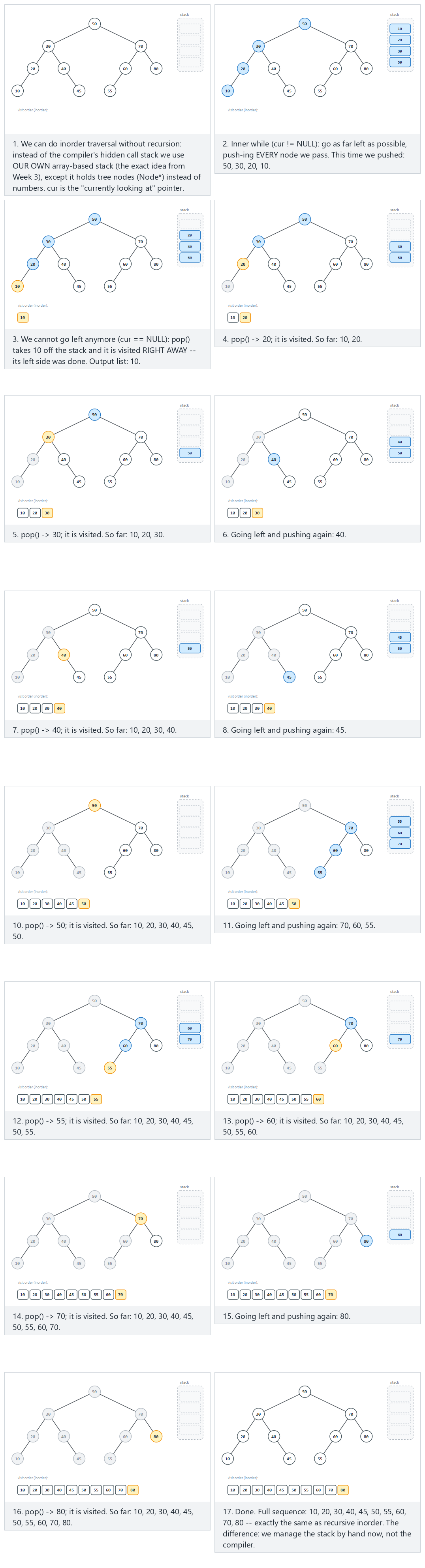
In the picker, also try 16 nodes, uneven depths (hard) and the edge cases left-skewed chain: the stack reaches its deepest point, 10 nodes and right-skewed chain: the stack never grows deep, 10 nodes — or press 🎲 for random data at four difficulty levels, or type your own level-order list.
static Node *stack_data[STACK_CAP];
static int top = -1;

static void push(Node *n) {
    top = top + 1;
    stack_data[top] = n;
}

static Node *pop(void) {
    Node *n = stack_data[top];
    top = top - 1;
    return n;
}

/* ... inside run_scenario: */
Node *cur = root;
while (cur != NULL || !is_empty()) {
    while (cur != NULL) {          /* push the whole left spine */
        push(cur);
        cur = cur->left;
    }
    cur = pop();                   /* can't go left anymore: pop, visit */
    printf("visit %d\n", cur->value);
    visited[visited_count++] = cur->value;
    cur = cur->right;              /* then walk into the right subtree */
}
static Node[] stackData = new Node[STACK_CAP];
static int top = -1;

static void push(Node n) {
    top = top + 1;
    stackData[top] = n;
}

static Node pop() {
    Node n = stackData[top];
    top = top - 1;
    return n;
}

// ... inside runScenario:
Node cur = root;
while (cur != null || !isEmpty()) {
    while (cur != null) {          // push the whole left spine
        push(cur);
        cur = cur.left;
    }
    cur = pop();                   // can't go left anymore: pop, visit
    System.out.println("visit " + cur.value);
    visited[visitedCount++] = cur.value;
    cur = cur.right;               // then walk into the right subtree
}
The full programs (code/week-04/c/inorder_stack.c, code/week-04/java/InorderStack.java) run the same four scenarios as the recursive traversals above.
Full program: inorder_stack.c / InorderStack.java
/* Week 4 -- Trees, Heaps, and Huffman Coding
 * Iterative inorder traversal with our own explicit array-based stack
 * (the exact stack idea from Week 3, holding tree nodes instead of numbers).
 * CEN207 Data Structures (CS50-style lecture notes)
 */
#include <limits.h>
#include <stdio.h>
#include <stdlib.h>

#define SLOT_NONE INT_MIN
#define MAX_VISITED 32
#define STACK_CAP 32

typedef struct Node {
    int value;
    struct Node *left, *right;
} Node;

static int visited[MAX_VISITED];
static int visited_count;

static Node *stack_data[STACK_CAP];
static int top = -1;

static void push(Node *n) {
    top = top + 1;
    stack_data[top] = n;
}

static Node *pop(void) {
    Node *n = stack_data[top];
    top = top - 1;
    return n;
}

static int is_empty(void) {
    return top == -1;
}

static Node *new_node(int value) {
    Node *n = malloc(sizeof(Node));
    n->value = value;
    n->left = NULL;
    n->right = NULL;
    return n;
}

static Node *build_tree(const int arr[], int n, int i) {
    if (i >= n || arr[i] == SLOT_NONE) return NULL;
    Node *node = new_node(arr[i]);
    node->left = build_tree(arr, n, 2 * i + 1);
    node->right = build_tree(arr, n, 2 * i + 2);
    return node;
}

static Node *build_left_chain(const int values[], int n) {
    Node *root = NULL, *tail = NULL;
    for (int i = 0; i < n; i++) {
        Node *node = new_node(values[i]);
        if (root == NULL) root = node; else tail->left = node;
        tail = node;
    }
    return root;
}

static Node *build_right_chain(const int values[], int n) {
    Node *root = NULL, *tail = NULL;
    for (int i = 0; i < n; i++) {
        Node *node = new_node(values[i]);
        if (root == NULL) root = node; else tail->right = node;
        tail = node;
    }
    return root;
}

static void free_tree(Node *node) {
    if (node == NULL) return;
    free_tree(node->left);
    free_tree(node->right);
    free(node);
}

static void run_scenario(const char *label, Node *root) {
    printf("-- %s --\n", label);
    visited_count = 0;
    top = -1;

    Node *cur = root;
    while (cur != NULL || !is_empty()) {
        while (cur != NULL) {          /* push the whole left spine */
            push(cur);
            cur = cur->left;
        }
        cur = pop();                   /* can't go left anymore: pop, visit */
        printf("visit %d\n", cur->value);
        visited[visited_count++] = cur->value;
        cur = cur->right;              /* then walk into the right subtree */
    }

    printf("inorder sequence:");
    for (int i = 0; i < visited_count; i++)
        printf(" %d", visited[i]);
    printf("\n\n");
    free_tree(root);
}

int main(void) {
    /* normal: 10 nodes, a balanced BST */
    int normal_arr[] = {50, 30, 70, 20, 40, 60, 80, 10, SLOT_NONE, SLOT_NONE, 45, 55};
    run_scenario("normal: 10 nodes, a balanced BST", build_tree(normal_arr, 12, 0));

    /* hard: 16 nodes, uneven depths */
    int hard_arr[] = {
        44, 22, 77, 11, 33, 60, 90, SLOT_NONE, 5, 17, 28, 39, 55, 65, 85,
        SLOT_NONE, SLOT_NONE, 95, SLOT_NONE, 99
    };
    run_scenario("hard: 16 nodes, uneven depths", build_tree(hard_arr, 20, 0));

    /* edge: left-skewed chain -- the stack reaches its deepest point, 10 nodes */
    int left_values[] = {88, 81, 74, 67, 60, 53, 46, 39, 32, 25};
    run_scenario("edge: left-skewed chain (stack goes deep), 10 nodes", build_left_chain(left_values, 10));

    /* edge: right-skewed chain -- the stack never grows past one item, 10 nodes */
    int right_values[] = {5, 13, 21, 29, 37, 45, 53, 61, 69, 77};
    run_scenario("edge: right-skewed chain (stack stays shallow), 10 nodes", build_right_chain(right_values, 10));

    return 0;
}
/* Week 4 -- Trees, Heaps, and Huffman Coding
 * Iterative inorder traversal with our own explicit array-based stack
 * (the exact stack idea from Week 3, holding tree nodes instead of numbers).
 * CEN207 Data Structures (CS50-style lecture notes)
 */
public class InorderStack {
    static final int SLOT_NONE = Integer.MIN_VALUE;
    static final int MAX_VISITED = 32;
    static final int STACK_CAP = 32;

    static class Node {
        int value;
        Node left, right;
        Node(int value) { this.value = value; }
    }

    static int[] visited = new int[MAX_VISITED];
    static int visitedCount;

    static Node[] stackData = new Node[STACK_CAP];
    static int top = -1;

    static void push(Node n) {
        top = top + 1;
        stackData[top] = n;
    }

    static Node pop() {
        Node n = stackData[top];
        top = top - 1;
        return n;
    }

    static boolean isEmpty() {
        return top == -1;
    }

    static Node buildTree(int[] arr, int n, int i) {
        if (i >= n || arr[i] == SLOT_NONE) return null;
        Node node = new Node(arr[i]);
        node.left = buildTree(arr, n, 2 * i + 1);
        node.right = buildTree(arr, n, 2 * i + 2);
        return node;
    }

    static Node buildLeftChain(int[] values) {
        Node root = null, tail = null;
        for (int v : values) {
            Node node = new Node(v);
            if (root == null) root = node; else tail.left = node;
            tail = node;
        }
        return root;
    }

    static Node buildRightChain(int[] values) {
        Node root = null, tail = null;
        for (int v : values) {
            Node node = new Node(v);
            if (root == null) root = node; else tail.right = node;
            tail = node;
        }
        return root;
    }

    static void runScenario(String label, Node root) {
        System.out.println("-- " + label + " --");
        visitedCount = 0;
        top = -1;

        Node cur = root;
        while (cur != null || !isEmpty()) {
            while (cur != null) {          // push the whole left spine
                push(cur);
                cur = cur.left;
            }
            cur = pop();                   // can't go left anymore: pop, visit
            System.out.println("visit " + cur.value);
            visited[visitedCount++] = cur.value;
            cur = cur.right;               // then walk into the right subtree
        }

        StringBuilder sb = new StringBuilder("inorder sequence:");
        for (int i = 0; i < visitedCount; i++) sb.append(' ').append(visited[i]);
        System.out.println(sb);
        System.out.println();
    }

    public static void main(String[] args) {
        // normal: 10 nodes, a balanced BST
        int[] normalArr = {50, 30, 70, 20, 40, 60, 80, 10, SLOT_NONE, SLOT_NONE, 45, 55};
        runScenario("normal: 10 nodes, a balanced BST", buildTree(normalArr, 12, 0));

        // hard: 16 nodes, uneven depths
        int[] hardArr = {
            44, 22, 77, 11, 33, 60, 90, SLOT_NONE, 5, 17, 28, 39, 55, 65, 85,
            SLOT_NONE, SLOT_NONE, 95, SLOT_NONE, 99
        };
        runScenario("hard: 16 nodes, uneven depths", buildTree(hardArr, 20, 0));

        // edge: left-skewed chain -- the stack reaches its deepest point, 10 nodes
        int[] leftValues = {88, 81, 74, 67, 60, 53, 46, 39, 32, 25};
        runScenario("edge: left-skewed chain (stack goes deep), 10 nodes", buildLeftChain(leftValues));

        // edge: right-skewed chain -- the stack never grows past one item, 10 nodes
        int[] rightValues = {5, 13, 21, 29, 37, 45, 53, 61, 69, 77};
        runScenario("edge: right-skewed chain (stack stays shallow), 10 nodes", buildRightChain(rightValues));
    }
}
Try it
Expected output:
-- normal: 10 nodes, a balanced BST --
visit 10
visit 20
visit 30
visit 40
visit 45
visit 50
visit 55
visit 60
visit 70
visit 80
inorder sequence: 10 20 30 40 45 50 55 60 70 80

-- hard: 16 nodes, uneven depths --
visit 11
visit 95
visit 5
visit 22
visit 99
visit 17
visit 33
visit 28
visit 44
visit 39
visit 60
visit 55
visit 77
visit 65
visit 90
visit 85
inorder sequence: 11 95 5 22 99 17 33 28 44 39 60 55 77 65 90 85

-- edge: left-skewed chain (stack goes deep), 10 nodes --
visit 25
visit 32
visit 39
visit 46
visit 53
visit 60
visit 67
visit 74
visit 81
visit 88
inorder sequence: 25 32 39 46 53 60 67 74 81 88

-- edge: right-skewed chain (stack stays shallow), 10 nodes --
visit 5
visit 13
visit 21
visit 29
visit 37
visit 45
visit 53
visit 61
visit 69
visit 77
inorder sequence: 5 13 21 29 37 45 53 61 69 77
Expected output: identical to the C run above (same algorithm, same data) — and, node for node, identical to inorder_recursive.c's output too: it is the exact same traversal, just with an explicit stack standing in for the compiler's hidden one.
On the left-skewed chain, the inner while (cur != NULL) loop pushes all 10 nodes before a single one is popped — the stack reaches depth 10. On the right-skewed chain, the inner loop pushes at most one node at a time before immediately popping it again — the stack never holds more than one item. This is precisely why a degenerate, left-leaning tree is the worst case for stack (and recursion) depth: O(n) instead of O(log n).
Complexity. O(n) time — every node is pushed exactly once and popped exactly once. O(h) space for the stack, exactly matching the O(h) recursion-stack space the recursive version used — we have not saved any memory, only moved the bookkeeping from the compiler's implicit stack to our own explicit one. The benefit is control: an explicit stack can be grown dynamically past a fixed recursion-depth limit, and it cannot trigger a stack overflow crash the way unbounded recursion could on a pathologically deep tree.
Common mistakes
- Popping before checking
cur != NULL. The outer loop condition iscur != NULL || !is_empty()— both halves matter. Drop the first half and you stop as soon ascurgoesNULL, even if the stack still has unvisited ancestors waiting; drop the second half and you loop forever oncecurisNULLand the stack is also empty. - Forgetting to descend into the right subtree after popping. After visiting the popped node, you must set
cur = cur->rightand let the outer loop's innerwhilepush that subtree's own left spine. Skipping this silently drops every right subtree from the traversal.
Self-check: stack depth
On a perfect binary tree of height h (so it has 2h+1 − 1 nodes), what is the maximum number of nodes ever sitting on the stack at once during this iterative inorder traversal?
Answer. h + 1. The stack only ever holds the nodes on the current left spine — the path from the root down through a chain of left children — and the longest such path in a perfect tree of height h has exactly h + 1 nodes (depths 0 through h).
3.5 Level order (breadth-first) with a queue
All four traversals so far go deep before they go wide: they follow one branch all the way down before backing up to try another. Level-order traversal (also called breadth-first search, BFS) does the exact opposite: it visits the root, then every node at depth 1, then every node at depth 2, and so on — completely finishing one level before starting the next. This needs a queue, not a stack: the very first node enqueued (the root) must also be the very first one processed, which is exactly FIFO behavior.
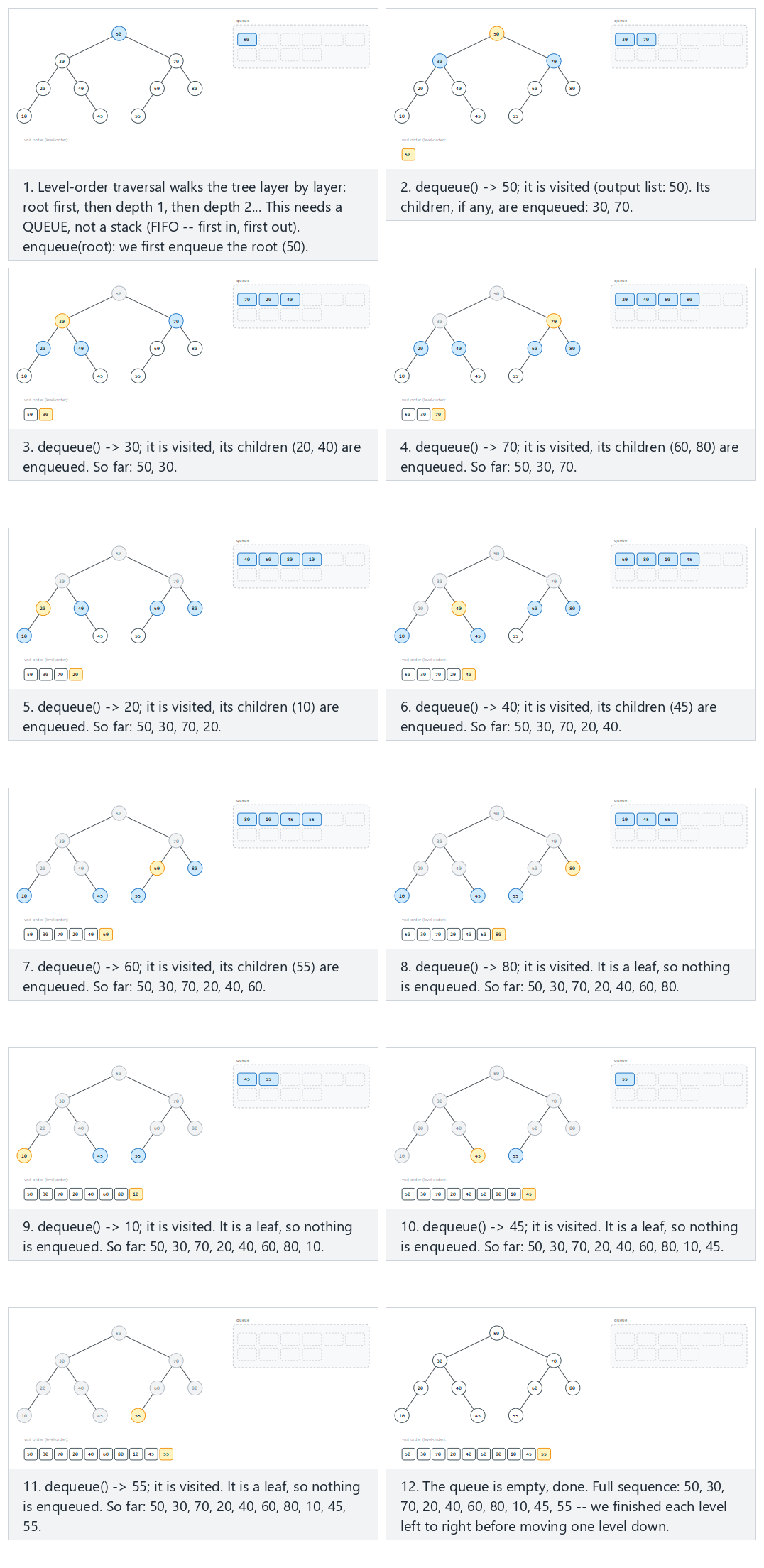
In the picker, also try 16 nodes, uneven depths (hard) and the edge cases left-skewed (degenerate) chain: the queue always holds one item, 10 nodes and right-skewed (degenerate) chain, 10 nodes — or press 🎲 for random data at four difficulty levels, or type your own level-order list.
static Node *queue_data[QUEUE_CAP];
static int front, rear, count;

static void enqueue(Node *n) {
    rear = (rear + 1) % QUEUE_CAP;
    queue_data[rear] = n;
    count++;
}

static Node *dequeue(void) {
    Node *n = queue_data[front];
    front = (front + 1) % QUEUE_CAP;
    count--;
    return n;
}

/* ... inside run_scenario: */
enqueue(root);
while (!is_empty()) {
    Node *cur = dequeue();
    printf("visit %d\n", cur->value);
    visited[visited_count++] = cur->value;
    if (cur->left != NULL) enqueue(cur->left);
    if (cur->right != NULL) enqueue(cur->right);
}
static Node[] queueData = new Node[QUEUE_CAP];
static int front, rear, count;

static void enqueue(Node n) {
    rear = (rear + 1) % QUEUE_CAP;
    queueData[rear] = n;
    count++;
}

static Node dequeue() {
    Node n = queueData[front];
    front = (front + 1) % QUEUE_CAP;
    count--;
    return n;
}

// ... inside runScenario:
enqueue(root);
while (!isEmpty()) {
    Node cur = dequeue();
    System.out.println("visit " + cur.value);
    visited[visitedCount++] = cur.value;
    if (cur.left != null) enqueue(cur.left);
    if (cur.right != null) enqueue(cur.right);
}
Notice the circular-queue convention: rear starts at −1 (not 0), precisely so that the very first enqueue call — which always does rear = (rear + 1) % QUEUE_CAP before writing — lands correctly on index 0. Get this backwards (initialize rear = 0) and the first slot written is index 1, leaving index 0 permanently empty — the exact bug this note's own first draft made, caught only by actually running the program and watching it segfault on the very first dequeue.
The full programs (code/week-04/c/levelorder_queue.c, code/week-04/java/LevelorderQueue.java) run the same four scenarios.
Full program: levelorder_queue.c / LevelorderQueue.java
/* Week 4 -- Trees, Heaps, and Huffman Coding
 * Level-order (breadth-first) traversal with an explicit circular queue.
 * CEN207 Data Structures (CS50-style lecture notes)
 */
#include <limits.h>
#include <stdio.h>
#include <stdlib.h>

#define SLOT_NONE INT_MIN
#define MAX_VISITED 32
#define QUEUE_CAP 32

typedef struct Node {
    int value;
    struct Node *left, *right;
} Node;

static int visited[MAX_VISITED];
static int visited_count;

static Node *queue_data[QUEUE_CAP];
static int front, rear, count;

static void enqueue(Node *n) {
    rear = (rear + 1) % QUEUE_CAP;
    queue_data[rear] = n;
    count++;
}

static Node *dequeue(void) {
    Node *n = queue_data[front];
    front = (front + 1) % QUEUE_CAP;
    count--;
    return n;
}

static int is_empty(void) {
    return count == 0;
}

static Node *new_node(int value) {
    Node *n = malloc(sizeof(Node));
    n->value = value;
    n->left = NULL;
    n->right = NULL;
    return n;
}

static Node *build_tree(const int arr[], int n, int i) {
    if (i >= n || arr[i] == SLOT_NONE) return NULL;
    Node *node = new_node(arr[i]);
    node->left = build_tree(arr, n, 2 * i + 1);
    node->right = build_tree(arr, n, 2 * i + 2);
    return node;
}

static Node *build_left_chain(const int values[], int n) {
    Node *root = NULL, *tail = NULL;
    for (int i = 0; i < n; i++) {
        Node *node = new_node(values[i]);
        if (root == NULL) root = node; else tail->left = node;
        tail = node;
    }
    return root;
}

static Node *build_right_chain(const int values[], int n) {
    Node *root = NULL, *tail = NULL;
    for (int i = 0; i < n; i++) {
        Node *node = new_node(values[i]);
        if (root == NULL) root = node; else tail->right = node;
        tail = node;
    }
    return root;
}

static void free_tree(Node *node) {
    if (node == NULL) return;
    free_tree(node->left);
    free_tree(node->right);
    free(node);
}

static void run_scenario(const char *label, Node *root) {
    printf("-- %s --\n", label);
    visited_count = 0;
    front = 0;
    rear = -1;              /* enqueue does rear = (rear + 1) % CAP first */
    count = 0;

    if (root == NULL) {
        printf("(empty tree, nothing enqueued)\n\n");
        return;
    }

    enqueue(root);
    while (!is_empty()) {
        Node *cur = dequeue();
        printf("visit %d\n", cur->value);
        visited[visited_count++] = cur->value;
        if (cur->left != NULL) enqueue(cur->left);
        if (cur->right != NULL) enqueue(cur->right);
    }

    printf("level-order sequence:");
    for (int i = 0; i < visited_count; i++)
        printf(" %d", visited[i]);
    printf("\n\n");
    free_tree(root);
}

int main(void) {
    /* normal: 10 nodes, a balanced BST */
    int normal_arr[] = {50, 30, 70, 20, 40, 60, 80, 10, SLOT_NONE, SLOT_NONE, 45, 55};
    run_scenario("normal: 10 nodes, a balanced BST", build_tree(normal_arr, 12, 0));

    /* hard: 16 nodes, uneven depths */
    int hard_arr[] = {
        44, 22, 77, 11, 33, 60, 90, SLOT_NONE, 5, 17, 28, 39, 55, 65, 85,
        SLOT_NONE, SLOT_NONE, 95, SLOT_NONE, 99
    };
    run_scenario("hard: 16 nodes, uneven depths", build_tree(hard_arr, 20, 0));

    /* edge: left-skewed chain -- the queue always holds exactly one item, 10 nodes */
    int left_values[] = {88, 81, 74, 67, 60, 53, 46, 39, 32, 25};
    run_scenario("edge: left-skewed (degenerate) chain, 10 nodes", build_left_chain(left_values, 10));

    /* edge: right-skewed chain, 10 nodes */
    int right_values[] = {5, 13, 21, 29, 37, 45, 53, 61, 69, 77};
    run_scenario("edge: right-skewed (degenerate) chain, 10 nodes", build_right_chain(right_values, 10));

    return 0;
}
/* Week 4 -- Trees, Heaps, and Huffman Coding
 * Level-order (breadth-first) traversal with an explicit circular queue.
 * CEN207 Data Structures (CS50-style lecture notes)
 */
public class LevelorderQueue {
    static final int SLOT_NONE = Integer.MIN_VALUE;
    static final int MAX_VISITED = 32;
    static final int QUEUE_CAP = 32;

    static class Node {
        int value;
        Node left, right;
        Node(int value) { this.value = value; }
    }

    static int[] visited = new int[MAX_VISITED];
    static int visitedCount;

    static Node[] queueData = new Node[QUEUE_CAP];
    static int front, rear, count;

    static void enqueue(Node n) {
        rear = (rear + 1) % QUEUE_CAP;
        queueData[rear] = n;
        count++;
    }

    static Node dequeue() {
        Node n = queueData[front];
        front = (front + 1) % QUEUE_CAP;
        count--;
        return n;
    }

    static boolean isEmpty() {
        return count == 0;
    }

    static Node buildTree(int[] arr, int n, int i) {
        if (i >= n || arr[i] == SLOT_NONE) return null;
        Node node = new Node(arr[i]);
        node.left = buildTree(arr, n, 2 * i + 1);
        node.right = buildTree(arr, n, 2 * i + 2);
        return node;
    }

    static Node buildLeftChain(int[] values) {
        Node root = null, tail = null;
        for (int v : values) {
            Node node = new Node(v);
            if (root == null) root = node; else tail.left = node;
            tail = node;
        }
        return root;
    }

    static Node buildRightChain(int[] values) {
        Node root = null, tail = null;
        for (int v : values) {
            Node node = new Node(v);
            if (root == null) root = node; else tail.right = node;
            tail = node;
        }
        return root;
    }

    static void runScenario(String label, Node root) {
        System.out.println("-- " + label + " --");
        visitedCount = 0;
        front = 0;
        rear = -1;              // enqueue does rear = (rear + 1) % CAP first
        count = 0;

        if (root == null) {
            System.out.println("(empty tree, nothing enqueued)\n");
            return;
        }

        enqueue(root);
        while (!isEmpty()) {
            Node cur = dequeue();
            System.out.println("visit " + cur.value);
            visited[visitedCount++] = cur.value;
            if (cur.left != null) enqueue(cur.left);
            if (cur.right != null) enqueue(cur.right);
        }

        StringBuilder sb = new StringBuilder("level-order sequence:");
        for (int i = 0; i < visitedCount; i++) sb.append(' ').append(visited[i]);
        System.out.println(sb);
        System.out.println();
    }

    public static void main(String[] args) {
        // normal: 10 nodes, a balanced BST
        int[] normalArr = {50, 30, 70, 20, 40, 60, 80, 10, SLOT_NONE, SLOT_NONE, 45, 55};
        runScenario("normal: 10 nodes, a balanced BST", buildTree(normalArr, 12, 0));

        // hard: 16 nodes, uneven depths
        int[] hardArr = {
            44, 22, 77, 11, 33, 60, 90, SLOT_NONE, 5, 17, 28, 39, 55, 65, 85,
            SLOT_NONE, SLOT_NONE, 95, SLOT_NONE, 99
        };
        runScenario("hard: 16 nodes, uneven depths", buildTree(hardArr, 20, 0));

        // edge: left-skewed (degenerate) chain, 10 nodes
        int[] leftValues = {88, 81, 74, 67, 60, 53, 46, 39, 32, 25};
        runScenario("edge: left-skewed (degenerate) chain, 10 nodes", buildLeftChain(leftValues));

        // edge: right-skewed (degenerate) chain, 10 nodes
        int[] rightValues = {5, 13, 21, 29, 37, 45, 53, 61, 69, 77};
        runScenario("edge: right-skewed (degenerate) chain, 10 nodes", buildRightChain(rightValues));
    }
}
Try it
Expected output:
-- normal: 10 nodes, a balanced BST --
visit 50
visit 30
visit 70
visit 20
visit 40
visit 60
visit 80
visit 10
visit 45
visit 55
level-order sequence: 50 30 70 20 40 60 80 10 45 55

-- hard: 16 nodes, uneven depths --
visit 44
visit 22
visit 77
visit 11
visit 33
visit 60
visit 90
visit 5
visit 17
visit 28
visit 39
visit 55
visit 65
visit 85
visit 95
visit 99
level-order sequence: 44 22 77 11 33 60 90 5 17 28 39 55 65 85 95 99

-- edge: left-skewed (degenerate) chain, 10 nodes --
visit 88
visit 81
visit 74
visit 67
visit 60
visit 53
visit 46
visit 39
visit 32
visit 25
level-order sequence: 88 81 74 67 60 53 46 39 32 25

-- edge: right-skewed (degenerate) chain, 10 nodes --
visit 5
visit 13
visit 21
visit 29
visit 37
visit 45
visit 53
visit 61
visit 69
visit 77
level-order sequence: 5 13 21 29 37 45 53 61 69 77
For the normal scenario, level order visits 50 (depth 0), then 30, 70 (depth 1), then 20, 40, 60, 80 (depth 2), then 10, 45, 55 (depth 3) — each depth's nodes appear together, left to right, exactly as the "level by level" definition promises. On both degenerate chains, since every node has only one child, level order happens to produce the exact same sequence as preorder: there is only ever one node "at" each depth.
Complexity. O(n) time — every node is enqueued once and dequeued once. O(w) space for the queue, where w is the tree's maximum width (the largest number of nodes at any single depth) — this can be as large as O(n) for a bushy, balanced tree (where the last level alone can hold roughly half the nodes), in contrast to the O(h) space the depth-first traversals need.
Common mistakes
- Using a stack instead of a queue "because it's basically the same code". Swap
dequeueforpop(take from the same end you insert at) and you silently get a depth-first order instead of breadth-first — the code compiles and runs without error, and the bug only shows up when you inspect the actual sequence. - Enqueuing
NULLchildren. The code above checkscur->left != NULLandcur->right != NULLbefore enqueuing — unlike the tree-shape checks in section 2, which deliberately enqueueNULLplaceholders to detect gaps. Mixing the two conventions up in one traversal either crashes on aNULLdequeue or breaks the completeness check, depending on which mistake you make.
Self-check: level order
Two different binary trees can have exactly the same level-order sequence of values. True or false, and why?
Answer. True — level order alone does not encode which node is whose child once a level has any gaps, so unlike a preorder-plus-inorder pair (which together uniquely determine a tree), a single level-order sequence by itself is not always enough to reconstruct one specific tree.
4. A complete tree in an array
4.1 A question to start
Every tree so far has lived in memory as nodes connected by pointers — one malloc per node, left and right fields threading them together. That costs extra memory for the pointers themselves, and it means "find the parent of this node" requires either a stored parent pointer or a search from the root. But what if the tree happens to be complete (section 2's definition: every level full except possibly the last, which is filled left to right with no gaps)? For a complete tree specifically, there is a much cheaper trick: throw away the pointers entirely and store the values in a plain array, ordered level by level — because the shape is so regular that a node's children (and parent) can always be found by arithmetic on its index, without following a single pointer. This is exactly the representation the binary heap in section 5 depends on.
4.2 The index formulas
If a node sits at index i (0-based) in the array, then:
- its left child is at index
2*i + 1 - its right child is at index
2*i + 2 - its parent is at index
(i - 1) / 2(integer division)
These three formulas are the entire representation. There is no left field, no right field, no parent field anywhere — just one array, and arithmetic.
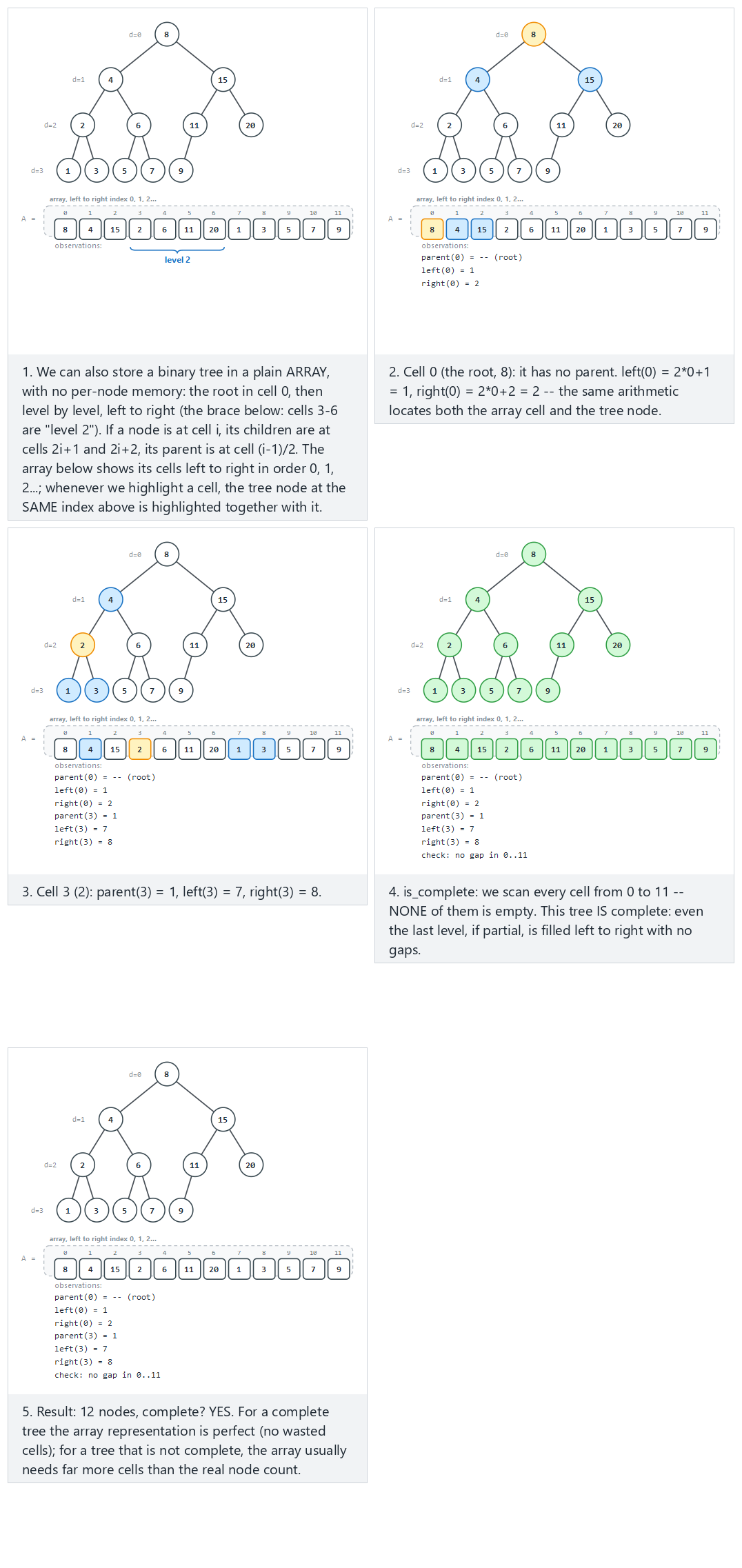
In the picker, also try 19 nodes, complete -- last level half full (hard) and the edge cases NOT complete: index 9 and 10 are empty but index 11 is filled -- there is a gap, a single node (trivially complete), and an empty tree (by convention: complete, 0 nodes) — or press 🎲 for random data at four difficulty levels, or type your own level-order list.
/* a tree stored in level order, inside a plain array: */
static int parent(int i) { return (i - 1) / 2; }
static int left(int i)   { return 2 * i + 1; }
static int right(int i)  { return 2 * i + 2; }

/* complete: every slot up to the last real one is filled -- no gaps */
static bool is_complete(int arr[], int n, int last_real) {
    (void) n;
    for (int i = 0; i <= last_real; i++)
        if (arr[i] == EMPTY) return false;   /* a hole before the end */
    return true;
}
// a tree stored in level order, inside a plain array:
static int parent(int i) { return (i - 1) / 2; }
static int left(int i)   { return 2 * i + 1; }
static int right(int i)  { return 2 * i + 2; }

// complete: every slot up to the last real one is filled -- no gaps
static boolean isComplete(int[] arr, int n, int lastReal) {
    for (int i = 0; i <= lastReal; i++)
        if (arr[i] == EMPTY) return false;    // a hole before the end
    return true;
}
The full programs (code/week-04/c/complete_tree_array.c, code/week-04/java/CompleteTreeArray.java) apply the three formulas to a few probe indices and run the completeness check on three arrays.
Full program: complete_tree_array.c / CompleteTreeArray.java
/* Week 4 -- Trees, Heaps, and Huffman Coding
 * Storing a binary tree in a plain array: parent/left/right index formulas,
 * and a check for whether the tree is actually "complete" (no gaps before
 * the last real slot).
 * CEN207 Data Structures (CS50-style lecture notes)
 */
#include <limits.h>
#include <stdbool.h>
#include <stdio.h>

#define EMPTY INT_MIN

/* a tree stored in level order, inside a plain array: */
static int parent(int i) { return (i - 1) / 2; }
static int left(int i)   { return 2 * i + 1; }
static int right(int i)  { return 2 * i + 2; }

/* complete: every slot up to the last real one is filled -- no gaps */
static bool is_complete(int arr[], int n, int last_real) {
    (void) n;
    for (int i = 0; i <= last_real; i++)
        if (arr[i] == EMPTY) return false;   /* a hole before the end */
    return true;
}

static int last_real_index(int arr[], int n) {
    int last = -1;
    for (int i = 0; i < n; i++)
        if (arr[i] != EMPTY) last = i;
    return last;
}

static int count_real(int arr[], int n) {
    int count = 0;
    for (int i = 0; i < n; i++)
        if (arr[i] != EMPTY) count++;
    return count;
}

static void print_slot(int arr[], int i, int n) {
    if (i < 0 || i >= n || arr[i] == EMPTY)
        printf("--");
    else
        printf("%d", arr[i]);
}

static void run_scenario(const char *label, int arr[], int n) {
    printf("-- %s --\n", label);
    printf("array:");
    for (int i = 0; i < n; i++) {
        printf(" [%d]=", i);
        print_slot(arr, i, n);
    }
    printf("\n");

    int last_real = last_real_index(arr, n);
    printf("parent(0) = -- (root)\n");
    for (int probe = 1; probe < n && probe <= 4; probe++) {
        printf("parent(%d) = %d, left(%d) = %d, right(%d) = %d\n",
               probe, parent(probe), probe, left(probe), probe, right(probe));
    }

    bool complete = is_complete(arr, n, last_real);
    printf("real nodes = %d, last real index = %d, complete = %s\n\n",
           count_real(arr, n), last_real, complete ? "true" : "false");
}

int main(void) {
    /* normal: 12 nodes, a complete tree -- no gaps in the array */
    int normal_arr[] = {8, 4, 15, 2, 6, 11, 20, 1, 3, 5, 7, 9};
    run_scenario("normal: 12 nodes, complete -- no gaps", normal_arr, 12);

    /* hard: 19 nodes, a complete tree -- the last level is half full */
    int hard_arr[] = {
        50, 30, 70, 20, 40, 60, 80, 10, 25, 35, 45, 55, 65, 75, 85, 5, 15, 22, 28
    };
    run_scenario("hard: 19 nodes, complete -- last level half full", hard_arr, 19);

    /* edge: NOT complete -- index 9 and 10 are empty but index 11 is filled */
    int gap_arr[] = {9, 4, 12, 2, 6, 10, 15, 1, 3, EMPTY, EMPTY, 7};
    run_scenario("edge: NOT complete -- a gap at index 9-10, index 11 filled", gap_arr, 12);

    return 0;
}
/* Week 4 -- Trees, Heaps, and Huffman Coding
 * Storing a binary tree in a plain array: parent/left/right index formulas,
 * and a check for whether the tree is actually "complete" (no gaps before
 * the last real slot).
 * CEN207 Data Structures (CS50-style lecture notes)
 */
public class CompleteTreeArray {
    static final int EMPTY = Integer.MIN_VALUE;

    // a tree stored in level order, inside a plain array:
    static int parent(int i) { return (i - 1) / 2; }
    static int left(int i)   { return 2 * i + 1; }
    static int right(int i)  { return 2 * i + 2; }

    // complete: every slot up to the last real one is filled -- no gaps
    static boolean isComplete(int[] arr, int n, int lastReal) {
        for (int i = 0; i <= lastReal; i++)
            if (arr[i] == EMPTY) return false;    // a hole before the end
        return true;
    }

    static int lastRealIndex(int[] arr, int n) {
        int last = -1;
        for (int i = 0; i < n; i++)
            if (arr[i] != EMPTY) last = i;
        return last;
    }

    static int countReal(int[] arr, int n) {
        int count = 0;
        for (int i = 0; i < n; i++)
            if (arr[i] != EMPTY) count++;
        return count;
    }

    static String slot(int[] arr, int i, int n) {
        if (i < 0 || i >= n || arr[i] == EMPTY) return "--";
        return String.valueOf(arr[i]);
    }

    static void runScenario(String label, int[] arr, int n) {
        System.out.println("-- " + label + " --");
        StringBuilder sb = new StringBuilder("array:");
        for (int i = 0; i < n; i++) sb.append(" [").append(i).append("]=").append(slot(arr, i, n));
        System.out.println(sb);

        int lastReal = lastRealIndex(arr, n);
        System.out.println("parent(0) = -- (root)");
        for (int probe = 1; probe < n && probe <= 4; probe++) {
            System.out.println("parent(" + probe + ") = " + parent(probe) +
                                ", left(" + probe + ") = " + left(probe) +
                                ", right(" + probe + ") = " + right(probe));
        }

        boolean complete = isComplete(arr, n, lastReal);
        System.out.println("real nodes = " + countReal(arr, n) + ", last real index = " + lastReal +
                            ", complete = " + complete);
        System.out.println();
    }

    public static void main(String[] args) {
        // normal: 12 nodes, a complete tree -- no gaps in the array
        int[] normalArr = {8, 4, 15, 2, 6, 11, 20, 1, 3, 5, 7, 9};
        runScenario("normal: 12 nodes, complete -- no gaps", normalArr, 12);

        // hard: 19 nodes, a complete tree -- the last level is half full
        int[] hardArr = {
            50, 30, 70, 20, 40, 60, 80, 10, 25, 35, 45, 55, 65, 75, 85, 5, 15, 22, 28
        };
        runScenario("hard: 19 nodes, complete -- last level half full", hardArr, 19);

        // edge: NOT complete -- index 9 and 10 are empty but index 11 is filled
        int[] gapArr = {9, 4, 12, 2, 6, 10, 15, 1, 3, EMPTY, EMPTY, 7};
        runScenario("edge: NOT complete -- a gap at index 9-10, index 11 filled", gapArr, 12);
    }
}
Try it
Expected output:
-- normal: 12 nodes, complete -- no gaps --
array: [0]=8 [1]=4 [2]=15 [3]=2 [4]=6 [5]=11 [6]=20 [7]=1 [8]=3 [9]=5 [10]=7 [11]=9
parent(0) = -- (root)
parent(1) = 0, left(1) = 3, right(1) = 4
parent(2) = 0, left(2) = 5, right(2) = 6
parent(3) = 1, left(3) = 7, right(3) = 8
parent(4) = 1, left(4) = 9, right(4) = 10
real nodes = 12, last real index = 11, complete = true

-- hard: 19 nodes, complete -- last level half full --
array: [0]=50 [1]=30 [2]=70 [3]=20 [4]=40 [5]=60 [6]=80 [7]=10 [8]=25 [9]=35 [10]=45 [11]=55 [12]=65 [13]=75 [14]=85 [15]=5 [16]=15 [17]=22 [18]=28
parent(0) = -- (root)
parent(1) = 0, left(1) = 3, right(1) = 4
parent(2) = 0, left(2) = 5, right(2) = 6
parent(3) = 1, left(3) = 7, right(3) = 8
parent(4) = 1, left(4) = 9, right(4) = 10
real nodes = 19, last real index = 18, complete = true

-- edge: NOT complete -- a gap at index 9-10, index 11 filled --
array: [0]=9 [1]=4 [2]=12 [3]=2 [4]=6 [5]=10 [6]=15 [7]=1 [8]=3 [9]=-- [10]=-- [11]=7
parent(0) = -- (root)
parent(1) = 0, left(1) = 3, right(1) = 4
parent(2) = 0, left(2) = 5, right(2) = 6
parent(3) = 1, left(3) = 7, right(3) = 8
parent(4) = 1, left(4) = 9, right(4) = 10
real nodes = 10, last real index = 11, complete = false
In the edge scenario, indices 9 and 10 are empty (--) but index 11 holds 7 — a real node after a gap. That single gap is enough to make is_complete return false, no matter how tightly packed the rest of the array is. This is exactly the situation where the array representation stops paying off: to store this particular tree faithfully you would need 12 array cells for only 10 real nodes, and the waste only gets worse the further a tree drifts from "complete".
Complexity. Every one of parent, left, right is O(1) — pure arithmetic, no traversal at all. This is the entire point of the representation: on a complete tree, "go to the parent" or "go to a child" costs the same O(1) whether the tree has 10 nodes or 10 million. is_complete itself is O(n), since it must scan the array once.
Common mistakes
- Using the formulas on a tree that is not actually complete. The arithmetic still computes an index, but if the array has gaps,
2*i + 1may point at an empty (or logically unrelated) slot, or the "tree" the formulas describe may not match the tree you intended at all. Always check completeness first, or guarantee it by construction (as the binary heap in section 5 does). - Off-by-one in the parent formula.
(i - 1) / 2relies on integer division truncating toward zero; double-check this against your language's actual division semantics for negative numerators before reusing the formula elsewhere. Fori = 0the formula gives-1 / 2, which is why the root's parent is always handled as a special case ("no parent") rather than trusted blindly. - Confusing "array representation" with "the tree must be complete forever". Nothing stops you from storing an incomplete tree in an array (with sentinel values marking gaps, as the edge scenario does) — you simply lose the O(1) child/parent arithmetic's guarantee of no wasted space, and
is_completeis precisely the check that tells you when that guarantee has been lost.
Self-check: index arithmetic
A complete binary tree is stored in an array. Its node at index 11 has two children. At which indices do they live, and at which index is index 11's own parent?
Answer. Children at 2*11 + 1 = 23 and 2*11 + 2 = 24; parent at (11 - 1) / 2 = 5.
5. The binary heap
5.1 A question to start
Your operating system needs to know, at every instant, which of a hundred waiting processes should run next. A hospital triage desk needs to know, among fifty waiting patients, who is most urgent right now. Both problems share the same shape: repeatedly ask "what's the best (most urgent) item currently waiting?", remove it, maybe add new items, and ask again — over and over. Sorting the whole waiting list every time a new patient arrives would be wasteful (that's O(n log n) per arrival). What is the cheapest structure that always keeps the single best item within instant reach, while still accepting new arrivals quickly? That structure is the binary heap, and it is built directly on top of the complete-tree array from section 4.
5.2 A short history and the heap property
The heap was introduced by J. W. J. Williams in 1964, in the same short paper that introduced heap sort (section 5.4) — the heap was invented specifically to make that sorting algorithm possible. Shortly afterward, R. W. Floyd published a faster way to build a heap from an already-existing array (section 5.3), turning an O(n log n) construction into O(n).
A binary heap is a complete binary tree (so it always fits perfectly in an array — no wasted cells) that additionally satisfies the heap property: in a min-heap, every node's value is less than or equal to both of its children's values, so the smallest value in the entire tree is always sitting at the root; in a max-heap, every node's value is greater than or equal to both children, so the largest value is always at the root. Note carefully what a heap does not promise: it is not a sorted structure — a node's left child and right child have no required order relative to each other, only each parent is guaranteed to beat both of its own children.
| Operation | What it does | Complexity |
|---|---|---|
peek() | Returns the root (the best value) without removing it | O(1) |
insert(x) | Adds x, then restores the heap property by sift-up | O(log n) |
extract() | Removes and returns the root, then restores the heap property by sift-down | O(log n) |
build_heap(arr) | Turns an arbitrary array into a valid heap, all at once | O(n) |
5.3 Insertion: sift-up (bubble-up)
To insert a new value: place it in the very next free array slot (this keeps the tree complete), then repeatedly compare it with its parent and swap upward whenever the heap property is violated, stopping the moment it is not (or the new value reaches the root). This "floating upward" motion is called sift-up or bubble-up.
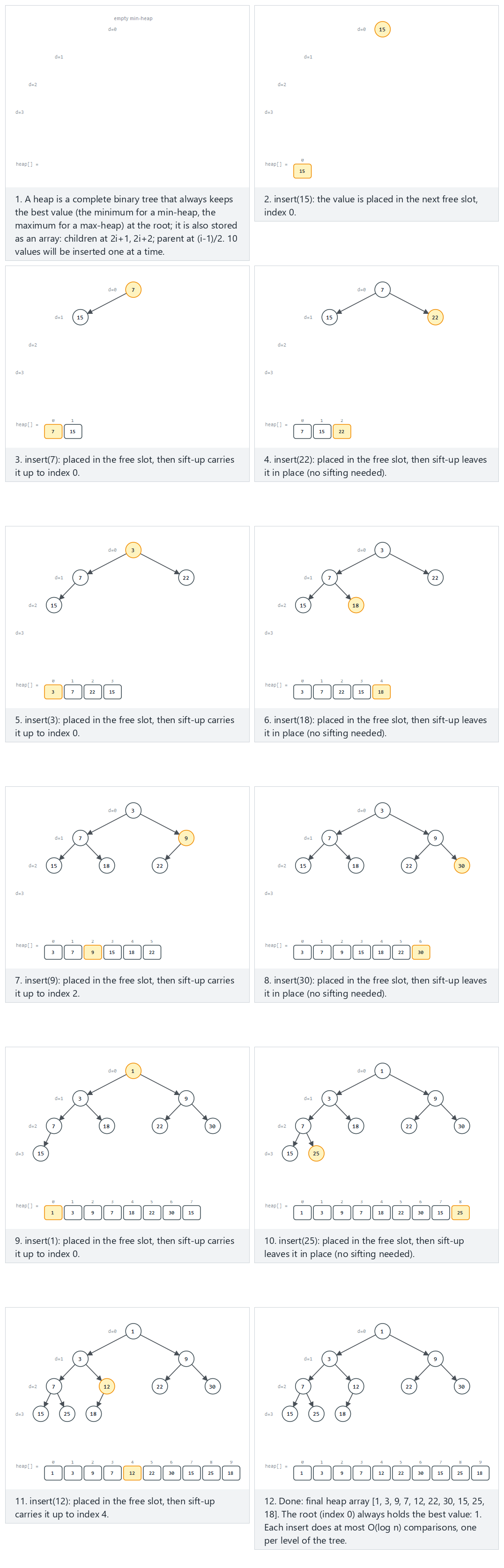
In the picker, also try max-heap: 14 ascending values, every insert floats all the way to the root (hard) and the edge cases already in order: 12 ascending values into a min-heap, no sifting ever needed, all equal: value 7, ten times, a single value, and extreme values: INT_MAX, INT_MIN, and zero — or press 🎲 for random data at four difficulty levels, or type your own values.
/* Week 4 -- Trees, Heaps, and Huffman Coding
 * Binary heap insertion by sift-up (bubble-up). kind_is_max selects a
 * max-heap (parent >= children) or a min-heap (parent <= children); the
 * sift-up loop itself is exactly the same either way.
 * CEN207 Data Structures (CS50-style lecture notes)
 */
#include <stdbool.h>
#include <stdio.h>

#define MAX_CAP 20

static int heap[MAX_CAP];
static int size;
static bool kind_is_max;        /* false = min-heap, true = max-heap */

/* better(a, b): true if a belongs closer to the root than b */
static bool better(int a, int b) {
    return kind_is_max ? (a > b) : (a < b);
}

void insert(int value) {
    heap[size] = value;      /* place at the next free slot */
    int i = size;
    size++;

    while (i > 0) {                          /* sift-up */
        int parent = (i - 1) / 2;
        if (!better(heap[i], heap[parent]))
            break;                            /* heap property holds, stop */
        int tmp = heap[parent];
        heap[parent] = heap[i];
        heap[i] = tmp;
        i = parent;
    }
}

static void print_heap(void) {
    printf("heap:");
    for (int i = 0; i < size; i++)
        printf(" %d", heap[i]);
    printf("  [size = %d]\n", size);
}

static void run_scenario(const char *label, bool is_max, const int values[], int n) {
    printf("-- %s --\n", label);
    size = 0;
    kind_is_max = is_max;
    print_heap();
    for (int i = 0; i < n; i++) {
        insert(values[i]);
        printf("insert(%d)\n", values[i]);
        print_heap();
    }
    printf("root (best value) = %d\n\n", heap[0]);
}

int main(void) {
    /* normal: min-heap, 10 values inserted one by one */
    int normal[] = {15, 7, 22, 3, 18, 9, 30, 1, 25, 12};
    run_scenario("normal: min-heap, 10 values inserted one by one", false, normal, 10);

    /* hard: max-heap, 14 ascending values -- every insert floats to the root */
    int hard[] = {1, 2, 3, 4, 5, 6, 7, 8, 9, 10, 11, 12, 13, 14};
    run_scenario("hard: max-heap, 14 ascending values (every insert floats to the root)", true, hard, 14);

    /* edge: min-heap, all equal -- value 7, ten times */
    int all_equal[] = {7, 7, 7, 7, 7, 7, 7, 7, 7, 7};
    run_scenario("edge: min-heap, all equal (value 7, ten times)", false, all_equal, 10);

    /* edge: min-heap, extreme values (INT_MAX, INT_MIN, and zero) */
    int extreme[] = {2147483647, -2147483648, 0, 1000000, -1000000, 5, -5, 2147483646, -2147483647, 1, -1};
    run_scenario("edge: min-heap, extreme values", false, extreme, 11);

    return 0;
}
static int[] heap = new int[MAX_CAP];
static int size;
static boolean kindIsMax;       // false = min-heap, true = max-heap

// better(a, b): true if a belongs closer to the root than b
static boolean better(int a, int b) {
    return kindIsMax ? (a > b) : (a < b);
}

static void insert(int value) {
    heap[size] = value;      // place at the next free slot
    int i = size;
    size++;

    while (i > 0) {                          // sift-up
        int parent = (i - 1) / 2;
        if (!better(heap[i], heap[parent]))
            break;                            // heap property holds, stop
        int tmp = heap[parent];
        heap[parent] = heap[i];
        heap[i] = tmp;
        i = parent;
    }
}
The full class (code/week-04/java/HeapInsert.java) mirrors the C program's four scenarios exactly.
Full program: heap_insert.c / HeapInsert.java
/* Week 4 -- Trees, Heaps, and Huffman Coding
 * Binary heap insertion by sift-up (bubble-up). kind_is_max selects a
 * max-heap (parent >= children) or a min-heap (parent <= children); the
 * sift-up loop itself is exactly the same either way.
 * CEN207 Data Structures (CS50-style lecture notes)
 */
#include <stdbool.h>
#include <stdio.h>

#define MAX_CAP 20

static int heap[MAX_CAP];
static int size;
static bool kind_is_max;        /* false = min-heap, true = max-heap */

/* better(a, b): true if a belongs closer to the root than b */
static bool better(int a, int b) {
    return kind_is_max ? (a > b) : (a < b);
}

void insert(int value) {
    heap[size] = value;      /* place at the next free slot */
    int i = size;
    size++;

    while (i > 0) {                          /* sift-up */
        int parent = (i - 1) / 2;
        if (!better(heap[i], heap[parent]))
            break;                            /* heap property holds, stop */
        int tmp = heap[parent];
        heap[parent] = heap[i];
        heap[i] = tmp;
        i = parent;
    }
}

static void print_heap(void) {
    printf("heap:");
    for (int i = 0; i < size; i++)
        printf(" %d", heap[i]);
    printf("  [size = %d]\n", size);
}

static void run_scenario(const char *label, bool is_max, const int values[], int n) {
    printf("-- %s --\n", label);
    size = 0;
    kind_is_max = is_max;
    print_heap();
    for (int i = 0; i < n; i++) {
        insert(values[i]);
        printf("insert(%d)\n", values[i]);
        print_heap();
    }
    printf("root (best value) = %d\n\n", heap[0]);
}

int main(void) {
    /* normal: min-heap, 10 values inserted one by one */
    int normal[] = {15, 7, 22, 3, 18, 9, 30, 1, 25, 12};
    run_scenario("normal: min-heap, 10 values inserted one by one", false, normal, 10);

    /* hard: max-heap, 14 ascending values -- every insert floats to the root */
    int hard[] = {1, 2, 3, 4, 5, 6, 7, 8, 9, 10, 11, 12, 13, 14};
    run_scenario("hard: max-heap, 14 ascending values (every insert floats to the root)", true, hard, 14);

    /* edge: min-heap, all equal -- value 7, ten times */
    int all_equal[] = {7, 7, 7, 7, 7, 7, 7, 7, 7, 7};
    run_scenario("edge: min-heap, all equal (value 7, ten times)", false, all_equal, 10);

    /* edge: min-heap, extreme values (INT_MAX, INT_MIN, and zero) */
    int extreme[] = {2147483647, -2147483648, 0, 1000000, -1000000, 5, -5, 2147483646, -2147483647, 1, -1};
    run_scenario("edge: min-heap, extreme values", false, extreme, 11);

    return 0;
}
/* Week 4 -- Trees, Heaps, and Huffman Coding
 * Binary heap insertion by sift-up (bubble-up). kindIsMax selects a
 * max-heap (parent >= children) or a min-heap (parent <= children); the
 * sift-up loop itself is exactly the same either way.
 * CEN207 Data Structures (CS50-style lecture notes)
 */
public class HeapInsert {
    static final int MAX_CAP = 20;

    static int[] heap = new int[MAX_CAP];
    static int size;
    static boolean kindIsMax;       // false = min-heap, true = max-heap

    // better(a, b): true if a belongs closer to the root than b
    static boolean better(int a, int b) {
        return kindIsMax ? (a > b) : (a < b);
    }

    static void insert(int value) {
        heap[size] = value;      // place at the next free slot
        int i = size;
        size++;

        while (i > 0) {                          // sift-up
            int parent = (i - 1) / 2;
            if (!better(heap[i], heap[parent]))
                break;                            // heap property holds, stop
            int tmp = heap[parent];
            heap[parent] = heap[i];
            heap[i] = tmp;
            i = parent;
        }
    }

    static void printHeap() {
        StringBuilder sb = new StringBuilder("heap:");
        for (int i = 0; i < size; i++) sb.append(' ').append(heap[i]);
        sb.append("  [size = ").append(size).append(']');
        System.out.println(sb);
    }

    static void runScenario(String label, boolean isMax, int[] values) {
        System.out.println("-- " + label + " --");
        size = 0;
        kindIsMax = isMax;
        printHeap();
        for (int v : values) {
            insert(v);
            System.out.println("insert(" + v + ")");
            printHeap();
        }
        System.out.println("root (best value) = " + heap[0]);
        System.out.println();
    }

    public static void main(String[] args) {
        // normal: min-heap, 10 values inserted one by one
        int[] normal = {15, 7, 22, 3, 18, 9, 30, 1, 25, 12};
        runScenario("normal: min-heap, 10 values inserted one by one", false, normal);

        // hard: max-heap, 14 ascending values -- every insert floats to the root
        int[] hard = {1, 2, 3, 4, 5, 6, 7, 8, 9, 10, 11, 12, 13, 14};
        runScenario("hard: max-heap, 14 ascending values (every insert floats to the root)", true, hard);

        // edge: min-heap, all equal -- value 7, ten times
        int[] allEqual = {7, 7, 7, 7, 7, 7, 7, 7, 7, 7};
        runScenario("edge: min-heap, all equal (value 7, ten times)", false, allEqual);

        // edge: min-heap, extreme values (Integer.MAX_VALUE, Integer.MIN_VALUE, and zero)
        int[] extreme = {2147483647, -2147483648, 0, 1000000, -1000000, 5, -5, 2147483646, -2147483647, 1, -1};
        runScenario("edge: min-heap, extreme values", false, extreme);
    }
}
Try it
Expected output:
-- normal: min-heap, 10 values inserted one by one --
heap:  [size = 0]
insert(15)
heap: 15  [size = 1]
insert(7)
heap: 7 15  [size = 2]
insert(22)
heap: 7 15 22  [size = 3]
insert(3)
heap: 3 7 22 15  [size = 4]
insert(18)
heap: 3 7 22 15 18  [size = 5]
insert(9)
heap: 3 7 9 15 18 22  [size = 6]
insert(30)
heap: 3 7 9 15 18 22 30  [size = 7]
insert(1)
heap: 1 3 9 7 18 22 30 15  [size = 8]
insert(25)
heap: 1 3 9 7 18 22 30 15 25  [size = 9]
insert(12)
heap: 1 3 9 7 12 22 30 15 25 18  [size = 10]
root (best value) = 1

-- hard: max-heap, 14 ascending values (every insert floats to the root) --
heap:  [size = 0]
insert(1)
heap: 1  [size = 1]
insert(2)
heap: 2 1  [size = 2]
insert(3)
heap: 3 1 2  [size = 3]
insert(4)
heap: 4 3 2 1  [size = 4]
insert(5)
heap: 5 4 2 1 3  [size = 5]
insert(6)
heap: 6 4 5 1 3 2  [size = 6]
insert(7)
heap: 7 4 6 1 3 2 5  [size = 7]
insert(8)
heap: 8 7 6 4 3 2 5 1  [size = 8]
insert(9)
heap: 9 8 6 7 3 2 5 1 4  [size = 9]
insert(10)
heap: 10 9 6 7 8 2 5 1 4 3  [size = 10]
insert(11)
heap: 11 10 6 7 9 2 5 1 4 3 8  [size = 11]
insert(12)
heap: 12 10 11 7 9 6 5 1 4 3 8 2  [size = 12]
insert(13)
heap: 13 10 12 7 9 11 5 1 4 3 8 2 6  [size = 13]
insert(14)
heap: 14 10 13 7 9 11 12 1 4 3 8 2 6 5  [size = 14]
root (best value) = 14

-- edge: min-heap, all equal (value 7, ten times) --
heap:  [size = 0]
insert(7)
heap: 7  [size = 1]
insert(7)
heap: 7 7  [size = 2]
insert(7)
heap: 7 7 7  [size = 3]
insert(7)
heap: 7 7 7 7  [size = 4]
insert(7)
heap: 7 7 7 7 7  [size = 5]
insert(7)
heap: 7 7 7 7 7 7  [size = 6]
insert(7)
heap: 7 7 7 7 7 7 7  [size = 7]
insert(7)
heap: 7 7 7 7 7 7 7 7  [size = 8]
insert(7)
heap: 7 7 7 7 7 7 7 7 7  [size = 9]
insert(7)
heap: 7 7 7 7 7 7 7 7 7 7  [size = 10]
root (best value) = 7

-- edge: min-heap, extreme values --
heap:  [size = 0]
insert(2147483647)
heap: 2147483647  [size = 1]
insert(-2147483648)
heap: -2147483648 2147483647  [size = 2]
insert(0)
heap: -2147483648 2147483647 0  [size = 3]
insert(1000000)
heap: -2147483648 1000000 0 2147483647  [size = 4]
insert(-1000000)
heap: -2147483648 -1000000 0 2147483647 1000000  [size = 5]
insert(5)
heap: -2147483648 -1000000 0 2147483647 1000000 5  [size = 6]
insert(-5)
heap: -2147483648 -1000000 -5 2147483647 1000000 5 0  [size = 7]
insert(2147483646)
heap: -2147483648 -1000000 -5 2147483646 1000000 5 0 2147483647  [size = 8]
insert(-2147483647)
heap: -2147483648 -2147483647 -5 -1000000 1000000 5 0 2147483647 2147483646  [size = 9]
insert(1)
heap: -2147483648 -2147483647 -5 -1000000 1 5 0 2147483647 2147483646 1000000  [size = 10]
insert(-1)
heap: -2147483648 -2147483647 -5 -1000000 -1 5 0 2147483647 2147483646 1000000 1  [size = 11]
root (best value) = -2147483648
In the "hard" scenario, every single insert floats all the way up to the root, because the values arrive in strictly ascending order and this is a max-heap — each new value is larger than everything already there, so it beats its parent again and again until it has no parent left to beat. In the "all equal" edge case, better is never strictly true for equal values, so no swap ever happens after the first insert — the heap property (<= for a min-heap) is satisfied trivially by equal values sitting anywhere.
Complexity. Each insert does at most one comparison-and-swap per level of the tree, so it costs O(log n) — the height of a complete tree with n nodes. peek (reading heap[0]) is O(1).
5.4 Extraction: sift-down (bubble-down)
To remove the best value (the root): save it as the result, move the very last element in the array into the now-empty root slot (this keeps the tree complete — no gap is ever left in the middle), shrink the size by one, then repeatedly compare the new root with its better child and swap downward whenever the heap property is violated. This "sinking downward" motion is called sift-down or bubble-down.
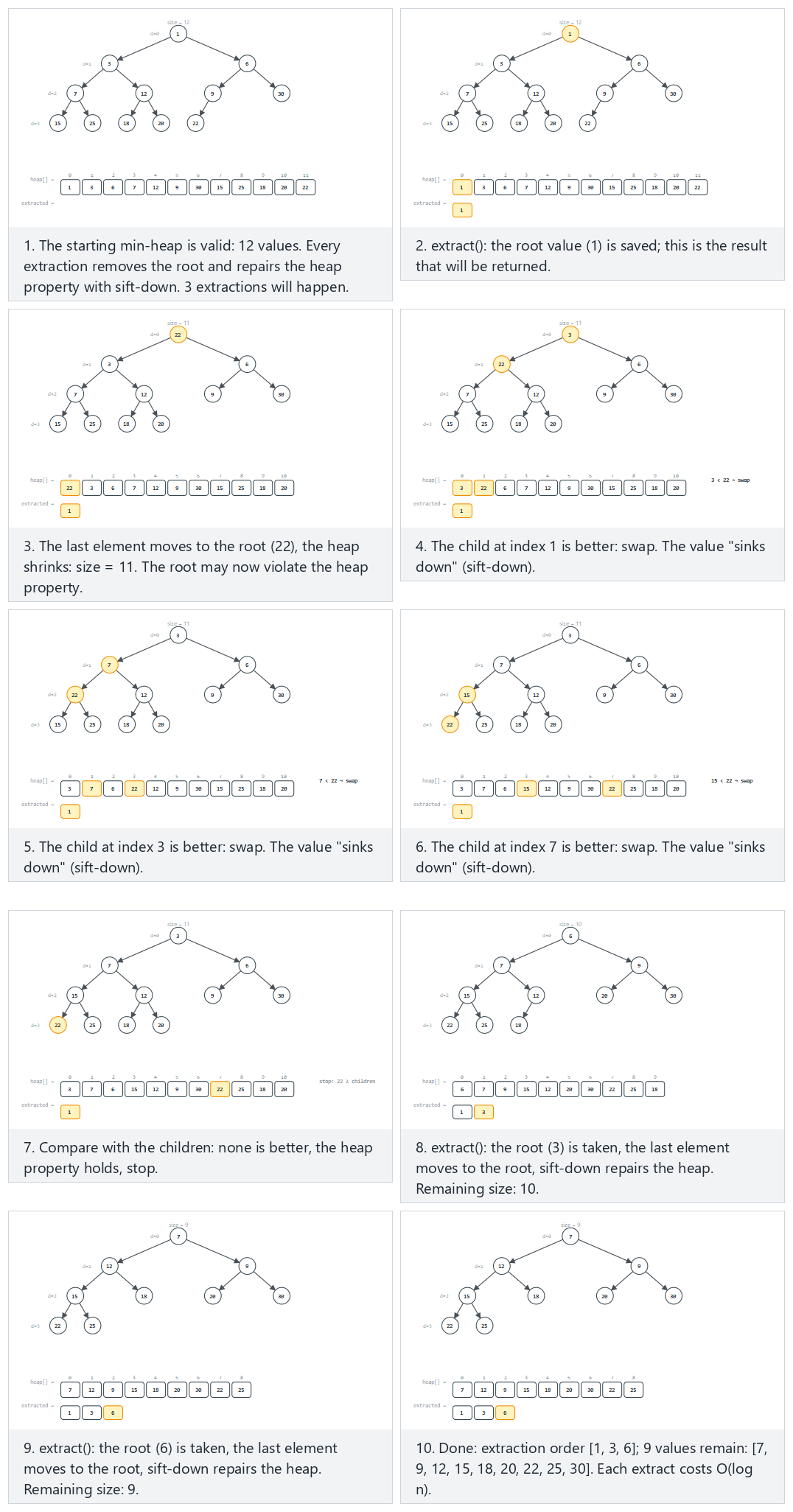
In the picker, also try max-heap: 5 extractions from 16 values (hard) and the edge cases drain fully: all 10 values are extracted, all equal: value 9, ten times, a single value, one extraction, and extreme values — or press 🎲 for random data at four difficulty levels, or type your own values.
/* remove and return the root (the minimum for a min-heap, the maximum for a max-heap) */
int extract(void) {
    int best = heap[0];
    size--;
    heap[0] = heap[size];    /* move the last element to the root */

    int i = 0;
    while (1) {                              /* sift-down */
        int left = 2 * i + 1;
        int right = 2 * i + 2;
        int target = i;

        if (left < size && better(heap[left], heap[target]))
            target = left;
        if (right < size && better(heap[right], heap[target]))
            target = right;
        if (target == i)
            break;

        int tmp = heap[i];
        heap[i] = heap[target];
        heap[target] = tmp;
        i = target;
    }
    return best;
}
static int extract() {
    int best = heap[0];
    size--;
    heap[0] = heap[size];    // move the last element to the root

    int i = 0;
    while (true) {                            // sift-down
        int left = 2 * i + 1;
        int right = 2 * i + 2;
        int target = i;

        if (left < size && better(heap[left], heap[target]))
            target = left;
        if (right < size && better(heap[right], heap[target]))
            target = right;
        if (target == i)
            break;

        int tmp = heap[i];
        heap[i] = heap[target];
        heap[target] = tmp;
        i = target;
    }
    return best;
}
Both programs (code/week-04/c/heap_extract.c, code/week-04/java/HeapExtract.java) first turn a raw array into a valid starting heap with a small heapify_prepare helper (a preview of section 5.5's build_heap) — this preparation step is not part of extract itself, only a way to set the scene.
Full program: heap_extract.c / HeapExtract.java
/* Week 4 -- Trees, Heaps, and Huffman Coding
 * Binary heap extraction by sift-down (bubble-down). kind_is_max selects a
 * max-heap or a min-heap; heapify_prepare turns a raw array into a valid
 * starting heap and is used only to SET UP each scenario, never by extract
 * itself.
 * CEN207 Data Structures (CS50-style lecture notes)
 */
#include <stdbool.h>
#include <stdio.h>

#define MAX_CAP 20

static int heap[MAX_CAP];
static int size;
static bool kind_is_max;

static bool better(int a, int b) {
    return kind_is_max ? (a > b) : (a < b);
}

/* remove and return the root (the minimum for a min-heap, the maximum for a max-heap) */
int extract(void) {
    int best = heap[0];
    size--;
    heap[0] = heap[size];    /* move the last element to the root */

    int i = 0;
    while (1) {                              /* sift-down */
        int left = 2 * i + 1;
        int right = 2 * i + 2;
        int target = i;

        if (left < size && better(heap[left], heap[target]))
            target = left;
        if (right < size && better(heap[right], heap[target]))
            target = right;
        if (target == i)
            break;

        int tmp = heap[i];
        heap[i] = heap[target];
        heap[target] = tmp;
        i = target;
    }
    return best;
}

static void sift_down_at(int i) {
    while (1) {
        int left = 2 * i + 1, right = 2 * i + 2, target = i;
        if (left < size && better(heap[left], heap[target])) target = left;
        if (right < size && better(heap[right], heap[target])) target = right;
        if (target == i) break;
        int tmp = heap[i]; heap[i] = heap[target]; heap[target] = tmp;
        i = target;
    }
}

/* preparation only, not part of extract itself: turn a raw array into a valid heap */
static void heapify_prepare(const int values[], int n) {
    size = n;
    for (int i = 0; i < n; i++) heap[i] = values[i];
    for (int i = n / 2 - 1; i >= 0; i--) sift_down_at(i);
}

static void print_heap(void) {
    printf("heap:");
    for (int i = 0; i < size; i++)
        printf(" %d", heap[i]);
    printf("  [size = %d]\n", size);
}

static void run_scenario(const char *label, bool is_max, const int raw[], int n, int extracts) {
    printf("-- %s --\n", label);
    kind_is_max = is_max;
    heapify_prepare(raw, n);
    printf("starting heap: ");
    print_heap();
    for (int k = 0; k < extracts && size > 0; k++) {
        int best = extract();
        printf("extract() -> %d\n", best);
        print_heap();
    }
    printf("\n");
}

int main(void) {
    /* normal: min-heap, 3 extractions from 12 values */
    int normal[] = {15, 7, 22, 3, 18, 9, 30, 1, 25, 12, 20, 6};
    run_scenario("normal: min-heap, 3 extractions from 12 values", false, normal, 12, 3);

    /* hard: max-heap, 5 extractions from 16 values */
    int hard[] = {40, 11, 27, 8, 33, 16, 45, 2, 19, 37, 24, 6, 50, 29, 3, 44};
    run_scenario("hard: max-heap, 5 extractions from 16 values", true, hard, 16, 5);

    /* edge: drain fully -- all 10 values are extracted */
    int drain[] = {31, 5, 17, 26, 9, 44, 13, 2, 38, 20};
    run_scenario("edge: drain fully, all 10 values extracted (min-heap)", false, drain, 10, 10);

    return 0;
}
/* Week 4 -- Trees, Heaps, and Huffman Coding
 * Binary heap extraction by sift-down (bubble-down). kindIsMax selects a
 * max-heap or a min-heap; heapifyPrepare turns a raw array into a valid
 * starting heap and is used only to SET UP each scenario, never by extract
 * itself.
 * CEN207 Data Structures (CS50-style lecture notes)
 */
public class HeapExtract {
    static final int MAX_CAP = 20;

    static int[] heap = new int[MAX_CAP];
    static int size;
    static boolean kindIsMax;

    static boolean better(int a, int b) {
        return kindIsMax ? (a > b) : (a < b);
    }

    // remove and return the root (the minimum for a min-heap, the maximum for a max-heap)
    static int extract() {
        int best = heap[0];
        size--;
        heap[0] = heap[size];    // move the last element to the root

        int i = 0;
        while (true) {                            // sift-down
            int left = 2 * i + 1;
            int right = 2 * i + 2;
            int target = i;

            if (left < size && better(heap[left], heap[target]))
                target = left;
            if (right < size && better(heap[right], heap[target]))
                target = right;
            if (target == i)
                break;

            int tmp = heap[i];
            heap[i] = heap[target];
            heap[target] = tmp;
            i = target;
        }
        return best;
    }

    static void siftDownAt(int i) {
        while (true) {
            int left = 2 * i + 1, right = 2 * i + 2, target = i;
            if (left < size && better(heap[left], heap[target])) target = left;
            if (right < size && better(heap[right], heap[target])) target = right;
            if (target == i) break;
            int tmp = heap[i]; heap[i] = heap[target]; heap[target] = tmp;
            i = target;
        }
    }

    // preparation only, not part of extract itself: turn a raw array into a valid heap
    static void heapifyPrepare(int[] values) {
        size = values.length;
        for (int i = 0; i < size; i++) heap[i] = values[i];
        for (int i = size / 2 - 1; i >= 0; i--) siftDownAt(i);
    }

    static void printHeap() {
        StringBuilder sb = new StringBuilder("heap:");
        for (int i = 0; i < size; i++) sb.append(' ').append(heap[i]);
        sb.append("  [size = ").append(size).append(']');
        System.out.println(sb);
    }

    static void runScenario(String label, boolean isMax, int[] raw, int extracts) {
        System.out.println("-- " + label + " --");
        kindIsMax = isMax;
        heapifyPrepare(raw);
        System.out.print("starting heap: ");
        printHeap();
        for (int k = 0; k < extracts && size > 0; k++) {
            int best = extract();
            System.out.println("extract() -> " + best);
            printHeap();
        }
        System.out.println();
    }

    public static void main(String[] args) {
        // normal: min-heap, 3 extractions from 12 values
        int[] normal = {15, 7, 22, 3, 18, 9, 30, 1, 25, 12, 20, 6};
        runScenario("normal: min-heap, 3 extractions from 12 values", false, normal, 3);

        // hard: max-heap, 5 extractions from 16 values
        int[] hard = {40, 11, 27, 8, 33, 16, 45, 2, 19, 37, 24, 6, 50, 29, 3, 44};
        runScenario("hard: max-heap, 5 extractions from 16 values", true, hard, 5);

        // edge: drain fully -- all 10 values are extracted
        int[] drain = {31, 5, 17, 26, 9, 44, 13, 2, 38, 20};
        runScenario("edge: drain fully, all 10 values extracted (min-heap)", false, drain, 10);
    }
}
Try it
Expected output:
-- normal: min-heap, 3 extractions from 12 values --
starting heap: heap: 1 3 6 7 12 9 30 15 25 18 20 22  [size = 12]
extract() -> 1
heap: 3 7 6 15 12 9 30 22 25 18 20  [size = 11]
extract() -> 3
heap: 6 7 9 15 12 20 30 22 25 18  [size = 10]
extract() -> 6
heap: 7 12 9 15 18 20 30 22 25  [size = 9]

-- hard: max-heap, 5 extractions from 16 values --
starting heap: heap: 50 44 45 19 37 27 40 8 11 33 24 6 16 29 3 2  [size = 16]
extract() -> 50
heap: 45 44 40 19 37 27 29 8 11 33 24 6 16 2 3  [size = 15]
extract() -> 45
heap: 44 37 40 19 33 27 29 8 11 3 24 6 16 2  [size = 14]
extract() -> 44
heap: 40 37 29 19 33 27 2 8 11 3 24 6 16  [size = 13]
extract() -> 40
heap: 37 33 29 19 24 27 2 8 11 3 16 6  [size = 12]
extract() -> 37
heap: 33 24 29 19 16 27 2 8 11 3 6  [size = 11]

-- edge: drain fully, all 10 values extracted (min-heap) --
starting heap: heap: 2 5 13 26 9 44 17 31 38 20  [size = 10]
extract() -> 2
heap: 5 9 13 26 20 44 17 31 38  [size = 9]
extract() -> 5
heap: 9 20 13 26 38 44 17 31  [size = 8]
extract() -> 9
heap: 13 20 17 26 38 44 31  [size = 7]
extract() -> 13
heap: 17 20 31 26 38 44  [size = 6]
extract() -> 17
heap: 20 26 31 44 38  [size = 5]
extract() -> 20
heap: 26 38 31 44  [size = 4]
extract() -> 26
heap: 31 38 44  [size = 3]
extract() -> 31
heap: 38 44  [size = 2]
extract() -> 38
heap: 44  [size = 1]
extract() -> 44
heap:  [size = 0]
Notice the "drain fully" edge case: extracting all 10 values, one at a time, produces them in fully sorted order (2, 5, 9, 13, 17, 20, 26, 31, 38, 44) — this is not a coincidence, it is how heap sort (section 5.5) works. Also notice the final line, heap: [size = 0]: extracting the very last element correctly leaves an empty heap, with no out-of-bounds access, because size becomes 0 and the sift-down loop's left < size / right < size guards make the loop body simply never execute.
Complexity. O(log n) — the sift-down loop takes at most one step per level of the tree, exactly the mirror image of sift-up's cost.
Common mistakes (insert and extract)
- Forgetting to check
size > 0before callingextract. Both functions above assume the caller already checked; callingextracton an empty heap readsheap[0]andheap[-1]-adjacent memory (viasizegoing negative) — a silent, dangerous bug rather than a clean crash. - Comparing with only one child in sift-down. You must compare the node with both children and swap with whichever is better, not simply the left one. Comparing only the left child can leave the heap property violated against the right child, corrupting the structure while still "running without error".
- Writing
<=instead of<(or vice versa) inbetter. This does not corrupt the heap — a heap remains valid whichever way ties are broken — but it does change whether sift-up/sift-down loops keep going (and possibly do extra, harmless swaps) on equal values, which can be a surprise when comparing trace output against someone else's implementation.
5.5 Building a heap from scratch in O(n)
Given an arbitrary array of n values in no particular order, one way to turn it into a heap is to insert them one at a time into an initially empty heap: n inserts at O(log n) each gives O(n log n) total. Floyd's algorithm (1964) does better: treat the array as already being a complete tree (it is, structurally — the values just do not yet satisfy the heap property), notice that every leaf is trivially a valid one-node heap already, and sift-down only the internal nodes, working from the last internal node backward up to the root.
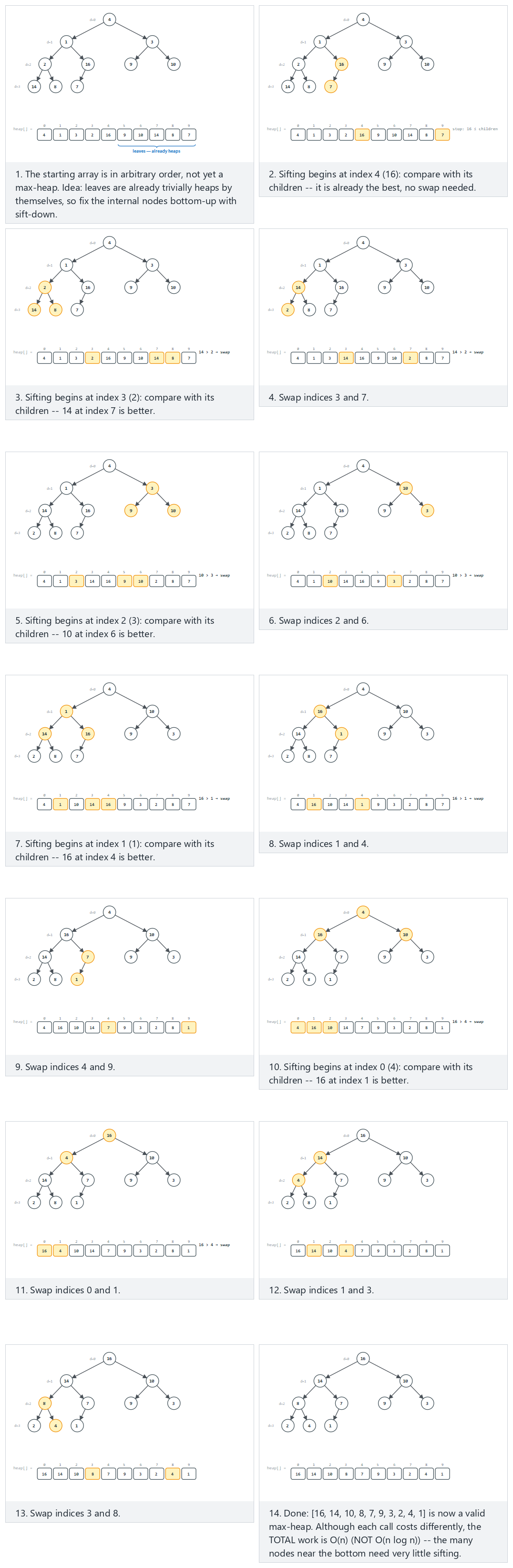
In the picker, also try min-heap: 14 values in REVERSE order (maximum sifting) (hard) and the edge cases input is already a valid max-heap: most nodes need no sifting, all equal: value 6, ten times, a single value, and extreme values — or press 🎲 for random data at four difficulty levels, or type your own values.
/* sift-down: swap with the better child while a child is better */
void sift_down(int arr[], int n, int i) {
    while (1) {
        int left = 2 * i + 1;
        int right = 2 * i + 2;
        int best = i;

        if (left < n && better(arr[left], arr[best]))
            best = left;
        if (right < n && better(arr[right], arr[best]))
            best = right;
        if (best == i)
            break;

        int tmp = arr[i];
        arr[i] = arr[best];
        arr[best] = tmp;
        i = best;
    }
}

/* bottom-up build: only the n/2 internal nodes need sifting, so this is O(n) */
void build_heap(int arr[], int n) {
    for (int i = n / 2 - 1; i >= 0; i--)
        sift_down(arr, n, i);
}
static void siftDown(int[] arr, int n, int i) {
    while (true) {
        int left = 2 * i + 1;
        int right = 2 * i + 2;
        int best = i;
        if (left < n && better(arr[left], arr[best])) best = left;
        if (right < n && better(arr[right], arr[best])) best = right;
        if (best == i) break;
        int tmp = arr[i]; arr[i] = arr[best]; arr[best] = tmp;
        i = best;
    }
}

static void buildHeap(int[] arr, int n) {
    for (int i = n / 2 - 1; i >= 0; i--)
        siftDown(arr, n, i);
}
The full programs (code/week-04/c/build_heap.c, code/week-04/java/BuildHeap.java) print the array before and after build_heap, for three scenarios.
Full program: build_heap.c / BuildHeap.java
/* Week 4 -- Trees, Heaps, and Huffman Coding
 * Bottom-up build-heap (Floyd's algorithm), O(n).
 * CEN207 Data Structures (CS50-style lecture notes)
 */
#include <stdbool.h>
#include <stdio.h>

#define MAX_CAP 20

static int arr[MAX_CAP];
static int n;
static bool kind_is_max;

static bool better(int a, int b) {
    return kind_is_max ? (a > b) : (a < b);
}

/* sift-down: swap with the better child while a child is better */
void sift_down(int arr[], int n, int i) {
    while (1) {
        int left = 2 * i + 1;
        int right = 2 * i + 2;
        int best = i;

        if (left < n && better(arr[left], arr[best]))
            best = left;
        if (right < n && better(arr[right], arr[best]))
            best = right;
        if (best == i)
            break;

        int tmp = arr[i];
        arr[i] = arr[best];
        arr[best] = tmp;
        i = best;
    }
}

/* bottom-up build: only the n/2 internal nodes need sifting, so this is O(n) */
void build_heap(int arr[], int n) {
    for (int i = n / 2 - 1; i >= 0; i--)
        sift_down(arr, n, i);
}

static void print_array(void) {
    printf("[");
    for (int i = 0; i < n; i++)
        printf("%d%s", arr[i], i == n - 1 ? "" : ", ");
    printf("]\n");
}

static void run_scenario(const char *label, bool is_max, const int values[], int count) {
    printf("-- %s --\n", label);
    kind_is_max = is_max;
    n = count;
    for (int i = 0; i < n; i++) arr[i] = values[i];
    printf("before: ");
    print_array();
    build_heap(arr, n);
    printf("after:  ");
    print_array();
    printf("root (best value) = %d\n\n", arr[0]);
}

int main(void) {
    /* normal: max-heap, 10 values in arbitrary order */
    int normal[] = {4, 1, 3, 2, 16, 9, 10, 14, 8, 7};
    run_scenario("normal: max-heap, 10 values in arbitrary order", true, normal, 10);

    /* hard: min-heap, 14 values in REVERSE order (maximum sifting) */
    int hard[] = {14, 13, 12, 11, 10, 9, 8, 7, 6, 5, 4, 3, 2, 1};
    run_scenario("hard: min-heap, 14 values in reverse order (maximum sifting)", false, hard, 14);

    /* edge: input is already a valid max-heap, 11 values -- most nodes need no sifting */
    int already_heap[] = {30, 25, 22, 18, 20, 9, 12, 1, 3, 7, 15};
    run_scenario("edge: input already a valid max-heap, 11 values", true, already_heap, 11);

    return 0;
}
/* Week 4 -- Trees, Heaps, and Huffman Coding
 * Bottom-up build-heap (Floyd's algorithm), O(n).
 * CEN207 Data Structures (CS50-style lecture notes)
 */
public class BuildHeap {
    static boolean kindIsMax;

    static boolean better(int a, int b) {
        return kindIsMax ? (a > b) : (a < b);
    }

    // sift-down: swap with the better child while a child is better
    static void siftDown(int[] arr, int n, int i) {
        while (true) {
            int left = 2 * i + 1;
            int right = 2 * i + 2;
            int best = i;

            if (left < n && better(arr[left], arr[best]))
                best = left;
            if (right < n && better(arr[right], arr[best]))
                best = right;
            if (best == i)
                break;

            int tmp = arr[i];
            arr[i] = arr[best];
            arr[best] = tmp;
            i = best;
        }
    }

    // bottom-up build: only the n/2 internal nodes need sifting, so this is O(n)
    static void buildHeap(int[] arr, int n) {
        for (int i = n / 2 - 1; i >= 0; i--)
            siftDown(arr, n, i);
    }

    static void printArray(int[] arr, int n) {
        StringBuilder sb = new StringBuilder("[");
        for (int i = 0; i < n; i++) sb.append(arr[i]).append(i == n - 1 ? "" : ", ");
        sb.append(']');
        System.out.println(sb);
    }

    static void runScenario(String label, boolean isMax, int[] values) {
        System.out.println("-- " + label + " --");
        kindIsMax = isMax;
        int n = values.length;
        int[] arr = values.clone();
        System.out.print("before: ");
        printArray(arr, n);
        buildHeap(arr, n);
        System.out.print("after:  ");
        printArray(arr, n);
        System.out.println("root (best value) = " + arr[0]);
        System.out.println();
    }

    public static void main(String[] args) {
        // normal: max-heap, 10 values in arbitrary order
        int[] normal = {4, 1, 3, 2, 16, 9, 10, 14, 8, 7};
        runScenario("normal: max-heap, 10 values in arbitrary order", true, normal);

        // hard: min-heap, 14 values in REVERSE order (maximum sifting)
        int[] hard = {14, 13, 12, 11, 10, 9, 8, 7, 6, 5, 4, 3, 2, 1};
        runScenario("hard: min-heap, 14 values in reverse order (maximum sifting)", false, hard);

        // edge: input is already a valid max-heap, 11 values -- most nodes need no sifting
        int[] alreadyHeap = {30, 25, 22, 18, 20, 9, 12, 1, 3, 7, 15};
        runScenario("edge: input already a valid max-heap, 11 values", true, alreadyHeap);
    }
}
Try it
Expected output:
-- normal: max-heap, 10 values in arbitrary order --
before: [4, 1, 3, 2, 16, 9, 10, 14, 8, 7]
after:  [16, 14, 10, 8, 7, 9, 3, 2, 4, 1]
root (best value) = 16

-- hard: min-heap, 14 values in reverse order (maximum sifting) --
before: [14, 13, 12, 11, 10, 9, 8, 7, 6, 5, 4, 3, 2, 1]
after:  [1, 4, 2, 6, 5, 3, 8, 7, 11, 13, 10, 14, 9, 12]
root (best value) = 1

-- edge: input already a valid max-heap, 11 values --
before: [30, 25, 22, 18, 20, 9, 12, 1, 3, 7, 15]
after:  [30, 25, 22, 18, 20, 9, 12, 1, 3, 7, 15]
root (best value) = 30
In the edge case, the array was already a valid max-heap, so every sift-down call finds best == i immediately and does nothing — the "before" and "after" arrays are identical. This is the whole point of checking best == i rather than blindly swapping: build_heap does exactly as much work as each specific input needs, no more.
Why this is O(n), not O(n log n). This is the one genuinely surprising complexity result in this whole week, and it is worth sitting with. A sift-down call on a node at height h costs at most O(h) — but in a complete tree, most nodes are near the bottom, at small heights. Concretely: there are roughly n/2 nodes at height 0 (the leaves — these are skipped entirely, no sift-down needed at all), roughly n/4 nodes at height 1 (costing at most 1 swap each), roughly n/8 at height 2, and so on. Summing "count at height h times cost h" over the whole tree gives a series that converges to O(n), not O(n log n) — the many cheap sifts near the bottom dominate over the few expensive ones near the top.
Common mistakes
- Starting the loop at
i = 0instead ofi = n / 2 - 1. Starting from the root and going down would sift-down nodes whose children have not been fixed yet, producing a broken result. The loop must run backward, from the last internal node to the root, so that by the time any node is sifted, its subtrees are already valid heaps. - Assuming
build_heapis "just n calls to insert". They produce a valid heap either way, but not necessarily the same array layout, and definitely not the same cost — conflating the two is a common source of confusion when comparing traces against a textbook or another student's output.
5.6 Heap sort
Once you can build_heap in O(n) and extract the best value in O(log n), sorting an array is almost free: build a max-heap from the whole array, then repeatedly move the root (the current maximum) to the end of the array — swapping it with the last element of the still-unsorted region — shrink the heap by one, and sift-down to restore the heap property. Repeat until only one element remains. The array ends up sorted in ascending order (using a max-heap); using a min-heap instead produces descending order, the mirror image.
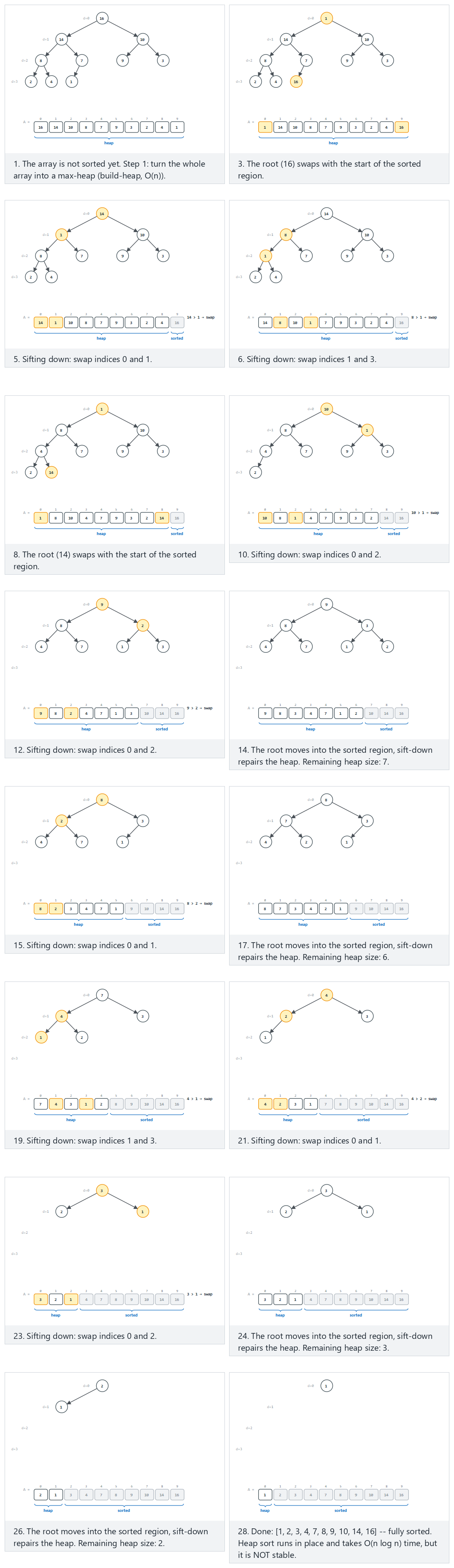
In the picker, also try descending sort with a min-heap, 14 values (hard) and the edge cases already ascending: 12 values, reverse (descending) input: 12 values, all equal: value 8, ten times, a single value, and extreme values — or press 🎲 for random data at four difficulty levels, or type your own values.
/* ascending order for a max-heap, descending for a min-heap */
void heap_sort(int arr[], int n) {
    for (int i = n / 2 - 1; i >= 0; i--)
        sift_down(arr, n, i);           /* build-heap, O(n) */

    for (int heap_size = n; heap_size > 1; heap_size--) {
        int tmp = arr[0];                     /* move the current best to the sorted tail */
        arr[0] = arr[heap_size - 1];
        arr[heap_size - 1] = tmp;
        sift_down(arr, heap_size - 1, 0);    /* restore the heap on the shrunk region */
    }
}
static void heapSort(int[] arr, int n) {
    for (int i = n / 2 - 1; i >= 0; i--)
        siftDown(arr, n, i);             // build-heap, O(n)

    for (int heapSize = n; heapSize > 1; heapSize--) {
        int tmp = arr[0];                     // move the current best to the sorted tail
        arr[0] = arr[heapSize - 1];
        arr[heapSize - 1] = tmp;
        siftDown(arr, heapSize - 1, 0);      // restore the heap on the shrunk region
    }
}
The full programs (code/week-04/c/heap_sort.c, code/week-04/java/HeapSort.java) print the array before and after heap_sort, for three scenarios.
Full program: heap_sort.c / HeapSort.java
/* Week 4 -- Trees, Heaps, and Huffman Coding
 * Heap sort: build-heap once, then repeatedly move the root to the sorted
 * tail and sift-down. A max-heap sorts ascending (the classic heap sort);
 * a min-heap sorts descending (the mirror image).
 * CEN207 Data Structures (CS50-style lecture notes)
 */
#include <stdbool.h>
#include <stdio.h>

#define MAX_CAP 20

static bool kind_is_max;

static bool better(int a, int b) {
    return kind_is_max ? (a > b) : (a < b);
}

/* sift-down (see build_heap.c) */
void sift_down(int arr[], int n, int i) {
    while (1) {
        int left = 2 * i + 1, right = 2 * i + 2, best = i;
        if (left < n && better(arr[left], arr[best])) best = left;
        if (right < n && better(arr[right], arr[best])) best = right;
        if (best == i) break;
        int tmp = arr[i]; arr[i] = arr[best]; arr[best] = tmp;
        i = best;
    }
}

/* ascending order for a max-heap, descending for a min-heap */
void heap_sort(int arr[], int n) {
    for (int i = n / 2 - 1; i >= 0; i--)
        sift_down(arr, n, i);           /* build-heap, O(n) */

    for (int heap_size = n; heap_size > 1; heap_size--) {
        int tmp = arr[0];                     /* move the current best to the sorted tail */
        arr[0] = arr[heap_size - 1];
        arr[heap_size - 1] = tmp;
        sift_down(arr, heap_size - 1, 0);    /* restore the heap on the shrunk region */
    }
}

static void print_array(const int arr[], int n) {
    printf("[");
    for (int i = 0; i < n; i++)
        printf("%d%s", arr[i], i == n - 1 ? "" : ", ");
    printf("]\n");
}

static void run_scenario(const char *label, bool is_max, const int values[], int n) {
    printf("-- %s --\n", label);
    kind_is_max = is_max;
    int arr[MAX_CAP];
    for (int i = 0; i < n; i++) arr[i] = values[i];
    printf("before: ");
    print_array(arr, n);
    heap_sort(arr, n);
    printf("after:  ");
    print_array(arr, n);
    printf("\n");
}

int main(void) {
    /* normal: ascending sort with a max-heap, 10 values */
    int normal[] = {16, 14, 10, 8, 7, 9, 3, 2, 4, 1};
    run_scenario("normal: ascending sort with a max-heap, 10 values", true, normal, 10);

    /* hard: descending sort with a min-heap, 14 values */
    int hard[] = {40, 11, 27, 8, 33, 16, 45, 2, 19, 37, 24, 6, 50, 29};
    run_scenario("hard: descending sort with a min-heap, 14 values", false, hard, 14);

    /* edge: already ascending input, 12 values (with a max-heap) */
    int already_sorted[] = {1, 2, 3, 4, 5, 6, 7, 8, 9, 10, 11, 12};
    run_scenario("edge: already ascending input, 12 values", true, already_sorted, 12);

    return 0;
}
/* Week 4 -- Trees, Heaps, and Huffman Coding
 * Heap sort: build-heap once, then repeatedly move the root to the sorted
 * tail and sift-down. A max-heap sorts ascending (the classic heap sort);
 * a min-heap sorts descending (the mirror image).
 * CEN207 Data Structures (CS50-style lecture notes)
 */
public class HeapSort {
    static boolean kindIsMax;

    static boolean better(int a, int b) {
        return kindIsMax ? (a > b) : (a < b);
    }

    // sift-down (see BuildHeap.java)
    static void siftDown(int[] arr, int n, int i) {
        while (true) {
            int left = 2 * i + 1, right = 2 * i + 2, best = i;
            if (left < n && better(arr[left], arr[best])) best = left;
            if (right < n && better(arr[right], arr[best])) best = right;
            if (best == i) break;
            int tmp = arr[i]; arr[i] = arr[best]; arr[best] = tmp;
            i = best;
        }
    }

    // ascending order for a max-heap, descending for a min-heap
    static void heapSort(int[] arr, int n) {
        for (int i = n / 2 - 1; i >= 0; i--)
            siftDown(arr, n, i);             // build-heap, O(n)

        for (int heapSize = n; heapSize > 1; heapSize--) {
            int tmp = arr[0];                     // move the current best to the sorted tail
            arr[0] = arr[heapSize - 1];
            arr[heapSize - 1] = tmp;
            siftDown(arr, heapSize - 1, 0);      // restore the heap on the shrunk region
        }
    }

    static void printArray(int[] arr, int n) {
        StringBuilder sb = new StringBuilder("[");
        for (int i = 0; i < n; i++) sb.append(arr[i]).append(i == n - 1 ? "" : ", ");
        sb.append(']');
        System.out.println(sb);
    }

    static void runScenario(String label, boolean isMax, int[] values) {
        System.out.println("-- " + label + " --");
        kindIsMax = isMax;
        int n = values.length;
        int[] arr = values.clone();
        System.out.print("before: ");
        printArray(arr, n);
        heapSort(arr, n);
        System.out.print("after:  ");
        printArray(arr, n);
        System.out.println();
    }

    public static void main(String[] args) {
        // normal: ascending sort with a max-heap, 10 values
        int[] normal = {16, 14, 10, 8, 7, 9, 3, 2, 4, 1};
        runScenario("normal: ascending sort with a max-heap, 10 values", true, normal);

        // hard: descending sort with a min-heap, 14 values
        int[] hard = {40, 11, 27, 8, 33, 16, 45, 2, 19, 37, 24, 6, 50, 29};
        runScenario("hard: descending sort with a min-heap, 14 values", false, hard);

        // edge: already ascending input, 12 values (with a max-heap)
        int[] alreadySorted = {1, 2, 3, 4, 5, 6, 7, 8, 9, 10, 11, 12};
        runScenario("edge: already ascending input, 12 values", true, alreadySorted);
    }
}
Try it
Expected output:
-- normal: ascending sort with a max-heap, 10 values --
before: [16, 14, 10, 8, 7, 9, 3, 2, 4, 1]
after:  [1, 2, 3, 4, 7, 8, 9, 10, 14, 16]

-- hard: descending sort with a min-heap, 14 values --
before: [40, 11, 27, 8, 33, 16, 45, 2, 19, 37, 24, 6, 50, 29]
after:  [50, 45, 40, 37, 33, 29, 27, 24, 19, 16, 11, 8, 6, 2]

-- edge: already ascending input, 12 values --
before: [1, 2, 3, 4, 5, 6, 7, 8, 9, 10, 11, 12]
after:  [1, 2, 3, 4, 5, 6, 7, 8, 9, 10, 11, 12]
Complexity. build_heap costs O(n) (section 5.5); the loop then runs n − 1 times, each iteration doing one swap (O(1)) plus one sift-down (O(log n)), for O(n log n) total. So heap sort is O(n log n) overall — the same asymptotic class as merge sort or quicksort's average case — and it sorts in place, needing no extra array the way merge sort does.
Common mistakes
- Believing heap sort is stable. It is not: two equal elements can end up swapped relative to their original order, because the algorithm only ever compares by value, never by original position. If you need a stable sort, heap sort is the wrong tool regardless of its good time complexity.
- Sifting down over the wrong range after each swap. The sift-down after moving the root to the sorted tail must be bounded by the shrunk heap size (
heap_size - 1in the call above), not the original array length — sifting over the full array would let the sift-down wander into the already-sorted region at the end and corrupt it.
Self-check: build-heap vs. heap sort
Both build_heap and the main loop of heap_sort call sift_down repeatedly. Why is the first one O(n) overall while the second one is O(n log n) overall, even though both are "a bunch of sift-downs"?
Answer. build_heap calls sift-down exactly once per internal node, and — as section 5.5 explains — the vast majority of those nodes are near the bottom of the tree, where sift-down is cheap; the sum converges to O(n). heap_sort's main loop instead calls sift-down once per extraction, and every single one of those calls starts from the root (height up to log n), so there is no cheap majority to average against — all n − 1 calls cost up to O(log n) each, giving O(n log n) total.
6. Priority queue: the ADT a heap is built to serve
6.1 The ADT
A priority queue is an abstract data type — the interface, independent of how it is implemented — that manages a collection of items, each with a priority, and supports:
| Operation | What it does | Precondition | Complexity (heap-backed) |
|---|---|---|---|
insert(x) | Adds x with its priority | none | O(log n) |
peek() | Returns the highest-priority item without removing it | queue not empty | O(1) |
extract() | Removes and returns the highest-priority item | queue not empty | O(log n) |
update_key(id, new_priority) | Changes an item's priority (decrease-key or increase-key) | id still present | O(n) with a linear scan; O(log n) with an id→index table |
A queue (Week 3) always serves the item that arrived first; a priority queue always serves the item that is most important, regardless of arrival order — and the binary heap from section 5 is by far the most common way to implement one, since peek/extract/insert map directly onto the heap operations you already built.
The one genuinely new piece is update_key: once an item's priority changes, it may need to move — up if it just became better (a decrease-key in a min-priority queue), down if it just became worse (an increase-key). To make this possible at all, each inserted item is given a permanent id, stable no matter where the item later moves inside the underlying array — real-world uses include Dijkstra's shortest-path algorithm (a later course topic), which repeatedly decreases a vertex's priority as shorter paths to it are discovered, and operating-system schedulers, which raise or lower a process's priority as it waits or runs.
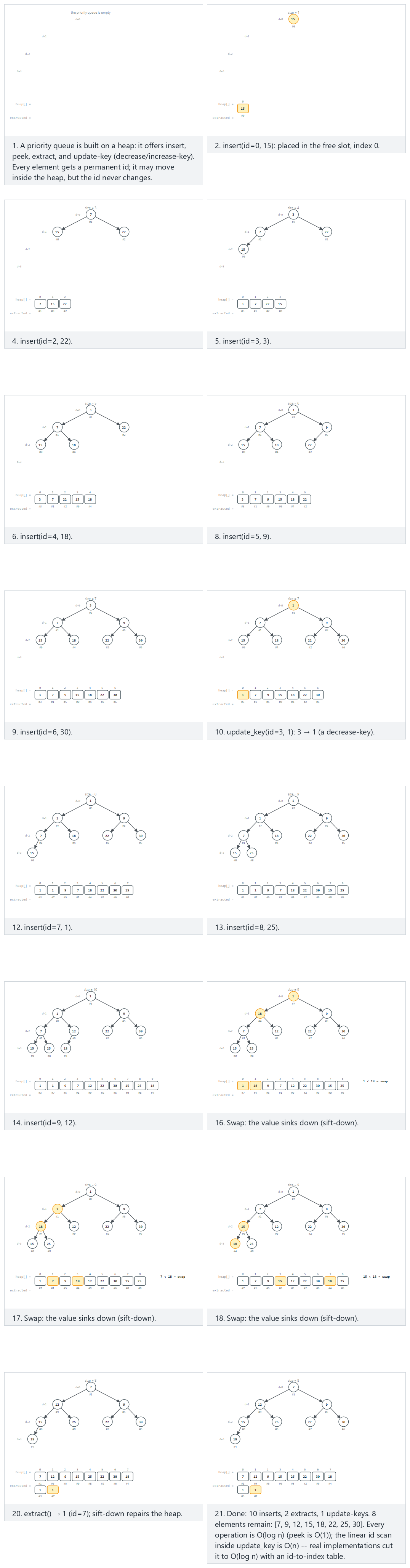
In the picker, also try max-priority: 14 inserts, many mixed operations (hard) and the edge cases extract/ peek while empty, then 10 inserts, all equal: value 5, ten times, then 3 extracts, a single insert, extract, then extract while empty, trying to update-key an id that was already extracted, and extreme values and an update — or press 🎲 for random data at four difficulty levels, or type your own operations.
typedef struct {
    int id;
    int key;
} Item;

/* better decides this heap's order */
static bool better(Item a, Item b) {
    return kind_is_max ? (a.key > b.key) : (a.key < b.key);
}

Item peek(void) { return heap[0]; }   /* caller must check size > 0 */

void insert(int id, int key) {
    heap[size] = (Item){id, key};
    sift_up(size);
    size++;
}

Item extract(void) {              /* caller must check size > 0 */
    Item best = heap[0];
    size--;
    heap[0] = heap[size];
    sift_down(0);
    return best;
}

static int find_by_id(int id) {
    for (int i = 0; i < size; i++)
        if (heap[i].id == id) return i;
    return -1;                    /* not found (already extracted) */
}

void update_key(int id, int new_key) {
    int i = find_by_id(id);       /* linear scan for the handle */
    if (i == -1) { printf("id not found, ignored\n"); return; }
    heap[i].key = new_key;
    if (i > 0 && better(heap[i], heap[(i - 1) / 2]))
        sift_up(i);
    else
        sift_down(i);
}
static class Item {
    int id, key;
    Item(int id, int key) { this.id = id; this.key = key; }
}

static boolean better(Item a, Item b) {
    return kindIsMax ? (a.key > b.key) : (a.key < b.key);
}

static Item peek() { return heap[0]; }   // caller must check size > 0

static void insert(int id, int key) {
    heap[size] = new Item(id, key);
    siftUp(size);
    size++;
}

static Item extract() {                  // caller must check size > 0
    Item best = heap[0];
    size--;
    heap[0] = heap[size];
    siftDown(0);
    return best;
}

static int findById(int id) {
    for (int i = 0; i < size; i++)
        if (heap[i].id == id) return i;
    return -1;                    // not found (already extracted)
}

static void updateKey(int id, int newKey) {
    int i = findById(id);         // linear scan for the handle
    if (i == -1) { System.out.println("id not found, ignored"); return; }
    heap[i].key = newKey;
    if (i > 0 && better(heap[i], heap[(i - 1) / 2]))
        siftUp(i);
    else
        siftDown(i);
}
The full programs (code/week-04/c/priority_queue_demo.c, code/week-04/java/PriorityQueueDemo.java) run a sequence of inserts, peeks, extracts, and updates, printing each item as key(#id).
Full program: priority_queue_demo.c / PriorityQueueDemo.java
/* Week 4 -- Trees, Heaps, and Huffman Coding
 * Priority queue built on an array heap: insert, peek, extract, and
 * update_key (decrease/increase-key), addressed by a stable id handle --
 * the k-th insert always keeps id k, wherever it later moves in the array.
 * CEN207 Data Structures (CS50-style lecture notes)
 */
#include <stdbool.h>
#include <stdio.h>

#define MAX_CAP 20

typedef struct {
    int id;
    int key;
} Item;

static Item heap[MAX_CAP];
static int size;
static bool kind_is_max;
static int next_id;

/* better decides this heap's order */
static bool better(Item a, Item b) {
    return kind_is_max ? (a.key > b.key) : (a.key < b.key);
}

Item peek(void) { return heap[0]; }   /* caller must check size > 0 */

void sift_up(int i) {
    while (i > 0) {
        int p = (i - 1) / 2;
        if (!better(heap[i], heap[p])) break;
        Item tmp = heap[p]; heap[p] = heap[i]; heap[i] = tmp;
        i = p;
    }
}

void sift_down(int i) {
    while (1) {
        int l = 2 * i + 1, r = 2 * i + 2, best = i;
        if (l < size && better(heap[l], heap[best])) best = l;
        if (r < size && better(heap[r], heap[best])) best = r;
        if (best == i) break;
        Item tmp = heap[i]; heap[i] = heap[best]; heap[best] = tmp;
        i = best;
    }
}

void insert(int id, int key) {
    heap[size] = (Item){id, key};
    sift_up(size);
    size++;
}

Item extract(void) {              /* caller must check size > 0 */
    Item best = heap[0];
    size--;
    heap[0] = heap[size];
    sift_down(0);
    return best;
}

static int find_by_id(int id) {
    for (int i = 0; i < size; i++)
        if (heap[i].id == id) return i;
    return -1;                    /* not found (already extracted) */
}

void update_key(int id, int new_key) {
    int i = find_by_id(id);       /* linear scan for the handle */
    if (i == -1) {
        printf("update_key(id=%d, %d): id not found, ignored\n", id, new_key);
        return;
    }
    heap[i].key = new_key;
    if (i > 0 && better(heap[i], heap[(i - 1) / 2]))
        sift_up(i);
    else
        sift_down(i);
}

static void print_heap(void) {
    printf("heap:");
    for (int i = 0; i < size; i++)
        printf(" %d(#%d)", heap[i].key, heap[i].id);
    printf("  [size = %d]\n", size);
}

typedef struct {
    char kind;      /* 'i' = insert, 'p' = peek, 'e' = extract, 'u' = update */
    int a, b;        /* insert: value; update: id, new value */
} Op;

static void run_scenario(const char *label, bool is_max, const Op ops[], int n) {
    printf("-- %s --\n", label);
    size = 0;
    next_id = 0;
    kind_is_max = is_max;
    print_heap();
    for (int i = 0; i < n; i++) {
        Op op = ops[i];
        if (op.kind == 'i') {
            int id = next_id++;
            insert(id, op.a);
            printf("insert(id=%d, %d)\n", id, op.a);
        } else if (op.kind == 'p') {
            if (size == 0) {
                printf("peek() -> underflow, queue is empty\n");
            } else {
                Item top = peek();
                printf("peek() -> %d (id=%d)\n", top.key, top.id);
            }
        } else if (op.kind == 'e') {
            if (size == 0) {
                printf("extract() -> underflow, queue is empty\n");
            } else {
                Item best = extract();
                printf("extract() -> %d (id=%d)\n", best.key, best.id);
            }
        } else { /* 'u' */
            printf("update_key(id=%d, %d)\n", op.a, op.b);
            update_key(op.a, op.b);
        }
        print_heap();
    }
    printf("\n");
}

int main(void) {
    /* normal: min-priority, 10 inserts + peek + 2 extracts + 1 update-key */
    Op normal[] = {
        {'i', 15, 0}, {'i', 7, 0}, {'i', 22, 0}, {'i', 3, 0}, {'i', 18, 0}, {'p', 0, 0},
        {'i', 9, 0}, {'i', 30, 0}, {'u', 3, 1}, {'i', 1, 0}, {'i', 25, 0}, {'i', 12, 0},
        {'e', 0, 0}, {'e', 0, 0}
    };
    run_scenario("normal: min-priority, 10 inserts + peek + 2 extracts + 1 update-key", false, normal, 14);

    /* hard: max-priority, 14 inserts, many mixed operations */
    Op hard[] = {
        {'i', 40, 0}, {'i', 11, 0}, {'i', 27, 0}, {'p', 0, 0}, {'e', 0, 0}, {'i', 8, 0}, {'i', 33, 0},
        {'u', 2, 60}, {'i', 16, 0}, {'i', 45, 0}, {'e', 0, 0}, {'i', 2, 0}, {'i', 19, 0},
        {'i', 37, 0}, {'u', 5, 1}, {'i', 24, 0}, {'i', 6, 0}, {'i', 50, 0}, {'p', 0, 0},
        {'i', 29, 0}, {'i', 3, 0}, {'e', 0, 0}
    };
    run_scenario("hard: max-priority, 14 inserts, many mixed operations", true, hard, 22);

    /* edge: extract/peek while empty, then 10 inserts, then a final extract */
    Op edge[] = {
        {'e', 0, 0}, {'p', 0, 0},
        {'i', 6, 0}, {'i', 14, 0}, {'i', 3, 0}, {'i', 27, 0}, {'i', 19, 0}, {'i', 8, 0},
        {'i', 35, 0}, {'i', 11, 0}, {'i', 24, 0}, {'i', 17, 0}, {'e', 0, 0}
    };
    run_scenario("edge: extract/peek while empty, then 10 inserts, then an extract", false, edge, 13);

    return 0;
}
/* Week 4 -- Trees, Heaps, and Huffman Coding
 * Priority queue built on an array heap: insert, peek, extract, and
 * updateKey (decrease/increase-key), addressed by a stable id handle --
 * the k-th insert always keeps id k, wherever it later moves in the array.
 * CEN207 Data Structures (CS50-style lecture notes)
 */
public class PriorityQueueDemo {
    static final int MAX_CAP = 20;

    static class Item {
        int id, key;
        Item(int id, int key) { this.id = id; this.key = key; }
    }

    static Item[] heap = new Item[MAX_CAP];
    static int size;
    static boolean kindIsMax;
    static int nextId;

    // better decides this heap's order
    static boolean better(Item a, Item b) {
        return kindIsMax ? (a.key > b.key) : (a.key < b.key);
    }

    static Item peek() { return heap[0]; }   // caller must check size > 0

    static void siftUp(int i) {
        while (i > 0) {
            int p = (i - 1) / 2;
            if (!better(heap[i], heap[p])) break;
            Item tmp = heap[p]; heap[p] = heap[i]; heap[i] = tmp;
            i = p;
        }
    }

    static void siftDown(int i) {
        while (true) {
            int l = 2 * i + 1, r = 2 * i + 2, best = i;
            if (l < size && better(heap[l], heap[best])) best = l;
            if (r < size && better(heap[r], heap[best])) best = r;
            if (best == i) break;
            Item tmp = heap[i]; heap[i] = heap[best]; heap[best] = tmp;
            i = best;
        }
    }

    static void insert(int id, int key) {
        heap[size] = new Item(id, key);
        siftUp(size);
        size++;
    }

    static Item extract() {                  // caller must check size > 0
        Item best = heap[0];
        size--;
        heap[0] = heap[size];
        siftDown(0);
        return best;
    }

    static int findById(int id) {
        for (int i = 0; i < size; i++)
            if (heap[i].id == id) return i;
        return -1;                    // not found (already extracted)
    }

    static void updateKey(int id, int newKey) {
        int i = findById(id);         // linear scan for the handle
        if (i == -1) {
            System.out.println("update_key(id=" + id + ", " + newKey + "): id not found, ignored");
            return;
        }
        heap[i].key = newKey;
        if (i > 0 && better(heap[i], heap[(i - 1) / 2]))
            siftUp(i);
        else
            siftDown(i);
    }

    static void printHeap() {
        StringBuilder sb = new StringBuilder("heap:");
        for (int i = 0; i < size; i++) sb.append(' ').append(heap[i].key).append("(#").append(heap[i].id).append(')');
        sb.append("  [size = ").append(size).append(']');
        System.out.println(sb);
    }

    static class Op {
        char kind;   // 'i' = insert, 'p' = peek, 'e' = extract, 'u' = update
        int a, b;
        Op(char kind, int a, int b) { this.kind = kind; this.a = a; this.b = b; }
    }

    static void runScenario(String label, boolean isMax, Op[] ops) {
        System.out.println("-- " + label + " --");
        size = 0;
        nextId = 0;
        kindIsMax = isMax;
        printHeap();
        for (Op op : ops) {
            if (op.kind == 'i') {
                int id = nextId++;
                insert(id, op.a);
                System.out.println("insert(id=" + id + ", " + op.a + ")");
            } else if (op.kind == 'p') {
                if (size == 0) {
                    System.out.println("peek() -> underflow, queue is empty");
                } else {
                    Item top = peek();
                    System.out.println("peek() -> " + top.key + " (id=" + top.id + ")");
                }
            } else if (op.kind == 'e') {
                if (size == 0) {
                    System.out.println("extract() -> underflow, queue is empty");
                } else {
                    Item best = extract();
                    System.out.println("extract() -> " + best.key + " (id=" + best.id + ")");
                }
            } else { // 'u'
                System.out.println("update_key(id=" + op.a + ", " + op.b + ")");
                updateKey(op.a, op.b);
            }
            printHeap();
        }
        System.out.println();
    }

    public static void main(String[] args) {
        // normal: min-priority, 10 inserts + peek + 2 extracts + 1 update-key
        Op[] normal = {
            new Op('i', 15, 0), new Op('i', 7, 0), new Op('i', 22, 0), new Op('i', 3, 0), new Op('i', 18, 0), new Op('p', 0, 0),
            new Op('i', 9, 0), new Op('i', 30, 0), new Op('u', 3, 1), new Op('i', 1, 0), new Op('i', 25, 0), new Op('i', 12, 0),
            new Op('e', 0, 0), new Op('e', 0, 0)
        };
        runScenario("normal: min-priority, 10 inserts + peek + 2 extracts + 1 update-key", false, normal);

        // hard: max-priority, 14 inserts, many mixed operations
        Op[] hard = {
            new Op('i', 40, 0), new Op('i', 11, 0), new Op('i', 27, 0), new Op('p', 0, 0), new Op('e', 0, 0), new Op('i', 8, 0), new Op('i', 33, 0),
            new Op('u', 2, 60), new Op('i', 16, 0), new Op('i', 45, 0), new Op('e', 0, 0), new Op('i', 2, 0), new Op('i', 19, 0),
            new Op('i', 37, 0), new Op('u', 5, 1), new Op('i', 24, 0), new Op('i', 6, 0), new Op('i', 50, 0), new Op('p', 0, 0),
            new Op('i', 29, 0), new Op('i', 3, 0), new Op('e', 0, 0)
        };
        runScenario("hard: max-priority, 14 inserts, many mixed operations", true, hard);

        // edge: extract/peek while empty, then 10 inserts, then a final extract
        Op[] edge = {
            new Op('e', 0, 0), new Op('p', 0, 0),
            new Op('i', 6, 0), new Op('i', 14, 0), new Op('i', 3, 0), new Op('i', 27, 0), new Op('i', 19, 0), new Op('i', 8, 0),
            new Op('i', 35, 0), new Op('i', 11, 0), new Op('i', 24, 0), new Op('i', 17, 0), new Op('e', 0, 0)
        };
        runScenario("edge: extract/peek while empty, then 10 inserts, then an extract", false, edge);
    }
}
Try it
Expected output (normal scenario; hard and edge scenarios follow the same pattern):
-- normal: min-priority, 10 inserts + peek + 2 extracts + 1 update-key --
heap:  [size = 0]
insert(id=0, 15)
heap: 15(#0)  [size = 1]
insert(id=1, 7)
heap: 7(#1) 15(#0)  [size = 2]
insert(id=2, 22)
heap: 7(#1) 15(#0) 22(#2)  [size = 3]
insert(id=3, 3)
heap: 3(#3) 7(#1) 22(#2) 15(#0)  [size = 4]
insert(id=4, 18)
heap: 3(#3) 7(#1) 22(#2) 15(#0) 18(#4)  [size = 5]
peek() -> 3 (id=3)
heap: 3(#3) 7(#1) 22(#2) 15(#0) 18(#4)  [size = 5]
insert(id=5, 9)
heap: 3(#3) 7(#1) 9(#5) 15(#0) 18(#4) 22(#2)  [size = 6]
insert(id=6, 30)
heap: 3(#3) 7(#1) 9(#5) 15(#0) 18(#4) 22(#2) 30(#6)  [size = 7]
update_key(id=3, 1)
heap: 1(#3) 7(#1) 9(#5) 15(#0) 18(#4) 22(#2) 30(#6)  [size = 7]
insert(id=7, 1)
heap: 1(#3) 1(#7) 9(#5) 7(#1) 18(#4) 22(#2) 30(#6) 15(#0)  [size = 8]
insert(id=8, 25)
heap: 1(#3) 1(#7) 9(#5) 7(#1) 18(#4) 22(#2) 30(#6) 15(#0) 25(#8)  [size = 9]
insert(id=9, 12)
heap: 1(#3) 1(#7) 9(#5) 7(#1) 12(#9) 22(#2) 30(#6) 15(#0) 25(#8) 18(#4)  [size = 10]
extract() -> 1 (id=3)
heap: 1(#7) 7(#1) 9(#5) 15(#0) 12(#9) 22(#2) 30(#6) 18(#4) 25(#8)  [size = 9]
extract() -> 1 (id=7)
heap: 7(#1) 12(#9) 9(#5) 15(#0) 25(#8) 22(#2) 30(#6) 18(#4)  [size = 8]
The edge scenario demonstrates safe handling of underflow and stale ids:
-- edge: extract/peek while empty, then 10 inserts, then an extract --
heap:  [size = 0]
extract() -> underflow, queue is empty
heap:  [size = 0]
peek() -> underflow, queue is empty
heap:  [size = 0]
insert(id=0, 6)
heap: 6(#0)  [size = 1]
...
extract() -> 3 (id=2)
heap: 6(#0) 11(#7) 8(#5) 14(#1) 17(#9) 19(#4) 35(#6) 27(#3) 24(#8)  [size = 9]
Watch the update_key(id=3, 1) step closely: the item with id 3 (currently holding key 3, sitting at whatever array index it happens to occupy) gets its key lowered to 1 — a decrease-key in this min-priority queue, making it even better — so sift_up is called and it floats toward the root. Its id never changes, even though its array index does, every single time the heap reshuffles around it; that stability is exactly what makes update_key possible at all.
Complexity. insert and extract are O(log n), peek is O(1) — all inherited directly from the underlying heap. update_key's find_by_id linear scan is O(n), making the whole operation O(n) as implemented above; a real-world implementation typically adds a hash table mapping id → current array index, updated on every swap, cutting update_key down to O(log n) as well — a classic space-for-time trade whose bookkeeping cost is not worth the added complexity for a lecture-sized example, but very much worth it in Dijkstra's algorithm or an OS scheduler managing thousands of items.
Common mistakes
- Confusing the item's id with its current array index. The id is permanent; the index is not. Storing or comparing indices across calls to
insert/extract/update_key(instead of ids) will silently point at the wrong item the moment the heap reshuffles. - Calling
peekorextractwithout checkingsize > 0first. Exactly like the plain heap in section 5, both operations assume a non-empty queue; the edge scenario's "underflow" messages exist precisely to show the caller doing that check, not the heap operations themselves silently tolerating it. - Picking the wrong sift direction after
update_key. After changing a key, you must sift up if the new key is now better than its parent, and sift down otherwise — sift-down alone would fail to fix a decrease-key, and sift-up alone would fail to fix an increase-key.
Self-check: priority queue
An operating system scheduler uses a min-priority queue keyed by "time remaining until deadline" — the most urgent process (soonest deadline) should run next. A running process just got interrupted by a much more urgent request. Is updating that request's priority a decrease-key or an increase-key, and which sift direction does it trigger?
Answer. In a min-priority queue, "more urgent" means a smaller key (sooner deadline), so this is a decrease-key, and it triggers sift-up — the request needs to float toward the root, since the root holds the minimum (most urgent) key.
7. Heap variants: trading one property for another
The binary heap is not the only design; each variant below relaxes or changes one property of the plain binary heap, trading it for a different advantage.
7.1 The d-ary heap
A d-ary heap is the same array-backed idea as a binary heap, except every node may have up to D children instead of 2. Child c (0-indexed, 0 <= c < D) of node i sits at index D*i + 1 + c; the parent of node i is at index (i - 1) / D. D = 2 recovers exactly the ordinary binary heap.
The trade-off is direct: a larger D makes the tree shorter (height only logD n instead of log₂ n), so extract's sift-down needs fewer levels — but at every level it must now compare against up to D children instead of just 2, so each level costs more. insert, whose sift-up only ever compares against a single parent, becomes strictly cheaper with a larger D (O(logD n) with a smaller constant, no extra per-level comparisons) — which is exactly why d-ary heaps are popular in workloads dominated by inserts, such as network event schedulers.
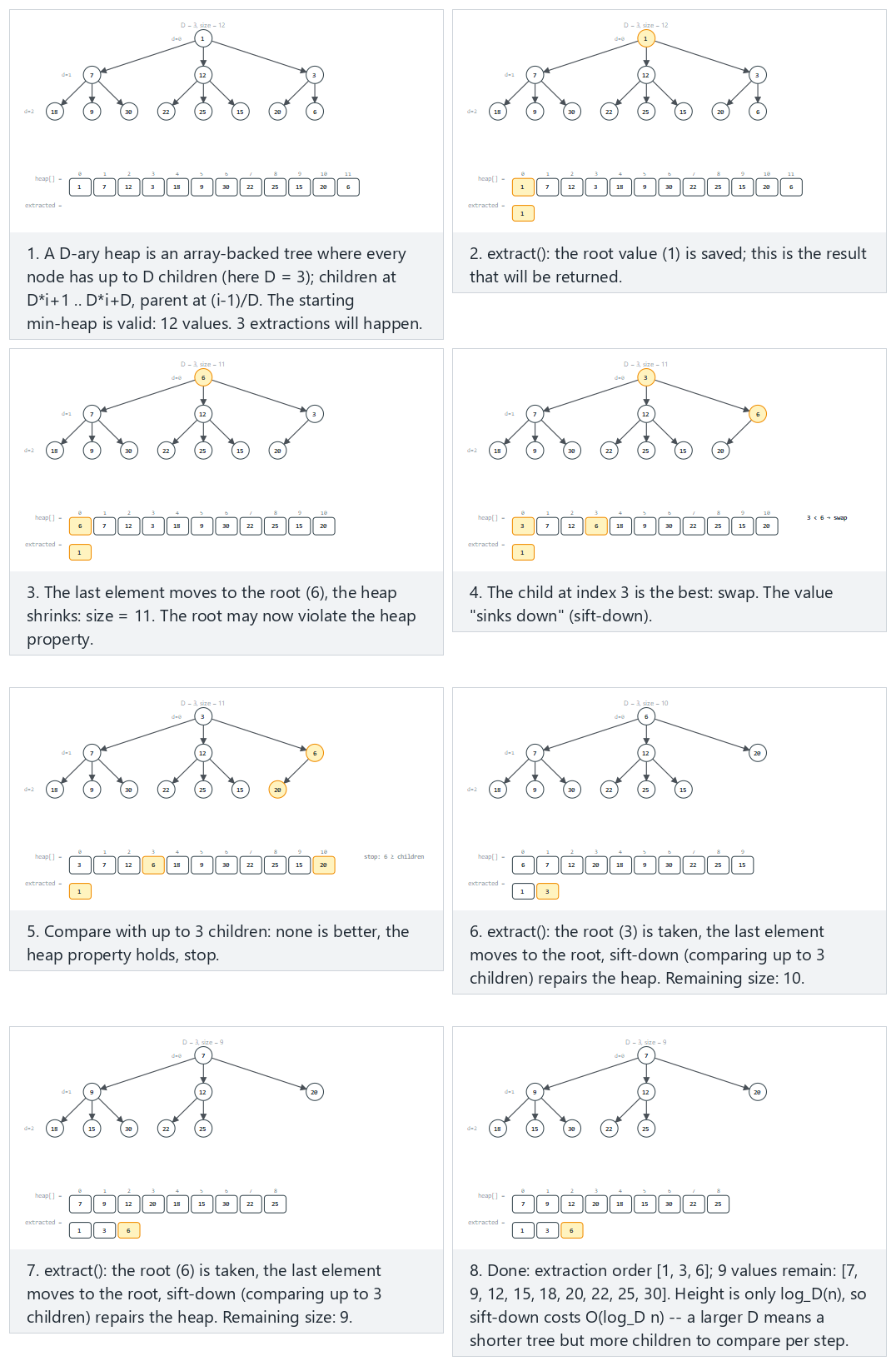
In the picker, also try D=4, max-heap: 5 extractions from 16 values (hard) and the edge cases D=3: drain fully, all 10 values are extracted, D=4, all equal: value 6, ten times, D=3, a single value, one extraction, and D=4, extreme values — or press 🎲 for random data at four difficulty levels, or type your own values.
static int heap[MAX_CAP];
static int size;
static int D;                   /* every node has up to D children */
static bool kind_is_max;

static bool better(int a, int b) {
    return kind_is_max ? (a > b) : (a < b);
}

/* remove and return the root (the minimum for a min-heap, the maximum for a max-heap) */
int extract(void) {
    int best = heap[0];
    size--;
    heap[0] = heap[size];        /* move the last element to the root */

    int i = 0;
    while (1) {                              /* sift-down */
        int target = i, base = D * i + 1;
        for (int c = 0; c < D; c++) {
            int child = base + c;
            if (child < size && better(heap[child], heap[target]))
                target = child;
        }
        if (target == i) break;

        int tmp = heap[i];
        heap[i] = heap[target];
        heap[target] = tmp;
        i = target;
    }
    return best;
}
static int extract() {
    int best = heap[0];
    size--;
    heap[0] = heap[size];

    int i = 0;
    while (true) {
        int target = i, base = d * i + 1;
        for (int c = 0; c < d; c++) {
            int child = base + c;
            if (child < size && better(heap[child], heap[target])) target = child;
        }
        if (target == i) break;
        int tmp = heap[i]; heap[i] = heap[target]; heap[target] = tmp;
        i = target;
    }
    return best;
}
The full programs (code/week-04/c/dary_heap_extract.c, code/week-04/java/DaryHeapExtract.java) run with D = 3 and D = 4, using the same heapify_prepare preparation idea as section 5.4's plain binary heap.
Full program: dary_heap_extract.c / DaryHeapExtract.java
/* Week 4 -- Trees, Heaps, and Huffman Coding
 * D-ary heap: the same array-backed idea as a binary heap, but every node
 * has up to D children (child c of node i sits at D*i + 1 + c, parent at
 * (i-1)/D). D = 3 or 4, chosen per scenario.
 * CEN207 Data Structures (CS50-style lecture notes)
 */
#include <stdbool.h>
#include <stdio.h>

#define MAX_CAP 20

static int heap[MAX_CAP];
static int size;
static int D;                   /* every node has up to D children */
static bool kind_is_max;

static bool better(int a, int b) {
    return kind_is_max ? (a > b) : (a < b);
}

/* remove and return the root (the minimum for a min-heap, the maximum for a max-heap) */
int extract(void) {
    int best = heap[0];
    size--;
    heap[0] = heap[size];        /* move the last element to the root */

    int i = 0;
    while (1) {                              /* sift-down */
        int target = i, base = D * i + 1;
        for (int c = 0; c < D; c++) {
            int child = base + c;
            if (child < size && better(heap[child], heap[target]))
                target = child;
        }
        if (target == i) break;

        int tmp = heap[i];
        heap[i] = heap[target];
        heap[target] = tmp;
        i = target;
    }
    return best;
}

static void sift_down_at(int i) {
    while (1) {
        int target = i, base = D * i + 1;
        for (int c = 0; c < D; c++) {
            int child = base + c;
            if (child < size && better(heap[child], heap[target])) target = child;
        }
        if (target == i) break;
        int tmp = heap[i]; heap[i] = heap[target]; heap[target] = tmp;
        i = target;
    }
}

/* preparation only, not part of extract itself: turn a raw array into a valid D-ary heap */
static void heapify_prepare(const int values[], int n) {
    size = n;
    for (int i = 0; i < n; i++) heap[i] = values[i];
    for (int i = (n - 2) / D; i >= 0; i--) sift_down_at(i);
}

static void print_heap(void) {
    printf("heap:");
    for (int i = 0; i < size; i++)
        printf(" %d", heap[i]);
    printf("  [D = %d, size = %d]\n", D, size);
}

static void run_scenario(const char *label, int d, bool is_max, const int raw[], int n, int extracts) {
    printf("-- %s --\n", label);
    D = d;
    kind_is_max = is_max;
    heapify_prepare(raw, n);
    printf("starting heap: ");
    print_heap();
    for (int k = 0; k < extracts && size > 0; k++) {
        int best = extract();
        printf("extract() -> %d\n", best);
        print_heap();
    }
    printf("\n");
}

int main(void) {
    /* normal: D=3, min-heap, 3 extractions from 12 values */
    int normal[] = {15, 7, 22, 3, 18, 9, 30, 1, 25, 12, 20, 6};
    run_scenario("normal: D=3, min-heap, 3 extractions from 12 values", 3, false, normal, 12, 3);

    /* hard: D=4, max-heap, 5 extractions from 16 values */
    int hard[] = {40, 11, 27, 8, 33, 16, 45, 2, 19, 37, 24, 6, 50, 29, 3, 44};
    run_scenario("hard: D=4, max-heap, 5 extractions from 16 values", 4, true, hard, 16, 5);

    /* edge: D=3, drain fully, all 10 values extracted (min-heap) */
    int drain[] = {31, 5, 17, 26, 9, 44, 13, 2, 38, 20};
    run_scenario("edge: D=3, drain fully, all 10 values extracted (min-heap)", 3, false, drain, 10, 10);

    return 0;
}
/* Week 4 -- Trees, Heaps, and Huffman Coding
 * D-ary heap: the same array-backed idea as a binary heap, but every node
 * has up to D children (child c of node i sits at D*i + 1 + c, parent at
 * (i-1)/D). D = 3 or 4, chosen per scenario.
 * CEN207 Data Structures (CS50-style lecture notes)
 */
public class DaryHeapExtract {
    static final int MAX_CAP = 20;

    static int[] heap = new int[MAX_CAP];
    static int size;
    static int d;                   // every node has up to D children
    static boolean kindIsMax;

    static boolean better(int a, int b) {
        return kindIsMax ? (a > b) : (a < b);
    }

    // remove and return the root (the minimum for a min-heap, the maximum for a max-heap)
    static int extract() {
        int best = heap[0];
        size--;
        heap[0] = heap[size];        // move the last element to the root

        int i = 0;
        while (true) {                            // sift-down
            int target = i, base = d * i + 1;
            for (int c = 0; c < d; c++) {
                int child = base + c;
                if (child < size && better(heap[child], heap[target]))
                    target = child;
            }
            if (target == i) break;

            int tmp = heap[i];
            heap[i] = heap[target];
            heap[target] = tmp;
            i = target;
        }
        return best;
    }

    static void siftDownAt(int i) {
        while (true) {
            int target = i, base = d * i + 1;
            for (int c = 0; c < d; c++) {
                int child = base + c;
                if (child < size && better(heap[child], heap[target])) target = child;
            }
            if (target == i) break;
            int tmp = heap[i]; heap[i] = heap[target]; heap[target] = tmp;
            i = target;
        }
    }

    // preparation only, not part of extract itself: turn a raw array into a valid D-ary heap
    static void heapifyPrepare(int[] values) {
        size = values.length;
        for (int i = 0; i < size; i++) heap[i] = values[i];
        for (int i = (size - 2) / d; i >= 0; i--) siftDownAt(i);
    }

    static void printHeap() {
        StringBuilder sb = new StringBuilder("heap:");
        for (int i = 0; i < size; i++) sb.append(' ').append(heap[i]);
        sb.append("  [D = ").append(d).append(", size = ").append(size).append(']');
        System.out.println(sb);
    }

    static void runScenario(String label, int dValue, boolean isMax, int[] raw, int extracts) {
        System.out.println("-- " + label + " --");
        d = dValue;
        kindIsMax = isMax;
        heapifyPrepare(raw);
        System.out.print("starting heap: ");
        printHeap();
        for (int k = 0; k < extracts && size > 0; k++) {
            int best = extract();
            System.out.println("extract() -> " + best);
            printHeap();
        }
        System.out.println();
    }

    public static void main(String[] args) {
        // normal: D=3, min-heap, 3 extractions from 12 values
        int[] normal = {15, 7, 22, 3, 18, 9, 30, 1, 25, 12, 20, 6};
        runScenario("normal: D=3, min-heap, 3 extractions from 12 values", 3, false, normal, 3);

        // hard: D=4, max-heap, 5 extractions from 16 values
        int[] hard = {40, 11, 27, 8, 33, 16, 45, 2, 19, 37, 24, 6, 50, 29, 3, 44};
        runScenario("hard: D=4, max-heap, 5 extractions from 16 values", 4, true, hard, 5);

        // edge: D=3, drain fully, all 10 values extracted (min-heap)
        int[] drain = {31, 5, 17, 26, 9, 44, 13, 2, 38, 20};
        runScenario("edge: D=3, drain fully, all 10 values extracted (min-heap)", 3, false, drain, 10);
    }
}
Try it
Expected output (normal and edge scenarios; hard follows the same pattern with D=4):
-- normal: D=3, min-heap, 3 extractions from 12 values --
starting heap: heap: 1 7 12 3 18 9 30 22 25 15 20 6  [D = 3, size = 12]
extract() -> 1
heap: 3 7 12 6 18 9 30 22 25 15 20  [D = 3, size = 11]
extract() -> 3
heap: 6 7 12 20 18 9 30 22 25 15  [D = 3, size = 10]
extract() -> 6
heap: 7 9 12 20 18 15 30 22 25  [D = 3, size = 9]

-- hard: D=4, max-heap, 5 extractions from 16 values --
starting heap: heap: 50 45 40 44 33 16 11 2 19 37 24 6 27 29 3 8  [D = 4, size = 16]
extract() -> 50
heap: 45 19 40 44 33 16 11 2 8 37 24 6 27 29 3  [D = 4, size = 15]
extract() -> 45
heap: 44 19 40 29 33 16 11 2 8 37 24 6 27 3  [D = 4, size = 14]
extract() -> 44
heap: 40 19 37 29 33 16 11 2 8 3 24 6 27  [D = 4, size = 13]
extract() -> 40
heap: 37 19 27 29 33 16 11 2 8 3 24 6  [D = 4, size = 12]
extract() -> 37
heap: 33 19 27 29 6 16 11 2 8 3 24  [D = 4, size = 11]

-- edge: D=3, drain fully, all 10 values extracted (min-heap) --
starting heap: heap: 2 5 17 26 9 44 13 31 38 20  [D = 3, size = 10]
extract() -> 2
heap: 5 9 17 26 20 44 13 31 38  [D = 3, size = 9]
extract() -> 5
heap: 9 13 17 26 20 44 38 31  [D = 3, size = 8]
extract() -> 9
heap: 13 20 17 26 31 44 38  [D = 3, size = 7]
extract() -> 13
heap: 17 20 38 26 31 44  [D = 3, size = 6]
extract() -> 17
heap: 20 31 38 26 44  [D = 3, size = 5]
extract() -> 20
heap: 26 31 38 44  [D = 3, size = 4]
extract() -> 26
heap: 31 44 38  [D = 3, size = 3]
extract() -> 31
heap: 38 44  [D = 3, size = 2]
extract() -> 38
heap: 44  [D = 3, size = 1]
extract() -> 44
heap:  [D = 3, size = 0]
Complexity. extract is O(D · logD n): logD n levels, up to D comparisons per level. insert's sift-up is O(logD n), with only one comparison per level regardless of D.
Common mistakes
- Reusing the binary heap's
2*i+1/2*i+2formulas unchanged. They are the D = 2 special case ofD*i + 1 + c; plugging in a different D without updating the child-index arithmetic silently addresses the wrong array cells. - Forgetting that a larger D helps inserts but can hurt extracts. Choosing D purely to "make the tree shorter" without counting the cost of comparing more children per level can make
extractslower overall for a workload that extracts often.
7.2 The binomial heap
A binomial heap — introduced by Jean Vuillemin in 1978 — gives up the "always a single complete tree in one array" shape entirely, in exchange for a fast union: merging two whole heaps into one. It is a forest (collection) of binomial trees, where a binomial tree of order k has exactly 2k nodes and is built by taking two order-(k−1) trees and making one the leftmost child of the other's root — this is called linking. A binomial heap with n elements decomposes uniquely into a set of binomial trees whose orders are exactly the set bits of n in binary — for example, 13 = 0b1101 decomposes into orders 0, 2, and 3 (trees of size 1, 4, and 8, summing to 13).
Union merges two root lists exactly like binary addition with a carry: walking orders from low to high, if only one heap has a tree at this order, it passes straight through to the result; if both do, they link into an order-(k+1) tree that "carries" into the next position — exactly the way adding two binary digits can produce a carry bit.
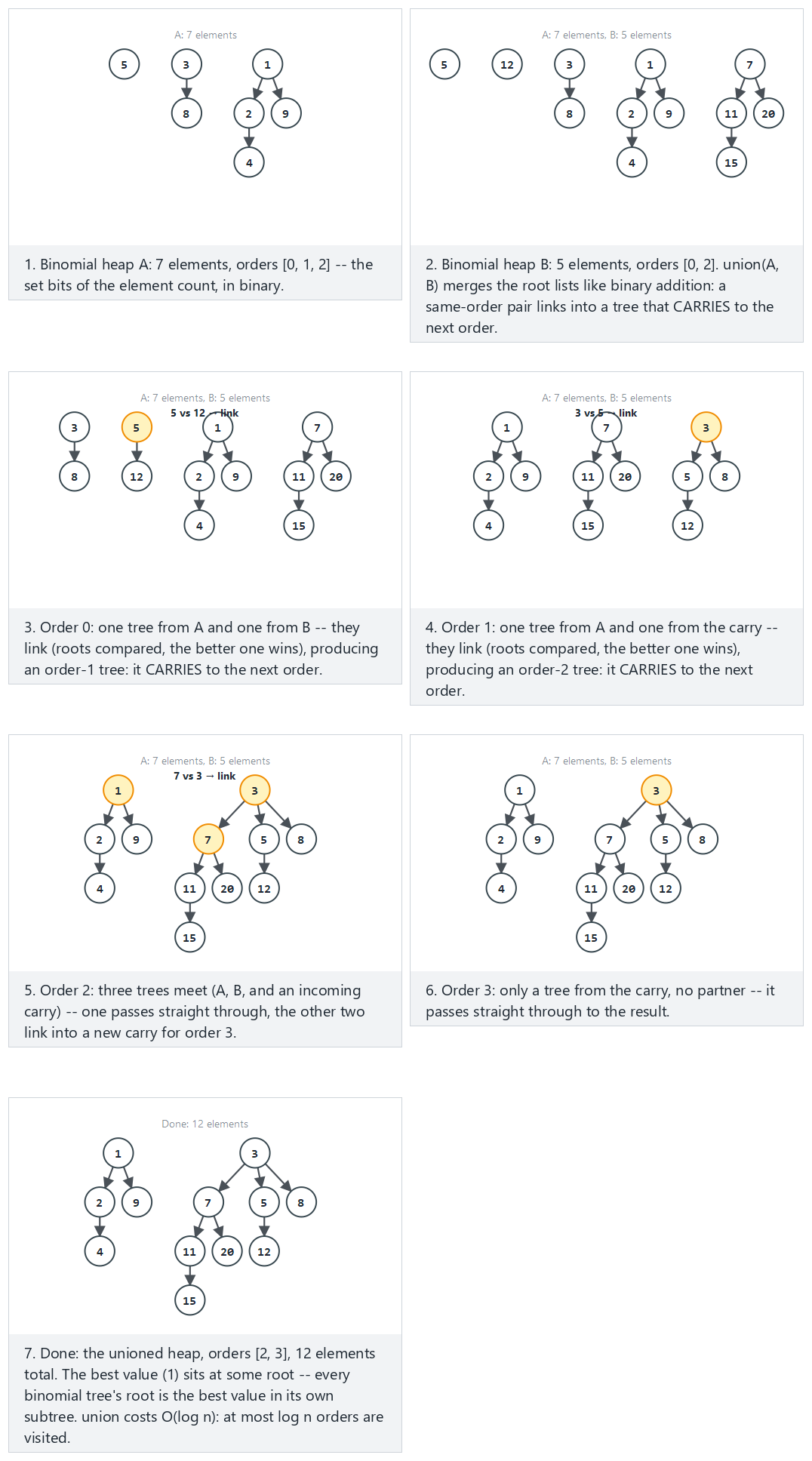
In the picker, also try max: A and B share the same orders (0/½) -- a carry forms at every order (hard) and the edge cases A is empty, union with B (11 elements), A (8, order 3) union B (8, order 3): one long carry chain, all equal: two 6-element heaps, value 7, extreme values: 5 + 6 elements, and a single element union an empty heap — or press 🎲 for random data at four difficulty levels, or type your own two heaps.
/* link: the worse root becomes a new leftmost child of the better root */
Node *link(Node *t1, Node *t2) {
    Node *winner = better(t2->key, t1->key) ? t2 : t1;
    Node *loser  = (winner == t1) ? t2 : t1;
    loser->sibling = winner->child;
    winner->child = loser;
    winner->order++;
    return winner;
}

/* union: merge two root lists (indexed by order) like binary addition; a
 * same-order pair links into a "carry" tree that is picked up one order
 * higher, exactly like a carry bit */
void union_heaps(Node *a[], Node *b[], Node *result[]) {
    Node *carry = NULL;
    for (int order = 0; order < MAX_ORDER; order++) {
        Node *group[3];
        int g = 0;
        if (a[order]) group[g++] = a[order];
        if (b[order]) group[g++] = b[order];
        if (carry) group[g++] = carry;
        carry = NULL;

        if (g == 0) result[order] = NULL;
        else if (g == 1) result[order] = group[0];
        else if (g == 2) { result[order] = NULL; carry = link(group[0], group[1]); }
        else { result[order] = group[0]; carry = link(group[1], group[2]); }
    }
}
static Node link(Node t1, Node t2) {
    Node winner = better(t2.key, t1.key) ? t2 : t1;
    Node loser  = (winner == t1) ? t2 : t1;
    loser.sibling = winner.child;
    winner.child = loser;
    winner.order++;
    return winner;
}

static void unionHeaps(Node[] a, Node[] b, Node[] result) {
    Node carry = null;
    for (int order = 0; order < MAX_ORDER; order++) {
        Node[] group = new Node[3];
        int g = 0;
        if (a[order] != null) group[g++] = a[order];
        if (b[order] != null) group[g++] = b[order];
        if (carry != null) group[g++] = carry;
        carry = null;

        if (g == 0) result[order] = null;
        else if (g == 1) result[order] = group[0];
        else if (g == 2) { result[order] = null; carry = link(group[0], group[1]); }
        else { result[order] = group[0]; carry = link(group[1], group[2]); }
    }
}
A root list is represented here as a plain array indexed by order (null = no tree of that order) — the direct picture of "binary addition with a carry" — rather than a linked list of trees; insert(x) is simply union with a single order-0 tree holding x. The full programs (code/week-04/c/binomial_heap_union.c, code/week-04/java/BinomialHeapUnion.java) build two heaps this way (one insert, i.e. one union, per value) and then union them together.
Full program: binomial_heap_union.c / BinomialHeapUnion.java
/* Week 4 -- Trees, Heaps, and Huffman Coding
 * Binomial heap union: merge two root lists like binary addition. A
 * binomial heap decomposes uniquely into trees whose sizes are the set
 * bits of its element count (order k has 2^k nodes). A root list is
 * represented here as an array indexed by order (NULL = absent), the
 * direct picture of "binary addition with a carry".
 * CEN207 Data Structures (CS50-style lecture notes)
 */
#include <stdbool.h>
#include <stdio.h>
#include <stdlib.h>

#define MAX_ORDER 6

typedef struct Node {
    int key;
    int order;
    struct Node *child;
    struct Node *sibling;
} Node;

static bool kind_is_max;

static bool better(int a, int b) {
    return kind_is_max ? (a > b) : (a < b);
}

static Node *new_leaf(int key) {
    Node *n = malloc(sizeof(Node));
    n->key = key;
    n->order = 0;
    n->child = NULL;
    n->sibling = NULL;
    return n;
}

/* link: the worse root becomes a new leftmost child of the better root */
Node *link(Node *t1, Node *t2) {
    Node *winner = better(t2->key, t1->key) ? t2 : t1;
    Node *loser  = (winner == t1) ? t2 : t1;
    loser->sibling = winner->child;
    winner->child = loser;
    winner->order++;
    return winner;
}

/* union: merge two root lists (indexed by order) like binary addition; a
 * same-order pair links into a "carry" tree that is picked up one order
 * higher, exactly like a carry bit */
void union_heaps(Node *a[], Node *b[], Node *result[]) {
    Node *carry = NULL;
    for (int order = 0; order < MAX_ORDER; order++) {
        Node *group[3];
        int g = 0;
        if (a[order]) group[g++] = a[order];
        if (b[order]) group[g++] = b[order];
        if (carry) group[g++] = carry;
        carry = NULL;

        if (g == 0) {
            result[order] = NULL;
        } else if (g == 1) {
            result[order] = group[0];
        } else if (g == 2) {
            result[order] = NULL;
            carry = link(group[0], group[1]);
        } else {
            result[order] = group[0];
            carry = link(group[1], group[2]);
        }
    }
}

/* insert(x) is exactly union with a single order-0 tree -- the operation
 * this whole file is really about */
static void insert(Node *trees[], int value) {
    Node *singleton[MAX_ORDER] = {0};
    singleton[0] = new_leaf(value);
    Node *result[MAX_ORDER];
    union_heaps(trees, singleton, result);
    for (int k = 0; k < MAX_ORDER; k++) trees[k] = result[k];
}

static void build_from_values(Node *trees[], const int values[], int n) {
    for (int k = 0; k < MAX_ORDER; k++) trees[k] = NULL;
    for (int i = 0; i < n; i++) insert(trees, values[i]);
}

static void print_tree(Node *node, int depth) {
    for (int i = 0; i < depth; i++) printf("  ");
    printf("%d\n", node->key);
    for (Node *c = node->child; c != NULL; c = c->sibling)
        print_tree(c, depth + 1);
}

static void print_forest(const char *label, Node *trees[]) {
    printf("%s -- orders present:", label);
    for (int k = 0; k < MAX_ORDER; k++)
        if (trees[k]) printf(" %d", k);
    printf("\n");
    for (int k = 0; k < MAX_ORDER; k++) {
        if (trees[k]) {
            printf("  order %d (root %d):\n", k, trees[k]->key);
            print_tree(trees[k], 2);
        }
    }
}

static void walk_count_best(Node *node, int *count, int *best, bool *have_best) {
    if (node == NULL) return;
    (*count)++;
    if (!*have_best || better(node->key, *best)) { *best = node->key; *have_best = true; }
    walk_count_best(node->child, count, best, have_best);
    walk_count_best(node->sibling, count, best, have_best);
}

static void summarize(Node *trees[]) {
    int count = 0, best = 0;
    bool have_best = false;
    for (int k = 0; k < MAX_ORDER; k++)
        walk_count_best(trees[k], &count, &best, &have_best);
    printf("total elements = %d, best value = %d\n", count, have_best ? best : 0);
}

static void free_forest(Node *node) {
    if (node == NULL) return;
    free_forest(node->child);
    free_forest(node->sibling);
    free(node);
}

static void run_scenario(const char *label, bool is_max,
                          const int a_values[], int na, const int b_values[], int nb) {
    printf("-- %s --\n", label);
    kind_is_max = is_max;

    Node *A[MAX_ORDER], *B[MAX_ORDER], *result[MAX_ORDER];
    build_from_values(A, a_values, na);
    build_from_values(B, b_values, nb);
    print_forest("A", A);
    print_forest("B", B);

    union_heaps(A, B, result);
    print_forest("union(A, B)", result);
    summarize(result);
    printf("\n");

    for (int k = 0; k < MAX_ORDER; k++) free_forest(result[k]);
}

int main(void) {
    /* normal: min, A (7 elements, orders 0/1/2) union B (5 elements, orders 0/2) */
    int a_normal[] = {5, 3, 8, 1, 9, 2, 4};
    int b_normal[] = {12, 15, 11, 20, 7};
    run_scenario("normal: min, A (7) union B (5) -- overlapping orders", false, a_normal, 7, b_normal, 5);

    /* hard: max, A and B share the same orders (0/1/2) -- a carry forms at every order */
    int a_hard[] = {10, 40, 25, 60, 15, 55, 30};
    int b_hard[] = {70, 20, 90, 35, 80, 45, 65};
    run_scenario("hard: max, A and B share orders 0/1/2 -- carry at every order", true, a_hard, 7, b_hard, 7);

    /* edge: A is empty, union with B (11 elements) */
    int b_edge[] = {6, 19, 3, 27, 11, 8, 35, 14, 22, 9, 41};
    run_scenario("edge: A is empty, union with B (11 elements)", false, NULL, 0, b_edge, 11);

    return 0;
}
/* Week 4 -- Trees, Heaps, and Huffman Coding
 * Binomial heap union: merge two root lists like binary addition. A
 * binomial heap decomposes uniquely into trees whose sizes are the set
 * bits of its element count (order k has 2^k nodes). A root list is
 * represented here as an array indexed by order (null = absent), the
 * direct picture of "binary addition with a carry".
 * CEN207 Data Structures (CS50-style lecture notes)
 */
public class BinomialHeapUnion {
    static final int MAX_ORDER = 6;

    static class Node {
        int key;
        int order;
        Node child, sibling;
        Node(int key) { this.key = key; }
    }

    static boolean kindIsMax;

    static boolean better(int a, int b) {
        return kindIsMax ? (a > b) : (a < b);
    }

    // link: the worse root becomes a new leftmost child of the better root
    static Node link(Node t1, Node t2) {
        Node winner = better(t2.key, t1.key) ? t2 : t1;
        Node loser  = (winner == t1) ? t2 : t1;
        loser.sibling = winner.child;
        winner.child = loser;
        winner.order++;
        return winner;
    }

    // union: merge two root lists (indexed by order) like binary addition; a
    // same-order pair links into a "carry" tree that is picked up one order
    // higher, exactly like a carry bit
    static void unionHeaps(Node[] a, Node[] b, Node[] result) {
        Node carry = null;
        for (int order = 0; order < MAX_ORDER; order++) {
            Node[] group = new Node[3];
            int g = 0;
            if (a[order] != null) group[g++] = a[order];
            if (b[order] != null) group[g++] = b[order];
            if (carry != null) group[g++] = carry;
            carry = null;

            if (g == 0) {
                result[order] = null;
            } else if (g == 1) {
                result[order] = group[0];
            } else if (g == 2) {
                result[order] = null;
                carry = link(group[0], group[1]);
            } else {
                result[order] = group[0];
                carry = link(group[1], group[2]);
            }
        }
    }

    // insert(x) is exactly union with a single order-0 tree -- the operation
    // this whole file is really about
    static void insert(Node[] trees, int value) {
        Node[] singleton = new Node[MAX_ORDER];
        singleton[0] = new Node(value);
        Node[] result = new Node[MAX_ORDER];
        unionHeaps(trees, singleton, result);
        System.arraycopy(result, 0, trees, 0, MAX_ORDER);
    }

    static Node[] buildFromValues(int[] values) {
        Node[] trees = new Node[MAX_ORDER];
        for (int v : values) insert(trees, v);
        return trees;
    }

    static void printTree(Node node, int depth, StringBuilder sb) {
        for (int i = 0; i < depth; i++) sb.append("  ");
        sb.append(node.key).append('\n');
        for (Node c = node.child; c != null; c = c.sibling)
            printTree(c, depth + 1, sb);
    }

    static void printForest(String label, Node[] trees) {
        StringBuilder sb = new StringBuilder(label + " -- orders present:");
        for (int k = 0; k < MAX_ORDER; k++)
            if (trees[k] != null) sb.append(' ').append(k);
        sb.append('\n');
        for (int k = 0; k < MAX_ORDER; k++) {
            if (trees[k] != null) {
                sb.append("  order ").append(k).append(" (root ").append(trees[k].key).append("):\n");
                printTree(trees[k], 2, sb);
            }
        }
        System.out.print(sb);
    }

    static class Counter { int count; int best; boolean haveBest; }

    static void walkCountBest(Node node, Counter c) {
        if (node == null) return;
        c.count++;
        if (!c.haveBest || better(node.key, c.best)) { c.best = node.key; c.haveBest = true; }
        walkCountBest(node.child, c);
        walkCountBest(node.sibling, c);
    }

    static void summarize(Node[] trees) {
        Counter c = new Counter();
        for (int k = 0; k < MAX_ORDER; k++) walkCountBest(trees[k], c);
        System.out.println("total elements = " + c.count + ", best value = " + (c.haveBest ? c.best : 0));
    }

    static void runScenario(String label, boolean isMax, int[] aValues, int[] bValues) {
        System.out.println("-- " + label + " --");
        kindIsMax = isMax;

        Node[] a = buildFromValues(aValues);
        Node[] b = buildFromValues(bValues);
        printForest("A", a);
        printForest("B", b);

        Node[] result = new Node[MAX_ORDER];
        unionHeaps(a, b, result);
        printForest("union(A, B)", result);
        summarize(result);
        System.out.println();
    }

    public static void main(String[] args) {
        // normal: min, A (7 elements, orders 0/1/2) union B (5 elements, orders 0/2)
        int[] aNormal = {5, 3, 8, 1, 9, 2, 4};
        int[] bNormal = {12, 15, 11, 20, 7};
        runScenario("normal: min, A (7) union B (5) -- overlapping orders", false, aNormal, bNormal);

        // hard: max, A and B share the same orders (0/1/2) -- a carry forms at every order
        int[] aHard = {10, 40, 25, 60, 15, 55, 30};
        int[] bHard = {70, 20, 90, 35, 80, 45, 65};
        runScenario("hard: max, A and B share orders 0/1/2 -- carry at every order", true, aHard, bHard);

        // edge: A is empty, union with B (11 elements)
        int[] bEdge = {6, 19, 3, 27, 11, 8, 35, 14, 22, 9, 41};
        runScenario("edge: A is empty, union with B (11 elements)", false, new int[0], bEdge);
    }
}
Try it
Expected output (normal scenario):
-- normal: min, A (7) union B (5) -- overlapping orders --
A -- orders present: 0 1 2
  order 0 (root 4):
    4
  order 1 (root 2):
    2
      9
  order 2 (root 1):
    1
      3
        5
      8
B -- orders present: 0 2
  order 0 (root 7):
    7
  order 2 (root 11):
    11
      12
        15
      20
union(A, B) -- orders present: 2 3
  order 2 (root 1):
    1
      3
        5
      8
  order 3 (root 2):
    2
      11
        12
          15
        20
      4
        7
      9
total elements = 12, best value = 1
Follow the arithmetic: A has 7 elements (orders 0, 1, 2 — since 7 = 0b111), B has 5 elements (orders 0, 2 — since 5 = 0b101). At order 0, both A and B have a tree: they link into an order-1 "carry". At order 1, A already had a tree, and the carry from order 0 arrives too: they link again, producing an order-2 carry. At order 2, A, B, and the incoming carry all have a tree — three trees meet at once (the "g == 3" case above): one passes straight through, the other two link into an order-3 carry. The result has orders {2, 3}, holding 12 = 7 + 5 elements total — exactly 0b1100 in binary, matching the arithmetic.
Complexity. link is O(1) — it only ever reassigns a handful of pointers. union visits at most O(log n) orders (a binomial heap of n elements has at most ⌊log₂ n⌋ + 1 trees), so it costs O(log n) — and since insert is defined as a union, it too is O(log n) (in contrast to a plain binary heap's insert, which is also O(log n) but for a completely different reason: sift-up, not linking).
Common mistakes
- Forgetting the carry can itself combine with two more trees. At any given order, up to three trees can meet at once — one from A, one from B, and one carried in from the previous order — not just two. Handling only the two-tree case misses exactly the situation the "hard" scenario above is built to exercise.
- Re-deriving
insertfrom scratch instead of reusingunion. A binomial heap'sinsertis not a separate algorithm to memorize — it is exactlyunion_heapscalled with a single order-0 tree as the second argument. Missing this connection leads to duplicated, easily desynchronized code.
7.3 The leftist heap
A leftist heap — introduced by C. A. Crane in 1972 — is a plain pointer-based binary tree (no array, and generally not a complete tree at all) built entirely around one operation, merge, from which insert and extract both fall out as special cases (insert(x) is merge with a single new node; extract is merge of the root's two children, after removing the root).
Every node tracks its null path length (npl): the distance to its nearest missing child (a NULL child has npl −1 by convention; a leaf, whose children are both NULL, therefore has npl 0). The leftist property requires that at every node, the left child's npl is never smaller than the right child's — the tree deliberately leans left, and as a direct consequence, the right spine (the path following only right children from the root) is always the shortest path to a missing child, of length O(log n) even if the tree as a whole is wildly unbalanced.
merge exploits exactly this: it recurses down the (always-short) right spines of both trees, splicing them together by comparison (the better root always wins and absorbs the other tree into its own right side), and on the way back up, swaps children wherever necessary to keep the leftist property intact.
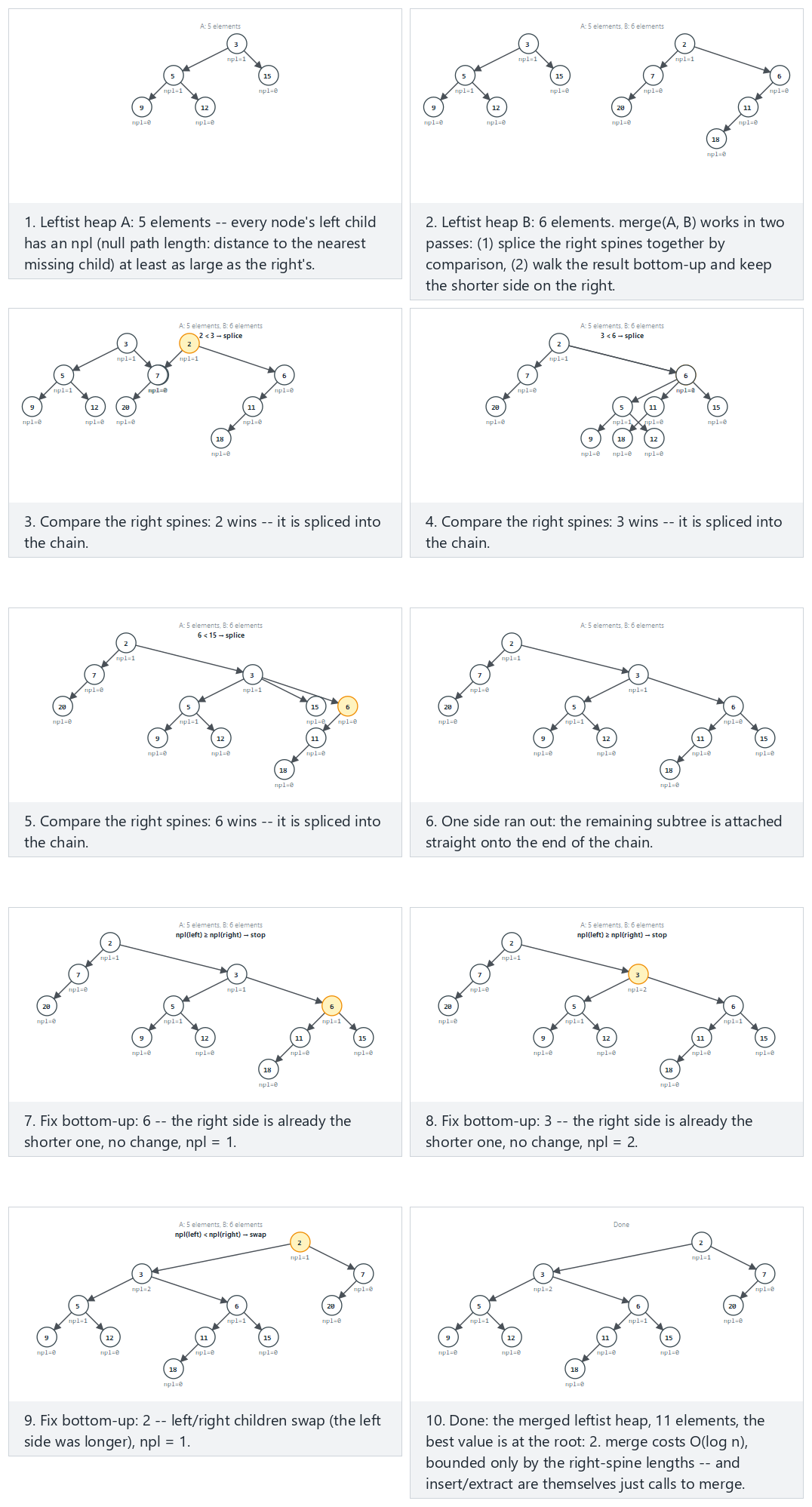
In the picker, also try max: A ascending 8, B descending 7 (a long right spine) (hard) and the edge cases A is empty, merge with B (11 elements), all equal: value 4, 11 elements total, extreme values: 5 + 6 elements, and merging two single-element heaps — or press 🎲 for random data at four difficulty levels, or type your own two heaps.
/* null path length: NULL has npl -1 */
int npl(Node *t) { return t ? t->npl : -1; }

/* merge: the better root wins, its right subtree absorbs the other heap;
 * then the leftist property is restored on the way back up */
Node *merge(Node *t1, Node *t2) {
    if (t1 == NULL) return t2;
    if (t2 == NULL) return t1;
    if (!better(t1->key, t2->key)) {
        Node *tmp = t1; t1 = t2; t2 = tmp;   /* t1 is now the better root */
    }
    t1->right = merge(t1->right, t2);
    if (npl(t1->left) < npl(t1->right)) {
        Node *tmp = t1->left; t1->left = t1->right; t1->right = tmp;
    }
    t1->npl = npl(t1->right) + 1;
    return t1;
}
static int npl(Node t) { return t != null ? t.npl : -1; }

static Node merge(Node t1, Node t2) {
    if (t1 == null) return t2;
    if (t2 == null) return t1;
    if (!better(t1.key, t2.key)) {
        Node tmp = t1; t1 = t2; t2 = tmp;
    }
    t1.right = merge(t1.right, t2);
    if (npl(t1.left) < npl(t1.right)) {
        Node tmp = t1.left; t1.left = t1.right; t1.right = tmp;
    }
    t1.npl = npl(t1.right) + 1;
    return t1;
}
This recursive form is equivalent to (and more compact than) splicing the two right spines in one pass and then walking back up fixing npls in a second pass — the two-phase version the animation narrates step by step. The full programs (code/week-04/c/leftist_heap_merge.c, code/week-04/java/LeftistHeapMerge.java) build two heaps by repeated single-node merges, merge them together, and check that the result still satisfies both the heap-order and leftist properties.
Full program: leftist_heap_merge.c / LeftistHeapMerge.java
/* Week 4 -- Trees, Heaps, and Huffman Coding
 * Leftist heap merge, the operation everything else (insert, extract) is
 * built from. The recursive form used here always keeps the shorter side
 * (by null path length, npl) on the right -- the leftist property.
 * CEN207 Data Structures (CS50-style lecture notes)
 */
#include <stdbool.h>
#include <stdio.h>
#include <stdlib.h>

typedef struct Node {
    int key;
    int npl;                   /* null path length: distance to the nearest missing child */
    struct Node *left, *right;
} Node;

static bool kind_is_max;

static bool better(int a, int b) {
    return kind_is_max ? (a > b) : (a < b);
}

/* null path length: NULL has npl -1 */
int npl(Node *t) { return t ? t->npl : -1; }

/* merge: the better root wins, its right subtree absorbs the other heap;
 * then the leftist property is restored on the way back up */
Node *merge(Node *t1, Node *t2) {
    if (t1 == NULL) return t2;
    if (t2 == NULL) return t1;
    if (!better(t1->key, t2->key)) {
        Node *tmp = t1; t1 = t2; t2 = tmp;   /* t1 is now the better root */
    }
    t1->right = merge(t1->right, t2);
    if (npl(t1->left) < npl(t1->right)) {
        Node *tmp = t1->left; t1->left = t1->right; t1->right = tmp;
    }
    t1->npl = npl(t1->right) + 1;
    return t1;
}

static Node *new_leaf(int key) {
    Node *n = malloc(sizeof(Node));
    n->key = key;
    n->npl = 0;
    n->left = NULL;
    n->right = NULL;
    return n;
}

static Node *build_from_values(const int values[], int n) {
    Node *h = NULL;
    for (int i = 0; i < n; i++)
        h = merge(h, new_leaf(values[i]));
    return h;
}

static void print_tree(Node *node, int depth) {
    if (node == NULL) return;
    for (int i = 0; i < depth; i++) printf("  ");
    printf("%d (npl=%d)\n", node->key, node->npl);
    print_tree(node->left, depth + 1);
    print_tree(node->right, depth + 1);
}

static void count_and_best(Node *node, int *count, int *best, bool *have_best) {
    if (node == NULL) return;
    (*count)++;
    if (!*have_best || better(node->key, *best)) { *best = node->key; *have_best = true; }
    count_and_best(node->left, count, best, have_best);
    count_and_best(node->right, count, best, have_best);
}

/* checks both the heap-order property (no child beats its parent) and the
 * leftist property (the right side's npl is never longer than the left's) */
static bool is_leftist(Node *node) {
    if (node == NULL) return true;
    if (node->left && better(node->left->key, node->key)) return false;
    if (node->right && better(node->right->key, node->key)) return false;
    if (npl(node->left) < npl(node->right)) return false;
    return is_leftist(node->left) && is_leftist(node->right);
}

static void free_tree(Node *node) {
    if (node == NULL) return;
    free_tree(node->left);
    free_tree(node->right);
    free(node);
}

static void run_scenario(const char *label, bool is_max, const int a_values[], int na,
                          const int b_values[], int nb) {
    printf("-- %s --\n", label);
    kind_is_max = is_max;

    Node *a = build_from_values(a_values, na);
    Node *b = build_from_values(b_values, nb);
    printf("heap A (%d elements):\n", na);
    print_tree(a, 1);
    printf("heap B (%d elements):\n", nb);
    print_tree(b, 1);

    Node *result = merge(a, b);
    printf("merge(A, B):\n");
    print_tree(result, 1);

    int count = 0, best = 0;
    bool have_best = false;
    count_and_best(result, &count, &best, &have_best);
    printf("total elements = %d, best value = %d, leftist property holds = %s\n\n",
           count, have_best ? best : 0, is_leftist(result) ? "true" : "false");

    free_tree(result);
}

int main(void) {
    /* normal: min, A (5 elements) merges with B (6 elements) */
    int a_normal[] = {9, 5, 12, 3, 15};
    int b_normal[] = {7, 20, 2, 11, 18, 6};
    run_scenario("normal: min, A (5) merges with B (6)", false, a_normal, 5, b_normal, 6);

    /* hard: max, A ascending 8, B descending 7 -- a long right spine */
    int a_hard[] = {1, 2, 3, 4, 5, 6, 7, 8};
    int b_hard[] = {30, 25, 20, 15, 10, 5, 1};
    run_scenario("hard: max, A ascending 8, B descending 7", true, a_hard, 8, b_hard, 7);

    /* edge: A is empty, merge with B (11 elements) */
    int b_edge[] = {6, 19, 3, 27, 11, 8, 35, 14, 22, 9, 41};
    run_scenario("edge: A is empty, merge with B (11 elements)", false, NULL, 0, b_edge, 11);

    return 0;
}
/* Week 4 -- Trees, Heaps, and Huffman Coding
 * Leftist heap merge, the operation everything else (insert, extract) is
 * built from. The recursive form used here always keeps the shorter side
 * (by null path length, npl) on the right -- the leftist property.
 * CEN207 Data Structures (CS50-style lecture notes)
 */
public class LeftistHeapMerge {
    static class Node {
        int key;
        int npl;                   // null path length: distance to the nearest missing child
        Node left, right;
        Node(int key) { this.key = key; }
    }

    static boolean kindIsMax;

    static boolean better(int a, int b) {
        return kindIsMax ? (a > b) : (a < b);
    }

    // null path length: null has npl -1
    static int npl(Node t) { return t != null ? t.npl : -1; }

    // merge: the better root wins, its right subtree absorbs the other heap;
    // then the leftist property is restored on the way back up
    static Node merge(Node t1, Node t2) {
        if (t1 == null) return t2;
        if (t2 == null) return t1;
        if (!better(t1.key, t2.key)) {
            Node tmp = t1; t1 = t2; t2 = tmp;   // t1 is now the better root
        }
        t1.right = merge(t1.right, t2);
        if (npl(t1.left) < npl(t1.right)) {
            Node tmp = t1.left; t1.left = t1.right; t1.right = tmp;
        }
        t1.npl = npl(t1.right) + 1;
        return t1;
    }

    static Node buildFromValues(int[] values) {
        Node h = null;
        for (int v : values) h = merge(h, new Node(v));
        return h;
    }

    static void printTree(Node node, int depth, StringBuilder sb) {
        if (node == null) return;
        for (int i = 0; i < depth; i++) sb.append("  ");
        sb.append(node.key).append(" (npl=").append(node.npl).append(")\n");
        printTree(node.left, depth + 1, sb);
        printTree(node.right, depth + 1, sb);
    }

    static class Counter { int count; int best; boolean haveBest; }

    static void countAndBest(Node node, Counter c) {
        if (node == null) return;
        c.count++;
        if (!c.haveBest || better(node.key, c.best)) { c.best = node.key; c.haveBest = true; }
        countAndBest(node.left, c);
        countAndBest(node.right, c);
    }

    // checks both the heap-order property (no child beats its parent) and the
    // leftist property (the right side's npl is never longer than the left's)
    static boolean isLeftist(Node node) {
        if (node == null) return true;
        if (node.left != null && better(node.left.key, node.key)) return false;
        if (node.right != null && better(node.right.key, node.key)) return false;
        if (npl(node.left) < npl(node.right)) return false;
        return isLeftist(node.left) && isLeftist(node.right);
    }

    static void runScenario(String label, boolean isMax, int[] aValues, int[] bValues) {
        System.out.println("-- " + label + " --");
        kindIsMax = isMax;

        Node a = buildFromValues(aValues);
        Node b = buildFromValues(bValues);
        StringBuilder sb = new StringBuilder();
        sb.append("heap A (").append(aValues.length).append(" elements):\n");
        printTree(a, 1, sb);
        sb.append("heap B (").append(bValues.length).append(" elements):\n");
        printTree(b, 1, sb);

        Node result = merge(a, b);
        sb.append("merge(A, B):\n");
        printTree(result, 1, sb);
        System.out.print(sb);

        Counter c = new Counter();
        countAndBest(result, c);
        System.out.println("total elements = " + c.count + ", best value = " + (c.haveBest ? c.best : 0) +
                            ", leftist property holds = " + isLeftist(result));
        System.out.println();
    }

    public static void main(String[] args) {
        // normal: min, A (5 elements) merges with B (6 elements)
        int[] aNormal = {9, 5, 12, 3, 15};
        int[] bNormal = {7, 20, 2, 11, 18, 6};
        runScenario("normal: min, A (5) merges with B (6)", false, aNormal, bNormal);

        // hard: max, A ascending 8, B descending 7 -- a long right spine
        int[] aHard = {1, 2, 3, 4, 5, 6, 7, 8};
        int[] bHard = {30, 25, 20, 15, 10, 5, 1};
        runScenario("hard: max, A ascending 8, B descending 7", true, aHard, bHard);

        // edge: A is empty, merge with B (11 elements)
        int[] bEdge = {6, 19, 3, 27, 11, 8, 35, 14, 22, 9, 41};
        runScenario("edge: A is empty, merge with B (11 elements)", false, new int[0], bEdge);
    }
}
Try it
Expected output (normal scenario):
-- normal: min, A (5) merges with B (6) --
heap A (5 elements):
  3 (npl=1)
    5 (npl=1)
      9 (npl=0)
      12 (npl=0)
    15 (npl=0)
heap B (6 elements):
  2 (npl=1)
    7 (npl=0)
      20 (npl=0)
    6 (npl=0)
      11 (npl=0)
        18 (npl=0)
merge(A, B):
  2 (npl=1)
    3 (npl=2)
      5 (npl=1)
        9 (npl=0)
        12 (npl=0)
      6 (npl=1)
        11 (npl=0)
          18 (npl=0)
        15 (npl=0)
    7 (npl=0)
      20 (npl=0)
total elements = 11, best value = 2, leftist property holds = true
Notice the merged tree's root is 2 — the smaller of A's root (3) and B's root (2), exactly as merge guarantees. Notice too that 3 (the loser of that first comparison) becomes part of 2's right subtree first — t1->right = merge(t1->right, t2) always attaches the recursive result on the right — and only afterward, if needed, gets swapped over to the left to keep the leftist property (npl(left) >= npl(right)) intact.
Complexity. merge costs O(log n), bounded strictly by the length of the two trees' right spines (each O(log n) by the leftist property), regardless of how unbalanced the rest of the tree is. Since insert and extract are both defined in terms of merge, they inherit the same O(log n) bound.
Common mistakes
- Confusing npl with height. They are related but not the same: npl measures the distance to the nearest missing child, height measures the distance to the farthest leaf. A node can have a large height but a small npl if one side is short even though the other is long.
- Forgetting to swap children when the leftist property is violated. After the recursive
mergecall returns, the checknpl(t1->left) < npl(t1->right)and the resulting swap are not optional cosmetic steps — skip them, and the tree stops being leftist, which silently invalidates the O(log n) short-right- spine guarantee that makes the whole structure worthwhile.
Self-check: heap variants
You need a heap that supports merging two large heaps together as fast as possible, far more often than you need to insert single elements one at a time. Which of this section's three variants fits best, and why?
Answer. The leftist heap (or, similarly, the binomial heap) — both are built specifically so that merge/union costs only O(log n), unlike a plain array-backed binary heap (or a d-ary heap), which has no fast way to merge two whole heaps at all short of re-inserting every element of one into the other.
8. Huffman coding
8.1 A question to start
Plain ASCII spends exactly 8 bits on every character, whether it is the letter E (extremely common in English text) or Z (rare). If a text is going to be stored or transmitted, that is wasteful: what if common characters got short codes and rare characters got long codes instead, the way Morse code already gives E a single dot and reserves long sequences for rare letters? The catch is that codes of different lengths, mixed together in one bitstream with no separators, could easily become ambiguous to decode — unless they are built with one very specific property. Huffman coding, invented in 1952, builds exactly such a code, and it does it with nothing more than a min-heap of trees — this section is the payoff for everything the rest of this week has built.
8.2 A short history
David A. Huffman developed this algorithm in 1952 as a term paper for a graduate course at MIT taught by Robert Fano — who had, together with Claude Shannon, already developed a similar but suboptimal coding scheme. Huffman's professor offered the class a choice: take the final exam, or find a provably optimal prefix code. Huffman found one — and, as the well-known story goes, proved his greedy tree-merging method always produces an optimal code, a result stronger than his own professor's earlier scheme had achieved. The algorithm has been in continuous practical use ever since, as a core building block inside formats like ZIP, JPEG, and MP3.
8.3 Building the Huffman tree with a min-heap
Given the frequency of every distinct symbol in a message, place a leaf node for each symbol into a min-heap, keyed by frequency. Then repeatedly: pop the two lowest-frequency roots off the heap, create a new internal node whose two children are exactly those two roots (its own frequency is their sum), and push that new node back onto the heap. Repeat until only one node remains — that node is the root of the finished Huffman tree. Every left edge is conventionally labeled 0 and every right edge 1; a symbol's code is simply the sequence of edge labels on the path from the root down to its leaf.
Because rare symbols get merged early (while they are still small and near the bottom of the eventual tree) and common symbols get merged late (staying near the top), common symbols end up with short root-to-leaf paths — short codes — and rare symbols end up with long ones, exactly the goal from section 8.1.
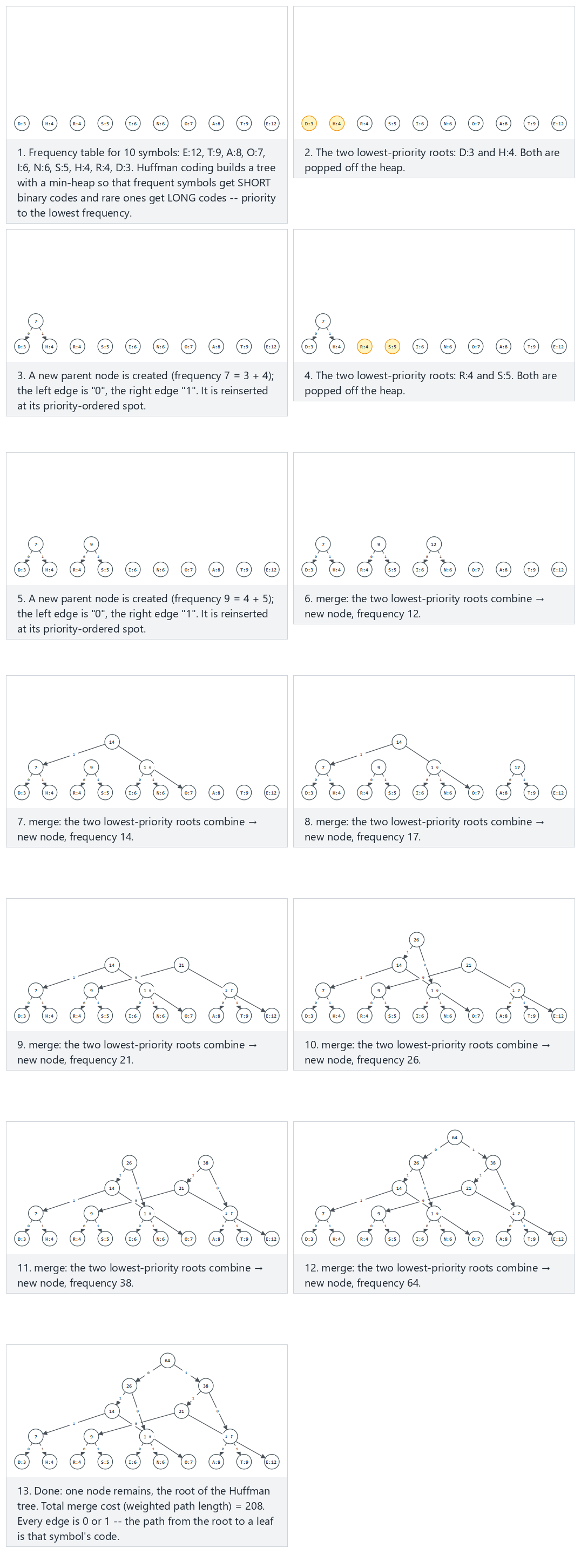
In the picker, also try 14 symbols, many equal frequencies (tie-breaking matters) (hard) and the edge cases the smallest meaningful example: 2 symbols, all equal frequency: 10 symbols, all 1, extremely skewed: one dominant symbol, 9 rare ones, and 16 symbols: a bigger tree — or press 🎲 for random data at four difficulty levels, or type your own letter:frequency list.
/* ordering key: smaller frequency first; ties broken by a stable tie_id */
static int is_less(Node *a, Node *b) {
    if (a->freq != b->freq) return a->freq < b->freq;
    return a->tie_id < b->tie_id;
}

/* repeatedly merge the two lowest-priority roots until one remains */
int merge_id = 256;
while (heap_size > 1) {
    Node *a = heap_pop();          /* smallest */
    Node *b = heap_pop();          /* second smallest */
    Node *parent = new_internal(a, b, merge_id++);
    heap_push(parent);
}
Node *root = heap_pop();           /* the Huffman tree */
static boolean isLess(Node a, Node b) {
    if (a.freq != b.freq) return a.freq < b.freq;
    return a.tieId < b.tieId;
}

// repeatedly merge the two lowest-priority roots until one remains
int mergeId = 256;
while (heapSize > 1) {
    Node a = heapPop();            // smallest
    Node b = heapPop();            // second smallest
    Node parent = newInternal(a, b, mergeId++);
    heapPush(parent);
}
Node root = heapPop();             // the Huffman tree
heap_push/heap_pop here are exactly the array-based min-heap insert/extract from section 5, just ordering Node * pointers by is_less instead of ordering plain ints — a direct, concrete illustration of why "build a heap of anything comparable", not just of numbers, is such a broadly useful idea. Ties (equal frequencies) are broken by a stable tie_id (a leaf's own character code, or 256 plus its merge order for an internal node), guaranteeing every run of the algorithm is fully deterministic.
8.4 Encoding and decoding
Once the tree is built, encoding a message is just looking up each character's code (found by walking the tree once, recording the 0/1 path down to every leaf) and concatenating them. Decoding walks the tree one bit at a time from the root — 0 means go left, 1 means go right — and every time a leaf is reached, that leaf's character is emitted and the walk restarts from the root. This only works unambiguously because a Huffman code is prefix-free: no symbol's code is ever a prefix of another symbol's code (a direct consequence of every code corresponding to a distinct leaf, and only leaves ever emit a character), so there is never a moment of doubt about where one code ends and the next begins.
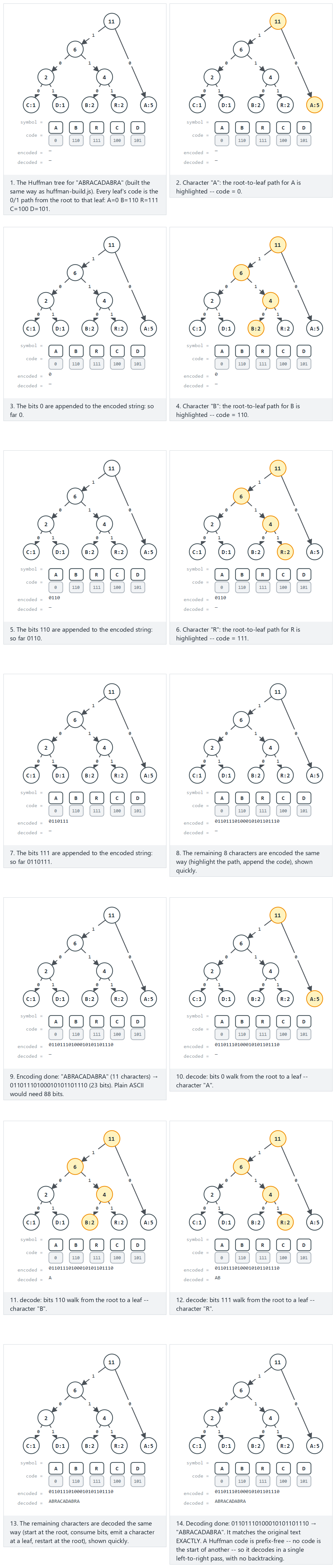
In the picker, also try more variety: "THEQUICKBROWNFOX" (17 characters) (hard) and the edge cases only 2 distinct symbols: 10 characters, very skewed: nine As, one B, with digits: 14 characters, and a long text: 30 characters — or press 🎲 for random data at four difficulty levels, or type your own text (at least 10 characters, at least 2 distinct).
/* assign a 0/1 code to every leaf by walking the tree */
static void assign_codes(Node *node, char *path, int depth) {
    if (node->left == NULL && node->right == NULL) {
        path[depth] = '\0';
        strcpy(codes[(unsigned char) node->ch], path);
        return;
    }
    path[depth] = '0'; assign_codes(node->left,  path, depth + 1);
    path[depth] = '1'; assign_codes(node->right, path, depth + 1);
}

/* encode: concatenate each character's code */
static char *encode(const char *text, char *out) {
    out[0] = '\0';
    for (int i = 0; text[i] != '\0'; i++)
        strcat(out, codes[(unsigned char) text[i]]);
    return out;
}

/* decode: walk the tree one bit at a time; a leaf emits a character and restarts at the root */
static char *decode(const char *bits, Node *root, char *out) {
    int n = 0;
    Node *node = root;
    for (int i = 0; bits[i] != '\0'; i++) {
        node = bits[i] == '0' ? node->left : node->right;
        if (node->left == NULL && node->right == NULL) {
            out[n++] = node->ch;
            node = root;
        }
    }
    out[n] = '\0';
    return out;
}
static void assignCodes(Node node, StringBuilder path) {
    if (node.left == null && node.right == null) {
        codes[node.ch] = path.toString();
        return;
    }
    path.append('0'); assignCodes(node.left, path); path.deleteCharAt(path.length() - 1);
    path.append('1'); assignCodes(node.right, path); path.deleteCharAt(path.length() - 1);
}

static String encode(String text) {
    StringBuilder out = new StringBuilder();
    for (int i = 0; i < text.length(); i++)
        out.append(codes[text.charAt(i)]);
    return out.toString();
}

static String decode(String bits, Node root) {
    StringBuilder out = new StringBuilder();
    Node node = root;
    for (int i = 0; i < bits.length(); i++) {
        node = bits.charAt(i) == '0' ? node.left : node.right;
        if (node.left == null && node.right == null) {
            out.append(node.ch);
            node = root;
        }
    }
    return out.toString();
}
The full programs (code/week-04/c/huffman.c, code/week-04/java/Huffman.java) count each scenario's character frequencies directly from its text, build the tree exactly as in section 8.3, print the code table, encode the text, decode it back, and check the round trip matches.
Full program: huffman.c / Huffman.java
/* Week 4 -- Trees, Heaps, and Huffman Coding
 * Huffman coding: count frequencies, build the tree with a min-heap of
 * trees (repeatedly merging the two lowest-frequency roots), assign a
 * 0/1 code to every leaf, then encode and decode.
 * CEN207 Data Structures (CS50-style lecture notes)
 */
#include <stdio.h>
#include <stdlib.h>
#include <string.h>

typedef struct Node {
    char ch;
    int freq;
    int tie_id;             /* leaf: ASCII code of ch; internal: 256 + merge order */
    struct Node *left, *right;
} Node;

static Node *new_leaf(char ch, int freq) {
    Node *n = malloc(sizeof(Node));
    n->ch = ch;
    n->freq = freq;
    n->tie_id = (unsigned char)ch;
    n->left = NULL;
    n->right = NULL;
    return n;
}

static Node *new_internal(Node *a, Node *b, int tie_id) {
    Node *n = malloc(sizeof(Node));
    n->ch = '\0';
    n->freq = a->freq + b->freq;
    n->tie_id = tie_id;
    n->left = a;
    n->right = b;
    return n;
}

/* ordering key: smaller frequency first; ties broken by a stable tie_id */
static int is_less(Node *a, Node *b) {
    if (a->freq != b->freq) return a->freq < b->freq;
    return a->tie_id < b->tie_id;
}

/* --- array-based min-heap of Node*, own sift-up/sift-down --- */
#define HEAP_CAP 32
static Node *heap[HEAP_CAP];
static int heap_size = 0;

static void heap_push(Node *node) {
    heap[heap_size] = node;
    int i = heap_size;
    heap_size++;

    while (i > 0) {
        int parent = (i - 1) / 2;
        if (!is_less(heap[i], heap[parent]))
            break;
        Node *tmp = heap[parent];
        heap[parent] = heap[i];
        heap[i] = tmp;
        i = parent;
    }
}

static Node *heap_pop(void) {
    Node *top = heap[0];
    heap_size--;
    heap[0] = heap[heap_size];

    int i = 0;
    while (1) {
        int left = 2 * i + 1;
        int right = 2 * i + 2;
        int smallest = i;

        if (left < heap_size && is_less(heap[left], heap[smallest]))
            smallest = left;
        if (right < heap_size && is_less(heap[right], heap[smallest]))
            smallest = right;
        if (smallest == i)
            break;

        Node *tmp = heap[i];
        heap[i] = heap[smallest];
        heap[smallest] = tmp;
        i = smallest;
    }

    return top;
}

/* --- frequency counting --- */
#define ALPHABET 256
static int index_of[ALPHABET];
static char distinct_chars[ALPHABET];
static int freq_of[ALPHABET];
static int distinct_count = 0;

static void count_frequencies(const char *text) {
    for (int i = 0; i < ALPHABET; i++)
        index_of[i] = -1;
    distinct_count = 0;

    for (int i = 0; text[i] != '\0'; i++) {
        unsigned char c = (unsigned char)text[i];
        if (index_of[c] == -1) {
            index_of[c] = distinct_count;
            distinct_chars[distinct_count] = (char)c;
            freq_of[distinct_count] = 0;
            distinct_count++;
        }
        freq_of[index_of[c]]++;
    }
}

/* --- code table, built by walking the tree --- */
static char codes[ALPHABET][ALPHABET];

/* assign a 0/1 code to every leaf by walking the tree */
static void assign_codes(Node *node, char *path, int depth) {
    if (node->left == NULL && node->right == NULL) {
        path[depth] = '\0';
        strcpy(codes[(unsigned char)node->ch], path);
        return;
    }
    path[depth] = '0'; assign_codes(node->left, path, depth + 1);
    path[depth] = '1'; assign_codes(node->right, path, depth + 1);
}

/* encode: concatenate each character's code */
static char *encode(const char *text, char *out) {
    out[0] = '\0';
    for (int i = 0; text[i] != '\0'; i++)
        strcat(out, codes[(unsigned char)text[i]]);
    return out;
}

/* decode: walk the tree one bit at a time; a leaf emits a character and restarts at the root */
static char *decode(const char *bits, Node *root, char *out) {
    int n = 0;
    Node *node = root;
    for (int i = 0; bits[i] != '\0'; i++) {
        node = bits[i] == '0' ? node->left : node->right;
        if (node->left == NULL && node->right == NULL) {
            out[n++] = node->ch;
            node = root;
        }
    }
    out[n] = '\0';
    return out;
}

static void free_tree(Node *node) {
    if (node == NULL) return;
    free_tree(node->left);
    free_tree(node->right);
    free(node);
}

static void run_scenario(const char *label, const char *text) {
    printf("-- %s --\n", label);
    printf("text: \"%s\" (%d characters)\n", text, (int)strlen(text));

    count_frequencies(text);
    printf("frequency table:");
    for (int i = 0; i < distinct_count; i++)
        printf(" %c:%d", distinct_chars[i], freq_of[i]);
    printf("\n");

    heap_size = 0;
    for (int i = 0; i < distinct_count; i++)
        heap_push(new_leaf(distinct_chars[i], freq_of[i]));

    /* repeatedly merge the two lowest-priority roots until one remains */
    int merge_id = 256;
    while (heap_size > 1) {
        Node *a = heap_pop();          /* smallest */
        Node *b = heap_pop();          /* second smallest */
        Node *parent = new_internal(a, b, merge_id++);
        heap_push(parent);
    }
    Node *root = heap_pop();           /* the Huffman tree */

    char path[ALPHABET];
    assign_codes(root, path, 0);

    printf("codes:");
    for (int i = 0; i < distinct_count; i++)
        printf(" %c=%s", distinct_chars[i], codes[(unsigned char)distinct_chars[i]]);
    printf("\n");

    char encoded[4096];
    encode(text, encoded);
    int plain_bits = (int)strlen(text) * 8;
    printf("encoded (%d bits): %s\n", (int)strlen(encoded), encoded);
    printf("plain ASCII would need %d * 8 = %d bits\n", (int)strlen(text), plain_bits);

    char decoded[4096];
    decode(encoded, root, decoded);
    printf("decoded: \"%s\" -- %s\n\n", decoded,
           strcmp(decoded, text) == 0 ? "matches the original" : "DOES NOT MATCH (bug!)");

    free_tree(root);
}

int main(void) {
    /* normal: the classic example, 11 characters */
    run_scenario("normal: the classic example", "ABRACADABRA");

    /* hard: more variety, 16 characters */
    run_scenario("hard: more variety", "THEQUICKBROWNFOX");

    /* edge: only 2 distinct symbols, very skewed frequencies (9 A's, 1 B) */
    run_scenario("edge: only 2 symbols, very skewed (9 A's, 1 B)", "AAAAAAAAAB");

    return 0;
}
/* Week 4 -- Trees, Heaps, and Huffman Coding
 * Huffman coding: count frequencies, build the tree with a min-heap of
 * trees (repeatedly merging the two lowest-frequency roots), assign a
 * 0/1 code to every leaf, then encode and decode.
 * CEN207 Data Structures (CS50-style lecture notes)
 */
public class Huffman {
    static class Node {
        char ch;
        int freq;
        int tieId;               // leaf: char code of ch; internal: 256 + merge order
        Node left, right;
    }

    static Node newLeaf(char ch, int freq) {
        Node n = new Node();
        n.ch = ch;
        n.freq = freq;
        n.tieId = ch;
        return n;
    }

    static Node newInternal(Node a, Node b, int tieId) {
        Node n = new Node();
        n.ch = '\0';
        n.freq = a.freq + b.freq;
        n.tieId = tieId;
        n.left = a;
        n.right = b;
        return n;
    }

    // ordering key: smaller frequency first; ties broken by a stable tieId
    static boolean isLess(Node a, Node b) {
        if (a.freq != b.freq) return a.freq < b.freq;
        return a.tieId < b.tieId;
    }

    // --- array-based min-heap of Node, own sift-up/sift-down ---
    static final int HEAP_CAP = 32;
    static Node[] heap = new Node[HEAP_CAP];
    static int heapSize = 0;

    static void heapPush(Node node) {
        heap[heapSize] = node;
        int i = heapSize;
        heapSize++;

        while (i > 0) {
            int parent = (i - 1) / 2;
            if (!isLess(heap[i], heap[parent]))
                break;
            Node tmp = heap[parent];
            heap[parent] = heap[i];
            heap[i] = tmp;
            i = parent;
        }
    }

    static Node heapPop() {
        Node top = heap[0];
        heapSize--;
        heap[0] = heap[heapSize];

        int i = 0;
        while (true) {
            int left = 2 * i + 1;
            int right = 2 * i + 2;
            int smallest = i;

            if (left < heapSize && isLess(heap[left], heap[smallest]))
                smallest = left;
            if (right < heapSize && isLess(heap[right], heap[smallest]))
                smallest = right;
            if (smallest == i)
                break;

            Node tmp = heap[i];
            heap[i] = heap[smallest];
            heap[smallest] = tmp;
            i = smallest;
        }

        return top;
    }

    // --- frequency counting ---
    static char[] distinctChars = new char[256];
    static int[] freqOf = new int[256];
    static int distinctCount = 0;

    static void countFrequencies(String text) {
        java.util.HashMap<Character, Integer> indexOf = new java.util.HashMap<>();
        distinctCount = 0;
        for (int i = 0; i < text.length(); i++) {
            char c = text.charAt(i);
            Integer idx = indexOf.get(c);
            if (idx == null) {
                idx = distinctCount;
                indexOf.put(c, idx);
                distinctChars[distinctCount] = c;
                freqOf[distinctCount] = 0;
                distinctCount++;
            }
            freqOf[idx]++;
        }
    }

    // --- code table, built by walking the tree ---
    static String[] codes = new String[256];

    // assign a 0/1 code to every leaf by walking the tree
    static void assignCodes(Node node, StringBuilder path) {
        if (node.left == null && node.right == null) {
            codes[node.ch] = path.toString();
            return;
        }
        path.append('0'); assignCodes(node.left, path); path.deleteCharAt(path.length() - 1);
        path.append('1'); assignCodes(node.right, path); path.deleteCharAt(path.length() - 1);
    }

    // encode: concatenate each character's code
    static String encode(String text) {
        StringBuilder out = new StringBuilder();
        for (int i = 0; i < text.length(); i++)
            out.append(codes[text.charAt(i)]);
        return out.toString();
    }

    // decode: walk the tree one bit at a time; a leaf emits a character and restarts at the root
    static String decode(String bits, Node root) {
        StringBuilder out = new StringBuilder();
        Node node = root;
        for (int i = 0; i < bits.length(); i++) {
            node = bits.charAt(i) == '0' ? node.left : node.right;
            if (node.left == null && node.right == null) {
                out.append(node.ch);
                node = root;
            }
        }
        return out.toString();
    }

    static void runScenario(String label, String text) {
        System.out.println("-- " + label + " --");
        System.out.println("text: \"" + text + "\" (" + text.length() + " characters)");

        countFrequencies(text);
        StringBuilder freqLine = new StringBuilder("frequency table:");
        for (int i = 0; i < distinctCount; i++)
            freqLine.append(' ').append(distinctChars[i]).append(':').append(freqOf[i]);
        System.out.println(freqLine);

        heapSize = 0;
        for (int i = 0; i < distinctCount; i++)
            heapPush(newLeaf(distinctChars[i], freqOf[i]));

        // repeatedly merge the two lowest-priority roots until one remains
        int mergeId = 256;
        while (heapSize > 1) {
            Node a = heapPop();          // smallest
            Node b = heapPop();          // second smallest
            Node parent = newInternal(a, b, mergeId++);
            heapPush(parent);
        }
        Node root = heapPop();           // the Huffman tree

        assignCodes(root, new StringBuilder());

        StringBuilder codeLine = new StringBuilder("codes:");
        for (int i = 0; i < distinctCount; i++)
            codeLine.append(' ').append(distinctChars[i]).append('=').append(codes[distinctChars[i]]);
        System.out.println(codeLine);

        String encoded = encode(text);
        int plainBits = text.length() * 8;
        System.out.println("encoded (" + encoded.length() + " bits): " + encoded);
        System.out.println("plain ASCII would need " + text.length() + " * 8 = " + plainBits + " bits");

        String decoded = decode(encoded, root);
        System.out.println("decoded: \"" + decoded + "\" -- " +
                            (decoded.equals(text) ? "matches the original" : "DOES NOT MATCH (bug!)"));
        System.out.println();
    }

    public static void main(String[] args) {
        // normal: the classic example, 11 characters
        runScenario("normal: the classic example", "ABRACADABRA");

        // hard: more variety, 16 characters
        runScenario("hard: more variety", "THEQUICKBROWNFOX");

        // edge: only 2 distinct symbols, very skewed frequencies (9 A's, 1 B)
        runScenario("edge: only 2 symbols, very skewed (9 A's, 1 B)", "AAAAAAAAAB");
    }
}
Try it
Expected output:
-- normal: the classic example --
text: "ABRACADABRA" (11 characters)
frequency table: A:5 B:2 R:2 C:1 D:1
codes: A=0 B=110 R=111 C=100 D=101
encoded (23 bits): 01101110100010101101110
plain ASCII would need 11 * 8 = 88 bits
decoded: "ABRACADABRA" -- matches the original

-- hard: more variety --
text: "THEQUICKBROWNFOX" (16 characters)
frequency table: T:1 H:1 E:1 Q:1 U:1 I:1 C:1 K:1 B:1 R:1 O:2 W:1 N:1 F:1 X:1
codes: T=1100 H=0110 E=0100 Q=1010 U=1101 I=0111 C=0011 K=1000 B=0010 R=1011 O=000 W=1110 N=1001 F=0101 X=1111
encoded (62 bits): 11000110010010101101011100111000001010110001110100101010001111
plain ASCII would need 16 * 8 = 128 bits
decoded: "THEQUICKBROWNFOX" -- matches the original

-- edge: only 2 symbols, very skewed (9 A's, 1 B) --
text: "AAAAAAAAAB" (10 characters)
frequency table: A:9 B:1
codes: A=1 B=0
encoded (10 bits): 1111111110
plain ASCII would need 10 * 8 = 80 bits
decoded: "AAAAAAAAAB" -- matches the original
Look at the compression ratio in each case: "ABRACADABRA" shrinks from 88 bits (plain ASCII) to 23 bits — a symbol that appears often, A (5 of 11 characters), gets the shortest possible code, a single bit (0). "THEQUICKBROWNFOX" — 15 distinct symbols out of 16 characters, almost no repetition at all — compresses far less dramatically (128 → 62 bits), because there is very little frequency skew left to exploit: Huffman coding's gains come entirely from uneven frequencies, and a message where every symbol is equally rare has little room to save. The skewed edge case, 9 As and 1 B, still needs 10 bits (one per character, since there are only 2 symbols and a single bit distinguishes them) — a reminder that Huffman coding cannot do better than 1 bit per character once only 2 symbols remain, no matter how skewed their frequencies are.
Complexity. Building the tree does exactly n − 1 merges for n distinct symbols, each involving two heap_pop and one heap_push at O(log n) each, for O(n log n) total (counting frequencies first is a separate O(L) pass over the text, where L is the text's length). Encoding is O(L): one code lookup and append per character. Decoding is O(B), where B is the number of encoded bits: one tree step per bit, since every bit moves exactly one edge down the tree.
Common mistakes
- Forgetting the tie-breaker. Two symbols with equal frequency can be merged in either order without affecting the code's optimality (both orders produce an equally good tree), but without a deterministic tie-breaker (
tie_idabove), two runs on the same input can silently produce two different — though both optimal — trees, which makes debugging and testing far harder than it needs to be. - Assuming the code table is fixed in advance, like ASCII. A Huffman code is built per message (or per known frequency distribution) — the letter
Emight get code0in one document and code101in another, purely depending on that document's own symbol frequencies. The decoder always needs either the tree itself or the frequency table alongside the encoded bits. - Testing decode without also testing the round trip. A decode routine with an off-by-one in
depthor a swapped'0'/'1'branch can still run without crashing, silently producing the wrong string; always checkdecode(encode(text)) == text, exactly as the "matches the original" line above does.
Self-check: Huffman coding
In a Huffman tree, is it possible for one symbol's code to be a prefix of another symbol's code (for example, symbol X gets code 01 and symbol Y gets code 010)? Why or why not?
Answer. No. Every symbol corresponds to exactly one leaf, and a leaf, by definition, has no children — so no leaf's path can ever be extended into a longer path that reaches a different leaf. This is exactly what "prefix-free" means, and it is precisely what makes unambiguous single-pass decoding possible.
Summary
- A tree is nodes connected by edges with exactly one root, no cycles, and every non-root node having exactly one parent — the vocabulary (root, parent, child, sibling, leaf, internal node, edge, depth, height, degree, subtree) applies to any rooted tree, general or binary.
- A binary tree restricts every node to at most two children,
leftandright. Five independent shape questions — full, complete, perfect, degenerate, height-balanced — describe how "tightly packed" a binary tree is, and a perfect tree of height h has exactly 2h+1 − 1 nodes. - Five traversals visit every node exactly once, in five generally different orders: preorder (visit, left, right — rebuilds a tree), inorder (left, visit, right — sorted order on a BST), postorder (left, right, visit — safe deletion), an iterative inorder using our own explicit stack instead of recursion, and level order (breadth-first) using a queue.
- A complete binary tree can be stored in a plain array with no pointers at all: child i's children live at
2i+1/2i+2, its parent at(i-1)/2— pure O(1) arithmetic. - A binary heap is a complete tree satisfying the heap property (parent always beats both children):
insert(sift-up) andextract(sift-down) are O(log n);build_heapturns a whole array into a heap in O(n); heap sort uses exactly these two pieces to sort in O(n log n), in place, but not stably. - A priority queue is the ADT (
insert,peek,extract,update_key) that a heap most commonly implements;update_keyneeds a stable id per item, since an item's array position can change on every operation. - Three heap variants each trade one property for another: the d-ary heap trades faster inserts for slower per-level extracts; the binomial heap and the leftist heap both trade the plain heap's array-friendliness for a fast O(log n)
union/merge. - Huffman coding builds an optimal prefix-free binary code with nothing but a min-heap of trees, repeatedly merging the two lowest-frequency roots — giving common symbols short codes and rare symbols long ones.
Exercises
- Draw the binary tree given by the level-order array
[40, 20, 60, 10, 30, 50, 70, null, null, 25]. Is it full? Complete? Perfect? Give its height. - Write out the preorder, inorder, and postorder sequences for the tree from Exercise 1, by hand, before running any code.
- Modify
preorder_recursive.c(or its Java twin) to also print each node's depth alongside its value, without adding any new global state — think about what a single extra parameter topreorderneeds to carry. - Using the array-index formulas from section 4, write a function that returns
trueif and only if a given indexiis a leaf in a complete tree ofnnodes, without building any tree object at all. - Trace
heap_insert.c's "normal" scenario by hand for the first four inserts only (15, 7, 22, 3into an initially empty min-heap), drawing the array and the tree after each insert, then check your work against the program's real output. - A max-heap currently holds
[50, 30, 40, 10, 20, 35, 38]. Traceextract()by hand: which value is returned, and what does the array look like afterward? - Explain, in your own words and without looking back at section 5.5, why
build_heapis O(n) rather than the "obviously plausible" O(n log n). - A priority queue currently holds
{id=0: 12, id=1: 5, id=2: 20}as a min-priority queue. Traceupdate_key(id=2, 2)by hand: which sift direction does it trigger, and what is the array afterward? - For the text
"MISSISSIPPI", compute the character frequencies by hand, then build the Huffman tree the way section 8.3 describes (break any ties by alphabetical order of the character). What code doesSget? What aboutM? - Challenge. Modify
dary_heap_extract.c(or its Java twin) to also implementinsert, by adaptingheap_insert.c's sift-up loop to compare against a single parent at index(i-1)/Dinstead of(i-1)/2. Verify your newinsertand the existingextractagree with each other by inserting 10 values and then extracting them all — the values should come back out in sorted order.
Self-check quiz
1. What is the maximum number of nodes in a binary tree of height 4?
24+1 − 1 = 31 nodes (a perfect tree of that height).
2. Which traversal visits the root of a binary tree last?
Postorder (left, right, visit) — the root is always the very last node visited.
3. In a complete binary tree stored in an array, what is the parent index of the node at index 9?
(9 - 1) / 2 = 4 (using integer division).
4. True or false: every complete binary tree is also a perfect binary tree.
False. A complete tree's last level is merely allowed to be partially filled (left to right, no gaps); a perfect tree additionally requires every leaf to sit at the same depth.
5. In a min-heap, where is the smallest value always located?
At the root (array index 0).
??? success "6. What is the time complexity of building a heap from an arbitrary array of n elements using Floyd's bottom-up method, and why is it not O(n log n)?" O(n). Although each sift-down can cost up to O(height), the great majority of nodes are near the bottom of the tree (at small heights), and summing "count at height h times cost h" over the whole tree converges to O(n), not O(n log n).
7. Is heap sort a stable sorting algorithm?
No. Heap sort compares only by value, so two equal elements can end up in a different relative order than they started in.
8. In a priority queue, why does every inserted item need a permanent, stable id?
Because an item's position inside the underlying heap's array can change on almost every operation (insert, extract, or another item's update), so update_key needs some way to find "this specific item" that does not depend on where it currently sits.
??? success "9. What single structural property lets a leftist heap's merge run in O(log n), even though the tree as a whole may be very unbalanced?" The leftist property guarantees the right spine (the path following only right children) is always the shortest path from the root to a missing child — O(log n) long — and merge only ever recurses down right spines, never the potentially much longer left side.
??? success "10. Why is a Huffman code guaranteed to be uniquely and unambiguously decodable, even though different symbols get codes of different lengths?" Because every symbol corresponds to exactly one leaf of the tree, and a leaf has no children — so no symbol's code can ever be a prefix of another symbol's code (the code is "prefix-free"), which means a single left-to-right pass through the bits, walking down from the root, never has to guess where one code ends and the next begins.
Looking ahead
Next week introduces the graph — the natural generalization of a tree once you drop the "no cycles, exactly one parent" restrictions and allow any pattern of connections between nodes. Many of this week's ideas return immediately: breadth-first search (section 3.5's level-order traversal, generalized to structures with cycles) finds shortest paths in an unweighted graph, and the priority queue from section 6 is the central engine inside Dijkstra's algorithm, which finds shortest paths when edges carry different weights — precisely the "repeatedly extract the most urgent/closest item, then possibly decrease some other item's priority" pattern this week's update_key was built to support.
References
- Cormen, T. H., Leiserson, C. E., Rivest, R. L., & Stein, C. (2022). Introduction to Algorithms (4th ed.). MIT Press. — Chapters on heaps, binomial heaps, and Fibonacci heaps.
- Sedgewick, R., & Wayne, K. (2011). Algorithms (4th ed.). Addison-Wesley. — Chapter 3.5 (Priority Queues) and the accompanying heap sort treatment.
- Knuth, D. E. (1997). The Art of Computer Programming, Volume 1: Fundamental Algorithms (3rd ed.). Addison-Wesley. — Section 2.3, the classical source for tree terminology and binary tree properties.
- Huffman, D. A. (1952). "A Method for the Construction of Minimum-Redundancy Codes." Proceedings of the IRE, 40(9), 1098–1101.
- Williams, J. W. J. (1964). "Algorithm 232: Heapsort." Communications of the ACM, 7(6), 347–348.
- Floyd, R. W. (1964). "Algorithm 245: Treesort 3." Communications of the ACM, 7(12), 701. — The O(n) bottom-up build-heap method.
- Vuillemin, J. (1978). "A Data Structure for Manipulating Priority Queues." Communications of the ACM, 21(4), 309–315. — The binomial heap.
- Cayley, A. (1857). "On the Theory of the Analytical Forms Called Trees." Philosophical Magazine, 13, 172–176.
- williamfiset/Algorithms (MIT License). https://github.com/williamfiset/Algorithms — reference Java implementations for trees, heaps, and priority queues.
- Programiz DSA. https://www.programiz.com/dsa — step-by-step introductory explanations of trees, heaps, and Huffman coding.