Week 2 — Linked Lists, Arrays and Matrices
CEN207 Data Structures (formerly CE205) · Fall 2026–2027
Lecture notes (PDF) Lecture notes (DOCX) Slides (PDF) Slides (PPTX) Slides (HTML, offline) Download all (ZIP) Open slides full screen
Click inside the slides and use the arrow keys; use the button at the bottom right of the slides, or the "Open slides full screen" link above, for full screen.
This week
Learning outcomes. By the end of this week you will be able to explain, draw, and implement the two families of structure that everything else in this course builds on. The first family is the array: values packed side by side in memory, indexed by simple arithmetic, extended into two-dimensional matrices and compacted into sparse form when almost all of their cells are zero. The second family is the linked list: values scattered across memory and stitched together by pointers, which trades the array's instant indexing for cheap insertion and deletion anywhere. You will insert into and delete from a plain array by hand, watch a dynamic array grow, compute the memory address of M[i][j] in both row-major and column-major layouts, rotate and rearrange an array in place, store a sparse matrix as a table of triplets and transpose and add two of them without ever touching a zero, and then build, by hand, five kinds of linked list — singly, doubly, circular (and its classic puzzle, the Josephus problem), XOR, and skip list — inserting, deleting, searching, and reversing at every step. These outcomes map to LO.1 (explain fundamental data structures), LO.2 (analyze algorithmic complexity), and LO.7 (choose the right structure for a problem) of the course syllabus.
What you need already. Week 1 gave you Big-O notation, a picture of memory as a long row of numbered boxes, and — most importantly — pointers: a variable that holds another variable's address, written int *p, dereferenced with *p, and capable of pointing at nothing at all (NULL). Week 1 also gave you the struct (a bundle of named fields) and malloc/free (asking the operating system for a block of memory and giving it back). Everything below assumes all four of those are solid; the short recap in section 0 gets you there in a few minutes if any of them feel shaky.
Time plan for a 3-hour session. Arrays in memory, insertion and deletion, dynamic array growth (~30 min) · two-dimensional arrays and matrices, row-major vs. column-major (~20 min) · array algorithms: rotation and rearrangement (~20 min) · short break · sparse matrices: triplets, fast transpose, addition (~30 min) · linked lists: inception, singly linked list insert/delete/search/reverse (~40 min) · doubly linked list (~20 min) · circular linked list and the Josephus problem (~20 min) · XOR linked list and skip list (~20 min) · arrays vs. linked lists, wrap-up and self-check (~10 min).
0. Before we start
0.1 What you already know
Three ideas from Week 1 carry almost all of this week's weight. Let's make sure they are solid.
Memory as numbered boxes. RAM is one enormous row of byte-sized boxes, each with its own address, starting at 0 and counting up. A struct reserves a run of consecutive boxes and gives each field a fixed offset inside that run; an int typically occupies 4 of those boxes. Nothing in this week's material needs more of a mental model than that.
Pointers. A pointer is a variable whose value is an address — the number of a box, not the contents of a box. Node *p declares "p holds the address of a Node"; p->data means "go to the box p points at, and read its data field"; p = NULL means "p points at nothing" (address 0, by convention never a valid object). Every operation in this week's material — inserting into an array, walking a linked list, rewiring two neighbours around a deleted node — is nothing more than reading and writing a handful of these address-sized numbers.
malloc and free. malloc(sizeof(Node)) asks the operating system for a fresh block of memory exactly big enough for one Node, and returns its address (or NULL if none is available); free(p) gives that block back once you are done with it. Every node a linked list creates in this chapter is malloc'd once and free'd exactly once — our example programs track this carefully, and you should too: a node that is never freed is a memory leak, and a pointer used after its node is freed is a dangling pointer, one of the most common bugs in C.
If any of this feels new rather than "oh right, I remember", five minutes with the Week 1 notes before continuing will pay for itself many times over — everything below assumes it.
0.2 The map of this week
flowchart TD
    W2["Week 2: Linked Lists, Arrays, and Matrices"]
    W2 --> A["Arrays in memory"]
    A --> A1["Index to address: O(1) access"]
    A --> A2["insert_at / delete_at: shifting, O(n)"]
    A --> A3["Dynamic arrays: growth by doubling, amortized O(1) append"]
    W2 --> M["Two-dimensional arrays and matrices"]
    M --> M1["Row-major: addr = i*COLS+j"]
    M --> M2["Column-major: addr = j*ROWS+i"]
    W2 --> ALG["Array algorithms"]
    ALG --> ALG1["Rotation by three reversals"]
    ALG --> ALG2["Rearrangement: two-pointer partition"]
    W2 --> SP["Sparse matrices"]
    SP --> SP1["Triplet (row, col, value) form"]
    SP --> SP2["Fast transpose: counting + prefix sums"]
    SP --> SP3["Addition: merge two sorted triplet lists"]
    W2 --> LL["Linked lists: node, head, NULL"]
    LL --> S["Singly linked list"]
    S --> S1["insert: head / tail / after"]
    S --> S2["delete by value"]
    S --> S3["search"]
    S --> S4["reverse"]
    LL --> D["Doubly linked list"]
    LL --> C["Circular linked list"]
    C --> C1["The Josephus problem"]
    LL --> X["XOR linked list"]
    LL --> K["Skip list"]
Every box gets its own section below, most with a short step-by-step animation, a complete C and Java program, and a note on complexity and common mistakes.
1. Arrays in memory
1.1 A question to start
A parking garage has 200 numbered spaces in a straight row. If you know a car is in space 137, you drive straight there — you never search space 1, then 2, then 3. Now imagine the opposite: a garage with no numbers, where every car has a note taped to it saying "the next car is behind the blue pillar over there." Finding car 137 now means walking car to car, reading 136 notes along the way. Both are perfectly valid ways to organize a collection of "cars", but they behave completely differently once you start asking to add or remove one in the middle. This week is about both organizations — the numbered garage is the array, and the note-taped-to-car scheme is the linked list — and about learning exactly when each one is the right tool.
1.2 Intuition and the address formula
An array is a block of memory holding n elements of the same type, placed one immediately after another — contiguously. Because every element has exactly the same size, the computer never has to search for element i: it computes its address directly from the array's own starting address (the base address), the element's fixed size, and the index:
For an array of int (4 bytes each) starting at address 1000, A[0] is at 1000, A[1] is at 1004, A[5] is at 1020 — one multiplication and one addition, however large i is. This is why indexing into an array is O(1): the cost never depends on n or on i.
1.3 The array as an abstract data type
| Operation | What it does | Precondition | Complexity |
|---|---|---|---|
A[i] (read/write) | Access the element at index i | 0 <= i < size | O(1) |
insert_at(k, v) | Insert v at index k, shifting A[k..size-1] one step right | array not full | O(n) — O(1) only when k == size |
delete_at(k) | Remove the element at index k, shifting A[k+1..size-1] one step left | 0 <= k < size | O(n) — O(1) only when k == size-1 |
Reading and writing by index cost nothing extra because the address formula above needs no searching. Inserting or deleting in the middle, though, has a real physical cost: every element after the gap has to physically move one slot over, so that the array stays contiguous with no holes. The animation below makes that shifting completely visible, one cell at a time.
1.4 Insertion and deletion by shifting
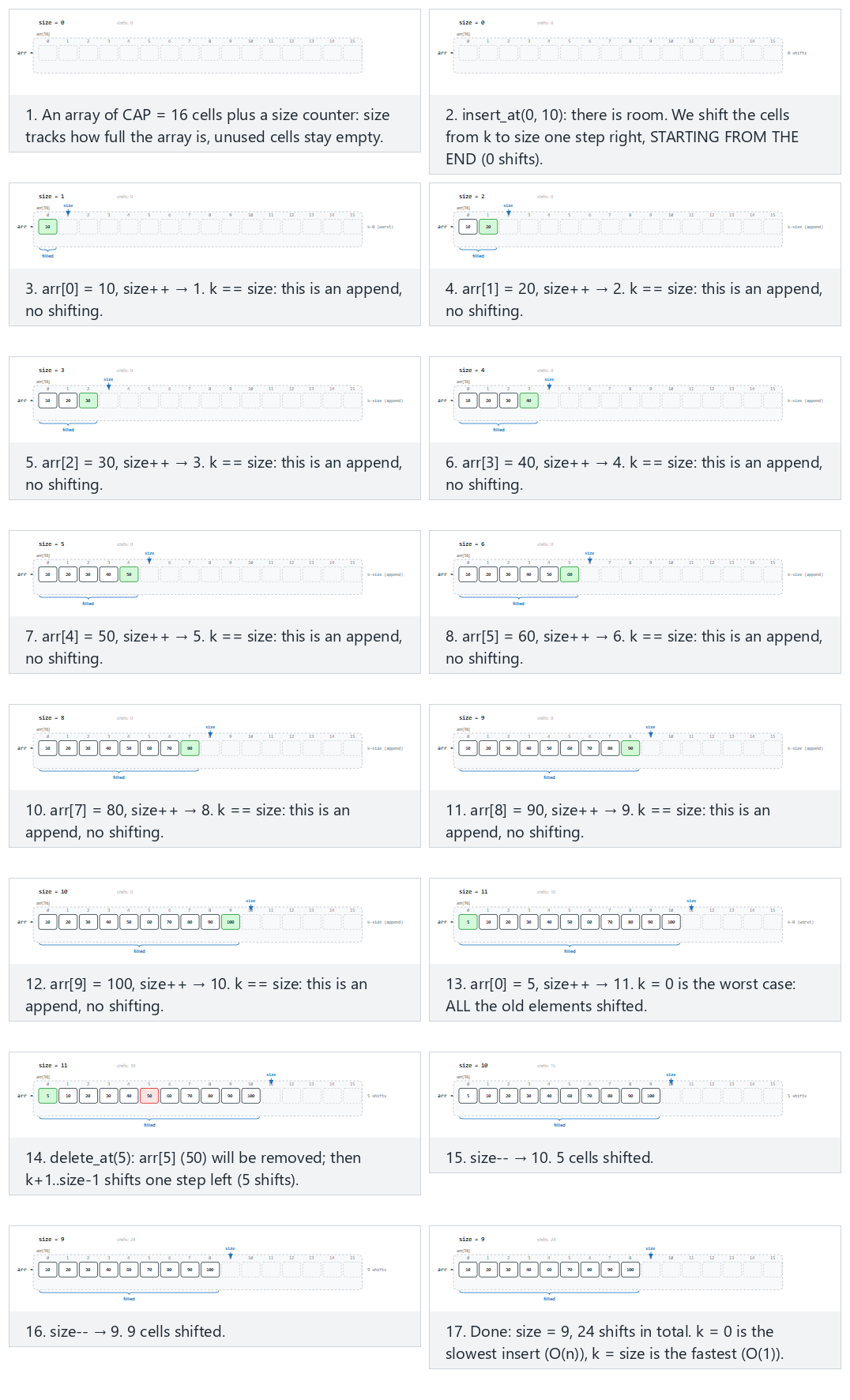
In the picker, also try a 14-capacity array with frequent front inserts, negative and duplicate values, and mixed deletes (hard) and the edge cases overflow: fill a 10-capacity array, then an insert is rejected, underflow: delete from an empty array, and boundary: always insert at index 0, then always at the end — or press 🎲 for random data at four difficulty levels, or type your own cap=N plus a sequence of iK:V / dK operations.
Notice in the "overflow" and "underflow" edge cases that both insert_at and delete_at check their precondition before touching any memory, and simply refuse the operation (returning false) rather than writing past the end of the array or reading before its beginning — this is exactly the discipline every array implementation in this course follows.
#define MAX_CAP 16
static int arr[MAX_CAP];
static int size;
static int cap;              /* this scenario's capacity, <= MAX_CAP */

/* insert v at index k; shifts arr[k..size-1] right, from the end backwards */
bool insert_at(int k, int v) {
    if (size == cap)
        return false;            /* full: overflow, nothing inserted */
    for (int i = size; i > k; i--)
        arr[i] = arr[i - 1];    /* shift right */
    arr[k] = v;
    size++;
    return true;
}

/* delete the value at index k; shifts arr[k+1..size-1] left */
bool delete_at(int k) {
    if (size == 0)
        return false;            /* empty: underflow, nothing to delete */
    for (int i = k; i < size - 1; i++)
        arr[i] = arr[i + 1];    /* shift left */
    size--;
    return true;
}
static final int MAX_CAP = 16;
static int[] arr = new int[MAX_CAP];
static int size;
static int cap;              // this scenario's capacity, <= MAX_CAP

// insert v at index k; shifts arr[k..size-1] right, from the end backwards
static boolean insertAt(int k, int v) {
    if (size == cap)
        return false;            // full: overflow, nothing inserted
    for (int i = size; i > k; i--)
        arr[i] = arr[i - 1];    // shift right
    arr[k] = v;
    size++;
    return true;
}

// delete the value at index k; shifts arr[k+1..size-1] left
static boolean deleteAt(int k) {
    if (size == 0)
        return false;            // empty: underflow, nothing to delete
    for (int i = k; i < size - 1; i++)
        arr[i] = arr[i + 1];    // shift left
    size--;
    return true;
}
The full class (code/week-02/java/ArrayInsertDelete.java) mirrors the C program's four scenarios exactly.
Full program: array_insert_delete.c / ArrayInsertDelete.java
/* Week 2 -- Linked Lists, Arrays and Matrices
 * A fixed-capacity array with a running size: insert at an index k
 * (shifting the tail right, from the end backwards) and delete at an index
 * k (shifting the tail left). Matches the array-insert-delete.js animation.
 * The animation gives each preset its own #define CAP; this program keeps
 * one array big enough for every scenario (MAX_CAP) and tracks the
 * scenario's own capacity in the runtime variable `cap`, so insert_at and
 * delete_at are otherwise identical to the animation's code panel.
 * CEN207 Data Structures (formerly CE205)
 */
#include <stdbool.h>
#include <stdio.h>
#include <stdlib.h>

#define MAX_CAP 16
static int arr[MAX_CAP];
static int size;
static int cap;              /* this scenario's capacity, <= MAX_CAP */

/* insert v at index k; shifts arr[k..size-1] right, from the end backwards */
bool insert_at(int k, int v) {
    if (size == cap)
        return false;            /* full: overflow, nothing inserted */
    for (int i = size; i > k; i--)
        arr[i] = arr[i - 1];    /* shift right */
    arr[k] = v;
    size++;
    return true;
}

/* delete the value at index k; shifts arr[k+1..size-1] left */
bool delete_at(int k) {
    if (size == 0)
        return false;            /* empty: underflow, nothing to delete */
    for (int i = k; i < size - 1; i++)
        arr[i] = arr[i + 1];    /* shift left */
    size--;
    return true;
}

static void print_array(void) {
    printf("arr:");
    for (int i = 0; i < size; i++) printf(" %d", arr[i]);
    printf("  [size=%d cap=%d]\n", size, cap);
}

/* tokens: "iK:V" = insert_at(K, V); "dK" = delete_at(K) */
static void run_scenario(const char *label, int scenario_cap, const char *ops[], int n) {
    printf("-- %s --\n", label);
    size = 0;
    cap = scenario_cap;
    print_array();
    for (int i = 0; i < n; i++) {
        const char *op = ops[i];
        if (op[0] == 'i') {
            int k, v;
            sscanf(op + 1, "%d:%d", &k, &v);
            bool ok = insert_at(k, v);
            printf("insert_at(%d, %d): %s\n", k, v, ok ? "ok" : "overflow, rejected");
        } else {
            int k = atoi(op + 1);
            bool ok = delete_at(k);
            printf("delete_at(%d): %s\n", k, ok ? "ok" : "underflow, rejected");
        }
        print_array();
    }
    printf("\n");
}

int main(void) {
    /* normal: 16-capacity: 10 appends, an insert at the front, a middle and a front delete */
    const char *normal[] = {"i0:10", "i1:20", "i2:30", "i3:40", "i4:50", "i5:60", "i6:70", "i7:80", "i8:90", "i9:100", "i0:5", "d5", "d0"};
    run_scenario("normal: 16-capacity: 10 appends, an insert at the front, a middle and a front delete", 16, normal, 13);

    /* hard: 14-capacity: frequent front inserts, negative/duplicate values, mixed deletes */
    const char *hard[] = {"i0:7", "i1:-3", "i2:15", "i0:-3", "i4:22", "i5:-3", "i0:99", "i7:-40", "i8:100", "i9:-100", "d3", "i9:50", "i10:60", "i0:1000", "d0", "d5"};
    run_scenario("hard: 14-capacity: frequent front inserts, negative/duplicate values, mixed deletes", 14, hard, 16);

    /* edge: overflow: fill a 10-capacity array, then an insert is rejected */
    const char *overflow[] = {"i0:3", "i1:6", "i2:9", "i3:12", "i4:15", "i5:18", "i6:21", "i7:24", "i8:27", "i9:30", "i4:777", "i0:111", "d3", "i3:888"};
    run_scenario("edge: overflow: fill a 10-capacity array, then an insert is rejected", 10, overflow, 14);

    /* edge: underflow: delete from an empty array, then fill it and drain it completely */
    const char *delete_empty[] = {"d0", "i0:5", "i1:15", "i2:25", "i3:35", "i4:45", "i5:55", "i6:65", "i7:75", "i8:85", "i9:95",
                                   "d0", "d0", "d0", "d0", "d0", "d0", "d0", "d0", "d0", "d0", "d0"};
    run_scenario("edge: underflow: delete from an empty array, then fill it and drain it completely", 12, delete_empty, 22);

    return 0;
}
/* Week 2 -- Linked Lists, Arrays and Matrices
 * A fixed-capacity array with a running size: insert at an index k
 * (shifting the tail right, from the end backwards) and delete at an index
 * k (shifting the tail left). Matches the array-insert-delete.js animation.
 * The animation gives each preset its own capacity constant; this program
 * keeps one array big enough for every scenario (MAX_CAP) and tracks the
 * scenario's own capacity in the runtime field `cap`, so insertAt and
 * deleteAt are otherwise identical to the animation's code panel.
 * CEN207 Data Structures (formerly CE205)
 */
public class ArrayInsertDelete {
    static final int MAX_CAP = 16;
    static int[] arr = new int[MAX_CAP];
    static int size;
    static int cap;              // this scenario's capacity, <= MAX_CAP

    // insert v at index k; shifts arr[k..size-1] right, from the end backwards
    static boolean insertAt(int k, int v) {
        if (size == cap)
            return false;            // full: overflow, nothing inserted
        for (int i = size; i > k; i--)
            arr[i] = arr[i - 1];    // shift right
        arr[k] = v;
        size++;
        return true;
    }

    // delete the value at index k; shifts arr[k+1..size-1] left
    static boolean deleteAt(int k) {
        if (size == 0)
            return false;            // empty: underflow, nothing to delete
        for (int i = k; i < size - 1; i++)
            arr[i] = arr[i + 1];    // shift left
        size--;
        return true;
    }

    static void printArray() {
        StringBuilder sb = new StringBuilder("arr:");
        for (int i = 0; i < size; i++) sb.append(' ').append(arr[i]);
        sb.append("  [size=").append(size).append(" cap=").append(cap).append(']');
        System.out.println(sb);
    }

    // tokens: "iK:V" = insertAt(K, V); "dK" = deleteAt(K)
    static void runScenario(String label, int scenarioCap, String[] ops) {
        System.out.println("-- " + label + " --");
        size = 0;
        cap = scenarioCap;
        printArray();
        for (String op : ops) {
            if (op.charAt(0) == 'i') {
                String[] parts = op.substring(1).split(":");
                int k = Integer.parseInt(parts[0]), v = Integer.parseInt(parts[1]);
                boolean ok = insertAt(k, v);
                System.out.println("insert_at(" + k + ", " + v + "): " + (ok ? "ok" : "overflow, rejected"));
            } else {
                int k = Integer.parseInt(op.substring(1));
                boolean ok = deleteAt(k);
                System.out.println("delete_at(" + k + "): " + (ok ? "ok" : "underflow, rejected"));
            }
            printArray();
        }
        System.out.println();
    }

    public static void main(String[] args) {
        // normal: 16-capacity: 10 appends, an insert at the front, a middle and a front delete
        String[] normal = {"i0:10", "i1:20", "i2:30", "i3:40", "i4:50", "i5:60", "i6:70", "i7:80", "i8:90", "i9:100", "i0:5", "d5", "d0"};
        runScenario("normal: 16-capacity: 10 appends, an insert at the front, a middle and a front delete", 16, normal);

        // hard: 14-capacity: frequent front inserts, negative/duplicate values, mixed deletes
        String[] hard = {"i0:7", "i1:-3", "i2:15", "i0:-3", "i4:22", "i5:-3", "i0:99", "i7:-40", "i8:100", "i9:-100", "d3", "i9:50", "i10:60", "i0:1000", "d0", "d5"};
        runScenario("hard: 14-capacity: frequent front inserts, negative/duplicate values, mixed deletes", 14, hard);

        // edge: overflow: fill a 10-capacity array, then an insert is rejected
        String[] overflow = {"i0:3", "i1:6", "i2:9", "i3:12", "i4:15", "i5:18", "i6:21", "i7:24", "i8:27", "i9:30", "i4:777", "i0:111", "d3", "i3:888"};
        runScenario("edge: overflow: fill a 10-capacity array, then an insert is rejected", 10, overflow);

        // edge: underflow: delete from an empty array, then fill it and drain it completely
        String[] deleteEmpty = {"d0", "i0:5", "i1:15", "i2:25", "i3:35", "i4:45", "i5:55", "i6:65", "i7:75", "i8:85", "i9:95",
                                 "d0", "d0", "d0", "d0", "d0", "d0", "d0", "d0", "d0", "d0", "d0"};
        runScenario("edge: underflow: delete from an empty array, then fill it and drain it completely", 12, deleteEmpty);
    }
}
Try it
Expected output:
-- normal: 16-capacity: 10 appends, an insert at the front, a middle and a front delete --
arr:  [size=0 cap=16]
insert_at(0, 10): ok
arr: 10  [size=1 cap=16]
insert_at(1, 20): ok
arr: 10 20  [size=2 cap=16]
insert_at(2, 30): ok
arr: 10 20 30  [size=3 cap=16]
insert_at(3, 40): ok
arr: 10 20 30 40  [size=4 cap=16]
insert_at(4, 50): ok
arr: 10 20 30 40 50  [size=5 cap=16]
insert_at(5, 60): ok
arr: 10 20 30 40 50 60  [size=6 cap=16]
insert_at(6, 70): ok
arr: 10 20 30 40 50 60 70  [size=7 cap=16]
insert_at(7, 80): ok
arr: 10 20 30 40 50 60 70 80  [size=8 cap=16]
insert_at(8, 90): ok
arr: 10 20 30 40 50 60 70 80 90  [size=9 cap=16]
insert_at(9, 100): ok
arr: 10 20 30 40 50 60 70 80 90 100  [size=10 cap=16]
insert_at(0, 5): ok
arr: 5 10 20 30 40 50 60 70 80 90 100  [size=11 cap=16]
delete_at(5): ok
arr: 5 10 20 30 40 60 70 80 90 100  [size=10 cap=16]
delete_at(0): ok
arr: 10 20 30 40 60 70 80 90 100  [size=9 cap=16]

…

-- edge: underflow: delete from an empty array, then fill it and drain it completely --
arr:  [size=0 cap=12]
delete_at(0): underflow, rejected
arr:  [size=0 cap=12]
insert_at(0, 5): ok
arr: 5  [size=1 cap=12]
insert_at(1, 15): ok
arr: 5 15  [size=2 cap=12]
insert_at(2, 25): ok
arr: 5 15 25  [size=3 cap=12]
insert_at(3, 35): ok
arr: 5 15 25 35  [size=4 cap=12]
insert_at(4, 45): ok
arr: 5 15 25 35 45  [size=5 cap=12]
insert_at(5, 55): ok
arr: 5 15 25 35 45 55  [size=6 cap=12]
insert_at(6, 65): ok
arr: 5 15 25 35 45 55 65  [size=7 cap=12]
insert_at(7, 75): ok
arr: 5 15 25 35 45 55 65 75  [size=8 cap=12]
insert_at(8, 85): ok
arr: 5 15 25 35 45 55 65 75 85  [size=9 cap=12]
insert_at(9, 95): ok
arr: 5 15 25 35 45 55 65 75 85 95  [size=10 cap=12]
delete_at(0): ok
arr: 15 25 35 45 55 65 75 85 95  [size=9 cap=12]
delete_at(0): ok
arr: 25 35 45 55 65 75 85 95  [size=8 cap=12]
delete_at(0): ok
arr: 35 45 55 65 75 85 95  [size=7 cap=12]
delete_at(0): ok
arr: 45 55 65 75 85 95  [size=6 cap=12]
delete_at(0): ok
arr: 55 65 75 85 95  [size=5 cap=12]
delete_at(0): ok
arr: 65 75 85 95  [size=4 cap=12]
delete_at(0): ok
arr: 75 85 95  [size=3 cap=12]
delete_at(0): ok
arr: 85 95  [size=2 cap=12]
delete_at(0): ok
arr: 95  [size=1 cap=12]
delete_at(0): ok
arr:  [size=0 cap=12]
delete_at(0): underflow, rejected
arr:  [size=0 cap=12]
Complexity. insert_at/delete_at cost O(1) at the very end of the array (k == size or k == size-1) and O(n) at the front (k == 0), where every existing element has to shift; on average, inserting or deleting at a uniformly random index costs O(n) too, since the expected number of shifted elements is proportional to n.
Common mistakes
- Forgetting to check
size == capbefore writing — this overruns the array and corrupts whatever memory comes after it, one of the most common causes of crashes in beginner C code. - Shifting in the wrong direction during insertion: the loop in
insert_atmust run fromsizedown tok, copying each element one slot to the right, and it must go backwards (from the end) — copying forwards would overwrite values before they have been read. - Off-by-one errors in the shift bound for
delete_at: the loop stops atsize - 1, notsize, sincearr[size]does not (yet) hold a valid element.
2. Dynamic arrays: growing on demand
2.1 A question to start
The fixed-capacity array from section 1 has an uncomfortable question baked into it: what capacity do you pick? Too small, and the array fills up and rejects further inserts; too large, and you waste memory that may never be used. A dynamic array (std::vector in C++, ArrayList in Java, the list behind Python's list) solves this by starting small and growing itself whenever it runs out of room — but growing a contiguous block of memory is not free: every single existing element has to be copied into the new, larger block. How can "sometimes copy everything" still add up to a fast structure overall?
2.2 Growing by a factor, and the "amortized" idea
A dynamic array keeps three things: a pointer to its current block, a size (how many elements are actually stored), and a cap (how many the current block can hold before it is full). Appending is simple when there is room: write the value at data[size], then size++ — O(1). The moment size == cap, though, the array must grow: allocate a fresh block whose capacity is cap multiplied by some growth factor (2 in most textbook implementations, though 1.5 is common too), copy every one of the size existing elements into it, free the old block, and only then write the new value. That single append costs O(n).
The trick that makes dynamic arrays fast on average is that growth doubles the capacity every time it happens, so it happens only O(log n) times over the life of n appends, and the total number of elements ever copied is bounded by n + n/2 + n/4 + ... < 2n — a geometric series. Spread that 2n total copying cost over n appends and each append costs O(1) on average, even though any individual append can cost O(n). This kind of average-over-a-sequence-of-operations argument is called amortized analysis, and a growing dynamic array is its textbook example.
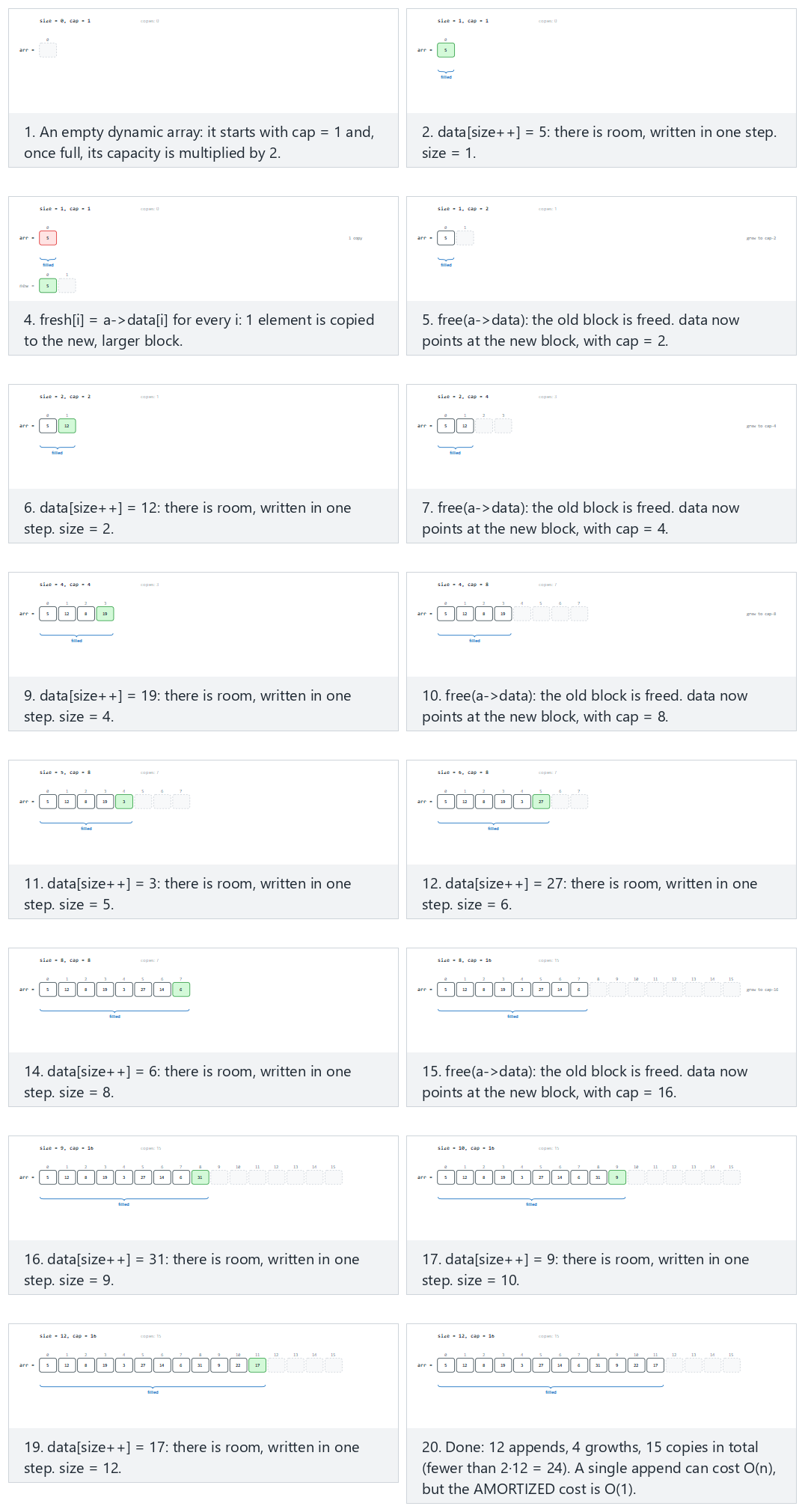
In the picker, also try cap0=2, factor 2: 14 appends with 2 removes in between (no shrinking) (hard) and the edge cases growth factor 1.5 instead of 2: more frequent, smaller growths and shrinking: capacity halves once the array is only a quarter full — or press 🎲 for random data at four difficulty levels, or type your own cap0=, factor=, shrink= settings plus a sequence of aV (append) / r (remove last) operations.
typedef struct {
    int *data;
    int size;
    int cap;
} DynArray;

static void da_resize(DynArray *a, int new_cap) {
    int *fresh = malloc(new_cap * sizeof(int));
    for (int i = 0; i < a->size; i++)
        fresh[i] = a->data[i];      /* copy every element to the new block */
    free(a->data);                  /* old block is freed */
    a->data = fresh;
    a->cap = new_cap;
}

void da_append(DynArray *a, int v) {
    if (a->size == a->cap) {
        int new_cap = (int)(a->cap * factor);   /* growth factor `factor` */
        if (new_cap <= a->cap) new_cap = a->cap + 1;
        da_resize(a, new_cap);       /* full: grow before writing */
    }
    a->data[a->size++] = v;
}

void da_remove_last(DynArray *a) {
    if (a->size == 0) return;
    a->size--;
    if (shrink_on && a->size <= a->cap / 4 && a->cap / 2 >= cap0)
        da_resize(a, a->cap / 2);    /* quarter full: shrink to save memory */
}
class DynArray {
    int[] data;
    int size;
    int cap;
}

static void resize(DynArray a, int newCap) {
    int[] fresh = new int[newCap];
    for (int i = 0; i < a.size; i++)
        fresh[i] = a.data[i];        // copy every element to the new block
    a.data = fresh;                  // old block is now garbage -- freed by the GC
    a.cap = newCap;
}

static void append(DynArray a, int v) {
    if (a.size == a.cap) {
        int newCap = (int) (a.cap * factor);   // growth factor `factor`
        if (newCap <= a.cap) newCap = a.cap + 1;
        resize(a, newCap);           // full: grow before writing
    }
    a.data[a.size++] = v;
}

static void removeLast(DynArray a) {
    if (a.size == 0) return;
    a.size--;
    if (shrinkOn && a.size <= a.cap / 4 && a.cap / 2 >= cap0)
        resize(a, a.cap / 2);        // quarter full: shrink to save memory
}
The full class (code/week-02/java/DynamicArrayGrowth.java) mirrors the C program's four scenarios exactly.
Full program: dynamic_array_growth.c / DynamicArrayGrowth.java
/* Week 2 -- Linked Lists, Arrays and Matrices
 * A dynamic array: append n values into a block that starts tiny and grows
 * by a factor whenever it is full; count every element copy to show why
 * appending is amortized O(1) even though a single growing append is
 * O(n). Matches the dynamic-array-growth.js animation. The animation bakes
 * cap0/factor/shrink into the source text per preset; this program keeps
 * them as runtime globals set per scenario, so da_resize/da_append/
 * da_remove_last are otherwise identical to the animation's code panel.
 * CEN207 Data Structures (formerly CE205)
 */
#include <stdio.h>
#include <stdlib.h>

typedef struct {
    int *data;
    int size;
    int cap;
} DynArray;

static double factor;   /* growth factor, e.g. 2 or 1.5 */
static int cap0;        /* starting capacity, for the shrink floor */
static int shrink_on;   /* whether da_remove_last shrinks at all */
static int copies;      /* total elements copied by resizes, this scenario */
static int growths, shrinks;

static void da_resize(DynArray *a, int new_cap) {
    int *fresh = malloc(new_cap * sizeof(int));
    for (int i = 0; i < a->size; i++)
        fresh[i] = a->data[i];      /* copy every element to the new block */
    copies += a->size;
    free(a->data);                  /* old block is freed */
    a->data = fresh;
    a->cap = new_cap;
}

void da_append(DynArray *a, int v) {
    if (a->size == a->cap) {
        int new_cap = (int)(a->cap * factor);   /* growth factor `factor` */
        if (new_cap <= a->cap) new_cap = a->cap + 1;
        da_resize(a, new_cap);       /* full: grow before writing */
        growths++;
    }
    a->data[a->size++] = v;
}

void da_remove_last(DynArray *a) {
    if (a->size == 0) return;
    a->size--;
    if (shrink_on && a->size <= a->cap / 4 && a->cap / 2 >= cap0) {
        da_resize(a, a->cap / 2);    /* quarter full: shrink to save memory */
        shrinks++;
    }
}

static void print_array(DynArray *a) {
    printf("arr:");
    for (int i = 0; i < a->size; i++) printf(" %d", a->data[i]);
    printf("  [size=%d cap=%d]\n", a->size, a->cap);
}

/* tokens: "aV" = da_append(V); "r" = da_remove_last() */
static void run_scenario(const char *label, int scenario_cap0, double scenario_factor, int scenario_shrink, const char *ops[], int n) {
    printf("-- %s --\n", label);
    cap0 = scenario_cap0;
    factor = scenario_factor;
    shrink_on = scenario_shrink;
    copies = 0; growths = 0; shrinks = 0;
    DynArray a;
    a.cap = cap0;
    a.size = 0;
    a.data = malloc((size_t) cap0 * sizeof(int));
    print_array(&a);
    for (int i = 0; i < n; i++) {
        const char *op = ops[i];
        if (op[0] == 'a') {
            int v = atoi(op + 1);
            da_append(&a, v);
            printf("da_append(%d)\n", v);
        } else {
            da_remove_last(&a);
            printf("da_remove_last()\n");
        }
        print_array(&a);
    }
    printf("growths=%d shrinks=%d copies=%d\n\n", growths, shrinks, copies);
    free(a.data);
}

int main(void) {
    /* normal: cap0=1, factor 2: 12 appends, total copies < 2n */
    const char *normal[] = {"a5", "a12", "a8", "a19", "a3", "a27", "a14", "a6", "a31", "a9", "a22", "a17"};
    run_scenario("normal: cap0=1, factor 2: 12 appends, total copies < 2n", 1, 2.0, 0, normal, 12);

    /* hard: cap0=2, factor 2: 14 appends with 2 removes in between (no shrinking) */
    const char *hard[] = {"a10", "a-4", "a21", "a7", "r", "a33", "a-15", "a2", "a40", "r", "a18", "a-9", "a25", "a11", "a6", "a29"};
    run_scenario("hard: cap0=2, factor 2: 14 appends with 2 removes in between (no shrinking)", 2, 2.0, 0, hard, 16);

    /* edge: growth factor 1.5 (instead of 2): more frequent, smaller growths */
    const char *factor15[] = {"a4", "a9", "a15", "a2", "a23", "a8", "a31", "a6", "a19", "a1", "a27", "a13"};
    run_scenario("edge: growth factor 1.5 (instead of 2): more frequent, smaller growths", 1, 1.5, 0, factor15, 12);

    /* edge: shrinking: capacity halves once the array is only a quarter full */
    const char *shrink_quarter[] = {"a3", "a8", "a15", "a1", "a22", "a9", "a30", "a4", "a17", "a6", "a25", "a11", "r", "r", "r", "r", "r", "r", "r", "r", "r"};
    run_scenario("edge: shrinking: capacity halves once the array is only a quarter full", 2, 2.0, 1, shrink_quarter, 21);

    return 0;
}
/* Week 2 -- Linked Lists, Arrays and Matrices
 * A dynamic array: append n values into a block that starts tiny and grows
 * by a factor whenever it is full; count every element copy to show why
 * appending is amortized O(1) even though a single growing append is
 * O(n). Matches the dynamic-array-growth.js animation. The animation bakes
 * cap0/factor/shrink into the source text per preset; this program keeps
 * them as runtime fields set per scenario, so resize/append/removeLast are
 * otherwise identical to the animation's code panel.
 * CEN207 Data Structures (formerly CE205)
 */
public class DynamicArrayGrowth {
    static class DynArray {
        int[] data;
        int size;
        int cap;
    }

    static double factor;   // growth factor, e.g. 2 or 1.5
    static int cap0;        // starting capacity, for the shrink floor
    static boolean shrinkOn; // whether removeLast shrinks at all
    static int copies;      // total elements copied by resizes, this scenario
    static int growths, shrinks;

    static void resize(DynArray a, int newCap) {
        int[] fresh = new int[newCap];
        for (int i = 0; i < a.size; i++)
            fresh[i] = a.data[i];        // copy every element to the new block
        copies += a.size;
        a.data = fresh;                  // old block is now garbage -- freed by the GC
        a.cap = newCap;
    }

    static void append(DynArray a, int v) {
        if (a.size == a.cap) {
            int newCap = (int) (a.cap * factor);   // growth factor `factor`
            if (newCap <= a.cap) newCap = a.cap + 1;
            resize(a, newCap);           // full: grow before writing
            growths++;
        }
        a.data[a.size++] = v;
    }

    static void removeLast(DynArray a) {
        if (a.size == 0) return;
        a.size--;
        if (shrinkOn && a.size <= a.cap / 4 && a.cap / 2 >= cap0) {
            resize(a, a.cap / 2);        // quarter full: shrink to save memory
            shrinks++;
        }
    }

    static void printArray(DynArray a) {
        StringBuilder sb = new StringBuilder("arr:");
        for (int i = 0; i < a.size; i++) sb.append(' ').append(a.data[i]);
        sb.append("  [size=").append(a.size).append(" cap=").append(a.cap).append(']');
        System.out.println(sb);
    }

    // tokens: "aV" = append(V); "r" = removeLast()
    static void runScenario(String label, int scenarioCap0, double scenarioFactor, boolean scenarioShrink, String[] ops) {
        System.out.println("-- " + label + " --");
        cap0 = scenarioCap0;
        factor = scenarioFactor;
        shrinkOn = scenarioShrink;
        copies = 0; growths = 0; shrinks = 0;
        DynArray a = new DynArray();
        a.cap = cap0;
        a.size = 0;
        a.data = new int[cap0];
        printArray(a);
        for (String op : ops) {
            if (op.charAt(0) == 'a') {
                int v = Integer.parseInt(op.substring(1));
                append(a, v);
                System.out.println("da_append(" + v + ")");
            } else {
                removeLast(a);
                System.out.println("da_remove_last()");
            }
            printArray(a);
        }
        System.out.println("growths=" + growths + " shrinks=" + shrinks + " copies=" + copies);
        System.out.println();
    }

    public static void main(String[] args) {
        // normal: cap0=1, factor 2: 12 appends, total copies < 2n
        String[] normal = {"a5", "a12", "a8", "a19", "a3", "a27", "a14", "a6", "a31", "a9", "a22", "a17"};
        runScenario("normal: cap0=1, factor 2: 12 appends, total copies < 2n", 1, 2.0, false, normal);

        // hard: cap0=2, factor 2: 14 appends with 2 removes in between (no shrinking)
        String[] hard = {"a10", "a-4", "a21", "a7", "r", "a33", "a-15", "a2", "a40", "r", "a18", "a-9", "a25", "a11", "a6", "a29"};
        runScenario("hard: cap0=2, factor 2: 14 appends with 2 removes in between (no shrinking)", 2, 2.0, false, hard);

        // edge: growth factor 1.5 (instead of 2): more frequent, smaller growths
        String[] factor15 = {"a4", "a9", "a15", "a2", "a23", "a8", "a31", "a6", "a19", "a1", "a27", "a13"};
        runScenario("edge: growth factor 1.5 (instead of 2): more frequent, smaller growths", 1, 1.5, false, factor15);

        // edge: shrinking: capacity halves once the array is only a quarter full
        String[] shrinkQuarter = {"a3", "a8", "a15", "a1", "a22", "a9", "a30", "a4", "a17", "a6", "a25", "a11", "r", "r", "r", "r", "r", "r", "r", "r", "r"};
        runScenario("edge: shrinking: capacity halves once the array is only a quarter full", 2, 2.0, true, shrinkQuarter);
    }
}
Try it
Expected output:
-- normal: cap0=1, factor 2: 12 appends, total copies < 2n --
arr:  [size=0 cap=1]
da_append(5)
arr: 5  [size=1 cap=1]
da_append(12)
arr: 5 12  [size=2 cap=2]
da_append(8)
arr: 5 12 8  [size=3 cap=4]
da_append(19)
arr: 5 12 8 19  [size=4 cap=4]
da_append(3)
arr: 5 12 8 19 3  [size=5 cap=8]
da_append(27)
arr: 5 12 8 19 3 27  [size=6 cap=8]
da_append(14)
arr: 5 12 8 19 3 27 14  [size=7 cap=8]
da_append(6)
arr: 5 12 8 19 3 27 14 6  [size=8 cap=8]
da_append(31)
arr: 5 12 8 19 3 27 14 6 31  [size=9 cap=16]
da_append(9)
arr: 5 12 8 19 3 27 14 6 31 9  [size=10 cap=16]
da_append(22)
arr: 5 12 8 19 3 27 14 6 31 9 22  [size=11 cap=16]
da_append(17)
arr: 5 12 8 19 3 27 14 6 31 9 22 17  [size=12 cap=16]
growths=4 shrinks=0 copies=15

…

-- edge: shrinking: capacity halves once the array is only a quarter full --
arr:  [size=0 cap=2]
da_append(3)
arr: 3  [size=1 cap=2]
da_append(8)
arr: 3 8  [size=2 cap=2]
da_append(15)
arr: 3 8 15  [size=3 cap=4]
da_append(1)
arr: 3 8 15 1  [size=4 cap=4]
da_append(22)
arr: 3 8 15 1 22  [size=5 cap=8]
da_append(9)
arr: 3 8 15 1 22 9  [size=6 cap=8]
da_append(30)
arr: 3 8 15 1 22 9 30  [size=7 cap=8]
da_append(4)
arr: 3 8 15 1 22 9 30 4  [size=8 cap=8]
da_append(17)
arr: 3 8 15 1 22 9 30 4 17  [size=9 cap=16]
da_append(6)
arr: 3 8 15 1 22 9 30 4 17 6  [size=10 cap=16]
da_append(25)
arr: 3 8 15 1 22 9 30 4 17 6 25  [size=11 cap=16]
da_append(11)
arr: 3 8 15 1 22 9 30 4 17 6 25 11  [size=12 cap=16]
da_remove_last()
arr: 3 8 15 1 22 9 30 4 17 6 25  [size=11 cap=16]
da_remove_last()
arr: 3 8 15 1 22 9 30 4 17 6  [size=10 cap=16]
da_remove_last()
arr: 3 8 15 1 22 9 30 4 17  [size=9 cap=16]
da_remove_last()
arr: 3 8 15 1 22 9 30 4  [size=8 cap=16]
da_remove_last()
arr: 3 8 15 1 22 9 30  [size=7 cap=16]
da_remove_last()
arr: 3 8 15 1 22 9  [size=6 cap=16]
da_remove_last()
arr: 3 8 15 1 22  [size=5 cap=16]
da_remove_last()
arr: 3 8 15 1  [size=4 cap=8]
da_remove_last()
arr: 3 8 15  [size=3 cap=8]
growths=3 shrinks=1 copies=18
Complexity. A single append costs O(1) when there is room, and O(n) exactly when it triggers a growth; over n appends starting from a small capacity, the total cost of all the growths is O(n) (the geometric-series argument above), so the amortized cost per append is O(1). The "shrinking" edge case shows the same idea running in reverse: da_remove_last costs O(1) normally, and O(n) exactly when it triggers a shrink.
Common mistakes
- Shrinking back to exactly
size(or growing by only +1 each time) defeats the whole point: if capacity only ever grows by a fixed amount, a run of n appends does O(n) resizes of average cost O(n/2), giving O(n²) total — no better than the fixed array from section 1. The growth factor (not a fixed increment) is what makes the geometric series converge. - Shrinking back at exactly the size that just triggered a growth (e.g. shrinking the moment
size == cap/2) can cause thrashing: one more append immediately triggers growth again, and the array oscillates between two sizes on every alternating append/remove. This program only shrinks once the array is down to a quarter full, leaving a safety margin. - Forgetting to copy the existing elements before freeing the old block —
da_resizemust copy first,freesecond, in that order, or the data is lost.
3. Two-dimensional arrays and matrices
3.1 A question to start
A spreadsheet, a chessboard, and a black-and-white image all share the same shape: rows and columns. In code we write M[i][j] and think of a grid, but RAM has no grids — it is one flat, numbered row of bytes. So where does M[i][j] actually live, and does the order in which we visit the cells of a matrix change how fast our code runs?
3.2 Flattening a grid into a line: row-major and column-major
A ROWS x COLS matrix stored in row-major order lays the entire first row down first, then the entire second row immediately after it, and so on — exactly how C, Java, and Python store int[][]/List[List[]]. The address (counted in elements, not bytes) of M[i][j] is then
Column-major order (used by Fortran, MATLAB, and R) does the opposite: the entire first column is laid down first. Its address formula swaps the roles of rows and columns:
Neither order is "more correct" — they are simply two different, equally valid ways to flatten the same grid. What matters is whether your traversal order matches your storage order. If it does, consecutive steps of the loop visit consecutive memory addresses (a jump of Δ = 1 every time) — which is exactly what a CPU's cache is built to reward, since it fetches memory in chunks and a Δ = 1 access pattern reuses a chunk that is already loaded. If the traversal order goes against the storage order, every single step jumps by a whole row (or column) in memory, which is much less cache-friendly.
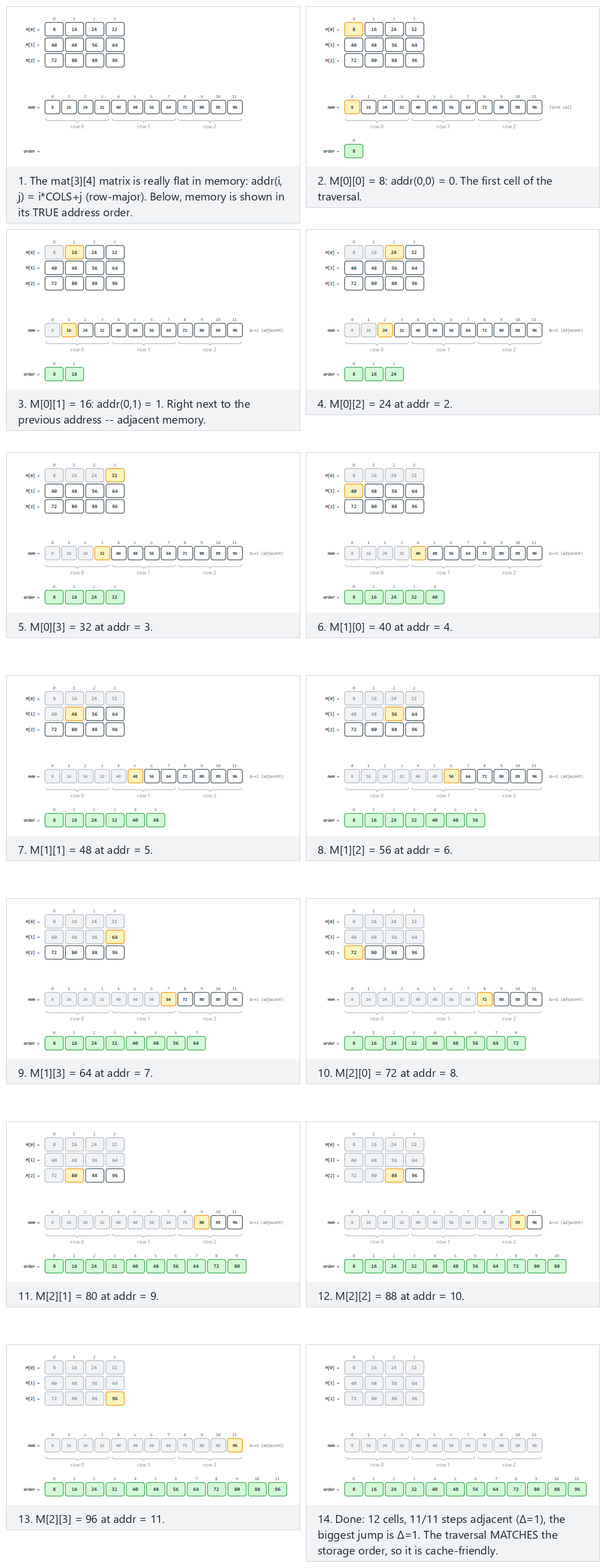
In the picker, also try a 4x4 row-major matrix visited column-by-column: a jump on every step (hard) and the edge cases a 3x5 column-major matrix visited row-by-row and a 3x4 column-major matrix visited column-by-column — or press 🎲 for random data at four difficulty levels, or type your own layout= / traversal= choice plus rows separated by ;.
/* address of mat[i][j], counted in ints from the start of the array */
int addr(int i, int j) {
    return row_major ? i * cols + j : j * rows + i;
}

void traverse_row_major(int mat[MAX_ROWS][MAX_COLS]) {
    for (int i = 0; i < rows; i++)
        for (int j = 0; j < cols; j++)
            visit(mat[i][j]);
}

void traverse_col_major(int mat[MAX_ROWS][MAX_COLS]) {
    for (int j = 0; j < cols; j++)
        for (int i = 0; i < rows; i++)
            visit(mat[i][j]);
}
// address of mat[i][j], counted in ints from the start of the array
static int addr(int i, int j) {
    return rowMajor ? i * cols + j : j * rows + i;
}

static void traverseRowMajor(int[][] mat) {
    for (int i = 0; i < rows; i++)
        for (int j = 0; j < cols; j++)
            visit(mat[i][j]);
}

static void traverseColMajor(int[][] mat) {
    for (int j = 0; j < cols; j++)
        for (int i = 0; i < rows; i++)
            visit(mat[i][j]);
}
The full class (code/week-02/java/MatrixRowMajor.java) mirrors the C program's four scenarios exactly.
Full program: matrix_row_major.c / MatrixRowMajor.java
/* Week 2 -- Linked Lists, Arrays and Matrices
 * A 2D matrix is really flat, 1D memory underneath. Row-major storage
 * places mat[i][j] at word offset i*COLS+j (column-major: j*ROWS+i).
 * Matches the matrix-row-major.js animation. The animation bakes the
 * layout into the source text per preset; this program keeps a runtime
 * flag `row_major` so addr/traverse_row_major/traverse_col_major are
 * otherwise identical to the animation's code panel.
 * CEN207 Data Structures (formerly CE205)
 */
#include <stdio.h>

#define MAX_ROWS 4
#define MAX_COLS 5

static int rows, cols;
static int row_major;   /* 1 = row-major layout, 0 = column-major layout */

/* address of mat[i][j], counted in ints from the start of the array */
int addr(int i, int j) {
    return row_major ? i * cols + j : j * rows + i;
}

void traverse_row_major(int mat[MAX_ROWS][MAX_COLS]) {
    int prev = -1;
    for (int i = 0; i < rows; i++)
        for (int j = 0; j < cols; j++) {
            int a = addr(i, j);
            printf("  M[%d][%d]=%d addr=%d%s\n", i, j, mat[i][j], a,
                   prev < 0 ? "" : (a - prev == 1 ? " (adjacent)" : " (jump)"));
            prev = a;
        }
}

void traverse_col_major(int mat[MAX_ROWS][MAX_COLS]) {
    int prev = -1;
    for (int j = 0; j < cols; j++)
        for (int i = 0; i < rows; i++) {
            int a = addr(i, j);
            printf("  M[%d][%d]=%d addr=%d%s\n", i, j, mat[i][j], a,
                   prev < 0 ? "" : (a - prev == 1 ? " (adjacent)" : " (jump)"));
            prev = a;
        }
}

static void run_scenario(const char *label, int r, int c, int mat[MAX_ROWS][MAX_COLS], int layout_row_major, int traversal_row) {
    printf("-- %s --\n", label);
    rows = r; cols = c; row_major = layout_row_major;
    printf("layout=%s traversal=%s\n", row_major ? "row-major" : "column-major", traversal_row ? "row" : "column");
    if (traversal_row) traverse_row_major(mat); else traverse_col_major(mat);
    printf("\n");
}

int main(void) {
    /* normal: 3x4 row-major, row-by-row traversal: always adjacent */
    int normal[MAX_ROWS][MAX_COLS] = {{8, 16, 24, 32}, {40, 48, 56, 64}, {72, 80, 88, 96}};
    run_scenario("normal: 3x4 row-major, row-by-row traversal: always adjacent", 3, 4, normal, 1, 1);

    /* hard: 4x4 row-major, column-by-column traversal: a jump on every step */
    int hard[MAX_ROWS][MAX_COLS] = {{3, -7, 15, 22}, {9, -14, 31, 6}, {18, -2, 27, 11}, {5, -19, 33, 8}};
    run_scenario("hard: 4x4 row-major, column-by-column traversal: a jump on every step", 4, 4, hard, 1, 0);

    /* edge: 3x5 column-major, row-by-row traversal: jumpy */
    int col_row[MAX_ROWS][MAX_COLS] = {{4, 9, -3, 16, 21}, {7, -12, 25, 2, 18}, {-6, 14, 8, -20, 30}};
    run_scenario("edge: 3x5 column-major, row-by-row traversal: jumpy", 3, 5, col_row, 0, 1);

    /* edge: 3x4 column-major, column-by-column traversal: adjacent again */
    int col_col[MAX_ROWS][MAX_COLS] = {{2, 5, -8, 13}, {19, -4, 7, 22}, {10, -15, 26, 1}};
    run_scenario("edge: 3x4 column-major, column-by-column traversal: adjacent again", 3, 4, col_col, 0, 0);

    return 0;
}
/* Week 2 -- Linked Lists, Arrays and Matrices
 * A 2D matrix is really flat, 1D memory underneath. Row-major storage
 * places mat[i][j] at word offset i*COLS+j (column-major: j*ROWS+i).
 * Matches the matrix-row-major.js animation. The animation bakes the
 * layout into the source text per preset; this program keeps a runtime
 * flag `rowMajor` so addr/traverseRowMajor/traverseColMajor are otherwise
 * identical to the animation's code panel.
 * CEN207 Data Structures (formerly CE205)
 */
public class MatrixRowMajor {
    static int rows, cols;
    static boolean rowMajor;   // true = row-major layout, false = column-major layout

    // address of mat[i][j], counted in ints from the start of the array
    static int addr(int i, int j) {
        return rowMajor ? i * cols + j : j * rows + i;
    }

    static void traverseRowMajor(int[][] mat) {
        int prev = -1;
        for (int i = 0; i < rows; i++)
            for (int j = 0; j < cols; j++) {
                int a = addr(i, j);
                System.out.println("  M[" + i + "][" + j + "]=" + mat[i][j] + " addr=" + a
                        + (prev < 0 ? "" : (a - prev == 1 ? " (adjacent)" : " (jump)")));
                prev = a;
            }
    }

    static void traverseColMajor(int[][] mat) {
        int prev = -1;
        for (int j = 0; j < cols; j++)
            for (int i = 0; i < rows; i++) {
                int a = addr(i, j);
                System.out.println("  M[" + i + "][" + j + "]=" + mat[i][j] + " addr=" + a
                        + (prev < 0 ? "" : (a - prev == 1 ? " (adjacent)" : " (jump)")));
                prev = a;
            }
    }

    static void runScenario(String label, int[][] mat, boolean layoutRowMajor, boolean traversalRow) {
        System.out.println("-- " + label + " --");
        rows = mat.length; cols = mat[0].length; rowMajor = layoutRowMajor;
        System.out.println("layout=" + (rowMajor ? "row-major" : "column-major") + " traversal=" + (traversalRow ? "row" : "column"));
        if (traversalRow) traverseRowMajor(mat); else traverseColMajor(mat);
        System.out.println();
    }

    public static void main(String[] args) {
        // normal: 3x4 row-major, row-by-row traversal: always adjacent
        int[][] normal = {{8, 16, 24, 32}, {40, 48, 56, 64}, {72, 80, 88, 96}};
        runScenario("normal: 3x4 row-major, row-by-row traversal: always adjacent", normal, true, true);

        // hard: 4x4 row-major, column-by-column traversal: a jump on every step
        int[][] hard = {{3, -7, 15, 22}, {9, -14, 31, 6}, {18, -2, 27, 11}, {5, -19, 33, 8}};
        runScenario("hard: 4x4 row-major, column-by-column traversal: a jump on every step", hard, true, false);

        // edge: 3x5 column-major, row-by-row traversal: jumpy
        int[][] colRow = {{4, 9, -3, 16, 21}, {7, -12, 25, 2, 18}, {-6, 14, 8, -20, 30}};
        runScenario("edge: 3x5 column-major, row-by-row traversal: jumpy", colRow, false, true);

        // edge: 3x4 column-major, column-by-column traversal: adjacent again
        int[][] colCol = {{2, 5, -8, 13}, {19, -4, 7, 22}, {10, -15, 26, 1}};
        runScenario("edge: 3x4 column-major, column-by-column traversal: adjacent again", colCol, false, false);
    }
}
Try it
Expected output:
-- normal: 3x4 row-major, row-by-row traversal: always adjacent --
layout=row-major traversal=row
  M[0][0]=8 addr=0
  M[0][1]=16 addr=1 (adjacent)
  M[0][2]=24 addr=2 (adjacent)
  M[0][3]=32 addr=3 (adjacent)
  M[1][0]=40 addr=4 (adjacent)
  M[1][1]=48 addr=5 (adjacent)
  M[1][2]=56 addr=6 (adjacent)
  M[1][3]=64 addr=7 (adjacent)
  M[2][0]=72 addr=8 (adjacent)
  M[2][1]=80 addr=9 (adjacent)
  M[2][2]=88 addr=10 (adjacent)
  M[2][3]=96 addr=11 (adjacent)

-- hard: 4x4 row-major, column-by-column traversal: a jump on every step --
layout=row-major traversal=column
  M[0][0]=3 addr=0
  M[1][0]=9 addr=4 (jump)
  M[2][0]=18 addr=8 (jump)
  M[3][0]=5 addr=12 (jump)
  M[0][1]=-7 addr=1 (jump)
  M[1][1]=-14 addr=5 (jump)
  M[2][1]=-2 addr=9 (jump)
  M[3][1]=-19 addr=13 (jump)
  M[0][2]=15 addr=2 (jump)
  M[1][2]=31 addr=6 (jump)
  M[2][2]=27 addr=10 (jump)
  M[3][2]=33 addr=14 (jump)
  M[0][3]=22 addr=3 (jump)
  M[1][3]=6 addr=7 (jump)
  M[2][3]=11 addr=11 (jump)
  M[3][3]=8 addr=15 (jump)

-- edge: 3x5 column-major, row-by-row traversal: jumpy --
layout=column-major traversal=row
  M[0][0]=4 addr=0
  M[0][1]=9 addr=3 (jump)
  M[0][2]=-3 addr=6 (jump)
  M[0][3]=16 addr=9 (jump)
  M[0][4]=21 addr=12 (jump)
  M[1][0]=7 addr=1 (jump)
  M[1][1]=-12 addr=4 (jump)
  M[1][2]=25 addr=7 (jump)
  M[1][3]=2 addr=10 (jump)
  M[1][4]=18 addr=13 (jump)
  M[2][0]=-6 addr=2 (jump)
  M[2][1]=14 addr=5 (jump)
  M[2][2]=8 addr=8 (jump)
  M[2][3]=-20 addr=11 (jump)
  M[2][4]=30 addr=14 (jump)

-- edge: 3x4 column-major, column-by-column traversal: adjacent again --
layout=column-major traversal=column
  M[0][0]=2 addr=0
  M[1][0]=19 addr=1 (adjacent)
  M[2][0]=10 addr=2 (adjacent)
  M[0][1]=5 addr=3 (adjacent)
  M[1][1]=-4 addr=4 (adjacent)
  M[2][1]=-15 addr=5 (adjacent)
  M[0][2]=-8 addr=6 (adjacent)
  M[1][2]=7 addr=7 (adjacent)
  M[2][2]=26 addr=8 (adjacent)
  M[0][3]=13 addr=9 (adjacent)
  M[1][3]=22 addr=10 (adjacent)
  M[2][3]=1 addr=11 (adjacent)
Complexity. Computing addr(i, j) is O(1) either way — one multiplication and two additions. Visiting every cell of an R x C matrix is always O(R·C) regardless of traversal order; what changes is not the count of memory accesses but their locality, which is invisible in Big-O but very visible in wall-clock time on real hardware.
Common mistakes
- Writing
for (j...) for (i...)on a row-major matrix "because that's how I'd read the grid out loud" — swapping the loop order relative to the storage layout is the single most common way to accidentally write a cache-hostile inner loop. - Assuming row-major and column-major give different values for
M[i][j]— they do not; both describe the same logical matrix, just laid out differently underneath. Only the address formula changes.
4. Array algorithms
4.1 Rotation by three reversals
A question to start. A music player's "shuffle forward" button moves every song's position back by d slots, wrapping the first d songs around to the end. The obvious way to rotate an array left by d positions uses a second array of the same size — copy A[d..n-1] to the front, then A[0..d-1] to the back. That costs O(n) extra memory. Can we rotate in place, using only O(1) extra memory?
We can, with a pleasantly surprising trick: reverse the first d elements, reverse the remaining n-d elements, then reverse the entire array. Each reversal is a simple two-pointer swap working inward from both ends, and three reversals of total length 2n still add up to O(n) — but now with no extra array at all.
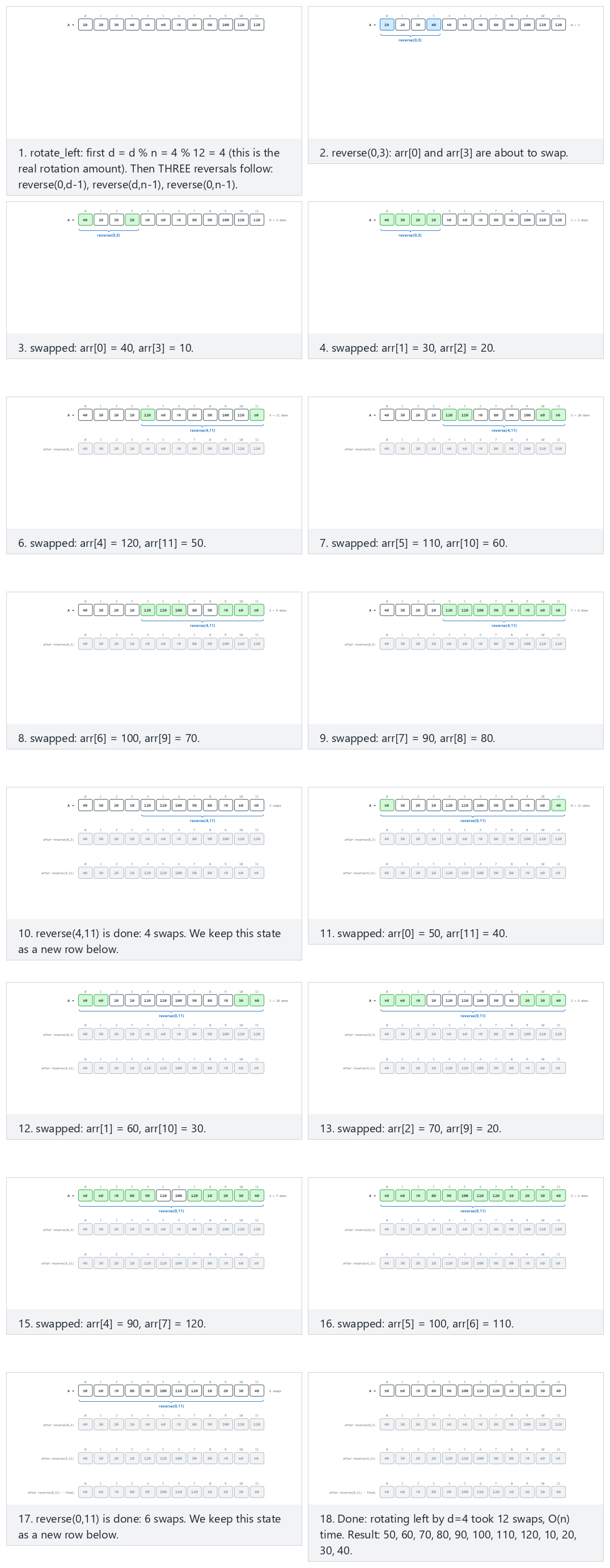
In the picker, also try 15 values (negative/duplicate), d=7 (near half) (hard) and the edge cases d=0: nothing should change, d=n: d%n=0, still no change, and d>n: reduced by d%n — or press 🎲 for random data at four difficulty levels, or type your own d=N plus an array.
void reverse(int arr[], int lo, int hi) {
    while (lo < hi) {
        int tmp = arr[lo];
        arr[lo] = arr[hi];
        arr[hi] = tmp;
        lo++;
        hi--;
    }
}

void rotate_left(int arr[], int n, int d) {
    if (n == 0)
        return;                     /* empty array: nothing to rotate */
    d = d % n;
    reverse(arr, 0, d - 1);        /* reverse the first d elements */
    reverse(arr, d, n - 1);        /* reverse the remaining n-d elements */
    reverse(arr, 0, n - 1);        /* reverse the whole array */
}
static void reverse(int[] arr, int lo, int hi) {
    while (lo < hi) {
        int tmp = arr[lo];
        arr[lo] = arr[hi];
        arr[hi] = tmp;
        lo++;
        hi--;
    }
}

static void rotateLeft(int[] arr, int d) {
    int n = arr.length;
    if (n == 0)
        return;                     // empty array: nothing to rotate
    d = d % n;
    reverse(arr, 0, d - 1);        // reverse the first d elements
    reverse(arr, d, n - 1);        // reverse the remaining n-d elements
    reverse(arr, 0, n - 1);        // reverse the whole array
}
The full class (code/week-02/java/ArrayRotation.java) mirrors the C program's five scenarios exactly.
Full program: array_rotation.c / ArrayRotation.java
/* Week 2 -- Linked Lists, Arrays and Matrices
 * Rotate an array left by d positions with the reversal algorithm: reverse
 * the first d elements, reverse the rest, then reverse the whole thing.
 * Matches the array-rotation.js animation.
 * CEN207 Data Structures (formerly CE205)
 */
#include <stdio.h>

void reverse(int arr[], int lo, int hi) {
    while (lo < hi) {
        int tmp = arr[lo];
        arr[lo] = arr[hi];
        arr[hi] = tmp;
        lo++;
        hi--;
    }
}

void rotate_left(int arr[], int n, int d) {
    if (n == 0)
        return;                     /* empty array: nothing to rotate */
    d = d % n;
    reverse(arr, 0, d - 1);        /* reverse the first d elements */
    reverse(arr, d, n - 1);        /* reverse the remaining n-d elements */
    reverse(arr, 0, n - 1);        /* reverse the whole array */
}

static void print_array(const char *label, const int arr[], int n) {
    printf("%s:", label);
    for (int i = 0; i < n; i++) printf(" %d", arr[i]);
    printf("\n");
}

static void run_scenario(const char *label, int arr[], int n, int d) {
    printf("-- %s --\n", label);
    print_array("before", arr, n);
    printf("rotate_left(arr, %d, %d)\n", n, d);
    rotate_left(arr, n, d);
    print_array("after", arr, n);
    printf("\n");
}

int main(void) {
    /* normal: 12 values, d=4 */
    int normal[] = {10, 20, 30, 40, 50, 60, 70, 80, 90, 100, 110, 120};
    run_scenario("normal: 12 values, d=4", normal, 12, 4);

    /* hard: 15 values (negative/duplicate), d=7 (near half) */
    int hard[] = {3, -8, 15, 3, 22, -1, 40, 9, -17, 26, 5, -30, 11, 3, 18};
    run_scenario("hard: 15 values (negative/duplicate), d=7 (near half)", hard, 15, 7);

    /* edge: d=0: nothing should change */
    int d_zero[] = {4, 9, 15, 23, 2, 31, 8, 19, 6, 27};
    run_scenario("edge: d=0: nothing should change", d_zero, 10, 0);

    /* edge: d=n: d%n=0, still no change */
    int d_eq_n[] = {5, 12, 18, 24, 3, 30, 9, 21, 15, 6};
    run_scenario("edge: d=n: d%n=0, still no change", d_eq_n, 10, 10);

    /* edge: d>n: reduced by d%n (d=23, n=10 -> 3) */
    int d_gt_n[] = {7, 14, 21, 2, 28, 9, 35, 16, 4, 22};
    run_scenario("edge: d>n: reduced by d%n (d=23, n=10 -> 3)", d_gt_n, 10, 23);

    return 0;
}
/* Week 2 -- Linked Lists, Arrays and Matrices
 * Rotate an array left by d positions with the reversal algorithm: reverse
 * the first d elements, reverse the rest, then reverse the whole thing.
 * Matches the array-rotation.js animation.
 * CEN207 Data Structures (formerly CE205)
 */
public class ArrayRotation {
    static void reverse(int[] arr, int lo, int hi) {
        while (lo < hi) {
            int tmp = arr[lo];
            arr[lo] = arr[hi];
            arr[hi] = tmp;
            lo++;
            hi--;
        }
    }

    static void rotateLeft(int[] arr, int d) {
        int n = arr.length;
        if (n == 0)
            return;                     // empty array: nothing to rotate
        d = d % n;
        reverse(arr, 0, d - 1);        // reverse the first d elements
        reverse(arr, d, n - 1);        // reverse the remaining n-d elements
        reverse(arr, 0, n - 1);        // reverse the whole array
    }

    static void printArray(String label, int[] arr) {
        StringBuilder sb = new StringBuilder(label + ":");
        for (int v : arr) sb.append(' ').append(v);
        System.out.println(sb);
    }

    static void runScenario(String label, int[] arr, int d) {
        System.out.println("-- " + label + " --");
        printArray("before", arr);
        System.out.println("rotate_left(arr, " + arr.length + ", " + d + ")");
        rotateLeft(arr, d);
        printArray("after", arr);
        System.out.println();
    }

    public static void main(String[] args) {
        // normal: 12 values, d=4
        int[] normal = {10, 20, 30, 40, 50, 60, 70, 80, 90, 100, 110, 120};
        runScenario("normal: 12 values, d=4", normal, 4);

        // hard: 15 values (negative/duplicate), d=7 (near half)
        int[] hard = {3, -8, 15, 3, 22, -1, 40, 9, -17, 26, 5, -30, 11, 3, 18};
        runScenario("hard: 15 values (negative/duplicate), d=7 (near half)", hard, 7);

        // edge: d=0: nothing should change
        int[] dZero = {4, 9, 15, 23, 2, 31, 8, 19, 6, 27};
        runScenario("edge: d=0: nothing should change", dZero, 0);

        // edge: d=n: d%n=0, still no change
        int[] dEqN = {5, 12, 18, 24, 3, 30, 9, 21, 15, 6};
        runScenario("edge: d=n: d%n=0, still no change", dEqN, 10);

        // edge: d>n: reduced by d%n (d=23, n=10 -> 3)
        int[] dGtN = {7, 14, 21, 2, 28, 9, 35, 16, 4, 22};
        runScenario("edge: d>n: reduced by d%n (d=23, n=10 -> 3)", dGtN, 23);
    }
}
Try it
Expected output:
-- normal: 12 values, d=4 --
before: 10 20 30 40 50 60 70 80 90 100 110 120
rotate_left(arr, 12, 4)
after: 50 60 70 80 90 100 110 120 10 20 30 40

-- hard: 15 values (negative/duplicate), d=7 (near half) --
before: 3 -8 15 3 22 -1 40 9 -17 26 5 -30 11 3 18
rotate_left(arr, 15, 7)
after: 9 -17 26 5 -30 11 3 18 3 -8 15 3 22 -1 40

-- edge: d=0: nothing should change --
before: 4 9 15 23 2 31 8 19 6 27
rotate_left(arr, 10, 0)
after: 4 9 15 23 2 31 8 19 6 27

-- edge: d=n: d%n=0, still no change --
before: 5 12 18 24 3 30 9 21 15 6
rotate_left(arr, 10, 10)
after: 5 12 18 24 3 30 9 21 15 6

-- edge: d>n: reduced by d%n (d=23, n=10 -> 3) --
before: 7 14 21 2 28 9 35 16 4 22
rotate_left(arr, 10, 23)
after: 2 28 9 35 16 4 22 7 14 21
Complexity. Each of the three reversals costs O(length), and the three lengths (d, n-d, n) sum to 2n, so rotate_left is O(n) time and O(1) extra space — no auxiliary array needed.
4.2 Rearrangement: partitioning with two pointers
A question to start. A conveyor belt sorts items into "reject" and "accept" bins by sliding rejects to one side, without needing them in any particular order within that side — just segregated. This is a smaller ask than sorting, and it can be done in a single O(n) pass with two pointers walking toward each other from opposite ends, exactly the partitioning step used inside quicksort: left skips values already on the correct side, right skips values already on the correct side from the other direction, and whenever both stop, the two values in between are out of place and swap.
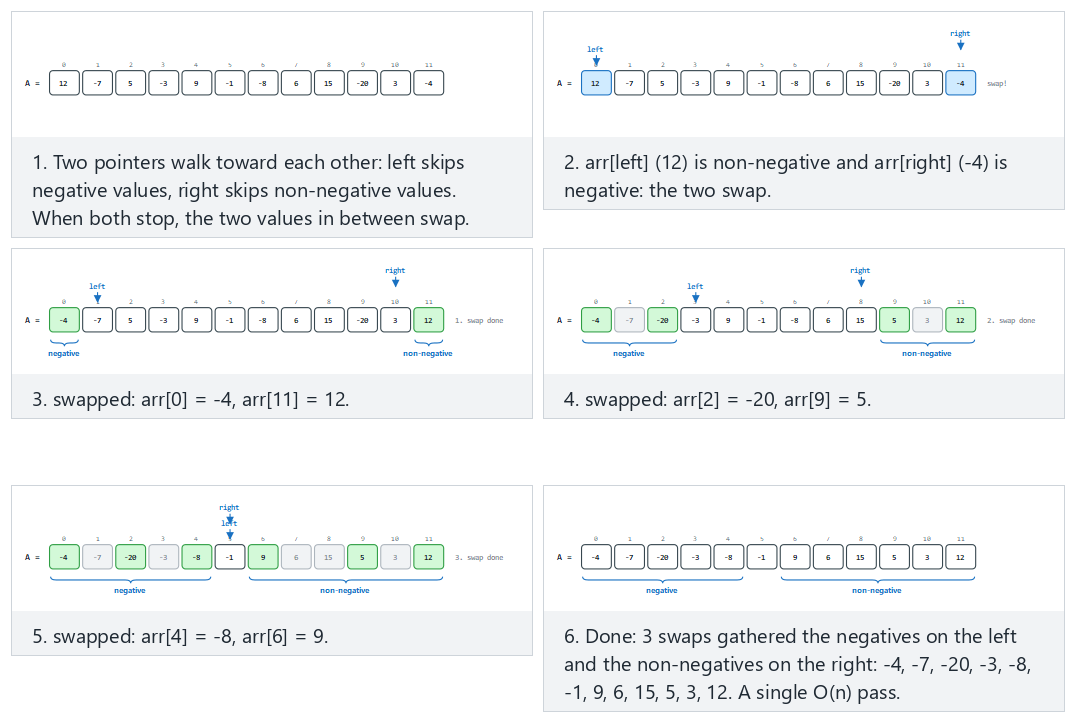
In the picker, also try 15 values with zeros and duplicates (0 does NOT count as negative) (hard) and the edge cases all negative: no swap is ever needed, all non-negative (0 included): no swap is ever needed, and already segregated: the pointers cross without any swap — or press 🎲 for random data at four difficulty levels, or type your own array.
void segregate(int arr[], int n) {
    int left = 0, right = n - 1;
    while (left < right) {
        while (left < right && arr[left] < 0)
            left++;                 /* already negative: leave it */
        while (left < right && arr[right] >= 0)
            right--;                /* already non-negative: leave it */
        if (left < right) {
            int tmp = arr[left];
            arr[left] = arr[right];
            arr[right] = tmp;
            left++;
            right--;
        }
    }
}
static void segregate(int[] arr) {
    int left = 0, right = arr.length - 1;
    while (left < right) {
        while (left < right && arr[left] < 0)
            left++;                 // already negative: leave it
        while (left < right && arr[right] >= 0)
            right--;                // already non-negative: leave it
        if (left < right) {
            int tmp = arr[left];
            arr[left] = arr[right];
            arr[right] = tmp;
            left++;
            right--;
        }
    }
}
The full class (code/week-02/java/ArrayRearrange.java) mirrors the C program's five scenarios exactly.
Full program: array_rearrange.c / ArrayRearrange.java
/* Week 2 -- Linked Lists, Arrays and Matrices
 * Rearrange an array in place: every negative value ends up left of every
 * non-negative value, using two pointers walking toward each other (the
 * same shape as a quicksort partition). Matches the array-rearrange.js
 * animation.
 * CEN207 Data Structures (formerly CE205)
 */
#include <stdio.h>

void segregate(int arr[], int n) {
    int left = 0, right = n - 1;
    while (left < right) {
        while (left < right && arr[left] < 0)
            left++;                 /* already negative: leave it */
        while (left < right && arr[right] >= 0)
            right--;                /* already non-negative: leave it */
        if (left < right) {
            int tmp = arr[left];
            arr[left] = arr[right];
            arr[right] = tmp;
            left++;
            right--;
        }
    }
}

static void print_array(const char *label, const int arr[], int n) {
    printf("%s:", label);
    for (int i = 0; i < n; i++) printf(" %d", arr[i]);
    printf("\n");
}

static void run_scenario(const char *label, int arr[], int n) {
    printf("-- %s --\n", label);
    print_array("before", arr, n);
    segregate(arr, n);
    print_array("after ", arr, n);
    printf("\n");
}

int main(void) {
    /* normal: 12 values, mixed sign */
    int normal[] = {12, -7, 5, -3, 9, -1, -8, 6, 15, -20, 3, -4};
    run_scenario("normal: 12 values, mixed sign", normal, 12);

    /* hard: 15 values with zeros and duplicates (0 does NOT count as negative) */
    int hard[] = {0, -5, 3, -5, 0, 8, -12, 0, 4, -3, 7, -7, 0, 9, -2};
    run_scenario("hard: 15 values with zeros and duplicates (0 does NOT count as negative)", hard, 15);

    /* edge: all negative: no swap is ever needed */
    int all_negative[] = {-3, -8, -1, -15, -22, -4, -9, -17, -2, -6};
    run_scenario("edge: all negative: no swap is ever needed", all_negative, 10);

    /* edge: all non-negative (0 included): no swap is ever needed */
    int all_nonnegative[] = {4, 0, 9, 15, 2, 8, 0, 11, 6, 3};
    run_scenario("edge: all non-negative (0 included): no swap is ever needed", all_nonnegative, 10);

    /* edge: already segregated: the pointers cross without any swap */
    int already[] = {-5, -3, -8, -1, -9, 2, 4, 6, 8, 10, 12, 14};
    run_scenario("edge: already segregated: the pointers cross without any swap", already, 12);

    return 0;
}
/* Week 2 -- Linked Lists, Arrays and Matrices
 * Rearrange an array in place: every negative value ends up left of every
 * non-negative value, using two pointers walking toward each other (the
 * same shape as a quicksort partition). Matches the array-rearrange.js
 * animation.
 * CEN207 Data Structures (formerly CE205)
 */
public class ArrayRearrange {
    static void segregate(int[] arr) {
        int left = 0, right = arr.length - 1;
        while (left < right) {
            while (left < right && arr[left] < 0)
                left++;                 // already negative: leave it
            while (left < right && arr[right] >= 0)
                right--;                // already non-negative: leave it
            if (left < right) {
                int tmp = arr[left];
                arr[left] = arr[right];
                arr[right] = tmp;
                left++;
                right--;
            }
        }
    }

    static void printArray(String label, int[] arr) {
        StringBuilder sb = new StringBuilder(label + ":");
        for (int v : arr) sb.append(' ').append(v);
        System.out.println(sb);
    }

    static void runScenario(String label, int[] arr) {
        System.out.println("-- " + label + " --");
        printArray("before", arr);
        segregate(arr);
        printArray("after ", arr);
        System.out.println();
    }

    public static void main(String[] args) {
        // normal: 12 values, mixed sign
        int[] normal = {12, -7, 5, -3, 9, -1, -8, 6, 15, -20, 3, -4};
        runScenario("normal: 12 values, mixed sign", normal);

        // hard: 15 values with zeros and duplicates (0 does NOT count as negative)
        int[] hard = {0, -5, 3, -5, 0, 8, -12, 0, 4, -3, 7, -7, 0, 9, -2};
        runScenario("hard: 15 values with zeros and duplicates (0 does NOT count as negative)", hard);

        // edge: all negative: no swap is ever needed
        int[] allNegative = {-3, -8, -1, -15, -22, -4, -9, -17, -2, -6};
        runScenario("edge: all negative: no swap is ever needed", allNegative);

        // edge: all non-negative (0 included): no swap is ever needed
        int[] allNonnegative = {4, 0, 9, 15, 2, 8, 0, 11, 6, 3};
        runScenario("edge: all non-negative (0 included): no swap is ever needed", allNonnegative);

        // edge: already segregated: the pointers cross without any swap
        int[] already = {-5, -3, -8, -1, -9, 2, 4, 6, 8, 10, 12, 14};
        runScenario("edge: already segregated: the pointers cross without any swap", already);
    }
}
Try it
Expected output:
-- normal: 12 values, mixed sign --
before: 12 -7 5 -3 9 -1 -8 6 15 -20 3 -4
after : -4 -7 -20 -3 -8 -1 9 6 15 5 3 12

-- hard: 15 values with zeros and duplicates (0 does NOT count as negative) --
before: 0 -5 3 -5 0 8 -12 0 4 -3 7 -7 0 9 -2
after : -2 -5 -7 -5 -3 -12 8 0 4 0 7 3 0 9 0

-- edge: all negative: no swap is ever needed --
before: -3 -8 -1 -15 -22 -4 -9 -17 -2 -6
after : -3 -8 -1 -15 -22 -4 -9 -17 -2 -6

-- edge: all non-negative (0 included): no swap is ever needed --
before: 4 0 9 15 2 8 0 11 6 3
after : 4 0 9 15 2 8 0 11 6 3

-- edge: already segregated: the pointers cross without any swap --
before: -5 -3 -8 -1 -9 2 4 6 8 10 12 14
after : -5 -3 -8 -1 -9 2 4 6 8 10 12 14
Complexity. left and right only ever move toward each other and never backtrack, so together they take at most n steps total: O(n) time, O(1) extra space.
Common mistakes
- Confusing this with a stable partition:
segregatedoes not preserve the relative order of elements within each side (notice12and3swap places relative to each other in the "normal" scenario above). If order must be preserved, a different (O(n) extra space) technique is needed. - Missing the
left < rightguard inside the innerwhileloops: without it, an all-negative or all-non-negative array makes one of the inner loops walkleftorrightstraight past the other, reading out of bounds.
5. Sparse matrices
5.1 A question to start
A social network's "who follows whom" matrix for a million users would need 1,000,000 x 1,000,000 cells — a trillion of them — yet the overwhelming majority of those cells are 0 (most people do not follow most other people). Storing all trillion cells, almost all zero, wastes essentially all of that memory. A matrix in which the great majority of entries are zero is called sparse, and it deserves a representation that only pays for the entries that are actually there.
5.2 The triplet representation
The simplest sparse representation lists only the nonzero cells, each as a (row, col, value) triplet, scanned in row-major order. A matrix that is, say, 95% zero shrinks to a table roughly 5% the size of the dense grid — and the savings only grow as the matrix gets bigger or sparser.

In the picker, also try a 6x6 matrix (36 cells), 9 nonzero (negatives included) (hard) and the edge cases a 4x4 matrix, all zero: the triplet table stays empty and a 4x3 matrix, all nonzero: the triplet table grows as large as the array — or press 🎲 for random data at four difficulty levels, or type your own matrix rows separated by ;.
static class Triplet {
    int row, col, value;
    Triplet(int row, int col, int value) { this.row = row; this.col = col; this.value = value; }
}

static Triplet[] toTriplets(int[][] mat) {
    Triplet[] out = new Triplet[ROWS * COLS];
    int k = 0;
    for (int i = 0; i < ROWS; i++)
        for (int j = 0; j < COLS; j++)
            if (mat[i][j] != 0)
                out[k++] = new Triplet(i, j, mat[i][j]);
    Triplet[] trimmed = new Triplet[k];
    System.arraycopy(out, 0, trimmed, 0, k);
    return trimmed;
}
The full class (code/week-02/java/SparseMatrixTriplet.java) mirrors the C program's four scenarios exactly.
Full program: sparse_matrix_triplet.c / SparseMatrixTriplet.java
/* Week 2 -- Linked Lists, Arrays and Matrices
 * A sparse matrix (mostly zeros) wastes memory if stored densely. Scan it
 * row-major and record only the nonzero cells as (row, col, value)
 * triplets. Matches the sparse-matrix-triplet.js animation. The animation
 * bakes ROWS/COLS into the source text per preset; this program keeps
 * runtime globals `rows`/`cols` set per scenario, so to_triplets is
 * otherwise identical to the animation's code panel.
 * CEN207 Data Structures (formerly CE205)
 */
#include <stdio.h>

#define MAX_ROWS 6
#define MAX_COLS 6
#define MAX_NNZ (MAX_ROWS * MAX_COLS)

typedef struct {
    int row, col, value;
} Triplet;

static int rows, cols;

int to_triplets(int mat[MAX_ROWS][MAX_COLS], Triplet out[]) {
    int k = 0;
    for (int i = 0; i < rows; i++)
        for (int j = 0; j < cols; j++)
            if (mat[i][j] != 0) {
                out[k].row = i;
                out[k].col = j;
                out[k].value = mat[i][j];
                k++;
            }
    return k;
}

static void run_scenario(const char *label, int r, int c, int mat[MAX_ROWS][MAX_COLS]) {
    printf("-- %s --\n", label);
    rows = r; cols = c;
    Triplet out[MAX_NNZ];
    int nnz = to_triplets(mat, out);
    printf("rows=%d cols=%d cells=%d nnz=%d\n", rows, cols, rows * cols, nnz);
    for (int i = 0; i < nnz; i++)
        printf("  (%d, %d, %d)\n", out[i].row, out[i].col, out[i].value);
    printf("\n");
}

int main(void) {
    /* normal: 5x6 (30 cells), only 6 nonzero */
    int normal[MAX_ROWS][MAX_COLS] = {
        {0, 0, 3, 0, 0, 0}, {0, 0, 0, 0, 4, 0}, {0, 5, 0, 0, 0, 0}, {0, 0, 0, 0, 0, 7}, {6, 0, 0, 8, 0, 0}
    };
    run_scenario("normal: 5x6 (30 cells), only 6 nonzero", 5, 6, normal);

    /* hard: 6x6 (36 cells), 9 nonzero (negatives included) */
    int hard[MAX_ROWS][MAX_COLS] = {
        {0, -3, 0, 0, 0, 5}, {0, 0, 0, 9, 0, 0}, {7, 0, 0, 0, 0, 0},
        {0, 0, -12, 0, 4, 0}, {0, 0, 0, 0, 0, 0}, {2, 0, 0, -6, 0, 11}
    };
    run_scenario("hard: 6x6 (36 cells), 9 nonzero (negatives included)", 6, 6, hard);

    /* edge: 4x4 (16 cells), all zero: the triplet table stays empty */
    int all_zero[MAX_ROWS][MAX_COLS] = { {0} };
    run_scenario("edge: 4x4 (16 cells), all zero: the triplet table stays empty", 4, 4, all_zero);

    /* edge: 4x3 (12 cells), all nonzero: the triplet table grows as large as the array */
    int fully_dense[MAX_ROWS][MAX_COLS] = { {1, 2, 3}, {4, 5, 6}, {7, 8, 9}, {10, 11, 12} };
    run_scenario("edge: 4x3 (12 cells), all nonzero: the triplet table grows as large as the array", 4, 3, fully_dense);

    return 0;
}
/* Week 2 -- Linked Lists, Arrays and Matrices
 * A sparse matrix (mostly zeros) wastes memory if stored densely. Scan it
 * row-major and record only the nonzero cells as (row, col, value)
 * triplets. Matches the sparse-matrix-triplet.js animation.
 * CEN207 Data Structures (formerly CE205)
 */
public class SparseMatrixTriplet {
    static class Triplet {
        int row, col, value;
        Triplet(int row, int col, int value) { this.row = row; this.col = col; this.value = value; }
    }

    static Triplet[] toTriplets(int[][] mat) {
        int rows = mat.length, cols = mat[0].length;
        Triplet[] out = new Triplet[rows * cols];
        int k = 0;
        for (int i = 0; i < rows; i++)
            for (int j = 0; j < cols; j++)
                if (mat[i][j] != 0)
                    out[k++] = new Triplet(i, j, mat[i][j]);
        Triplet[] trimmed = new Triplet[k];
        System.arraycopy(out, 0, trimmed, 0, k);
        return trimmed;
    }

    static void runScenario(String label, int[][] mat) {
        System.out.println("-- " + label + " --");
        int rows = mat.length, cols = mat[0].length;
        Triplet[] out = toTriplets(mat);
        System.out.println("rows=" + rows + " cols=" + cols + " cells=" + (rows * cols) + " nnz=" + out.length);
        for (Triplet t : out)
            System.out.println("  (" + t.row + ", " + t.col + ", " + t.value + ")");
        System.out.println();
    }

    public static void main(String[] args) {
        // normal: 5x6 (30 cells), only 6 nonzero
        int[][] normal = {
            {0, 0, 3, 0, 0, 0}, {0, 0, 0, 0, 4, 0}, {0, 5, 0, 0, 0, 0}, {0, 0, 0, 0, 0, 7}, {6, 0, 0, 8, 0, 0}
        };
        runScenario("normal: 5x6 (30 cells), only 6 nonzero", normal);

        // hard: 6x6 (36 cells), 9 nonzero (negatives included)
        int[][] hard = {
            {0, -3, 0, 0, 0, 5}, {0, 0, 0, 9, 0, 0}, {7, 0, 0, 0, 0, 0},
            {0, 0, -12, 0, 4, 0}, {0, 0, 0, 0, 0, 0}, {2, 0, 0, -6, 0, 11}
        };
        runScenario("hard: 6x6 (36 cells), 9 nonzero (negatives included)", hard);

        // edge: 4x4 (16 cells), all zero: the triplet table stays empty
        int[][] allZero = { {0, 0, 0, 0}, {0, 0, 0, 0}, {0, 0, 0, 0}, {0, 0, 0, 0} };
        runScenario("edge: 4x4 (16 cells), all zero: the triplet table stays empty", allZero);

        // edge: 4x3 (12 cells), all nonzero: the triplet table grows as large as the array
        int[][] fullyDense = { {1, 2, 3}, {4, 5, 6}, {7, 8, 9}, {10, 11, 12} };
        runScenario("edge: 4x3 (12 cells), all nonzero: the triplet table grows as large as the array", fullyDense);
    }
}
Try it
Expected output:
-- normal: 5x6 (30 cells), only 6 nonzero --
rows=5 cols=6 cells=30 nnz=6
  (0, 2, 3)
  (1, 4, 4)
  (2, 1, 5)
  (3, 5, 7)
  (4, 0, 6)
  (4, 3, 8)

-- hard: 6x6 (36 cells), 9 nonzero (negatives included) --
rows=6 cols=6 cells=36 nnz=9
  (0, 1, -3)
  (0, 5, 5)
  (1, 3, 9)
  (2, 0, 7)
  (3, 2, -12)
  (3, 4, 4)
  (5, 0, 2)
  (5, 3, -6)
  (5, 5, 11)

-- edge: 4x4 (16 cells), all zero: the triplet table stays empty --
rows=4 cols=4 cells=16 nnz=0

-- edge: 4x3 (12 cells), all nonzero: the triplet table grows as large as the array --
rows=4 cols=3 cells=12 nnz=12
  (0, 0, 1)
  (0, 1, 2)
  (0, 2, 3)
  (1, 0, 4)
  (1, 1, 5)
  (1, 2, 6)
  (2, 0, 7)
  (2, 1, 8)
  (2, 2, 9)
  (3, 0, 10)
  (3, 1, 11)
  (3, 2, 12)
Complexity. Building the triplet table is O(rows·cols) — the scan visits every cell once, whether it turns out to be zero or not. The table itself takes O(nnz) space, where nnz (**n**umber of **n**on**z**ero) can be far smaller than rows·cols.
5.3 Fast transpose: counting instead of sorting
A question to start. Transposing a dense matrix just swaps M[i][j] with M[j][i]. Transposing a sparse triplet list is trickier: swapping row and col inside every triplet is easy, but the result is no longer sorted in row-major order — it needs re-sorting, which costs O(nnz log nnz) with a general-purpose sort. Can we do better?
We can, in O(nnz + COLS), using the same idea as counting sort: first count how many nonzeros sit in each column of the original matrix (which is each row of the transpose); turn those counts into starting positions with a running total (a prefix sum); then make one more pass over the original triplets, and for each one, look up where its column's block starts in the output, place it there, and bump that starting position by one for the next triplet in the same column. The result comes out already in the transpose's row-major order — no comparison-based sort ever runs.
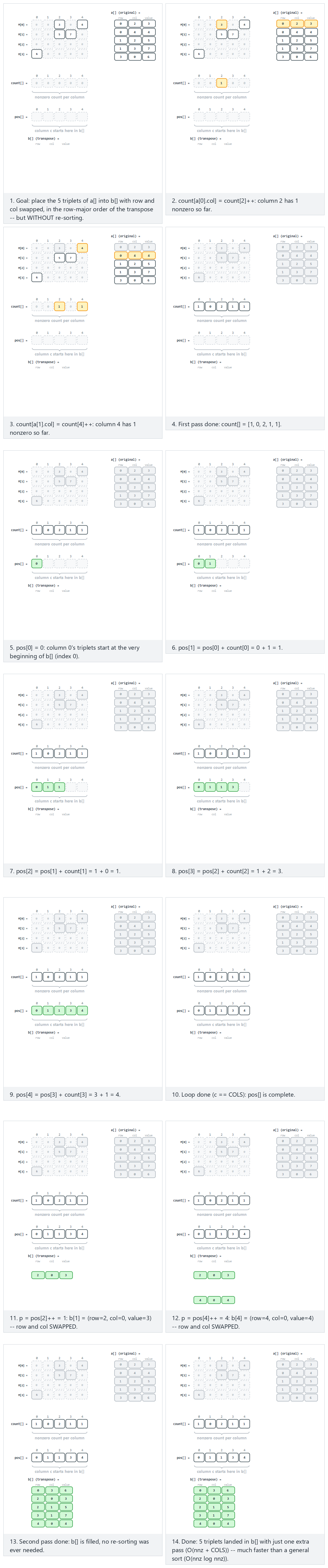
In the picker, also try a 6x6 matrix, 9 nonzero (negatives included) (hard) and the edge cases a 4x4 matrix, all zero: the transpose stays empty too and a 4x3 matrix, all nonzero: every cell enters the transpose — or press 🎲 for random data at four difficulty levels, or type your own matrix rows separated by ;.
/* Builds the triplets of the transpose in ONE pass, already sorted in
   row-major order of the transpose -- no re-sorting needed afterwards. */
void fast_transpose(Triplet a[], int nnz, Triplet b[]) {
    int count[COLS] = {0};
    int pos[COLS];

    for (int i = 0; i < nnz; i++)
        count[a[i].col]++;             /* how many nonzeros in each column */

    pos[0] = 0;
    for (int c = 1; c < COLS; c++)
        pos[c] = pos[c - 1] + count[c - 1];   /* where column c starts in b */

    for (int i = 0; i < nnz; i++) {
        int c = a[i].col;
        int p = pos[c]++;
        b[p].row = a[i].col;            /* row and col swap ... */
        b[p].col = a[i].row;
        b[p].value = a[i].value;
    }
}
static Triplet[] fastTranspose(Triplet[] a) {
    int[] count = new int[COLS];
    int[] pos = new int[COLS];

    for (Triplet e : a)
        count[e.col]++;                 // how many nonzeros in each column

    pos[0] = 0;
    for (int c = 1; c < COLS; c++)
        pos[c] = pos[c - 1] + count[c - 1];   // where column c starts in b

    Triplet[] b = new Triplet[a.length];
    for (Triplet e : a) {
        int p = pos[e.col]++;
        b[p] = new Triplet(e.col, e.row, e.value);   // row and col swap ...
    }
    return b;
}
The full class (code/week-02/java/SparseMatrixTranspose.java) mirrors the C program's four scenarios exactly.
Full program: sparse_matrix_transpose.c / SparseMatrixTranspose.java
/* Week 2 -- Linked Lists, Arrays and Matrices
 * Sparse matrix transpose, the fast way: count how many nonzeros sit in
 * each column, turn that into starting positions with a prefix sum, then
 * place every triplet directly at its final spot in one more pass. Matches
 * the sparse-matrix-transpose.js animation.
 * CEN207 Data Structures (formerly CE205)
 */
#include <stdio.h>

#define MAX_ROWS 6
#define MAX_COLS 6
#define MAX_NNZ (MAX_ROWS * MAX_COLS)

typedef struct {
    int row, col, value;
} Triplet;

static int cols;

/* Builds the triplets of the transpose in ONE pass, already sorted in
   row-major order of the transpose -- no re-sorting needed afterwards. */
void fast_transpose(Triplet a[], int nnz, Triplet b[]) {
    int count[MAX_COLS] = {0};
    int pos[MAX_COLS];

    for (int i = 0; i < nnz; i++)
        count[a[i].col]++;             /* how many nonzeros in each column */

    pos[0] = 0;
    for (int c = 1; c < cols; c++)
        pos[c] = pos[c - 1] + count[c - 1];   /* where column c starts in b */

    for (int i = 0; i < nnz; i++) {
        int c = a[i].col;
        int p = pos[c]++;
        b[p].row = a[i].col;            /* row and col swap ... */
        b[p].col = a[i].row;
        b[p].value = a[i].value;
    }
}

static int to_triplets(int rows, int c, int mat[MAX_ROWS][MAX_COLS], Triplet out[]) {
    int k = 0;
    for (int i = 0; i < rows; i++)
        for (int j = 0; j < c; j++)
            if (mat[i][j] != 0) { out[k].row = i; out[k].col = j; out[k].value = mat[i][j]; k++; }
    return k;
}

static void run_scenario(const char *label, int rows, int c, int mat[MAX_ROWS][MAX_COLS]) {
    printf("-- %s --\n", label);
    cols = c;
    Triplet a[MAX_NNZ], b[MAX_NNZ];
    int nnz = to_triplets(rows, c, mat, a);
    printf("rows=%d cols=%d nnz=%d\n", rows, c, nnz);
    printf("a[] (original):\n");
    for (int i = 0; i < nnz; i++) printf("  (%d, %d, %d)\n", a[i].row, a[i].col, a[i].value);
    fast_transpose(a, nnz, b);
    printf("b[] (transpose):\n");
    for (int i = 0; i < nnz; i++) printf("  (%d, %d, %d)\n", b[i].row, b[i].col, b[i].value);
    printf("\n");
}

int main(void) {
    /* normal: 4x5 (same example matrix), 5 nonzero */
    int normal[MAX_ROWS][MAX_COLS] = { {0, 0, 3, 0, 4}, {0, 0, 5, 7, 0}, {0, 0, 0, 0, 0}, {6, 0, 0, 0, 0} };
    run_scenario("normal: 4x5 (same example matrix), 5 nonzero", 4, 5, normal);

    /* hard: 6x6, 9 nonzero (negatives included) */
    int hard[MAX_ROWS][MAX_COLS] = {
        {0, -3, 0, 0, 0, 5}, {0, 0, 0, 9, 0, 0}, {7, 0, 0, 0, 0, 0},
        {0, 0, -12, 0, 4, 0}, {0, 0, 0, 0, 0, 0}, {2, 0, 0, -6, 0, 11}
    };
    run_scenario("hard: 6x6, 9 nonzero (negatives included)", 6, 6, hard);

    /* edge: 4x4, all zero: the transpose stays empty too */
    int all_zero[MAX_ROWS][MAX_COLS] = { {0} };
    run_scenario("edge: 4x4, all zero: the transpose stays empty too", 4, 4, all_zero);

    /* edge: 4x3, all nonzero: every cell enters the transpose */
    int fully_dense[MAX_ROWS][MAX_COLS] = { {1, 2, 3}, {4, 5, 6}, {7, 8, 9}, {10, 11, 12} };
    run_scenario("edge: 4x3, all nonzero: every cell enters the transpose", 4, 3, fully_dense);

    return 0;
}
/* Week 2 -- Linked Lists, Arrays and Matrices
 * Sparse matrix transpose, the fast way: count how many nonzeros sit in
 * each column, turn that into starting positions with a prefix sum, then
 * place every triplet directly at its final spot in one more pass. Matches
 * the sparse-matrix-transpose.js animation.
 * CEN207 Data Structures (formerly CE205)
 */
public class SparseMatrixTranspose {
    static class Triplet {
        int row, col, value;
        Triplet(int row, int col, int value) { this.row = row; this.col = col; this.value = value; }
    }

    static Triplet[] fastTranspose(Triplet[] a, int cols) {
        int[] count = new int[cols];
        int[] pos = new int[cols];

        for (Triplet e : a)
            count[e.col]++;                 // how many nonzeros in each column

        pos[0] = 0;
        for (int c = 1; c < cols; c++)
            pos[c] = pos[c - 1] + count[c - 1];   // where column c starts in b

        Triplet[] b = new Triplet[a.length];
        for (Triplet e : a) {
            int p = pos[e.col]++;
            b[p] = new Triplet(e.col, e.row, e.value);   // row and col swap ...
        }
        return b;
    }

    static Triplet[] toTriplets(int[][] mat) {
        int rows = mat.length, cols = mat[0].length;
        Triplet[] out = new Triplet[rows * cols];
        int k = 0;
        for (int i = 0; i < rows; i++)
            for (int j = 0; j < cols; j++)
                if (mat[i][j] != 0)
                    out[k++] = new Triplet(i, j, mat[i][j]);
        Triplet[] trimmed = new Triplet[k];
        System.arraycopy(out, 0, trimmed, 0, k);
        return trimmed;
    }

    static void runScenario(String label, int[][] mat) {
        System.out.println("-- " + label + " --");
        int rows = mat.length, cols = mat[0].length;
        Triplet[] a = toTriplets(mat);
        System.out.println("rows=" + rows + " cols=" + cols + " nnz=" + a.length);
        System.out.println("a[] (original):");
        for (Triplet t : a) System.out.println("  (" + t.row + ", " + t.col + ", " + t.value + ")");
        Triplet[] b = fastTranspose(a, cols);
        System.out.println("b[] (transpose):");
        for (Triplet t : b) System.out.println("  (" + t.row + ", " + t.col + ", " + t.value + ")");
        System.out.println();
    }

    public static void main(String[] args) {
        // normal: 4x5 (same example matrix), 5 nonzero
        int[][] normal = { {0, 0, 3, 0, 4}, {0, 0, 5, 7, 0}, {0, 0, 0, 0, 0}, {6, 0, 0, 0, 0} };
        runScenario("normal: 4x5 (same example matrix), 5 nonzero", normal);

        // hard: 6x6, 9 nonzero (negatives included)
        int[][] hard = {
            {0, -3, 0, 0, 0, 5}, {0, 0, 0, 9, 0, 0}, {7, 0, 0, 0, 0, 0},
            {0, 0, -12, 0, 4, 0}, {0, 0, 0, 0, 0, 0}, {2, 0, 0, -6, 0, 11}
        };
        runScenario("hard: 6x6, 9 nonzero (negatives included)", hard);

        // edge: 4x4, all zero: the transpose stays empty too
        int[][] allZero = { {0, 0, 0, 0}, {0, 0, 0, 0}, {0, 0, 0, 0}, {0, 0, 0, 0} };
        runScenario("edge: 4x4, all zero: the transpose stays empty too", allZero);

        // edge: 4x3, all nonzero: every cell enters the transpose
        int[][] fullyDense = { {1, 2, 3}, {4, 5, 6}, {7, 8, 9}, {10, 11, 12} };
        runScenario("edge: 4x3, all nonzero: every cell enters the transpose", fullyDense);
    }
}
Try it
Expected output:
-- normal: 4x5 (same example matrix), 5 nonzero --
rows=4 cols=5 nnz=5
a[] (original):
  (0, 2, 3)
  (0, 4, 4)
  (1, 2, 5)
  (1, 3, 7)
  (3, 0, 6)
b[] (transpose):
  (0, 3, 6)
  (2, 0, 3)
  (2, 1, 5)
  (3, 1, 7)
  (4, 0, 4)

-- hard: 6x6, 9 nonzero (negatives included) --
rows=6 cols=6 nnz=9
a[] (original):
  (0, 1, -3)
  (0, 5, 5)
  (1, 3, 9)
  (2, 0, 7)
  (3, 2, -12)
  (3, 4, 4)
  (5, 0, 2)
  (5, 3, -6)
  (5, 5, 11)
b[] (transpose):
  (0, 2, 7)
  (0, 5, 2)
  (1, 0, -3)
  (2, 3, -12)
  (3, 1, 9)
  (3, 5, -6)
  (4, 3, 4)
  (5, 0, 5)
  (5, 5, 11)

-- edge: 4x4, all zero: the transpose stays empty too --
rows=4 cols=4 nnz=0
a[] (original):
b[] (transpose):

-- edge: 4x3, all nonzero: every cell enters the transpose --
rows=4 cols=3 nnz=12
a[] (original):
  (0, 0, 1)
  (0, 1, 2)
  (0, 2, 3)
  (1, 0, 4)
  (1, 1, 5)
  (1, 2, 6)
  (2, 0, 7)
  (2, 1, 8)
  (2, 2, 9)
  (3, 0, 10)
  (3, 1, 11)
  (3, 2, 12)
b[] (transpose):
  (0, 0, 1)
  (0, 1, 4)
  (0, 2, 7)
  (0, 3, 10)
  (1, 0, 2)
  (1, 1, 5)
  (1, 2, 8)
  (1, 3, 11)
  (2, 0, 3)
  (2, 1, 6)
  (2, 2, 9)
  (2, 3, 12)
Complexity. fast_transpose makes two linear passes over the nnz triplets plus one linear pass over the COLS counts: O(nnz + COLS) — compare this to the O(nnz log nnz) a general-purpose sort would cost after a naive row/col swap.
5.4 Addition: merging two sorted triplet lists
A question to start. Adding two dense matrices is trivial: add each pair of cells. Adding two sparse matrices in triplet form should be cheaper still — most cells are zero in both, and 0 + 0 = 0 needs no work at all. If both triplet lists are already sorted in row-major order (as ours are, since they came straight out of to_triplets), addition becomes a merge — exactly the merge step from merge sort: walk both lists with one pointer each, always copying through whichever list's current (row, col) comes first; when both lists agree on the same (row, col), add the two values together, and write the sum only if it is nonzero (two nonzero values can cancel each other out exactly).
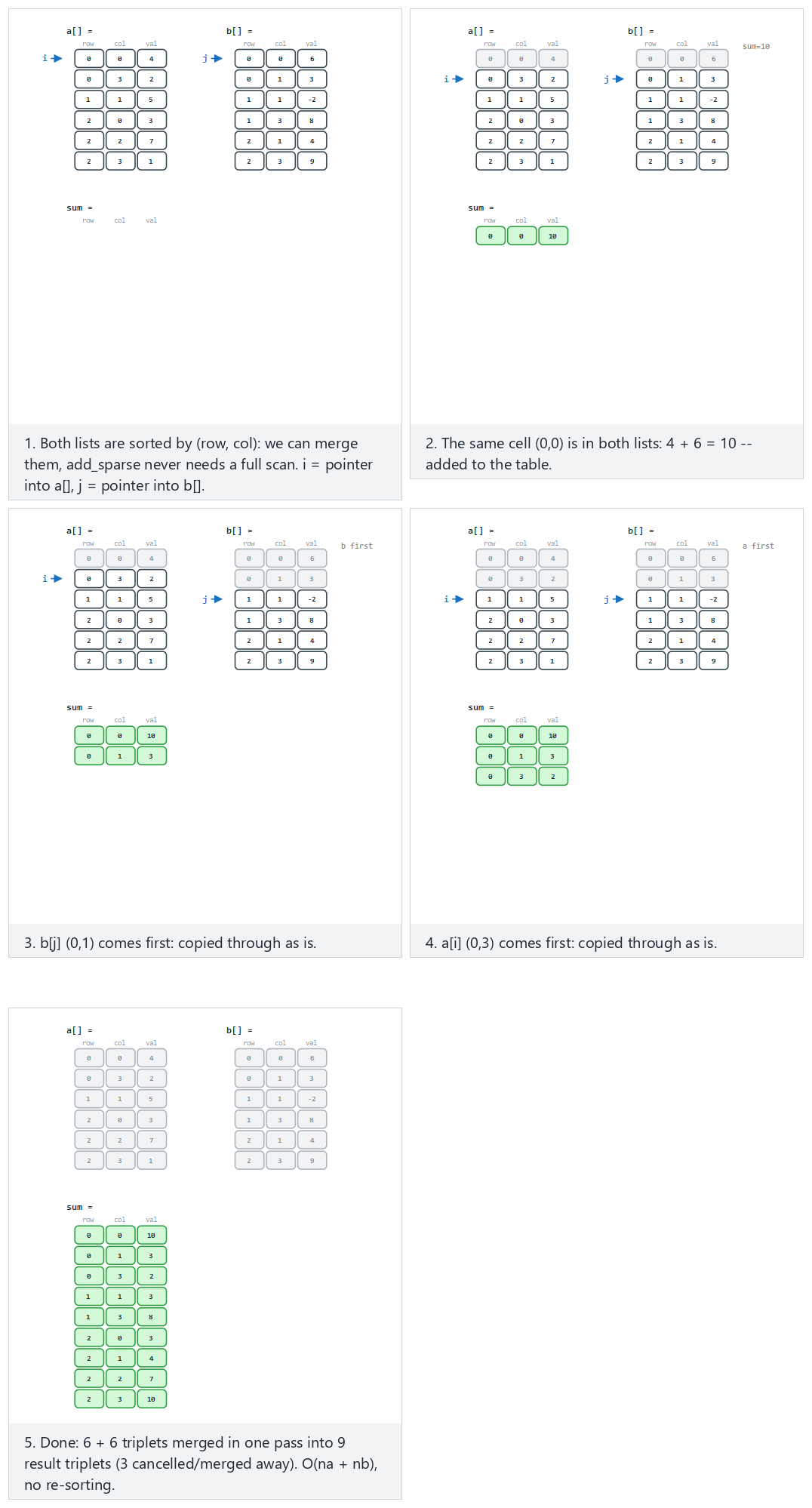
In the picker, also try a 4x4 matrix, 7+7 triplets, negative values, no cancellation (hard) and the edge cases no shared cells: every triplet is simply copied through and three cells cancel out exactly — or press 🎲 for random data at four difficulty levels, or type your own aR,C,V / bR,C,V triplet lists.
/* Both a[] and b[] must already be sorted in row-major order.
   Returns the number of entries written to out[]. */
int add_sparse(Triplet a[], int na, Triplet b[], int nb, Triplet out[]) {
    int i = 0, j = 0, k = 0;
    while (i < na && j < nb) {
        if (a[i].row < b[j].row || (a[i].row == b[j].row && a[i].col < b[j].col)) {
            out[k++] = a[i++];                       /* a's entry comes first */
        } else if (a[i].row > b[j].row || (a[i].row == b[j].row && a[i].col > b[j].col)) {
            out[k++] = b[j++];                       /* b's entry comes first */
        } else {
            int sum = a[i].value + b[j].value;       /* same cell in both */
            if (sum != 0) {
                out[k].row = a[i].row;
                out[k].col = a[i].col;
                out[k].value = sum;
                k++;
            }
            i++;
            j++;
        }
    }
    while (i < na) out[k++] = a[i++];
    while (j < nb) out[k++] = b[j++];
    return k;
}
// Both a[] and b[] must already be sorted in row-major order.
static Triplet[] addSparse(Triplet[] a, Triplet[] b) {
    Triplet[] out = new Triplet[a.length + b.length];
    int i = 0, j = 0, k = 0;
    while (i < a.length && j < b.length) {
        if (a[i].row < b[j].row || (a[i].row == b[j].row && a[i].col < b[j].col)) {
            out[k++] = a[i++];                          // a's entry comes first
        } else if (a[i].row > b[j].row || (a[i].row == b[j].row && a[i].col > b[j].col)) {
            out[k++] = b[j++];                          // b's entry comes first
        } else {
            int sum = a[i].value + b[j].value;          // same cell in both
            if (sum != 0)
                out[k++] = new Triplet(a[i].row, a[i].col, sum);
            i++;
            j++;
        }
    }
    while (i < a.length) out[k++] = a[i++];
    while (j < b.length) out[k++] = b[j++];
    Triplet[] trimmed = new Triplet[k];
    System.arraycopy(out, 0, trimmed, 0, k);
    return trimmed;
}
The full class (code/week-02/java/SparseMatrixAddition.java) mirrors the C program's four scenarios exactly.
Full program: sparse_matrix_addition.c / SparseMatrixAddition.java
/* Week 2 -- Linked Lists, Arrays and Matrices
 * Add two sparse matrices directly in triplet form: merge a[] and b[]
 * (both already sorted row-major) like the merge step of merge sort.
 * Matches the sparse-matrix-addition.js animation.
 * CEN207 Data Structures (formerly CE205)
 */
#include <stdio.h>

typedef struct {
    int row, col, value;
} Triplet;

/* Both a[] and b[] must already be sorted in row-major order.
   Returns the number of entries written to out[]. */
int add_sparse(Triplet a[], int na, Triplet b[], int nb, Triplet out[]) {
    int i = 0, j = 0, k = 0;
    while (i < na && j < nb) {
        if (a[i].row < b[j].row || (a[i].row == b[j].row && a[i].col < b[j].col)) {
            out[k++] = a[i++];                       /* a's entry comes first */
        } else if (a[i].row > b[j].row || (a[i].row == b[j].row && a[i].col > b[j].col)) {
            out[k++] = b[j++];                       /* b's entry comes first */
        } else {
            int sum = a[i].value + b[j].value;       /* same cell in both */
            if (sum != 0) {
                out[k].row = a[i].row;
                out[k].col = a[i].col;
                out[k].value = sum;
                k++;
            }
            i++;
            j++;
        }
    }
    while (i < na) out[k++] = a[i++];
    while (j < nb) out[k++] = b[j++];
    return k;
}

static void print_triplets(const char *label, Triplet t[], int n) {
    printf("%s:\n", label);
    for (int i = 0; i < n; i++) printf("  (%d, %d, %d)\n", t[i].row, t[i].col, t[i].value);
}

static void run_scenario(const char *label, Triplet a[], int na, Triplet b[], int nb) {
    printf("-- %s --\n", label);
    print_triplets("a[]", a, na);
    print_triplets("b[]", b, nb);
    Triplet out[64];
    int k = add_sparse(a, na, b, nb, out);
    print_triplets("sum", out, k);
    printf("\n");
}

int main(void) {
    /* normal: 3x4, 6+6 triplets, some cells shared */
    Triplet a1[] = { {0, 0, 4}, {0, 3, 2}, {1, 1, 5}, {2, 0, 3}, {2, 2, 7}, {2, 3, 1} };
    Triplet b1[] = { {0, 0, 6}, {0, 1, 3}, {1, 1, -2}, {1, 3, 8}, {2, 1, 4}, {2, 3, 9} };
    run_scenario("normal: 3x4, 6+6 triplets, some cells shared", a1, 6, b1, 6);

    /* hard: 4x4, 7+7 triplets, negative values, no cancellation */
    Triplet a2[] = { {0, 1, -8}, {0, 2, 5}, {1, 0, 12}, {1, 3, -4}, {2, 2, 9}, {3, 0, -15}, {3, 3, 6} };
    Triplet b2[] = { {0, 1, 3}, {0, 3, 7}, {1, 0, -10}, {2, 1, 10}, {2, 2, -5}, {3, 0, 10}, {3, 2, 2} };
    run_scenario("hard: 4x4, 7+7 triplets, negative values, no cancellation", a2, 7, b2, 7);

    /* edge: 3x4, no shared cells: every triplet is simply copied through */
    Triplet a3[] = { {0, 0, 3}, {0, 2, 5}, {1, 1, 7}, {2, 0, 9}, {2, 3, 2} };
    Triplet b3[] = { {0, 1, 4}, {0, 3, 6}, {1, 0, 8}, {1, 2, -3}, {2, 1, 10}, {2, 2, -7} };
    run_scenario("edge: 3x4, no shared cells: every triplet is simply copied through", a3, 5, b3, 6);

    /* edge: 3x3 (the program's own example, extended): three cells cancel out */
    Triplet a4[] = { {0, 0, 5}, {0, 2, 3}, {1, 1, 4}, {1, 2, -6}, {2, 0, 2}, {2, 1, 9} };
    Triplet b4[] = { {0, 0, -5}, {0, 1, 7}, {1, 1, 6}, {1, 2, 6}, {2, 0, -2}, {2, 2, 9} };
    run_scenario("edge: 3x3 (the program's own example, extended): three cells cancel out", a4, 6, b4, 6);

    return 0;
}
/* Week 2 -- Linked Lists, Arrays and Matrices
 * Add two sparse matrices directly in triplet form: merge a[] and b[]
 * (both already sorted row-major) like the merge step of merge sort.
 * Matches the sparse-matrix-addition.js animation.
 * CEN207 Data Structures (formerly CE205)
 */
public class SparseMatrixAddition {
    static class Triplet {
        int row, col, value;
        Triplet(int row, int col, int value) { this.row = row; this.col = col; this.value = value; }
    }

    // Both a[] and b[] must already be sorted in row-major order.
    static Triplet[] addSparse(Triplet[] a, Triplet[] b) {
        Triplet[] out = new Triplet[a.length + b.length];
        int i = 0, j = 0, k = 0;
        while (i < a.length && j < b.length) {
            if (a[i].row < b[j].row || (a[i].row == b[j].row && a[i].col < b[j].col)) {
                out[k++] = a[i++];                          // a's entry comes first
            } else if (a[i].row > b[j].row || (a[i].row == b[j].row && a[i].col > b[j].col)) {
                out[k++] = b[j++];                          // b's entry comes first
            } else {
                int sum = a[i].value + b[j].value;          // same cell in both
                if (sum != 0)
                    out[k++] = new Triplet(a[i].row, a[i].col, sum);
                i++;
                j++;
            }
        }
        while (i < a.length) out[k++] = a[i++];
        while (j < b.length) out[k++] = b[j++];
        Triplet[] trimmed = new Triplet[k];
        System.arraycopy(out, 0, trimmed, 0, k);
        return trimmed;
    }

    static void printTriplets(String label, Triplet[] t) {
        System.out.println(label + ":");
        for (Triplet e : t) System.out.println("  (" + e.row + ", " + e.col + ", " + e.value + ")");
    }

    static void runScenario(String label, Triplet[] a, Triplet[] b) {
        System.out.println("-- " + label + " --");
        printTriplets("a[]", a);
        printTriplets("b[]", b);
        Triplet[] sum = addSparse(a, b);
        printTriplets("sum", sum);
        System.out.println();
    }

    public static void main(String[] args) {
        // normal: 3x4, 6+6 triplets, some cells shared
        Triplet[] a1 = { new Triplet(0, 0, 4), new Triplet(0, 3, 2), new Triplet(1, 1, 5), new Triplet(2, 0, 3), new Triplet(2, 2, 7), new Triplet(2, 3, 1) };
        Triplet[] b1 = { new Triplet(0, 0, 6), new Triplet(0, 1, 3), new Triplet(1, 1, -2), new Triplet(1, 3, 8), new Triplet(2, 1, 4), new Triplet(2, 3, 9) };
        runScenario("normal: 3x4, 6+6 triplets, some cells shared", a1, b1);

        // hard: 4x4, 7+7 triplets, negative values, no cancellation
        Triplet[] a2 = { new Triplet(0, 1, -8), new Triplet(0, 2, 5), new Triplet(1, 0, 12), new Triplet(1, 3, -4), new Triplet(2, 2, 9), new Triplet(3, 0, -15), new Triplet(3, 3, 6) };
        Triplet[] b2 = { new Triplet(0, 1, 3), new Triplet(0, 3, 7), new Triplet(1, 0, -10), new Triplet(2, 1, 10), new Triplet(2, 2, -5), new Triplet(3, 0, 10), new Triplet(3, 2, 2) };
        runScenario("hard: 4x4, 7+7 triplets, negative values, no cancellation", a2, b2);

        // edge: 3x4, no shared cells: every triplet is simply copied through
        Triplet[] a3 = { new Triplet(0, 0, 3), new Triplet(0, 2, 5), new Triplet(1, 1, 7), new Triplet(2, 0, 9), new Triplet(2, 3, 2) };
        Triplet[] b3 = { new Triplet(0, 1, 4), new Triplet(0, 3, 6), new Triplet(1, 0, 8), new Triplet(1, 2, -3), new Triplet(2, 1, 10), new Triplet(2, 2, -7) };
        runScenario("edge: 3x4, no shared cells: every triplet is simply copied through", a3, b3);

        // edge: 3x3 (the program's own example, extended): three cells cancel out
        Triplet[] a4 = { new Triplet(0, 0, 5), new Triplet(0, 2, 3), new Triplet(1, 1, 4), new Triplet(1, 2, -6), new Triplet(2, 0, 2), new Triplet(2, 1, 9) };
        Triplet[] b4 = { new Triplet(0, 0, -5), new Triplet(0, 1, 7), new Triplet(1, 1, 6), new Triplet(1, 2, 6), new Triplet(2, 0, -2), new Triplet(2, 2, 9) };
        runScenario("edge: 3x3 (the program's own example, extended): three cells cancel out", a4, b4);
    }
}
Try it
Expected output:
-- normal: 3x4, 6+6 triplets, some cells shared --
a[]:
  (0, 0, 4)
  (0, 3, 2)
  (1, 1, 5)
  (2, 0, 3)
  (2, 2, 7)
  (2, 3, 1)
b[]:
  (0, 0, 6)
  (0, 1, 3)
  (1, 1, -2)
  (1, 3, 8)
  (2, 1, 4)
  (2, 3, 9)
sum:
  (0, 0, 10)
  (0, 1, 3)
  (0, 3, 2)
  (1, 1, 3)
  (1, 3, 8)
  (2, 0, 3)
  (2, 1, 4)
  (2, 2, 7)
  (2, 3, 10)

…

-- edge: 3x3 (the program's own example, extended): three cells cancel out --
a[]:
  (0, 0, 5)
  (0, 2, 3)
  (1, 1, 4)
  (1, 2, -6)
  (2, 0, 2)
  (2, 1, 9)
b[]:
  (0, 0, -5)
  (0, 1, 7)
  (1, 1, 6)
  (1, 2, 6)
  (2, 0, -2)
  (2, 2, 9)
sum:
  (0, 1, 7)
  (0, 2, 3)
  (1, 1, 10)
  (2, 1, 9)
  (2, 2, 9)
Complexity. add_sparse walks each list once, with two pointers that only ever move forward, so it costs O(na + nb) — no comparisons wasted, and no zero-times-zero work ever done.
Common mistakes
- Forgetting the "sum is zero" case:
(0,0,5)plus(0,0,-5)must vanish from the output entirely, not appear as(0,0,0)— a stored zero would defeat the whole purpose of a sparse representation. - Comparing only
row(or onlycol) when deciding which triplet comes first: the correct row-major order comparesrowfirst, and only breaks ties withcolwhen both rows match. - Running
add_sparseon triplet lists that are not sorted: the merge only works because both inputs are already in row-major order — this program only ever calls it on the output ofto_triplets, which is always sorted by construction.
6. Linked lists: inception, node, head, and NULL
6.1 A question to start
Section 1 showed the array's Achilles' heel: inserting or deleting anywhere but the very end costs O(n), because every following element has to physically shift to keep the array contiguous. What if elements did not have to be contiguous at all — what if each one simply knew where the next one lived? Then inserting would mean creating one new element and rewiring a couple of "knows where the next one is" links, with no shifting at all. That structure is the linked list.
6.2 A short history
The linked list is one of the oldest data structures in computing, older than the field's modern name. It was devised in 1955–56 by Allen Newell, Cliff Shaw, and Herbert A. Simon at RAND Corporation, as part of the Information Processing Language (IPL), built to support their Logic Theorist program — widely considered the first working artificial intelligence program, able to prove theorems from Whitehead and Russell's Principia Mathematica. IPL needed a way to represent symbolic expressions of unpredictable, changing size, and the list of linked cells — each holding a value and the address of the next cell — was their answer. The idea proved so useful that it appears, in one form or another, in essentially every general-purpose programming language written since.
6.3 Intuition: the node, the head, and NULL
A linked list is a chain of nodes. Each node bundles a piece of data with a pointer to the next node in the chain:
The list as a whole is identified by a single pointer, the head, which points at the first node (or is NULL if the list is empty). The last node's next field is NULL — that NULL is the list's only "end of list" marker; there is no length field baked into the chain itself (though a program is free to track one separately, as our example programs do implicitly by counting as they go).
| Operation | What it does | Precondition | Complexity |
|---|---|---|---|
insert_head(head, v) | Adds v as the new first node | — | O(1) |
insert_tail(head, v) | Adds v as the new last node | — | O(n) without a tail pointer, O(1) with one |
insert_after(prev, v) | Adds v right after a known node prev | prev != NULL | O(1) |
delete_value(head, v) | Removes the first node holding v | — | O(n) — must be found by walking |
search(head, v) | Returns the position of the first node holding v, or "not found" | — | O(n) |
reverse(head) | Reverses the list in place | — | O(n) |
Every one of these operations is built entirely out of reading and writing next pointers — no shifting, ever. The price for that freedom is that a linked list gives up the array's O(1) random access: to reach the i-th node you must walk there one next at a time, starting from the head.
7. Singly linked list operations
7.1 Insertion: at the head, at the tail, and after a given node
Inserting at the head is the cheapest possible operation on any list: allocate a new node, point it at the old head, and make it the new head — three pointer writes, O(1), regardless of how long the list already is. Inserting at the tail (when no separate tail pointer is kept) needs a full walk to find the current last node first, making it O(n). Inserting after a node you already have a pointer to is O(1) again, but the order of the two pointer writes matters critically: the new node must be wired to point at its successor before the previous node is repointed at the new node — reversing that order would, even for a single instant, disconnect the rest of the list from anything that can reach it.
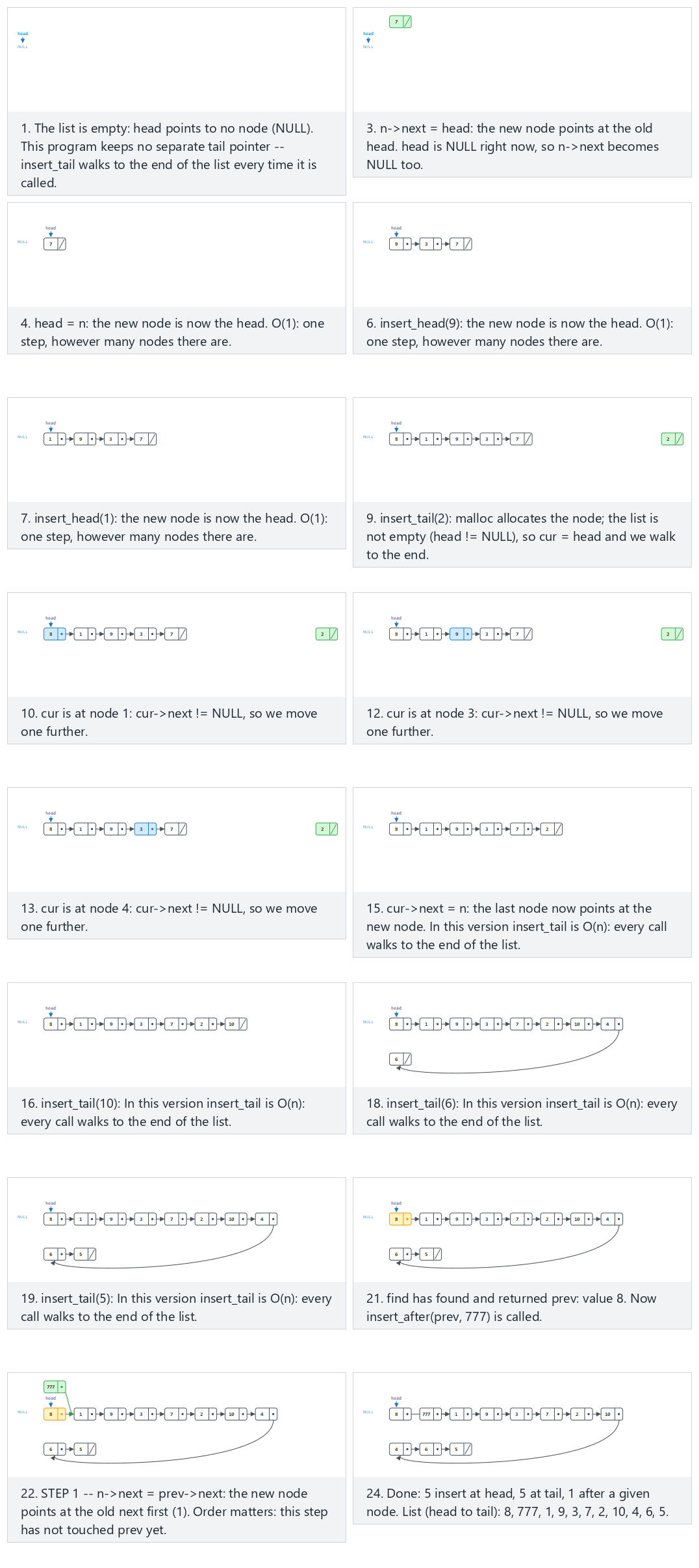
In the picker, also try 12 values (duplicates/negatives), insert after the FIRST match of a duplicate target (hard) and the edge cases insert into an empty list, insert right after the head and right after the tail, and if the two pointer-writes inside insert_after are swapped, the list is cut off (an illustration only — it is never run on the real list) — or press 🎲 for random data at four difficulty levels, or type your own hN / tN / aX:N operations.
typedef struct Node {
    int data;
    struct Node *next;
} Node;
Node *insert_head(Node *head, int value) {
Node *n = malloc(sizeof(Node));
n->data = value;
n->next = head; /* new node points at the old head */
return n; /* new node is the head now */
}
Node *insert_tail(Node *head, int value) { /* no tail pointer here: walks the list */
Node *n = malloc(sizeof(Node));
n->data = value;
n->next = NULL;
if (head == NULL)
return n;
Node *cur = head;
while (cur->next != NULL) /* walk to the last node: O(n) */
cur = cur->next;
cur->next = n;
return head;
}
void insert_after(Node *prev, int value) {
Node *n = malloc(sizeof(Node));
n->data = value;
n->next = prev->next; /* STEP 1: new node first */
prev->next = n; /* STEP 2: then link prev to it */
}
Node *find(Node *head, int value) {
for (Node *cur = head; cur != NULL; cur = cur->next)
if (cur->data == value)
return cur;
return NULL;
}
class Node {
int data;
Node next;
Node(int data) { this.data = data; }
}
static Node insertHead(Node head, int value) {
Node n = new Node(value);
n.next = head; // new node points at the old head
return n; // new node is the head now
}
static Node insertTail(Node head, int value) { // no tail field here: walks the list
Node n = new Node(value);
if (head == null)
return n;
Node cur = head;
while (cur.next != null) // walk to the last node: O(n)
cur = cur.next;
cur.next = n;
return head;
}
static void insertAfter(Node prev, int value) {
Node n = new Node(value);
n.next = prev.next; // STEP 1: new node first
prev.next = n; // STEP 2: then link prev to it
}
static Node find(Node head, int value) {
for (Node cur = head; cur != null; cur = cur.next)
if (cur.data == value)
return cur;
return null;
}
The full class (code/week-02/java/SinglyInsert.java) mirrors the C program's four scenarios exactly.
Full program: singly_insert.c / SinglyInsert.java
/* Week 2 -- Linked Lists, Arrays and Matrices
* Singly linked list: insert at head, at tail (no tail pointer -- walks the
* list), and after a given node. Matches the singly-insert.js animation.
* CEN207 Data Structures (formerly CE205)
*/
#include <stdio.h>
#include <stdlib.h>
typedef struct Node {
    int data;
    struct Node *next;
} Node;

Node *insert_head(Node *head, int value) {
    Node *n = malloc(sizeof(Node));
    n->data = value;
    n->next = head;      /* new node points at the old head */
    return n;            /* new node is the head now */
}

Node *insert_tail(Node *head, int value) {   /* no tail pointer here: walks the list */
    Node *n = malloc(sizeof(Node));
    n->data = value;
    n->next = NULL;
    if (head == NULL)
        return n;
    Node *cur = head;
    while (cur->next != NULL)   /* walk to the last node: O(n) */
        cur = cur->next;
    cur->next = n;
    return head;
}

void insert_after(Node *prev, int value) {
    Node *n = malloc(sizeof(Node));
    n->data = value;
    n->next = prev->next;   /* STEP 1: new node first */
    prev->next = n;         /* STEP 2: then link prev to it */
}

Node *find(Node *head, int value) {
    for (Node *cur = head; cur != NULL; cur = cur->next)
        if (cur->data == value)
            return cur;
    return NULL;
}
static void print_list(Node *head) {
printf("list:");
for (Node *cur = head; cur != NULL; cur = cur->next)
printf(" %d", cur->data);
printf("\n");
}
static void free_list(Node *head) {
while (head != NULL) {
Node *tmp = head;
head = head->next;
free(tmp);
}
}
/* op tokens: "hV" = insert_head(V); "tV" = insert_tail(V); "aX:V" = insert_after(find(X), V) */
static Node *run_scenario(const char *label, const char *ops[], int n) {
printf("-- %s --\n", label);
Node *head = NULL;
print_list(head);
for (int i = 0; i < n; i++) {
const char *op = ops[i];
if (op[0] == 'h') {
int v = atoi(op + 1);
head = insert_head(head, v);
printf("insert_head(%d)\n", v);
} else if (op[0] == 't') {
int v = atoi(op + 1);
head = insert_tail(head, v);
printf("insert_tail(%d)\n", v);
} else if (op[0] == 'a') {
int target, v;
sscanf(op + 1, "%d:%d", &target, &v);
Node *prev = find(head, target);
insert_after(prev, v);
printf("insert_after(find(%d), %d)\n", target, v);
}
print_list(head);
}
printf("\n");
return head;
}
int main(void) {
/* normal: 5 inserts at head, 5 at tail, then one after a node */
const char *normal[] = {"h7", "h3", "h9", "h1", "h8", "t2", "t10", "t4", "t6", "t5", "a8:777"};
Node *l1 = run_scenario("normal: 5 inserts at head, 5 at tail, then one after a node", normal, 11);
/* hard: 12 values (duplicates/negatives), insert after the FIRST match of a duplicate target */
const char *hard[] = {"t5", "t-3", "t5", "t0", "t-3", "t8", "t8", "t-1", "t2", "t-3", "t100", "t-100", "a-3:777"};
Node *l2 = run_scenario("hard: 12 values (duplicates/negatives), insert after the FIRST match of a duplicate target", hard, 13);
/* edge: insert into an empty list at the head */
const char *into_empty[] = {"h42"};
Node *l3 = run_scenario("edge: insert into an empty list at the head", into_empty, 1);
/* edge: insert right after the head and right after the tail (position k = 0 and k = last) */
const char *after_head_tail[] = {"t10", "t20", "t30", "t40", "t50", "t60", "t70", "t80", "t90", "t100", "a10:111", "a100:222"};
Node *l4 = run_scenario("edge: insert right after the head and right after the tail (position k = 0 and k = last)", after_head_tail, 12);
free_list(l1);
free_list(l2);
free_list(l3);
free_list(l4);
return 0;
}
/* Week 2 -- Linked Lists, Arrays and Matrices
 * Singly linked list: insert at head, at tail (no tail field -- walks the
 * list), and after a given node. Matches the singly-insert.js animation.
 * CEN207 Data Structures (formerly CE205)
 */
public class SinglyInsert {
    static class Node {
        int data;
        Node next;
        Node(int data) { this.data = data; }
    }

    static Node insertHead(Node head, int value) {
        Node n = new Node(value);
        n.next = head;        // new node points at the old head
        return n;              // new node is the head now
    }

    static Node insertTail(Node head, int value) {   // no tail field here: walks the list
        Node n = new Node(value);
        if (head == null)
            return n;
        Node cur = head;
        while (cur.next != null)     // walk to the last node: O(n)
            cur = cur.next;
        cur.next = n;
        return head;
    }

    static void insertAfter(Node prev, int value) {
        Node n = new Node(value);
        n.next = prev.next;    // STEP 1: new node first
        prev.next = n;         // STEP 2: then link prev to it
    }

    static Node find(Node head, int value) {
        for (Node cur = head; cur != null; cur = cur.next)
            if (cur.data == value)
                return cur;
        return null;
    }

    static void printList(Node head) {
        StringBuilder sb = new StringBuilder("list:");
        for (Node cur = head; cur != null; cur = cur.next) sb.append(' ').append(cur.data);
        System.out.println(sb);
    }

    // op tokens: "hV" = insertHead(V); "tV" = insertTail(V); "aX:V" = insertAfter(find(X), V)
    static Node runScenario(String label, String[] ops) {
        System.out.println("-- " + label + " --");
        Node head = null;
        printList(head);
        for (String op : ops) {
            char kind = op.charAt(0);
            if (kind == 'h') {
                int v = Integer.parseInt(op.substring(1));
                head = insertHead(head, v);
                System.out.println("insert_head(" + v + ")");   // trace text matches the C program's output
            } else if (kind == 't') {
                int v = Integer.parseInt(op.substring(1));
                head = insertTail(head, v);
                System.out.println("insert_tail(" + v + ")");
            } else if (kind == 'a') {
                String[] parts = op.substring(1).split(":");
                int target = Integer.parseInt(parts[0]), v = Integer.parseInt(parts[1]);
                Node prev = find(head, target);
                insertAfter(prev, v);
                System.out.println("insert_after(find(" + target + "), " + v + ")");
            }
            printList(head);
        }
        System.out.println();
        return head;
    }

    public static void main(String[] args) {
        // normal: 5 inserts at head, 5 at tail, then one after a node
        String[] normal = {"h7", "h3", "h9", "h1", "h8", "t2", "t10", "t4", "t6", "t5", "a8:777"};
        runScenario("normal: 5 inserts at head, 5 at tail, then one after a node", normal);

        // hard: 12 values (duplicates/negatives), insert after the FIRST match of a duplicate target
        String[] hard = {"t5", "t-3", "t5", "t0", "t-3", "t8", "t8", "t-1", "t2", "t-3", "t100", "t-100", "a-3:777"};
        runScenario("hard: 12 values (duplicates/negatives), insert after the FIRST match of a duplicate target", hard);

        // edge: insert into an empty list at the head
        String[] intoEmpty = {"h42"};
        runScenario("edge: insert into an empty list at the head", intoEmpty);

        // edge: insert right after the head and right after the tail (position k = 0 and k = last)
        String[] afterHeadTail = {"t10", "t20", "t30", "t40", "t50", "t60", "t70", "t80", "t90", "t100", "a10:111", "a100:222"};
        runScenario("edge: insert right after the head and right after the tail (position k = 0 and k = last)", afterHeadTail);
    }
}
Try it
Expected output:
-- normal: 5 inserts at head, 5 at tail, then one after a node --
list:
insert_head(7)
list: 7
insert_head(3)
list: 3 7
insert_head(9)
list: 9 3 7
insert_head(1)
list: 1 9 3 7
insert_head(8)
list: 8 1 9 3 7
insert_tail(2)
list: 8 1 9 3 7 2
insert_tail(10)
list: 8 1 9 3 7 2 10
insert_tail(4)
list: 8 1 9 3 7 2 10 4
insert_tail(6)
list: 8 1 9 3 7 2 10 4 6
insert_tail(5)
list: 8 1 9 3 7 2 10 4 6 5
insert_after(find(8), 777)
list: 8 777 1 9 3 7 2 10 4 6 5

-- hard: 12 values (duplicates/negatives), insert after the FIRST match of a duplicate target --
list:
insert_tail(5)
list: 5
insert_tail(-3)
list: 5 -3
insert_tail(5)
list: 5 -3 5
insert_tail(0)
list: 5 -3 5 0
insert_tail(-3)
list: 5 -3 5 0 -3
insert_tail(8)
list: 5 -3 5 0 -3 8
insert_tail(8)
list: 5 -3 5 0 -3 8 8
insert_tail(-1)
list: 5 -3 5 0 -3 8 8 -1
insert_tail(2)
list: 5 -3 5 0 -3 8 8 -1 2
insert_tail(-3)
list: 5 -3 5 0 -3 8 8 -1 2 -3
insert_tail(100)
list: 5 -3 5 0 -3 8 8 -1 2 -3 100
insert_tail(-100)
list: 5 -3 5 0 -3 8 8 -1 2 -3 100 -100
insert_after(find(-3), 777)
list: 5 -3 777 5 0 -3 8 8 -1 2 -3 100 -100

-- edge: insert into an empty list at the head --
list:
insert_head(42)
list: 42

-- edge: insert right after the head and right after the tail (position k = 0 and k = last) --
list:
insert_tail(10)
list: 10
insert_tail(20)
list: 10 20
insert_tail(30)
list: 10 20 30
insert_tail(40)
list: 10 20 30 40
insert_tail(50)
list: 10 20 30 40 50
insert_tail(60)
list: 10 20 30 40 50 60
insert_tail(70)
list: 10 20 30 40 50 60 70
insert_tail(80)
list: 10 20 30 40 50 60 70 80
insert_tail(90)
list: 10 20 30 40 50 60 70 80 90
insert_tail(100)
list: 10 20 30 40 50 60 70 80 90 100
insert_after(find(10), 111)
list: 10 111 20 30 40 50 60 70 80 90 100
insert_after(find(100), 222)
list: 10 111 20 30 40 50 60 70 80 90 100 222
Complexity. insert_head and insert_after are O(1) — a handful of pointer writes regardless of list length. insert_tail, in this version with no separate tail pointer, is O(n) because every call walks to the end; keeping a tail pointer (as section 8's doubly linked list does) brings it down to O(1) too.
7.2 Deletion by value
To delete a node, we must first find it — and, critically, find the node before it, since removing a node means making its predecessor skip over it (prev->next = cur->next) and then freeing it. The head is a special case with no predecessor at all: deleting it just means moving the head pointer forward one node.
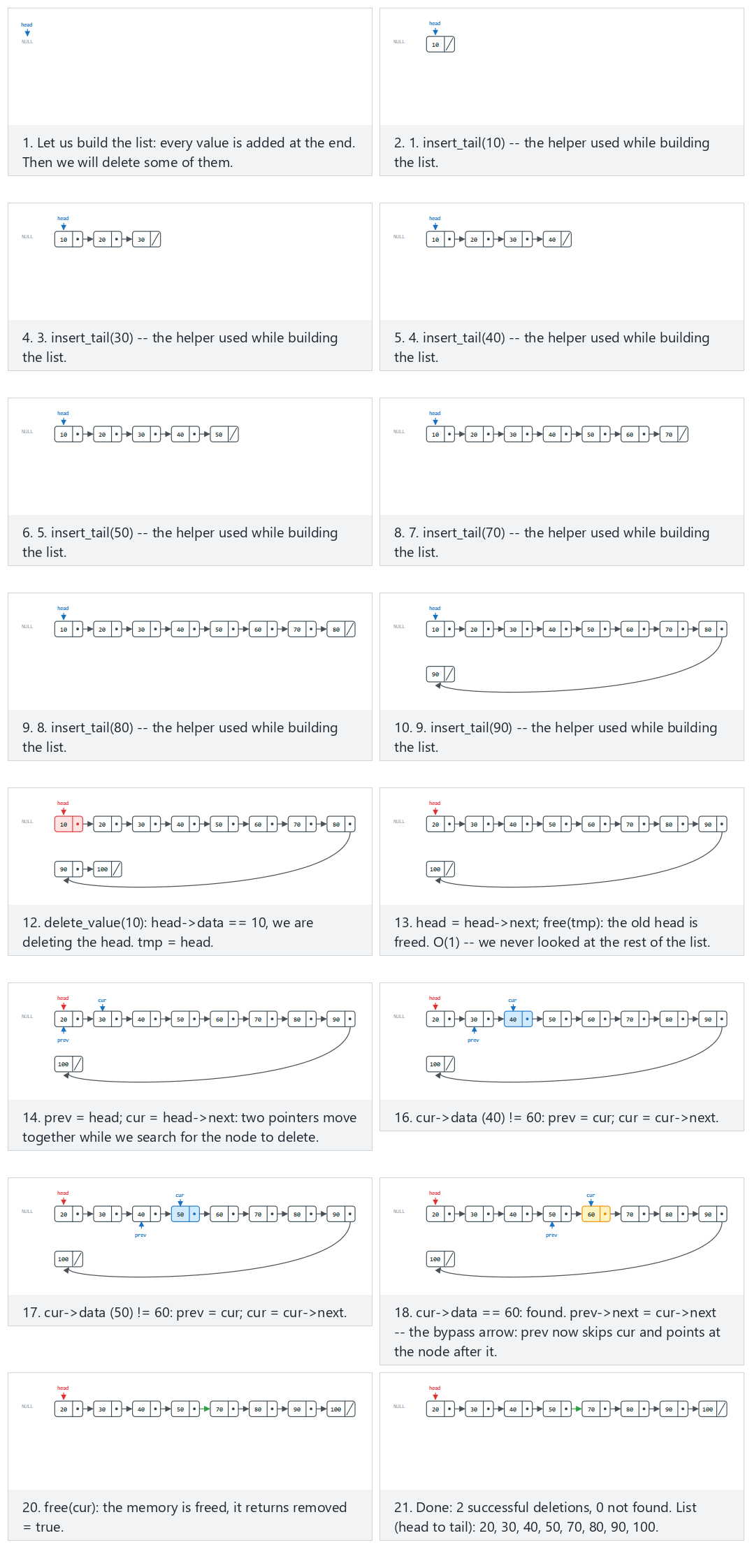
In the picker, also try 12 nodes with duplicate 5s: the head copy goes first, then a middle copy (hard) and the edge cases a single node: delete it, then delete again from the now-empty list and 10 nodes: delete the tail, then delete a value that is not present — or press 🎲 for random data at four difficulty levels, or type your own sequence of numbers (insert) and dN (delete).
typedef struct Node {
    int data;
    struct Node *next;
} Node;

Node *delete_value(Node *head, int value, bool *removed) {
    *removed = false;
    if (head == NULL)
        return NULL;

    if (head->data == value) {         /* removing the head itself */
        Node *tmp = head;
        head = head->next;
        free(tmp);
        *removed = true;
        return head;
    }

    Node *prev = head;
    Node *cur = head->next;
    while (cur != NULL) {
        if (cur->data == value) {
            prev->next = cur->next;    /* skip over cur: the bypass arrow */
            free(cur);
            *removed = true;
            return head;
        }
        prev = cur;
        cur = cur->next;
    }
    return head;                       /* value not found */
}
class Node {
    int data;
    Node next;
    Node(int data) { this.data = data; }
}

static DeleteResult deleteValue(Node head, int value) {
    if (head == null)
        return new DeleteResult(null, false);

    if (head.data == value)              // removing the head itself
        return new DeleteResult(head.next, true);

    Node prev = head;
    Node cur = head.next;
    while (cur != null) {
        if (cur.data == value) {
            prev.next = cur.next;        // skip over cur: the bypass arrow
            return new DeleteResult(head, true);
        }
        prev = cur;
        cur = cur.next;
    }
    return new DeleteResult(head, false); // value not found
}
The full class (code/week-02/java/SinglyDelete.java) mirrors the C program's four scenarios exactly.
Full program: singly_delete.c / SinglyDelete.java
/* Week 2 -- Linked Lists, Arrays and Matrices
 * Singly linked list: delete by value (head, a middle node, the tail, a
 * value not present, and deleting from an empty list). Matches the
 * singly-delete.js animation.
 * CEN207 Data Structures (formerly CE205)
 */
#include <stdbool.h>
#include <stdio.h>
#include <stdlib.h>

typedef struct Node {
    int data;
    struct Node *next;
} Node;

Node *delete_value(Node *head, int value, bool *removed) {
    *removed = false;
    if (head == NULL)
        return NULL;

    if (head->data == value) {         /* removing the head itself */
        Node *tmp = head;
        head = head->next;
        free(tmp);
        *removed = true;
        return head;
    }

    Node *prev = head;
    Node *cur = head->next;
    while (cur != NULL) {
        if (cur->data == value) {
            prev->next = cur->next;    /* skip over cur: the bypass arrow */
            free(cur);
            *removed = true;
            return head;
        }
        prev = cur;
        cur = cur->next;
    }
    return head;                       /* value not found */
}

static Node *insert_tail(Node *head, int value) {
    Node *n = malloc(sizeof(Node));
    n->data = value;
    n->next = NULL;
    if (head == NULL)
        return n;
    Node *cur = head;
    while (cur->next != NULL)
        cur = cur->next;
    cur->next = n;
    return head;
}

static void print_list(Node *head) {
    printf("list:");
    for (Node *cur = head; cur != NULL; cur = cur->next)
        printf(" %d", cur->data);
    printf("\n");
}

static void free_list(Node *head) {
    while (head != NULL) {
        Node *tmp = head;
        head = head->next;
        free(tmp);
    }
}

/* tokens: a plain number inserts it at the tail while building the list; "dV" deletes value V */
static Node *run_scenario(const char *label, const char *ops[], int n) {
    printf("-- %s --\n", label);
    Node *head = NULL;
    int removed_count = 0, not_found_count = 0;
    for (int i = 0; i < n; i++) {
        const char *op = ops[i];
        if (op[0] == 'd') {
            int v = atoi(op + 1);
            bool removed;
            head = delete_value(head, v, &removed);
            if (removed) { removed_count++; printf("delete_value(%d): removed\n", v); }
            else { not_found_count++; printf("delete_value(%d): not found\n", v); }
        } else {
            int v = atoi(op);
            head = insert_tail(head, v);
            printf("insert_tail(%d)\n", v);
        }
        print_list(head);
    }
    printf("removed=%d, not_found=%d\n\n", removed_count, not_found_count);
    return head;
}

int main(void) {
    /* normal: 10 nodes, delete the head, then delete a middle node */
    const char *normal[] = {"10", "20", "30", "40", "50", "60", "70", "80", "90", "100", "d10", "d60"};
    Node *l1 = run_scenario("normal: 10 nodes, delete the head, then delete a middle node", normal, 12);

    /* hard: 12 nodes with duplicate 5s: the head copy goes first, then a middle copy */
    const char *hard[] = {"5", "5", "20", "30", "5", "40", "50", "5", "60", "70", "80", "5", "d5", "d5"};
    Node *l2 = run_scenario("hard: 12 nodes with duplicate 5s: the head copy goes first, then a middle copy", hard, 14);

    /* edge: a single node: delete it, then delete again from the now-empty list */
    const char *single_then_empty[] = {"99", "d99", "d99"};
    Node *l3 = run_scenario("edge: a single node: delete it, then delete again from the now-empty list", single_then_empty, 3);

    /* edge: 10 nodes: delete the tail, then delete a value that is not present */
    const char *tail_and_missing[] = {"10", "20", "30", "40", "50", "60", "70", "80", "90", "100", "d100", "d12345"};
    Node *l4 = run_scenario("edge: 10 nodes: delete the tail, then delete a value that is not present", tail_and_missing, 12);

    free_list(l1);
    free_list(l2);
    free_list(l3);
    free_list(l4);
    return 0;
}
/* Week 2 -- Linked Lists, Arrays and Matrices
 * Singly linked list: delete by value (head, a middle node, the tail, a
 * value not present, and deleting from an empty list). Matches the
 * singly-delete.js animation.
 * CEN207 Data Structures (formerly CE205)
 */
public class SinglyDelete {
    static class Node {
        int data;
        Node next;
        Node(int data) { this.data = data; }
    }

    static class DeleteResult {
        Node head;
        boolean found;
        DeleteResult(Node head, boolean found) { this.head = head; this.found = found; }
    }

    static DeleteResult deleteValue(Node head, int value) {
        if (head == null)
            return new DeleteResult(null, false);

        if (head.data == value)              // removing the head itself
            return new DeleteResult(head.next, true);

        Node prev = head;
        Node cur = head.next;
        while (cur != null) {
            if (cur.data == value) {
                prev.next = cur.next;        // skip over cur: the bypass arrow
                return new DeleteResult(head, true);
            }
            prev = cur;
            cur = cur.next;
        }
        return new DeleteResult(head, false); // value not found
    }

    static Node insertTail(Node head, int value) {
        Node n = new Node(value);
        if (head == null)
            return n;
        Node cur = head;
        while (cur.next != null)
            cur = cur.next;
        cur.next = n;
        return head;
    }

    static void printList(Node head) {
        StringBuilder sb = new StringBuilder("list:");
        for (Node cur = head; cur != null; cur = cur.next) sb.append(' ').append(cur.data);
        System.out.println(sb);
    }

    // tokens: a plain number inserts it at the tail while building the list; "dV" deletes value V
    static Node runScenario(String label, String[] ops) {
        System.out.println("-- " + label + " --");
        Node head = null;
        int removedCount = 0, notFoundCount = 0;
        for (String op : ops) {
            if (op.charAt(0) == 'd') {
                int v = Integer.parseInt(op.substring(1));
                DeleteResult r = deleteValue(head, v);
                head = r.head;
                if (r.found) { removedCount++; System.out.println("delete_value(" + v + "): removed"); }
                else { notFoundCount++; System.out.println("delete_value(" + v + "): not found"); }
            } else {
                int v = Integer.parseInt(op);
                head = insertTail(head, v);
                System.out.println("insert_tail(" + v + ")");
            }
            printList(head);
        }
        System.out.println("removed=" + removedCount + ", not_found=" + notFoundCount);
        System.out.println();
        return head;
    }

    public static void main(String[] args) {
        // normal: 10 nodes, delete the head, then delete a middle node
        String[] normal = {"10", "20", "30", "40", "50", "60", "70", "80", "90", "100", "d10", "d60"};
        runScenario("normal: 10 nodes, delete the head, then delete a middle node", normal);

        // hard: 12 nodes with duplicate 5s: the head copy goes first, then a middle copy
        String[] hard = {"5", "5", "20", "30", "5", "40", "50", "5", "60", "70", "80", "5", "d5", "d5"};
        runScenario("hard: 12 nodes with duplicate 5s: the head copy goes first, then a middle copy", hard);

        // edge: a single node: delete it, then delete again from the now-empty list
        String[] singleThenEmpty = {"99", "d99", "d99"};
        runScenario("edge: a single node: delete it, then delete again from the now-empty list", singleThenEmpty);

        // edge: 10 nodes: delete the tail, then delete a value that is not present
        String[] tailAndMissing = {"10", "20", "30", "40", "50", "60", "70", "80", "90", "100", "d100", "d12345"};
        runScenario("edge: 10 nodes: delete the tail, then delete a value that is not present", tailAndMissing);
    }
}
Try it
Expected output:
-- normal: 10 nodes, delete the head, then delete a middle node --
insert_tail(10)
list: 10
insert_tail(20)
list: 10 20
insert_tail(30)
list: 10 20 30
insert_tail(40)
list: 10 20 30 40
insert_tail(50)
list: 10 20 30 40 50
insert_tail(60)
list: 10 20 30 40 50 60
insert_tail(70)
list: 10 20 30 40 50 60 70
insert_tail(80)
list: 10 20 30 40 50 60 70 80
insert_tail(90)
list: 10 20 30 40 50 60 70 80 90
insert_tail(100)
list: 10 20 30 40 50 60 70 80 90 100
delete_value(10): removed
list: 20 30 40 50 60 70 80 90 100
delete_value(60): removed
list: 20 30 40 50 70 80 90 100
removed=2, not_found=0

…

-- edge: 10 nodes: delete the tail, then delete a value that is not present --
insert_tail(10)
list: 10
insert_tail(20)
list: 10 20
insert_tail(30)
list: 10 20 30
insert_tail(40)
list: 10 20 30 40
insert_tail(50)
list: 10 20 30 40 50
insert_tail(60)
list: 10 20 30 40 50 60
insert_tail(70)
list: 10 20 30 40 50 60 70
insert_tail(80)
list: 10 20 30 40 50 60 70 80
insert_tail(90)
list: 10 20 30 40 50 60 70 80 90
insert_tail(100)
list: 10 20 30 40 50 60 70 80 90 100
delete_value(100): removed
list: 10 20 30 40 50 60 70 80 90
delete_value(12345): not found
list: 10 20 30 40 50 60 70 80 90
removed=1, not_found=1
Complexity. Deleting the head is O(1) — no search needed. Deleting any other value (found or not) is O(n), because the list must be walked from the head until the value turns up or the list ends.
Common mistakes
- Freeing a node before reading the field you still need from it —
prev->next = cur->nextmust happen beforefree(cur), not after, sincefreeinvalidatescur's memory. - Losing the rest of the list by overwriting
prev->nextwith the wrong pointer — it must becomecur->next(the node after the one being deleted), notNULLand notcuritself. - Forgetting the head is a special case: it has no
prevto update, so deleting it means moving the head pointer itself, not walking with two pointers as the rest of the function does.
7.3 Search
Searching a linked list is the same idea as Week 1's linear search on an array — walk from the start, compare each element, stop at the first match — except that "next element" now means following a next pointer instead of incrementing an index. There is no equivalent of Week 1's binary search here: binary search needs to jump straight to the middle element in O(1), and a linked list has no way to do that without walking there first, which defeats the whole point. (If you have not looked at array_linear_search.c and array_binary_search.c from Week 1 recently, section 12's table below revisits exactly this trade-off, and Exercise 1 asks you to re-run them side by side with this section's singly_search.c.)
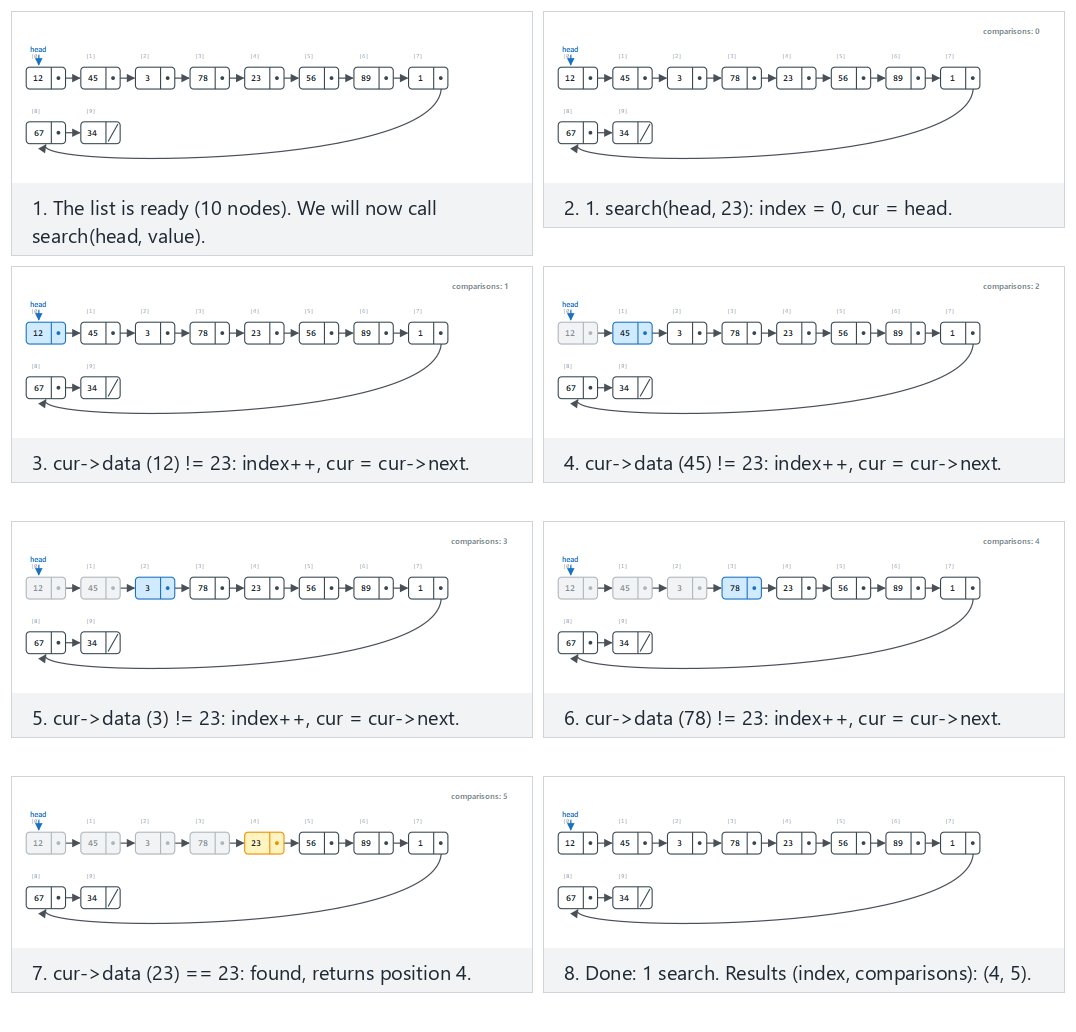
In the picker, also try 12 values with duplicates — the first match wins (hard) and the edge cases the first element, the last element, and a value that is not present and search on an empty list — or press 🎲 for random data at four difficulty levels, or type your own list and target values.
class Node {
    int data;
    Node next;
    Node(int data) { this.data = data; }
}

static int search(Node head, int value) {
    int index = 0;
    for (Node cur = head; cur != null; cur = cur.next) {
        if (cur.data == value)
            return index;      // found at this position
        index++;
    }
    return -1;                 // not found
}
The full class (code/week-02/java/SinglySearch.java) mirrors the C program's four scenarios exactly.
Full program: singly_search.c / SinglySearch.java
/* Week 2 -- Linked Lists, Arrays and Matrices
 * Singly linked list: linear search with a comparison count. Matches the
 * singly-search.js animation.
 * CEN207 Data Structures (formerly CE205)
 */
#include <stdio.h>
#include <stdlib.h>

typedef struct Node {
    int data;
    struct Node *next;
} Node;

int search(Node *head, int value, int *comparisons) {
    int index = 0;
    *comparisons = 0;
    for (Node *cur = head; cur != NULL; cur = cur->next) {
        (*comparisons)++;
        if (cur->data == value)
            return index;      /* found at this position */
        index++;
    }
    return -1;                 /* not found */
}

static Node *build_list(const int values[], int n) {
    Node *head = NULL, *tail = NULL;
    for (int i = 0; i < n; i++) {
        Node *node = malloc(sizeof(Node));
        node->data = values[i];
        node->next = NULL;
        if (tail == NULL) head = node; else tail->next = node;
        tail = node;
    }
    return head;
}

static void free_list(Node *head) {
    while (head != NULL) {
        Node *tmp = head;
        head = head->next;
        free(tmp);
    }
}

static void run_scenario(const char *label, const int values[], int n, const int queries[], int qn) {
    printf("-- %s --\n", label);
    Node *head = build_list(values, n);
    printf("list:");
    for (int i = 0; i < n; i++) printf(" %d", values[i]);
    printf("\n");
    for (int q = 0; q < qn; q++) {
        int comparisons;
        int index = search(head, queries[q], &comparisons);
        printf("search(%d) = index %d, comparisons %d\n", queries[q], index, comparisons);
    }
    printf("\n");
    free_list(head);
}

int main(void) {
    /* normal: 10 values, the target is in the middle */
    int normal[] = {12, 45, 3, 78, 23, 56, 89, 1, 67, 34};
    int normal_q[] = {23};
    run_scenario("normal: 10 values, the target is in the middle", normal, 10, normal_q, 1);

    /* hard: 12 values with duplicates -- the first match wins */
    int hard[] = {8, 15, 8, 22, 40, 8, 55, 61, 8, 70, 80, 90};
    int hard_q[] = {8};
    run_scenario("hard: 12 values with duplicates -- the first match wins", hard, 12, hard_q, 1);

    /* edge: the first element, the last element, and a value that is not present */
    int first_last[] = {12, 45, 3, 78, 23, 56, 89, 1, 67, 34};
    int first_last_q[] = {12, 34, 999};
    run_scenario("edge: the first element, the last element, and a value that is not present", first_last, 10, first_last_q, 3);

    /* edge: search on an empty list */
    int empty[] = {0};
    int empty_q[] = {1};
    run_scenario("edge: search on an empty list", empty, 0, empty_q, 1);

    return 0;
}
/* Week 2 -- Linked Lists, Arrays and Matrices
 * Singly linked list: linear search with a comparison count. Matches the
 * singly-search.js animation.
 * CEN207 Data Structures (formerly CE205)
 */
public class SinglySearch {
    static class Node {
        int data;
        Node next;
        Node(int data) { this.data = data; }
    }

    static class SearchResult {
        int index;
        int comparisons;
        SearchResult(int index, int comparisons) { this.index = index; this.comparisons = comparisons; }
    }

    static SearchResult search(Node head, int value) {
        int index = 0, comparisons = 0;
        for (Node cur = head; cur != null; cur = cur.next) {
            comparisons++;
            if (cur.data == value)
                return new SearchResult(index, comparisons);      // found at this position
            index++;
        }
        return new SearchResult(-1, comparisons);                 // not found
    }

    static Node buildList(int[] values) {
        Node head = null, tail = null;
        for (int v : values) {
            Node node = new Node(v);
            if (tail == null) head = node; else tail.next = node;
            tail = node;
        }
        return head;
    }

    static void runScenario(String label, int[] values, int[] queries) {
        System.out.println("-- " + label + " --");
        Node head = buildList(values);
        StringBuilder sb = new StringBuilder("list:");
        for (int v : values) sb.append(' ').append(v);
        System.out.println(sb);
        for (int q : queries) {
            SearchResult r = search(head, q);
            System.out.println("search(" + q + ") = index " + r.index + ", comparisons " + r.comparisons);
        }
        System.out.println();
    }

    public static void main(String[] args) {
        // normal: 10 values, the target is in the middle
        int[] normal = {12, 45, 3, 78, 23, 56, 89, 1, 67, 34};
        runScenario("normal: 10 values, the target is in the middle", normal, new int[]{23});

        // hard: 12 values with duplicates -- the first match wins
        int[] hard = {8, 15, 8, 22, 40, 8, 55, 61, 8, 70, 80, 90};
        runScenario("hard: 12 values with duplicates -- the first match wins", hard, new int[]{8});

        // edge: the first element, the last element, and a value that is not present
        int[] firstLast = {12, 45, 3, 78, 23, 56, 89, 1, 67, 34};
        runScenario("edge: the first element, the last element, and a value that is not present", firstLast, new int[]{12, 34, 999});

        // edge: search on an empty list
        int[] empty = {};
        runScenario("edge: search on an empty list", empty, new int[]{1});
    }
}
Try it
Expected output:
-- normal: 10 values, the target is in the middle --
list: 12 45 3 78 23 56 89 1 67 34
search(23) = index 4, comparisons 5

-- hard: 12 values with duplicates -- the first match wins --
list: 8 15 8 22 40 8 55 61 8 70 80 90
search(8) = index 0, comparisons 1

-- edge: the first element, the last element, and a value that is not present --
list: 12 45 3 78 23 56 89 1 67 34
search(12) = index 0, comparisons 1
search(34) = index 9, comparisons 10
search(999) = index -1, comparisons 10

-- edge: search on an empty list --
list:
search(1) = index -1, comparisons 0
Complexity. O(n) in the worst case (the value is last or absent) and O(1) in the best case (the value is at the head) — there is no way to do better without an auxiliary structure, since the list gives no information about where a value might be before you look.
7.4 Reversing a list in place
Reversing a linked list means flipping every single next arrow to point the other way, so that the old tail becomes the new head. This has to be done with three pointers moving together: prev (initially NULL), curr (initially head), and a temporary next that saves curr's original successor before curr->next is overwritten — without that temporary, the rest of the list would be lost the instant the first arrow is flipped.
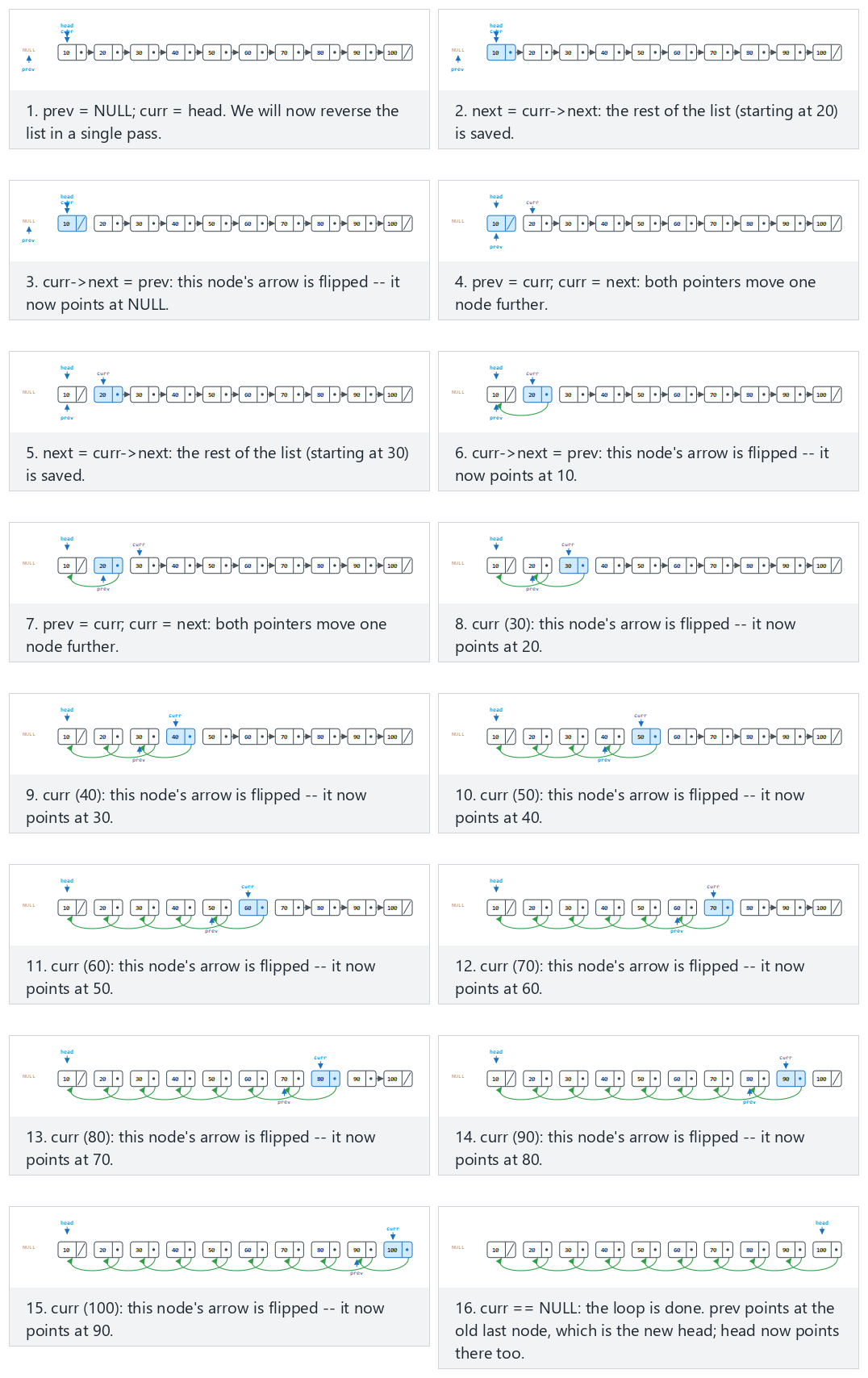
In the picker, also try 20 nodes (duplicates/negatives, two rows) (hard) and the edge cases an empty list, a single node, and two nodes — or press 🎲 for random data at four difficulty levels, or type your own list (it may be left empty).
typedef struct Node {
    int data;
    struct Node *next;
} Node;

Node *reverse(Node *head) {
    Node *prev = NULL;
    Node *curr = head;
    while (curr != NULL) {
        Node *next = curr->next;   /* save the rest of the list */
        curr->next = prev;          /* flip this node's arrow */
        prev = curr;                 /* prev catches up */
        curr = next;                 /* curr moves on */
    }
    return prev;                     /* prev is the new head */
}
class Node {
    int data;
    Node next;
    Node(int data) { this.data = data; }
}

static Node reverse(Node head) {
    Node prev = null;
    Node curr = head;
    while (curr != null) {
        Node next = curr.next;    // save the rest of the list
        curr.next = prev;          // flip this node's arrow
        prev = curr;                // prev catches up
        curr = next;                // curr moves on
    }
    return prev;                    // prev is the new head
}
The full class (code/week-02/java/SinglyReverse.java) mirrors the C program's five scenarios exactly.
Full program: singly_reverse.c / SinglyReverse.java
/* Week 2 -- Linked Lists, Arrays and Matrices
 * Singly linked list: iterative reverse with three pointers (prev, curr,
 * next). Matches the singly-reverse.js animation.
 * CEN207 Data Structures (formerly CE205)
 */
#include <stdio.h>
#include <stdlib.h>

typedef struct Node {
    int data;
    struct Node *next;
} Node;

Node *reverse(Node *head) {
    Node *prev = NULL;
    Node *curr = head;
    while (curr != NULL) {
        Node *next = curr->next;   /* save the rest of the list */
        curr->next = prev;          /* flip this node's arrow */
        prev = curr;                 /* prev catches up */
        curr = next;                 /* curr moves on */
    }
    return prev;                     /* prev is the new head */
}

static Node *build_list(const int values[], int n) {
    Node *head = NULL, *tail = NULL;
    for (int i = 0; i < n; i++) {
        Node *node = malloc(sizeof(Node));
        node->data = values[i];
        node->next = NULL;
        if (tail == NULL) head = node; else tail->next = node;
        tail = node;
    }
    return head;
}

static void print_list(Node *head) {
    printf("list:");
    for (Node *cur = head; cur != NULL; cur = cur->next)
        printf(" %d", cur->data);
    printf("\n");
}

static void free_list(Node *head) {
    while (head != NULL) {
        Node *tmp = head;
        head = head->next;
        free(tmp);
    }
}

static void run_scenario(const char *label, const int values[], int n) {
    printf("-- %s --\n", label);
    Node *head = build_list(values, n);
    print_list(head);
    head = reverse(head);
    printf("reverse():\n");
    print_list(head);
    printf("\n");
    free_list(head);
}

int main(void) {
    /* normal: 10 nodes */
    int normal[] = {10, 20, 30, 40, 50, 60, 70, 80, 90, 100};
    run_scenario("normal: 10 nodes", normal, 10);

    /* hard: 20 nodes (duplicates/negatives, two rows) */
    int hard[] = {5, -3, 5, 0, -3, 8, 8, -1, 2, -3, 100, -100, 7, 7, -50, 63, -8, 19, 0, 44};
    run_scenario("hard: 20 nodes (duplicates/negatives, two rows)", hard, 20);

    /* edge: empty list */
    run_scenario("edge: empty list", NULL, 0);

    /* edge: a single node */
    int one_node[] = {7};
    run_scenario("edge: a single node", one_node, 1);

    /* edge: two nodes */
    int two_nodes[] = {1, 2};
    run_scenario("edge: two nodes", two_nodes, 2);

    return 0;
}
/* Week 2 -- Linked Lists, Arrays and Matrices
 * Singly linked list: iterative reverse with three pointers (prev, curr,
 * next). Matches the singly-reverse.js animation.
 * CEN207 Data Structures (formerly CE205)
 */
public class SinglyReverse {
    static class Node {
        int data;
        Node next;
        Node(int data) { this.data = data; }
    }

    static Node reverse(Node head) {
        Node prev = null;
        Node curr = head;
        while (curr != null) {
            Node next = curr.next;    // save the rest of the list
            curr.next = prev;          // flip this node's arrow
            prev = curr;                // prev catches up
            curr = next;                // curr moves on
        }
        return prev;                    // prev is the new head
    }

    static Node buildList(int[] values) {
        Node head = null, tail = null;
        for (int v : values) {
            Node node = new Node(v);
            if (tail == null) head = node; else tail.next = node;
            tail = node;
        }
        return head;
    }

    static void printList(Node head) {
        StringBuilder sb = new StringBuilder("list:");
        for (Node cur = head; cur != null; cur = cur.next) sb.append(' ').append(cur.data);
        System.out.println(sb);
    }

    static void runScenario(String label, int[] values) {
        System.out.println("-- " + label + " --");
        Node head = buildList(values);
        printList(head);
        head = reverse(head);
        System.out.println("reverse():");
        printList(head);
        System.out.println();
    }

    public static void main(String[] args) {
        // normal: 10 nodes
        int[] normal = {10, 20, 30, 40, 50, 60, 70, 80, 90, 100};
        runScenario("normal: 10 nodes", normal);

        // hard: 20 nodes (duplicates/negatives, two rows)
        int[] hard = {5, -3, 5, 0, -3, 8, 8, -1, 2, -3, 100, -100, 7, 7, -50, 63, -8, 19, 0, 44};
        runScenario("hard: 20 nodes (duplicates/negatives, two rows)", hard);

        // edge: empty list
        runScenario("edge: empty list", new int[]{});

        // edge: a single node
        runScenario("edge: a single node", new int[]{7});

        // edge: two nodes
        runScenario("edge: two nodes", new int[]{1, 2});
    }
}
Try it
Expected output:
-- normal: 10 nodes --
list: 10 20 30 40 50 60 70 80 90 100
reverse():
list: 100 90 80 70 60 50 40 30 20 10

-- hard: 20 nodes (duplicates/negatives, two rows) --
list: 5 -3 5 0 -3 8 8 -1 2 -3 100 -100 7 7 -50 63 -8 19 0 44
reverse():
list: 44 0 19 -8 63 -50 7 7 -100 100 -3 2 -1 8 8 -3 0 5 -3 5

-- edge: empty list --
list:
reverse():
list:

-- edge: a single node --
list: 7
reverse():
list: 7

-- edge: two nodes --
list: 1 2
reverse():
list: 2 1
Complexity. O(n) time — each node is visited exactly once — and O(1) extra space: reverse rewires the existing nodes in place and never allocates a new one.
Common mistakes
- Forgetting to save
curr->nextbefore overwriting it — without the temporarynextvariable, flippingcurr->next = prevsevers the only link to the rest of the original list, and everything aftercurris lost forever (a classic memory leak in C, and simply unreachable data in Java). - Returning
headinstead ofprevat the end — after the loop, the originalheadvariable still points at the first node of the original list, which is now the last node; the new head isprev. - Assuming the empty-list and single-node cases need special handling — they do not: the same three-pointer loop handles
n = 0(the loop body never runs,previs stillNULL) andn = 1(the loop runs once) correctly, with no branches needed.
8. Doubly linked list
8.1 A question to start
Section 7 built insert_tail by walking the whole list to find the last node, and delete_value by walking with two pointers so that the predecessor is always in hand when it is needed. Both of these costs come from the same limitation: a node in a singly linked list only knows what comes after it, never what comes before. What if every node also stored a pointer to its predecessor?
8.2 Two pointers per node, a head and a tail
A doubly linked list node carries prev and next fields; the list itself keeps both a head pointer (the first node) and a tail pointer (the last node). This buys three things at once: O(1) tail insertion (no walk needed — tail is already known), backward traversal (walk tail, tail->prev, and so on), and, if you ever hold a pointer to some node cur directly, O(1) deletion of it (its neighbours are already known via cur->prev and cur->next — no search needed at all). The price is double the pointer bookkeeping: every insertion and deletion must keep prev and next consistent on both sides of the change, and the head/tail pointers must be kept correct for the edge cases where the node being touched is the first or last one in the list.
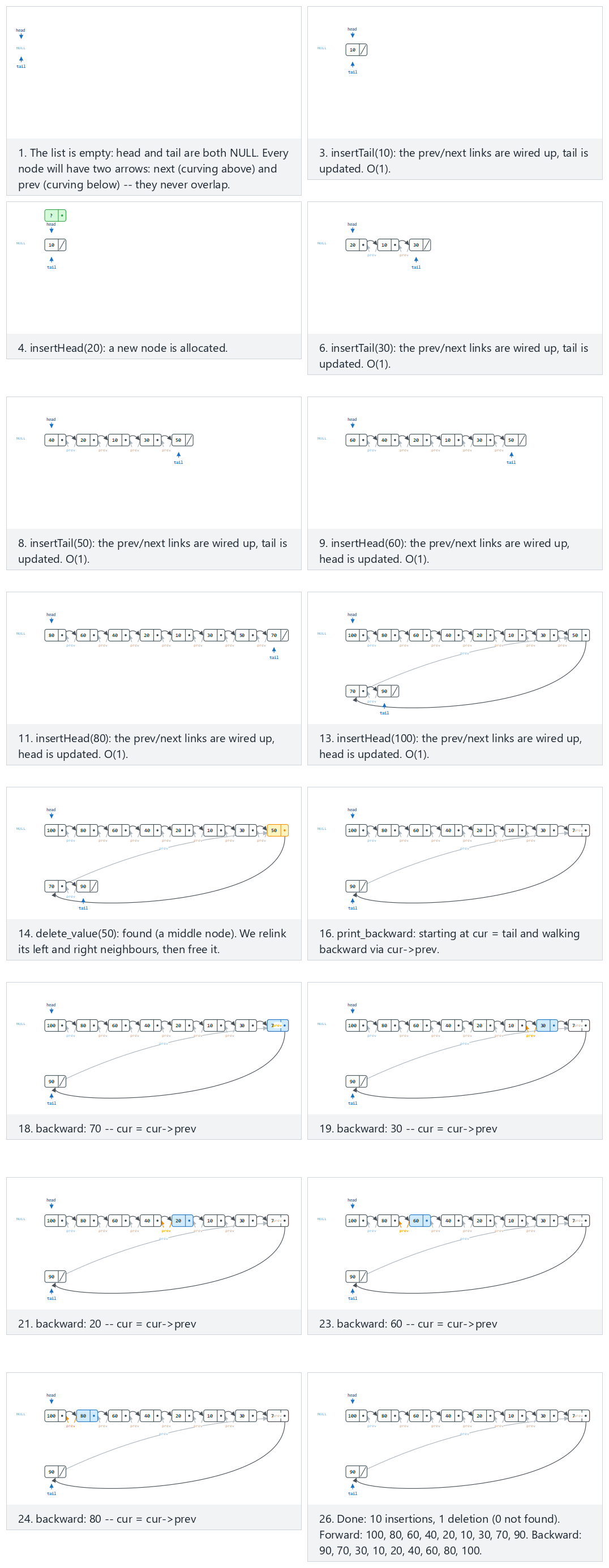
In the picker, also try 12 nodes, duplicates/negatives; the FIRST match of a duplicate is deleted (hard) and the edge cases a single node: insert it, then delete it, 10 nodes: delete the head, delete the tail, delete a value that is not present, insert after a middle value, insert after the node tail points to: the new node becomes the new tail, and trying to insert after a value that is not in the list — or press 🎲 for random data at four difficulty levels, or type your own hN / tN / aT:V / dN / b (traverse backward) operations.
typedef struct Node {
    int data;
    struct Node *prev;
    struct Node *next;
} Node;
typedef struct { Node *head; Node *tail; } List;

void insert_head(List *list, int value) {
    Node *n = malloc(sizeof(Node));
    n->data = value; n->prev = NULL; n->next = list->head;
    if (list->head != NULL) list->head->prev = n;  /* old head now has a prev */
    list->head = n;
    if (list->tail == NULL) list->tail = n;
}

void insert_tail(List *list, int value) {
    Node *n = malloc(sizeof(Node));
    n->data = value; n->next = NULL; n->prev = list->tail;
    if (list->tail != NULL) list->tail->next = n;  /* old tail now has a next */
    list->tail = n;
    if (list->head == NULL) list->head = n;
}

bool insert_after(List *list, int target, int value) {
    for (Node *cur = list->head; cur != NULL; cur = cur->next) {
        if (cur->data == target) {
            Node *n = malloc(sizeof(Node));
            n->data = value; n->prev = cur; n->next = cur->next;
            if (cur->next != NULL) cur->next->prev = n; else list->tail = n;  /* cur was the tail */
            cur->next = n;
            return true;
        }
    }
    return false;                                    /* target not found */
}

bool delete_value(List *list, int value) {
    for (Node *cur = list->head; cur != NULL; cur = cur->next) {
        if (cur->data == value) {
            if (cur->prev != NULL) cur->prev->next = cur->next; else list->head = cur->next;
            if (cur->next != NULL) cur->next->prev = cur->prev; else list->tail = cur->prev;
            free(cur);
            return true;
        }
    }
    return false;
}

void print_backward(List *list) {
    for (Node *cur = list->tail; cur != NULL; cur = cur->prev)
        printf(" %d", cur->data);
}
class Node { int data; Node prev, next; Node(int d) { data = d; } }
class List { Node head, tail; }

static void insertHead(List list, int value) {
    Node n = new Node(value);
    n.next = list.head;
    if (list.head != null) list.head.prev = n;  // old head now has a prev
    list.head = n;
    if (list.tail == null) list.tail = n;
}

static void insertTail(List list, int value) {
    Node n = new Node(value);
    n.prev = list.tail;
    if (list.tail != null) list.tail.next = n;  // old tail now has a next
    list.tail = n;
    if (list.head == null) list.head = n;
}

static boolean insertAfter(List list, int target, int value) {
    for (Node cur = list.head; cur != null; cur = cur.next) {
        if (cur.data == target) {
            Node n = new Node(value);
            n.prev = cur; n.next = cur.next;
            if (cur.next != null) cur.next.prev = n; else list.tail = n;  // cur was the tail
            cur.next = n;
            return true;
        }
    }
    return false;                                    // target not found
}

static boolean deleteValue(List list, int value) {
    for (Node cur = list.head; cur != null; cur = cur.next) {
        if (cur.data == value) {
            if (cur.prev != null) cur.prev.next = cur.next; else list.head = cur.next;
            if (cur.next != null) cur.next.prev = cur.prev; else list.tail = cur.prev;
            return true;
        }
    }
    return false;
}

static void printBackward(List list) {
    for (Node cur = list.tail; cur != null; cur = cur.prev)
        System.out.print(" " + cur.data);
}
The full class (code/week-02/java/DoublyLinkedList.java) mirrors the C program's five scenarios exactly.
Full program: doubly_linked_list.c / DoublyLinkedList.java
/* Week 2 -- Linked Lists, Arrays and Matrices
 * Doubly linked list: insert at the front, at the back and after a given
 * value, delete anywhere by value, and traverse backwards. Matches the
 * doubly-linked-list.js animation.
 * CEN207 Data Structures (formerly CE205)
 */
#include <stdbool.h>
#include <stdio.h>
#include <stdlib.h>

typedef struct Node {
    int data;
    struct Node *prev;
    struct Node *next;
} Node;
typedef struct { Node *head; Node *tail; } List;

void insert_head(List *list, int value) {
    Node *n = malloc(sizeof(Node));
    n->data = value; n->prev = NULL; n->next = list->head;
    if (list->head != NULL) list->head->prev = n;  /* old head now has a prev */
    list->head = n;
    if (list->tail == NULL) list->tail = n;
}

void insert_tail(List *list, int value) {
    Node *n = malloc(sizeof(Node));
    n->data = value; n->next = NULL; n->prev = list->tail;
    if (list->tail != NULL) list->tail->next = n;  /* old tail now has a next */
    list->tail = n;
    if (list->head == NULL) list->head = n;
}

bool insert_after(List *list, int target, int value) {
    for (Node *cur = list->head; cur != NULL; cur = cur->next) {
        if (cur->data == target) {
            Node *n = malloc(sizeof(Node));
            n->data = value; n->prev = cur; n->next = cur->next;
            if (cur->next != NULL) cur->next->prev = n; else list->tail = n;  /* cur was the tail */
            cur->next = n;
            return true;
        }
    }
    return false;                                    /* target not found */
}

bool delete_value(List *list, int value) {
    for (Node *cur = list->head; cur != NULL; cur = cur->next) {
        if (cur->data == value) {
            if (cur->prev != NULL) cur->prev->next = cur->next; else list->head = cur->next;
            if (cur->next != NULL) cur->next->prev = cur->prev; else list->tail = cur->prev;
            free(cur);
            return true;
        }
    }
    return false;
}

void print_backward(List *list) {
    for (Node *cur = list->tail; cur != NULL; cur = cur->prev)
        printf(" %d", cur->data);
}

static void print_forward(List *list) {
    printf("forward: ");
    for (Node *cur = list->head; cur != NULL; cur = cur->next)
        printf(" %d", cur->data);
    printf("\n");
}

static void free_list(List *list) {
    Node *cur = list->head;
    while (cur != NULL) {
        Node *tmp = cur;
        cur = cur->next;
        free(tmp);
    }
    list->head = list->tail = NULL;
}

/* tokens: "hV" = insert_head(V); "tV" = insert_tail(V); "aX:V" = insert_after(X, V);
 * "dV" = delete_value(V); "b" = print backward */
static void run_scenario(const char *label, const char *ops[], int n) {
    printf("-- %s --\n", label);
    List list = { NULL, NULL };
    for (int i = 0; i < n; i++) {
        const char *op = ops[i];
        if (op[0] == 'h') {
            int v = atoi(op + 1);
            insert_head(&list, v);
            printf("insert_head(%d)\n", v);
        } else if (op[0] == 't') {
            int v = atoi(op + 1);
            insert_tail(&list, v);
            printf("insert_tail(%d)\n", v);
        } else if (op[0] == 'a') {
            int target, v;
            sscanf(op + 1, "%d:%d", &target, &v);
            bool ok = insert_after(&list, target, v);
            printf("insert_after(%d, %d): %s\n", target, v, ok ? "inserted" : "not found");
        } else if (op[0] == 'd') {
            int v = atoi(op + 1);
            bool ok = delete_value(&list, v);
            printf("delete_value(%d): %s\n", v, ok ? "removed" : "not found");
        } else if (op[0] == 'b') {
            printf("backward:");
            print_backward(&list);
            printf("\n");
            continue;
        }
        print_forward(&list);
    }
    printf("\n");
    free_list(&list);
}

int main(void) {
    /* normal: 10 nodes (alternating front/back), delete a middle node, traverse backward */
    const char *normal[] = {"t10", "h20", "t30", "h40", "t50", "h60", "t70", "h80", "t90", "h100", "d50", "b"};
    run_scenario("normal: 10 nodes (alternating front/back), delete a middle node, traverse backward", normal, 12);

    /* hard: 12 nodes, duplicates/negatives; the FIRST match of a duplicate -3 is deleted */
    const char *hard[] = {"t5", "h-3", "t5", "h0", "t-3", "h8", "t8", "h-1", "t2", "h-3", "t100", "h-100", "d-3", "b"};
    run_scenario("hard: 12 nodes, duplicates/negatives; the FIRST match of a duplicate -3 is deleted", hard, 14);

    /* edge: a single node: insert it, then delete it (the list is empty again) */
    const char *single_element[] = {"h5", "d5", "b"};
    run_scenario("edge: a single node: insert it, then delete it (the list is empty again)", single_element, 3);

    /* edge: insert after the node tail points to: the new node becomes the new tail */
    const char *insert_after_tail[] = {"t10", "t20", "t30", "t40", "t50", "t60", "t70", "t80", "t90", "t100", "a100:105", "b"};
    run_scenario("edge: insert after the node tail points to: the new node becomes the new tail", insert_after_tail, 12);

    /* edge: trying to insert after a value that is not in the list */
    const char *insert_after_not_found[] = {"t10", "t20", "t30", "t40", "t50", "t60", "t70", "t80", "t90", "t100", "a99999:1", "b"};
    run_scenario("edge: trying to insert after a value that is not in the list", insert_after_not_found, 12);

    return 0;
}
/* Week 2 -- Linked Lists, Arrays and Matrices
 * Doubly linked list: insert at the front, at the back and after a given
 * value, delete anywhere by value, and traverse backwards. Matches the
 * doubly-linked-list.js animation.
 * CEN207 Data Structures (formerly CE205)
 */
public class DoublyLinkedList {
    static class Node { int data; Node prev, next; Node(int d) { data = d; } }
    static class List { Node head, tail; }

    static void insertHead(List list, int value) {
        Node n = new Node(value);
        n.next = list.head;
        if (list.head != null) list.head.prev = n;  // old head now has a prev
        list.head = n;
        if (list.tail == null) list.tail = n;
    }

    static void insertTail(List list, int value) {
        Node n = new Node(value);
        n.prev = list.tail;
        if (list.tail != null) list.tail.next = n;  // old tail now has a next
        list.tail = n;
        if (list.head == null) list.head = n;
    }

    static boolean insertAfter(List list, int target, int value) {
        for (Node cur = list.head; cur != null; cur = cur.next) {
            if (cur.data == target) {
                Node n = new Node(value);
                n.prev = cur; n.next = cur.next;
                if (cur.next != null) cur.next.prev = n; else list.tail = n;  // cur was the tail
                cur.next = n;
                return true;
            }
        }
        return false;                                    // target not found
    }

    static boolean deleteValue(List list, int value) {
        for (Node cur = list.head; cur != null; cur = cur.next) {
            if (cur.data == value) {
                if (cur.prev != null) cur.prev.next = cur.next; else list.head = cur.next;
                if (cur.next != null) cur.next.prev = cur.prev; else list.tail = cur.prev;
                return true;
            }
        }
        return false;
    }

    static void printBackward(List list, StringBuilder out) {
        for (Node cur = list.tail; cur != null; cur = cur.prev)
            out.append(' ').append(cur.data);
    }

    static void printForward(List list) {
        StringBuilder sb = new StringBuilder("forward: ");
        for (Node cur = list.head; cur != null; cur = cur.next) sb.append(' ').append(cur.data);
        System.out.println(sb);
    }

    // tokens: "hV" = insertHead(V); "tV" = insertTail(V); "aX:V" = insertAfter(X, V);
    // "dV" = deleteValue(V); "b" = print backward
    static void runScenario(String label, String[] ops) {
        System.out.println("-- " + label + " --");
        List list = new List();
        for (String op : ops) {
            char kind = op.charAt(0);
            if (kind == 'h') {
                int v = Integer.parseInt(op.substring(1));
                insertHead(list, v);
                System.out.println("insert_head(" + v + ")");
            } else if (kind == 't') {
                int v = Integer.parseInt(op.substring(1));
                insertTail(list, v);
                System.out.println("insert_tail(" + v + ")");
            } else if (kind == 'a') {
                String[] parts = op.substring(1).split(":");
                int target = Integer.parseInt(parts[0]), v = Integer.parseInt(parts[1]);
                boolean ok = insertAfter(list, target, v);
                System.out.println("insert_after(" + target + ", " + v + "): " + (ok ? "inserted" : "not found"));
            } else if (kind == 'd') {
                int v = Integer.parseInt(op.substring(1));
                boolean ok = deleteValue(list, v);
                System.out.println("delete_value(" + v + "): " + (ok ? "removed" : "not found"));
            } else if (kind == 'b') {
                StringBuilder sb = new StringBuilder("backward:");
                printBackward(list, sb);
                System.out.println(sb);
                continue;
            }
            printForward(list);
        }
        System.out.println();
    }

    public static void main(String[] args) {
        // normal: 10 nodes (alternating front/back), delete a middle node, traverse backward
        String[] normal = {"t10", "h20", "t30", "h40", "t50", "h60", "t70", "h80", "t90", "h100", "d50", "b"};
        runScenario("normal: 10 nodes (alternating front/back), delete a middle node, traverse backward", normal);

        // hard: 12 nodes, duplicates/negatives; the FIRST match of a duplicate -3 is deleted
        String[] hard = {"t5", "h-3", "t5", "h0", "t-3", "h8", "t8", "h-1", "t2", "h-3", "t100", "h-100", "d-3", "b"};
        runScenario("hard: 12 nodes, duplicates/negatives; the FIRST match of a duplicate -3 is deleted", hard);

        // edge: a single node: insert it, then delete it (the list is empty again)
        String[] singleElement = {"h5", "d5", "b"};
        runScenario("edge: a single node: insert it, then delete it (the list is empty again)", singleElement);

        // edge: insert after the node tail points to: the new node becomes the new tail
        String[] insertAfterTail = {"t10", "t20", "t30", "t40", "t50", "t60", "t70", "t80", "t90", "t100", "a100:105", "b"};
        runScenario("edge: insert after the node tail points to: the new node becomes the new tail", insertAfterTail);

        // edge: trying to insert after a value that is not in the list
        String[] insertAfterNotFound = {"t10", "t20", "t30", "t40", "t50", "t60", "t70", "t80", "t90", "t100", "a99999:1", "b"};
        runScenario("edge: trying to insert after a value that is not in the list", insertAfterNotFound);
    }
}
Try it
Expected output:
-- normal: 10 nodes (alternating front/back), delete a middle node, traverse backward --
insert_tail(10)
forward:  10
insert_head(20)
forward:  20 10
insert_tail(30)
forward:  20 10 30
insert_head(40)
forward:  40 20 10 30
insert_tail(50)
forward:  40 20 10 30 50
insert_head(60)
forward:  60 40 20 10 30 50
insert_tail(70)
forward:  60 40 20 10 30 50 70
insert_head(80)
forward:  80 60 40 20 10 30 50 70
insert_tail(90)
forward:  80 60 40 20 10 30 50 70 90
insert_head(100)
forward:  100 80 60 40 20 10 30 50 70 90
delete_value(50): removed
forward:  100 80 60 40 20 10 30 70 90
backward: 90 70 30 10 20 40 60 80 100

…

-- edge: trying to insert after a value that is not in the list --
insert_tail(10)
forward:  10
insert_tail(20)
forward:  10 20
insert_tail(30)
forward:  10 20 30
insert_tail(40)
forward:  10 20 30 40
insert_tail(50)
forward:  10 20 30 40 50
insert_tail(60)
forward:  10 20 30 40 50 60
insert_tail(70)
forward:  10 20 30 40 50 60 70
insert_tail(80)
forward:  10 20 30 40 50 60 70 80
insert_tail(90)
forward:  10 20 30 40 50 60 70 80 90
insert_tail(100)
forward:  10 20 30 40 50 60 70 80 90 100
insert_after(99999, 1): not found
forward:  10 20 30 40 50 60 70 80 90 100
backward: 100 90 80 70 60 50 40 30 20 10
Complexity. insert_head and insert_tail are O(1) (no walk — head/tail are always known). insert_after and delete_value are O(n) here because they search for the target by value first; if you already hold a direct pointer to the node (as you would after, say, insert_head returned it), deleting that specific node becomes O(1), since both of its neighbours are one field-read away. print_backward is O(n).
Common mistakes
- Updating
nexton one side of a change but forgettingprevon the other — every insertion or deletion touches up to four pointer fields (the new/deleted node's ownprev/next, plus its neighbours' matching fields), and missing even one leaves the list inconsistent in one traversal direction while looking correct in the other. - Forgetting the
head/tailedge cases: deleting the only node in the list must leave bothheadandtailNULL, andinsert_afteron the current tail must updatelist->tailto the new node, ortail(and hence every backward traversal) silently goes stale.
9. Circular linked list and the Josephus problem
9.1 A question to start
A round-robin CPU scheduler cycles through a fixed set of processes, giving each a time slice in turn, forever — after the last process, it goes straight back to the first, with no "end" at all. A singly linked list's NULL terminator is exactly wrong for this: what we want is a list that wraps around.
9.2 A list that loops back on itself
A circular linked list simply makes the last node's next pointer point back at the first node instead of NULL. There is no NULL anywhere in a non-empty circular list — the "end" is detected by comparing against a starting point (or by counting steps), never by testing for NULL. This particular implementation keeps only a tail pointer (the most recently inserted node); the head is always available as tail->next, so a separate head pointer would be redundant. Because there is no prev link, deleting by value still has to scan forward from the head, exactly like a plain singly linked list.
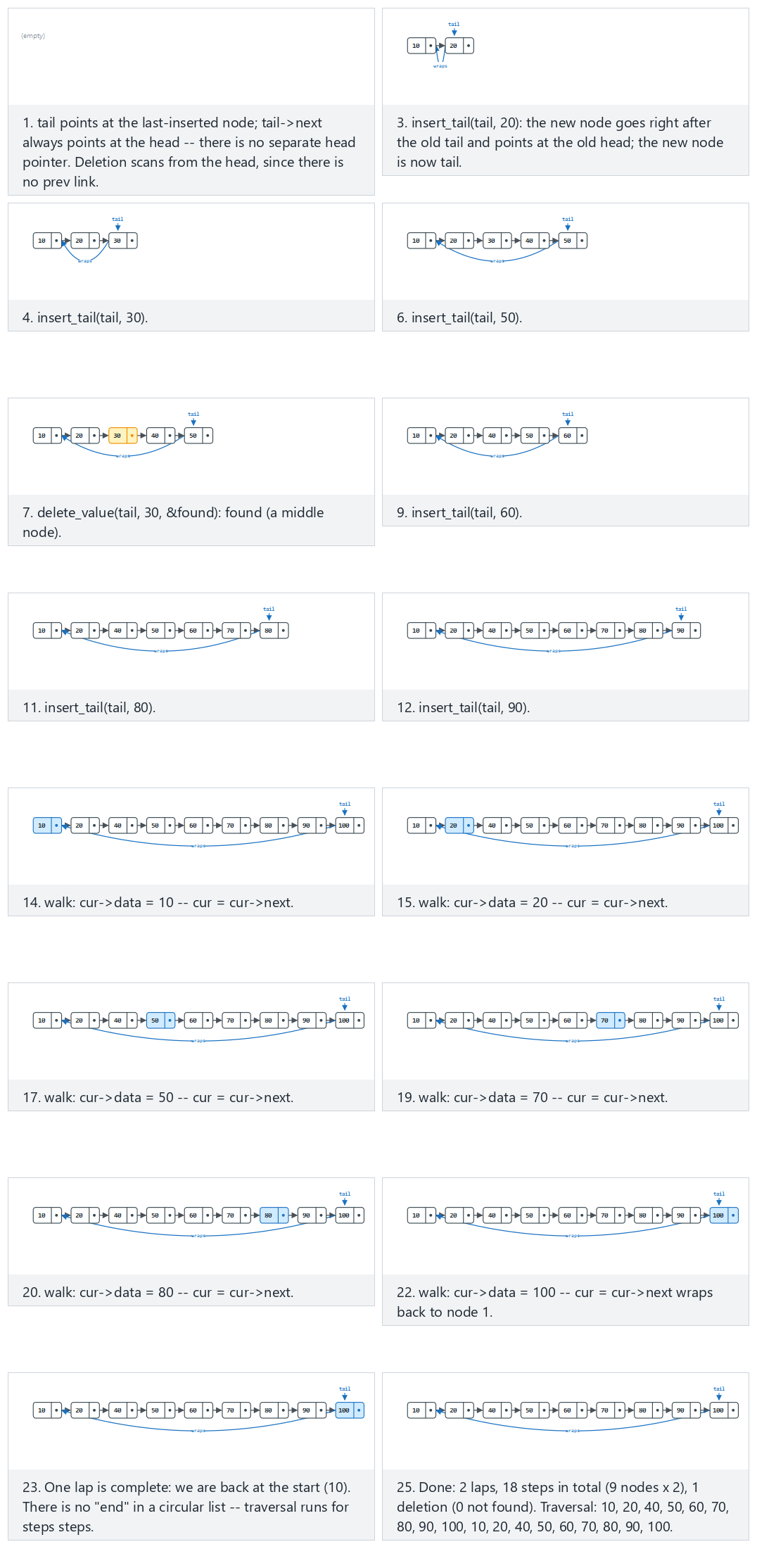
In the picker, also try 12 inserts (duplicates), 2 deletes (one not found), 3 laps (hard) and the edge cases a single node: deleting it empties the list, the last-inserted (tail) node is deleted, the first-inserted (head) node is deleted, and an attempt to delete a value that is not in the list — or press 🎲 for random data at four difficulty levels, or type your own numbers (insert) / dN (delete), followed by a lap count after |.
typedef struct Node {
    int data;
    struct Node *next;
} Node;

/* 'tail' always points at the last-inserted node; tail->next is the head. */
Node *insert_tail(Node *tail, int value) {
    Node *n = malloc(sizeof(Node));
    n->data = value;
    if (tail == NULL) {
        n->next = n;            /* a single node points at itself */
        return n;
    }
    n->next = tail->next;       /* new node -> old head */
    tail->next = n;             /* old tail -> new node */
    return n;                   /* new node is the new tail */
}

/* Deletes the FIRST node holding value, scanning forward from the head (no prev link to walk backward).
   Returns the (possibly updated) tail via the return value; *found reports success. */
Node *delete_value(Node *tail, int value, bool *found) {
    *found = false;
    if (tail == NULL) return NULL;               /* empty list */
    Node *prev = tail, *cur = tail->next;         /* cur starts at the head */
    int n = list_size(tail);
    for (int i = 0; i < n; i++) {
        if (cur->data == value) {
            *found = true;
            if (cur == cur->next) {               /* the only node in the list */
                free(cur);
                return NULL;                       /* list becomes empty */
            }
            prev->next = cur->next;                /* unlink cur */
            Node *new_tail = (cur == tail) ? prev : tail;
            free(cur);
            return new_tail;
        }
        prev = cur;
        cur = cur->next;
    }
    return tail;                                   /* not found: unchanged */
}

void traverse(Node *tail, int laps) {
    Node *head = tail->next;
    Node *cur = head;
    int steps = list_size(tail) * laps;
    for (int i = 0; i < steps; i++) {
        printf(" %d", cur->data);
        cur = cur->next;
    }
}
class Node { int data; Node next; Node(int d) { data = d; } }

// 'tail' always points at the last-inserted node; tail.next is the head.
static Node insertTail(Node tail, int value) {
    Node n = new Node(value);
    if (tail == null) {
        n.next = n;              // a single node points at itself
        return n;
    }
    n.next = tail.next;          // new node -> old head
    tail.next = n;               // old tail -> new node
    return n;                    // new node is the new tail
}

// Deletes the FIRST node holding value, scanning forward from the head (no prev link to walk backward).
// Returns the (possibly updated) tail; sets `found` to report success.
static boolean found;
static Node deleteValue(Node tail, int value) {
    found = false;
    if (tail == null) return null;                // empty list
    Node prev = tail, cur = tail.next;             // cur starts at the head
    int n = listSize(tail);
    for (int i = 0; i < n; i++) {
        if (cur.data == value) {
            found = true;
            if (cur == cur.next) {                 // the only node in the list
                return null;                        // list becomes empty
            }
            prev.next = cur.next;                   // unlink cur
            return (cur == tail) ? prev : tail;
        }
        prev = cur;
        cur = cur.next;
    }
    return tail;                                    // not found: unchanged
}

static void traverse(Node tail, int laps) {
    Node head = tail.next;
    Node cur = head;
    int steps = listSize(tail) * laps;
    for (int i = 0; i < steps; i++) {
        System.out.print(" " + cur.data);
        cur = cur.next;
    }
}
The full class (code/week-02/java/CircularLinkedList.java) mirrors the C program's five scenarios exactly.
Full program: circular_linked_list.c / CircularLinkedList.java
/* Week 2 -- Linked Lists, Arrays and Matrices
 * Circular linked list: insert at the tail (no separate head pointer --
 * tail->next IS the head), delete by value, and a traversal that wraps
 * around. Matches the circular-linked-list.js animation.
 * CEN207 Data Structures (formerly CE205)
 */
#include <stdbool.h>
#include <stdio.h>
#include <stdlib.h>

typedef struct Node {
    int data;
    struct Node *next;
} Node;

static int list_size(Node *tail) {
    if (tail == NULL) return 0;
    int n = 1;
    for (Node *cur = tail->next; cur != tail; cur = cur->next) n++;
    return n;
}

/* 'tail' always points at the last-inserted node; tail->next is the head. */
Node *insert_tail(Node *tail, int value) {
    Node *n = malloc(sizeof(Node));
    n->data = value;
    if (tail == NULL) {
        n->next = n;            /* a single node points at itself */
        return n;
    }
    n->next = tail->next;       /* new node -> old head */
    tail->next = n;             /* old tail -> new node */
    return n;                   /* new node is the new tail */
}

/* Deletes the FIRST node holding value, scanning forward from the head (no prev link to walk backward).
   Returns the (possibly updated) tail via the return value; *found reports success. */
Node *delete_value(Node *tail, int value, bool *found) {
    *found = false;
    if (tail == NULL) return NULL;               /* empty list */
    Node *prev = tail, *cur = tail->next;         /* cur starts at the head */
    int n = list_size(tail);
    for (int i = 0; i < n; i++) {
        if (cur->data == value) {
            *found = true;
            if (cur == cur->next) {               /* the only node in the list */
                free(cur);
                return NULL;                       /* list becomes empty */
            }
            prev->next = cur->next;                /* unlink cur */
            Node *new_tail = (cur == tail) ? prev : tail;
            free(cur);
            return new_tail;
        }
        prev = cur;
        cur = cur->next;
    }
    return tail;                                   /* not found: unchanged */
}

void traverse(Node *tail, int laps) {
    Node *head = tail->next;
    Node *cur = head;
    int steps = list_size(tail) * laps;
    for (int i = 0; i < steps; i++) {
        printf(" %d", cur->data);
        cur = cur->next;
    }
}

static void free_circle(Node *tail) {
    if (tail == NULL) return;
    Node *cur = tail->next;
    while (cur != tail) {
        Node *tmp = cur;
        cur = cur->next;
        free(tmp);
    }
    free(tail);
}

/* tokens: a plain number is insert_tail(value); "dV" deletes value V */
static void run_scenario(const char *label, const char *ops[], int n, int laps) {
    printf("-- %s --\n", label);
    Node *tail = NULL;
    for (int i = 0; i < n; i++) {
        const char *op = ops[i];
        if (op[0] == 'd') {
            int v = atoi(op + 1);
            bool found;
            tail = delete_value(tail, v, &found);
            printf("delete_value(%d): %s\n", v, found ? "removed" : "not found");
        } else {
            int v = atoi(op);
            tail = insert_tail(tail, v);
            printf("insert_tail(%d)\n", v);
        }
    }
    printf("size = %d\n", list_size(tail));
    if (tail != NULL) {
        printf("traverse(%d laps):", laps);
        traverse(tail, laps);
        printf("\n");
    } else {
        printf("traverse(%d laps): (empty)\n", laps);
    }
    printf("\n");
    free_circle(tail);
}

int main(void) {
    /* normal: 10 inserts, delete one value from the middle, 2 laps */
    const char *normal[] = {"10", "20", "30", "40", "50", "d30", "60", "70", "80", "90", "100"};
    run_scenario("normal: 10 inserts, delete one value from the middle, 2 laps", normal, 11, 2);

    /* hard: 12 inserts (duplicates), 2 deletes (one not found), 3 laps */
    const char *hard[] = {"5", "5", "20", "30", "d5", "5", "40", "50", "5", "60", "70", "d12345", "80", "5"};
    run_scenario("hard: 12 inserts (duplicates), 2 deletes (one not found), 3 laps", hard, 14, 3);

    /* edge: a single node: deleting it empties the list */
    const char *one_node[] = {"42", "d42"};
    run_scenario("edge: a single node: deleting it empties the list", one_node, 2, 5);

    /* edge: the first-inserted (head) node is deleted: tail->next changes */
    const char *delete_head[] = {"11", "12", "13", "14", "15", "16", "17", "18", "19", "20", "d11"};
    run_scenario("edge: the first-inserted (head) node is deleted: tail->next changes", delete_head, 11, 2);

    /* edge: 10 inserts, an attempt to delete a value that is not in the list */
    const char *not_found[] = {"3", "6", "9", "12", "15", "18", "21", "24", "27", "30", "d999"};
    run_scenario("edge: 10 inserts, an attempt to delete a value that is not in the list", not_found, 11, 2);

    return 0;
}
/* Week 2 -- Linked Lists, Arrays and Matrices
 * Circular linked list: insert at the tail (no separate head field --
 * tail.next IS the head), delete by value, and a traversal that wraps
 * around. Matches the circular-linked-list.js animation.
 * CEN207 Data Structures (formerly CE205)
 */
public class CircularLinkedList {
    static class Node { int data; Node next; Node(int d) { data = d; } }

    static int listSize(Node tail) {
        if (tail == null) return 0;
        int n = 1;
        for (Node cur = tail.next; cur != tail; cur = cur.next) n++;
        return n;
    }

    // 'tail' always points at the last-inserted node; tail.next is the head.
    static Node insertTail(Node tail, int value) {
        Node n = new Node(value);
        if (tail == null) {
            n.next = n;              // a single node points at itself
            return n;
        }
        n.next = tail.next;          // new node -> old head
        tail.next = n;               // old tail -> new node
        return n;                    // new node is the new tail
    }

    // Deletes the FIRST node holding value, scanning forward from the head (no prev link to walk backward).
    // Returns the (possibly updated) tail; sets `found` to report success.
    static boolean found;
    static Node deleteValue(Node tail, int value) {
        found = false;
        if (tail == null) return null;                // empty list
        Node prev = tail, cur = tail.next;             // cur starts at the head
        int n = listSize(tail);
        for (int i = 0; i < n; i++) {
            if (cur.data == value) {
                found = true;
                if (cur == cur.next) {                 // the only node in the list
                    return null;                        // list becomes empty
                }
                prev.next = cur.next;                   // unlink cur
                return (cur == tail) ? prev : tail;
            }
            prev = cur;
            cur = cur.next;
        }
        return tail;                                    // not found: unchanged
    }

    static void traverse(Node tail, int laps, StringBuilder out) {
        Node head = tail.next;
        Node cur = head;
        int steps = listSize(tail) * laps;
        for (int i = 0; i < steps; i++) {
            out.append(' ').append(cur.data);
            cur = cur.next;
        }
    }

    // tokens: a plain number is insertTail(value); "dV" deletes value V
    static void runScenario(String label, String[] ops, int laps) {
        System.out.println("-- " + label + " --");
        Node tail = null;
        for (String op : ops) {
            if (op.charAt(0) == 'd') {
                int v = Integer.parseInt(op.substring(1));
                tail = deleteValue(tail, v);
                System.out.println("delete_value(" + v + "): " + (found ? "removed" : "not found"));
            } else {
                int v = Integer.parseInt(op);
                tail = insertTail(tail, v);
                System.out.println("insert_tail(" + v + ")");
            }
        }
        System.out.println("size = " + listSize(tail));
        if (tail != null) {
            StringBuilder sb = new StringBuilder("traverse(" + laps + " laps):");
            traverse(tail, laps, sb);
            System.out.println(sb);
        } else {
            System.out.println("traverse(" + laps + " laps): (empty)");
        }
        System.out.println();
    }

    public static void main(String[] args) {
        // normal: 10 inserts, delete one value from the middle, 2 laps
        String[] normal = {"10", "20", "30", "40", "50", "d30", "60", "70", "80", "90", "100"};
        runScenario("normal: 10 inserts, delete one value from the middle, 2 laps", normal, 2);

        // hard: 12 inserts (duplicates), 2 deletes (one not found), 3 laps
        String[] hard = {"5", "5", "20", "30", "d5", "5", "40", "50", "5", "60", "70", "d12345", "80", "5"};
        runScenario("hard: 12 inserts (duplicates), 2 deletes (one not found), 3 laps", hard, 3);

        // edge: a single node: deleting it empties the list
        String[] oneNode = {"42", "d42"};
        runScenario("edge: a single node: deleting it empties the list", oneNode, 5);

        // edge: the first-inserted (head) node is deleted: tail->next changes
        String[] deleteHead = {"11", "12", "13", "14", "15", "16", "17", "18", "19", "20", "d11"};
        runScenario("edge: the first-inserted (head) node is deleted: tail->next changes", deleteHead, 2);

        // edge: 10 inserts, an attempt to delete a value that is not in the list
        String[] notFound = {"3", "6", "9", "12", "15", "18", "21", "24", "27", "30", "d999"};
        runScenario("edge: 10 inserts, an attempt to delete a value that is not in the list", notFound, 2);
    }
}
Try it
Expected output:
-- normal: 10 inserts, delete one value from the middle, 2 laps --
insert_tail(10)
insert_tail(20)
insert_tail(30)
insert_tail(40)
insert_tail(50)
delete_value(30): removed
insert_tail(60)
insert_tail(70)
insert_tail(80)
insert_tail(90)
insert_tail(100)
size = 9
traverse(2 laps): 10 20 40 50 60 70 80 90 100 10 20 40 50 60 70 80 90 100

-- hard: 12 inserts (duplicates), 2 deletes (one not found), 3 laps --
insert_tail(5)
insert_tail(5)
insert_tail(20)
insert_tail(30)
delete_value(5): removed
insert_tail(5)
insert_tail(40)
insert_tail(50)
insert_tail(5)
insert_tail(60)
insert_tail(70)
delete_value(12345): not found
insert_tail(80)
insert_tail(5)
size = 11
traverse(3 laps): 5 20 30 5 40 50 5 60 70 80 5 5 20 30 5 40 50 5 60 70 80 5 5 20 30 5 40 50 5 60 70 80 5

-- edge: a single node: deleting it empties the list --
insert_tail(42)
delete_value(42): removed
size = 0
traverse(5 laps): (empty)

-- edge: the first-inserted (head) node is deleted: tail->next changes --
insert_tail(11)
insert_tail(12)
insert_tail(13)
insert_tail(14)
insert_tail(15)
insert_tail(16)
insert_tail(17)
insert_tail(18)
insert_tail(19)
insert_tail(20)
delete_value(11): removed
size = 9
traverse(2 laps): 12 13 14 15 16 17 18 19 20 12 13 14 15 16 17 18 19 20

-- edge: 10 inserts, an attempt to delete a value that is not in the list --
insert_tail(3)
insert_tail(6)
insert_tail(9)
insert_tail(12)
insert_tail(15)
insert_tail(18)
insert_tail(21)
insert_tail(24)
insert_tail(27)
insert_tail(30)
delete_value(999): not found
size = 10
traverse(2 laps): 3 6 9 12 15 18 21 24 27 30 3 6 9 12 15 18 21 24 27 30
Complexity. insert_tail is O(1) — the new node's neighbours (tail and tail->next, the head) are already known. delete_value is O(n) — it must scan forward, and (with no prev link) list_size is called just to know how many steps make a full lap, so the scan cannot simply run "until we get back to where we started" by pointer comparison alone. traverse is O(n · laps) by construction.
9.3 The Josephus problem
A short history. Flavius Josephus, a 1st-century historian, is said to have survived a mass suicide pact during the Siege of Yodfat (67 CE) by working out where to stand in a circle of soldiers who agreed to kill every k-th person until only one remained — whether or not the story is literally true, the puzzle it describes has carried his name ever since, and it is a natural, vivid application of a circular linked list: n people stand in a circle, and starting from a fixed point, every k-th person is removed until only one survivor remains.
The simulation is a direct use of the circular list from section 9.2: build a circle of n nodes, then repeatedly count k - 1 steps forward from the current position and remove the node reached, exactly the way delete_value unlinks a node — except here the node to remove is found by counting steps, not by comparing values.
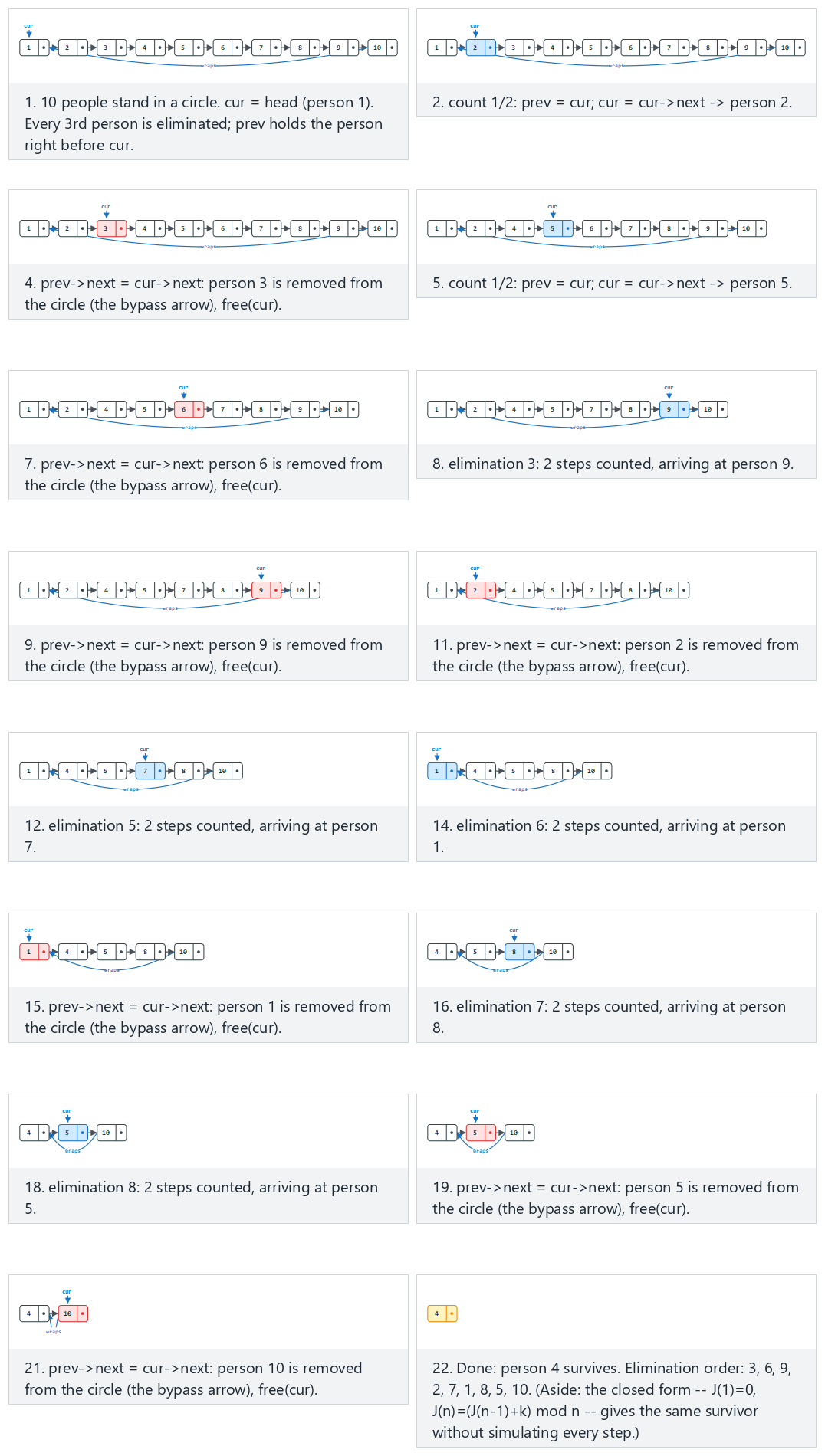
In the picker, also try n = 12, k = 5 (hard) and the edge cases n = 10, k = 1: eliminate in plain order and n = 1: nobody to eliminate — or press 🎲 for random data at four difficulty levels, or type your own n=N k=K.
typedef struct Node { int id; struct Node *next; } Node;

int josephus(int n, int k) {
    Node *head = build_circle(n);
    Node *prev = head;
    while (prev->next != head)   /* find the node before head */
        prev = prev->next;

    Node *cur = head;
    int remaining = n;
    while (remaining > 1) {
        for (int step = 1; step < k; step++) {   /* count k-1 steps forward */
            prev = cur;
            cur = cur->next;
        }
        prev->next = cur->next;   /* remove cur from the circle */
        free(cur);
        cur = prev->next;
        remaining--;
    }
    return cur->id;                /* the sole survivor */
}
class Node { int id; Node next; Node(int id) { this.id = id; } }

static int josephus(int n, int k) {
    Node head = buildCircle(n);
    Node prev = head;
    while (prev.next != head)    // find the node before head
        prev = prev.next;

    Node cur = head;
    int remaining = n;
    while (remaining > 1) {
        for (int step = 1; step < k; step++) {   // count k-1 steps forward
            prev = cur;
            cur = cur.next;
        }
        prev.next = cur.next;     // remove cur from the circle
        cur = prev.next;
        remaining--;
    }
    return cur.id;                 // the sole survivor
}
The full class (code/week-02/java/Josephus.java) mirrors the C program's four scenarios exactly.
Full program: josephus.c / Josephus.java
/* Week 2 -- Linked Lists, Arrays and Matrices
 * The Josephus problem: n people in a circle, every k-th one eliminated,
 * who survives? Solved with a circular linked list. Matches the josephus.js
 * animation.
 * CEN207 Data Structures (formerly CE205)
 */
#include <stdio.h>
#include <stdlib.h>

typedef struct Node { int id; struct Node *next; } Node;

static Node *build_circle(int n) {
    Node *head = NULL, *tail = NULL;
    for (int i = 1; i <= n; i++) {
        Node *node = malloc(sizeof(Node));
        node->id = i;
        node->next = NULL;
        if (tail == NULL) head = node; else tail->next = node;
        tail = node;
    }
    tail->next = head;   /* close the circle */
    return head;
}

int josephus(int n, int k) {
    Node *head = build_circle(n);
    Node *prev = head;
    while (prev->next != head)   /* find the node before head */
        prev = prev->next;

    Node *cur = head;
    int remaining = n;
    while (remaining > 1) {
        for (int step = 1; step < k; step++) {   /* count k-1 steps forward */
            prev = cur;
            cur = cur->next;
        }
        printf("eliminate %d\n", cur->id);
        prev->next = cur->next;   /* remove cur from the circle */
        free(cur);
        cur = prev->next;
        remaining--;
    }
    int survivor = cur->id;
    free(cur);
    return survivor;                /* the sole survivor */
}

static void run_scenario(const char *label, int n, int k) {
    printf("-- %s --\n", label);
    printf("n=%d k=%d\n", n, k);
    int survivor = josephus(n, k);
    printf("survivor = %d\n\n", survivor);
}

int main(void) {
    /* normal: n = 10, k = 3 */
    run_scenario("normal: n = 10, k = 3", 10, 3);

    /* hard: n = 12, k = 5 */
    run_scenario("hard: n = 12, k = 5", 12, 5);

    /* edge: n = 10, k = 1: eliminate in plain order */
    run_scenario("edge: n = 10, k = 1: eliminate in plain order", 10, 1);

    /* edge: n = 1: nobody to eliminate */
    run_scenario("edge: n = 1: nobody to eliminate", 1, 3);

    return 0;
}
/* Week 2 -- Linked Lists, Arrays and Matrices
 * The Josephus problem: n people in a circle, every k-th one eliminated,
 * who survives? Solved with a circular linked list. Matches the josephus.js
 * animation.
 * CEN207 Data Structures (formerly CE205)
 */
public class Josephus {
    static class Node { int id; Node next; Node(int id) { this.id = id; } }

    static Node buildCircle(int n) {
        Node head = null, tail = null;
        for (int i = 1; i <= n; i++) {
            Node node = new Node(i);
            if (tail == null) head = node; else tail.next = node;
            tail = node;
        }
        tail.next = head;    // close the circle
        return head;
    }

    static int josephus(int n, int k) {
        Node head = buildCircle(n);
        Node prev = head;
        while (prev.next != head)    // find the node before head
            prev = prev.next;

        Node cur = head;
        int remaining = n;
        while (remaining > 1) {
            for (int step = 1; step < k; step++) {   // count k-1 steps forward
                prev = cur;
                cur = cur.next;
            }
            System.out.println("eliminate " + cur.id);
            prev.next = cur.next;     // remove cur from the circle
            cur = prev.next;
            remaining--;
        }
        return cur.id;                 // the sole survivor
    }

    static void runScenario(String label, int n, int k) {
        System.out.println("-- " + label + " --");
        System.out.println("n=" + n + " k=" + k);
        int survivor = josephus(n, k);
        System.out.println("survivor = " + survivor);
        System.out.println();
    }

    public static void main(String[] args) {
        // normal: n = 10, k = 3
        runScenario("normal: n = 10, k = 3", 10, 3);

        // hard: n = 12, k = 5
        runScenario("hard: n = 12, k = 5", 12, 5);

        // edge: n = 10, k = 1: eliminate in plain order
        runScenario("edge: n = 10, k = 1: eliminate in plain order", 10, 1);

        // edge: n = 1: nobody to eliminate
        runScenario("edge: n = 1: nobody to eliminate", 1, 3);
    }
}
Try it
Expected output:
-- normal: n = 10, k = 3 --
n=10 k=3
eliminate 3
eliminate 6
eliminate 9
eliminate 2
eliminate 7
eliminate 1
eliminate 8
eliminate 5
eliminate 10
survivor = 4

-- hard: n = 12, k = 5 --
n=12 k=5
eliminate 5
eliminate 10
eliminate 3
eliminate 9
eliminate 4
eliminate 12
eliminate 8
eliminate 7
eliminate 11
eliminate 2
eliminate 6
survivor = 1

-- edge: n = 10, k = 1: eliminate in plain order --
n=10 k=1
eliminate 1
eliminate 2
eliminate 3
eliminate 4
eliminate 5
eliminate 6
eliminate 7
eliminate 8
eliminate 9
survivor = 10

-- edge: n = 1: nobody to eliminate --
n=1 k=3
survivor = 1
Complexity. Each elimination counts up to k steps and removes one node, so the whole simulation is O(n · k) — for k = 1 (eliminate in plain order) it degenerates to a single clean O(n) sweep, visible in the "edge: k = 1" scenario above. A closed-form recurrence, J(1) = 0 and J(n) = (J(n-1) + k) mod n, gives the survivor's position in O(n) without simulating a single elimination — but it does not reveal the elimination order, which the simulation above prints as it goes.
Common mistakes
- Counting
ksteps instead ofk - 1: "every 3rd person is eliminated" starting from the current position means the current position is step 1, so only 2 more steps get you to the 3rd person — the loop runsk - 1times, notk. - Forgetting that
prevmust be re-found (or tracked continuously) after every elimination — since the circle has noprevlink, whoever removes a node must already know that node's predecessor, which is exactly whyprevandcurare advanced together throughout, never separately.
10. XOR linked list
10.1 A question to start
Section 8's doubly linked list gets backward traversal by paying for a second pointer field in every node. What if we could get the same two-way traversal ability while paying for only one pointer's worth of memory per node? This sounds impossible — until you remember the exclusive-or operation's neat property: a XOR b XOR b == a. That single identity is the entire trick behind the XOR linked list.
10.2 One field, prev XOR next
Each node stores a single field, npx, holding the bitwise XOR of the addresses of its predecessor and successor: npx = addr(prev) XOR addr(next). On its own this number tells you nothing — but if you are walking the list and you know the address of the node you just came from, you can recover the other neighbour by XOR-ing npx with the address you arrived from: addr(next) = npx XOR addr(prev). Walking forward means always knowing where you came from (prev), so the trick works in both directions, symmetrically — it is simply a question of which address you treat as "the one you know."
This is presented here as a memory-saving curiosity, not a technique to reach for in production code, for two concrete reasons. First, standard C does not actually guarantee this works: casting a pointer to an integer, XOR-ing integers, and casting the result back to a pointer is implementation-defined behaviour, not something the C standard promises will round-trip correctly on every platform — it happens to work on essentially every real machine's flat address space, but it is technically living outside guaranteed C semantics. Second, and more fundamentally, a garbage-collected language cannot do this trick at all: a garbage collector needs to see every live pointer to a heap object in order to know the object is still reachable and decide whether to keep or reclaim it, and an address hidden inside an XOR of two other addresses is invisible to it. That is why our Java version below cannot use real object references for npx at all — it keeps its own small array (a "pool") of nodes and stores plain integer indices into that array instead of addresses, XOR-ing indices rather than pointers.
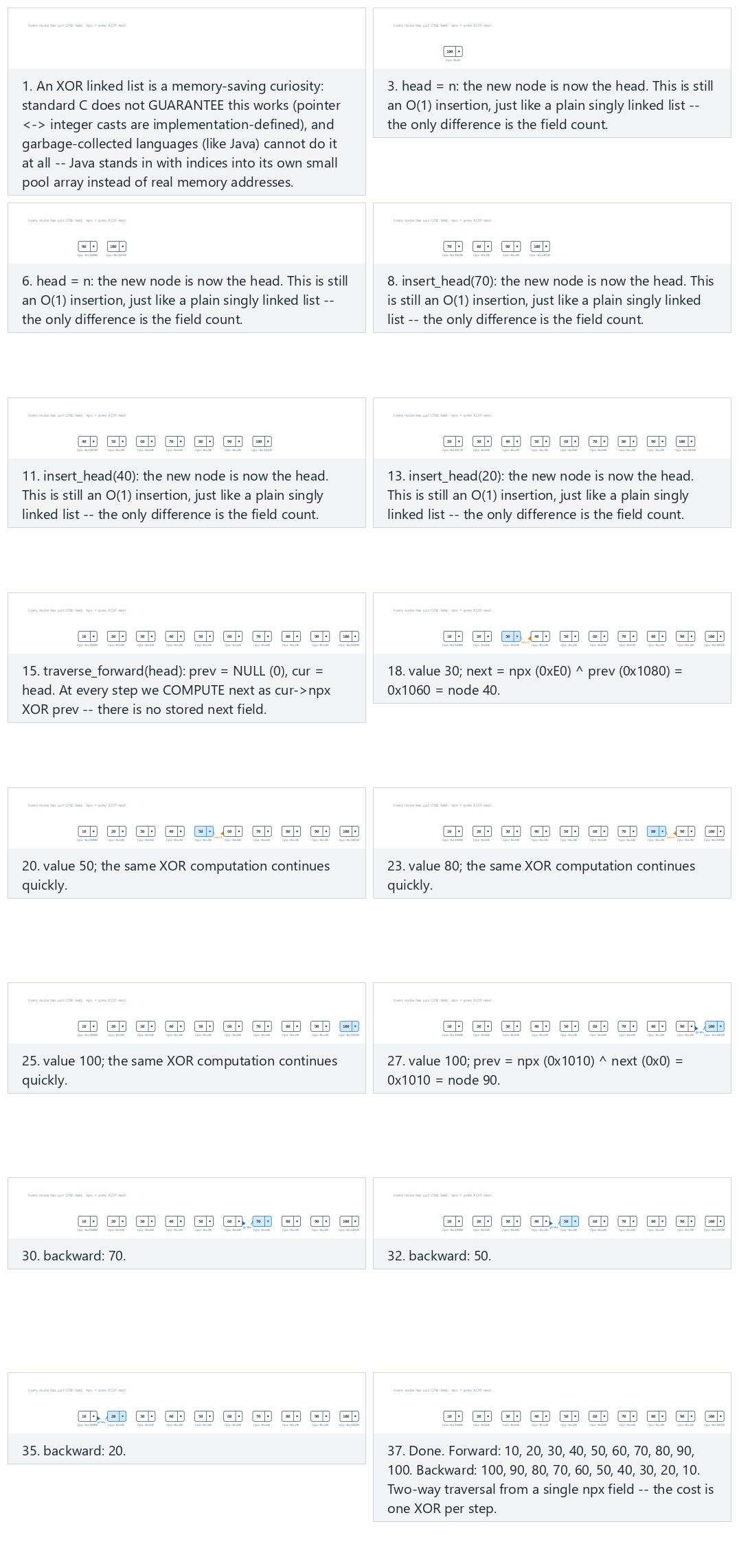
In the picker, also try 12 nodes (duplicates/negatives) (hard) and the edge cases a single node, two nodes, 10 nodes inserted one by one with insert_tail (FIFO order), 12 nodes, mixing insert_head and insert_tail, and insert_tail into an empty list: a single node becomes both head and tail — or press 🎲 for random data at four difficulty levels, or type your own numbers (insert_head) / tN (insert_tail).
typedef struct Node {
    int data;
    uintptr_t npx;      /* XOR of the addresses of prev and next */
} Node;

static uintptr_t addr(Node *p) { return (uintptr_t)p; }
static Node *xor_node(uintptr_t npx, Node *known) { return (Node *)(npx ^ addr(known)); }

Node *insert_head(Node *head, Node **tail, int value) {
    Node *n = malloc(sizeof(Node));
    n->data = value;
    n->npx = addr(NULL) ^ addr(head);     /* prev = NULL, next = old head */
    if (head != NULL)
        head->npx = addr(n) ^ addr(xor_node(head->npx, NULL));  /* old head's prev becomes n */
    else
        *tail = n;                        /* first node is both head and tail */
    return n;
}

Node *insert_tail(Node **head, Node *tail, int value) {
    Node *n = malloc(sizeof(Node));
    n->data = value;
    n->npx = addr(tail) ^ addr(NULL);     /* prev = old tail, next = NULL */
    if (tail != NULL)
        tail->npx = addr(xor_node(tail->npx, NULL)) ^ addr(n);  /* old tail's next becomes n */
    else
        *head = n;                        /* first node is both head and tail */
    return n;
}

void traverse_forward(Node *head) {
    Node *prev = NULL, *cur = head;
    while (cur != NULL) {
        printf(" %d", cur->data);
        Node *next = xor_node(cur->npx, prev);
        prev = cur; cur = next;
    }
}

void traverse_backward(Node *tail) {
    Node *next = NULL, *cur = tail;
    while (cur != NULL) {
        printf(" %d", cur->data);
        Node *prev = xor_node(cur->npx, next);
        next = cur; cur = prev;
    }
}
// Java has no pointer arithmetic: each node's "address" is its index in a small pool array.
static final int NONE = 0;   // 0 means "no node" (real nodes live at indices 1..n)
class Node { int data; int npx; }   // XOR of the POOL INDEX of prev and of next
Node[] pool = new Node[100]; int count = 0;

static int insertHead(int head, int[] tail, int value) {
    int n = allocate(value);
    pool[n].npx = NONE ^ head;                 // prev = NONE, next = old head
    if (head != NONE) {
        int headNext = pool[head].npx ^ NONE;  // old head's prev was NONE
        pool[head].npx = n ^ headNext;         // old head's prev becomes n
    } else tail[0] = n;                        // first node is both head and tail
    return n;
}

static int insertTail(int[] head, int tail, int value) {
    int n = allocate(value);
    pool[n].npx = tail ^ NONE;                 // prev = old tail, next = NONE
    if (tail != NONE) {
        int tailNext = pool[tail].npx ^ NONE;  // old tail's next was NONE
        pool[tail].npx = n ^ tailNext;         // old tail's next becomes n
    } else head[0] = n;                        // first node is both head and tail
    return n;
}

static void traverseForward(int head) {
    int prev = NONE, cur = head;
    while (cur != NONE) {
        System.out.print(" " + pool[cur].data);
        int next = pool[cur].npx ^ prev;
        prev = cur; cur = next;
    }
}

static void traverseBackward(int tail) {
    int next = NONE, cur = tail;
    while (cur != NONE) {
        System.out.print(" " + pool[cur].data);
        int prev = pool[cur].npx ^ next;
        next = cur; cur = prev;
    }
}
The full class (code/week-02/java/XorLinkedList.java) mirrors the C program's four scenarios exactly.
Full program: xor_linked_list.c / XorLinkedList.java
/* Week 2 -- Linked Lists, Arrays and Matrices
 * XOR linked list: one field, npx, holds XOR(prev, next) instead of two
 * separate pointers. Matches the xor-linked-list.js animation.
 * CEN207 Data Structures (formerly CE205)
 */
#include <stdint.h>
#include <stdio.h>
#include <stdlib.h>

typedef struct Node {
    int data;
    uintptr_t npx;      /* XOR of the addresses of prev and next */
} Node;

static uintptr_t addr(Node *p) { return (uintptr_t)p; }
static Node *xor_node(uintptr_t npx, Node *known) { return (Node *)(npx ^ addr(known)); }

Node *insert_head(Node *head, Node **tail, int value) {
    Node *n = malloc(sizeof(Node));
    n->data = value;
    n->npx = addr(NULL) ^ addr(head);     /* prev = NULL, next = old head */
    if (head != NULL)
        head->npx = addr(n) ^ addr(xor_node(head->npx, NULL));  /* old head's prev becomes n */
    else
        *tail = n;                        /* first node is both head and tail */
    return n;
}

Node *insert_tail(Node **head, Node *tail, int value) {
    Node *n = malloc(sizeof(Node));
    n->data = value;
    n->npx = addr(tail) ^ addr(NULL);     /* prev = old tail, next = NULL */
    if (tail != NULL)
        tail->npx = addr(xor_node(tail->npx, NULL)) ^ addr(n);  /* old tail's next becomes n */
    else
        *head = n;                        /* first node is both head and tail */
    return n;
}

void traverse_forward(Node *head) {
    Node *prev = NULL, *cur = head;
    while (cur != NULL) {
        printf(" %d", cur->data);
        Node *next = xor_node(cur->npx, prev);
        prev = cur; cur = next;
    }
}

void traverse_backward(Node *tail) {
    Node *next = NULL, *cur = tail;
    while (cur != NULL) {
        printf(" %d", cur->data);
        Node *prev = xor_node(cur->npx, next);
        next = cur; cur = prev;
    }
}

static void free_all(Node **pool, int count) {
    for (int i = 0; i < count; i++) free(pool[i]);
}

/* tokens: a plain number is insert_head(value); "tV" is insert_tail(value) */
static void run_scenario(const char *label, const char *ops[], int n) {
    printf("-- %s --\n", label);
    Node *head = NULL, *tail = NULL;
    Node *pool[32];
    int count = 0;
    for (int i = 0; i < n; i++) {
        const char *op = ops[i];
        if (op[0] == 't') {
            int v = atoi(op + 1);
            Node *node = insert_tail(&head, tail, v);
            tail = node;
            pool[count++] = node;
            printf("insert_tail(%d)\n", v);
        } else {
            int v = atoi(op);
            Node *node = insert_head(head, &tail, v);
            head = node;
            pool[count++] = node;
            printf("insert_head(%d)\n", v);
        }
    }
    printf("forward: ");
    traverse_forward(head);
    printf("\n");
    printf("backward:");
    traverse_backward(tail);
    printf("\n\n");
    free_all(pool, count);
}

int main(void) {
    /* normal: 10 nodes, inserted one by one with insert_head */
    const char *normal[] = {"100", "90", "80", "70", "60", "50", "40", "30", "20", "10"};
    run_scenario("normal: 10 nodes, inserted one by one with insert_head", normal, 10);

    /* hard: 12 nodes (duplicates/negatives) */
    const char *hard[] = {"-100", "100", "-3", "2", "-1", "8", "8", "-3", "0", "5", "-3", "5"};
    run_scenario("hard: 12 nodes (duplicates/negatives)", hard, 12);

    /* edge: 10 nodes, inserted one by one with insert_tail (FIFO order) */
    const char *tail_basic[] = {"t10", "t20", "t30", "t40", "t50", "t60", "t70", "t80", "t90", "t100"};
    run_scenario("edge: 10 nodes, inserted one by one with insert_tail (FIFO order)", tail_basic, 10);

    /* edge: 12 nodes, mixing insert_head and insert_tail */
    const char *mixed[] = {"10", "t20", "30", "t40", "50", "t60", "70", "t80", "90", "t100", "110", "t120"};
    run_scenario("edge: 12 nodes, mixing insert_head and insert_tail", mixed, 12);

    return 0;
}
/* Week 2 -- Linked Lists, Arrays and Matrices
 * XOR linked list: one field, npx, holds XOR(prev, next) instead of two
 * separate pointers. Java has no pointer arithmetic: each node's "address"
 * is its index in a small pool array. Matches the xor-linked-list.js
 * animation.
 * CEN207 Data Structures (formerly CE205)
 */
public class XorLinkedList {
    static final int NONE = 0;   // 0 means "no node" (real nodes live at indices 1..n)
    static class Node { int data; int npx; }   // XOR of the POOL INDEX of prev and of next
    static Node[] pool = new Node[100];
    static int count = 0;

    static int allocate(int value) {
        count++;
        pool[count] = new Node();
        pool[count].data = value;
        return count;
    }

    static int insertHead(int head, int[] tail, int value) {
        int n = allocate(value);
        pool[n].npx = NONE ^ head;                 // prev = NONE, next = old head
        if (head != NONE) {
            int headNext = pool[head].npx ^ NONE;  // old head's prev was NONE
            pool[head].npx = n ^ headNext;         // old head's prev becomes n
        } else tail[0] = n;                        // first node is both head and tail
        return n;
    }

    static int insertTail(int[] head, int tail, int value) {
        int n = allocate(value);
        pool[n].npx = tail ^ NONE;                 // prev = old tail, next = NONE
        if (tail != NONE) {
            int tailNext = pool[tail].npx ^ NONE;  // old tail's next was NONE
            pool[tail].npx = n ^ tailNext;         // old tail's next becomes n
        } else head[0] = n;                        // first node is both head and tail
        return n;
    }

    static void traverseForward(int head, StringBuilder out) {
        int prev = NONE, cur = head;
        while (cur != NONE) {
            out.append(' ').append(pool[cur].data);
            int next = pool[cur].npx ^ prev;
            prev = cur; cur = next;
        }
    }

    static void traverseBackward(int tail, StringBuilder out) {
        int next = NONE, cur = tail;
        while (cur != NONE) {
            out.append(' ').append(pool[cur].data);
            int prev = pool[cur].npx ^ next;
            next = cur; cur = prev;
        }
    }

    // tokens: a plain number is insertHead(value); "tV" is insertTail(value)
    static void runScenario(String label, String[] ops) {
        System.out.println("-- " + label + " --");
        int[] head = {NONE}, tail = {NONE};
        for (String op : ops) {
            if (op.charAt(0) == 't') {
                int v = Integer.parseInt(op.substring(1));
                int n = insertTail(head, tail[0], v);
                tail[0] = n;
                System.out.println("insert_tail(" + v + ")");
            } else {
                int v = Integer.parseInt(op);
                int n = insertHead(head[0], tail, v);
                head[0] = n;
                System.out.println("insert_head(" + v + ")");
            }
        }
        StringBuilder fwd = new StringBuilder("forward: ");
        traverseForward(head[0], fwd);
        System.out.println(fwd);
        StringBuilder bwd = new StringBuilder("backward:");
        traverseBackward(tail[0], bwd);
        System.out.println(bwd);
        System.out.println();
    }

    public static void main(String[] args) {
        // normal: 10 nodes, inserted one by one with insert_head
        String[] normal = {"100", "90", "80", "70", "60", "50", "40", "30", "20", "10"};
        runScenario("normal: 10 nodes, inserted one by one with insert_head", normal);

        // hard: 12 nodes (duplicates/negatives)
        String[] hard = {"-100", "100", "-3", "2", "-1", "8", "8", "-3", "0", "5", "-3", "5"};
        runScenario("hard: 12 nodes (duplicates/negatives)", hard);

        // edge: 10 nodes, inserted one by one with insert_tail (FIFO order)
        String[] tailBasic = {"t10", "t20", "t30", "t40", "t50", "t60", "t70", "t80", "t90", "t100"};
        runScenario("edge: 10 nodes, inserted one by one with insert_tail (FIFO order)", tailBasic);

        // edge: 12 nodes, mixing insert_head and insert_tail
        String[] mixed = {"10", "t20", "30", "t40", "50", "t60", "70", "t80", "90", "t100", "110", "t120"};
        runScenario("edge: 12 nodes, mixing insert_head and insert_tail", mixed);
    }
}
Try it
Expected output:
-- normal: 10 nodes, inserted one by one with insert_head --
insert_head(100)
insert_head(90)
insert_head(80)
insert_head(70)
insert_head(60)
insert_head(50)
insert_head(40)
insert_head(30)
insert_head(20)
insert_head(10)
forward:  10 20 30 40 50 60 70 80 90 100
backward: 100 90 80 70 60 50 40 30 20 10

-- hard: 12 nodes (duplicates/negatives) --
insert_head(-100)
insert_head(100)
insert_head(-3)
insert_head(2)
insert_head(-1)
insert_head(8)
insert_head(8)
insert_head(-3)
insert_head(0)
insert_head(5)
insert_head(-3)
insert_head(5)
forward:  5 -3 5 0 -3 8 8 -1 2 -3 100 -100
backward: -100 100 -3 2 -1 8 8 -3 0 5 -3 5

-- edge: 10 nodes, inserted one by one with insert_tail (FIFO order) --
insert_tail(10)
insert_tail(20)
insert_tail(30)
insert_tail(40)
insert_tail(50)
insert_tail(60)
insert_tail(70)
insert_tail(80)
insert_tail(90)
insert_tail(100)
forward:  10 20 30 40 50 60 70 80 90 100
backward: 100 90 80 70 60 50 40 30 20 10

-- edge: 12 nodes, mixing insert_head and insert_tail --
insert_head(10)
insert_tail(20)
insert_head(30)
insert_tail(40)
insert_head(50)
insert_tail(60)
insert_head(70)
insert_tail(80)
insert_head(90)
insert_tail(100)
insert_head(110)
insert_tail(120)
forward:  110 90 70 50 30 10 20 40 60 80 100 120
backward: 120 100 80 60 40 20 10 30 50 70 90 110
Complexity. Every operation shown — insert_head, insert_tail, and a step of either traversal — is O(1) per node, exactly matching a doubly linked list's time complexity; the only difference is space, one address (or index) per node instead of two.
Common mistakes
- Losing track of "which address you arrived from": every step of
xor_node(npx, known)needs the correct "known" neighbour — using the wrong one silently sends the traversal off into unrelated memory (in C) or to the wrong pool slot (in Java), rather than raising an obvious error. - Trying to jump into the middle of an XOR linked list without first walking in from an end: since no node's
npxalone reveals a real address, you cannot dereference "the third node" directly — the whole structure only makes sense as a sequential walk from a known starting point (headortail). - Assuming this technique is portable, safe C or is usable at all in Java: as section 10.2 explains, it relies on implementation-defined pointer/integer round-tripping in C, and cannot be done with real references in a garbage-collected language at all.
11. Skip list
11.1 A question to start
Section 7.3 showed that searching a linked list is O(n) — there is no way to "jump to the middle" the way binary search does on a sorted array, because reaching any node requires walking there from the head. But what if the list had an express lane: a second, shorter chain layered on top of the full list, connecting only every few nodes, that you could use to skip large stretches at a time before dropping down to the full list for the final few steps?
11.2 A short history
The skip list was invented by William Pugh in 1990, published as "Skip Lists: A Probabilistic Alternative to Balanced Trees" (Communications of the ACM). Pugh's original design decides each new node's "how many express lanes does it join" by an actual coin flip at insertion time, giving expected O(log n) search performance with much simpler code than a balanced tree like a red-black tree, at the cost of expected (rather than guaranteed) bounds. Our example programs make the level assignment for each key an explicit input instead of an actual coin flip, so that every run is exactly repeatable — but the search and insert algorithms themselves are precisely Pugh's.
11.3 Two layers: the base list and an express lane
This implementation keeps exactly two levels: level 0 is the ordinary sorted linked list, holding every key; level 1 is the express lane, holding only some of the keys. A special header sentinel node sits at the front of both levels. To search for a value, start at the header on the top level (the express lane) and move right as long as the next key on that level is still smaller than the target; the moment it is not (or there is no next key), drop down one level and repeat, continuing until level 0 is exhausted — the value is either the very next node on level 0, or it is not in the list at all. Insertion runs the same top-down scan first, remembering the rightmost node reached at each level (the update array), then splices the new node into every level it belongs to, right after the corresponding remembered predecessor.
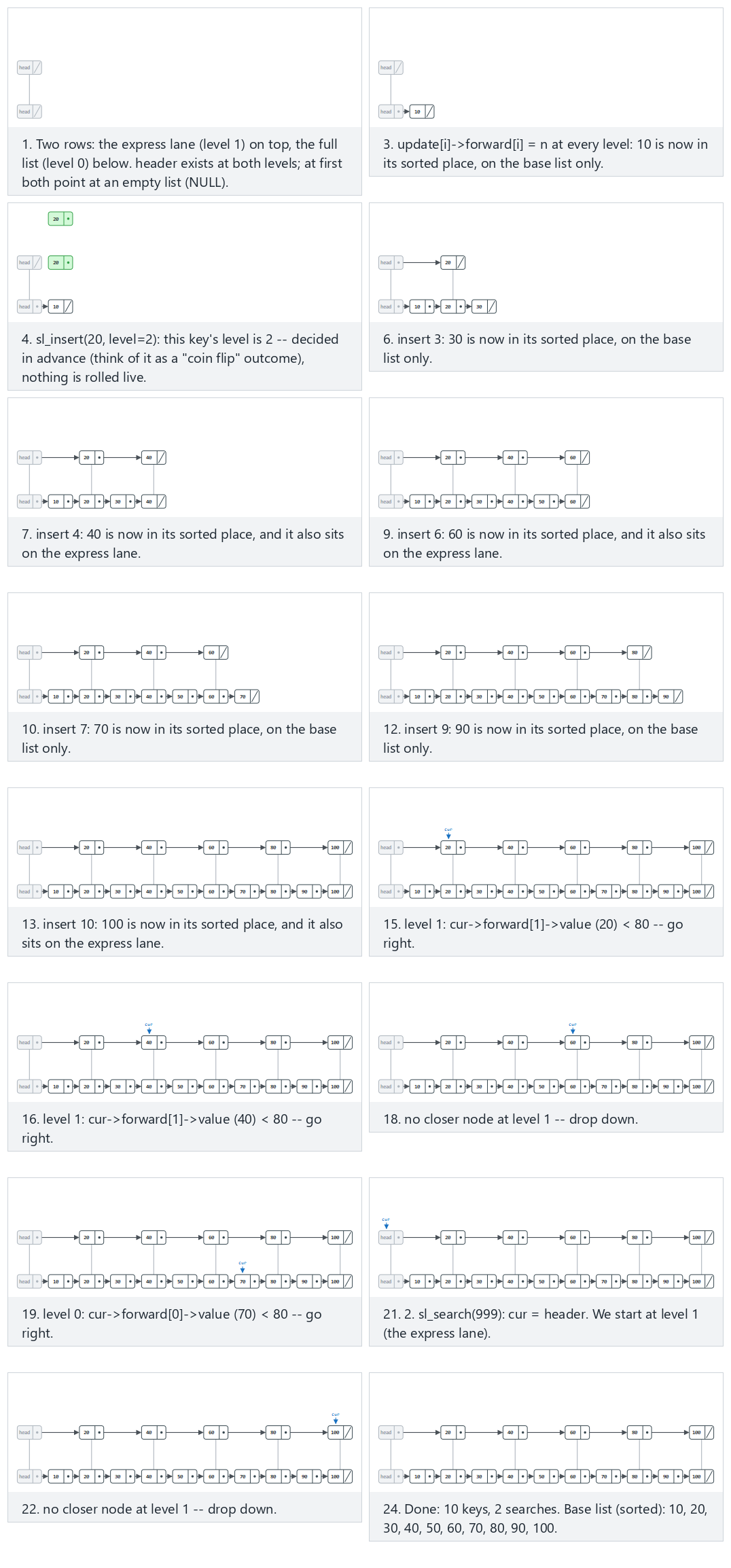
In the picker, also try 14 keys (duplicates/negatives), inserted out of sorted order (hard) and the edge cases 10 keys, only ONE node on the express lane and 12 keys: the first key, the last key, and a value that is not present — or press 🎲 for random data at four difficulty levels, or type your own value:level pairs plus target values after a |.
#define MAX_LEVEL 2   /* level 0 = the full list, level 1 = the express lane */
typedef struct Node { int value; struct Node *forward[MAX_LEVEL]; } Node;
typedef struct { Node *header; } SkipList;      /* header: sentinel, present at every level */

void sl_insert(SkipList *sl, int value, int level, bool verbose) {
    Node *update[MAX_LEVEL];
    Node *cur = sl->header;
    for (int i = MAX_LEVEL - 1; i >= 0; i--) {
        while (cur->forward[i] != NULL && cur->forward[i]->value < value)
            cur = cur->forward[i];
        update[i] = cur;             /* predecessor of the new node at level i */
    }
    Node *n = new_node(value);
    for (int i = 0; i < level; i++) {
        n->forward[i] = update[i]->forward[i];
        update[i]->forward[i] = n;
    }
}

int sl_search(SkipList *sl, int value, int *comparisons) {
    Node *cur = sl->header;
    *comparisons = 0;
    for (int i = MAX_LEVEL - 1; i >= 0; i--) {
        while (cur->forward[i] != NULL && cur->forward[i]->value < value) {
            cur = cur->forward[i];   /* go right */
            (*comparisons)++;
        }
        /* else: drop down one level */
    }
    cur = cur->forward[0];
    (*comparisons)++;
    return cur != NULL && cur->value == value;
}
static final int MAX_LEVEL = 2;   // level 0 = the full list, level 1 = the express lane
class Node { int value; Node[] forward = new Node[MAX_LEVEL]; Node(int v) { value = v; } }
class SList { Node header = new Node(Integer.MIN_VALUE); }   // header: sentinel, present at every level

static void insert(SList sl, int value, int level, boolean verbose) {
    Node[] update = new Node[MAX_LEVEL];
    Node cur = sl.header;
    for (int i = MAX_LEVEL - 1; i >= 0; i--) {
        while (cur.forward[i] != null && cur.forward[i].value < value)
            cur = cur.forward[i];
        update[i] = cur;             // predecessor of the new node at level i
    }
    Node n = new Node(value);
    for (int i = 0; i < level; i++) {
        n.forward[i] = update[i].forward[i];
        update[i].forward[i] = n;
    }
}

static SearchResult search(SList sl, int value) {
    Node cur = sl.header;
    SearchResult r = new SearchResult();
    for (int i = MAX_LEVEL - 1; i >= 0; i--) {
        while (cur.forward[i] != null && cur.forward[i].value < value) {
            cur = cur.forward[i];    // go right
            r.comparisons++;
        }
        // else: drop down one level
    }
    cur = cur.forward[0];
    r.comparisons++;
    r.found = cur != null && cur.value == value;
    return r;
}
The full class (code/week-02/java/SkipList.java) mirrors the C program's four scenarios exactly.
Full program: skip_list.c / SkipList.java
/* Week 2 -- Linked Lists, Arrays and Matrices
 * Skip list: a sorted linked list with an extra "express lane". Levels are
 * given explicitly per key (a deterministic stand-in for a coin flip), not
 * chosen at random, so every run is repeatable. Matches the skip-list.js
 * animation (MAX_LEVEL = 2: level 0 is the full list, level 1 is the
 * express lane).
 * CEN207 Data Structures (formerly CE205)
 */
#include <limits.h>
#include <stdbool.h>
#include <stdio.h>
#include <stdlib.h>

#define MAX_LEVEL 2   /* level 0 = the full list, level 1 = the express lane */
typedef struct Node { int value; struct Node *forward[MAX_LEVEL]; } Node;
typedef struct { Node *header; } SkipList;      /* header: sentinel, present at every level */

static Node *new_node(int value) {
    Node *n = malloc(sizeof(Node));
    n->value = value;
    for (int i = 0; i < MAX_LEVEL; i++) n->forward[i] = NULL;
    return n;
}

void sl_insert(SkipList *sl, int value, int level, bool verbose) {
    Node *update[MAX_LEVEL];
    Node *cur = sl->header;
    for (int i = MAX_LEVEL - 1; i >= 0; i--) {
        while (cur->forward[i] != NULL && cur->forward[i]->value < value)
            cur = cur->forward[i];
        update[i] = cur;             /* predecessor of the new node at level i */
    }
    Node *n = new_node(value);
    for (int i = 0; i < level; i++) {
        n->forward[i] = update[i]->forward[i];
        update[i]->forward[i] = n;
    }
    if (verbose) printf("sl_insert(%d, level=%d)\n", value, level);
}

int sl_search(SkipList *sl, int value, int *comparisons) {
    Node *cur = sl->header;
    *comparisons = 0;
    for (int i = MAX_LEVEL - 1; i >= 0; i--) {
        while (cur->forward[i] != NULL && cur->forward[i]->value < value) {
            cur = cur->forward[i];   /* go right */
            (*comparisons)++;
        }
        /* else: drop down one level */
    }
    cur = cur->forward[0];
    (*comparisons)++;
    return cur != NULL && cur->value == value;
}

static void print_sorted(SkipList *sl) {
    printf("sorted:");
    for (Node *cur = sl->header->forward[0]; cur != NULL; cur = cur->forward[0])
        printf(" %d", cur->value);
    printf("\n");
}

static void free_list(SkipList *sl) {
    Node *cur = sl->header->forward[0];
    while (cur != NULL) {
        Node *tmp = cur;
        cur = cur->forward[0];
        free(tmp);
    }
}

static void run_scenario(const char *label, const int values[], const int levels[], int n, const int searches[], int sn) {
    printf("-- %s --\n", label);
    Node header_node = { INT_MIN, { NULL, NULL } };
    SkipList sl = { &header_node };
    for (int i = 0; i < n; i++)
        sl_insert(&sl, values[i], levels[i], true);
    print_sorted(&sl);
    for (int q = 0; q < sn; q++) {
        int comparisons;
        int found = sl_search(&sl, searches[q], &comparisons);
        printf("sl_search(%d): %s, comparisons %d\n", searches[q], found ? "found" : "not found", comparisons);
    }
    printf("\n");
    free_list(&sl);
}

int main(void) {
    /* normal: 10 keys, every other one on the express lane, two searches */
    int normal_v[] = {10, 20, 30, 40, 50, 60, 70, 80, 90, 100};
    int normal_l[] = {1, 2, 1, 2, 1, 2, 1, 2, 1, 2};
    int normal_s[] = {80, 999};
    run_scenario("normal: 10 keys, every other one on the express lane, two searches", normal_v, normal_l, 10, normal_s, 2);

    /* hard: 14 keys (duplicates/negatives), inserted out of sorted order */
    int hard_v[] = {50, -20, 10, 10, 70, -20, 30, 90, 30, 0, 60, 40, 80, 20};
    int hard_l[] = {1, 2, 1, 2, 1, 1, 2, 1, 1, 2, 1, 2, 1, 1};
    int hard_s[] = {30, -20, 1000};
    run_scenario("hard: 14 keys (duplicates/negatives), inserted out of sorted order", hard_v, hard_l, 14, hard_s, 3);

    /* edge: 10 keys, only ONE node on the express lane */
    int one_express_v[] = {5, 15, 25, 35, 45, 55, 65, 75, 85, 95};
    int one_express_l[] = {1, 1, 1, 2, 1, 1, 1, 1, 1, 1};
    int one_express_s[] = {35, 90};
    run_scenario("edge: 10 keys, only ONE node on the express lane", one_express_v, one_express_l, 10, one_express_s, 2);

    /* edge: 12 keys: the first key, the last key, and a value that is not present */
    int fl_v[] = {8, 16, 24, 32, 40, 48, 56, 64, 72, 80, 88, 96};
    int fl_l[] = {2, 1, 2, 1, 2, 1, 2, 1, 2, 1, 2, 1};
    int fl_s[] = {8, 96, 200};
    run_scenario("edge: 12 keys: the first key, the last key, and a value that is not present", fl_v, fl_l, 12, fl_s, 3);

    return 0;
}
/* Week 2 -- Linked Lists, Arrays and Matrices
 * Skip list: a sorted linked list with an extra "express lane". Levels are
 * given explicitly per key (a deterministic stand-in for a coin flip), not
 * chosen at random, so every run is repeatable. Matches the skip-list.js
 * animation (MAX_LEVEL = 2: level 0 is the full list, level 1 is the
 * express lane).
 * CEN207 Data Structures (formerly CE205)
 */
public class SkipList {
    static final int MAX_LEVEL = 2;   // level 0 = the full list, level 1 = the express lane
    static class Node { int value; Node[] forward = new Node[MAX_LEVEL]; Node(int v) { value = v; } }
    static class SList { Node header = new Node(Integer.MIN_VALUE); }   // header: sentinel, present at every level

    static class SearchResult { boolean found; int comparisons; }

    static void insert(SList sl, int value, int level, boolean verbose) {
        Node[] update = new Node[MAX_LEVEL];
        Node cur = sl.header;
        for (int i = MAX_LEVEL - 1; i >= 0; i--) {
            while (cur.forward[i] != null && cur.forward[i].value < value)
                cur = cur.forward[i];
            update[i] = cur;             // predecessor of the new node at level i
        }
        Node n = new Node(value);
        for (int i = 0; i < level; i++) {
            n.forward[i] = update[i].forward[i];
            update[i].forward[i] = n;
        }
        if (verbose) System.out.println("sl_insert(" + value + ", level=" + level + ")");
    }

    static SearchResult search(SList sl, int value) {
        Node cur = sl.header;
        SearchResult r = new SearchResult();
        for (int i = MAX_LEVEL - 1; i >= 0; i--) {
            while (cur.forward[i] != null && cur.forward[i].value < value) {
                cur = cur.forward[i];    // go right
                r.comparisons++;
            }
            // else: drop down one level
        }
        cur = cur.forward[0];
        r.comparisons++;
        r.found = cur != null && cur.value == value;
        return r;
    }

    static void printSorted(SList sl) {
        StringBuilder sb = new StringBuilder("sorted:");
        for (Node cur = sl.header.forward[0]; cur != null; cur = cur.forward[0]) sb.append(' ').append(cur.value);
        System.out.println(sb);
    }

    static void runScenario(String label, int[] values, int[] levels, int[] searches) {
        System.out.println("-- " + label + " --");
        SList sl = new SList();
        for (int i = 0; i < values.length; i++)
            insert(sl, values[i], levels[i], true);
        printSorted(sl);
        for (int q : searches) {
            SearchResult r = search(sl, q);
            System.out.println("sl_search(" + q + "): " + (r.found ? "found" : "not found") + ", comparisons " + r.comparisons);
        }
        System.out.println();
    }

    public static void main(String[] args) {
        // normal: 10 keys, every other one on the express lane, two searches
        int[] normalV = {10, 20, 30, 40, 50, 60, 70, 80, 90, 100};
        int[] normalL = {1, 2, 1, 2, 1, 2, 1, 2, 1, 2};
        runScenario("normal: 10 keys, every other one on the express lane, two searches", normalV, normalL, new int[]{80, 999});

        // hard: 14 keys (duplicates/negatives), inserted out of sorted order
        int[] hardV = {50, -20, 10, 10, 70, -20, 30, 90, 30, 0, 60, 40, 80, 20};
        int[] hardL = {1, 2, 1, 2, 1, 1, 2, 1, 1, 2, 1, 2, 1, 1};
        runScenario("hard: 14 keys (duplicates/negatives), inserted out of sorted order", hardV, hardL, new int[]{30, -20, 1000});

        // edge: 10 keys, only ONE node on the express lane
        int[] oneExpressV = {5, 15, 25, 35, 45, 55, 65, 75, 85, 95};
        int[] oneExpressL = {1, 1, 1, 2, 1, 1, 1, 1, 1, 1};
        runScenario("edge: 10 keys, only ONE node on the express lane", oneExpressV, oneExpressL, new int[]{35, 90});

        // edge: 12 keys: the first key, the last key, and a value that is not present
        int[] flV = {8, 16, 24, 32, 40, 48, 56, 64, 72, 80, 88, 96};
        int[] flL = {2, 1, 2, 1, 2, 1, 2, 1, 2, 1, 2, 1};
        runScenario("edge: 12 keys: the first key, the last key, and a value that is not present", flV, flL, new int[]{8, 96, 200});
    }
}
Try it
Expected output:
-- normal: 10 keys, every other one on the express lane, two searches --
sl_insert(10, level=1)
sl_insert(20, level=2)
sl_insert(30, level=1)
sl_insert(40, level=2)
sl_insert(50, level=1)
sl_insert(60, level=2)
sl_insert(70, level=1)
sl_insert(80, level=2)
sl_insert(90, level=1)
sl_insert(100, level=2)
sorted: 10 20 30 40 50 60 70 80 90 100
sl_search(80): found, comparisons 5
sl_search(999): not found, comparisons 6

-- hard: 14 keys (duplicates/negatives), inserted out of sorted order --
sl_insert(50, level=1)
sl_insert(-20, level=2)
sl_insert(10, level=1)
sl_insert(10, level=2)
sl_insert(70, level=1)
sl_insert(-20, level=1)
sl_insert(30, level=2)
sl_insert(90, level=1)
sl_insert(30, level=1)
sl_insert(0, level=2)
sl_insert(60, level=1)
sl_insert(40, level=2)
sl_insert(80, level=1)
sl_insert(20, level=1)
sorted: -20 -20 0 10 10 20 30 30 40 50 60 70 80 90
sl_search(30): found, comparisons 6
sl_search(-20): found, comparisons 1
sl_search(1000): not found, comparisons 11

-- edge: 10 keys, only ONE node on the express lane --
sl_insert(5, level=1)
sl_insert(15, level=1)
sl_insert(25, level=1)
sl_insert(35, level=2)
sl_insert(45, level=1)
sl_insert(55, level=1)
sl_insert(65, level=1)
sl_insert(75, level=1)
sl_insert(85, level=1)
sl_insert(95, level=1)
sorted: 5 15 25 35 45 55 65 75 85 95
sl_search(35): found, comparisons 4
sl_search(90): not found, comparisons 7

-- edge: 12 keys: the first key, the last key, and a value that is not present --
sl_insert(8, level=2)
sl_insert(16, level=1)
sl_insert(24, level=2)
sl_insert(32, level=1)
sl_insert(40, level=2)
sl_insert(48, level=1)
sl_insert(56, level=2)
sl_insert(64, level=1)
sl_insert(72, level=2)
sl_insert(80, level=1)
sl_insert(88, level=2)
sl_insert(96, level=1)
sorted: 8 16 24 32 40 48 56 64 72 80 88 96
sl_search(8): found, comparisons 1
sl_search(96): found, comparisons 7
sl_search(200): not found, comparisons 8
Complexity. With a full, well-distributed multi-level skip list (many levels, each roughly half as populated as the one below), search, insert, and delete are all expected O(log n) — Pugh's key result. This two-level teaching version is simpler to trace by hand but does not by itself demonstrate the O(log n) bound; Exercise 9 asks you to reason about what happens as more levels are added.
Common mistakes
- Scanning level 0 first instead of starting at the top level: the whole point of the express lane is to cover long stretches cheaply before dropping down, so the scan must always start at the highest level and work downward.
- Forgetting to update
update[i]at every level the loop visits, even levels the new node will not join —updaterecords where the scan currently is at each level, which is needed to decide the predecessor correctly at whichever levels the new node does join. - Confusing "value not found" with "reached the end of a level": dropping down a level is not the same as the search being over — the search is only complete once level 0 itself is exhausted.
12. Arrays vs. linked lists: when to use which
Every structure in this chapter is a variation on one of two underlying ideas — values packed contiguously and indexed by arithmetic, or values scattered and connected by pointers — and the choice between them is a real engineering decision you will keep making throughout this course and beyond.
| Array (section 1–5) | Linked list (section 6–11) | |
|---|---|---|
| Memory layout | Contiguous | Scattered, connected by pointers |
Random access A[i] | O(1) | O(n) — must walk from the head |
| Insert/delete at a known position | O(n) (shifting) — O(1) at the very end of a dynamic array | O(1), given a pointer to the right spot |
| Insert/delete by value | O(n) to find it, then O(n) or O(1) to remove it | O(n) to find it, then O(1) (doubly) or O(n) (singly/circular) to remove it |
| Extra memory per element | None (just the value) | One pointer (singly/circular/XOR-effective) or two (doubly) |
| Cache behaviour | Excellent — sequential access is the CPU's favourite pattern | Poor — each node can be anywhere in memory |
| Growth | Fixed, or amortized O(1) append for a dynamic array | Naturally dynamic, one node at a time, no resizing ever needed |
Neither structure is "better" in general — a hash table (a later course topic) even uses arrays and linked lists together, exactly to get the strengths of both. As a rule of thumb: reach for an array (or a dynamic array) when you need fast indexed access or your data is naturally sequential and read far more often than it is restructured; reach for a linked list when insertions and deletions in the middle dominate, when you cannot predict the final size in advance, or (as with the circular list's Josephus problem) when the shape of the problem is naturally a chain or a cycle rather than a numbered sequence.
Summary
- An array packs elements contiguously, so
A[i]is O(1) arithmetic; inserting or deleting in the middle costs O(n) because everything after the gap must physically shift. - A dynamic array starts small and grows by a multiplicative factor whenever it is full, copying every existing element into a fresh, larger block; a single growing append costs O(n), but the amortized cost per append, averaged over a long sequence, is O(1).
- A 2D matrix is really flat 1D memory: row-major storage places
M[i][j]ati*COLS+j, column-major atj*ROWS+i; a traversal that matches the storage order is cache-friendly (Δ = 1 every step), one that goes against it jumps a whole row or column on every step. - Two classic array algorithms: rotation by three reversals (O(n) time, O(1) extra space) and rearrangement by a two-pointer partition (O(n), also O(1) extra space).
- A sparse matrix (mostly zeros) is stored as a table of
(row, col, value)triplets; its transpose can be computed in one extra pass with counting + prefix sums, avoiding a full re-sort, and two sorted triplet lists can be added by merging, exactly like the merge step of merge sort. - A linked list is a chain of
malloc'd nodes, each holding a value and anextpointer, identified by aheadpointer and terminated byNULL; it trades an array's O(1) indexing for O(1) insertion/deletion once you are already at the right spot. - The singly linked list supports
insert(head O(1), tail O(n) without a tail pointer, after-a-node O(1)),delete_value(O(n)),search(O(n)), and an iterative three-pointerreverse(O(n), O(1) extra space). - The doubly linked list adds a
prevfield and atailpointer to get O(1) tail insertion, backward traversal, and O(1) deletion of an already-known node. - The circular linked list has no
NULLat all — the last node'snextwraps back to the first — which makes it the natural structure for the Josephus problem (every k-th of n people in a circle is eliminated until one survives). - The XOR linked list packs
prevandnextinto a single field vianpx = addr(prev) XOR addr(next), a memory-saving curiosity that standard C does not strictly guarantee and garbage-collected languages cannot do with real references at all. - The skip list (Pugh, 1990) layers an "express lane" on top of a sorted linked list, bringing search down from O(n) toward O(log n) by skipping large stretches before dropping to the full list for the final steps.
Exercises
- Trace
array_insert_delete.c's "hard" scenario by hand for the first four operations only (i0:7, i1:-3, i2:15, i0:-3into an initially empty, 14-capacity array), drawing the array's contents andsizeafter each step, then check your work against the program's real output. - Modify
array_rotation.c(or its Java twin) to rotate right bydinstead of left, using the same three-reversal technique — think about which ranges the threereversecalls need to cover. - Using
sparse_matrix_triplet.c's "hard" 6x6 matrix, compute by hand whatadd_sparsewould produce if that same matrix were added to itself (i.e.a[]andb[]are identical triplet lists). Which entries, if any, would ever cancel to zero? - Draw the singly linked list built by
singly_insert.c's "hard" scenario (12 tail-inserts, then oneinsert_after) after every single operation, labelingheadat each step, then compare against the program's real output. - Write, on paper, the sequence of
prev/cur/nextpointer values thatsingly_reverse.c'sreversefunction produces for the input[1, 2, 3], one line per loop iteration. - A doubly linked list currently holds
10 <-> 20 <-> 30(headat 10,tailat 30). Tracedelete_value(20)by hand: which four pointer fields (at most) change, and what areheadandtailafterward? - For
n = 7, k = 3in the Josephus problem, compute the survivor by hand usingjosephus.c's simulation (list every elimination in order), then check your answer against the closed-form recurrence from section 9.3. - Explain, in your own words and without looking back at section 10.2, why an XOR linked list's
npxfield cannot be used by a garbage collector to determine whether a node is still reachable. - Challenge.
skip_list.cuses exactly two levels (MAX_LEVEL = 2). Suppose it used four levels instead, with each level holding roughly half as many keys as the one below (level 0: all n keys, level 1: n/2, level 2: n/4, level 3: n/8). Explain why a search in this four-level list touches roughly the same number of nodes as a search in a perfectly balanced binary search tree of the same n keys — and what that implies about the general relationship between "number of levels" and search cost as n grows. - Challenge. Modify
sparse_matrix_addition.c(or its Java twin) to implement sparse matrix subtraction by adaptingadd_sparse's merge: what is the one line that needs to change, and why does everything else (including the "drop the entry if the result is zero" check) stay exactly the same?
Self-check quiz
1. What is the time complexity of A[i] for an array, and why?
O(1). The address is computed directly as base + i * sizeof(T) — one multiplication and one addition, with no dependence on n or on searching.
2. Why is inserting at index 0 of an array more expensive than inserting at the end?
Inserting at index 0 must shift every one of the array's existing elements one slot to the right to make room — O(n) — while inserting at the end (when there is spare capacity) just writes into the next free slot — O(1).
??? success "3. A dynamic array starts at capacity 1 and doubles every time it is full. After 8 appends, how many times has it grown, and what is its final capacity?" It grows at appends 2, 3, 5, and 9 — but only 8 appends happen here, so it grows when going from 1->2, then 2->4, then 4->8 (at the 2nd, 3rd, and 5th appends): 3 growths, final capacity 8.
4. In a ROWS x COLS matrix stored row-major, what is the address (in elements) of M[i][j]?
i * COLS + j.
5. Why is a traversal that visits a row-major matrix column-by-column considered cache-unfriendly?
Because consecutive steps of that traversal are COLS elements apart in actual memory (a jump), rather than adjacent (Δ = 1), so each step is likely to miss the CPU cache and fetch a fresh memory chunk.
6. What does the triplet representation of a sparse matrix store, and why does it save memory?
A list of (row, col, value) triplets, one per nonzero cell only — the (usually vast majority of) zero cells are never stored at all.
??? success "7. In a singly linked list, why is insert_head O(1) but insert_tail (with no tail pointer) O(n)?" insert_head only ever touches the first node and the list's own head pointer, regardless of length. insert_tail, with no separate tail pointer, must walk the entire list from the head to find the current last node before it can attach the new one.
??? success "8. What is the key advantage a doubly linked list has over a singly linked list when deleting a node you already have a direct pointer to?" O(1) deletion: the node's prev and next fields already give direct access to both neighbours, so no search is needed to find the predecessor (unlike a singly linked list, where the predecessor must be located by walking from the head).
??? success "9. In the Josephus problem with n people and step size k, how many steps forward does the counting loop take before each elimination, and why not k?" k - 1 steps. The person currently at the count already counts as "1", so only k - 1 further steps are needed to reach the k-th person from there.
10. What single number does a skip list search accumulate as it runs, and what does it measure?
The number of comparisons — how many times the search moved right (at any level) plus the one final check at level 0 — a direct measure of how much cheaper the express lane made this particular search compared to a plain O(n) linear scan.
Looking ahead
Next week introduces the stack and the queue — two restricted-access ADTs (LIFO and FIFO, respectively) that can each be implemented on top of either structure from this week: an array-backed stack or queue reuses this week's insert_at/delete_at at one fixed end (or, for a circular queue, wrapping around exactly the way section 9's circular linked list does), while a linked-list-backed stack or queue reuses insert_head and delete_value from section 7 directly. Week 3 also introduces recursion, and shows that a recursive call really is a stack of pending calls managed by the compiler — the same LIFO discipline you will have just built by hand.
References
- Cormen, T. H., Leiserson, C. E., Rivest, R. L., & Stein, C. (2022). Introduction to Algorithms (4th ed.). MIT Press. — Chapter 10 (Elementary Data Structures: arrays, matrices, linked lists) and the discussion of amortized analysis for dynamic arrays.
- Sedgewick, R., & Wayne, K. (2011). Algorithms (4th ed.). Addison-Wesley. — Chapter 1.3 (Bags, Queues, and Stacks) for linked-list fundamentals, and the resizing-array treatment for amortized analysis.
- Knuth, D. E. (1997). The Art of Computer Programming, Volume 1: Fundamental Algorithms (3rd ed.). Addison-Wesley. — Chapter 2.2 (Linear lists) and Chapter 2.2.6 (row-major/column-major array representation).
- Pugh, W. (1990). "Skip Lists: A Probabilistic Alternative to Balanced Trees." Communications of the ACM, 33(6), 668–676.
- Newell, A., Shaw, J. C., & Simon, H. A. (1957). "Empirical Explorations of the Logic Theory Machine: A Case Study in Heuristic." Proceedings of the Western Joint Computer Conference. — The Logic Theorist, built on the Information Processing Language (IPL) and its linked list of symbolic cells.
- williamfiset/Algorithms (MIT License). https://github.com/williamfiset/Algorithms — reference Java implementations for linked lists and dynamic arrays.
- Programiz DSA. https://www.programiz.com/dsa — step-by-step introductory explanations of arrays, linked lists, and sparse matrices.