Week 13 — File Organisation I: Sequential and Direct Files
CEN207 Data Structures (formerly CE205) · Fall 2026–2027
Lecture notes (PDF) Lecture notes (DOCX) Slides (PDF) Slides (PPTX) Slides (HTML, offline) Download all (ZIP) Open slides full screen
Click inside the slides and use the arrow keys; use the button at the bottom right of the slides, or the "Open slides full screen" link above, for full screen.
This week
Learning outcomes. By the end of this week you will be able to explain, draw, and implement the two classical ways a program organises records inside a file on disk: sequential files, where records are searched, scanned, updated and merged in the order they are stored, and direct (relative) files, where a record's location is computed instead of searched for — either directly from a record number, or by hashing a key to a bucket. You will learn why disk I/O is measured in block reads and writes rather than in comparisons, what a blocking factor is and why it matters for both speed and wasted space, how a sequential update merges a transaction file into a master file in a single efficient pass (add / change / delete, with proper error handling), how a relative file gives O(1) access by record number, how hashing to buckets resolves collisions by chaining overflow blocks, how progressive overflow (linear probing) resolves collisions directly inside the file itself, and why deleting a record from a probed file needs a tombstone rather than simply marking the slot empty. Every program you write this week performs real file I/O — fopen, fseek, fread, fwrite in C; RandomAccessFile / DataOutputStream in Java — inside a temporary lab folder your own program creates and cleans up. These outcomes map to LO.1 (explain fundamental data structures), LO.2 (analyze algorithmic complexity), LO.6 (implement data structures correctly in C and Java), and LO.7 (choose the right structure for a problem) of the course syllabus.
What you need already. Every data structure so far this semester — arrays (Week 1), linked lists (Week 2), stacks and queues (Week 3), trees and heaps (Week 4), graphs (Week 5), hash tables (Week 6), sorting (Week 10), advanced trees (Week 11), strings (Week 12) — assumed the data already sat in RAM, where accessing arr[i] or following a pointer costs (for our purposes) the same handful of nanoseconds no matter which i or which pointer. This week drops that assumption. A file lives on a disk; moving the read/write head and waiting for the platter to spin (or, on an SSD, servicing a block-level request) costs orders of magnitude more than touching RAM, and — critically — a disk is not read one byte or one record at a time; it is read and written one block at a time. Week 6's hashing (division method, collision resolution by chaining or open addressing, rehashing) reappears here almost unchanged in its logic, but now every "look at a slot" becomes "read a block from disk", and the cost we count changes from comparisons to block reads.
Time plan for a 3-hour session. Why files are different: block-oriented I/O (~15 min) · records and fields (~15 min) · blocking factor (~15 min) · sequential search of a file (~15 min) · binary search of a sorted file (~15 min) · short break · sequential update: merging master and transaction files (~30 min) · relative (direct) files (~15 min) · hashing to buckets (~20 min) · progressive overflow / linear probing on disk (~20 min) · deletion with tombstones (~15 min) · comparison table, choosing a technique, wrap-up and self-check (~15 min).
0. Before we start
0.1 What you already know
Three ideas from earlier in the course matter most this week.
From Week 1 — arrays and computed addresses. arr[i] is computed directly as base_address + i * element_size; no searching is needed to reach index i. This week's relative file (section 7) is exactly this idea moved to disk: block = rrn / bf, offset = rrn % bf computes a record's location from its record number, the same way array indexing computes an address from an index — the only difference is that "the array" is now a file, and reaching a location means one fseek plus one block read instead of one pointer addition.
From Week 6 — hashing, collisions, and open addressing. Week 6 built a hash table entirely in RAM: h(k) = k mod m picked a slot, collisions were resolved by chaining a linked list per slot or by probing for another slot inside the table. Sections 8–10 of this week reuse exactly the same two ideas — chaining (now chaining whole overflow blocks, section 8) and open addressing (now called progressive overflow, section 9, because each "slot" is a disk position, not a RAM cell) — but every probe now costs a real disk access, which is why counting probes (equivalently, block reads) matters so much more here than it did in Week 6.
A genuinely new idea: the cost unit changes from "comparison" to "block read". Every algorithm from Weeks 1–12 was analyzed by counting comparisons, swaps, or pointer hops — operations that cost (for our purposes) a constant, tiny amount of time each, so counting how many of them happen tells you almost everything about real-world speed. On disk, a single block read costs so much more than any in-memory operation on that block's contents that we mostly stop counting comparisons altogether and count block reads and writes instead. A sequential search that reads 100 blocks and compares 1 key per block is, in practice, no faster than one that reads 100 blocks and compares 1000 keys per block — the disk access dominates. This one shift in what you count is the organizing idea of the whole week.
0.2 The map of this week
flowchart TD
    W13["Week 13: File Organisation I"]
    W13 --> F["Foundations: records, fields, blocks"]
    F --> F1["Records and fields: fixed-length vs. delimited vs. length-prefixed"]
    F --> F2["Blocking factor: records per block, wasted space"]
    W13 --> S["Sequential files: process records IN ORDER"]
    S --> S1["Sequential search: read every block until found"]
    S --> S2["Binary search of a SORTED file: jump to the middle block"]
    S --> S3["Sequential update: merge a transaction file into the master, one pass"]
    W13 --> D["Direct (relative) files: COMPUTE the location"]
    D --> D1["Direct access: block = rrn / bf, offset = rrn % bf"]
    W13 --> H["Direct files via hashing: compute a BUCKET, then handle collisions"]
    H --> H1["Hashing to buckets: chain overflow blocks"]
    H --> H2["Progressive overflow: linear probing inside the file"]
    H --> H3["Deletion needs a tombstone, not a cleared slot"]
Every box gets its own section below, most with a step-by-step animation, a complete C and Java program that performs real file I/O, and a note on complexity and common mistakes.
1. Why files are different: block-oriented I/O
1.1 A question to start
Every data structure this semester lived in RAM, where arr[500000] costs the same as arr[0]. A file — a student roster, a bank's account ledger, a database table — usually cannot fit in RAM at all, and even when it could, the operating system still moves it to and from disk one block at a time (typically 512 bytes, 4 KB, or some other fixed size chosen by the file system). If a program needs one 20-byte record, why does the disk not just hand over 20 bytes?
1.2 The idea: a block is the smallest unit of disk I/O
A disk (spinning or solid-state) is organized into fixed-size blocks. Every single read or write transfers one whole block, never less — even if the program only asked for one record's worth of bytes, the operating system reads the entire block that record lives in, then hands the program the slice it wanted. This is a hardware and file-system fact, not a design choice a program can opt out of, and it is why file-organisation techniques exist as a topic at all: every technique in this chapter is really a strategy for minimizing the number of block reads and writes, because that number — not the number of records, not the number of comparisons — is what determines how long a real program actually takes.
Throughout this week, every drawing follows the same convention: a disk row shows named, numbered blocks (their contents drawn inside them); a RAM buffer row shows the one block currently loaded into memory, where a program can actually inspect individual records; and a running count of block reads and block writes is shown on the right, updated every step. That count is this week's O(...) — the quantity every complexity discussion below is really about.
1.3 Sequential vs. direct: the two families this week
There are two fundamentally different strategies for organising a file, and this week covers one algorithm or more from each:
| Family | Idea | How a record is located | This week's sections |
|---|---|---|---|
| Sequential | Records are processed in the order they are stored (usually sorted by key) | Read blocks in order (or jump to a middle block on a sorted file) until you find it | 3, 4, 5 |
| Direct (relative) | A record's key or record number computes its block and offset directly | One arithmetic calculation, then one block read | 6, 7, 8, 9 |
Sequential organisation is simple and is unbeatable when you need to process every record anyway (printing every student's transcript, say); direct organisation is unbeatable when you need to look up one specific record among millions and cannot afford to read the whole file to find it. Real systems very often use both at once — a sequential file for batch processing, a hashed or indexed file for interactive lookups — which is exactly why both families are worth knowing well.
2. Records and fields
2.1 A question to start
A file is a sequence of bytes; a record (one student, one transaction, one employee) has several fields (an ID, a name, a score) that need to be packed into those bytes and unpacked again on read. A name can be three letters or thirty. Should every record reserve the same number of bytes for a name field regardless of how long the actual name is, or should each record's size adapt to its actual content?
2.2 Three layouts for the same field
Fixed-length. Every record reserves exactly NAME_FIXED bytes for the name, whatever the real name's length: a short name is padded with filler bytes, a name that does not fit is truncated — and the truncated characters are permanently lost. The payoff is that every record is exactly the same size, which (as the next two sections show) is what makes computing a record's address from its position possible at all.
Delimited. The name is written exactly as long as it is, followed by a delimiter byte (here |) that marks where it ends. No padding, no truncation, no wasted space — but reading a record back means scanning byte by byte for the delimiter, since nothing says in advance how long the name will be.
Length-prefixed. A single length byte is written first, then exactly that many bytes of the name. Reading back is now O(1) per field instead of a scan: read the length byte, then read exactly that many more bytes — no delimiter character is needed at all (and no character has to be reserved as "cannot appear inside a name" the way a literal | inside a name would break the delimited scheme).
2.3 In memory, and the code
#define NAME_FIXED 8

int write_fixed(FILE *fp, int id, const char *name, int score) {
    FixedRecord r; r.id = id; r.score = score;
    int n = (int) strlen(name);
    if (n >= NAME_FIXED) {                 /* too long: truncate, data is lost */
        memcpy(r.name, name, NAME_FIXED);
    } else {
        memcpy(r.name, name, n);
        memset(r.name + n, '_', NAME_FIXED - n);   /* pad with filler bytes */
    }
    return fwrite(&r, sizeof(r), 1, fp) == 1 ? (int) sizeof(r) : -1;
}

int write_delim(FILE *fp, int id, const char *name, int score) {
    (void) id; (void) score;   /* still fixed 4-byte fields; only name is variable here */
    return fprintf(fp, "%s|", name) > 0 ? 4 + (int) strlen(name) + 1 + 4 : -1;
}

int write_lenpfx(FILE *fp, int id, const char *name, int score) {
    (void) id; (void) score;
    unsigned char len = (unsigned char) strlen(name);   /* 1-byte length prefix */
    fwrite(&len, 1, 1, fp);
    fwrite(name, 1, len, fp);
    return 4 + 1 + (int) len + 4;
}
static final int NAME_FIXED = 8;

static int writeFixed(DataOutputStream out, int id, String name, int score) throws IOException {
    out.writeInt(id);
    byte[] raw = name.getBytes(StandardCharsets.US_ASCII);
    int n = raw.length;
    if (n >= NAME_FIXED) {                    // too long: truncate, data is lost
        out.write(raw, 0, NAME_FIXED);
    } else {
        out.write(raw);
        for (int i = n; i < NAME_FIXED; i++) out.write('_');   // pad with filler bytes
    }
    out.writeInt(score);
    return 4 + NAME_FIXED + 4;
}

static int writeDelim(DataOutputStream out, int id, String name, int score) throws IOException {
    // id and score are still fixed 4-byte fields; only name is variable here
    byte[] raw = name.getBytes(StandardCharsets.US_ASCII);
    out.write(raw); out.writeByte('|');
    return 4 + raw.length + 1 + 4;
}

static int writeLenPrefixed(DataOutputStream out, int id, String name, int score) throws IOException {
    // id and score are still fixed 4-byte fields; only the name is variable here
    byte[] raw = name.getBytes(StandardCharsets.US_ASCII);
    out.writeByte(raw.length);            // 1-byte length prefix
    out.write(raw);
    return 4 + 1 + raw.length + 4;
}
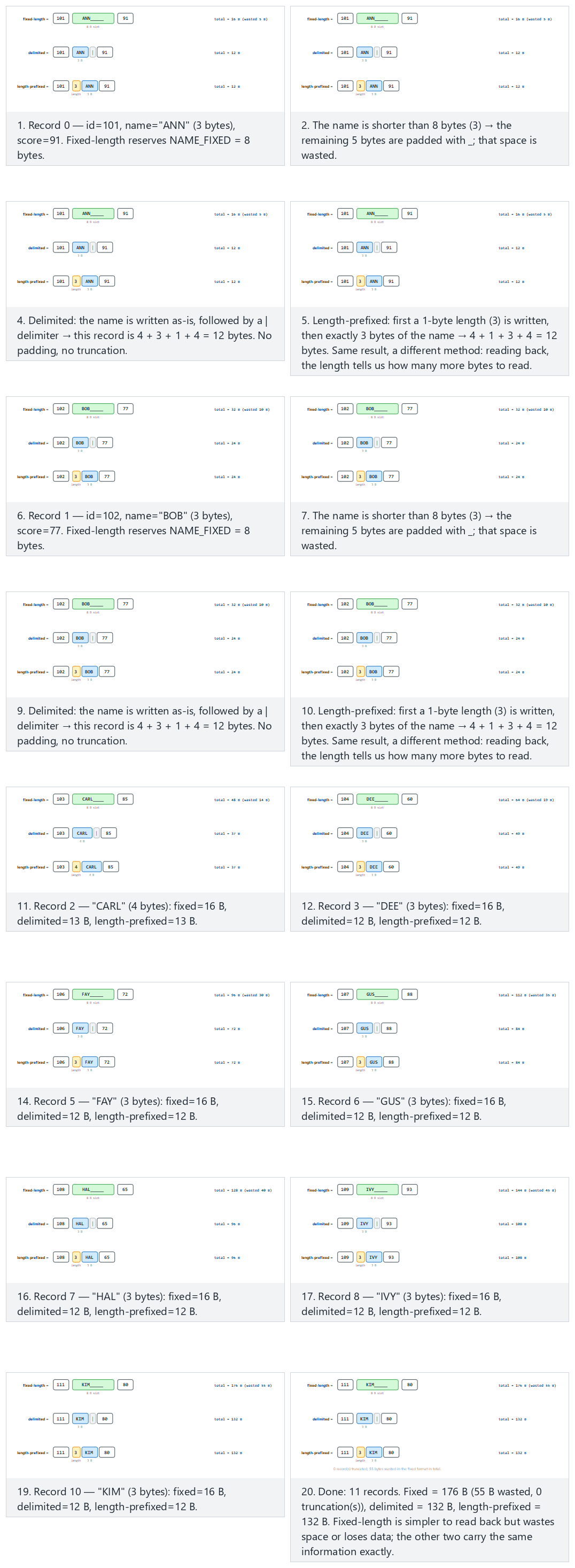
In the picker, also try hard: 13 records, mixed lengths (some truncated, some padded, some exact), or the edge cases empty name and a very long name and every name longer than 8 characters (every single record truncated in the fixed layout) — or press 🎲 for random data, or type your own id:name:score list.
2.4 Try it
Full program: records_and_fields.c / RecordsAndFields.java
Both programs create a temporary lab folder (in the OS temp directory, never inside the course repository) and write three REAL files inside it — fixed.dat, delim.dat, lenpfx.dat — for each scenario below, then read each file's actual size back with ftell (C) / File.length() (Java) before deleting the files and, at the end, the lab folder itself.
/* Week 13 -- File Organisation I
 * Records and fields: the same records are written to three REAL files, one per layout --
 * fixed-length (padded/truncated to NAME_FIXED bytes), delimited (name + '|'), and length-prefixed
 * (1-byte length + name). The files are created only inside a temporary lab folder that main()
 * creates and removes.
 * CEN207 Data Structures (formerly CE205)
 */
#include <stdio.h>
#include <stdlib.h>
#include <string.h>
#include <sys/stat.h>
#ifdef _WIN32
#include <direct.h>
#define MKDIR(path) _mkdir(path)
#define RMDIR(path) _rmdir(path)
#else
#define MKDIR(path) mkdir(path, 0755)
#define RMDIR(path) rmdir(path)
#endif

/* A fresh, empty temporary folder under the OS temp directory -- never inside the repository -- that this
   program creates and removes itself; every file this program writes lives only inside it. */
static void lab_path(char *out, size_t n) {
#ifdef _WIN32
    const char *base = getenv("TEMP");
    if (!base) base = getenv("TMP");
    if (!base) base = ".";
#else
    const char *base = getenv("TMPDIR");
    if (!base) base = "/tmp";
#endif
    snprintf(out, n, "%s/cen207_week13_records_lab", base);
}

#define NAME_FIXED 8

typedef struct { int id; char name[NAME_FIXED]; int score; } FixedRecord;

int write_fixed(FILE *fp, int id, const char *name, int score) {
    FixedRecord r; r.id = id; r.score = score;
    int n = (int) strlen(name);
    if (n >= NAME_FIXED) {                 /* too long: truncate, data is lost */
        memcpy(r.name, name, NAME_FIXED);
    } else {
        memcpy(r.name, name, n);
        memset(r.name + n, '_', NAME_FIXED - n);   /* pad with filler bytes */
    }
    return fwrite(&r, sizeof(r), 1, fp) == 1 ? (int) sizeof(r) : -1;
}

int write_delim(FILE *fp, int id, const char *name, int score) {
    (void) id; (void) score;   /* still fixed 4-byte fields; only name is variable here */
    return fprintf(fp, "%s|", name) > 0 ? 4 + (int) strlen(name) + 1 + 4 : -1;
}

int write_lenpfx(FILE *fp, int id, const char *name, int score) {
    (void) id; (void) score;
    unsigned char len = (unsigned char) strlen(name);   /* 1-byte length prefix */
    fwrite(&len, 1, 1, fp);
    fwrite(name, 1, len, fp);
    return 4 + 1 + (int) len + 4;
}

/* ---- driver ------------------------------------------------------------ */

typedef struct { int id; const char *name; int score; } RecIn;

static long file_size(const char *path) {
    FILE *fp = fopen(path, "rb");
    if (!fp) return -1;
    fseek(fp, 0, SEEK_END);
    long sz = ftell(fp);
    fclose(fp);
    return sz;
}

static void run_scenario(const char *label, const char *lab, RecIn recs[], int n) {
    printf("-- %s --\n", label);
    char pfixed[512], pdelim[512], plen[512];
    snprintf(pfixed, sizeof(pfixed), "%s/fixed.dat", lab);
    snprintf(pdelim, sizeof(pdelim), "%s/delim.dat", lab);
    snprintf(plen, sizeof(plen), "%s/lenpfx.dat", lab);

    FILE *ffixed = fopen(pfixed, "wb");
    FILE *fdelim = fopen(pdelim, "wb");
    FILE *flen = fopen(plen, "wb");
    if (!ffixed || !fdelim || !flen) {                 /* clean up whichever of the three did open */
        if (ffixed) fclose(ffixed);
        if (fdelim) fclose(fdelim);
        if (flen) fclose(flen);
        remove(pfixed); remove(pdelim); remove(plen);
        printf("  could not open lab files\n");
        return;
    }

    int wasted = 0, truncated = 0;
    for (int i = 0; i < n; i++) {
        int nlen = (int) strlen(recs[i].name);
        write_fixed(ffixed, recs[i].id, recs[i].name, recs[i].score);
        write_delim(fdelim, recs[i].id, recs[i].name, recs[i].score);
        write_lenpfx(flen, recs[i].id, recs[i].name, recs[i].score);
        if (nlen >= NAME_FIXED) truncated++; else wasted += NAME_FIXED - nlen;
        printf("  id=%-4d name=\"%-10s\" (%2d B) score=%-4d%s\n",
               recs[i].id, recs[i].name, nlen, recs[i].score, nlen >= NAME_FIXED ? "  -- truncated in fixed.dat!" : "");
    }
    fclose(ffixed); fclose(fdelim); fclose(flen);

    long szf = file_size(pfixed), szd = file_size(pdelim), szl = file_size(plen);
    printf("  fixed.dat  = %ld B (expected %d, %d B wasted, %d truncated)\n", szf, n * (8 + NAME_FIXED), wasted, truncated);
    printf("  delim.dat  = %ld B\n", szd);
    printf("  lenpfx.dat = %ld B\n", szl);
    printf("summary: %d records, fixed saves nothing here (%ld B) but reads back at a constant stride;\n"
           "         delim/lenpfx are %ld B smaller, but need parsing to find record boundaries.\n\n",
           n, szf, szf - szd);

    remove(pfixed); remove(pdelim); remove(plen);
}

int main(void) {
    char lab[512];
    lab_path(lab, sizeof(lab));
    RMDIR(lab);           /* in case a previous crashed run left it behind */
    MKDIR(lab);

    RecIn normal[] = {
        {101, "ANN", 91}, {102, "BOB", 77}, {103, "CARL", 85}, {104, "DEE", 60}, {105, "ED", 99},
        {106, "FAY", 72}, {107, "GUS", 88}, {108, "HAL", 65}, {109, "IVY", 93}, {110, "JOE", 58}, {111, "KIM", 80}
    };
    RecIn mixed[] = {
        {201, "AL", 70}, {202, "BRENDA", 84}, {203, "CARLITOX", 66}, {204, "DOMINIQUE", 91}, {205, "ED", 55},
        {206, "FRANCESCA", 62}, {207, "GIA", 89}, {208, "HECTOR", 73}, {209, "IRA", 95}, {210, "JULIETTE", 68},
        {211, "KEN", 81}, {212, "LIONEL", 77}, {213, "MAX", 90}
    };
    RecIn edge_empty_long[] = {
        {301, "", 40}, {302, "ALEXANDRIA", 71}, {303, "A", 50}, {304, "BO", 61}, {305, "CHRISTOPHERSON", 82},
        {306, "", 30}, {307, "D", 45}, {308, "EIGHTCHRS", 59}, {309, "F", 66}, {310, "GABRIELLA", 74}, {311, "H", 53}
    };
    RecIn edge_all_truncated[] = {
        {401, "ABCDEFGHIJ", 10}, {402, "KLMNOPQRST", 20}, {403, "UVWXYZABCD", 30}, {404, "EFGHIJKLMN", 40},
        {405, "OPQRSTUVWX", 50}, {406, "YZABCDEFGH", 60}, {407, "IJKLMNOPQR", 70}, {408, "STUVWXYZAB", 80},
        {409, "CDEFGHIJKL", 90}, {410, "MNOPQRSTUV", 15}
    };

    run_scenario("normal: 11 records, short names (padding, no truncation)", lab, normal, 11);
    run_scenario("hard: 13 records, mixed lengths", lab, mixed, 13);
    run_scenario("edge: empty name and a very long name", lab, edge_empty_long, 11);
    run_scenario("edge: every name longer than 8 characters", lab, edge_all_truncated, 10);

    RMDIR(lab);
    return 0;
}
import java.io.DataOutputStream;
import java.io.File;
import java.io.FileOutputStream;
import java.io.IOException;
import java.nio.charset.StandardCharsets;

/* Week 13 -- File Organisation I
 * Records and fields: the same records are written to three REAL files, one per layout --
 * fixed-length (padded/truncated to NAME_FIXED bytes), delimited (name + '|'), and length-prefixed
 * (1-byte length + name). The files are created only inside a temporary lab folder that main()
 * creates and removes.
 * CEN207 Data Structures (formerly CE205)
 */
public class RecordsAndFields {
    static final int NAME_FIXED = 8;

    static int writeFixed(DataOutputStream out, int id, String name, int score) throws IOException {
        out.writeInt(id);
        byte[] raw = name.getBytes(StandardCharsets.US_ASCII);
        int n = raw.length;
        if (n >= NAME_FIXED) {                    // too long: truncate, data is lost
            out.write(raw, 0, NAME_FIXED);
        } else {
            out.write(raw);
            for (int i = n; i < NAME_FIXED; i++) out.write('_');   // pad with filler bytes
        }
        out.writeInt(score);
        return 4 + NAME_FIXED + 4;
    }

    static int writeDelim(DataOutputStream out, int id, String name, int score) throws IOException {
        // id and score are still fixed 4-byte fields; only name is variable here
        byte[] raw = name.getBytes(StandardCharsets.US_ASCII);
        out.write(raw); out.writeByte('|');
        return 4 + raw.length + 1 + 4;
    }

    static int writeLenPrefixed(DataOutputStream out, int id, String name, int score) throws IOException {
        // id and score are still fixed 4-byte fields; only the name is variable here
        byte[] raw = name.getBytes(StandardCharsets.US_ASCII);
        out.writeByte(raw.length);            // 1-byte length prefix
        out.write(raw);
        return 4 + 1 + raw.length + 4;
    }

    /* ---- driver ------------------------------------------------------------ */

    static class RecIn { int id; String name; int score; RecIn(int i, String n, int s) { id = i; name = n; score = s; } }

    static void runScenario(String label, File lab, RecIn[] recs) throws IOException {
        System.out.println("-- " + label + " --");
        File fixedFile = new File(lab, "fixed.dat"), delimFile = new File(lab, "delim.dat"), lenFile = new File(lab, "lenpfx.dat");
        int wasted = 0, truncated = 0;
        try (DataOutputStream fixedOut = new DataOutputStream(new FileOutputStream(fixedFile));
             DataOutputStream delimOut = new DataOutputStream(new FileOutputStream(delimFile));
             DataOutputStream lenOut = new DataOutputStream(new FileOutputStream(lenFile))) {
            for (RecIn r : recs) {
                int nlen = r.name.getBytes(StandardCharsets.US_ASCII).length;
                writeFixed(fixedOut, r.id, r.name, r.score);
                writeDelim(delimOut, r.id, r.name, r.score);
                writeLenPrefixed(lenOut, r.id, r.name, r.score);
                if (nlen >= NAME_FIXED) truncated++; else wasted += NAME_FIXED - nlen;
                System.out.printf("  id=%-4d name=\"%-10s\" (%2d B) score=%-4d%s%n",
                        r.id, r.name, nlen, r.score, nlen >= NAME_FIXED ? "  -- truncated in fixed.dat!" : "");
            }
        }
        long szf = fixedFile.length(), szd = delimFile.length(), szl = lenFile.length();
        System.out.printf("  fixed.dat  = %d B (expected %d, %d B wasted, %d truncated)%n", szf, recs.length * (8 + NAME_FIXED), wasted, truncated);
        System.out.printf("  delim.dat  = %d B%n", szd);
        System.out.printf("  lenpfx.dat = %d B%n", szl);
        System.out.printf("summary: %d records, fixed saves nothing here (%d B) but reads back at a constant stride;%n" +
                "         delim/lenpfx are %d B smaller, but need parsing to find record boundaries.%n%n",
                recs.length, szf, szf - szd);
        fixedFile.delete(); delimFile.delete(); lenFile.delete();
    }

    public static void main(String[] args) throws IOException {
        File lab = new File(System.getProperty("java.io.tmpdir"), "cen207_week13_records_lab_java");
        if (lab.exists()) for (File f : lab.listFiles()) f.delete();
        lab.mkdir();

        RecIn[] normal = {
            new RecIn(101, "ANN", 91), new RecIn(102, "BOB", 77), new RecIn(103, "CARL", 85), new RecIn(104, "DEE", 60), new RecIn(105, "ED", 99),
            new RecIn(106, "FAY", 72), new RecIn(107, "GUS", 88), new RecIn(108, "HAL", 65), new RecIn(109, "IVY", 93), new RecIn(110, "JOE", 58), new RecIn(111, "KIM", 80)
        };
        RecIn[] mixed = {
            new RecIn(201, "AL", 70), new RecIn(202, "BRENDA", 84), new RecIn(203, "CARLITOX", 66), new RecIn(204, "DOMINIQUE", 91), new RecIn(205, "ED", 55),
            new RecIn(206, "FRANCESCA", 62), new RecIn(207, "GIA", 89), new RecIn(208, "HECTOR", 73), new RecIn(209, "IRA", 95), new RecIn(210, "JULIETTE", 68),
            new RecIn(211, "KEN", 81), new RecIn(212, "LIONEL", 77), new RecIn(213, "MAX", 90)
        };
        RecIn[] edgeEmptyLong = {
            new RecIn(301, "", 40), new RecIn(302, "ALEXANDRIA", 71), new RecIn(303, "A", 50), new RecIn(304, "BO", 61), new RecIn(305, "CHRISTOPHERSON", 82),
            new RecIn(306, "", 30), new RecIn(307, "D", 45), new RecIn(308, "EIGHTCHRS", 59), new RecIn(309, "F", 66), new RecIn(310, "GABRIELLA", 74), new RecIn(311, "H", 53)
        };
        RecIn[] edgeAllTruncated = {
            new RecIn(401, "ABCDEFGHIJ", 10), new RecIn(402, "KLMNOPQRST", 20), new RecIn(403, "UVWXYZABCD", 30), new RecIn(404, "EFGHIJKLMN", 40),
            new RecIn(405, "OPQRSTUVWX", 50), new RecIn(406, "YZABCDEFGH", 60), new RecIn(407, "IJKLMNOPQR", 70), new RecIn(408, "STUVWXYZAB", 80),
            new RecIn(409, "CDEFGHIJKL", 90), new RecIn(410, "MNOPQRSTUV", 15)
        };

        runScenario("normal: 11 records, short names (padding, no truncation)", lab, normal);
        runScenario("hard: 13 records, mixed lengths", lab, mixed);
        runScenario("edge: empty name and a very long name", lab, edgeEmptyLong);
        runScenario("edge: every name longer than 8 characters", lab, edgeAllTruncated);

        lab.delete();
    }
}
Try it
Expected output:
-- normal: 11 records, short names (padding, no truncation) --
  id=101  name="ANN       " ( 3 B) score=91
  id=102  name="BOB       " ( 3 B) score=77
  id=103  name="CARL      " ( 4 B) score=85
  id=104  name="DEE       " ( 3 B) score=60
  id=105  name="ED        " ( 2 B) score=99
  id=106  name="FAY       " ( 3 B) score=72
  id=107  name="GUS       " ( 3 B) score=88
  id=108  name="HAL       " ( 3 B) score=65
  id=109  name="IVY       " ( 3 B) score=93
  id=110  name="JOE       " ( 3 B) score=58
  id=111  name="KIM       " ( 3 B) score=80
  fixed.dat  = 176 B (expected 176, 55 B wasted, 0 truncated)
  delim.dat  = 44 B
  lenpfx.dat = 44 B
summary: 11 records, fixed saves nothing here (176 B) but reads back at a constant stride;
         delim/lenpfx are 132 B smaller, but need parsing to find record boundaries.

-- hard: 13 records, mixed lengths --
  id=201  name="AL        " ( 2 B) score=70
  id=202  name="BRENDA    " ( 6 B) score=84
  id=203  name="CARLITOX  " ( 8 B) score=66    -- truncated in fixed.dat!
  id=204  name="DOMINIQUE " ( 9 B) score=91    -- truncated in fixed.dat!
  id=205  name="ED        " ( 2 B) score=55
  id=206  name="FRANCESCA " ( 9 B) score=62    -- truncated in fixed.dat!
  id=207  name="GIA       " ( 3 B) score=89
  id=208  name="HECTOR    " ( 6 B) score=73
  id=209  name="IRA       " ( 3 B) score=95
  id=210  name="JULIETTE  " ( 8 B) score=68    -- truncated in fixed.dat!
  id=211  name="KEN       " ( 3 B) score=81
  id=212  name="LIONEL    " ( 6 B) score=77
  id=213  name="MAX       " ( 3 B) score=90
  fixed.dat  = 208 B (expected 208, 38 B wasted, 4 truncated)
  delim.dat  = 81 B
  lenpfx.dat = 81 B
summary: 13 records, fixed saves nothing here (208 B) but reads back at a constant stride;
         delim/lenpfx are 127 B smaller, but need parsing to find record boundaries.

-- edge: empty name and a very long name --
  id=301  name="          " ( 0 B) score=40
  id=302  name="ALEXANDRIA" (10 B) score=71    -- truncated in fixed.dat!
  id=303  name="A         " ( 1 B) score=50
  id=304  name="BO        " ( 2 B) score=61
  id=305  name="CHRISTOPHERSON" (14 B) score=82    -- truncated in fixed.dat!
  id=306  name="          " ( 0 B) score=30
  id=307  name="D         " ( 1 B) score=45
  id=308  name="EIGHTCHRS " ( 9 B) score=59    -- truncated in fixed.dat!
  id=309  name="F         " ( 1 B) score=66
  id=310  name="GABRIELLA " ( 9 B) score=74    -- truncated in fixed.dat!
  id=311  name="H         " ( 1 B) score=53
  fixed.dat  = 176 B (expected 176, 50 B wasted, 4 truncated)
  delim.dat  = 59 B
  lenpfx.dat = 59 B
summary: 11 records, fixed saves nothing here (176 B) but reads back at a constant stride;
         delim/lenpfx are 117 B smaller, but need parsing to find record boundaries.

-- edge: every name longer than 8 characters --
  id=401  name="ABCDEFGHIJ" (10 B) score=10    -- truncated in fixed.dat!
  id=402  name="KLMNOPQRST" (10 B) score=20    -- truncated in fixed.dat!
  id=403  name="UVWXYZABCD" (10 B) score=30    -- truncated in fixed.dat!
  id=404  name="EFGHIJKLMN" (10 B) score=40    -- truncated in fixed.dat!
  id=405  name="OPQRSTUVWX" (10 B) score=50    -- truncated in fixed.dat!
  id=406  name="YZABCDEFGH" (10 B) score=60    -- truncated in fixed.dat!
  id=407  name="IJKLMNOPQR" (10 B) score=70    -- truncated in fixed.dat!
  id=408  name="STUVWXYZAB" (10 B) score=80    -- truncated in fixed.dat!
  id=409  name="CDEFGHIJKL" (10 B) score=90    -- truncated in fixed.dat!
  id=410  name="MNOPQRSTUV" (10 B) score=15    -- truncated in fixed.dat!
  fixed.dat  = 160 B (expected 160, 0 B wasted, 10 truncated)
  delim.dat  = 110 B
  lenpfx.dat = 110 B
summary: 10 records, fixed saves nothing here (160 B) but reads back at a constant stride;
         delim/lenpfx are 50 B smaller, but need parsing to find record boundaries.
2.5 Complexity, mistakes, self-check
Complexity. Writing or reading one field is O(field length) regardless of layout — the difference between the three is not asymptotic, it is about wasted space (fixed) versus parsing cost (delimited) versus neither (length-prefixed, at the cost of a hard limit on field length: one byte can only express lengths 0–255).
Common mistakes
- Forgetting that a fixed-length field is not null-terminated when it is exactly full or truncated.
memcpy(r.name, name, NAME_FIXED)on a name that is exactlyNAME_FIXEDbytes long, or longer and truncated, leaves no room for a trailing'\0'; reading it back as a C string without also tracking its known fixed length reads past the field into whatever bytes follow it. - Choosing a delimiter character that can legally appear inside the data. A name field delimited by
,breaks the moment a name legally contains a comma; length-prefixing sidesteps this class of bug entirely, at the cost of a maximum field length. - Silently truncating instead of reporting data loss. The fixed-length layout above prints a warning every time a name is truncated specifically so this is visible; a real system that truncates silently can corrupt data for years before anyone notices a name was cut short.
Self-check: why is a length-prefixed field's read cost O(1) plus the field's own length, while a delimited field's read cost is O(scan to the delimiter)?
A length-prefixed field tells the reader exactly how many bytes to read before reading any of the field's content — one byte read (the length), then exactly that many more bytes, no wasted comparisons. A delimited field gives the reader no such information in advance: the reader must examine each byte one at a time, comparing it against the delimiter character, until it happens to find one — an unavoidable scan whose length is exactly the field's own length (which the length-prefixed scheme already told you directly, without scanning).
3. Blocking factor
3.1 A question to start
Section 1 established that disk I/O happens one block at a time. If a block is 100 bytes and one record is 20 bytes, does the disk waste 80 bytes on every single read, or can several records share one block?
3.2 The idea: pack bf records per block
The blocking factor, bf, is how many fixed-size records fit in one block: bf = floor(blockSize / recSize). Records are accumulated in a small RAM buffer one at a time; the moment the buffer reaches bf records, the whole buffer is written to disk in a single fwrite call — one block, one disk access, bf records, not bf disk accesses for bf records. This is the entire payoff of blocking: disk access happens per block, not per record.
Blocking does not eliminate waste, it just relocates it. Internal fragmentation is the space left over inside every full block when bf * recSize does not exactly equal blockSize (bf is a floor, so there is almost always a remainder). A second, independent kind of waste shows up in the last block: if the total number of records is not an exact multiple of bf, the final block is only partly full, yet it still occupies a whole block on disk — block_flush writes it anyway, with however many empty record-slots' worth of extra waste that implies.
3.3 In memory, and the code
#define BLOCK_SIZE 100

typedef struct { int keys[MAX_BF]; int count; } Block;

int block_capacity(int rec_size) { return BLOCK_SIZE / rec_size; }   /* bf = floor(BLOCK_SIZE / rec_size) */

void block_put(Block *b, int bf, int key, FILE *fp, int *written) {
    b->keys[b->count++] = key;
    if (b->count == bf) {                    /* block full: flush it to disk */
        fwrite(b->keys, sizeof(int), bf, fp);
        (*written)++;
        b->count = 0;                        /* start a new, empty block */
    }
}

void block_flush(Block *b, FILE *fp, int *written) {
    if (b->count > 0) {                      /* partial last block is still written, with waste */
        fwrite(b->keys, sizeof(int), b->count, fp);
        (*written)++;
    }
}
static final int BLOCK_SIZE = 100;

static int blockCapacity(int recSize) { return BLOCK_SIZE / recSize; }   // bf = floor(BLOCK_SIZE / recSize)

static void blockPut(List<Integer> buf, int bf, int key, DataOutputStream out, int[] written) throws IOException {
    buf.add(key);
    if (buf.size() == bf) {                       // block full: flush it to disk
        for (int v : buf) out.writeInt(v);
        written[0]++;
        buf.clear();                              // start a new, empty block
    }
}

static void blockFlush(List<Integer> buf, DataOutputStream out, int[] written) throws IOException {
    if (!buf.isEmpty()) {                          // partial last block is still written, with waste
        for (int v : buf) out.writeInt(v);
        written[0]++;
    }
}
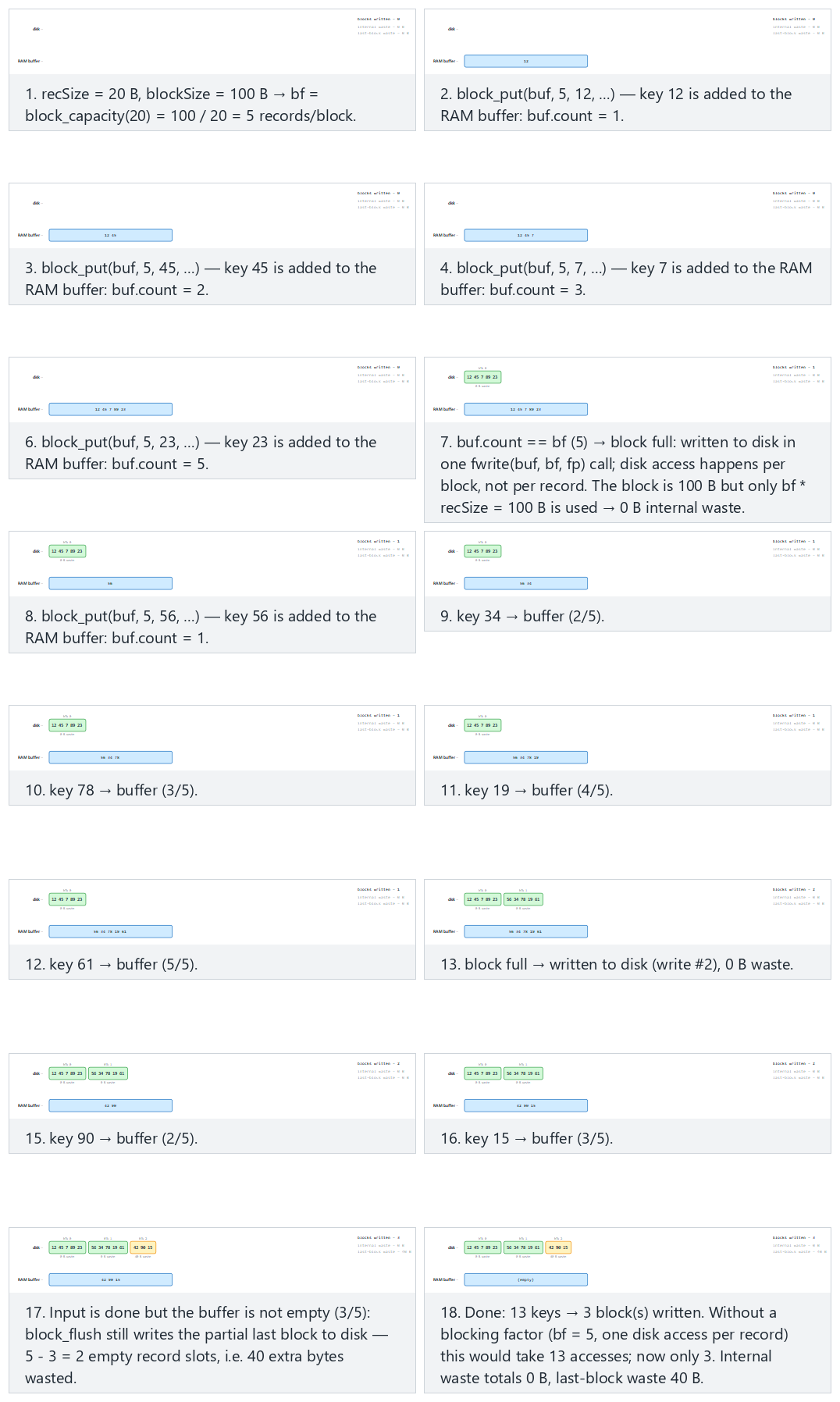
In the picker, also try hard: recSize=24, blockSize=100 (bf=4), 14 keys (internal fragmentation on every block, plus last-block waste), or the edge cases record bigger than block (bf=0, error) — a design error a real system must detect, not silently misbehave on — and 12 keys divide bf=3 exactly, no last-block waste (fragmentation still happens, but only inside full blocks) — or press 🎲 for random data, or type your own rec=N blk=N header and key list.
3.4 Try it
Full program: blocking_factor.c / BlockingFactor.java
/* Week 13 -- File Organisation I
 * Blocking factor: how many fixed-size records fit in one disk block (bf), and the waste that comes with it --
 * internal fragmentation inside every full block, plus extra waste in a partial last block. Every block is
 * really written to a file inside a temporary lab folder that main() creates and removes.
 * CEN207 Data Structures (formerly CE205)
 */
#include <stdio.h>
#include <stdlib.h>
#include <string.h>
#include <sys/stat.h>
#ifdef _WIN32
#include <direct.h>
#define MKDIR(path) _mkdir(path)
#define RMDIR(path) _rmdir(path)
#else
#define MKDIR(path) mkdir(path, 0755)
#define RMDIR(path) rmdir(path)
#endif

static void lab_path(char *out, size_t n) {
#ifdef _WIN32
    const char *base = getenv("TEMP");
    if (!base) base = getenv("TMP");
    if (!base) base = ".";
#else
    const char *base = getenv("TMPDIR");
    if (!base) base = "/tmp";
#endif
    snprintf(out, n, "%s/cen207_week13_blocking_lab", base);
}

#define BLOCK_SIZE 100
#define MAX_BF 20

typedef struct { int keys[MAX_BF]; int count; } Block;

int block_capacity(int rec_size) { return BLOCK_SIZE / rec_size; }   /* bf = floor(BLOCK_SIZE / rec_size) */

void block_put(Block *b, int bf, int key, FILE *fp, int *written) {
    b->keys[b->count++] = key;
    if (b->count == bf) {                    /* block full: flush it to disk */
        fwrite(b->keys, sizeof(int), bf, fp);
        (*written)++;
        b->count = 0;                        /* start a new, empty block */
    }
}

void block_flush(Block *b, FILE *fp, int *written) {
    if (b->count > 0) {                      /* partial last block is still written, with waste */
        fwrite(b->keys, sizeof(int), b->count, fp);
        (*written)++;
    }
}

/* ---- driver ------------------------------------------------------------ */

static void run_scenario(const char *label, const char *lab, int rec_size, int block_size, int keys[], int n) {
    printf("-- %s --\n", label);
    int bf = block_size / rec_size;
    printf("recSize=%d blockSize=%d -> bf=%d\n", rec_size, block_size, bf);
    if (bf < 1) {
        printf("ERROR: a record (%d B) does not fit in a block (%d B): no block can hold even one record.\n\n", rec_size, block_size);
        return;
    }

    char path[512];
    snprintf(path, sizeof(path), "%s/blocks.dat", lab);
    FILE *fp = fopen(path, "wb");
    if (!fp) { printf("  could not open lab file\n"); return; }

    Block b; b.count = 0;
    int written = 0, fragTotal = 0;
    for (int i = 0; i < n; i++) {
        int before = written;
        block_put(&b, bf, keys[i], fp, &written);
        if (written > before) {
            int frag = block_size - bf * rec_size;
            fragTotal += frag;
            printf("  key %d -> block full, flushed (write #%d), %d B internal waste\n", keys[i], written, frag);
        } else {
            printf("  key %d -> buffer (%d/%d)\n", keys[i], b.count, bf);
        }
    }
    int beforeFlush = written;
    int lastWaste = 0;
    if (b.count > 0) lastWaste = (bf - b.count) * rec_size;
    block_flush(&b, fp, &written);
    if (written > beforeFlush) {
        int lastFrag = block_size - bf * rec_size;
        fragTotal += lastFrag;
        printf("  final partial block -> flushed (write #%d), %d B internal waste + %d B last-block waste\n", written, lastFrag, lastWaste);
    }
    fclose(fp);

    fp = fopen(path, "rb");
    fseek(fp, 0, SEEK_END);
    long size = ftell(fp);
    fclose(fp);
    printf("summary: %d keys -> %d block(s) written (%ld B on disk), internal waste %d B, last-block waste %d B\n\n",
           n, written, size, fragTotal, lastWaste);
    remove(path);
}

int main(void) {
    char lab[512];
    lab_path(lab, sizeof(lab));
    RMDIR(lab);
    MKDIR(lab);

    int normal[] = { 12, 45, 7, 89, 23, 56, 34, 78, 19, 61, 42, 90, 15 };
    int hard[] = { 8, 31, 55, 12, 47, 63, 29, 71, 18, 40, 52, 6, 84, 25 };
    int edge_too_big[] = { 1, 2, 3, 4, 5, 6, 7, 8, 9, 10 };
    int edge_exact[] = { 3, 66, 21, 48, 11, 77, 34, 59, 2, 91, 26, 44 };

    run_scenario("normal: recSize=20, blockSize=100 (bf=5), 13 keys", lab, 20, 100, normal, 13);
    run_scenario("hard: recSize=24, blockSize=100 (bf=4), 14 keys", lab, 24, 100, hard, 14);
    run_scenario("edge: record bigger than block (bf=0, error)", lab, 60, 50, edge_too_big, 10);
    run_scenario("edge: 12 keys divide bf=3 exactly, no last-block waste", lab, 30, 100, edge_exact, 12);

    RMDIR(lab);
    return 0;
}
import java.io.DataOutputStream;
import java.io.FileOutputStream;
import java.io.IOException;
import java.util.ArrayList;
import java.util.List;

/* Week 13 -- File Organisation I
 * Blocking factor: how many fixed-size records fit in one disk block (bf), and the waste that comes with it --
 * internal fragmentation inside every full block, plus extra waste in a partial last block. Every block is
 * really written to a file inside a temporary lab folder that main() creates and removes.
 * CEN207 Data Structures (formerly CE205)
 */
public class BlockingFactor {
    static final int BLOCK_SIZE = 100;

    static int blockCapacity(int recSize) { return BLOCK_SIZE / recSize; }   // bf = floor(BLOCK_SIZE / recSize)

    static void blockPut(List<Integer> buf, int bf, int key, DataOutputStream out, int[] written) throws IOException {
        buf.add(key);
        if (buf.size() == bf) {                       // block full: flush it to disk
            for (int v : buf) out.writeInt(v);
            written[0]++;
            buf.clear();                              // start a new, empty block
        }
    }

    static void blockFlush(List<Integer> buf, DataOutputStream out, int[] written) throws IOException {
        if (!buf.isEmpty()) {                          // partial last block is still written, with waste
            for (int v : buf) out.writeInt(v);
            written[0]++;
        }
    }

    /* ---- driver ------------------------------------------------------------ */

    static void runScenario(String label, java.io.File lab, int recSize, int blockSize, int[] keys) throws IOException {
        System.out.println("-- " + label + " --");
        int bf = blockSize / recSize;
        System.out.printf("recSize=%d blockSize=%d -> bf=%d%n", recSize, blockSize, bf);
        if (bf < 1) {
            System.out.printf("ERROR: a record (%d B) does not fit in a block (%d B): no block can hold even one record.%n%n", recSize, blockSize);
            return;
        }

        java.io.File path = new java.io.File(lab, "blocks.dat");
        List<Integer> buf = new ArrayList<>();
        int[] written = { 0 };
        int fragTotal = 0;
        try (DataOutputStream out = new DataOutputStream(new FileOutputStream(path))) {
            for (int key : keys) {
                int before = written[0];
                blockPut(buf, bf, key, out, written);
                if (written[0] > before) {
                    int frag = blockSize - bf * recSize;
                    fragTotal += frag;
                    System.out.printf("  key %d -> block full, flushed (write #%d), %d B internal waste%n", key, written[0], frag);
                } else {
                    System.out.printf("  key %d -> buffer (%d/%d)%n", key, buf.size(), bf);
                }
            }
            int beforeFlush = written[0];
            int lastWaste = buf.isEmpty() ? 0 : (bf - buf.size()) * recSize;
            blockFlush(buf, out, written);
            if (written[0] > beforeFlush) {
                int lastFrag = blockSize - bf * recSize;
                fragTotal += lastFrag;
                System.out.printf("  final partial block -> flushed (write #%d), %d B internal waste + %d B last-block waste%n", written[0], lastFrag, lastWaste);
            }
            long size = path.length();
            System.out.printf("summary: %d keys -> %d block(s) written (%d B on disk), internal waste %d B, last-block waste %d B%n%n",
                    keys.length, written[0], size, fragTotal, lastWaste);
        }
        path.delete();
    }

    public static void main(String[] args) throws IOException {
        java.io.File lab = new java.io.File(System.getProperty("java.io.tmpdir"), "cen207_week13_blocking_lab_java");
        if (lab.exists()) for (java.io.File f : lab.listFiles()) f.delete();
        lab.mkdir();

        int[] normal = { 12, 45, 7, 89, 23, 56, 34, 78, 19, 61, 42, 90, 15 };
        int[] hard = { 8, 31, 55, 12, 47, 63, 29, 71, 18, 40, 52, 6, 84, 25 };
        int[] edgeTooBig = { 1, 2, 3, 4, 5, 6, 7, 8, 9, 10 };
        int[] edgeExact = { 3, 66, 21, 48, 11, 77, 34, 59, 2, 91, 26, 44 };

        runScenario("normal: recSize=20, blockSize=100 (bf=5), 13 keys", lab, 20, 100, normal);
        runScenario("hard: recSize=24, blockSize=100 (bf=4), 14 keys", lab, 24, 100, hard);
        runScenario("edge: record bigger than block (bf=0, error)", lab, 60, 50, edgeTooBig);
        runScenario("edge: 12 keys divide bf=3 exactly, no last-block waste", lab, 30, 100, edgeExact);

        lab.delete();
    }
}
Try it
Expected output:
-- normal: recSize=20, blockSize=100 (bf=5), 13 keys --
recSize=20 blockSize=100 -> bf=5
  key 12 -> buffer (1/5)
  key 45 -> buffer (2/5)
  key 7 -> buffer (3/5)
  key 89 -> buffer (4/5)
  key 23 -> block full, flushed (write #1), 0 B internal waste
  key 56 -> buffer (1/5)
  key 34 -> buffer (2/5)
  key 78 -> buffer (3/5)
  key 19 -> buffer (4/5)
  key 61 -> block full, flushed (write #2), 0 B internal waste
  key 42 -> buffer (1/5)
  key 90 -> buffer (2/5)
  key 15 -> buffer (3/5)
  final partial block -> flushed (write #3), 0 B internal waste + 40 B last-block waste
summary: 13 keys -> 3 block(s) written (52 B on disk), internal waste 0 B, last-block waste 40 B

-- hard: recSize=24, blockSize=100 (bf=4), 14 keys --
recSize=24 blockSize=100 -> bf=4
  key 8 -> buffer (1/4)
  key 31 -> buffer (2/4)
  key 55 -> buffer (3/4)
  key 12 -> block full, flushed (write #1), 4 B internal waste
  key 47 -> buffer (1/4)
  key 63 -> buffer (2/4)
  key 29 -> buffer (3/4)
  key 71 -> block full, flushed (write #2), 4 B internal waste
  key 18 -> buffer (1/4)
  key 40 -> buffer (2/4)
  key 52 -> buffer (3/4)
  key 6 -> block full, flushed (write #3), 4 B internal waste
  key 84 -> buffer (1/4)
  key 25 -> buffer (2/4)
  final partial block -> flushed (write #4), 4 B internal waste + 48 B last-block waste
summary: 14 keys -> 4 block(s) written (56 B on disk), internal waste 16 B, last-block waste 48 B

-- edge: record bigger than block (bf=0, error) --
recSize=60 blockSize=50 -> bf=0
ERROR: a record (60 B) does not fit in a block (50 B): no block can hold even one record.

-- edge: 12 keys divide bf=3 exactly, no last-block waste --
recSize=30 blockSize=100 -> bf=3
  key 3 -> buffer (1/3)
  key 66 -> buffer (2/3)
  key 21 -> block full, flushed (write #1), 10 B internal waste
  key 48 -> buffer (1/3)
  key 11 -> buffer (2/3)
  key 77 -> block full, flushed (write #2), 10 B internal waste
  key 34 -> buffer (1/3)
  key 59 -> buffer (2/3)
  key 2 -> block full, flushed (write #3), 10 B internal waste
  key 91 -> buffer (1/3)
  key 26 -> buffer (2/3)
  key 44 -> block full, flushed (write #4), 10 B internal waste
summary: 12 keys -> 4 block(s) written (48 B on disk), internal waste 40 B, last-block waste 0 B
3.5 Complexity, mistakes, self-check
Complexity. Writing n records costs ceil(n / bf) block writes instead of n — a factor-of-bf reduction in disk accesses. Blocking does not change how much data ultimately moves, only how many separate accesses it takes to move it, and it is the access count, not the byte count, that dominates real-world disk-bound performance (section 1.2).
Common mistakes
- Forgetting to flush the last, partial block. A loop that only calls
block_putand never callsblock_flushafter the loop silently drops the finalcount < bfrecords — they were buffered in RAM but never written to disk. - Assuming a larger
bfis always better. A largerbfmeans fewer disk accesses, but it also means more RAM must be buffered before anything is written (relevant when records are large or memory is tight), and — for the sequential-search algorithm in section 4 — a largerbfmeans more records must be linearly scanned once the right block is finally found. - Not detecting
bf = 0. If a record is larger than the block size,block_capacityreturns 0, and a naiveblock_putwould loop forever trying to fill a block that can never reach a full count of zero keys — this must be checked and reported as a configuration error, not run.
Self-check: for recSize=20, blockSize=100, why is the internal fragmentation exactly 0 bytes per block, but for recSize=24 it is 4 bytes per block?
bf = floor(blockSize / recSize). For recSize=20: bf = floor(100/20) = 5, and bf * recSize = 5 * 20 = 100, exactly the block size — no bytes left over. For recSize=24: bf = floor(100/24) = 4 (since 100 / 24 = 4.16...), and bf * recSize = 4 * 24 = 96, leaving 100 - 96 = 4 bytes unused in every full block. The waste is exactly blockSize mod recSize whenever that remainder is nonzero.
4. Sequential search of a file
4.1 A question to start
A file's records are not necessarily sorted. To find one specific key, is there any option other than reading every single block until the key turns up (or the file ends)?
4.2 The idea: read blocks in order, compare every record in the loaded block
Sequential search of a file is the direct file-based analogue of Week 1's linear search, adapted to the fact that records arrive bf at a time, not one at a time: read block 0 into the RAM buffer, compare every record inside it against the target; if not found, read block 1, and so on, until the target is found or the file is exhausted. The cost that matters is block reads, not comparisons — comparing a few extra records already sitting in a block that has already been read from disk costs almost nothing next to the disk access that loaded them.
4.3 In memory, and the code
#define BF 4   /* records per block */

int seq_search_file(FILE *fp, int n, int key, int *block_reads, int *comparisons) {
    int buf[BF];
    int nblocks = (n + BF - 1) / BF;
    for (int b = 0; b < nblocks; b++) {
        fseek(fp, (long) b * BF * sizeof(int), SEEK_SET);
        int cnt = (int) fread(buf, sizeof(int), BF, fp);   /* one block read */
        (*block_reads)++;
        for (int i = 0; i < cnt; i++) {
            (*comparisons)++;
            if (buf[i] == key) return b * BF + i;           /* found */
        }
    }
    return -1;                                              /* not found: every block was read */
}
static final int BF = 4;   // records per block

static int seqSearchFile(RandomAccessFile fp, int n, int key, int[] blockReads, int[] comparisons) throws IOException {
    int[] buf = new int[BF];
    int nblocks = (n + BF - 1) / BF;
    for (int b = 0; b < nblocks; b++) {
        fp.seek((long) b * BF * 4);
        int cnt = 0;
        for (; cnt < BF && fp.getFilePointer() < fp.length(); cnt++) buf[cnt] = fp.readInt();   // one block read
        blockReads[0]++;
        for (int i = 0; i < cnt; i++) {
            comparisons[0]++;
            if (buf[i] == key) return b * BF + i;             // found
        }
    }
    return -1;                                                // not found: every block was read
}
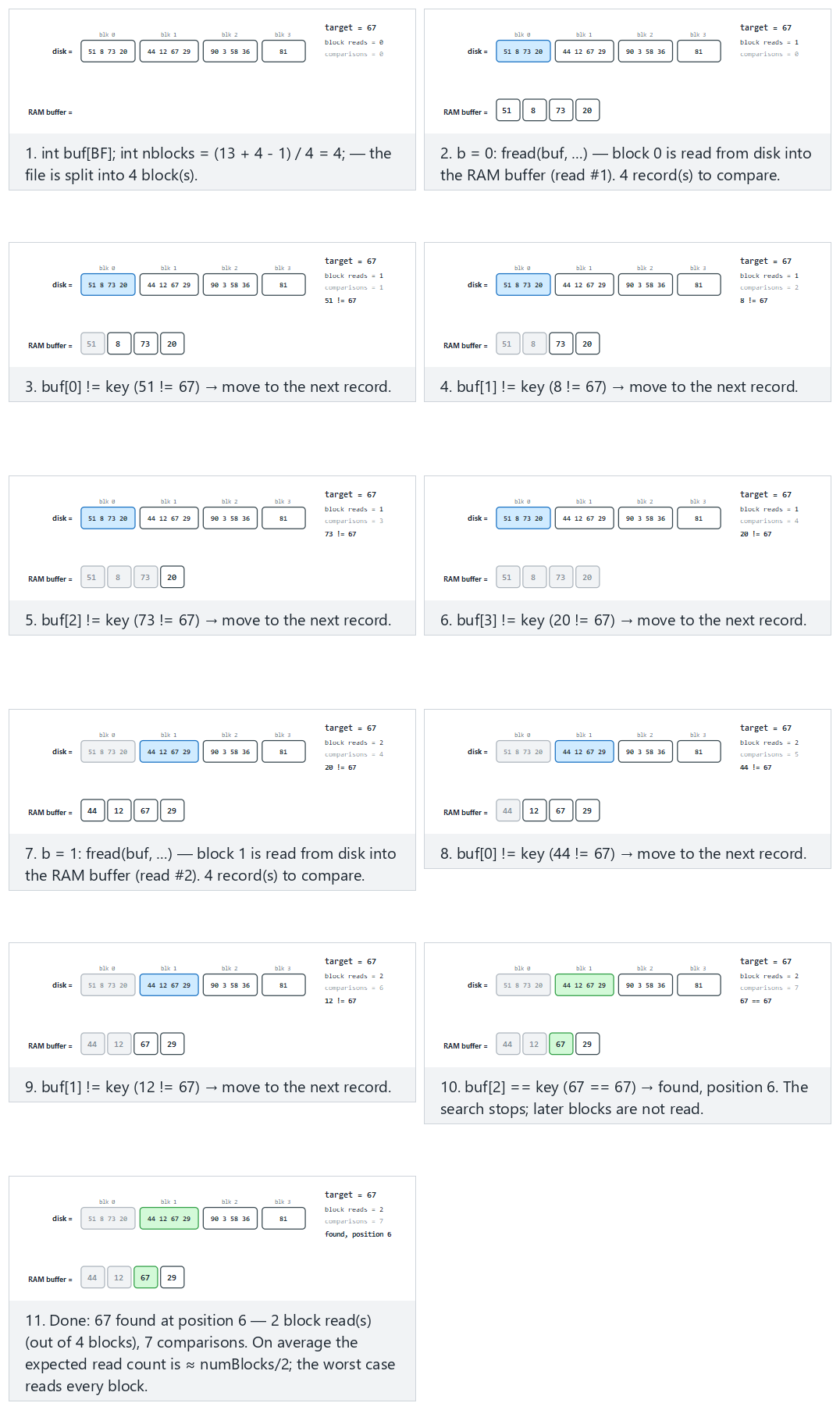
In the picker, also try hard: 14 keys, duplicate target in the last block (worst case) (the first, earlier occurrence of a duplicate is what gets returned), or the edge cases target absent, the whole file is scanned and target is the first record, best case (1 read) — or press 🎲 for random data, or type your own target=N header and key list.
4.4 Try it
Full program: sequential_search_file.c / SequentialSearchFile.java
/* Week 13 -- File Organisation I
 * Sequential search of a file: blocks are read from disk in order, and every record inside a loaded block is
 * compared until the key is found or the file ends. The cost is measured in BLOCK READS. The file really lives
 * on disk, inside a temporary lab folder that main() creates and removes.
 * CEN207 Data Structures (formerly CE205)
 */
#include <stdio.h>
#include <stdlib.h>
#include <sys/stat.h>
#ifdef _WIN32
#include <direct.h>
#define MKDIR(path) _mkdir(path)
#define RMDIR(path) _rmdir(path)
#else
#define MKDIR(path) mkdir(path, 0755)
#define RMDIR(path) rmdir(path)
#endif

static void lab_path(char *out, size_t n) {
#ifdef _WIN32
    const char *base = getenv("TEMP");
    if (!base) base = getenv("TMP");
    if (!base) base = ".";
#else
    const char *base = getenv("TMPDIR");
    if (!base) base = "/tmp";
#endif
    snprintf(out, n, "%s/cen207_week13_seqsearch_lab", base);
}

#define BF 4   /* records per block */

int seq_search_file(FILE *fp, int n, int key, int *block_reads, int *comparisons) {
    int buf[BF];
    int nblocks = (n + BF - 1) / BF;
    for (int b = 0; b < nblocks; b++) {
        fseek(fp, (long) b * BF * sizeof(int), SEEK_SET);
        int cnt = (int) fread(buf, sizeof(int), BF, fp);   /* one block read */
        (*block_reads)++;
        for (int i = 0; i < cnt; i++) {
            (*comparisons)++;
            if (buf[i] == key) return b * BF + i;           /* found */
        }
    }
    return -1;                                              /* not found: every block was read */
}

/* ---- driver ------------------------------------------------------------ */

static void run_scenario(const char *label, const char *lab, int keys[], int n, int target) {
    printf("-- %s --\n", label);
    char path[512];
    snprintf(path, sizeof(path), "%s/file.dat", lab);
    FILE *fp = fopen(path, "wb");
    fwrite(keys, sizeof(int), n, fp);
    fclose(fp);

    fp = fopen(path, "rb");
    int reads = 0, comparisons = 0;
    int idx = seq_search_file(fp, n, target, &reads, &comparisons);
    fclose(fp);

    int nblocks = (n + BF - 1) / BF;
    if (idx >= 0) printf("  search(%d): found at position %d, %d/%d block reads, %d comparisons\n", target, idx, reads, nblocks, comparisons);
    else printf("  search(%d): not found, %d/%d block reads, %d comparisons\n", target, reads, nblocks, comparisons);
    printf("summary: %d keys in %d block(s), bf=%d\n\n", n, nblocks, BF);
    remove(path);
}

int main(void) {
    char lab[512];
    lab_path(lab, sizeof(lab));
    RMDIR(lab);
    MKDIR(lab);

    int normal[] = { 51, 8, 73, 20, 44, 12, 67, 29, 90, 3, 58, 36, 81 };
    int hard[] = { 15, 42, 7, 63, 28, 91, 50, 19, 77, 33, 5, 62, 95, 62 };
    int edge_not_found[] = { 11, 34, 56, 9, 78, 23, 45, 67, 2, 88, 31, 60 };
    int edge_first[] = { 70, 14, 39, 82, 6, 55, 27, 48, 93, 11 };

    run_scenario("normal: 13 keys, target in the middle (found in block 2)", lab, normal, 13, 67);
    run_scenario("hard: 14 keys, duplicate target in the last block (worst case)", lab, hard, 14, 62);
    run_scenario("edge: target absent, the whole file is scanned", lab, edge_not_found, 12, 999);
    run_scenario("edge: target is the first record, best case (1 read)", lab, edge_first, 10, 70);

    RMDIR(lab);
    return 0;
}
import java.io.File;
import java.io.IOException;
import java.io.RandomAccessFile;

/* Week 13 -- File Organisation I
 * Sequential search of a file: blocks are read from disk in order, and every record inside a loaded block is
 * compared until the key is found or the file ends. The cost is measured in BLOCK READS. The file really lives
 * on disk, inside a temporary lab folder that main() creates and removes.
 * CEN207 Data Structures (formerly CE205)
 */
public class SequentialSearchFile {
    static final int BF = 4;   // records per block

    static int seqSearchFile(RandomAccessFile fp, int n, int key, int[] blockReads, int[] comparisons) throws IOException {
        int[] buf = new int[BF];
        int nblocks = (n + BF - 1) / BF;
        for (int b = 0; b < nblocks; b++) {
            fp.seek((long) b * BF * 4);
            int cnt = 0;
            for (; cnt < BF && fp.getFilePointer() < fp.length(); cnt++) buf[cnt] = fp.readInt();   // one block read
            blockReads[0]++;
            for (int i = 0; i < cnt; i++) {
                comparisons[0]++;
                if (buf[i] == key) return b * BF + i;             // found
            }
        }
        return -1;                                                // not found: every block was read
    }

    /* ---- driver ------------------------------------------------------------ */

    static void runScenario(String label, File lab, int[] keys, int target) throws IOException {
        System.out.println("-- " + label + " --");
        File path = new File(lab, "file.dat");
        try (RandomAccessFile fp = new RandomAccessFile(path, "rw")) {
            for (int k : keys) fp.writeInt(k);
        }

        int[] reads = { 0 }, comparisons = { 0 };
        int idx;
        try (RandomAccessFile fp = new RandomAccessFile(path, "r")) {
            idx = seqSearchFile(fp, keys.length, target, reads, comparisons);
        }

        int nblocks = (keys.length + BF - 1) / BF;
        if (idx >= 0) System.out.printf("  search(%d): found at position %d, %d/%d block reads, %d comparisons%n", target, idx, reads[0], nblocks, comparisons[0]);
        else System.out.printf("  search(%d): not found, %d/%d block reads, %d comparisons%n", target, reads[0], nblocks, comparisons[0]);
        System.out.printf("summary: %d keys in %d block(s), bf=%d%n%n", keys.length, nblocks, BF);
        path.delete();
    }

    public static void main(String[] args) throws IOException {
        File lab = new File(System.getProperty("java.io.tmpdir"), "cen207_week13_seqsearch_lab_java");
        if (lab.exists()) for (File f : lab.listFiles()) f.delete();
        lab.mkdir();

        int[] normal = { 51, 8, 73, 20, 44, 12, 67, 29, 90, 3, 58, 36, 81 };
        int[] hard = { 15, 42, 7, 63, 28, 91, 50, 19, 77, 33, 5, 62, 95, 62 };
        int[] edgeNotFound = { 11, 34, 56, 9, 78, 23, 45, 67, 2, 88, 31, 60 };
        int[] edgeFirst = { 70, 14, 39, 82, 6, 55, 27, 48, 93, 11 };

        runScenario("normal: 13 keys, target in the middle (found in block 2)", lab, normal, 67);
        runScenario("hard: 14 keys, duplicate target in the last block (worst case)", lab, hard, 62);
        runScenario("edge: target absent, the whole file is scanned", lab, edgeNotFound, 999);
        runScenario("edge: target is the first record, best case (1 read)", lab, edgeFirst, 70);

        lab.delete();
    }
}
Try it
Expected output:
-- normal: 13 keys, target in the middle (found in block 2) --
  search(67): found at position 6, 2/4 block reads, 7 comparisons
summary: 13 keys in 4 block(s), bf=4

-- hard: 14 keys, duplicate target in the last block (worst case) --
  search(62): found at position 11, 3/4 block reads, 12 comparisons
summary: 14 keys in 4 block(s), bf=4

-- edge: target absent, the whole file is scanned --
  search(999): not found, 3/3 block reads, 12 comparisons
summary: 12 keys in 3 block(s), bf=4

-- edge: target is the first record, best case (1 read) --
  search(70): found at position 0, 1/3 block reads, 1 comparisons
summary: 10 keys in 3 block(s), bf=4
4.5 Complexity, mistakes, self-check
Complexity. Worst case (not found, or found in the last block) is ceil(n / bf) block reads — every block in the file. Average case, for a target uniformly likely to be anywhere, is about half that. This is the exact file-based analogue of Week 1's linear search, O(n), except the unit being counted is blocks, not records — O(n / bf) block reads, which is why a larger blocking factor (section 3) directly speeds up sequential search, up to the point where a block becomes too large to buffer comfortably in RAM.
Common mistakes
- Counting comparisons instead of block reads as the real cost. Two files holding the same
nkeys with differentbfneed the same number of comparisons in the worst case, but very different numbers of block reads — it is the block reads that actually dominate wall-clock time on a real disk. - Stopping at the first block that could contain the key, without checking — sequential search has no way to know a key is absent without reading every remaining block; unlike section 5's sorted-file binary search, an unsorted sequential file offers no shortcut for the not-found case.
- Returning the last occurrence of a duplicate key instead of the first. The animation and the program above both stop at the first match found while scanning in block order — a common bug is to keep scanning and overwrite the returned index with a later match.
Self-check: why is sequential search's worst case exactly the same whether the target is absent or is the very last record?
In both cases, every block in the file must be read before the algorithm can conclude anything — for the last record, the match is not found until the final comparison in the final block; for an absent target, the algorithm cannot know the target is truly absent until it has ruled out every single block, since nothing in an unsorted sequential file indicates where a given key "should" be. Both paths read all ceil(n / bf) blocks and compare all n records, so their costs are identical.
5. Binary search of a sorted file
5.1 A question to start
If the file from section 4 is kept sorted by key, section 4's algorithm still reads every block until it finds (or rules out) the target — it never uses the fact that the file is sorted at all. Can a sorted file be searched the way Week 1's binary search searches a sorted array, but block by block instead of record by record?
5.2 The idea: binary search over BLOCKS, then a short scan inside one
Because the whole file is sorted, block b's records form a contiguous, sorted sub-range of keys — block 0 holds the smallest keys, the last block holds the largest, and every block in between holds a range that does not overlap any other block's range. That means an entire block can be ruled out with one comparison, exactly the way binary search rules out half an array with one comparison: read the middle block, compare the target to that block's first and last key. If the target is smaller than the first key, the whole block (and everything after it) is too big — discard the right half of the block range. If it is larger than the last key, discard the left half. Otherwise, the target's key — if it exists at all — must be inside this one block, so the binary search stops and a short linear scan inside the RAM buffer (section 4's idea, but now bounded to just bf records) finds it, or confirms it is a gap: a key that is missing even though it falls between two keys that are present.
5.3 In memory, and the code
#define BF 4   /* records per block; the whole file is sorted by key */

int bsearch_file(FILE *fp, int nblocks, int key, int *block_reads) {
    int lo = 0, hi = nblocks - 1;
    int buf[BF];
    while (lo <= hi) {
        int mid = (lo + hi) / 2;
        fseek(fp, (long) mid * BF * sizeof(int), SEEK_SET);
        int cnt = (int) fread(buf, sizeof(int), BF, fp);   /* one block read */
        (*block_reads)++;
        if (key < buf[0]) {
            hi = mid - 1;                                  /* whole block is too big: go left */
        } else if (key > buf[cnt - 1]) {
            lo = mid + 1;                                  /* whole block is too small: go right */
        } else {
            for (int i = 0; i < cnt; i++)                  /* key's block found: scan inside it */
                if (buf[i] == key) return mid * BF + i;
            return -1;                                      /* in range but absent: a gap */
        }
    }
    return -1;                                               /* outside the file's key range */
}
static final int BF = 4;   // records per block; the whole file is sorted by key

static int bsearchFile(RandomAccessFile fp, int nblocks, int key, int[] blockReads) throws IOException {
    int lo = 0, hi = nblocks - 1;
    int[] buf = new int[BF];
    while (lo <= hi) {
        int mid = (lo + hi) / 2;
        fp.seek((long) mid * BF * 4);
        int cnt = 0;
        for (; cnt < BF && fp.getFilePointer() < fp.length(); cnt++) buf[cnt] = fp.readInt();   // one block read
        blockReads[0]++;
        if (key < buf[0]) {
            hi = mid - 1;                                   // whole block is too big: go left
        } else if (key > buf[cnt - 1]) {
            lo = mid + 1;                                   // whole block is too small: go right
        } else {
            for (int i = 0; i < cnt; i++)                   // key's block found: scan inside it
                if (buf[i] == key) return mid * BF + i;
            return -1;                                       // in range but absent: a gap
        }
    }
    return -1;                                                // outside the file's key range
}
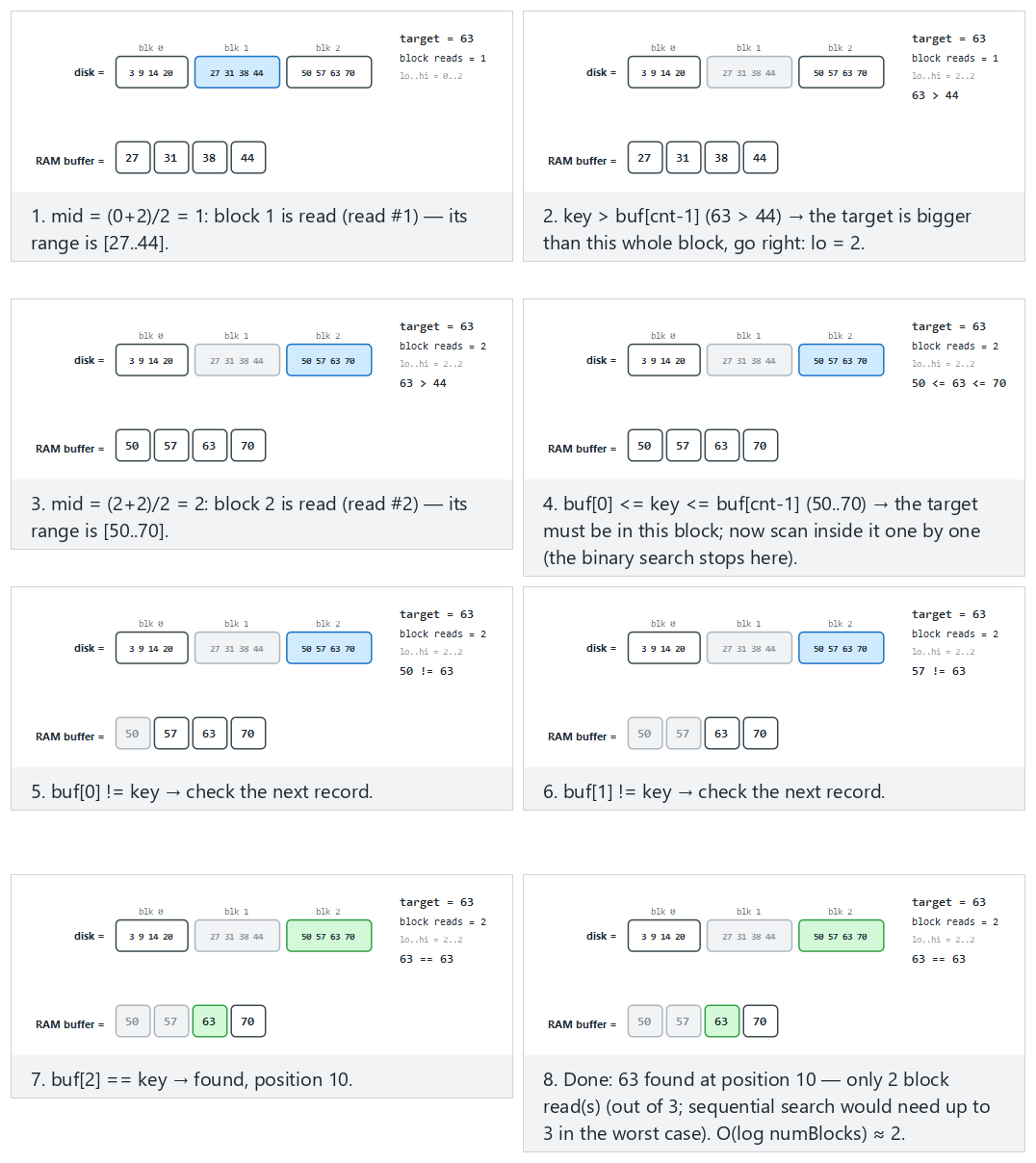
In the picker, also try hard: bf=4, 24 sorted keys (6 blocks), worst case needs 3 probes (the same scenario the program below prints), or the edge cases target is inside a block's range but absent (a gap) and target is outside the file's range (below the minimum) — or press 🎲 for random data, or type your own target=N bf=N header and ascending key list.
5.4 Try it
Full program: binary_search_sorted_file.c / BinarySearchSortedFile.java
/* Week 13 -- File Organisation I
 * Binary search of a SORTED file: jump to the middle BLOCK (compare the key to the block's first and last
 * key), then scan only inside that one block -- O(log numBlocks) block reads instead of O(numBlocks). The
 * file really lives on disk, inside a temporary lab folder that main() creates and removes.
 * CEN207 Data Structures (formerly CE205)
 */
#include <stdio.h>
#include <stdlib.h>
#include <sys/stat.h>
#ifdef _WIN32
#include <direct.h>
#define MKDIR(path) _mkdir(path)
#define RMDIR(path) _rmdir(path)
#else
#define MKDIR(path) mkdir(path, 0755)
#define RMDIR(path) rmdir(path)
#endif

static void lab_path(char *out, size_t n) {
#ifdef _WIN32
    const char *base = getenv("TEMP");
    if (!base) base = getenv("TMP");
    if (!base) base = ".";
#else
    const char *base = getenv("TMPDIR");
    if (!base) base = "/tmp";
#endif
    snprintf(out, n, "%s/cen207_week13_binsearch_lab", base);
}

#define BF 4   /* records per block; the whole file is sorted by key */

int bsearch_file(FILE *fp, int nblocks, int key, int *block_reads) {
    int lo = 0, hi = nblocks - 1;
    int buf[BF];
    while (lo <= hi) {
        int mid = (lo + hi) / 2;
        fseek(fp, (long) mid * BF * sizeof(int), SEEK_SET);
        int cnt = (int) fread(buf, sizeof(int), BF, fp);   /* one block read */
        (*block_reads)++;
        if (key < buf[0]) {
            hi = mid - 1;                                  /* whole block is too big: go left */
        } else if (key > buf[cnt - 1]) {
            lo = mid + 1;                                  /* whole block is too small: go right */
        } else {
            for (int i = 0; i < cnt; i++)                  /* key's block found: scan inside it */
                if (buf[i] == key) return mid * BF + i;
            return -1;                                      /* in range but absent: a gap */
        }
    }
    return -1;                                               /* outside the file's key range */
}

/* ---- driver ------------------------------------------------------------ */

static void run_scenario(const char *label, const char *lab, int keys[], int n, int target) {
    printf("-- %s --\n", label);
    char path[512];
    snprintf(path, sizeof(path), "%s/file.dat", lab);
    FILE *fp = fopen(path, "wb");
    fwrite(keys, sizeof(int), n, fp);
    fclose(fp);

    int nblocks = (n + BF - 1) / BF;
    fp = fopen(path, "rb");
    int reads = 0;
    int idx = bsearch_file(fp, nblocks, target, &reads);
    fclose(fp);

    if (idx >= 0) printf("  search(%d): found at position %d, %d/%d block reads\n", target, idx, reads, nblocks);
    else printf("  search(%d): not found, %d/%d block reads\n", target, reads, nblocks);
    printf("summary: %d keys in %d block(s), bf=%d\n\n", n, nblocks, BF);
    remove(path);
}

int main(void) {
    char lab[512];
    lab_path(lab, sizeof(lab));
    RMDIR(lab);
    MKDIR(lab);

    int normal[] = { 3, 9, 14, 20, 27, 31, 38, 44, 50, 57, 63, 70 };
    int hard[24]; for (int i = 0; i < 24; i++) hard[i] = 2 + i * 3;   /* 6 blocks: worst case needs 3 probes */
    int edge_gap[] = { 4, 11, 19, 26, 33, 40, 48, 55, 62, 69, 77, 85 };

    run_scenario("normal: bf=4, 12 sorted keys, target found in the 2nd probed block", lab, normal, 12, 63);
    run_scenario("hard: bf=4, 24 sorted keys (6 blocks), worst case needs 3 probes", lab, hard, 24, 71);
    run_scenario("edge: target is inside a block's range but absent (a gap)", lab, edge_gap, 12, 45);
    run_scenario("edge: target is outside the file's key range (below the minimum)", lab, edge_gap, 12, 1);

    RMDIR(lab);
    return 0;
}
import java.io.File;
import java.io.IOException;
import java.io.RandomAccessFile;

/* Week 13 -- File Organisation I
 * Binary search of a SORTED file: jump to the middle BLOCK (compare the key to the block's first and last
 * key), then scan only inside that one block -- O(log numBlocks) block reads instead of O(numBlocks). The
 * file really lives on disk, inside a temporary lab folder that main() creates and removes.
 * CEN207 Data Structures (formerly CE205)
 */
public class BinarySearchSortedFile {
    static final int BF = 4;   // records per block; the whole file is sorted by key

    static int bsearchFile(RandomAccessFile fp, int nblocks, int key, int[] blockReads) throws IOException {
        int lo = 0, hi = nblocks - 1;
        int[] buf = new int[BF];
        while (lo <= hi) {
            int mid = (lo + hi) / 2;
            fp.seek((long) mid * BF * 4);
            int cnt = 0;
            for (; cnt < BF && fp.getFilePointer() < fp.length(); cnt++) buf[cnt] = fp.readInt();   // one block read
            blockReads[0]++;
            if (key < buf[0]) {
                hi = mid - 1;                                   // whole block is too big: go left
            } else if (key > buf[cnt - 1]) {
                lo = mid + 1;                                   // whole block is too small: go right
            } else {
                for (int i = 0; i < cnt; i++)                   // key's block found: scan inside it
                    if (buf[i] == key) return mid * BF + i;
                return -1;                                       // in range but absent: a gap
            }
        }
        return -1;                                                // outside the file's key range
    }

    /* ---- driver ------------------------------------------------------------ */

    static void runScenario(String label, File lab, int[] keys, int target) throws IOException {
        System.out.println("-- " + label + " --");
        File path = new File(lab, "file.dat");
        try (RandomAccessFile fp = new RandomAccessFile(path, "rw")) {
            for (int k : keys) fp.writeInt(k);
        }

        int nblocks = (keys.length + BF - 1) / BF;
        int[] reads = { 0 };
        int idx;
        try (RandomAccessFile fp = new RandomAccessFile(path, "r")) {
            idx = bsearchFile(fp, nblocks, target, reads);
        }

        if (idx >= 0) System.out.printf("  search(%d): found at position %d, %d/%d block reads%n", target, idx, reads[0], nblocks);
        else System.out.printf("  search(%d): not found, %d/%d block reads%n", target, reads[0], nblocks);
        System.out.printf("summary: %d keys in %d block(s), bf=%d%n%n", keys.length, nblocks, BF);
        path.delete();
    }

    public static void main(String[] args) throws IOException {
        File lab = new File(System.getProperty("java.io.tmpdir"), "cen207_week13_binsearch_lab_java");
        if (lab.exists()) for (File f : lab.listFiles()) f.delete();
        lab.mkdir();

        int[] normal = { 3, 9, 14, 20, 27, 31, 38, 44, 50, 57, 63, 70 };
        int[] hard = new int[24];
        for (int i = 0; i < 24; i++) hard[i] = 2 + i * 3;   // 6 blocks: worst case needs 3 probes
        int[] edgeGap = { 4, 11, 19, 26, 33, 40, 48, 55, 62, 69, 77, 85 };

        runScenario("normal: bf=4, 12 sorted keys, target found in the 2nd probed block", lab, normal, 63);
        runScenario("hard: bf=4, 24 sorted keys (6 blocks), worst case needs 3 probes", lab, hard, 71);
        runScenario("edge: target is inside a block's range but absent (a gap)", lab, edgeGap, 45);
        runScenario("edge: target is outside the file's key range (below the minimum)", lab, edgeGap, 1);

        lab.delete();
    }
}
Try it
Expected output:
-- normal: bf=4, 12 sorted keys, target found in the 2nd probed block --
  search(63): found at position 10, 2/3 block reads
summary: 12 keys in 3 block(s), bf=4

-- hard: bf=4, 24 sorted keys (6 blocks), worst case needs 3 probes --
  search(71): found at position 23, 3/6 block reads
summary: 24 keys in 6 block(s), bf=4

-- edge: target is inside a block's range but absent (a gap) --
  search(45): not found, 1/3 block reads
summary: 12 keys in 3 block(s), bf=4

-- edge: target is outside the file's key range (below the minimum) --
  search(1): not found, 2/3 block reads
summary: 12 keys in 3 block(s), bf=4
5.5 Complexity, mistakes, self-check
Complexity. O(log2(numBlocks)) block reads, plus a short scan of at most bf records inside the one block found — compare this to section 4's O(numBlocks). For the "hard" scenario above (24 keys, 6 blocks), binary search needs at most 3 block reads versus sequential search's up to 6; the gap widens dramatically as the file grows, exactly like Week 1's array binary search versus linear search.
Common mistakes
- Forgetting that "in range" does not mean "present". A target strictly between a block's first and last key must still be searched for inside that block — it is not guaranteed to be there (the "gap" edge case above): binary search here narrows down which block could possibly contain the key, not whether the key exists at all.
- Comparing against the block's
mid-position key instead of its first/last key. Unlike Week 1's binary search, which compares against exactly one element (the middle of the array), this algorithm must compare against the whole block's range (buf[0]andbuf[cnt-1]) because an entire block of several records, not a single record, is being ruled in or out at each step. - Applying this algorithm to an unsorted file. Every step's correctness depends entirely on the file being globally sorted by key; on unsorted data this algorithm can silently return the wrong answer instead of merely being slow.
Self-check: why does binary search of a sorted file need only O(log numBlocks) reads, while binary search of a sorted ARRAY (Week 1) needs O(log n) comparisons — is one fundamentally better than the other?
They are the same idea applied to different units: array binary search halves the number of elements remaining at each comparison, needing log2(n) comparisons; file binary search halves the number of blocks remaining at each read, needing log2(numBlocks) reads, and numBlocks = n / bf is already bf times smaller than n. Neither is "more efficient" in principle — file binary search is simply binary search performed one level up, over groups of bf records instead of individual records, because grouping is what the disk's block-oriented I/O forces on you (section 1.2).
6. Sequential update: merging a transaction file into the master
6.1 A question to start
A bank's account file changes every day — new accounts opened, balances changed, accounts closed. Re-writing the entire master file from scratch for every single change would be absurd for a file with millions of records. Section 4 and 5 only searched a file; how does a sequential file actually get updated, in a way that touches every changed record but does not require random access to change any one of them?
6.2 The idea: merge two SORTED files in one pass
This is the classical algorithm this whole topic is named for, and it is worth understanding thoroughly: a transaction file — sorted by key, exactly like the master — lists every change as a record with a key and an operation, 'A' (add a new record), 'C' (change an existing record's value), or 'D' (delete a record). Because both files are sorted by the same key, a new master file can be produced in a single sequential pass with two "read heads" (one per file, exactly like the merge step of merge sort in Week 10), comparing the current master key to the current transaction key at every step:
master.key < txn.key— this master record has no transaction waiting for it: copy it to the new master unchanged, advance the master pointer.master.key > txn.key— the transaction's key has not been reached yet in the master, meaning it is not currently in the master. If the operation is'A'(add), this is exactly right — insert the transaction as a brand-new record. If it is'C'or'D', the key that should be changed or deleted does not exist — this is an error; nothing is written for it, and the master pointer is not touched.master.key == txn.key— the transaction applies to this record.'A'on a key that already exists is a duplicate-add error (the original record is still copied through unchanged — a rejected transaction must never delete data that was never asked to be deleted);'C'replaces the record's value and writes the updated record;'D'simply does not write the record at all — a deletion, in a sequential file, is nothing more than not copying a record forward.
When one file runs out, the other's remaining records are handled by simple rules: leftover master records are copied through unchanged (nothing asked to change them); leftover transactions can only be valid if they are all 'A' (their keys are larger than the master's largest key, so 'C'/'D' on them is still an error — the key still does not exist).
6.3 In memory, and the code
typedef struct { int key, val; } Rec;
typedef struct { int key; char op; int val; } Txn;   /* op: 'A' add, 'C' change, 'D' delete */

int merge_update(const Rec *master, int nm, const Txn *txn, int nt, FILE *out,
                 int *written, int *deleted, int *errors) {
    int i = 0, j = 0;
    while (i < nm && j < nt) {
        if (master[i].key < txn[j].key) {              /* master record has no transaction: copy it */
            fwrite(&master[i], sizeof(Rec), 1, out); (*written)++; i++;
        } else if (master[i].key > txn[j].key) {        /* transaction key is not in master (yet) */
            if (txn[j].op == 'A') {
                Rec r = { txn[j].key, txn[j].val };
                fwrite(&r, sizeof(Rec), 1, out); (*written)++;
            } else { (*errors)++; }                     /* change/delete: key not found */
            j++;
        } else {                                        /* same key: transaction applies to this record */
            if (txn[j].op == 'A') {                                 /* duplicate add: keep the original, flag the error */
                fwrite(&master[i], sizeof(Rec), 1, out); (*written)++; (*errors)++;
            }
            else if (txn[j].op == 'C') {
                Rec r = { master[i].key, txn[j].val };
                fwrite(&r, sizeof(Rec), 1, out); (*written)++;
            } else { (*deleted)++; }                    /* 'D': record is dropped, nothing written */
            i++; j++;
        }
    }
    while (i < nm) { fwrite(&master[i], sizeof(Rec), 1, out); (*written)++; i++; }   /* leftover master */
    while (j < nt) {                                                                  /* leftover transactions */
        if (txn[j].op == 'A') {
            Rec r = { txn[j].key, txn[j].val };
            fwrite(&r, sizeof(Rec), 1, out); (*written)++;
        } else { (*errors)++; }
        j++;
    }
    return *written;
}
static int mergeUpdate(Rec[] master, int nm, Txn[] txn, int nt, DataOutputStream out,
                       int[] written, int[] deleted, int[] errors) throws IOException {
    int i = 0, j = 0;
    while (i < nm && j < nt) {
        if (master[i].key < txn[j].key) {                // master record has no transaction: copy it
            out.writeInt(master[i].key); out.writeInt(master[i].val); written[0]++; i++;
        } else if (master[i].key > txn[j].key) {          // transaction key is not in master (yet)
            if (txn[j].op == 'A') {
                out.writeInt(txn[j].key); out.writeInt(txn[j].val); written[0]++;
            } else { errors[0]++; }                       // change/delete: key not found
            j++;
        } else {                                          // same key: transaction applies to this record
            if (txn[j].op == 'A') {                                   // duplicate add: keep the original, flag the error
                out.writeInt(master[i].key); out.writeInt(master[i].val); written[0]++; errors[0]++;
            }
            else if (txn[j].op == 'C') {
                out.writeInt(master[i].key); out.writeInt(txn[j].val); written[0]++;
            } else { deleted[0]++; }                      // 'D': record is dropped, nothing written
            i++; j++;
        }
    }
    while (i < nm) { out.writeInt(master[i].key); out.writeInt(master[i].val); written[0]++; i++; }   // leftover master
    while (j < nt) {                                                                                   // leftover transactions
        if (txn[j].op == 'A') {
            out.writeInt(txn[j].key); out.writeInt(txn[j].val); written[0]++;
        } else { errors[0]++; }
        j++;
    }
    return written[0];
}
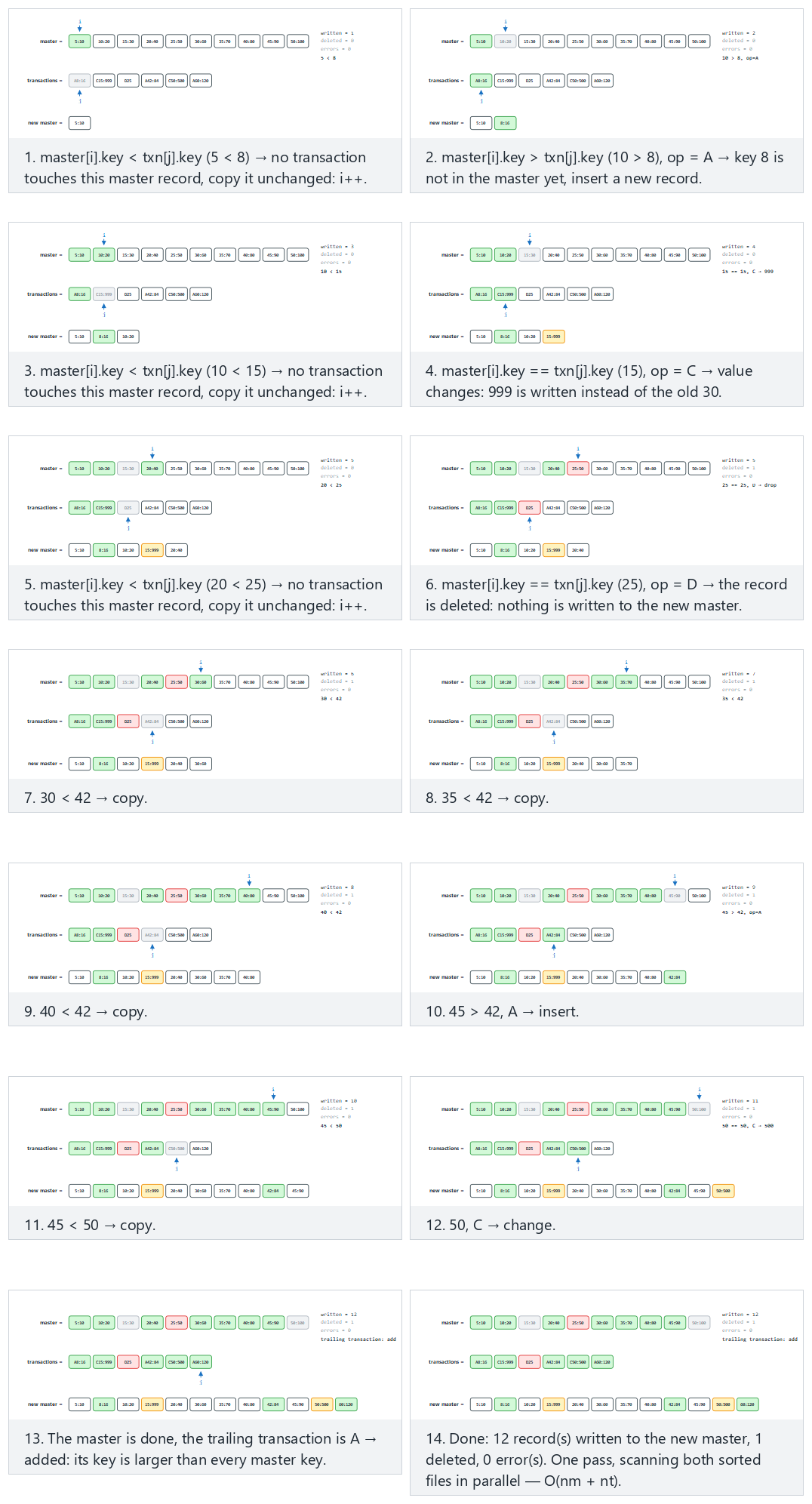
In the picker, also try hard: 11 master, 8 transactions (back-to-back adds) (two consecutive inserts land between the same pair of master keys), or the edge cases adding an existing key + acting on a missing key (errors) and master runs out, trailing transactions (some invalid) — or press 🎲 for random data, or type your own M<key>:<value> master list and A/C/D<key>[:<value>] transaction list, separated by |.
6.4 Try it
Full program: sequential_update_master_transaction.c / SequentialUpdateMasterTransaction.java
/* Week 13 -- File Organisation I
 * Sequential update: merge a SORTED transaction file into a SORTED master file in one pass, producing a new
 * master file. Every transaction is add / change / delete; a change or delete on a key that is not in the
 * master is an error, and adding a key that already exists is also an error. The new master really lives on
 * disk, inside a temporary lab folder that main() creates and removes.
 * CEN207 Data Structures (formerly CE205)
 */
#include <stdio.h>
#include <stdlib.h>
#include <sys/stat.h>
#ifdef _WIN32
#include <direct.h>
#define MKDIR(path) _mkdir(path)
#define RMDIR(path) _rmdir(path)
#else
#define MKDIR(path) mkdir(path, 0755)
#define RMDIR(path) rmdir(path)
#endif

static void lab_path(char *out, size_t n) {
#ifdef _WIN32
    const char *base = getenv("TEMP");
    if (!base) base = getenv("TMP");
    if (!base) base = ".";
#else
    const char *base = getenv("TMPDIR");
    if (!base) base = "/tmp";
#endif
    snprintf(out, n, "%s/cen207_week13_seqjoin_lab", base);
}

typedef struct { int key, val; } Rec;
typedef struct { int key; char op; int val; } Txn;   /* op: 'A' add, 'C' change, 'D' delete */

int merge_update(const Rec *master, int nm, const Txn *txn, int nt, FILE *out,
                 int *written, int *deleted, int *errors) {
    int i = 0, j = 0;
    while (i < nm && j < nt) {
        if (master[i].key < txn[j].key) {              /* master record has no transaction: copy it */
            fwrite(&master[i], sizeof(Rec), 1, out); (*written)++; i++;
        } else if (master[i].key > txn[j].key) {        /* transaction key is not in master (yet) */
            if (txn[j].op == 'A') {
                Rec r = { txn[j].key, txn[j].val };
                fwrite(&r, sizeof(Rec), 1, out); (*written)++;
            } else { (*errors)++; }                     /* change/delete: key not found */
            j++;
        } else {                                        /* same key: transaction applies to this record */
            if (txn[j].op == 'A') {                                 /* duplicate add: keep the original, flag the error */
                fwrite(&master[i], sizeof(Rec), 1, out); (*written)++; (*errors)++;
            }
            else if (txn[j].op == 'C') {
                Rec r = { master[i].key, txn[j].val };
                fwrite(&r, sizeof(Rec), 1, out); (*written)++;
            } else { (*deleted)++; }                    /* 'D': record is dropped, nothing written */
            i++; j++;
        }
    }
    while (i < nm) { fwrite(&master[i], sizeof(Rec), 1, out); (*written)++; i++; }   /* leftover master */
    while (j < nt) {                                                                  /* leftover transactions */
        if (txn[j].op == 'A') {
            Rec r = { txn[j].key, txn[j].val };
            fwrite(&r, sizeof(Rec), 1, out); (*written)++;
        } else { (*errors)++; }
        j++;
    }
    return *written;
}

/* ---- driver ------------------------------------------------------------ */

static void run_scenario(const char *label, const char *lab, Rec master[], int nm, Txn txn[], int nt) {
    printf("-- %s --\n", label);
    char path[512];
    snprintf(path, sizeof(path), "%s/newmaster.dat", lab);
    FILE *fp = fopen(path, "wb");
    int written = 0, deleted = 0, errors = 0;
    merge_update(master, nm, txn, nt, fp, &written, &deleted, &errors);
    fclose(fp);

    fp = fopen(path, "rb");
    Rec r;
    printf("  new master:");
    while (fread(&r, sizeof(r), 1, fp) == 1) printf(" %d:%d", r.key, r.val);
    printf("\n");
    fclose(fp);

    printf("summary: %d master, %d transactions -> written=%d deleted=%d errors=%d\n\n", nm, nt, written, deleted, errors);
    remove(path);
}

int main(void) {
    char lab[512];
    lab_path(lab, sizeof(lab));
    RMDIR(lab);
    MKDIR(lab);

    Rec normal_m[] = { { 5, 10 }, { 10, 20 }, { 15, 30 }, { 20, 40 }, { 25, 50 }, { 30, 60 }, { 35, 70 }, { 40, 80 }, { 45, 90 }, { 50, 100 } };
    Txn normal_t[] = { { 8, 'A', 16 }, { 15, 'C', 999 }, { 25, 'D', 0 }, { 42, 'A', 84 }, { 50, 'C', 500 }, { 60, 'A', 120 } };

    Rec hard_m[] = { { 2, 6 }, { 6, 18 }, { 10, 30 }, { 14, 42 }, { 18, 54 }, { 22, 66 }, { 26, 78 }, { 30, 90 }, { 34, 102 }, { 38, 114 }, { 42, 126 } };
    Txn hard_t[] = { { 5, 'A', 15 }, { 12, 'A', 36 }, { 13, 'A', 39 }, { 18, 'C', 999 }, { 22, 'D', 0 }, { 34, 'C', 111 }, { 40, 'A', 120 }, { 50, 'A', 150 } };

    Rec dup_m[] = { { 3, 103 }, { 7, 107 }, { 11, 111 }, { 15, 115 }, { 19, 119 }, { 23, 123 }, { 27, 127 }, { 31, 131 }, { 35, 135 }, { 39, 139 } };
    Txn dup_t[] = { { 7, 'A', 777 }, { 11, 'C', 555 }, { 39, 'C', 999 }, { 45, 'A', 900 }, { 50, 'D', 0 } };

    Rec trail_m[] = { { 1, 2 }, { 4, 8 }, { 7, 14 }, { 10, 20 }, { 13, 26 }, { 16, 32 }, { 19, 38 }, { 22, 44 }, { 25, 50 }, { 28, 56 } };
    Txn trail_t[] = { { 5, 'D', 0 }, { 30, 'A', 60 }, { 35, 'C', 999 }, { 40, 'A', 80 }, { 45, 'D', 0 }, { 50, 'A', 100 } };

    run_scenario("normal: 10 master, 6 valid transactions", lab, normal_m, 10, normal_t, 6);
    run_scenario("hard: 11 master, 8 transactions (back-to-back adds)", lab, hard_m, 11, hard_t, 8);
    run_scenario("edge: adding an existing key + acting on a missing key (errors)", lab, dup_m, 10, dup_t, 5);
    run_scenario("edge: master runs out, trailing transactions (some invalid)", lab, trail_m, 10, trail_t, 6);

    RMDIR(lab);
    return 0;
}
import java.io.DataOutputStream;
import java.io.File;
import java.io.FileOutputStream;
import java.io.IOException;
import java.io.RandomAccessFile;

/* Week 13 -- File Organisation I
 * Sequential update: merge a SORTED transaction file into a SORTED master file in one pass, producing a new
 * master file. Every transaction is add / change / delete; a change or delete on a key that is not in the
 * master is an error, and adding a key that already exists is also an error. The new master really lives on
 * disk, inside a temporary lab folder that main() creates and removes.
 * CEN207 Data Structures (formerly CE205)
 */
public class SequentialUpdateMasterTransaction {
    static class Rec { int key, val; Rec(int k, int v) { key = k; val = v; } }
    static class Txn { int key; char op; int val; Txn(int k, char o, int v) { key = k; op = o; val = v; } }

    static int mergeUpdate(Rec[] master, int nm, Txn[] txn, int nt, DataOutputStream out,
                           int[] written, int[] deleted, int[] errors) throws IOException {
        int i = 0, j = 0;
        while (i < nm && j < nt) {
            if (master[i].key < txn[j].key) {                // master record has no transaction: copy it
                out.writeInt(master[i].key); out.writeInt(master[i].val); written[0]++; i++;
            } else if (master[i].key > txn[j].key) {          // transaction key is not in master (yet)
                if (txn[j].op == 'A') {
                    out.writeInt(txn[j].key); out.writeInt(txn[j].val); written[0]++;
                } else { errors[0]++; }                       // change/delete: key not found
                j++;
            } else {                                          // same key: transaction applies to this record
                if (txn[j].op == 'A') {                                   // duplicate add: keep the original, flag the error
                    out.writeInt(master[i].key); out.writeInt(master[i].val); written[0]++; errors[0]++;
                }
                else if (txn[j].op == 'C') {
                    out.writeInt(master[i].key); out.writeInt(txn[j].val); written[0]++;
                } else { deleted[0]++; }                      // 'D': record is dropped, nothing written
                i++; j++;
            }
        }
        while (i < nm) { out.writeInt(master[i].key); out.writeInt(master[i].val); written[0]++; i++; }   // leftover master
        while (j < nt) {                                                                                   // leftover transactions
            if (txn[j].op == 'A') {
                out.writeInt(txn[j].key); out.writeInt(txn[j].val); written[0]++;
            } else { errors[0]++; }
            j++;
        }
        return written[0];
    }

    /* ---- driver ------------------------------------------------------------ */

    static void runScenario(String label, File lab, Rec[] master, Txn[] txn) throws IOException {
        System.out.println("-- " + label + " --");
        File path = new File(lab, "newmaster.dat");
        int[] written = { 0 }, deleted = { 0 }, errors = { 0 };
        try (DataOutputStream out = new DataOutputStream(new FileOutputStream(path))) {
            mergeUpdate(master, master.length, txn, txn.length, out, written, deleted, errors);
        }

        StringBuilder sb = new StringBuilder("  new master:");
        try (RandomAccessFile in = new RandomAccessFile(path, "r")) {
            while (in.getFilePointer() < in.length()) {
                int k = in.readInt(), v = in.readInt();
                sb.append(' ').append(k).append(':').append(v);
            }
        }
        System.out.println(sb);
        System.out.printf("summary: %d master, %d transactions -> written=%d deleted=%d errors=%d%n%n",
                master.length, txn.length, written[0], deleted[0], errors[0]);
        path.delete();
    }

    public static void main(String[] args) throws IOException {
        File lab = new File(System.getProperty("java.io.tmpdir"), "cen207_week13_seqjoin_lab_java");
        if (lab.exists()) for (File f : lab.listFiles()) f.delete();
        lab.mkdir();

        Rec[] normalM = { new Rec(5, 10), new Rec(10, 20), new Rec(15, 30), new Rec(20, 40), new Rec(25, 50), new Rec(30, 60), new Rec(35, 70), new Rec(40, 80), new Rec(45, 90), new Rec(50, 100) };
        Txn[] normalT = { new Txn(8, 'A', 16), new Txn(15, 'C', 999), new Txn(25, 'D', 0), new Txn(42, 'A', 84), new Txn(50, 'C', 500), new Txn(60, 'A', 120) };

        Rec[] hardM = { new Rec(2, 6), new Rec(6, 18), new Rec(10, 30), new Rec(14, 42), new Rec(18, 54), new Rec(22, 66), new Rec(26, 78), new Rec(30, 90), new Rec(34, 102), new Rec(38, 114), new Rec(42, 126) };
        Txn[] hardT = { new Txn(5, 'A', 15), new Txn(12, 'A', 36), new Txn(13, 'A', 39), new Txn(18, 'C', 999), new Txn(22, 'D', 0), new Txn(34, 'C', 111), new Txn(40, 'A', 120), new Txn(50, 'A', 150) };

        Rec[] dupM = { new Rec(3, 103), new Rec(7, 107), new Rec(11, 111), new Rec(15, 115), new Rec(19, 119), new Rec(23, 123), new Rec(27, 127), new Rec(31, 131), new Rec(35, 135), new Rec(39, 139) };
        Txn[] dupT = { new Txn(7, 'A', 777), new Txn(11, 'C', 555), new Txn(39, 'C', 999), new Txn(45, 'A', 900), new Txn(50, 'D', 0) };

        Rec[] trailM = { new Rec(1, 2), new Rec(4, 8), new Rec(7, 14), new Rec(10, 20), new Rec(13, 26), new Rec(16, 32), new Rec(19, 38), new Rec(22, 44), new Rec(25, 50), new Rec(28, 56) };
        Txn[] trailT = { new Txn(5, 'D', 0), new Txn(30, 'A', 60), new Txn(35, 'C', 999), new Txn(40, 'A', 80), new Txn(45, 'D', 0), new Txn(50, 'A', 100) };

        runScenario("normal: 10 master, 6 valid transactions", lab, normalM, normalT);
        runScenario("hard: 11 master, 8 transactions (back-to-back adds)", lab, hardM, hardT);
        runScenario("edge: adding an existing key + acting on a missing key (errors)", lab, dupM, dupT);
        runScenario("edge: master runs out, trailing transactions (some invalid)", lab, trailM, trailT);

        lab.delete();
    }
}
Try it
Expected output:
-- normal: 10 master, 6 valid transactions --
  new master: 5:10 8:16 10:20 15:999 20:40 30:60 35:70 40:80 42:84 45:90 50:500 60:120
summary: 10 master, 6 transactions -> written=12 deleted=1 errors=0

-- hard: 11 master, 8 transactions (back-to-back adds) --
  new master: 2:6 5:15 6:18 10:30 12:36 13:39 14:42 18:999 26:78 30:90 34:111 38:114 40:120 42:126 50:150
summary: 11 master, 8 transactions -> written=15 deleted=1 errors=0

-- edge: adding an existing key + acting on a missing key (errors) --
  new master: 3:103 7:107 11:555 15:115 19:119 23:123 27:127 31:131 35:135 39:999 45:900
summary: 10 master, 5 transactions -> written=11 deleted=0 errors=2

-- edge: master runs out, trailing transactions (some invalid) --
  new master: 1:2 4:8 7:14 10:20 13:26 16:32 19:38 22:44 25:50 28:56 30:60 40:80 50:100
summary: 10 master, 6 transactions -> written=13 deleted=0 errors=3
6.5 Complexity, mistakes, self-check
Complexity. O(nm + nt) — one pass, reading each master record and each transaction record exactly once, regardless of how many transactions apply to any given record (at most one transaction ever matches a given master key here, since transactions are per-key operations). This is dramatically cheaper than the naive alternative of, for every transaction, searching the entire master file for its key (O(nt * nm)), which is exactly what section 4 or 5's search would cost if applied once per transaction instead.
Common mistakes
- Silently dropping the master record on a duplicate-add error. It is tempting to write nothing at all when
op == 'A'collides with an existing key, but that would delete a perfectly valid record because of an unrelated, rejected transaction — the record must still be copied through unchanged, and only the transaction is rejected. - Forgetting the two "leftover" loops after the main merge loop ends. The main
while (i < nm && j < nt)loop stops the moment either file runs out; whichever file still has records left needs its own follow-up loop, or those records are silently lost from the new master. - Assuming both files are sorted without checking (or generating) that they actually are. The entire algorithm's correctness depends on both the master and the transaction file being sorted by the same key; a single out-of-order record anywhere silently produces a wrong merge, not a crash or an error message.
Self-check: why is a delete, in this algorithm, implemented by NOT writing a record, rather than writing a special \"deleted\" record?
The new master file is built by writing exactly the records that should exist going forward; a deleted record should not exist in the new master at all, so the simplest and most direct way to achieve that is to skip the fwrite/writeInt call for it entirely — the record's absence from the sequential output is the deletion, with no extra bookkeeping needed (contrast this with section 9's tombstones, which need an explicit "deleted" marker precisely because a probed file cannot just leave the deleted position looking identical to one that was never used — sequential files rewritten from scratch have no such constraint).
7. Relative (direct) file access
7.1 A question to start
Sections 4 and 5 both search for a record — reading anywhere from 1 to every block. Suppose a program already knows exactly which record it wants: "give me student record number 7." Does finding record 7 still require any searching at all?
7.2 The idea: compute the block and offset, do not search for them
A relative file (also called a direct file) assigns every record a relative record number (RRN) — 0, 1, 2, ... — exactly the way an array assigns every element an index. If every block holds exactly bf records, then record number rrn is always at block = rrn / bf, offset = rrn % bf — one integer division and one modulo, computed instantly, with no comparisons and no searching whatsoever. One fseek to that block's byte offset, one block read, and the record is in hand: this is genuine O(1) access, and it costs exactly the same one block read whether the file holds a hundred records or a hundred million.
Not every rrn a caller asks for is valid: a negative number, or a number at or beyond the file's actual record count, must be rejected before attempting any read — and even a valid-looking rrn can land inside the file's last, partial block (section 3), past however many real records that last block actually holds, which must also be detected and rejected.
7.3 In memory, and the code
#define BF 5   /* records per block */

int direct_read(FILE *fp, int total, int rrn, int *out, int *block_reads) {
    if (rrn < 0 || rrn >= total) return -1;          /* invalid record number */
    int block  = rrn / BF;
    int offset = rrn % BF;
    fseek(fp, (long) block * BF * sizeof(int), SEEK_SET);
    int buf[BF];
    int cnt = (int) fread(buf, sizeof(int), BF, fp);  /* exactly ONE read, always */
    (*block_reads)++;
    if (offset >= cnt) return -1;                     /* past the last, partial block */
    *out = buf[offset];
    return 0;
}
static final int BF = 5;   // records per block

static int directRead(RandomAccessFile fp, int total, int rrn, int[] out, int[] blockReads) throws IOException {
    if (rrn < 0 || rrn >= total) return -1;                    // invalid record number
    int block  = rrn / BF;
    int offset = rrn % BF;
    fp.seek((long) block * BF * 4);
    int[] buf = new int[BF];
    int cnt = 0;
    for (; cnt < BF && fp.getFilePointer() < fp.length(); cnt++) buf[cnt] = fp.readInt();   // exactly ONE read, always
    blockReads[0]++;
    if (offset >= cnt) return -1;                               // past the last, partial block
    out[0] = buf[offset];
    return 0;
}
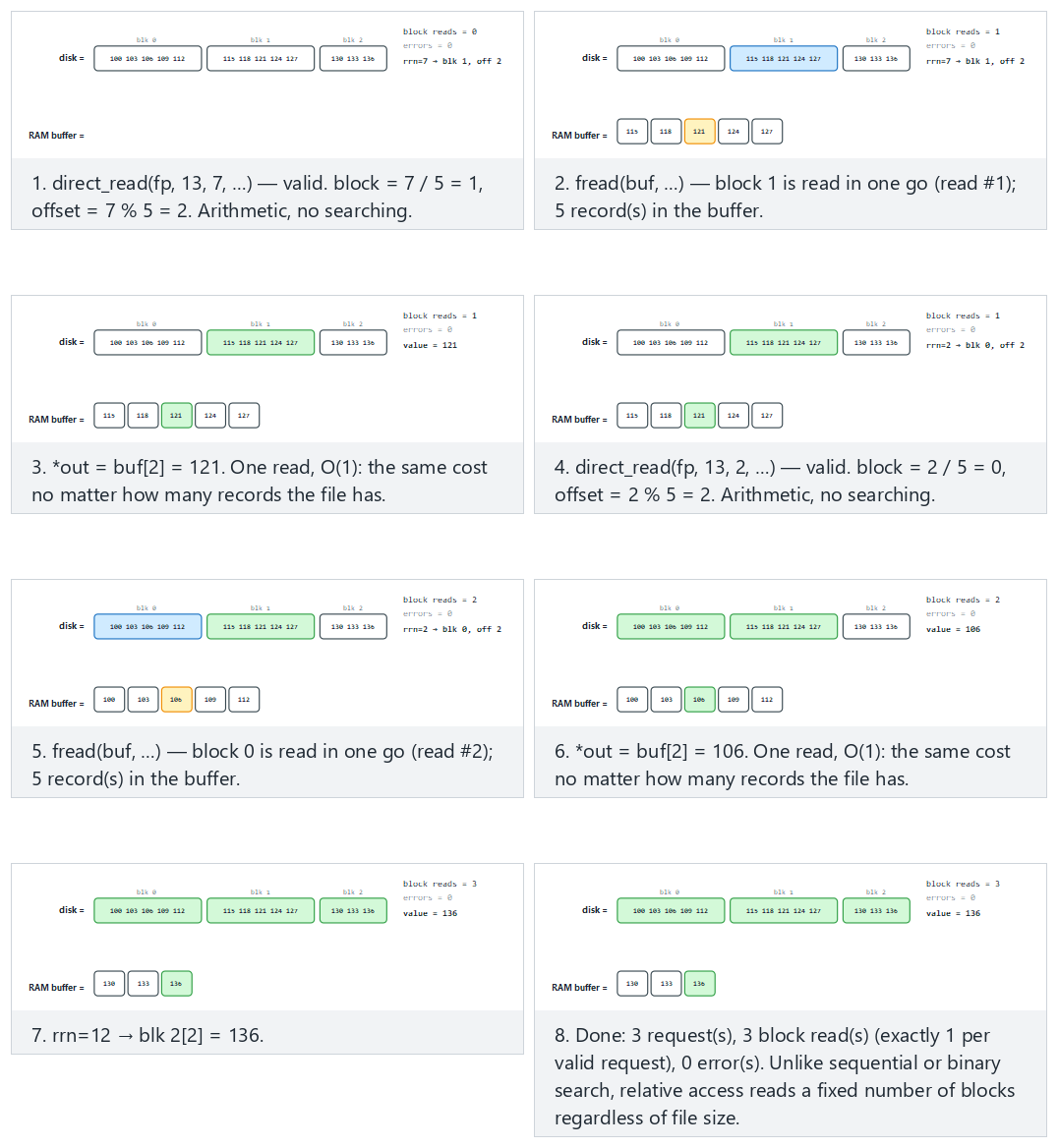
In the picker, also try hard: bf=5, 16 records, 5 requests at boundary offsets (offset 0 and offset bf-1 of several blocks), or the edge cases negative and out-of-range record numbers (errors) and the single record in the last partial block + out of range — or press 🎲 for random data, or type your own bf=N total=N header and requested-record-number list.
7.4 Try it
Full program: relative_file_direct_access.c / RelativeFileDirectAccess.java
/* Week 13 -- File Organisation I
 * Relative (direct) file access: a record number (RRN) maps straight to a block and an offset by arithmetic --
 * block = rrn / bf, offset = rrn % bf -- so a record is fetched with exactly ONE block read and no searching at
 * all. The file really lives on disk, inside a temporary lab folder that main() creates and removes.
 * CEN207 Data Structures (formerly CE205)
 */
#include <stdio.h>
#include <stdlib.h>
#include <sys/stat.h>
#ifdef _WIN32
#include <direct.h>
#define MKDIR(path) _mkdir(path)
#define RMDIR(path) _rmdir(path)
#else
#define MKDIR(path) mkdir(path, 0755)
#define RMDIR(path) rmdir(path)
#endif

static void lab_path(char *out, size_t n) {
#ifdef _WIN32
    const char *base = getenv("TEMP");
    if (!base) base = getenv("TMP");
    if (!base) base = ".";
#else
    const char *base = getenv("TMPDIR");
    if (!base) base = "/tmp";
#endif
    snprintf(out, n, "%s/cen207_week13_relative_lab", base);
}

#define BF 5   /* records per block */

int direct_read(FILE *fp, int total, int rrn, int *out, int *block_reads) {
    if (rrn < 0 || rrn >= total) return -1;          /* invalid record number */
    int block  = rrn / BF;
    int offset = rrn % BF;
    fseek(fp, (long) block * BF * sizeof(int), SEEK_SET);
    int buf[BF];
    int cnt = (int) fread(buf, sizeof(int), BF, fp);  /* exactly ONE read, always */
    (*block_reads)++;
    if (offset >= cnt) return -1;                     /* past the last, partial block */
    *out = buf[offset];
    return 0;
}

/* ---- driver ------------------------------------------------------------ */

static void run_scenario(const char *label, const char *lab, int total, int requests[], int nreq) {
    printf("-- %s --\n", label);
    char path[512];
    snprintf(path, sizeof(path), "%s/file.dat", lab);
    FILE *fp = fopen(path, "wb");
    for (int i = 0; i < total; i++) { int v = 100 + i * 3; fwrite(&v, sizeof(int), 1, fp); }
    fclose(fp);

    fp = fopen(path, "rb");
    int reads = 0, errors = 0;
    for (int i = 0; i < nreq; i++) {
        int val, rc = direct_read(fp, total, requests[i], &val, &reads);
        if (rc == 0) printf("  read(rrn=%d): value=%d (block=%d, offset=%d)\n", requests[i], val, requests[i] / BF, requests[i] % BF);
        else { errors++; printf("  read(rrn=%d): invalid\n", requests[i]); }
    }
    fclose(fp);
    printf("summary: %d request(s), %d block reads, %d errors\n\n", nreq, reads, errors);
    remove(path);
}

int main(void) {
    char lab[512];
    lab_path(lab, sizeof(lab));
    RMDIR(lab);
    MKDIR(lab);

    int normal_req[] = { 7, 2, 12 };
    int hard_req[] = { 0, 3, 4, 15, 8 };
    int invalid_req[] = { -1, 15, 5 };
    int last_partial_req[] = { 10, 9, 11 };

    run_scenario("normal: bf=5, 13 records, 3 valid requests", lab, 13, normal_req, 3);
    run_scenario("hard: bf=5, 16 records, 5 requests at boundary offsets", lab, 16, hard_req, 5);
    run_scenario("edge: negative and out-of-range record numbers (errors)", lab, 12, invalid_req, 3);
    run_scenario("edge: the single record in the last partial block + out of range", lab, 11, last_partial_req, 3);

    RMDIR(lab);
    return 0;
}
import java.io.File;
import java.io.IOException;
import java.io.RandomAccessFile;

/* Week 13 -- File Organisation I
 * Relative (direct) file access: a record number (RRN) maps straight to a block and an offset by arithmetic --
 * block = rrn / bf, offset = rrn % bf -- so a record is fetched with exactly ONE block read and no searching at
 * all. The file really lives on disk, inside a temporary lab folder that main() creates and removes.
 * CEN207 Data Structures (formerly CE205)
 */
public class RelativeFileDirectAccess {
    static final int BF = 5;   // records per block

    static int directRead(RandomAccessFile fp, int total, int rrn, int[] out, int[] blockReads) throws IOException {
        if (rrn < 0 || rrn >= total) return -1;                    // invalid record number
        int block  = rrn / BF;
        int offset = rrn % BF;
        fp.seek((long) block * BF * 4);
        int[] buf = new int[BF];
        int cnt = 0;
        for (; cnt < BF && fp.getFilePointer() < fp.length(); cnt++) buf[cnt] = fp.readInt();   // exactly ONE read, always
        blockReads[0]++;
        if (offset >= cnt) return -1;                               // past the last, partial block
        out[0] = buf[offset];
        return 0;
    }

    /* ---- driver ------------------------------------------------------------ */

    static void runScenario(String label, File lab, int total, int[] requests) throws IOException {
        System.out.println("-- " + label + " --");
        File path = new File(lab, "file.dat");
        try (RandomAccessFile w = new RandomAccessFile(path, "rw")) {
            w.setLength(0);
            for (int i = 0; i < total; i++) w.writeInt(100 + i * 3);
        }

        int[] reads = { 0 };
        int errors = 0;
        try (RandomAccessFile fp = new RandomAccessFile(path, "r")) {
            for (int rrn : requests) {
                int[] val = new int[1];
                int rc = directRead(fp, total, rrn, val, reads);
                if (rc == 0) System.out.printf("  read(rrn=%d): value=%d (block=%d, offset=%d)%n", rrn, val[0], rrn / BF, rrn % BF);
                else { errors++; System.out.printf("  read(rrn=%d): invalid%n", rrn); }
            }
        }
        System.out.printf("summary: %d request(s), %d block reads, %d errors%n%n", requests.length, reads[0], errors);
        path.delete();
    }

    public static void main(String[] args) throws IOException {
        File lab = new File(System.getProperty("java.io.tmpdir"), "cen207_week13_relative_lab_java");
        if (lab.exists()) for (File f : lab.listFiles()) f.delete();
        lab.mkdir();

        runScenario("normal: bf=5, 13 records, 3 valid requests", lab, 13, new int[] { 7, 2, 12 });
        runScenario("hard: bf=5, 16 records, 5 requests at boundary offsets", lab, 16, new int[] { 0, 3, 4, 15, 8 });
        runScenario("edge: negative and out-of-range record numbers (errors)", lab, 12, new int[] { -1, 15, 5 });
        runScenario("edge: the single record in the last partial block + out of range", lab, 11, new int[] { 10, 9, 11 });

        lab.delete();
    }
}
Try it
Expected output:
-- normal: bf=5, 13 records, 3 valid requests --
  read(rrn=7): value=121 (block=1, offset=2)
  read(rrn=2): value=106 (block=0, offset=2)
  read(rrn=12): value=136 (block=2, offset=2)
summary: 3 request(s), 3 block reads, 0 errors

-- hard: bf=5, 16 records, 5 requests at boundary offsets --
  read(rrn=0): value=100 (block=0, offset=0)
  read(rrn=3): value=109 (block=0, offset=3)
  read(rrn=4): value=112 (block=0, offset=4)
  read(rrn=15): value=145 (block=3, offset=0)
  read(rrn=8): value=124 (block=1, offset=3)
summary: 5 request(s), 5 block reads, 0 errors

-- edge: negative and out-of-range record numbers (errors) --
  read(rrn=-1): invalid
  read(rrn=15): invalid
  read(rrn=5): value=115 (block=1, offset=0)
summary: 3 request(s), 1 block reads, 2 errors

-- edge: the single record in the last partial block + out of range --
  read(rrn=10): value=130 (block=2, offset=0)
  read(rrn=9): value=127 (block=1, offset=4)
  read(rrn=11): invalid
summary: 3 request(s), 2 block reads, 1 errors
7.5 Complexity, mistakes, self-check
Complexity. O(1) — exactly one block read for every valid request, regardless of the file's size. This is the whole point of a relative file: sections 4 and 5's search cost, O(numBlocks) and O(log numBlocks) respectively, both still grow (however slowly) as the file grows; direct access does not grow at all.
Common mistakes
- Checking
rrn >= totalbut forgettingrrn < 0. An unchecked negativerrnproduces a negativeblock, and seeking to a negative byte offset is a serious, silent bug — not a clean, reportable error. - Not accounting for a partial last block. A file of 11 records with
bf = 5has its last block only ⅕ full; a request forrrn = 10computesoffset = 0inside a real, correctly-sized block — but the next record number,rrn = 11, must be rejected as out of range even thoughoffsetalone (11 % 5 = 1) does not look obviously wrong; the check must be against the total record count, not just against block boundaries. - Assuming direct access means no validation is needed. Because the location is computed instead of searched for, it is tempting to skip validating the request entirely — but an unvalidated
rrncomputed into an out-of-boundsfseekis exactly the kind of bug that corrupts a file instead of just failing cleanly.
Self-check: why does a relative file's O(1) access cost not depend on the blocking factor bf, while sections 4 and 5's search costs both do?
Direct access always performs exactly one fseek (computed, not searched for) and one block read, regardless of bf — the value of bf changes which block a given rrn lands in, but never changes how many blocks must be read to get there (always one). Sequential and binary search, by contrast, must read however many blocks it takes to locate or rule out the target, and that count is expressed directly in terms of bf (numBlocks = n / bf appears in both O(numBlocks) and O(log numBlocks)), because searching fundamentally means visiting blocks one at a time until the answer is found, not computing the answer's location outright.
8. Hashing to buckets
8.1 A question to start
Section 7's direct access needs a record number, 0, 1, 2, ..., known in advance. Real keys are rarely so convenient — a student ID, a product SKU, a customer's phone number. Week 6 solved exactly this problem in RAM with a hash function; can the same idea — h(key) computes a location directly, no searching — work for a file, where "one slot" is naturally "one block", not "one record"?
8.2 The idea: hash to a home BUCKET, chain overflow blocks on collision
Each key hashes, h(key) = key mod m, to one of m buckets — but unlike Week 6's in-RAM table, a bucket here is not one cell, it is an entire block, which can hold up to bf keys before it is full. Two keys sharing the same home bucket is not automatically a problem, the way it was in Week 6 — only once a bucket's bf slots are all used does a genuine collision occur, and at that point an overflow block is allocated and chained onto the full bucket (exactly like Week 6's separate chaining, except the "linked list nodes" are now whole disk blocks, not individual records) — a search or insert that finds its home bucket full simply follows the chain to the first overflow block with room, allocating a further block only if that one is also full.
8.3 In memory, and the code
#define BF 3    /* keys per bucket / overflow block */

typedef struct { int keys[BF]; int count; int next; } Bucket;   /* next = -1: no overflow yet */

int bucket_put(Bucket b[], int *nblocks, int m, int key, int *writes) {
    int h = key % m, cur = h;                    /* home bucket */
    while (b[cur].count == BF) {                  /* this block is full */
        if (b[cur].next < 0) {                      /* no overflow yet: allocate one */
            b[cur].next = (*nblocks)++;
            b[b[cur].next].count = 0; b[b[cur].next].next = -1;
            (*writes)++;                              /* the new, empty overflow block */
        }
        cur = b[cur].next;                                /* follow the chain */
    }
    b[cur].keys[b[cur].count++] = key;
    (*writes)++;                                          /* the block that now holds the key */
    return h;
}
static final int BF = 3;   // keys per bucket / overflow block

static class Bucket { int[] keys = new int[BF]; int count = 0; int next = -1; }   // next = -1: no overflow yet

static int bucketPut(Bucket[] b, int[] nblocks, int m, int key, int[] writes) {
    int h = key % m, cur = h;                       // home bucket
    while (b[cur].count == BF) {                     // this block is full
        if (b[cur].next < 0) {                         // no overflow yet: allocate one
            b[cur].next = nblocks[0]++;
            b[b[cur].next] = new Bucket();
            writes[0]++;                                 // the new, empty overflow block
        }
        cur = b[cur].next;                                // follow the chain
    }
    b[cur].keys[b[cur].count++] = key;
    writes[0]++;                                          // the block that now holds the key
    return h;
}
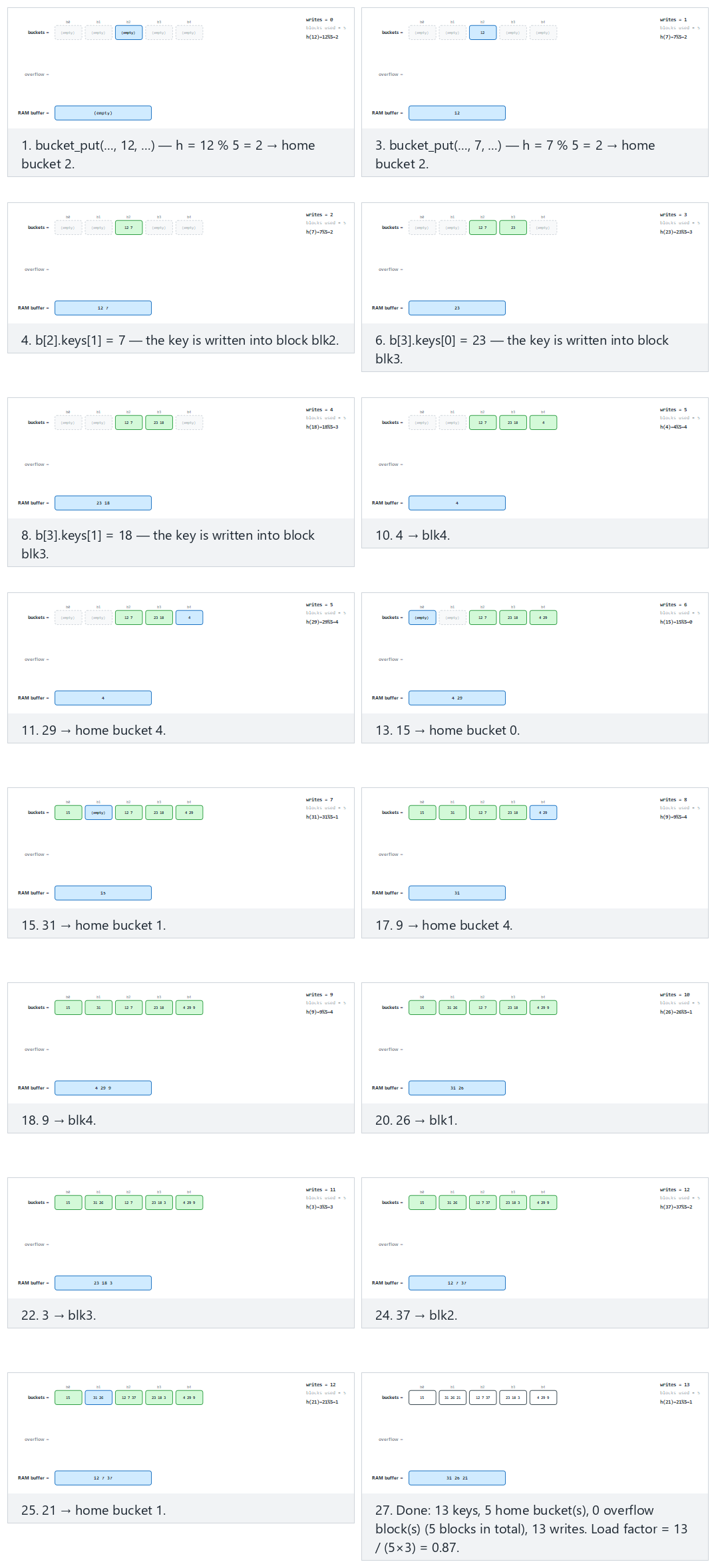
In the picker, also try hard: m=4, 14 keys, several buckets chain, or the edge cases all 10 keys hash to the same bucket (long chain) and m=1, one bucket, everything chains — or press 🎲 for random data, or type your own m=N bf=N header and key list.
8.4 Try it
Full program: hashing_to_buckets.c / HashingToBuckets.java
/* Week 13 -- File Organisation I
 * Hashing to buckets: h(key) = key mod m picks a HOME bucket; a bucket holds up to bf keys, and once it is full
 * an OVERFLOW block is allocated and chained onto it (bucket chaining) instead of searching elsewhere. Every
 * bucket and overflow block is a real block written to disk, inside a temporary lab folder that main() creates
 * and removes.
 * CEN207 Data Structures (formerly CE205)
 */
#include <stdio.h>
#include <stdlib.h>
#include <sys/stat.h>
#ifdef _WIN32
#include <direct.h>
#define MKDIR(path) _mkdir(path)
#define RMDIR(path) _rmdir(path)
#else
#define MKDIR(path) mkdir(path, 0755)
#define RMDIR(path) rmdir(path)
#endif

static void lab_path(char *out, size_t n) {
#ifdef _WIN32
    const char *base = getenv("TEMP");
    if (!base) base = getenv("TMP");
    if (!base) base = ".";
#else
    const char *base = getenv("TMPDIR");
    if (!base) base = "/tmp";
#endif
    snprintf(out, n, "%s/cen207_week13_buckets_lab", base);
}

#define BF 3    /* keys per bucket / overflow block */
#define MAXBLOCKS 40

typedef struct { int keys[BF]; int count; int next; } Bucket;   /* next = -1: no overflow yet */

int bucket_put(Bucket b[], int *nblocks, int m, int key, int *writes) {
    int h = key % m, cur = h;                    /* home bucket */
    while (b[cur].count == BF) {                  /* this block is full */
        if (b[cur].next < 0) {                      /* no overflow yet: allocate one */
            b[cur].next = (*nblocks)++;
            b[b[cur].next].count = 0; b[b[cur].next].next = -1;
            (*writes)++;                              /* the new, empty overflow block */
        }
        cur = b[cur].next;                                /* follow the chain */
    }
    b[cur].keys[b[cur].count++] = key;
    (*writes)++;                                          /* the block that now holds the key */
    return h;
}

/* ---- driver ------------------------------------------------------------ */

static void write_blocks(FILE *fp, Bucket b[], int nblocks) {
    for (int i = 0; i < nblocks; i++) fwrite(b[i].keys, sizeof(int), BF, fp);
}

static void run_scenario(const char *label, const char *lab, int m, int keys[], int n) {
    printf("-- %s --\n", label);
    Bucket b[MAXBLOCKS];
    for (int i = 0; i < m; i++) { b[i].count = 0; b[i].next = -1; }
    int nblocks = m, writes = 0;

    for (int i = 0; i < n; i++) {
        int h = bucket_put(b, &nblocks, m, keys[i], &writes);
        printf("  key %d -> home bucket %d\n", keys[i], h);
    }

    char path[512];
    snprintf(path, sizeof(path), "%s/buckets.dat", lab);
    FILE *fp = fopen(path, "wb");
    write_blocks(fp, b, nblocks);
    fclose(fp);

    fp = fopen(path, "rb");
    fseek(fp, 0, SEEK_END);
    long size = ftell(fp);
    fclose(fp);

    for (int i = 0; i < m; i++) {
        printf("  bucket %d:", i);
        for (int k = 0; k < b[i].count; k++) printf(" %d", b[i].keys[k]);
        int nx = b[i].next;
        while (nx >= 0) { printf(" ->"); for (int k = 0; k < b[nx].count; k++) printf(" %d", b[nx].keys[k]); nx = b[nx].next; }
        printf("\n");
    }
    printf("summary: %d keys, %d home bucket(s), %d overflow block(s) (%d blocks total, %ld B on disk), %d writes\n\n",
           n, m, nblocks - m, nblocks, size, writes);
    remove(path);
}

int main(void) {
    char lab[512];
    lab_path(lab, sizeof(lab));
    RMDIR(lab);
    MKDIR(lab);

    int normal[] = { 12, 7, 23, 18, 4, 29, 15, 31, 9, 26, 3, 37, 21 };
    int hard[] = { 4, 8, 12, 16, 20, 24, 1, 5, 9, 13, 17, 21, 2, 6 };
    int edge_all_same[] = { 6, 12, 18, 24, 30, 36, 42, 48, 54, 60 };
    int edge_one_bucket[] = { 5, 11, 2, 19, 8, 14, 3, 27, 6, 10 };

    run_scenario("normal: m=5, bf=3, 13 keys, little overflow", lab, 5, normal, 13);
    run_scenario("hard: m=4, 14 keys, several buckets chain", lab, 4, hard, 14);
    run_scenario("edge: all 10 keys hash to the same bucket (long chain)", lab, 6, edge_all_same, 10);
    run_scenario("edge: m=1, one bucket, everything chains", lab, 1, edge_one_bucket, 10);

    RMDIR(lab);
    return 0;
}
import java.io.DataOutputStream;
import java.io.File;
import java.io.FileOutputStream;
import java.io.IOException;

/* Week 13 -- File Organisation I
 * Hashing to buckets: h(key) = key mod m picks a HOME bucket; a bucket holds up to bf keys, and once it is full
 * an OVERFLOW block is allocated and chained onto it (bucket chaining) instead of searching elsewhere. Every
 * bucket and overflow block is a real block written to disk, inside a temporary lab folder that main() creates
 * and removes.
 * CEN207 Data Structures (formerly CE205)
 */
public class HashingToBuckets {
    static final int BF = 3;   // keys per bucket / overflow block

    static class Bucket { int[] keys = new int[BF]; int count = 0; int next = -1; }   // next = -1: no overflow yet

    static int bucketPut(Bucket[] b, int[] nblocks, int m, int key, int[] writes) {
        int h = key % m, cur = h;                       // home bucket
        while (b[cur].count == BF) {                     // this block is full
            if (b[cur].next < 0) {                         // no overflow yet: allocate one
                b[cur].next = nblocks[0]++;
                b[b[cur].next] = new Bucket();
                writes[0]++;                                 // the new, empty overflow block
            }
            cur = b[cur].next;                                // follow the chain
        }
        b[cur].keys[b[cur].count++] = key;
        writes[0]++;                                          // the block that now holds the key
        return h;
    }

    /* ---- driver ------------------------------------------------------------ */

    static final int MAXBLOCKS = 40;

    static void runScenario(String label, File lab, int m, int[] keys) throws IOException {
        System.out.println("-- " + label + " --");
        Bucket[] b = new Bucket[MAXBLOCKS];
        for (int i = 0; i < m; i++) b[i] = new Bucket();
        int[] nblocks = { m }, writes = { 0 };

        for (int key : keys) {
            int h = bucketPut(b, nblocks, m, key, writes);
            System.out.printf("  key %d -> home bucket %d%n", key, h);
        }

        File path = new File(lab, "buckets.dat");
        try (DataOutputStream out = new DataOutputStream(new FileOutputStream(path))) {
            for (int i = 0; i < nblocks[0]; i++) for (int k = 0; k < BF; k++) out.writeInt(b[i].keys[k]);
        }
        long size = path.length();

        for (int i = 0; i < m; i++) {
            StringBuilder sb = new StringBuilder("  bucket " + i + ":");
            for (int k = 0; k < b[i].count; k++) sb.append(' ').append(b[i].keys[k]);
            int nx = b[i].next;
            while (nx >= 0) {
                sb.append(" ->");
                for (int k = 0; k < b[nx].count; k++) sb.append(' ').append(b[nx].keys[k]);
                nx = b[nx].next;
            }
            System.out.println(sb);
        }
        System.out.printf("summary: %d keys, %d home bucket(s), %d overflow block(s) (%d blocks total, %d B on disk), %d writes%n%n",
                keys.length, m, nblocks[0] - m, nblocks[0], size, writes[0]);
        path.delete();
    }

    public static void main(String[] args) throws IOException {
        File lab = new File(System.getProperty("java.io.tmpdir"), "cen207_week13_buckets_lab_java");
        if (lab.exists()) for (File f : lab.listFiles()) f.delete();
        lab.mkdir();

        int[] normal = { 12, 7, 23, 18, 4, 29, 15, 31, 9, 26, 3, 37, 21 };
        int[] hard = { 4, 8, 12, 16, 20, 24, 1, 5, 9, 13, 17, 21, 2, 6 };
        int[] edgeAllSame = { 6, 12, 18, 24, 30, 36, 42, 48, 54, 60 };
        int[] edgeOneBucket = { 5, 11, 2, 19, 8, 14, 3, 27, 6, 10 };

        runScenario("normal: m=5, bf=3, 13 keys, little overflow", lab, 5, normal);
        runScenario("hard: m=4, 14 keys, several buckets chain", lab, 4, hard);
        runScenario("edge: all 10 keys hash to the same bucket (long chain)", lab, 6, edgeAllSame);
        runScenario("edge: m=1, one bucket, everything chains", lab, 1, edgeOneBucket);

        lab.delete();
    }
}
Try it
Expected output:
-- normal: m=5, bf=3, 13 keys, little overflow --
  key 12 -> home bucket 2
  key 7 -> home bucket 2
  key 23 -> home bucket 3
  key 18 -> home bucket 3
  key 4 -> home bucket 4
  key 29 -> home bucket 4
  key 15 -> home bucket 0
  key 31 -> home bucket 1
  key 9 -> home bucket 4
  key 26 -> home bucket 1
  key 3 -> home bucket 3
  key 37 -> home bucket 2
  key 21 -> home bucket 1
  bucket 0: 15
  bucket 1: 31 26 21
  bucket 2: 12 7 37
  bucket 3: 23 18 3
  bucket 4: 4 29 9
summary: 13 keys, 5 home bucket(s), 0 overflow block(s) (5 blocks total, 60 B on disk), 13 writes

-- hard: m=4, 14 keys, several buckets chain --
  key 4 -> home bucket 0
  key 8 -> home bucket 0
  key 12 -> home bucket 0
  key 16 -> home bucket 0
  key 20 -> home bucket 0
  key 24 -> home bucket 0
  key 1 -> home bucket 1
  key 5 -> home bucket 1
  key 9 -> home bucket 1
  key 13 -> home bucket 1
  key 17 -> home bucket 1
  key 21 -> home bucket 1
  key 2 -> home bucket 2
  key 6 -> home bucket 2
  bucket 0: 4 8 12 -> 16 20 24
  bucket 1: 1 5 9 -> 13 17 21
  bucket 2: 2 6
  bucket 3:
summary: 14 keys, 4 home bucket(s), 2 overflow block(s) (6 blocks total, 72 B on disk), 16 writes

-- edge: all 10 keys hash to the same bucket (long chain) --
  key 6 -> home bucket 0
  key 12 -> home bucket 0
  key 18 -> home bucket 0
  key 24 -> home bucket 0
  key 30 -> home bucket 0
  key 36 -> home bucket 0
  key 42 -> home bucket 0
  key 48 -> home bucket 0
  key 54 -> home bucket 0
  key 60 -> home bucket 0
  bucket 0: 6 12 18 -> 24 30 36 -> 42 48 54 -> 60
  bucket 1:
  bucket 2:
  bucket 3:
  bucket 4:
  bucket 5:
summary: 10 keys, 6 home bucket(s), 3 overflow block(s) (9 blocks total, 108 B on disk), 13 writes

-- edge: m=1, one bucket, everything chains --
  key 5 -> home bucket 0
  key 11 -> home bucket 0
  key 2 -> home bucket 0
  key 19 -> home bucket 0
  key 8 -> home bucket 0
  key 14 -> home bucket 0
  key 3 -> home bucket 0
  key 27 -> home bucket 0
  key 6 -> home bucket 0
  key 10 -> home bucket 0
  bucket 0: 5 11 2 -> 19 8 14 -> 3 27 6 -> 10
summary: 10 keys, 1 home bucket(s), 3 overflow block(s) (4 blocks total, 48 B on disk), 13 writes
8.5 Complexity, mistakes, self-check
Complexity. Average case O(1) block accesses per key, the same as Week 6's chaining — one read/write for the home bucket, plus one more for each overflow block that must be followed, which stays small as long as the load factor (n / (m * bf)) is kept reasonable. Worst case, exactly like Week 6's "all keys hash to one slot", degrades toward O(n / bf) — the "edge: m=1" scenario above is precisely this worst case, made maximally bad on purpose.
Common mistakes
- Chaining the new overflow block onto the wrong block. When a chain (home bucket already has one or more overflow blocks) is full, the new overflow block must be linked onto the last block in the chain, not back onto the home bucket directly — otherwise later insertions and searches would only ever see the newest overflow block and silently skip over the others.
- Choosing
mtoo small for the expected key count. Exactly as in Week 6, a badly undersizedm(m=1above being the extreme case) guarantees heavy overflow chaining regardless of how good the hash function otherwise is — the function was never given enough home buckets to spread keys across. - Forgetting that a bucket's capacity is
bf, not 1. Unlike Week 6's one-key-per-slot table, a collision here does not mean "two keys, same slot" — it means "thebf-th key competing for one already-full block", which is a materially rarer event for the samemand key count, precisely because each bucket can already absorbbfkeys before any overflow is needed at all.
Self-check: why is chaining overflow BLOCKS here a closer match to Week 6's separate chaining than to Week 6's open addressing, even though both approaches eventually appear later in this same week (sections 8 and 9)?
Week 6's separate chaining resolves a collision by growing a separate structure (a linked list) off to the side of the table, leaving the home slot's neighbors untouched; this section does exactly that — a full bucket grows a chain of additional blocks, never touching any other bucket. Week 6's open addressing (and this week's section 9) instead resolves a collision by claiming a different slot inside the same table — probing forward into neighboring positions that "belong" to no particular key. Bucket chaining and progressive overflow are therefore the direct file-organisation analogues of Week 6's two collision families, not two unrelated new ideas.
9. Progressive overflow: linear probing on disk
9.1 A question to start
Section 8's overflow blocks are simple, but they cost an entire extra block (however few keys it ends up holding) for every bucket that overflows even by a single key. Week 6's open addressing avoided that kind of waste in RAM by keeping every key inside the original table. Can the same idea — no separate structure at all, just keep probing for the next slot — work when "the table" is a file and "a slot" is one disk position?
9.2 The idea: probe the next slot, wrapping around, until you find room
Progressive overflow is file-organisation terminology for exactly Week 6's linear probing, with one slot holding exactly one record. A key's home slot is h(key) = key mod m; if that slot is occupied by a different key, the algorithm tries the next slot, (h+1) mod m, then the next, and so on — the mod m makes the probe sequence wrap around from the last slot back to slot 0 — until it finds an empty slot (the key is inserted there), finds the key already present (a duplicate), or has tried every one of the m slots without success (the file is genuinely full, and the insert must fail cleanly rather than loop forever). Every single slot probed, empty or not, costs one real disk access — which is precisely why this technique's cost is measured in probes, and why a heavily loaded file (many keys relative to m) gets dramatically slower as its free slots become scarce and probe sequences grow long.
9.3 In memory, and the code
#define EMPTY (-1)    /* marks an unused slot */

int po_insert(int table[], int m, int key, int *probes) {
    int h = key % m, i = h, tries = 0;
    while (tries < m) {
        (*probes)++;                                   /* one slot probed = one disk access */
        if (table[i] == EMPTY) { table[i] = key; return i; }   /* home or next free slot */
        if (table[i] == key) return -2;                        /* duplicate key */
        i = (i + 1) % m;                                       /* progressive overflow: try the next slot */
        tries++;
    }
    return -1;                                                 /* every slot tried: file is full */
}
static final int EMPTY = -1;   // marks an unused slot

static int poInsert(int[] table, int m, int key, int[] probes) {
    int h = key % m, i = h, tries = 0;
    while (tries < m) {
        probes[0]++;                                     // one slot probed = one disk access
        if (table[i] == EMPTY) { table[i] = key; return i; }     // home or next free slot
        if (table[i] == key) return -2;                          // duplicate key
        i = (i + 1) % m;                                         // progressive overflow: try the next slot
        tries++;
    }
    return -1;                                                   // every slot tried: file is full
}
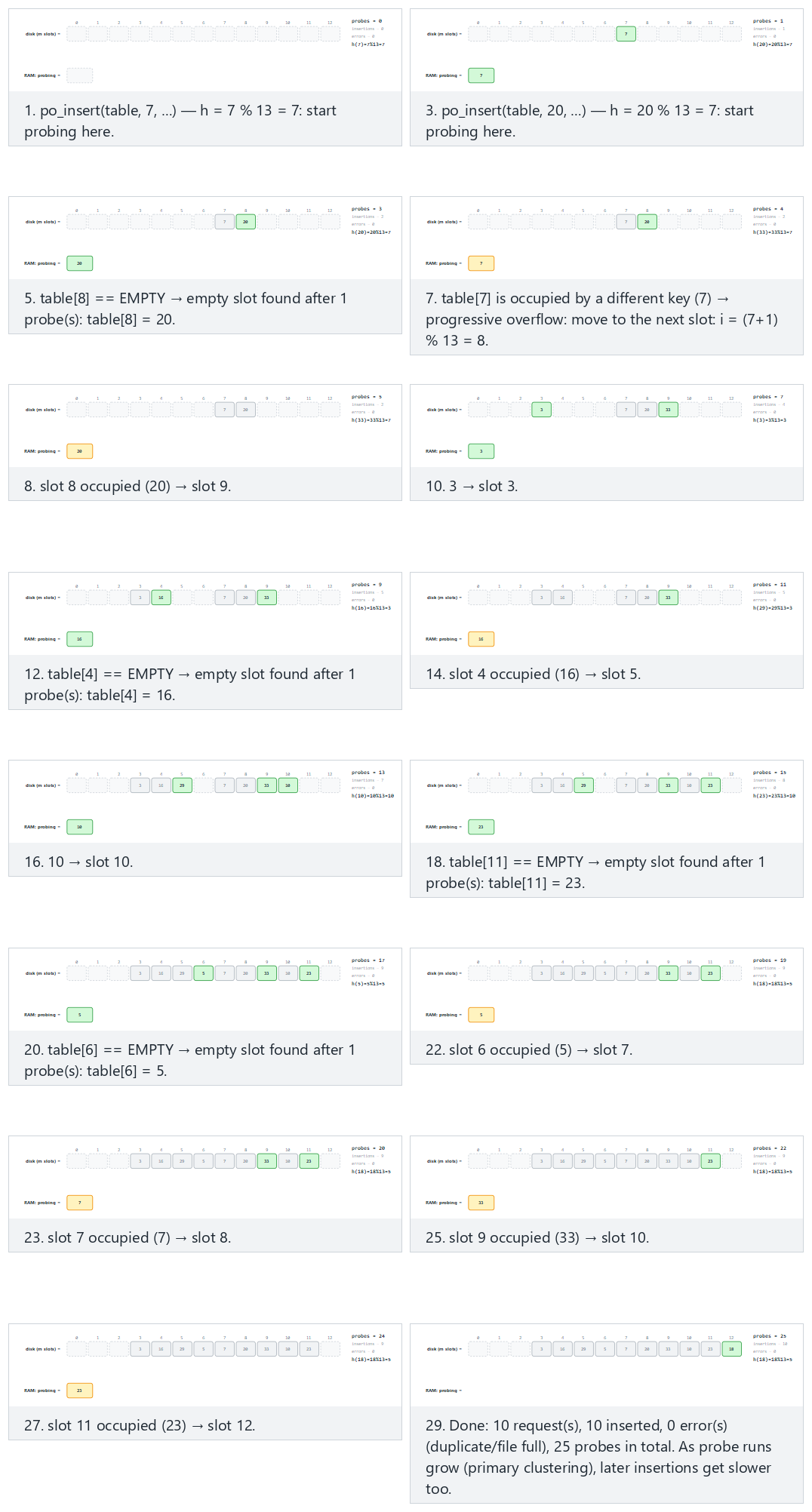
In the picker, also try hard: m=11, 10 keys, heavy load (91%), long probe runs, or the edge cases the file fills exactly, the 10th insert fails (file full) and every key shares the same home slot, the file fills — or press 🎲 for random data, or type your own m=N header and key list.
9.4 Try it
Full program: collision_progressive_overflow.c / CollisionProgressiveOverflow.java
/* Week 13 -- File Organisation I
 * Progressive overflow (linear probing) on disk: one record per slot; if the home slot h(key) = key mod m is
 * occupied, probe the NEXT slot, wrapping around, until an empty slot is found, the key is already there
 * (duplicate), or every slot has been tried (file full). The table really lives on disk, inside a temporary
 * lab folder that main() creates and removes.
 * CEN207 Data Structures (formerly CE205)
 */
#include <stdio.h>
#include <stdlib.h>
#include <sys/stat.h>
#ifdef _WIN32
#include <direct.h>
#define MKDIR(path) _mkdir(path)
#define RMDIR(path) _rmdir(path)
#else
#define MKDIR(path) mkdir(path, 0755)
#define RMDIR(path) rmdir(path)
#endif

static void lab_path(char *out, size_t n) {
#ifdef _WIN32
    const char *base = getenv("TEMP");
    if (!base) base = getenv("TMP");
    if (!base) base = ".";
#else
    const char *base = getenv("TMPDIR");
    if (!base) base = "/tmp";
#endif
    snprintf(out, n, "%s/cen207_week13_probing_lab", base);
}

#define EMPTY (-1)
#define M 20    /* table size: number of slots in the file (large enough for every scenario below) */

int po_insert(int table[], int m, int key, int *probes) {
    int h = key % m, i = h, tries = 0;
    while (tries < m) {
        (*probes)++;                                   /* one slot probed = one disk access */
        if (table[i] == EMPTY) { table[i] = key; return i; }   /* home or next free slot */
        if (table[i] == key) return -2;                        /* duplicate key */
        i = (i + 1) % m;                                       /* progressive overflow: try the next slot */
        tries++;
    }
    return -1;                                                 /* every slot tried: file is full */
}

/* ---- driver ------------------------------------------------------------ */

static void run_scenario(const char *label, const char *lab, int m, int keys[], int n) {
    printf("-- %s --\n", label);
    int table[M];
    for (int i = 0; i < m; i++) table[i] = EMPTY;
    int probes = 0, inserted = 0, errors = 0;
    for (int i = 0; i < n; i++) {
        int before = probes;
        int slot = po_insert(table, m, keys[i], &probes);
        if (slot >= 0) { inserted++; printf("  insert(%d): slot %d, %d probe(s)\n", keys[i], slot, probes - before); }
        else if (slot == -2) { errors++; printf("  insert(%d): duplicate key\n", keys[i]); }
        else { errors++; printf("  insert(%d): FILE FULL\n", keys[i]); }
    }

    char path[512];
    snprintf(path, sizeof(path), "%s/table.dat", lab);
    FILE *fp = fopen(path, "wb");
    fwrite(table, sizeof(int), m, fp);
    fclose(fp);
    fp = fopen(path, "rb");
    fseek(fp, 0, SEEK_END);
    long size = ftell(fp);
    fclose(fp);

    printf("  table:");
    for (int i = 0; i < m; i++) if (table[i] != EMPTY) printf(" [%d]=%d", i, table[i]);
    printf("\n");
    printf("summary: %d request(s), %d inserted, %d error(s), %d probes total, %ld B on disk\n\n", n, inserted, errors, probes, size);
    remove(path);
}

int main(void) {
    char lab[512];
    lab_path(lab, sizeof(lab));
    RMDIR(lab);
    MKDIR(lab);

    int normal[] = { 7, 20, 33, 3, 16, 29, 10, 23, 5, 18 };
    int hard[] = { 2, 13, 24, 35, 4, 15, 26, 6, 17, 8 };
    int edge_full[] = { 1, 2, 3, 4, 5, 6, 7, 8, 9, 45 };
    int edge_same_home[] = { 3, 12, 21, 30, 39, 48, 57, 66, 75, 84 };

    run_scenario("normal: m=13, 10 keys, moderate load (77%)", lab, 13, normal, 10);
    run_scenario("hard: m=11, 10 keys, heavy load (91%), long probe runs", lab, 11, hard, 10);
    run_scenario("edge: the file fills exactly, the 10th insert fails (file full)", lab, 9, edge_full, 10);
    run_scenario("edge: every key shares the same home slot, the file fills", lab, 9, edge_same_home, 10);

    RMDIR(lab);
    return 0;
}
import java.io.DataOutputStream;
import java.io.File;
import java.io.FileOutputStream;
import java.io.IOException;
import java.io.RandomAccessFile;

/* Week 13 -- File Organisation I
 * Progressive overflow (linear probing) on disk: one record per slot; if the home slot h(key) = key mod m is
 * occupied, probe the NEXT slot, wrapping around, until an empty slot is found, the key is already there
 * (duplicate), or every slot has been tried (file full). The table really lives on disk, inside a temporary
 * lab folder that main() creates and removes.
 * CEN207 Data Structures (formerly CE205)
 */
public class CollisionProgressiveOverflow {
    static final int EMPTY = -1;

    static int poInsert(int[] table, int m, int key, int[] probes) {
        int h = key % m, i = h, tries = 0;
        while (tries < m) {
            probes[0]++;                                     // one slot probed = one disk access
            if (table[i] == EMPTY) { table[i] = key; return i; }     // home or next free slot
            if (table[i] == key) return -2;                          // duplicate key
            i = (i + 1) % m;                                         // progressive overflow: try the next slot
            tries++;
        }
        return -1;                                                   // every slot tried: file is full
    }

    /* ---- driver ------------------------------------------------------------ */

    static void runScenario(String label, File lab, int m, int[] keys) throws IOException {
        System.out.println("-- " + label + " --");
        int[] table = new int[m];
        for (int i = 0; i < m; i++) table[i] = EMPTY;
        int[] probes = { 0 };
        int inserted = 0, errors = 0;
        for (int key : keys) {
            int before = probes[0];
            int slot = poInsert(table, m, key, probes);
            if (slot >= 0) { inserted++; System.out.printf("  insert(%d): slot %d, %d probe(s)%n", key, slot, probes[0] - before); }
            else if (slot == -2) { errors++; System.out.printf("  insert(%d): duplicate key%n", key); }
            else { errors++; System.out.printf("  insert(%d): FILE FULL%n", key); }
        }

        File path = new File(lab, "table.dat");
        try (DataOutputStream out = new DataOutputStream(new FileOutputStream(path))) {
            for (int v : table) out.writeInt(v);
        }
        long size;
        try (RandomAccessFile r = new RandomAccessFile(path, "r")) { size = r.length(); }

        StringBuilder sb = new StringBuilder("  table:");
        for (int i = 0; i < m; i++) if (table[i] != EMPTY) sb.append(String.format(" [%d]=%d", i, table[i]));
        System.out.println(sb);
        System.out.printf("summary: %d request(s), %d inserted, %d error(s), %d probes total, %d B on disk%n%n",
                keys.length, inserted, errors, probes[0], size);
        path.delete();
    }

    public static void main(String[] args) throws IOException {
        File lab = new File(System.getProperty("java.io.tmpdir"), "cen207_week13_probing_lab_java");
        if (lab.exists()) for (File f : lab.listFiles()) f.delete();
        lab.mkdir();

        int[] normal = { 7, 20, 33, 3, 16, 29, 10, 23, 5, 18 };
        int[] hard = { 2, 13, 24, 35, 4, 15, 26, 6, 17, 8 };
        int[] edgeFull = { 1, 2, 3, 4, 5, 6, 7, 8, 9, 45 };
        int[] edgeSameHome = { 3, 12, 21, 30, 39, 48, 57, 66, 75, 84 };

        runScenario("normal: m=13, 10 keys, moderate load (77%)", lab, 13, normal);
        runScenario("hard: m=11, 10 keys, heavy load (91%), long probe runs", lab, 11, hard);
        runScenario("edge: the file fills exactly, the 10th insert fails (file full)", lab, 9, edgeFull);
        runScenario("edge: every key shares the same home slot, the file fills", lab, 9, edgeSameHome);

        lab.delete();
    }
}
Try it
Expected output:
-- normal: m=13, 10 keys, moderate load (77%) --
  insert(7): slot 7, 1 probe(s)
  insert(20): slot 8, 2 probe(s)
  insert(33): slot 9, 3 probe(s)
  insert(3): slot 3, 1 probe(s)
  insert(16): slot 4, 2 probe(s)
  insert(29): slot 5, 3 probe(s)
  insert(10): slot 10, 1 probe(s)
  insert(23): slot 11, 2 probe(s)
  insert(5): slot 6, 2 probe(s)
  insert(18): slot 12, 8 probe(s)
  table: [3]=3 [4]=16 [5]=29 [6]=5 [7]=7 [8]=20 [9]=33 [10]=10 [11]=23 [12]=18
summary: 10 request(s), 10 inserted, 0 error(s), 25 probes total, 52 B on disk

-- hard: m=11, 10 keys, heavy load (91%), long probe runs --
  insert(2): slot 2, 1 probe(s)
  insert(13): slot 3, 2 probe(s)
  insert(24): slot 4, 3 probe(s)
  insert(35): slot 5, 4 probe(s)
  insert(4): slot 6, 3 probe(s)
  insert(15): slot 7, 4 probe(s)
  insert(26): slot 8, 5 probe(s)
  insert(6): slot 9, 4 probe(s)
  insert(17): slot 10, 5 probe(s)
  insert(8): slot 0, 4 probe(s)
  table: [0]=8 [2]=2 [3]=13 [4]=24 [5]=35 [6]=4 [7]=15 [8]=26 [9]=6 [10]=17
summary: 10 request(s), 10 inserted, 0 error(s), 35 probes total, 44 B on disk

-- edge: the file fills exactly, the 10th insert fails (file full) --
  insert(1): slot 1, 1 probe(s)
  insert(2): slot 2, 1 probe(s)
  insert(3): slot 3, 1 probe(s)
  insert(4): slot 4, 1 probe(s)
  insert(5): slot 5, 1 probe(s)
  insert(6): slot 6, 1 probe(s)
  insert(7): slot 7, 1 probe(s)
  insert(8): slot 8, 1 probe(s)
  insert(9): slot 0, 1 probe(s)
  insert(45): FILE FULL
  table: [0]=9 [1]=1 [2]=2 [3]=3 [4]=4 [5]=5 [6]=6 [7]=7 [8]=8
summary: 10 request(s), 9 inserted, 1 error(s), 18 probes total, 36 B on disk

-- edge: every key shares the same home slot, the file fills --
  insert(3): slot 3, 1 probe(s)
  insert(12): slot 4, 2 probe(s)
  insert(21): slot 5, 3 probe(s)
  insert(30): slot 6, 4 probe(s)
  insert(39): slot 7, 5 probe(s)
  insert(48): slot 8, 6 probe(s)
  insert(57): slot 0, 7 probe(s)
  insert(66): slot 1, 8 probe(s)
  insert(75): slot 2, 9 probe(s)
  insert(84): FILE FULL
  table: [0]=57 [1]=66 [2]=75 [3]=3 [4]=12 [5]=21 [6]=30 [7]=39 [8]=48
summary: 10 request(s), 9 inserted, 1 error(s), 54 probes total, 36 B on disk
9.5 Complexity, mistakes, self-check
Complexity. Average case is close to O(1) probes at a low load factor (n / m, the fraction of slots occupied), but this degrades sharply as the load factor rises — the "hard" scenario above (91% loaded) already needed as many as 5 probes for one insert, and any attempt to fill the very last slot or two can, in the worst case, need O(m) probes (every slot in the file). This is exactly Week 6's open-addressing degradation, now paid for in real disk accesses rather than RAM comparisons.
Common mistakes
- Not bounding the probe loop. Without the
tries < mguard, a completely full table with no matching key would makei = (i + 1) % mcycle forever — the loop must count how many distinct slots it has tried and give up once that reachesm, reporting "file full" instead of hanging. - Treating "file full" as a crash-worthy error instead of a normal, reportable outcome. A well-designed file-organisation program must detect and handle a full file gracefully — refusing the insert and telling the caller why — exactly as the program above does, rather than corrupting memory or silently dropping the key.
- Forgetting the negative-key guard from Week 6's
hash_division. Progressive overflow'skey % mhas exactly the same negative-remainder hazard Week 6 warned about; the programs in this section assume non-negative keys (as file record identifiers usually are) and do not include the guard — a real system accepting arbitrary integer keys would need it.
Self-check: what is \"primary clustering\", and why does the \"every key shares the same home slot\" edge case above demonstrate it in its most extreme form?
Primary clustering (introduced in Week 6) is the snowball effect where an occupied run of consecutive slots keeps growing, because any new key whose probe sequence reaches that run is forced to extend it by one more slot, making the run even more likely to catch the next colliding key too. The "every key shares the same home slot" scenario is the most extreme possible case: every single one of the 10 keys shares exactly the same home slot, so the very first insert starts a run that every subsequent insert is guaranteed to extend by exactly one slot — probe counts grow 1, 2, 3, ..., 9 in lock-step with insertion order, the textbook signature of primary clustering.
10. Deletion with tombstones
10.1 A question to start
Section 9's po_insert stops probing the moment it finds an empty slot — that is how it eventually reports "not found" or "here is a free slot to use." What happens to a later search, then, if a key that was deleted was sitting in the middle of some other key's probe chain, and its slot were simply cleared back to empty?
10.2 The idea: a tombstone means "keep looking", not "nothing was ever here"
If deleting a record just set its slot back to EMPTY, a later search for a different key that originally had to probe past that now-cleared slot (because it was occupied at insertion time) would incorrectly stop right there — EMPTY is exactly the signal a search uses to conclude "this key was never inserted, give up" — silently reporting a key as missing when it is actually still present, further along the very same probe chain. The fix is a tombstone: a special marker, distinct from both EMPTY and any real key, meaning "something was deleted here — keep probing, do not stop." A search skips over tombstones exactly as it skips over any other occupied-but-not-matching slot; only a genuine EMPTY slot — one that was truly never probed past — is allowed to end a search. A later insert, on the other hand, is free to treat a tombstone exactly like an empty slot and reuse it, reclaiming the space a deletion left behind without ever breaking any other key's probe chain.
10.3 In memory, and the code
#define EMPTY (-1)
#define TOMB  (-2)   /* deleted marker: "something was here, keep looking" */

int ts_find(int table[], int m, int key) {
    int i = key % m, tries = 0;
    while (tries < m) {
        if (table[i] == EMPTY) return -1;              /* truly empty: never probed past here */
        if (table[i] == key) return i;                  /* found */
        i = (i + 1) % m; tries++;                        /* TOMB or a different key: keep going */
    }
    return -1;
}

int ts_delete(int table[], int m, int key) {
    int i = ts_find(table, m, key);
    if (i < 0) return -1;
    table[i] = TOMB;                                     /* not EMPTY: later finds must not stop here */
    return i;
}

int ts_insert(int table[], int m, int key) {
    int i = key % m, tries = 0;
    while (tries < m) {
        if (table[i] == EMPTY || table[i] == TOMB) { table[i] = key; return i; }  /* reuse a tombstone */
        if (table[i] == key) return -2;                   /* duplicate */
        i = (i + 1) % m; tries++;
    }
    return -1;                                              /* file full */
}
static final int EMPTY = -1, TOMB = -2;   // TOMB = deleted marker: "something was here, keep looking"

static int tsFind(int[] table, int m, int key) {
    int i = key % m, tries = 0;
    while (tries < m) {
        if (table[i] == EMPTY) return -1;         // truly empty: never probed past here
        if (table[i] == key) return i;              // found
        i = (i + 1) % m; tries++;                    // TOMB or a different key: keep going
    }
    return -1;
}

static int tsDelete(int[] table, int m, int key) {
    int i = tsFind(table, m, key);
    if (i < 0) return -1;
    table[i] = TOMB;                                   // not EMPTY: later finds must not stop here
    return i;
}

static int tsInsert(int[] table, int m, int key) {
    int i = key % m, tries = 0;
    while (tries < m) {
        if (table[i] == EMPTY || table[i] == TOMB) { table[i] = key; return i; }   // reuse a tombstone
        if (table[i] == key) return -2;                 // duplicate
        i = (i + 1) % m; tries++;
    }
    return -1;                                           // file full
}
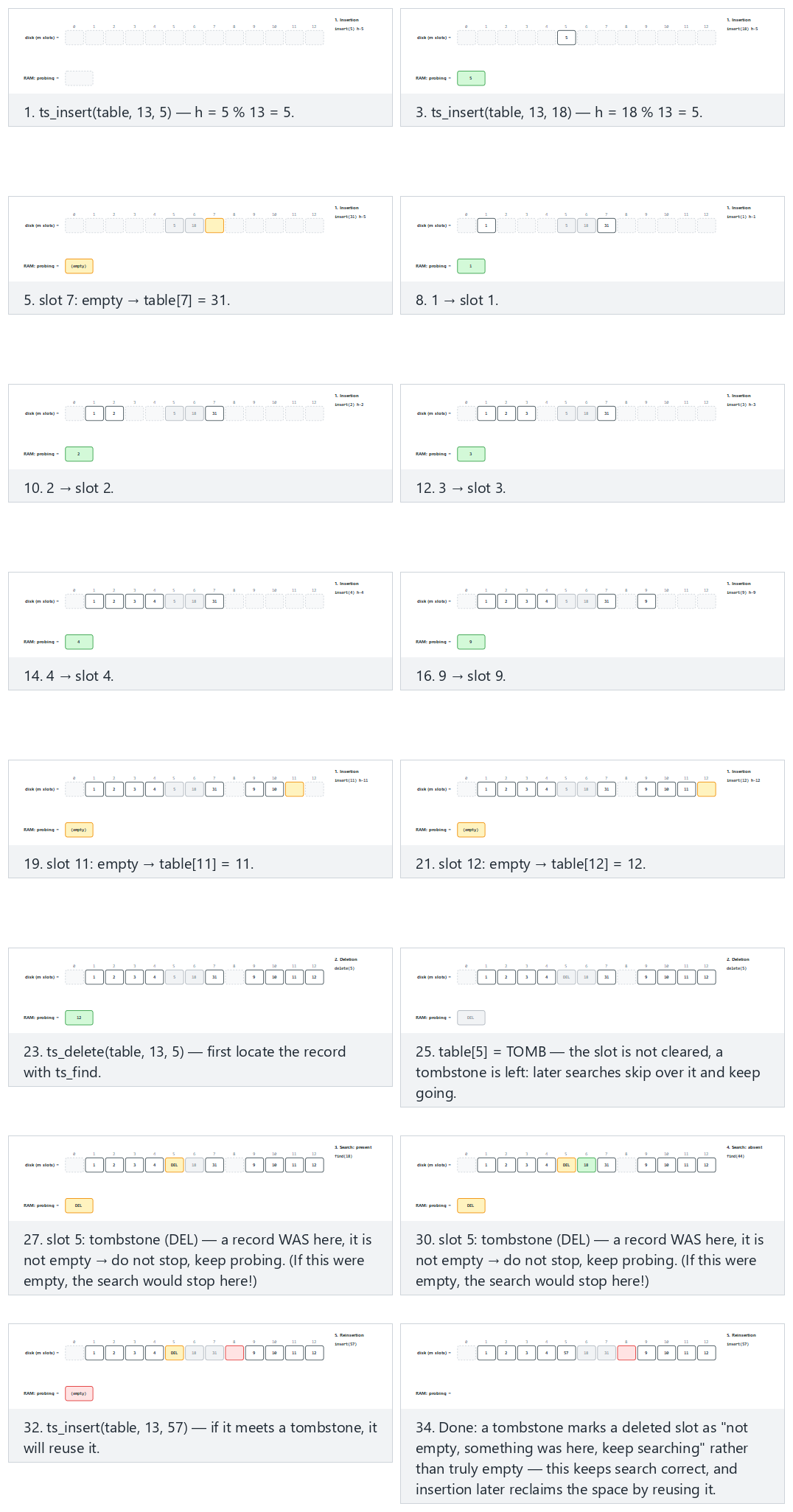
In the picker, also try hard: m=13, two deletions in a 5-chain (two tombstones to skip), or the edge cases a key is deleted, then the very same key is reinserted (it lands right back on its own tombstone) and the file is completely full; a whole chain is deleted, no true-empty slot remains (a search must be bounded by the tries < m bound alone, since it can never rely on hitting a real EMPTY slot to stop) — or press 🎲 for random data, or type your own m=N insert=... delete=... found=N missing=N reinsert=N fields.
10.4 Try it
Full program: deletion_with_tombstones.c / DeletionWithTombstones.java
/* Week 13 -- File Organisation I
 * Deletion with tombstones: in a probed (linearly-hashed) file, deleting a record cannot just clear its slot to
 * EMPTY -- a later search for a DIFFERENT key that once probed past this slot would then stop too early and
 * wrongly report "not found". A TOMBSTONE ("something was here, keep looking") fixes this; a search skips over
 * tombstones but a later INSERT may reuse one. The table really lives on disk, inside a temporary lab folder
 * that main() creates and removes.
 * CEN207 Data Structures (formerly CE205)
 */
#include <stdio.h>
#include <stdlib.h>
#include <sys/stat.h>
#ifdef _WIN32
#include <direct.h>
#define MKDIR(path) _mkdir(path)
#define RMDIR(path) _rmdir(path)
#else
#define MKDIR(path) mkdir(path, 0755)
#define RMDIR(path) rmdir(path)
#endif

static void lab_path(char *out, size_t n) {
#ifdef _WIN32
    const char *base = getenv("TEMP");
    if (!base) base = getenv("TMP");
    if (!base) base = ".";
#else
    const char *base = getenv("TMPDIR");
    if (!base) base = "/tmp";
#endif
    snprintf(out, n, "%s/cen207_week13_tombstone_lab", base);
}

#define EMPTY (-1)
#define TOMB  (-2)   /* deleted marker: "something was here, keep looking" */
#define M 20         /* table size: number of slots (large enough for every scenario below) */

int ts_find(int table[], int m, int key) {
    int i = key % m, tries = 0;
    while (tries < m) {
        if (table[i] == EMPTY) return -1;      /* truly empty: never probed past here */
        if (table[i] == key) return i;          /* found */
        i = (i + 1) % m; tries++;                /* TOMB or a different key: keep going */
    }
    return -1;
}

int ts_delete(int table[], int m, int key) {
    int i = ts_find(table, m, key);
    if (i < 0) return -1;
    table[i] = TOMB;                             /* not EMPTY: later finds must not stop here */
    return i;
}

int ts_insert(int table[], int m, int key) {
    int i = key % m, tries = 0;
    while (tries < m) {
        if (table[i] == EMPTY || table[i] == TOMB) { table[i] = key; return i; }  /* reuse a tombstone */
        if (table[i] == key) return -2;                   /* duplicate */
        i = (i + 1) % m; tries++;
    }
    return -1;                                              /* file full */
}

/* ---- driver ------------------------------------------------------------ */

static void print_table(int table[], int m) {
    printf("  table:");
    for (int i = 0; i < m; i++) {
        if (table[i] == EMPTY) continue;
        if (table[i] == TOMB) printf(" [%d]=DEL", i);
        else printf(" [%d]=%d", i, table[i]);
    }
    printf("\n");
}

static void run_scenario(const char *label, const char *lab, int m,
                          int insert_keys[], int n_insert, int delete_keys[], int n_delete,
                          int search_found, int search_missing, int reinsert_key) {
    printf("-- %s --\n", label);
    int table[M];
    for (int i = 0; i < m; i++) table[i] = EMPTY;

    for (int i = 0; i < n_insert; i++) ts_insert(table, m, insert_keys[i]);
    print_table(table, m);

    for (int i = 0; i < n_delete; i++) {
        int slot = ts_delete(table, m, delete_keys[i]);
        printf("  delete(%d): %s\n", delete_keys[i], slot >= 0 ? "tombstone left" : "not found");
    }
    print_table(table, m);

    int f1 = ts_find(table, m, search_found);
    printf("  find(%d): %s\n", search_found, f1 >= 0 ? "found" : "not found");
    int f2 = ts_find(table, m, search_missing);
    printf("  find(%d): %s\n", search_missing, f2 >= 0 ? "found" : "not found");
    int r = ts_insert(table, m, reinsert_key);
    printf("  reinsert(%d): slot %d\n", reinsert_key, r);
    print_table(table, m);

    char path[512];
    snprintf(path, sizeof(path), "%s/table.dat", lab);
    FILE *fp = fopen(path, "wb");
    fwrite(table, sizeof(int), m, fp);
    fclose(fp);
    fp = fopen(path, "rb");
    fseek(fp, 0, SEEK_END);
    long size = ftell(fp);
    fclose(fp);
    printf("summary: %d B on disk\n\n", size > 0 ? (int) size : 0);
    remove(path);
}

int main(void) {
    char lab[512];
    lab_path(lab, sizeof(lab));
    RMDIR(lab);
    MKDIR(lab);

    int normal_ins[] = { 5, 18, 31, 1, 2, 3, 4, 9, 10, 11, 12 };
    int normal_del[] = { 5 };
    int hard_ins[] = { 2, 15, 28, 41, 54, 7, 8, 9, 10, 11, 0 };
    int hard_del[] = { 15, 41 };
    int edge1_ins[] = { 3, 14, 25, 0, 1, 2, 6, 7, 8, 9 };
    int edge1_del[] = { 3 };
    int edge2_ins[] = { 4, 15, 26, 22, 12, 13, 14, 18, 19, 20, 21 };
    int edge2_del[] = { 4, 15, 26 };

    run_scenario("normal: m=13, the head of a 3-chain is deleted, search skips the tombstone",
                 lab, 13, normal_ins, 11, normal_del, 1, 18, 44, 57);
    run_scenario("hard: m=13, two deletions in a 5-chain (two tombstones to skip)",
                 lab, 13, hard_ins, 11, hard_del, 2, 54, 67, 80);
    run_scenario("edge: a key is deleted, then the very same key is reinserted",
                 lab, 11, edge1_ins, 10, edge1_del, 1, 14, 36, 3);
    run_scenario("edge: the file is completely full; a whole chain is deleted, no true-empty slot remains",
                 lab, 11, edge2_ins, 11, edge2_del, 3, 18, 37, 37);

    RMDIR(lab);
    return 0;
}
import java.io.DataOutputStream;
import java.io.File;
import java.io.FileOutputStream;
import java.io.IOException;
import java.io.RandomAccessFile;

/* Week 13 -- File Organisation I
 * Deletion with tombstones: in a probed (linearly-hashed) file, deleting a record cannot just clear its slot to
 * EMPTY -- a later search for a DIFFERENT key that once probed past this slot would then stop too early and
 * wrongly report "not found". A TOMBSTONE ("something was here, keep looking") fixes this; a search skips over
 * tombstones but a later INSERT may reuse one. The table really lives on disk, inside a temporary lab folder
 * that main() creates and removes.
 * CEN207 Data Structures (formerly CE205)
 */
public class DeletionWithTombstones {
    static final int EMPTY = -1, TOMB = -2;   // TOMB = deleted marker: "something was here, keep looking"

    static int tsFind(int[] table, int m, int key) {
        int i = key % m, tries = 0;
        while (tries < m) {
            if (table[i] == EMPTY) return -1;         // truly empty: nothing was ever probed past here
            if (table[i] == key) return i;              // found
            i = (i + 1) % m; tries++;                    // TOMB or a different key: keep going
        }
        return -1;
    }

    static int tsDelete(int[] table, int m, int key) {
        int i = tsFind(table, m, key);
        if (i < 0) return -1;
        table[i] = TOMB;                                   // NOT EMPTY: later finds must not stop here
        return i;
    }

    static int tsInsert(int[] table, int m, int key) {
        int i = key % m, tries = 0;
        while (tries < m) {
            if (table[i] == EMPTY || table[i] == TOMB) { table[i] = key; return i; }   // reuse a tombstone
            if (table[i] == key) return -2;                 // duplicate
            i = (i + 1) % m; tries++;
        }
        return -1;                                           // file full
    }

    /* ---- driver ------------------------------------------------------------ */

    static void printTable(int[] table, int m) {
        StringBuilder sb = new StringBuilder("  table:");
        for (int i = 0; i < m; i++) {
            if (table[i] == EMPTY) continue;
            if (table[i] == TOMB) sb.append(String.format(" [%d]=DEL", i));
            else sb.append(String.format(" [%d]=%d", i, table[i]));
        }
        System.out.println(sb);
    }

    static void runScenario(String label, File lab, int m, int[] insertKeys, int[] deleteKeys,
                             int searchFound, int searchMissing, int reinsertKey) throws IOException {
        System.out.println("-- " + label + " --");
        int[] table = new int[m];
        for (int i = 0; i < m; i++) table[i] = EMPTY;

        for (int k : insertKeys) tsInsert(table, m, k);
        printTable(table, m);

        for (int k : deleteKeys) {
            int slot = tsDelete(table, m, k);
            System.out.printf("  delete(%d): %s%n", k, slot >= 0 ? "tombstone left" : "not found");
        }
        printTable(table, m);

        int f1 = tsFind(table, m, searchFound);
        System.out.printf("  find(%d): %s%n", searchFound, f1 >= 0 ? "found" : "not found");
        int f2 = tsFind(table, m, searchMissing);
        System.out.printf("  find(%d): %s%n", searchMissing, f2 >= 0 ? "found" : "not found");
        int r = tsInsert(table, m, reinsertKey);
        System.out.printf("  reinsert(%d): slot %d%n", reinsertKey, r);
        printTable(table, m);

        File path = new File(lab, "table.dat");
        try (DataOutputStream out = new DataOutputStream(new FileOutputStream(path))) {
            for (int v : table) out.writeInt(v);
        }
        long size;
        try (RandomAccessFile ra = new RandomAccessFile(path, "r")) { size = ra.length(); }
        System.out.printf("summary: %d B on disk%n%n", size);
        path.delete();
    }

    public static void main(String[] args) throws IOException {
        File lab = new File(System.getProperty("java.io.tmpdir"), "cen207_week13_tombstone_lab_java");
        if (lab.exists()) for (File f : lab.listFiles()) f.delete();
        lab.mkdir();

        int[] normalIns = { 5, 18, 31, 1, 2, 3, 4, 9, 10, 11, 12 };
        int[] normalDel = { 5 };
        int[] hardIns = { 2, 15, 28, 41, 54, 7, 8, 9, 10, 11, 0 };
        int[] hardDel = { 15, 41 };
        int[] edge1Ins = { 3, 14, 25, 0, 1, 2, 6, 7, 8, 9 };
        int[] edge1Del = { 3 };
        int[] edge2Ins = { 4, 15, 26, 22, 12, 13, 14, 18, 19, 20, 21 };
        int[] edge2Del = { 4, 15, 26 };

        runScenario("normal: m=13, the head of a 3-chain is deleted, search skips the tombstone",
                lab, 13, normalIns, normalDel, 18, 44, 57);
        runScenario("hard: m=13, two deletions in a 5-chain (two tombstones to skip)",
                lab, 13, hardIns, hardDel, 54, 67, 80);
        runScenario("edge: a key is deleted, then the very same key is reinserted",
                lab, 11, edge1Ins, edge1Del, 14, 36, 3);
        runScenario("edge: the file is completely full; a whole chain is deleted, no true-empty slot remains",
                lab, 11, edge2Ins, edge2Del, 18, 37, 37);

        lab.delete();
    }
}
Try it
Expected output:
-- normal: m=13, the head of a 3-chain is deleted, search skips the tombstone --
  table: [1]=1 [2]=2 [3]=3 [4]=4 [5]=5 [6]=18 [7]=31 [9]=9 [10]=10 [11]=11 [12]=12
  delete(5): tombstone left
  table: [1]=1 [2]=2 [3]=3 [4]=4 [5]=DEL [6]=18 [7]=31 [9]=9 [10]=10 [11]=11 [12]=12
  find(18): found
  find(44): not found
  reinsert(57): slot 5
  table: [1]=1 [2]=2 [3]=3 [4]=4 [5]=57 [6]=18 [7]=31 [9]=9 [10]=10 [11]=11 [12]=12
summary: 52 B on disk

-- hard: m=13, two deletions in a 5-chain (two tombstones to skip) --
  table: [0]=0 [2]=2 [3]=15 [4]=28 [5]=41 [6]=54 [7]=7 [8]=8 [9]=9 [10]=10 [11]=11
  delete(15): tombstone left
  delete(41): tombstone left
  table: [0]=0 [2]=2 [3]=DEL [4]=28 [5]=DEL [6]=54 [7]=7 [8]=8 [9]=9 [10]=10 [11]=11
  find(54): found
  find(67): not found
  reinsert(80): slot 3
  table: [0]=0 [2]=2 [3]=80 [4]=28 [5]=DEL [6]=54 [7]=7 [8]=8 [9]=9 [10]=10 [11]=11
summary: 52 B on disk

-- edge: a key is deleted, then the very same key is reinserted --
  table: [0]=0 [1]=1 [2]=2 [3]=3 [4]=14 [5]=25 [6]=6 [7]=7 [8]=8 [9]=9
  delete(3): tombstone left
  table: [0]=0 [1]=1 [2]=2 [3]=DEL [4]=14 [5]=25 [6]=6 [7]=7 [8]=8 [9]=9
  find(14): found
  find(36): not found
  reinsert(3): slot 3
  table: [0]=0 [1]=1 [2]=2 [3]=3 [4]=14 [5]=25 [6]=6 [7]=7 [8]=8 [9]=9
summary: 44 B on disk

-- edge: the file is completely full; a whole chain is deleted, no true-empty slot remains --
  table: [0]=22 [1]=12 [2]=13 [3]=14 [4]=4 [5]=15 [6]=26 [7]=18 [8]=19 [9]=20 [10]=21
  delete(4): tombstone left
  delete(15): tombstone left
  delete(26): tombstone left
  table: [0]=22 [1]=12 [2]=13 [3]=14 [4]=DEL [5]=DEL [6]=DEL [7]=18 [8]=19 [9]=20 [10]=21
  find(18): found
  find(37): not found
  reinsert(37): slot 4
  table: [0]=22 [1]=12 [2]=13 [3]=14 [4]=37 [5]=DEL [6]=DEL [7]=18 [8]=19 [9]=20 [10]=21
summary: 44 B on disk
10.5 Complexity, mistakes, self-check
Complexity. Both ts_find and ts_delete (which is just a ts_find plus one write) cost the same O(probe chain length) as section 9's plain probing — tombstones add no new asymptotic cost, since a search was always going to walk past occupied slots anyway; the only change is which slots it is now willing to walk past. ts_insert similarly costs O(probe chain length), but often less in practice than a fresh insert into a table with the same number of live keys, since it may reuse a tombstone well before it would otherwise have reached a truly empty slot.
Common mistakes
- Deleting by simply clearing the slot to
EMPTY. This is precisely the bug tombstones exist to prevent — the "normal" scenario above is a direct demonstration: without a tombstone at slot 5,find(18)would incorrectly stop at the cleared slot 5 and report "not found", even though key 18 is sitting right there at slot 6. - Making
ts_findtreat a tombstone the same as a match, or stop at one. A tombstone is neither "found" nor "safe to stop at" — it must be skipped over exactly like any other occupied-but-different slot, which is whyts_find's only stopping conditions areEMPTY(stop, not found) andkey(stop, found); everything else,TOMBincluded, falls through to "keep probing." - Forgetting that a fully-tombstoned (or fully-occupied) table has no
EMPTYslot to rely on. The last edge case above shows why thetries < mbound in section 9's design is not just a defensive nicety — it is the only thing that stopsts_findfrom probing forever when a search for an absent key can never reach a genuineEMPTYslot.
Self-check: after ts_insert reuses a tombstone slot for a brand-new key, why does a search for some OTHER, unrelated key that also probes past that same slot still work correctly?
Once a tombstone slot is reused, it holds a real key again, exactly like any other occupied slot; a search for a different key that reaches this slot compares against the key now stored there, finds no match (since it is a different key), and continues probing — precisely the same behavior it would have had if that slot had never been deleted at all. Reusing a tombstone changes nothing about how other keys' searches behave, because from any other key's point of view, an occupied slot is an occupied slot, whether it holds its original key or a key that was inserted later into a reclaimed tombstone.
11. Comparison table of file organisations
| Organisation | Locate a record | Insert | Delete | Best for |
|---|---|---|---|---|
| Sequential (unsorted) | O(numBlocks) — read every block | O(1) — append at the end | O(numBlocks) — must find it first | Processing every record anyway; simplicity |
| Sequential (sorted) | O(log numBlocks) — block-level binary search | O(numBlocks) — must keep it sorted | O(numBlocks) — must find, then keep sorted | Frequent lookups on data that changes rarely, in batches (section 6's merge update) |
| Relative (direct) | O(1) — one computed block read | O(1) if the RRN is known/assigned in order | O(1) to mark, but leaves a hole | Record number is naturally known (row N of a fixed-format table) |
| Hashing, bucket chaining | O(1) average, O(chain length) worst case | O(1) average, may allocate an overflow block | O(1) average (no tombstone needed — chains are already "the side structure") | Key-based lookup with unpredictable keys, deletions common |
| Hashing, progressive overflow | O(1) average, O(probe chain) worst case | O(1) average, degrades as load factor rises | O(1) average, but needs a tombstone (section 10) | Key-based lookup, memory/disk-compact (no extra chain structure), deletions less frequent |
The one column every technique in this table shares is the unit being counted: block reads and writes, not comparisons — the organizing idea from section 1 applies to every single row.
12. Choosing a technique
| Situation | Best choice | Why |
|---|---|---|
| You will process every record in the file anyway (print every account, compute a total) | Sequential, any order | No technique beats reading every block once; sorting buys nothing here |
| You need to change a large batch of records at once, periodically | Sequential (sorted) + a transaction file | Section 6's merge update touches every changed record in one O(nm + nt) pass, far cheaper than nt separate searches |
| You need occasional exact-match lookups on a file that rarely changes, and it is convenient to keep it sorted | Sequential (sorted), binary search | O(log numBlocks) reads, no extra structure to maintain |
| Records are naturally numbered 0, 1, 2, ... (rows of a fixed-format table) | Relative (direct) file | O(1) access with zero searching and zero extra structure |
| Lookups are by an arbitrary key (not a small dense integer), and you want simplicity over compactness | Hashing with bucket chaining | Never needs a tombstone; a full bucket's collision is confined to its own chain |
| Lookups are by an arbitrary key, and disk space or cache locality matters most, with infrequent deletes | Hashing with progressive overflow | No separate chain structure at all; every key genuinely lives in the table |
| Lookups are by an arbitrary key, deletions ARE frequent, and you chose progressive overflow anyway | Hashing with progressive overflow + tombstones | Tombstones are mandatory the moment deletion enters the picture for any probed file |
The single biggest decision, as in Week 6, is not "which specific technique" — it is "does this file need to support efficient exact-match lookup by key, or will it always be processed as a whole?" If the latter, plain sequential organisation is simplest and hardest to get wrong. If the former, a relative file is unbeatable when record numbers are naturally available, and hashing (bucket chaining or progressive overflow) is the tool of choice when they are not — exactly the same value hashing brought to RAM in Week 6, now delivering it for data that does not fit in RAM at all.
Summary
This week moved every idea about "finding things fast" from RAM to disk, where the unit that matters is the block read, not the comparison. Records and fields can be packed fixed-length (simple, sometimes wasteful), delimited, or length-prefixed. The blocking factor determines how many records share one disk access, trading internal fragmentation and last-block waste for dramatically fewer reads and writes. Sequential files are searched either by reading every block in order (unsorted, O(numBlocks)) or, once sorted, by binary search at the block level (O(log numBlocks)) — and updated efficiently by merging a sorted transaction file into the sorted master in a single O(nm + nt) pass, handling add/change/delete and their error cases. Relative (direct) files compute a record's block and offset directly from its record number, giving true O(1) access. Hashing to buckets extends Week 6's division hash function and separate chaining to disk, chaining whole overflow blocks when a bucket fills; progressive overflow extends Week 6's linear probing to disk instead, keeping every key inside the file itself — and because a probed file cannot simply clear a deleted slot without breaking other keys' probe chains, deletion needs a tombstone, a marker that tells a later search "keep looking" while still letting a later insert reuse the reclaimed space.
Exercises
- Modify
records_and_fields.cto add a fourth layout,write_fixed_utf— the same aswrite_fixed, but truncation must never cut a multi-byte UTF-8 character in half. Explain in one sentence why this makes a fixed-length layout materially harder to implement correctly than either variable-length layout. - Using
blocking_factor.c'sblock_capacityfunction, find a(recSize, blockSize)pair where the internal fragmentation is more than half the block size (bf = 1but there is still room left over), and a second pair where it is exactly zero for abfgreater than 1. - Trace
sequential_search_file.c'sseq_search_fileby hand for the "hard" scenario's key list searching for95(the second-to-last key). How many block reads and comparisons does it take, and why is this not the worst possible case for a 14-key, bf=4 file? - Modify
binary_search_sorted_file.cto also return, on a "gap" result (-1whilelo <= hi's loop found the containing block), the two neighboring keys that DO exist in the file immediately below and above the missing target — useful for an "insert this new key in sorted order" feature. - Using
sequential_update_master_transaction.c'smerge_updateas a model, extend it (on paper, no need to implement) to support a fourth operation,'R'(rename a key: change a record's key, not just its value, fromtxn.keyto a new key given intxn.val). Explain why this operation is fundamentally harder to fit into a single sequential merge pass than add, change, or delete. - Using
relative_file_direct_access.c'sdirect_read, compute by hand the(block, offset)pair forrrn = 37whenbf = 6, and state how many total records the file must have (at minimum) for that request to be valid. hashing_to_buckets.c's "edge: m=1" scenario chains every key into one bucket. Modify the program to also print each key's chain position (0 for the home bucket, 1 for the first overflow block, etc.) next to each insertion, and explain in one sentence why this number can never decrease as more keys are inserted with a fixedm.- Using
collision_progressive_overflow.c's "edge: every key shares the same home slot" scenario, compute by hand what the total probe count would have been if the keys had been inserted in the exact reverse order instead. Is the total the same, larger, or smaller — and why? deletion_with_tombstones.c's "hard" scenario leaves two tombstones behind. Write out, in words, the exact probe sequencets_find(table, 13, 80)would follow before the reinsert of80happens (i.e., searching for a key that is not yet in the table but shares home slot 3 with the first tombstone) — which slots does it visit, and why does it stop where it does?- For a file of
n = 500,000records withbf = 20, compute the approximate number of block reads for (a) sequential search (worst case), (b) binary search of a sorted version of the same file (worst case), and © a relative file, direct access. Comment on how dramatically the three differ, and under what circumstance sequential search would nonetheless still be the right choice.
Self-check quiz
1. Why does this week's cost model count block reads and writes instead of comparisons, when every earlier week in the course counted comparisons, swaps, or pointer hops?
Every operation on data already loaded into RAM (a comparison, a swap, following a pointer) costs, for our purposes, a small constant amount of time regardless of how much RAM the program is using. A disk access costs orders of magnitude more than any of those RAM operations, and — critically — it always transfers a whole block regardless of how many bytes the program actually needed. Once one block read costs so much more than any number of in-memory operations on that block's contents, counting comparisons stops predicting real-world speed, and counting block accesses starts to.
2. What is lost forever if a fixed-length field's content is longer than the field's reserved size, and what is the corresponding cost of a field that is shorter?
A too-long value is truncated: the characters beyond the fixed size are never written at all, and that data is permanently lost the moment the record is written — there is no way to recover it later, even by reading the raw bytes back. A too-short value wastes space: the unused bytes are filled with padding that carries no information, paid for on disk (and in every future read of that record) even though nothing useful lives there.
3. Why does flushing a partial LAST block still cost a full block write, even though it may hold far fewer than bf records?
A disk block is the smallest unit any write operation can transfer — there is no way to write "3 records' worth of bytes" if those bytes do not fill an entire block; the block must be written in full, or not written at all. A partial last block is therefore written as a complete block on disk regardless of how many of its bf record-slots actually hold real data, which is exactly the "last-block waste" this week's animation and programs both measure.
4. In sequential search of a file, why is the cost the same — read every block — whether the target is absent or is the very last record in the file?
Neither outcome can be determined until every block has been read and every record inside it compared: for the last record, the match is not found until the final comparison of the final block; for an absent target, there is nothing in an unsorted file to indicate a key "should" be in some particular block, so every block must be ruled out individually before concluding the key is not present at all. Both paths read the same ceil(n / bf) blocks.
5. Why can binary search of a sorted file conclude \"this key is absent\" after reading only ONE block, in a case where sequential search on the same file would need to read the whole thing?
Because the file is globally sorted, block boundaries partition the key space into contiguous, non-overlapping ranges; comparing the target against a single block's first and last key tells the algorithm immediately whether the target's key — if it exists — must be inside that one block (a "gap", if a short scan inside it finds no match) or provably cannot exist there at all. Sequential search has no such range information to exploit and must rule out every block individually.
6. In the sequential update algorithm, why must a duplicate-add error (an 'A' transaction on a key that already exists) still copy the original master record forward, rather than writing nothing for it?
The master record itself did nothing wrong — only the erroneous transaction should be rejected. If nothing were written, the new master file would be missing a record that no one asked to delete, silently losing valid data as a side effect of an unrelated error. Copying the original record through unchanged, while still counting the error, is what correctly isolates the failure to just the bad transaction.
7. Why is a relative file's direct-access cost independent of the file's total size, while every other technique in this chapter's cost grows (even if only logarithmically) as the file grows?
Direct access computes a record's exact block and offset from its record number using fixed arithmetic (rrn / bf, rrn % bf) and then performs exactly one seek and one block read — nothing about that computation or that single read depends on how many other records the file holds. Every searching technique (sequential, binary, or probing through a hash table), by contrast, must visit blocks one at a time until an answer is found, and how many blocks that takes is inherently tied to how many blocks (hence how many records) the file contains.
8. What is the essential difference between hashing to buckets (section 8) and progressive overflow (section 9) as ways of handling a collision, in one sentence?
Bucket chaining resolves a collision by growing an entirely separate chain of overflow blocks off to the side, never touching any other bucket's contents, while progressive overflow resolves a collision by claiming the next available slot inside the very same table, meaning a colliding key's final position can end up occupying space that would otherwise have been some other key's home slot.
9. Why can a search in a probed file never safely stop the moment it encounters a TOMBSTONE, even though a tombstone means the key it is looking for is definitely not AT that particular slot?
A tombstone only tells the search that the key at this specific slot was deleted — it says nothing about whether the key being searched for might still exist further along the very same probe sequence, at a slot that was occupied (and never touched) both before and after the deletion. Only a truly EMPTY slot — one that has never had anything probed past it — can safely end a search, because only that condition guarantees the target was never inserted along this particular probe path in the first place.
10. Why is it safe for an INSERT to reuse a tombstone slot, when a SEARCH must not treat that same tombstone as a stopping point?
These are different questions with different correct answers precisely because insert and search have different jobs. Search must preserve every other key's ability to be found by continuing past a tombstone exactly as it would past any other occupied slot; reusing a tombstone during insert does not interfere with that at all, because after reuse the slot simply holds a new, real key — indistinguishable, from any other key's search's point of view, from a slot that had always held that key. Insert is free to treat "empty" and "tombstoned" as equally available precisely because neither ever needs to be told apart again once a real key occupies the slot.
Looking ahead
Week 14 continues directly from this week with File Organisation II: indexed sequential files (an index that speeds up sequential access without abandoning sorted order), B-trees (the disk-oriented, wide-branching cousin of Week 11's balanced trees, built specifically around the block-read cost model this week introduced), extendible hashing (a hashing scheme that grows its directory instead of rehashing the whole file, addressing the "what happens when a hashed file outgrows its m" question this week's sections 8–10 left open), and external sorting (how to sort a file far too large to fit in RAM, extending Week 10's in-memory sorting algorithms to the same block-oriented cost model this week has now made central to every file-organisation decision).
References
- Course syllabus, Week 13:
CEN207-2026-2027-Guz-Izlence.en.md. - A. L. Tharp. File Organization and Processing. John Wiley & Sons, 1988 — the primary course textbook for this topic: sequential and direct (relative) file organisation, blocking, sequential file updating (merging a transaction file into a master), hashing to buckets, collision resolution on disk (progressive overflow and other open-addressing variants), and deletion with tombstones.
- T. H. Cormen, C. E. Leiserson, R. L. Rivest, C. Stein. Introduction to Algorithms. MIT Press — the hash table chapter (direct addressing, collision resolution by chaining and open addressing), whose in-RAM ideas this week adapts directly to disk in sections 8–10.
- D. E. Knuth. The Art of Computer Programming, Volume 3: Sorting and Searching, 2nd ed. Addison-Wesley, 1998 — the chapters on file processing and on hashing (open addressing, including the historical analysis of linear probing that underlies this week's "progressive overflow" terminology).
- williamfiset/Algorithms (https://github.com/williamfiset/Algorithms, MIT License) — Java reference implementations of hashing and collision-resolution algorithms, adapted here to a file/disk setting.
- Programiz DSA (https://www.programiz.com/dsa) — step-by-step introductions to hashing and collision resolution techniques, whose style this week's presentation follows for the disk-based variants.