Week 12 — Strings: Structures and Algorithms
CEN207 Data Structures (formerly CE205) · Fall 2026–2027
Lecture notes (PDF) Lecture notes (DOCX) Slides (PDF) Slides (PPTX) Slides (HTML, offline) Download all (ZIP) Open slides full screen
Click inside the slides and use the arrow keys; use the button at the bottom right of the slides, or the "Open slides full screen" link above, for full screen.
This week
Learning outcomes. By the end of this week you will be able to explain, draw, and implement the two families of string algorithms that sit underneath text editors, compilers, search engines, spell checkers, and DNA analysis tools. The first family is structures: how a string actually lives in memory (a char array plus the '\0' convention, and the buffer-overflow bug that convention makes possible), how a buffer can grow itself as characters are appended, how a trie stores a whole dictionary of words with one edge per character, how a compressed trie (radix tree) collapses long unbranching chains into single substring-labeled edges, and how a suffix array lists every suffix of a text in sorted order to answer "does this pattern occur?" with a binary search. The second family is search: given a text and a pattern, where does the pattern occur? You will meet naive (brute-force) search and its O(n*m) worst case, then three cleverer algorithms that each avoid that worst case in a different way — Knuth-Morris-Pratt (KMP), which precomputes a failure function so the text pointer never rewinds; Rabin-Karp, which compares a cheap rolling hash of each window instead of the raw characters, verifying every hash match to catch spurious hits; and Boyer-Moore's bad-character rule, which scans each window right to left and jumps forward using what it just saw. You will also meet the Z-algorithm, a single self-comparison trick that solves the same search problem in one pass. Finally, you will meet dynamic programming for the first time in this course, through two classic string problems: edit distance (the fewest insertions, deletions, and substitutions to turn one string into another) and the longest common subsequence (the longest sequence of characters two strings share in order). These outcomes map to LO.1 (explain fundamental data structures), LO.2 (analyze algorithmic complexity), LO.6 (apply dynamic programming), and LO.7 (choose the right structure for a problem) of the course syllabus.
What you need already. Week 1 gave you the array — a char array is exactly what a C string is built from. Week 2 gave you the linked list and the idea of a node with pointers to children, which a trie reuses directly (a trie node's "next character" pointers are exactly a generalized linked structure). Week 4 gave you trees and recursive tree-walking, both central to tries and their compressed cousins; it also gave you Huffman coding, which we will explicitly reconnect to compressed tries below. Week 6 gave you hashing, which Rabin-Karp reuses as a rolling hash instead of a one-shot table lookup. No prior week introduced dynamic programming — this week introduces it from first principles, the same way every other new idea in this course has been introduced: with a question, a naive approach that is too slow, and a table that fixes it by never recomputing the same answer twice.
Time plan for a 3-hour session. C strings, '\0', strlen, and buffer safety (~15 min) · a growable string buffer (~10 min) · tries (~20 min) · compressed tries / radix trees, with the Huffman link-back (~15 min) · suffix arrays (~15 min) · short break · the string-matching problem and naive search (~10 min) · KMP's failure function (~15 min) · KMP search (~15 min) · Rabin-Karp (~15 min) · Boyer-Moore's bad-character rule (~15 min) · the Z-algorithm (~15 min) · comparison table (~5 min) · dynamic programming and edit distance (~20 min) · longest common subsequence (~15 min) · wrap-up and self-check (~10 min).
0. Before we start
0.1 What you already know
Three ideas from earlier weeks matter most this week.
From Week 1 — arrays. A char array is a contiguous block of memory, arr[i] computed directly as base_address + i. A C string is nothing more than a char array with one extra convention layered on top — that convention, and the bug it enables, is section 1's whole subject.
From Week 2 and Week 4 — linked nodes and trees. A trie node with 26 "next character" pointers is a generalized linked-list/tree node: instead of one next (a list) or two children (a binary tree), it has one child per possible next character. Recursive insertion, search, and freeing all work exactly the way they did for trees in Week 4.
From Week 6 — hashing. A hash function turns a key into a number in O(1). Rabin-Karp (section 9) reuses that idea, but computes a new window's hash from the previous window's hash in O(1), instead of hashing from scratch every time — a rolling hash.
A genuinely new idea this week: dynamic programming. Every algorithm before this week has either walked a structure once (O(n)) or narrowed a search space (O(log n)). Sections 13 and 14 introduce a third strategy: break a problem into overlapping smaller subproblems, solve each one exactly once, and store the answer in a table so it is never recomputed. This is dynamic programming, and edit distance is one of the cleanest possible examples of it.
0.2 The map of this week
flowchart TD
    W12["Week 12: Strings -- Structures and Algorithms"]
    W12 --> ST["String STRUCTURES: how strings live in memory"]
    ST --> S1["C strings: char array + '\0', strlen, buffer safety"]
    ST --> S2["Growable string buffers: amortized O(1) append"]
    ST --> S3["Tries: one edge per character"]
    S3 --> S4["Compressed tries (radix trees): edges hold substrings"]
    ST --> S5["Suffix arrays: every suffix, sorted"]
    W12 --> SE["String SEARCH: find pattern inside text"]
    SE --> S6["Naive search: O(n*m) worst case"]
    SE --> S7["KMP failure function: lps[], built from the pattern alone"]
    S7 --> S8["KMP search: the text pointer never rewinds, O(n+m)"]
    SE --> S9["Rabin-Karp: rolling hash, verify every match, O(n+m) average"]
    SE --> S10["Boyer-Moore bad-character rule: scan right to left, jump"]
    SE --> S11["Z-algorithm: one self-comparison array, O(n+m)"]
    W12 --> DP["String DYNAMIC PROGRAMMING (a new strategy this week)"]
    DP --> S12["Edit distance: cheapest transform of a into b"]
    DP --> S13["Longest common subsequence: shared order, not position"]
Every box gets its own section below, most with a step-by-step animation, a complete C and Java program, and a note on complexity and common mistakes.
1. C strings: memory, '\0', and strlen
1.1 A question to start
Every data structure so far has stored its size somewhere — an array's capacity was a separate variable, a linked list's length could be counted by walking next pointers, a tree's node count came from walking it. A C string stores no length field at all. So if you have a char array holding "HELLO", how does any function — printf, strlen, your own code — know where the text ends? C's answer, chosen when the language was designed in the early 1970s at Bell Labs (Dennis Ritchie), is a single reserved byte: '\0', the NUL character (value 0). A C string is a char array plus the convention that the first '\0' byte marks "the string ends here." Every character before it is part of the string; every byte after it, however many bytes the array actually has, is simply unused space.
1.2 The convention, and the bug it makes possible
Because the length is never stored, every operation that needs to know where a string ends must walk the array one byte at a time until it finds '\0' — there is no shortcut. strlen("HELLO") does not somehow know the answer is 5; it reads H, E, L, L, O, \0 and counts five non-'\0' bytes before stopping. Copying a string works the same way: strcpy(dest, src) reads src one character at a time and writes each one to dest, until it copies the '\0' too. Herein lies the classic C bug: if dest is a fixed-size buffer and src is longer than that buffer can hold, an unguarded copy keeps writing past the buffer's last valid index. That single extra write is undefined behavior (UB) — it may silently corrupt an unrelated variable, a saved return address, or crash the program outright, depending on what happens to live in memory right after the buffer. This is the buffer overflow, one of the most consequential bug classes in the history of software security. This note's animation and program both show the unsafe character-by-character copy loop that causes it, but guard every write with a bound check (if (i == cap) break;) so the actual out-of-bounds write is flagged and stopped, never executed — you will see the danger without ever triggering it for real.
1.3 In memory, and the code
char buf[CAP];

int i = 0;
while (src[i] != '\0') {
    if (i == CAP) break;        /* would need buf[CAP]: out of bounds -- stop, never write it */
    buf[i] = src[i];
    i++;
}
int overflow = (src[i] != '\0');    /* loop stopped early because of the guard, not '\0' */
if (!overflow) buf[i] = '\0';         /* room guaranteed: i < CAP here */

size_t len = 0;
if (!overflow)
    while (buf[len] != '\0') len++;   /* strlen: walk until the terminator */
char[] buf = new char[CAP];

int i = 0;
while (i < src.length()) {
    if (i == CAP) break;        // would need buf[CAP]: out of bounds -- stop, never write it
    buf[i] = src.charAt(i);
    i++;
}
boolean overflow = (i < src.length());   // loop stopped early because of the guard
// (no terminator byte needed in Java -- a String already carries its own length)

int len = 0;
if (!overflow)
    while (len < buf.length && buf[len] != 0) len++;
Play the animation to watch each character get copied one at a time, the terminator get written, and then strlen walk the same buffer a second time, from scratch, to recount the length.
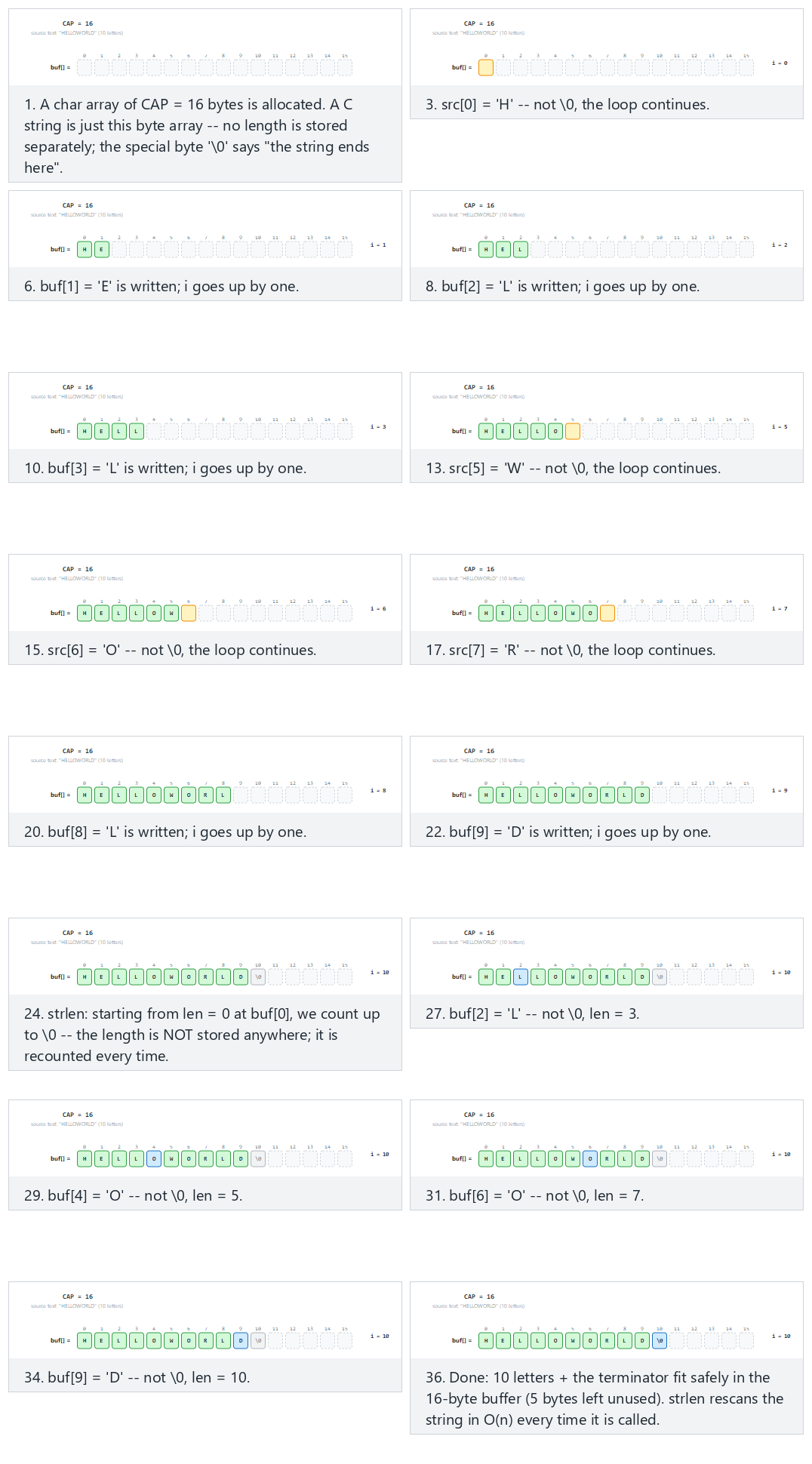
In the picker, also try cap=11, exact fit (0 bytes of slack) (hard) and the edge cases cap=8, overflow — flagged, never executed, and repeated character "AAAAAAAAAA" — or press 🎲 for random data at four difficulty levels, or type your own capacity and text.
1.4 Try it
Full program: c_string_memory.c / CStringMemory.java
/* Week 12 -- Strings: Structures and Algorithms
 * C string memory: a char array plus the '\0' convention, strlen(), and a buffer-overflow edge case that is
 * FLAGGED but never executed (no out-of-bounds write is ever performed -- the guard `if (i == cap) break;`
 * stops the copy one write before it would happen).
 * CEN207 Data Structures (formerly CE205)
 */
#include <stdio.h>
#include <string.h>

#define MAX_CAP 16

static char buf[MAX_CAP];

/* Copies src into buf, character by character, but never writes past index cap-1. If src needs more than
 * cap bytes (cap-1 characters plus the terminator), the copy stops as soon as it WOULD go out of bounds and
 * *overflow is set to 1 -- the out-of-bounds write is flagged, never executed. Returns the number of bytes
 * actually written (== cap on overflow, since buf[0..cap-1] are all filled and all valid). */
static int safe_store(const char *src, int cap, int *overflow) {
    int i = 0;
    while (src[i] != '\0') {
        if (i == cap) break;      /* would need buf[cap]: out of bounds -- stop, never write it */
        buf[i] = src[i];
        i++;
    }
    *overflow = (src[i] != '\0');
    if (!*overflow) buf[i] = '\0';
    return i;
}

static void run_scenario(const char *label, const char *text, int cap) {
    printf("-- %s --\n", label);
    printf("cap = %d, source = \"%s\" (%d letters)\n", cap, text, (int) strlen(text));
    int overflow = 0;
    int written = safe_store(text, cap, &overflow);
    if (overflow) {
        printf("overflow flagged after %d bytes: buf[%d] would be out of bounds (valid indices 0..%d) -- stopped, never executed\n", written, cap, cap - 1);
    } else {
        size_t len = strlen(buf);
        printf("stored \"%s\", strlen = %zu\n", buf, len);
    }
    printf("\n");
}

int main(void) {
    run_scenario("normal: cap=16, comfortable fit", "HELLOWORLD", 16);
    run_scenario("hard: cap=12, 1 byte of slack", "ALGORITHMS", 12);
    run_scenario("edge: cap=11, exact fit (0 bytes slack)", "ALGORITHMS", 11);
    run_scenario("edge: cap=8, overflow -- flagged, never executed", "STRUCTURES", 8);
    run_scenario("edge: cap=16, repeated character", "AAAAAAAAAA", 16);
    return 0;
}
/* Week 12 -- Strings: Structures and Algorithms
 * C string memory: a char array plus the '\0' convention, strlen(), and a buffer-overflow edge case that is
 * FLAGGED but never executed. Java strings carry their own length, so the overflow danger below is really a
 * C-only bug; we reproduce the same bounded-array exercise here so the two languages can be compared side by
 * side, with the identical safety guard.
 * CEN207 Data Structures (formerly CE205)
 */
public class CStringMemory {
    static final int MAX_CAP = 16;
    static char[] buf = new char[MAX_CAP];

    // Copies src into buf, character by character, but never writes past index cap-1. Returns the number of
    // characters actually written; overflow[0] is set to true if src needed more room than cap allowed.
    static int safeStore(String src, int cap, boolean[] overflow) {
        int i = 0;
        while (i < src.length()) {
            if (i == cap) break;      // would need buf[cap]: out of bounds -- stop, never write it
            buf[i] = src.charAt(i);
            i++;
        }
        overflow[0] = (i < src.length());
        return i;
    }

    static void runScenario(String label, String text, int cap) {
        System.out.println("-- " + label + " --");
        System.out.println("cap = " + cap + ", source = \"" + text + "\" (" + text.length() + " letters)");
        boolean[] overflow = new boolean[1];
        int written = safeStore(text, cap, overflow);
        if (overflow[0]) {
            System.out.println("overflow flagged after " + written + " bytes: buf[" + cap + "] would be out of bounds (valid indices 0.." + (cap - 1) + ") -- stopped, never executed");
        } else {
            String stored = new String(buf, 0, written);
            System.out.println("stored \"" + stored + "\", strlen = " + stored.length());
        }
        System.out.println();
    }

    public static void main(String[] args) {
        runScenario("normal: cap=16, comfortable fit", "HELLOWORLD", 16);
        runScenario("hard: cap=12, 1 byte of slack", "ALGORITHMS", 12);
        runScenario("edge: cap=11, exact fit (0 bytes slack)", "ALGORITHMS", 11);
        runScenario("edge: cap=8, overflow -- flagged, never executed", "STRUCTURES", 8);
        runScenario("edge: cap=16, repeated character", "AAAAAAAAAA", 16);
    }
}
Expected output:
-- normal: cap=16, comfortable fit --
cap = 16, source = "HELLOWORLD" (10 letters)
stored "HELLOWORLD", strlen = 10

-- hard: cap=12, 1 byte of slack --
cap = 12, source = "ALGORITHMS" (10 letters)
stored "ALGORITHMS", strlen = 10

-- edge: cap=11, exact fit (0 bytes slack) --
cap = 11, source = "ALGORITHMS" (10 letters)
stored "ALGORITHMS", strlen = 10

-- edge: cap=8, overflow -- flagged, never executed --
cap = 8, source = "STRUCTURES" (10 letters)
overflow flagged after 8 bytes: buf[8] would be out of bounds (valid indices 0..7) -- stopped, never executed

-- edge: cap=16, repeated character --
cap = 16, source = "AAAAAAAAAA" (10 letters)
stored "AAAAAAAAAA", strlen = 10
1.5 Complexity, mistakes, self-check
Complexity. Copying a string of length L into a buffer is O(L) — every character is touched exactly once. strlen is also O(L), and critically, it is O(L) every single time it is called, because the length is never cached anywhere. Calling strlen inside a loop condition (for (i = 0; i < strlen(s); i++)) silently turns an O(n) loop into O(n^2), because strlen re-walks the whole string on every iteration — this is one of the single most common accidental-quadratic-time bugs in C.
Common mistakes
- Forgetting the
+1for the terminator when sizing a buffer: a 10-character word needs 11 bytes (char buf[11]), not 10 — the missing byte is exactly where the overflow in this section's edge case happens. - Calling
strleninside a loop's condition, silently making anO(n)scanO(n^2). Compute the length once, store it, and reuse the stored value. - Comparing strings with
==instead ofstrcmp. In C,==on twochar*values compares the pointers (addresses), not the characters — two identical-looking strings stored at different addresses compare unequal with==even thoughstrcmpcorrectly reports them as equal.
Self-check: why can't strlen just return a stored field?
Because a C string is defined purely as "a char array plus wherever the first '\0' happens to be" — there is no struct, no length field, nothing but the raw bytes. strlen has no data source to read a length from; the only way to find '\0' is to look at each byte in order until one is found. This is also exactly why every C string function that needs the length (strcpy, strcat, strcmp, …) is at least O(L), never O(1).
2. A growable string buffer
2.1 A question to start
Section 1's buf[CAP] had a fixed capacity, chosen before a single character was written — and once it was full, that was that. But an editor's "type into a text box" operation, or a program building a string one piece at a time (think printf-style formatting, or reading a file line by line), does not know the final length in advance. What if the buffer could grow itself as needed, without the caller ever having to guess a capacity up front? That idea — used inside java.lang.StringBuilder, C++'s std::string, Python's list-append machinery, and Week 1's dynamic array — is this section's subject.
2.2 The idea: double when full, and why doubling (not +1) matters
A growable buffer keeps three numbers alongside its raw storage: len (how many characters are actually stored), cap (how many the current allocation can hold), and the storage itself. Appending a character is almost always trivial: buf[len] = c; len++. The interesting case is when len == cap — the buffer is full. The buffer then allocates a new block, double the old size, copies every existing character across, and only then writes the new character. Doubling (rather than growing by a fixed amount, like +1 or +10) is the crucial design choice: it guarantees that copying happens exponentially less often as the buffer gets bigger, which is exactly what makes the average cost of an append O(1) even though any individual append that triggers a growth costs O(len) — this is called amortized analysis, and section 2.5 works out why it holds.
2.3 In memory, and the code
Play the animation to watch the buffer fill up, hit capacity, and grow — the existing characters visibly flash as "copied" before the row widens and the new character lands in the freshly grown space.
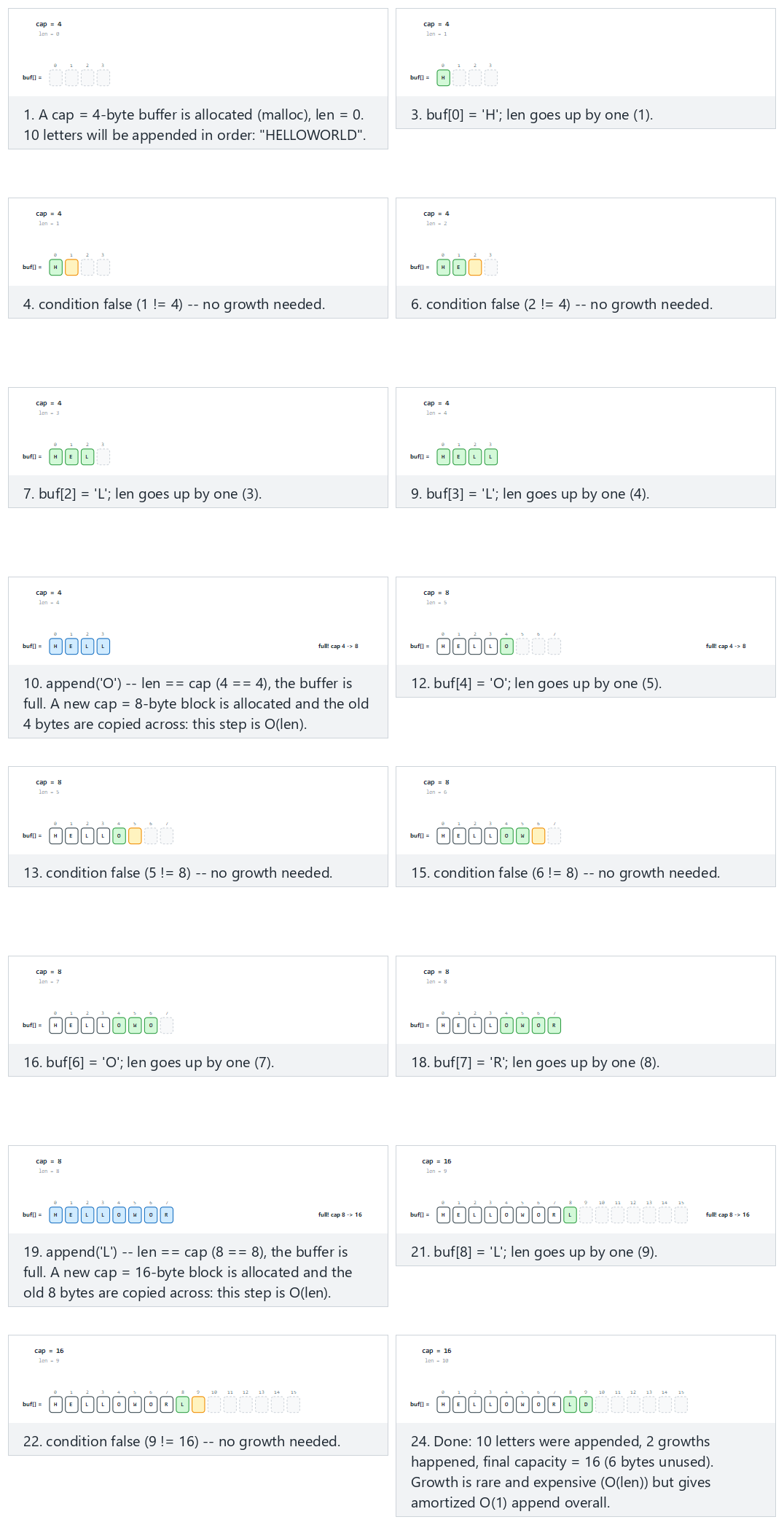
In the picker, also try initCap=2, many growths back to back (hard) and the edge cases initCap=10, exact fit, no growth at all, initCap=1, the smallest possible start, and initCap=9, a single growth right at the boundary — or press 🎲 for random data at four difficulty levels, or type your own starting capacity and text.
2.4 Try it
Full program: string_builder.c / StringBuilderDemo.java
/* Week 12 -- Strings: Structures and Algorithms
 * Growable string buffer: characters are appended one at a time; when full, a new block double the size is
 * allocated, every existing byte is copied across (realloc), then the new character is written. Appending is
 * O(1) most of the time and O(len) only on the rare growth step -- amortized O(1) overall.
 * CEN207 Data Structures (formerly CE205)
 */
#include <stdio.h>
#include <stdlib.h>
#include <string.h>

typedef struct {
    char *buf;
    int len;
    int cap;
    int growths;
} Builder;

static void builder_init(Builder *b, int init_cap) {
    b->cap = init_cap;
    b->buf = malloc((size_t) b->cap);
    b->len = 0;
    b->growths = 0;
}

static void builder_append(Builder *b, char c) {
    if (b->len == b->cap) {              /* full: grow before writing */
        b->cap = b->cap * 2;
        b->buf = realloc(b->buf, (size_t) b->cap);   /* copies every old byte across */
        b->growths++;
    }
    b->buf[b->len] = c;
    b->len++;
}

static void builder_free(Builder *b) {
    free(b->buf);
    b->buf = NULL;
}

static void run_scenario(const char *label, int init_cap, const char *chars) {
    printf("-- %s --\n", label);
    printf("initCap = %d, appending \"%s\" (%d letters)\n", init_cap, chars, (int) strlen(chars));
    Builder b;
    builder_init(&b, init_cap);
    for (int i = 0; chars[i] != '\0'; i++) builder_append(&b, chars[i]);
    printf("result: \"%.*s\", len = %d, finalCap = %d, growths = %d\n\n", b.len, b.buf, b.len, b.cap, b.growths);
    builder_free(&b);
}

int main(void) {
    run_scenario("normal: initCap=4", 4, "HELLOWORLD");
    run_scenario("hard: initCap=2, many growths back to back", 2, "ALGORITHMSDATA");
    run_scenario("edge: initCap=10, exact fit, no growth at all", 10, "ABCDEFGHIJ");
    run_scenario("edge: initCap=1, the smallest possible start", 1, "ABCDEFGHIJ");
    run_scenario("edge: initCap=9, a single growth right at the boundary", 9, "ABCDEFGHIJ");
    return 0;
}
/* Week 12 -- Strings: Structures and Algorithms
 * Growable string buffer, built by hand (java.lang.StringBuilder does exactly this internally). Characters
 * are appended one at a time; when full, a new array double the size is allocated, every existing character
 * is copied across, then the new character is written. Amortized O(1) append.
 * CEN207 Data Structures (formerly CE205)
 */
public class StringBuilderDemo {
    static class Builder {
        char[] buf;
        int len;
        int cap;
        int growths;

        Builder(int initCap) {
            cap = initCap;
            buf = new char[cap];
            len = 0;
            growths = 0;
        }

        void append(char c) {
            if (len == cap) {                          // full: grow before writing
                cap = cap * 2;
                char[] bigger = new char[cap];
                System.arraycopy(buf, 0, bigger, 0, len);   // copies every old byte across
                buf = bigger;
                growths++;
            }
            buf[len] = c;
            len++;
        }
    }

    static void runScenario(String label, int initCap, String chars) {
        System.out.println("-- " + label + " --");
        System.out.println("initCap = " + initCap + ", appending \"" + chars + "\" (" + chars.length() + " letters)");
        Builder b = new Builder(initCap);
        for (int i = 0; i < chars.length(); i++) b.append(chars.charAt(i));
        System.out.println("result: \"" + new String(b.buf, 0, b.len) + "\", len = " + b.len + ", finalCap = " + b.cap + ", growths = " + b.growths);
        System.out.println();
    }

    public static void main(String[] args) {
        runScenario("normal: initCap=4", 4, "HELLOWORLD");
        runScenario("hard: initCap=2, many growths back to back", 2, "ALGORITHMSDATA");
        runScenario("edge: initCap=10, exact fit, no growth at all", 10, "ABCDEFGHIJ");
        runScenario("edge: initCap=1, the smallest possible start", 1, "ABCDEFGHIJ");
        runScenario("edge: initCap=9, a single growth right at the boundary", 9, "ABCDEFGHIJ");
    }
}
Expected output:
-- normal: initCap=4 --
initCap = 4, appending "HELLOWORLD" (10 letters)
result: "HELLOWORLD", len = 10, finalCap = 16, growths = 2

-- hard: initCap=2, many growths back to back --
initCap = 2, appending "ALGORITHMSDATA" (14 letters)
result: "ALGORITHMSDATA", len = 14, finalCap = 16, growths = 3

-- edge: initCap=10, exact fit, no growth at all --
initCap = 10, appending "ABCDEFGHIJ" (10 letters)
result: "ABCDEFGHIJ", len = 10, finalCap = 10, growths = 0

-- edge: initCap=1, the smallest possible start --
initCap = 1, appending "ABCDEFGHIJ" (10 letters)
result: "ABCDEFGHIJ", len = 10, finalCap = 16, growths = 4

-- edge: initCap=9, a single growth right at the boundary --
initCap = 9, appending "ABCDEFGHIJ" (10 letters)
result: "ABCDEFGHIJ", len = 10, finalCap = 18, growths = 1
2.5 Complexity, mistakes, self-check
Complexity. A single append is O(1) when there is room, O(len) on the rare occasion it triggers a growth. Appending n characters one at a time costs, in total, n (the ordinary writes) plus 1 + 2 + 4 + 8 + ... + n (the copying done at each growth, a geometric series that sums to at most 2n) — so n appends cost O(n) total, i.e. O(1) amortized per append. This is the same argument, and the same guarantee, as Week 1's dynamic array.
Common mistakes
- Growing by a fixed amount (
cap = cap + 10) instead of doubling. This turnsnappends intoO(n^2)total work — withn/10growths, each copying up tonbytes, the total copying isO(n^2/10), notO(n). - Forgetting to update the pointer after
realloc(C only).reallocmay move the block to a new address; every pointer that referenced the old address is now dangling and must not be used again — only the returned pointer is valid. - Reading
lenbytes but allocating fewer thanlen + 1if the buffer will later be treated as a C string (needs a'\0'too) — the growable buffer here stores raw characters with an explicitlen, not a C string, precisely to sidestep that trap.
Self-check: why does doubling beat a fixed growth amount?
With doubling, the total bytes ever copied across all growths is 1 + 2 + 4 + ... + n/2 < n — a geometric series bounded by the final size. With a fixed growth of k, there are n/k growths, and the i-th one copies about i*k bytes, so the total is roughly k * (1 + 2 + ... + n/k) = O(n^2/k) — quadratic in n for any constant k. Doubling is what keeps the sum of all the copying linear.
3. Tries: one edge per character
3.1 A question to start
Suppose you need to store an entire dictionary — tens of thousands of words — and answer two questions fast: "is X a word?" and "what words start with the prefix X?" (exactly what an autocomplete box or a spell checker needs). A hash table (Week 6) answers the first question in O(1) average time, but it cannot answer the second at all — hashing deliberately scatters similar keys to unrelated slots, destroying any notion of "starts with." What if, instead, every word that shares a prefix also shared the path through the data structure that represents that prefix? That is the trie (the name comes from "re**trie**val," though it is usually pronounced "try" to avoid confusion with "tree" — Edward Fredkin introduced the structure and the name in a 1960 paper). A trie is a tree in which each edge is labeled with one character, and following the edges spelled out by a word's letters, starting from the root, traces that word's path through the tree.
3.2 The idea: shared prefixes share nodes
Insert "CAT", then "CAR", then "CARD", then "DOG" into an empty trie. "CAT" creates three new nodes, one per letter, with the last one marked "end of word." "CAR" shares the trie's first two new nodes (C, then A) with "CAT" — the C→A edges already exist — and only needs one brand-new node, R, marked "end." "CARD" shares C→A→R with "CAR" and adds one new node, D. "DOG" shares nothing with the other three (no word here starts with D) and creates an entirely new branch from the root. Notice that a node can be both a complete word's end and the start of a longer word's continuation — "CAR"'s R node is marked "end" (a complete word) even though the trie continues past it to D for "CARD".
| Operation | What it does | Cost |
|---|---|---|
insert(word) | Follows/creates one edge per character; marks the final node "end" | O(L), L = word's length |
search(word) | Follows one edge per character; found only if every edge exists and the final node is "end" | O(L) |
| prefix check | Same walk as search, but success only requires every edge to exist (the final node need not be "end") | O(L) |
The single most important property here: every trie operation's cost depends only on the word's length L — never on how many other words the trie already holds. A trie with 10 words and a trie with 10 million words answer search("CAT") in exactly the same number of steps.
3.3 In memory, and the code
#define ALPHA 26
typedef struct TrieNode { struct TrieNode *child[ALPHA]; bool isEnd; } TrieNode;

void insert(TrieNode *root, const char *word) {
    TrieNode *cur = root;
    for (int i = 0; word[i] != '\0'; i++) {
        int c = word[i] - 'A';
        if (cur->child[c] == NULL) {
            cur->child[c] = new_node();
        }
        cur = cur->child[c];
    }
    cur->isEnd = true;
}

bool search(TrieNode *root, const char *word, bool *isPrefix) {
    TrieNode *cur = root;
    for (int i = 0; word[i] != '\0'; i++) {
        int c = word[i] - 'A';
        if (cur->child[c] == NULL) {
            *isPrefix = false;
            return false;
        }
        cur = cur->child[c];
    }
    *isPrefix = true;
    return cur->isEnd;
}
static class TrieNode {
    Map<Character, TrieNode> child = new HashMap<>();
    boolean isEnd = false;
}

void insert(TrieNode root, String word) {
    TrieNode cur = root;
    for (char c : word.toCharArray()) {
        if (!cur.child.containsKey(c)) {
            cur.child.put(c, new TrieNode());
        }
        cur = cur.child.get(c);
    }
    cur.isEnd = true;
}

boolean search(TrieNode root, String word, boolean[] isPrefix) {
    TrieNode cur = root;
    for (char c : word.toCharArray()) {
        if (!cur.child.containsKey(c)) {
            isPrefix[0] = false;
            return false;
        }
        cur = cur.child.get(c);
    }
    isPrefix[0] = true;
    return cur.isEnd;
}
Notice the two languages take genuinely different approaches to "one edge per character": C uses a fixed 26-slot array per node (fast, O(1) lookup, but wastes memory for nodes with few children), while the Java version above uses a HashMap per node (memory-proportional to the actual children, at the cost of a hash lookup instead of a direct array index) — a real, common trade-off you will meet again outside this course.
Play the animation to watch shared prefixes reuse existing nodes, new branches create fresh ones, and searches walk the same edges to report "found," "prefix only," or "not found."
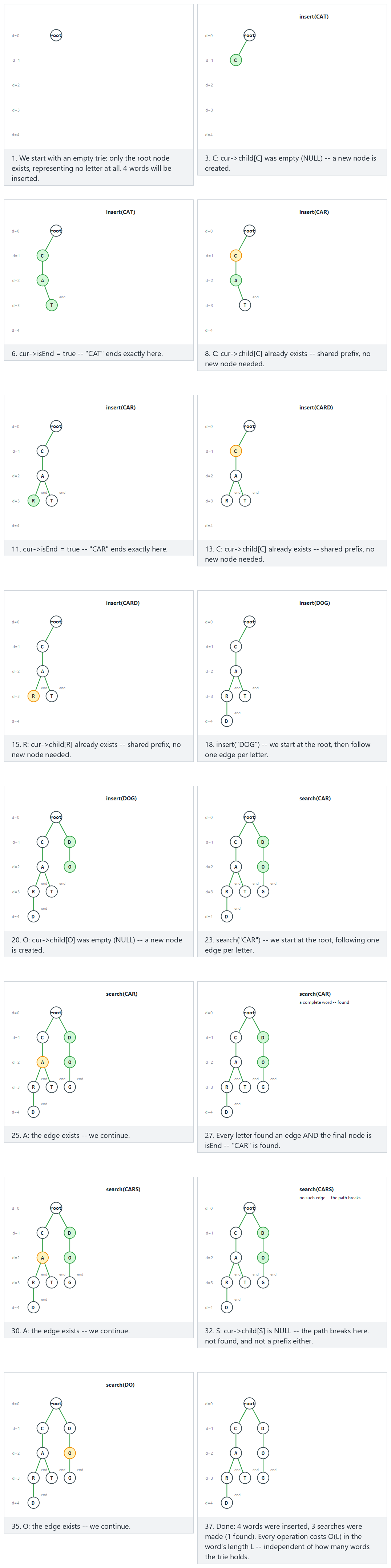
In the picker, also try the TRIE word family: TRIE, TRIED, TRIES, TRY, TRUE, TRUCK (hard) and the edge cases no shared prefix at all, a duplicate insert (idempotent), and a branchless chain: A, AB, ABC, ABCD — or press 🎲 for random data at four difficulty levels, or type your own words and searches.
3.4 Try it
Full program: trie_insert_search.c / TrieInsertSearch.java
/* Week 12 -- Strings: Structures and Algorithms
 * Trie (prefix tree): insert and search, one edge per character, a fixed 26-letter alphabet array per node.
 * CEN207 Data Structures (formerly CE205)
 */
#include <stdbool.h>
#include <stdio.h>
#include <stdlib.h>

#define ALPHA 26

typedef struct TrieNode {
    struct TrieNode *child[ALPHA];
    bool is_end;
} TrieNode;

static TrieNode *new_node(void) {
    TrieNode *n = malloc(sizeof(TrieNode));
    for (int i = 0; i < ALPHA; i++) n->child[i] = NULL;
    n->is_end = false;
    return n;
}

static void insert(TrieNode *root, const char *word) {
    TrieNode *cur = root;
    for (int i = 0; word[i] != '\0'; i++) {
        int c = word[i] - 'A';
        if (cur->child[c] == NULL)
            cur->child[c] = new_node();
        cur = cur->child[c];
    }
    cur->is_end = true;
}

static bool search(TrieNode *root, const char *word, bool *is_prefix) {
    TrieNode *cur = root;
    for (int i = 0; word[i] != '\0'; i++) {
        int c = word[i] - 'A';
        if (cur->child[c] == NULL) {
            *is_prefix = false;
            return false;
        }
        cur = cur->child[c];
    }
    *is_prefix = true;
    return cur->is_end;
}

static void free_trie(TrieNode *n) {
    if (n == NULL) return;
    for (int i = 0; i < ALPHA; i++) free_trie(n->child[i]);
    free(n);
}

static void run_scenario(const char *label, const char *const words[], int nwords, const char *const queries[], int nqueries) {
    printf("-- %s --\n", label);
    TrieNode *root = new_node();
    for (int i = 0; i < nwords; i++) {
        insert(root, words[i]);
        printf("insert(%s)\n", words[i]);
    }
    for (int i = 0; i < nqueries; i++) {
        bool is_prefix = false;
        bool found = search(root, queries[i], &is_prefix);
        printf("search(%s) -> found=%s, isPrefix=%s\n", queries[i], found ? "true" : "false", is_prefix ? "true" : "false");
    }
    free_trie(root);
    printf("\n");
}

int main(void) {
    const char *const w1[] = {"CAT", "CAR", "CARD", "DOG"};
    const char *const q1[] = {"CAR", "CARS", "DO"};
    run_scenario("normal: CAT, CAR, CARD, DOG; search CAR/CARS/DO", w1, 4, q1, 3);

    const char *const w2[] = {"TRIE", "TRIED", "TRIES", "TRY", "TRUE", "TRUCK"};
    const char *const q2[] = {"TRIE", "TR", "TRUCKS", "TRY", "TRUST"};
    run_scenario("hard: the TRIE word family, 5 searches", w2, 6, q2, 5);

    const char *const w3[] = {"AB", "CD", "EF", "GH", "IJ"};
    const char *const q3[] = {"AB", "XY", "A"};
    run_scenario("edge: no shared prefix, every word branches from the root", w3, 5, q3, 3);

    const char *const w4[] = {"DATA", "DATA", "STRUCTURE"};
    const char *const q4[] = {"DATA", "DAT", "STRUCTURES"};
    run_scenario("edge: duplicate insert of DATA (idempotent)", w4, 3, q4, 3);

    const char *const w5[] = {"A", "AB", "ABC", "ABCD"};
    const char *const q5[] = {"A", "ABCD", "ABCDE"};
    run_scenario("edge: a branchless chain A, AB, ABC, ABCD", w5, 4, q5, 3);

    return 0;
}
/* Week 12 -- Strings: Structures and Algorithms
 * Trie (prefix tree): insert and search, one edge per character, a HashMap of children per node.
 * CEN207 Data Structures (formerly CE205)
 */
import java.util.HashMap;
import java.util.Map;

public class TrieInsertSearch {
    static class TrieNode {
        Map<Character, TrieNode> child = new HashMap<>();
        boolean isEnd = false;
    }

    static void insert(TrieNode root, String word) {
        TrieNode cur = root;
        for (char c : word.toCharArray()) {
            if (!cur.child.containsKey(c))
                cur.child.put(c, new TrieNode());
            cur = cur.child.get(c);
        }
        cur.isEnd = true;
    }

    static boolean search(TrieNode root, String word, boolean[] isPrefix) {
        TrieNode cur = root;
        for (char c : word.toCharArray()) {
            if (!cur.child.containsKey(c)) {
                isPrefix[0] = false;
                return false;
            }
            cur = cur.child.get(c);
        }
        isPrefix[0] = true;
        return cur.isEnd;
    }

    static void runScenario(String label, String[] words, String[] queries) {
        System.out.println("-- " + label + " --");
        TrieNode root = new TrieNode();
        for (String w : words) {
            insert(root, w);
            System.out.println("insert(" + w + ")");
        }
        for (String q : queries) {
            boolean[] isPrefix = new boolean[1];
            boolean found = search(root, q, isPrefix);
            System.out.println("search(" + q + ") -> found=" + found + ", isPrefix=" + isPrefix[0]);
        }
        System.out.println();
    }

    public static void main(String[] args) {
        runScenario("normal: CAT, CAR, CARD, DOG; search CAR/CARS/DO",
                new String[]{"CAT", "CAR", "CARD", "DOG"}, new String[]{"CAR", "CARS", "DO"});

        runScenario("hard: the TRIE word family, 5 searches",
                new String[]{"TRIE", "TRIED", "TRIES", "TRY", "TRUE", "TRUCK"},
                new String[]{"TRIE", "TR", "TRUCKS", "TRY", "TRUST"});

        runScenario("edge: no shared prefix, every word branches from the root",
                new String[]{"AB", "CD", "EF", "GH", "IJ"}, new String[]{"AB", "XY", "A"});

        runScenario("edge: duplicate insert of DATA (idempotent)",
                new String[]{"DATA", "DATA", "STRUCTURE"}, new String[]{"DATA", "DAT", "STRUCTURES"});

        runScenario("edge: a branchless chain A, AB, ABC, ABCD",
                new String[]{"A", "AB", "ABC", "ABCD"}, new String[]{"A", "ABCD", "ABCDE"});
    }
}
Expected output:
-- normal: CAT, CAR, CARD, DOG; search CAR/CARS/DO --
insert(CAT)
insert(CAR)
insert(CARD)
insert(DOG)
search(CAR) -> found=true, isPrefix=true
search(CARS) -> found=false, isPrefix=false
search(DO) -> found=false, isPrefix=true

-- hard: the TRIE word family, 5 searches --
insert(TRIE)
insert(TRIED)
insert(TRIES)
insert(TRY)
insert(TRUE)
insert(TRUCK)
search(TRIE) -> found=true, isPrefix=true
search(TR) -> found=false, isPrefix=true
search(TRUCKS) -> found=false, isPrefix=false
search(TRY) -> found=true, isPrefix=true
search(TRUST) -> found=false, isPrefix=false

-- edge: no shared prefix, every word branches from the root --
insert(AB)
insert(CD)
insert(EF)
insert(GH)
insert(IJ)
search(AB) -> found=true, isPrefix=true
search(XY) -> found=false, isPrefix=false
search(A) -> found=false, isPrefix=true

-- edge: duplicate insert of DATA (idempotent) --
insert(DATA)
insert(DATA)
insert(STRUCTURE)
search(DATA) -> found=true, isPrefix=true
search(DAT) -> found=false, isPrefix=true
search(STRUCTURES) -> found=false, isPrefix=false

-- edge: a branchless chain A, AB, ABC, ABCD --
insert(A)
insert(AB)
insert(ABC)
insert(ABCD)
search(A) -> found=true, isPrefix=true
search(ABCD) -> found=true, isPrefix=true
search(ABCDE) -> found=false, isPrefix=false
3.5 Complexity, mistakes, self-check
Complexity. insert, search, and a prefix check are all O(L) in the word's length L, independent of n, the number of words already stored — a trie's biggest advantage over a sorted array or a balanced tree, both of which cost O(L * log n) (each of the O(log n) comparisons itself costs up to O(L) to compare two strings). The price is memory: a trie with the C-style 26-slot array per node can use far more memory than the words themselves need, especially deep in the tree where most nodes have only one or two real children — exactly the waste that section 4's compressed trie eliminates.
Common mistakes
- Confusing "found" with "is a prefix." Reaching the end of the query string by following real edges only proves the query is a prefix of something stored; it is a complete word only if that final node is also marked
isEnd.search("CAR")andsearch("CARP")walk the same first three edges in a trie holding"CARPET", but only one of them is a stored word. - Forgetting a node can be both
isEndand have children."CAR"being a complete word does not stop"CARD"from also being one — a common bug deletes or mishandles a node'sisEndflag when later code assumes "has children" and "is a complete word" are mutually exclusive. - Never freeing the trie (C only). Every
new_node()call is amalloc; without a matching recursivefree_triethat visits every child before freeing the parent, a long-running program leaks memory one node at a time.
Self-check: why is a trie's cost independent of how many words it holds?
Because every operation's work is exactly "follow one edge per character of the query" — the number of other words stored anywhere else in the trie never enters into that walk at all. A hash table's O(1) average lookup is a statistical guarantee (it can degrade under bad hashing or high load); a trie's O(L) bound is a direct consequence of its shape and holds unconditionally, for any n.
4. Compressed tries (radix trees)
4.1 A question to start
Insert just one long word, say "INTERNATIONAL" (13 letters), into an empty plain trie from section 3. It creates 13 new nodes, each with only one child — a long, thin chain with no branching at all, exactly like a linked list. That is a lot of memory and a lot of pointer-chasing to represent something that could, in principle, be stored as a single 13-character string. What if an edge could carry an entire substring instead of just one character, and nodes only needed to exist where the trie actually branches? That is the compressed trie, also called a radix tree or, in its classic form, a PATRICIA trie (Donald R. Morrison, 1968 — the name is an acronym for "Practical Algorithm To Retrieve Information Coded In Alphanumeric"). It is the same idea a plain trie uses, with every maximal non-branching chain collapsed into one edge.
4.2 The idea: extend, create, or split
Inserting a word into a compressed trie walks from the root, character by character, but now compares against whole edge labels, not single characters, and one of three things can happen at each edge:
- The word's remaining suffix matches the edge label completely. Descend past it and continue with what is left of the word (possibly nothing, in which case the node the edge leads to is simply marked "end").
- No edge starts with the word's next character at all. The entire remaining suffix becomes a brand-new leaf edge — exactly like a plain trie, just holding a whole substring instead of one letter.
- The word shares only a partial prefix with an existing edge's label. The edge is split: a new branching node appears holding the shared prefix, with the old edge's (now shortened) remainder and the new word's remainder as its two children.
Case 3 is the one genuinely new idea here. Insert "TEST" into an empty trie: one leaf edge, labeled "TEST". Now insert "TEA": it shares only "TE" with the existing "TEST" edge before they diverge (S vs A), so the "TEST" edge splits — a new node appears holding "TE", with two children: the old node (now reached by the shortened edge "ST") and a brand-new node for the remaining "A".
4.3 The link back to Week 4: two different ways to compress a tree
You have now met two completely different techniques for making a tree smaller by removing redundancy, in two different weeks, and it is worth naming the difference explicitly. Week 4's Huffman coding builds a tree whose shape is chosen to make frequent symbols cheap (a short root-to-leaf path) and rare symbols expensive — it compresses by exploiting a skewed probability distribution over symbols. This week's compressed trie compresses a completely different kind of redundancy: not skewed frequencies, but long unbranching chains in a structure whose shape was determined by the actual character sequences being stored, regardless of how often each one occurs. Put another way: Huffman coding asks "how do I use fewer bits per symbol for the symbols I see most often?"; a compressed trie asks "how do I avoid storing a tree node for every single character when a long stretch has nowhere else to branch?" Both are tree-compression ideas from this course, and both trade a small amount of extra bookkeeping (a canonical code table; an edge label instead of a single character) for a real structural saving — but they compress fundamentally different things.
4.4 In memory, and the code
typedef struct RNode {
    char *label;              /* edge INTO this node; root's label is "" */
    bool isEnd;
    struct RNode *child[26];  /* indexed by the first letter of each child edge */
} RNode;

int common_prefix_len(const char *a, const char *b) {
    int j = 0;
    while (a[j] && b[j] && a[j] == b[j]) j++;
    return j;
}

void insert(RNode *node, const char *word) {
    int i = 0;
    while (word[i] != '\0') {
        int c = word[i] - 'A';
        if (node->child[c] == NULL) {
            node->child[c] = new_leaf(word + i);   /* whole remaining suffix */
            return;
        }
        RNode *child = node->child[c];
        int j = common_prefix_len(word + i, child->label);
        if (j == (int) strlen(child->label)) {      /* whole edge matches: descend */
            node = child; i += j;
            if (word[i] == '\0') { node->isEnd = true; return; }
            continue;
        }
        RNode *mid = split_edge(node, child, j);    /* new node at the mismatch */
        if (word[i + j] == '\0') { mid->isEnd = true; return; }
        mid->child[word[i + j] - 'A'] = new_leaf(word + i + j);
        return;
    }
}
static class RNode {
    String label;              // edge INTO this node; root's label is ""
    boolean isEnd;
    Map<Character, RNode> child = new HashMap<>();
}

void insert(RNode node, String word) {
    int i = 0;
    while (i < word.length()) {
        char c = word.charAt(i);
        if (!node.child.containsKey(c)) {
            node.child.put(c, newLeaf(word.substring(i)));   // whole remaining suffix
            return;
        }
        RNode child = node.child.get(c);
        int j = commonPrefixLen(word.substring(i), child.label);
        if (j == child.label.length()) {        // whole edge matches: descend
            node = child; i += j;
            if (i == word.length()) { node.isEnd = true; return; }
            continue;
        }
        RNode mid = splitEdge(node, child, j);   // new node at the mismatch
        if (i + j == word.length()) { mid.isEnd = true; return; }
        mid.child.put(word.charAt(i + j), newLeaf(word.substring(i + j)));
        return;
    }
}
Play the animation to watch an edge get created, extended, or split — the shared prefix pulling out into its own branching node right at the character where two words first disagree.
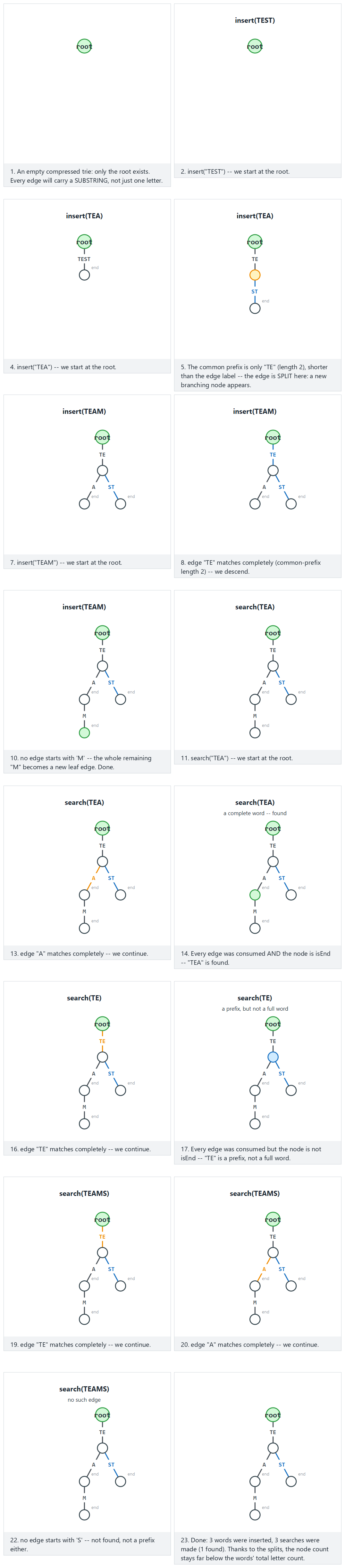
In the picker, also try the ROMAN word family: ROMAN, ROMANE, ROMANUS, ROMULUS (hard, several splits back to back) and the edge cases no shared prefix at all, CAR is itself a prefix of CARPET and CARD, and ANT, ARM, ART, AXE — splits nested inside splits — or press 🎲 for random data at four difficulty levels, or type your own words and searches.
4.5 Try it
Full program: compressed_trie.c / CompressedTrie.java
/* Week 12 -- Strings: Structures and Algorithms
 * Compressed trie (radix tree): each edge carries a whole substring; a new word either extends an existing
 * edge, becomes a brand-new leaf edge, or SPLITS an existing edge at the point where it first diverges.
 * CEN207 Data Structures (formerly CE205)
 */
#include <stdbool.h>
#include <stdio.h>
#include <stdlib.h>
#include <string.h>

#define ALPHA 26

typedef struct RNode {
    char *label;                 /* edge INTO this node; root's label is "" */
    bool is_end;
    struct RNode *child[ALPHA];  /* indexed by the first letter of each child edge */
} RNode;

static char *dup_str(const char *s, int len) {
    char *r = malloc((size_t) len + 1);
    memcpy(r, s, (size_t) len);
    r[len] = '\0';
    return r;
}

static RNode *new_node(const char *label, int label_len, bool is_end) {
    RNode *n = malloc(sizeof(RNode));
    n->label = dup_str(label, label_len);
    n->is_end = is_end;
    for (int i = 0; i < ALPHA; i++) n->child[i] = NULL;
    return n;
}

static int common_prefix_len(const char *a, const char *b) {
    int j = 0;
    while (a[j] && b[j] && a[j] == b[j]) j++;
    return j;
}

static void insert(RNode *node, const char *word) {
    if (word[0] == '\0') { node->is_end = true; return; }   /* the empty word ends exactly at this node */
    int i = 0;
    while (word[i] != '\0') {
        int c = word[i] - 'A';
        if (node->child[c] == NULL) {
            node->child[c] = new_node(word + i, (int) strlen(word + i), true);   /* whole remaining suffix */
            return;
        }
        RNode *child = node->child[c];
        int label_len = (int) strlen(child->label);
        int j = common_prefix_len(word + i, child->label);
        if (j == label_len) {                 /* whole edge matches: descend */
            node = child;
            i += j;
            if (word[i] == '\0') { node->is_end = true; return; }
            continue;
        }
        /* split: a new node holds the shared prefix; child keeps only its tail */
        RNode *mid = new_node(child->label, j, false);
        char *tail = dup_str(child->label + j, label_len - j);
        free(child->label);
        child->label = tail;
        mid->child[(unsigned char) (child->label[0] - 'A')] = child;
        node->child[c] = mid;
        if (word[i + j] == '\0') {
            mid->is_end = true;                /* the inserted word ends exactly at the split point */
            return;
        }
        mid->child[word[i + j] - 'A'] = new_node(word + i + j, (int) strlen(word + i + j), true);
        return;
    }
}

static bool search(RNode *root, const char *word, bool *is_prefix) {
    RNode *node = root;
    int i = 0;
    while (word[i] != '\0') {
        int c = word[i] - 'A';
        if (node->child[c] == NULL) {
            *is_prefix = false;
            return false;
        }
        RNode *child = node->child[c];
        int label_len = (int) strlen(child->label);
        int j = common_prefix_len(word + i, child->label);
        if (j < label_len) {
            *is_prefix = (word[i + j] == '\0');
            return false;
        }
        node = child;
        i += j;
    }
    *is_prefix = true;
    return node->is_end;
}

static void free_radix(RNode *n) {
    if (n == NULL) return;
    for (int i = 0; i < ALPHA; i++) free_radix(n->child[i]);
    free(n->label);
    free(n);
}

static void run_scenario(const char *label, const char *const words[], int nwords, const char *const queries[], int nqueries) {
    printf("-- %s --\n", label);
    RNode *root = new_node("", 0, false);
    for (int i = 0; i < nwords; i++) {
        insert(root, words[i]);
        printf("insert(%s)\n", words[i]);
    }
    for (int i = 0; i < nqueries; i++) {
        bool is_prefix = false;
        bool found = search(root, queries[i], &is_prefix);
        printf("search(%s) -> found=%s, isPrefix=%s\n", queries[i], found ? "true" : "false", is_prefix ? "true" : "false");
    }
    free_radix(root);
    printf("\n");
}

int main(void) {
    const char *const w1[] = {"TEST", "TEA", "TEAM"};
    const char *const q1[] = {"TEA", "TE", "TEAMS"};
    run_scenario("normal: TEST, TEA, TEAM -- one edge splits in two", w1, 3, q1, 3);

    const char *const w2[] = {"ROMAN", "ROMANE", "ROMANUS", "ROMULUS"};
    const char *const q2[] = {"ROMAN", "ROM", "ROMANEQ", "ROMULUS"};
    run_scenario("hard: the ROMAN word family -- several splits back to back", w2, 4, q2, 4);

    const char *const w3[] = {"APPLE", "BANANA"};
    const char *const q3[] = {"APPLE", "AP"};
    run_scenario("edge: no shared prefix, every word is a single long edge", w3, 2, q3, 2);

    const char *const w4[] = {"CAR", "CARPET", "CARD"};
    const char *const q4[] = {"CAR", "CARP", "CARPET"};
    run_scenario("edge: CAR is a prefix of CARPET and CARD", w4, 3, q4, 3);

    const char *const w5[] = {"ANT", "ARM", "ART", "AXE"};
    const char *const q5[] = {"ART", "AR", "ARK"};
    run_scenario("edge: ANT, ARM, ART, AXE -- splits nested inside splits", w5, 4, q5, 3);

    return 0;
}
/* Week 12 -- Strings: Structures and Algorithms
 * Compressed trie (radix tree): each edge carries a whole substring; a new word either extends an existing
 * edge, becomes a brand-new leaf edge, or SPLITS an existing edge at the point where it first diverges.
 * CEN207 Data Structures (formerly CE205)
 */
import java.util.HashMap;
import java.util.Map;

public class CompressedTrie {
    static class RNode {
        String label;                            // edge INTO this node; root's label is ""
        boolean isEnd;
        Map<Character, RNode> child = new HashMap<>();
        RNode(String label, boolean isEnd) { this.label = label; this.isEnd = isEnd; }
    }

    static int commonPrefixLen(String a, String b) {
        int j = 0;
        while (j < a.length() && j < b.length() && a.charAt(j) == b.charAt(j)) j++;
        return j;
    }

    static void insert(RNode node, String word) {
        if (word.isEmpty()) { node.isEnd = true; return; }   // the empty word ends exactly at this node
        int i = 0;
        while (i < word.length()) {
            char c = word.charAt(i);
            if (!node.child.containsKey(c)) {
                node.child.put(c, new RNode(word.substring(i), true));   // whole remaining suffix
                return;
            }
            RNode child = node.child.get(c);
            int j = commonPrefixLen(word.substring(i), child.label);
            if (j == child.label.length()) {        // whole edge matches: descend
                node = child;
                i += j;
                if (i == word.length()) { node.isEnd = true; return; }
                continue;
            }
            // split: a new node holds the shared prefix; child keeps only its tail
            RNode mid = new RNode(child.label.substring(0, j), false);
            child.label = child.label.substring(j);
            mid.child.put(child.label.charAt(0), child);
            node.child.put(c, mid);
            if (i + j == word.length()) {
                mid.isEnd = true;                     // the inserted word ends exactly at the split point
                return;
            }
            mid.child.put(word.charAt(i + j), new RNode(word.substring(i + j), true));
            return;
        }
    }

    static boolean search(RNode root, String word, boolean[] isPrefix) {
        RNode node = root;
        int i = 0;
        while (i < word.length()) {
            char c = word.charAt(i);
            if (!node.child.containsKey(c)) {
                isPrefix[0] = false;
                return false;
            }
            RNode child = node.child.get(c);
            int j = commonPrefixLen(word.substring(i), child.label);
            if (j < child.label.length()) {
                isPrefix[0] = (i + j == word.length());
                return false;
            }
            node = child;
            i += j;
        }
        isPrefix[0] = true;
        return node.isEnd;
    }

    static void runScenario(String label, String[] words, String[] queries) {
        System.out.println("-- " + label + " --");
        RNode root = new RNode("", false);
        for (String w : words) {
            insert(root, w);
            System.out.println("insert(" + w + ")");
        }
        for (String q : queries) {
            boolean[] isPrefix = new boolean[1];
            boolean found = search(root, q, isPrefix);
            System.out.println("search(" + q + ") -> found=" + found + ", isPrefix=" + isPrefix[0]);
        }
        System.out.println();
    }

    public static void main(String[] args) {
        runScenario("normal: TEST, TEA, TEAM -- one edge splits in two",
                new String[]{"TEST", "TEA", "TEAM"}, new String[]{"TEA", "TE", "TEAMS"});

        runScenario("hard: the ROMAN word family -- several splits back to back",
                new String[]{"ROMAN", "ROMANE", "ROMANUS", "ROMULUS"},
                new String[]{"ROMAN", "ROM", "ROMANEQ", "ROMULUS"});

        runScenario("edge: no shared prefix, every word is a single long edge",
                new String[]{"APPLE", "BANANA"}, new String[]{"APPLE", "AP"});

        runScenario("edge: CAR is a prefix of CARPET and CARD",
                new String[]{"CAR", "CARPET", "CARD"}, new String[]{"CAR", "CARP", "CARPET"});

        runScenario("edge: ANT, ARM, ART, AXE -- splits nested inside splits",
                new String[]{"ANT", "ARM", "ART", "AXE"}, new String[]{"ART", "AR", "ARK"});
    }
}
Expected output:
-- normal: TEST, TEA, TEAM -- one edge splits in two --
insert(TEST)
insert(TEA)
insert(TEAM)
search(TEA) -> found=true, isPrefix=true
search(TE) -> found=false, isPrefix=true
search(TEAMS) -> found=false, isPrefix=false

-- hard: the ROMAN word family -- several splits back to back --
insert(ROMAN)
insert(ROMANE)
insert(ROMANUS)
insert(ROMULUS)
search(ROMAN) -> found=true, isPrefix=true
search(ROM) -> found=false, isPrefix=true
search(ROMANEQ) -> found=false, isPrefix=false
search(ROMULUS) -> found=true, isPrefix=true

-- edge: no shared prefix, every word is a single long edge --
insert(APPLE)
insert(BANANA)
search(APPLE) -> found=true, isPrefix=true
search(AP) -> found=false, isPrefix=true

-- edge: CAR is a prefix of CARPET and CARD --
insert(CAR)
insert(CARPET)
insert(CARD)
search(CAR) -> found=true, isPrefix=true
search(CARP) -> found=false, isPrefix=true
search(CARPET) -> found=true, isPrefix=true

-- edge: ANT, ARM, ART, AXE -- splits nested inside splits --
insert(ANT)
insert(ARM)
insert(ART)
insert(AXE)
search(ART) -> found=true, isPrefix=true
search(AR) -> found=false, isPrefix=true
search(ARK) -> found=false, isPrefix=false
4.6 Complexity, mistakes, self-check
Complexity. insert and search remain O(L) in the word's length L, just like a plain trie — the extra common_prefix_len comparison at each edge does not change the asymptotic bound, since across the whole walk it never compares more than L character-pairs in total. The savings are in space: the number of nodes is bounded by the number of branch points and word endings, not by the total character count, so a compressed trie storing words with long unbranching runs (like "INTERNATIONAL") uses dramatically fewer nodes than a plain trie storing the same words.
Common mistakes
- Splitting at the wrong length. The split point is the common prefix length between the remaining query and the existing edge label — not the length of either string alone. Get this wrong and the new branching node's label is either too short (losing shared characters) or too long (crossing into territory the two words do not actually share).
- Forgetting to re-key the split child. After shortening
child->label, that child must be re-inserted into the newmidnode's child array/map under its new first character (child->label[0]after shortening), not its old one. - Treating "path exists" as "word found." Exactly as in section 3, reaching the end of a query by following real edges (even partway through one) proves the query is a prefix, not necessarily that it is itself a complete stored word — the final node's
isEndflag still decides that.
Self-check: why does INTERNATIONAL need so many fewer nodes here than in a plain trie?
A plain trie needs one node per character on the path — 13 nodes for a 13-letter word with no shared prefix, even though every one of those nodes has exactly one child. A compressed trie collapses that entire unbranching run into a single edge labeled "INTERNATIONAL", using just one leaf node. The savings scale with how long the unbranching runs are — words that branch early and often (short, similar prefixes) see less benefit than words that share almost nothing with anything else already stored.
5. Suffix arrays
5.1 A question to start
A trie answers "is X a stored word?" but that is a different question from "does the pattern P occur somewhere inside one long text T?" — the kind of question a text editor's "find" feature, or a genome browser searching a DNA sequence, asks constantly, often with a different P every time against the same T. Building a trie of every substring of T would answer it, but a string of length n has O(n^2) substrings — far too many. What if, instead, you only needed every suffix of T (there are only n of those), sorted so that a binary search could find any pattern's occurrences in O(m log n) time, m being the pattern's length? That sorted list of suffix starting positions is a suffix array.
5.2 The idea: every suffix, sorted lexicographically
A suffix array for a text of length n is simply an array of the n integers 0, 1, ..., n-1, reordered so that text[sa[0]..], text[sa[1]..], ..., text[sa[n-1]..] are in sorted (lexicographic) order. Because two distinct suffixes of the same finite string always have different lengths, one can never be a byte-for-byte duplicate of the other — when one is a prefix of the other, the shorter one simply sorts first (exactly the way "CAR" sorts before "CARD" in a dictionary), so no special end-of-string marker is needed to break ties. This note builds the suffix array with insertion sort over strcmp-style suffix comparisons — simple to animate, and each suffix is just a pointer into the same underlying buffer, so no character is ever copied during the sort. Production libraries use O(n log n) (or even O(n)) construction algorithms instead, but the final sorted order is identical either way.
5.3 In memory, and the code
int compare_suffix(const char *text, int a, int b) {
    return strcmp(text + a, text + b);   /* pointer INTO the same buffer, no copy */
}

void build_suffix_array(const char *text, int n, int sa[]) {
    for (int i = 0; i < n; i++) sa[i] = i;   /* start: unsorted, index order */
    for (int i = 1; i < n; i++) {
        int key = sa[i], j = i - 1;
        while (j >= 0 && compare_suffix(text, sa[j], key) > 0) {
            sa[j + 1] = sa[j];
            j--;
        }
        sa[j + 1] = key;
    }
}
static int compareSuffix(String text, int a, int b) {
    return text.substring(a).compareTo(text.substring(b));
}

static void buildSuffixArray(String text, int[] sa) {
    int n = text.length();
    for (int i = 0; i < n; i++) sa[i] = i;   // start: unsorted, index order
    for (int i = 1; i < n; i++) {
        int key = sa[i], j = i - 1;
        while (j >= 0 && compareSuffix(text, sa[j], key) > 0) {
            sa[j + 1] = sa[j];
            j--;
        }
        sa[j + 1] = key;
    }
}
Play the animation to watch each suffix, drawn as its own row, slide into sorted position among the rows already placed — exactly like insertion-sorting a list of strings.
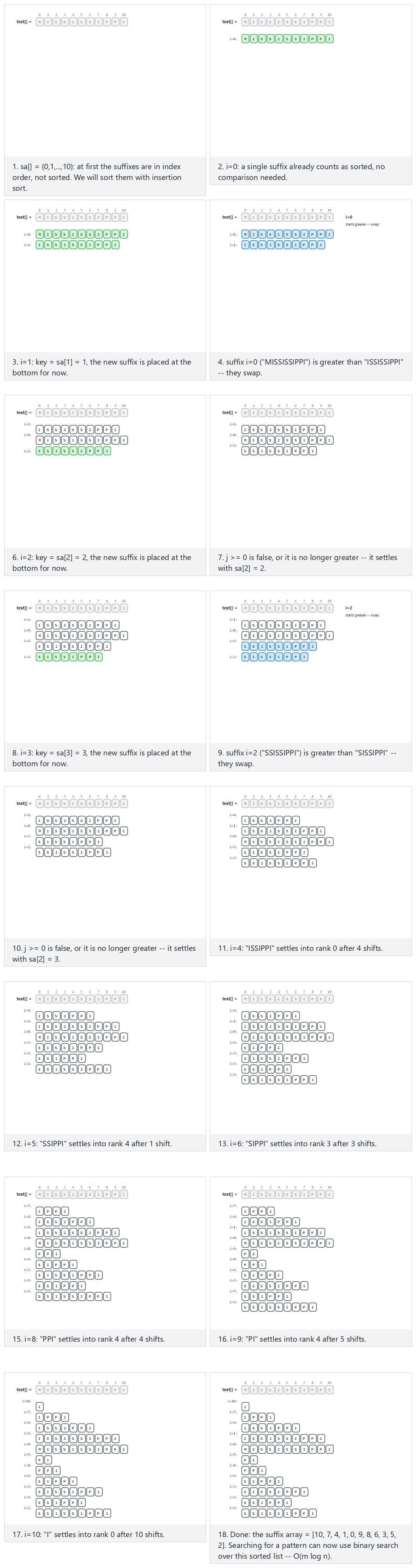
In the picker, also try "ABABABABAB": comparisons are near-ties throughout (hard) and the edge cases "AAAAAAAAAA": every character identical, "ABCDEFGHIJ": already ascending, and "JIHGFEDCBA": descending, the most shifting — or press 🎲 for random data at four difficulty levels, or type your own text.
5.4 Try it
Full program: suffix_array.c / SuffixArray.java
/* Week 12 -- Strings: Structures and Algorithms
 * Suffix array: every starting position of text, sorted by the suffix beginning there, built here with
 * insertion sort over strcmp(text+a, text+b) -- each suffix is just a pointer into the same buffer, no copy.
 * CEN207 Data Structures (formerly CE205)
 */
#include <stdio.h>
#include <string.h>

#define MAXN 24

static int compare_suffix(const char *text, int a, int b) {
    return strcmp(text + a, text + b);   /* pointer INTO the same buffer, no copy */
}

static void build_suffix_array(const char *text, int n, int sa[]) {
    for (int i = 0; i < n; i++) sa[i] = i;   /* start: unsorted, index order */
    for (int i = 1; i < n; i++) {
        int key = sa[i], j = i - 1;
        while (j >= 0 && compare_suffix(text, sa[j], key) > 0) {
            sa[j + 1] = sa[j];
            j--;
        }
        sa[j + 1] = key;
    }
}

static void run_scenario(const char *label, const char *text) {
    printf("-- %s --\n", label);
    int n = (int) strlen(text);
    printf("text = \"%s\" (%d letters)\n", text, n);
    int sa[MAXN];
    build_suffix_array(text, n, sa);
    printf("suffix array:");
    for (int i = 0; i < n; i++) printf(" %d", sa[i]);
    printf("\n");
    for (int i = 0; i < n; i++) printf("  sa[%d]=%d -> \"%s\"\n", i, sa[i], text + sa[i]);
    printf("\n");
}

int main(void) {
    run_scenario("normal: MISSISSIPPI, many repeating suffixes", "MISSISSIPPI");
    run_scenario("hard: ABABABABAB, near-ties throughout", "ABABABABAB");
    run_scenario("edge: AAAAAAAAAA, every character identical", "AAAAAAAAAA");
    run_scenario("edge: ABCDEFGHIJ, already ascending", "ABCDEFGHIJ");
    run_scenario("edge: JIHGFEDCBA, descending, the most shifting", "JIHGFEDCBA");
    return 0;
}
/* Week 12 -- Strings: Structures and Algorithms
 * Suffix array: every starting position of text, sorted by the suffix beginning there, built here with
 * insertion sort over String.compareTo on substrings.
 * CEN207 Data Structures (formerly CE205)
 */
public class SuffixArray {
    static int compareSuffix(String text, int a, int b) {
        return text.substring(a).compareTo(text.substring(b));
    }

    static int[] buildSuffixArray(String text) {
        int n = text.length();
        int[] sa = new int[n];
        for (int i = 0; i < n; i++) sa[i] = i;   // start: unsorted, index order
        for (int i = 1; i < n; i++) {
            int key = sa[i], j = i - 1;
            while (j >= 0 && compareSuffix(text, sa[j], key) > 0) {
                sa[j + 1] = sa[j];
                j--;
            }
            sa[j + 1] = key;
        }
        return sa;
    }

    static void runScenario(String label, String text) {
        System.out.println("-- " + label + " --");
        System.out.println("text = \"" + text + "\" (" + text.length() + " letters)");
        int[] sa = buildSuffixArray(text);
        StringBuilder line = new StringBuilder("suffix array:");
        for (int v : sa) line.append(' ').append(v);
        System.out.println(line);
        for (int i = 0; i < sa.length; i++) System.out.println("  sa[" + i + "]=" + sa[i] + " -> \"" + text.substring(sa[i]) + "\"");
        System.out.println();
    }

    public static void main(String[] args) {
        runScenario("normal: MISSISSIPPI, many repeating suffixes", "MISSISSIPPI");
        runScenario("hard: ABABABABAB, near-ties throughout", "ABABABABAB");
        runScenario("edge: AAAAAAAAAA, every character identical", "AAAAAAAAAA");
        runScenario("edge: ABCDEFGHIJ, already ascending", "ABCDEFGHIJ");
        runScenario("edge: JIHGFEDCBA, descending, the most shifting", "JIHGFEDCBA");
    }
}
Expected output:
-- normal: MISSISSIPPI, many repeating suffixes --
text = "MISSISSIPPI" (11 letters)
suffix array: 10 7 4 1 0 9 8 6 3 5 2
  sa[0]=10 -> "I"
  sa[1]=7 -> "IPPI"
  sa[2]=4 -> "ISSIPPI"
  sa[3]=1 -> "ISSISSIPPI"
  sa[4]=0 -> "MISSISSIPPI"
  sa[5]=9 -> "PI"
  sa[6]=8 -> "PPI"
  sa[7]=6 -> "SIPPI"
  sa[8]=3 -> "SISSIPPI"
  sa[9]=5 -> "SSIPPI"
  sa[10]=2 -> "SSISSIPPI"

-- hard: ABABABABAB, near-ties throughout --
text = "ABABABABAB" (10 letters)
suffix array: 8 6 4 2 0 9 7 5 3 1
  sa[0]=8 -> "AB"
  sa[1]=6 -> "ABAB"
  sa[2]=4 -> "ABABAB"
  sa[3]=2 -> "ABABABAB"
  sa[4]=0 -> "ABABABABAB"
  sa[5]=9 -> "B"
  sa[6]=7 -> "BAB"
  sa[7]=5 -> "BABAB"
  sa[8]=3 -> "BABABAB"
  sa[9]=1 -> "BABABABAB"

-- edge: AAAAAAAAAA, every character identical --
text = "AAAAAAAAAA" (10 letters)
suffix array: 9 8 7 6 5 4 3 2 1 0
  sa[0]=9 -> "A"
  sa[1]=8 -> "AA"
  sa[2]=7 -> "AAA"
  sa[3]=6 -> "AAAA"
  sa[4]=5 -> "AAAAA"
  sa[5]=4 -> "AAAAAA"
  sa[6]=3 -> "AAAAAAA"
  sa[7]=2 -> "AAAAAAAA"
  sa[8]=1 -> "AAAAAAAAA"
  sa[9]=0 -> "AAAAAAAAAA"

-- edge: ABCDEFGHIJ, already ascending --
text = "ABCDEFGHIJ" (10 letters)
suffix array: 0 1 2 3 4 5 6 7 8 9
  sa[0]=0 -> "ABCDEFGHIJ"
  sa[1]=1 -> "BCDEFGHIJ"
  sa[2]=2 -> "CDEFGHIJ"
  sa[3]=3 -> "DEFGHIJ"
  sa[4]=4 -> "EFGHIJ"
  sa[5]=5 -> "FGHIJ"
  sa[6]=6 -> "GHIJ"
  sa[7]=7 -> "HIJ"
  sa[8]=8 -> "IJ"
  sa[9]=9 -> "J"

-- edge: JIHGFEDCBA, descending, the most shifting --
text = "JIHGFEDCBA" (10 letters)
suffix array: 9 8 7 6 5 4 3 2 1 0
  sa[0]=9 -> "A"
  sa[1]=8 -> "BA"
  sa[2]=7 -> "CBA"
  sa[3]=6 -> "DCBA"
  sa[4]=5 -> "EDCBA"
  sa[5]=4 -> "FEDCBA"
  sa[6]=3 -> "GFEDCBA"
  sa[7]=2 -> "HGFEDCBA"
  sa[8]=1 -> "IHGFEDCBA"
  sa[9]=0 -> "JIHGFEDCBA"
5.5 Complexity, mistakes, self-check
Complexity. Insertion sort over n suffixes costs O(n^2) comparisons in the worst case, and each comparison can itself cost up to O(n) characters — O(n^3) worst-case total for the simple construction shown here. Real libraries build a suffix array in O(n log n) or O(n) instead. Once built, though, every implementation pays off the same way: searching for a pattern of length m is a binary search over the sorted suffixes, O(m log n) — dramatically faster than scanning the whole text (O(n)) when many different patterns will be searched against the same fixed text.
Common mistakes
- Forgetting that shorter-is-smaller-when-a-prefix is automatic, and adding an unnecessary sentinel character. Because two suffixes of one string always differ in length, plain lexicographic comparison already puts the shorter one first when it is a prefix of the longer — no
$marker is required (some other suffix-array algorithms do need one for a different technical reason, but the comparison rule itself does not). - Comparing suffixes by copying substrings instead of comparing in place.
text.substring(a)(Java) or manual copying (C) allocates a new string for every single comparison — expensive whenstrcmp(text + a, text + b)(C) can compare the same underlying bytes with zero allocation at all. - Confusing the suffix array's indices with the suffixes' characters.
sa[i]is a starting position in the original text, not a copy of the suffix itself — printingtext + sa[i](C) ortext.substring(sa[i])(Java) is how you recover the actual suffix text for display.
Self-check: why is no sentinel character needed here?
A sentinel (a character smaller than every real character, appended once to the end of the text) is a common trick in other suffix-array algorithms to guarantee that comparisons never run off the end of the buffer. But for the comparison rule itself — "does suffix A sort before suffix B?" — ordinary lexicographic comparison already handles the case where one suffix is a prefix of another correctly: a shorter string that matches another's start is, by definition, "less than" it (this is exactly how dictionary order already works: "CAR" comes before "CARD"). No suffix of a finite string can ever equal another suffix of the same string in both content and length, so ties never actually need to be broken by anything beyond this rule.
6. The string-matching problem, and naive search
6.1 A question to start
This section starts a new family: given one text and one pattern, at which positions (if any) does the pattern occur inside the text? Unlike section 5's suffix array, which pays an upfront sorting cost to answer many future queries fast, the four algorithms in this and the next four sections each answer a single search directly against the raw text, with no preprocessing of the text itself (KMP, Rabin-Karp, and the Z-algorithm do preprocess the pattern, which is normally much shorter). The simplest possible approach — try every position, compare character by character, give up and move on at the first mismatch — is naive (or brute-force) search, and it is exactly where you would start if nobody had ever taught you anything cleverer.
6.2 The idea: try every shift
Slide the pattern across the text one position (a shift s) at a time. At each shift, compare pattern[0] against text[s], then pattern[1] against text[s+1], and so on, left to right, stopping at the first mismatch (move to the next shift) or continuing all the way to a full match (record an occurrence at s, and still move on to the next shift afterward — matches can overlap, and naive search finds every one of them). There are n - m + 1 possible shifts for a text of length n and a pattern of length m.
6.3 In memory, and the code
void naive_search(const char *text, int n, const char *pattern, int m, int occ[], int *count) {
    int c = 0;
    for (int s = 0; s <= n - m; s++) {          /* try every shift */
        int j = 0;
        while (j < m && text[s + j] == pattern[j]) j++;   /* compare left to right */
        if (j == m) occ[c++] = s;                /* whole pattern matched: occurrence at s */
    }
    *count = c;
}
static int[] naiveSearch(String text, String pattern) {
    int n = text.length(), m = pattern.length(), c = 0;
    int[] occ = new int[n];
    for (int s = 0; s <= n - m; s++) {          // try every shift
        int j = 0;
        while (j < m && text.charAt(s + j) == pattern.charAt(j)) j++;   // compare left to right
        if (j == m) occ[c++] = s;                // whole pattern matched: occurrence at s
    }
    return Arrays.copyOf(occ, c);
}
Play the animation to watch the pattern slide one position at a time, comparing left to right and stopping the instant a mismatch is found.
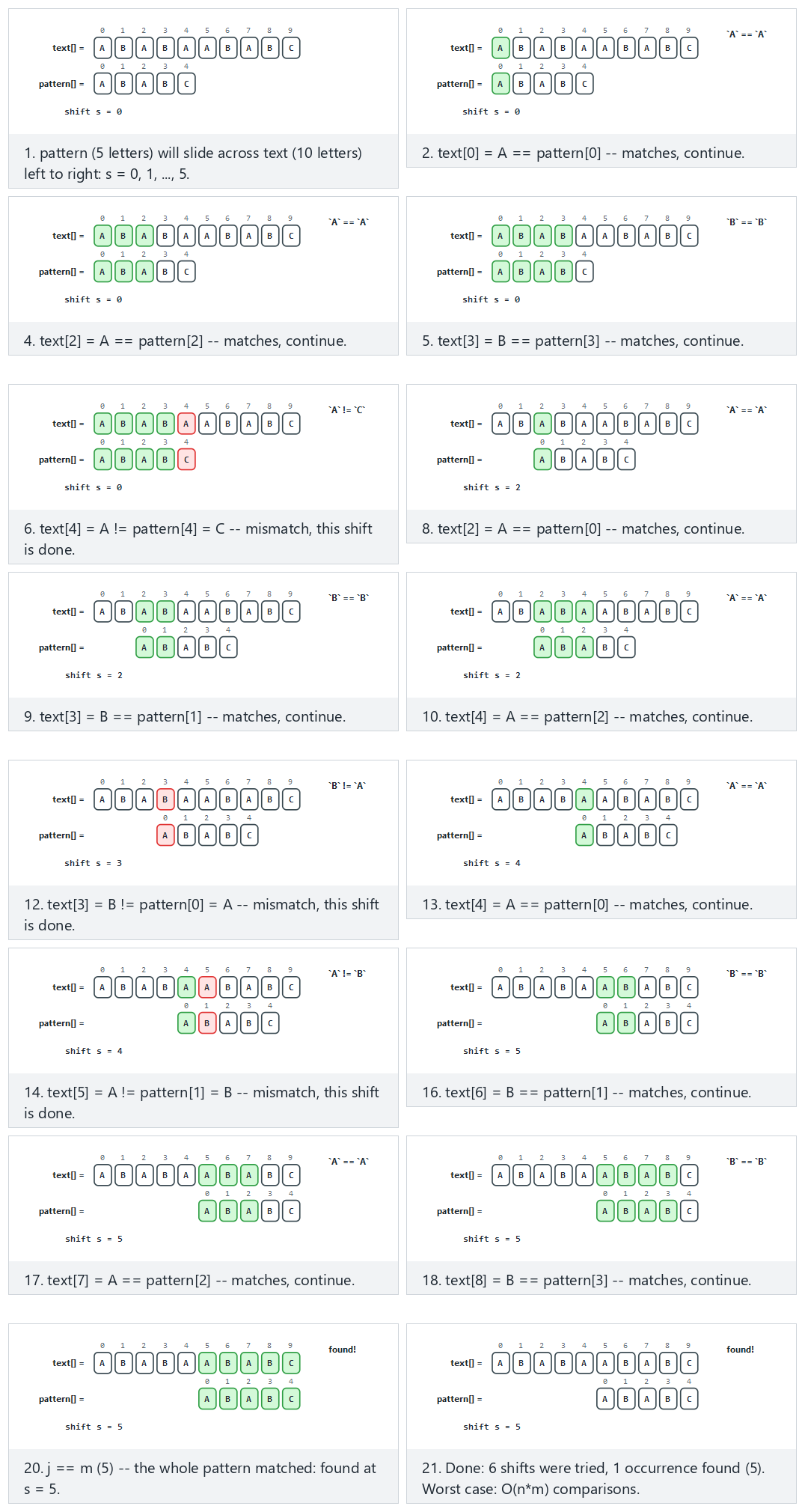
In the picker, also try text="AAAAAAAAAA", pattern="AAAB": worst case, fails late every time (hard) and the edge cases never found, always fails early, an overlapping match at every shift, and text == pattern, only one possible shift — or press 🎲 for random data at four difficulty levels, or type your own text and pattern.
6.4 Try it
Full program: naive_search.c / NaiveSearch.java
/* Week 12 -- Strings: Structures and Algorithms
 * Naive (brute-force) substring search: try every shift, compare left to right until a mismatch or a full
 * match. Worst case O(n*m).
 * CEN207 Data Structures (formerly CE205)
 */
#include <stdio.h>
#include <string.h>

#define MAXOCC 32

static int naive_search(const char *text, int n, const char *pattern, int m, int occ[]) {
    int c = 0;
    for (int s = 0; s <= n - m; s++) {          /* try every shift */
        int j = 0;
        while (j < m && text[s + j] == pattern[j]) j++;   /* compare left to right */
        if (j == m) occ[c++] = s;                /* whole pattern matched: occurrence at s */
    }
    return c;
}

static void print_occ(const int occ[], int count) {
    if (count == 0) { printf("(none)"); return; }
    for (int i = 0; i < count; i++) printf("%s%d", i ? ", " : "", occ[i]);
}

static void run_scenario(const char *label, const char *text, const char *pattern) {
    printf("-- %s --\n", label);
    printf("text = \"%s\" (%d letters), pattern = \"%s\" (%d letters)\n",
           text, (int) strlen(text), pattern, (int) strlen(pattern));
    int occ[MAXOCC];
    int count = naive_search(text, (int) strlen(text), pattern, (int) strlen(pattern), occ);
    printf("occurrences (%d): ", count);
    print_occ(occ, count);
    printf("\n\n");
}

int main(void) {
    run_scenario("normal: a few false starts", "ABABAABABC", "ABABC");
    run_scenario("hard: worst case, fails late every time", "AAAAAAAAAA", "AAAB");
    run_scenario("edge: never found, always fails early", "THEQUICKFOX", "ZEBRA");
    run_scenario("edge: an overlapping match at every shift", "AAAAAAAAAA", "AAA");
    run_scenario("edge: text == pattern, only one possible shift", "ALGORITHMS", "ALGORITHMS");
    return 0;
}
/* Week 12 -- Strings: Structures and Algorithms
 * Naive (brute-force) substring search: try every shift, compare left to right until a mismatch or a full
 * match. Worst case O(n*m).
 * CEN207 Data Structures (formerly CE205)
 */
import java.util.ArrayList;
import java.util.List;

public class NaiveSearch {
    static List<Integer> naiveSearch(String text, String pattern) {
        int n = text.length(), m = pattern.length();
        List<Integer> occ = new ArrayList<>();
        for (int s = 0; s <= n - m; s++) {          // try every shift
            int j = 0;
            while (j < m && text.charAt(s + j) == pattern.charAt(j)) j++;   // compare left to right
            if (j == m) occ.add(s);                  // whole pattern matched: occurrence at s
        }
        return occ;
    }

    static void runScenario(String label, String text, String pattern) {
        System.out.println("-- " + label + " --");
        System.out.println("text = \"" + text + "\" (" + text.length() + " letters), pattern = \"" + pattern + "\" (" + pattern.length() + " letters)");
        List<Integer> occ = naiveSearch(text, pattern);
        System.out.print("occurrences (" + occ.size() + "): ");
        if (occ.isEmpty()) System.out.print("(none)");
        else {
            for (int i = 0; i < occ.size(); i++) System.out.print((i > 0 ? ", " : "") + occ.get(i));
        }
        System.out.println();
        System.out.println();
    }

    public static void main(String[] args) {
        runScenario("normal: a few false starts", "ABABAABABC", "ABABC");
        runScenario("hard: worst case, fails late every time", "AAAAAAAAAA", "AAAB");
        runScenario("edge: never found, always fails early", "THEQUICKFOX", "ZEBRA");
        runScenario("edge: an overlapping match at every shift", "AAAAAAAAAA", "AAA");
        runScenario("edge: text == pattern, only one possible shift", "ALGORITHMS", "ALGORITHMS");
    }
}
Expected output:
-- normal: a few false starts --
text = "ABABAABABC" (10 letters), pattern = "ABABC" (5 letters)
occurrences (1): 5

-- hard: worst case, fails late every time --
text = "AAAAAAAAAA" (10 letters), pattern = "AAAB" (4 letters)
occurrences (0): (none)

-- edge: never found, always fails early --
text = "THEQUICKFOX" (11 letters), pattern = "ZEBRA" (5 letters)
occurrences (0): (none)

-- edge: an overlapping match at every shift --
text = "AAAAAAAAAA" (10 letters), pattern = "AAA" (3 letters)
occurrences (8): 0, 1, 2, 3, 4, 5, 6, 7

-- edge: text == pattern, only one possible shift --
text = "ALGORITHMS" (10 letters), pattern = "ALGORITHMS" (10 letters)
occurrences (1): 0
6.5 Complexity, mistakes, self-check
Complexity. Best case O(n) (every shift fails on its very first comparison — happens with a rich alphabet and no accidental repeats). Worst case O(n*m): a text like "AAAA...AB". against a pattern like "AAAB" re-compares almost the entire pattern at nearly every shift before finally failing — precisely the "hard" scenario above. This worst case is naive search's whole reason for existing in this note: sections 7–11 each fix it in a different way.
Common mistakes
- Forgetting matches can overlap. After a full match at shift
s, the very next shifts + 1must still be tried — a common bug jumps ahead bympositions after a match (as if matches never overlap), silently missing occurrences like the eight overlapping"AAA"matches in"AAAAAAAAAA"above. - Looping
sup toninstead ofn - m. Once fewer thanmcharacters remain in the text, no further shift can possibly produce a full match; comparing anyway either reads past the end of the array or wastes time on comparisons that cannot succeed. - Assuming naive search is "bad" and should never be used. For a short pattern against a short text (or a one-off search where preprocessing a pattern is not worth it), naive search's simplicity and tiny constant factor often make it faster in practice than a cleverer algorithm's setup cost — worst-case complexity is not the only consideration.
Self-check: construct your own worst-case input
Using an alphabet of just two letters, construct a text of length 10 and a pattern of length 4 that forces naive search to compare all four pattern characters at every single shift before finally finding no match at all. (Hint: look at the "hard" scenario above and explain, in one sentence, why the mismatch always happens on the pattern's last character rather than its first.)
Answer. text = "AAAAAAAAAA", pattern = "AAAB" is exactly this case: at every shift, pattern[0..2] ("AAA") matches three As from the text, and only pattern[3] ('B') fails to match the text's 'A' — the mismatch happens on the last character precisely because the first three characters of the pattern are indistinguishable from the text's repeated letter.
7. Knuth-Morris-Pratt: the failure function
7.1 A question to start
Naive search's worst case wastes work in a specific, fixable way: after matching "AAA" and failing on the fourth character, it throws away everything it just learned and restarts the very next shift from scratch, comparing the pattern's first character all over again — even though the text characters just examined are already known. Donald Knuth, James H. Morris, and Vaughan Pratt published an algorithm in 1977 (developed independently by Morris and Pratt around 1970, and by Knuth slightly later) that never throws that information away: it precomputes, from the pattern alone, exactly how far it can safely skip ahead on a mismatch, without ever re-examining a text character it has already looked at. That precomputed table is the failure function, usually called lps[] — "longest proper prefix that is also a suffix."
7.2 The idea: what lps[i] means
For every prefix pattern[0..i] of the pattern, lps[i] is the length of the longest proper prefix of that prefix (proper means "not the whole thing") which is also a suffix of it. For pattern = "ABABCABAB": lps[3] looks at the prefix "ABAB" and asks "what is the longest string that is both a proper prefix and a suffix of ABAB?" — the answer is "AB" (length 2), because "AB" is both how "ABAB" starts and how it ends, and no longer match ("ABA") satisfies both conditions. This table matters because when a search mismatches after matching the first j pattern characters, lps[j-1] tells you exactly how many of those already-matched characters can be reused as the start of the next attempt — no need to re-compare them against the text at all (section 8 uses the table this way). The table is built by comparing the pattern against itself: two pointers, i (the prefix currently being extended) and len (the current matched prefix-suffix length); on a mismatch, len falls back to lps[len-1] — the same "reuse what you already know" trick applied recursively — instead of resetting to 0, which is precisely what keeps building the whole table an O(m) operation rather than O(m^2).
7.3 In memory, and the code
static int[] computeLps(String pattern) {
    int m = pattern.length();
    int[] lps = new int[m];
    int len = 0, i = 1;
    while (i < m) {
        if (pattern.charAt(i) == pattern.charAt(len)) {
            len++;
            lps[i] = len;
            i++;
        } else if (len != 0) {
            len = lps[len - 1];       // fall back, do NOT advance i
        } else {
            lps[i] = 0;
            i++;
        }
    }
    return lps;
}
Play the animation to watch len grow on a match, fall back through lps[len-1] (never straight to 0) on a mismatch, and the table fill in one entry at a time.
![KMP failure function (the lps[] table) — step by step](../anim/kmp-failure-function.png)
In the picker, also try "AAAAAAAAAA": grows at every step, lps[i] = i (hard) and the edge cases no repetition at all, lps is always 0, a constantly oscillating pattern, and the fallback chases a chain (lps[len-1]) — or press 🎲 for random data at four difficulty levels, or type your own pattern.
7.4 Try it
Full program: kmp_failure_function.c / KmpFailureFunction.java
/* Week 12 -- Strings: Structures and Algorithms
 * KMP failure function (lps[]): for every prefix pattern[0..i], lps[i] is the length of the longest proper
 * prefix of that prefix that is also a suffix of it. Built in O(m) by comparing the pattern to itself.
 * CEN207 Data Structures (formerly CE205)
 */
#include <stdio.h>
#include <string.h>

static void compute_lps(const char *pattern, int m, int lps[]) {
    lps[0] = 0;
    int len = 0, i = 1;
    while (i < m) {
        if (pattern[i] == pattern[len]) {
            len++;
            lps[i] = len;
            i++;
        } else if (len != 0) {
            len = lps[len - 1];       /* fall back, do NOT advance i */
        } else {
            lps[i] = 0;
            i++;
        }
    }
}

static void run_scenario(const char *label, const char *pattern) {
    printf("-- %s --\n", label);
    int m = (int) strlen(pattern);
    printf("pattern = \"%s\" (%d letters)\n", pattern, m);
    int lps[64];
    compute_lps(pattern, m, lps);
    printf("lps:");
    for (int i = 0; i < m; i++) printf(" %d", lps[i]);
    printf("\n\n");
}

int main(void) {
    run_scenario("normal: mixed growth and fallback", "ABABCABABA");
    run_scenario("hard: grows at every step, lps[i] = i", "AAAAAAAAAA");
    run_scenario("edge: no repetition at all, lps is always 0", "ABCDEFGHIJ");
    run_scenario("edge: a constantly oscillating pattern", "ABABABABAB");
    run_scenario("edge: the fallback chases a chain (lps[len-1])", "AABAACAABAA");
    return 0;
}
/* Week 12 -- Strings: Structures and Algorithms
 * KMP failure function (lps[]): for every prefix pattern[0..i], lps[i] is the length of the longest proper
 * prefix of that prefix that is also a suffix of it. Built in O(m) by comparing the pattern to itself.
 * CEN207 Data Structures (formerly CE205)
 */
public class KmpFailureFunction {
    static int[] computeLps(String pattern) {
        int m = pattern.length();
        int[] lps = new int[m];
        int len = 0, i = 1;
        while (i < m) {
            if (pattern.charAt(i) == pattern.charAt(len)) {
                len++;
                lps[i] = len;
                i++;
            } else if (len != 0) {
                len = lps[len - 1];       // fall back, do NOT advance i
            } else {
                lps[i] = 0;
                i++;
            }
        }
        return lps;
    }

    static void runScenario(String label, String pattern) {
        System.out.println("-- " + label + " --");
        System.out.println("pattern = \"" + pattern + "\" (" + pattern.length() + " letters)");
        int[] lps = computeLps(pattern);
        StringBuilder line = new StringBuilder("lps:");
        for (int v : lps) line.append(' ').append(v);
        System.out.println(line);
        System.out.println();
    }

    public static void main(String[] args) {
        runScenario("normal: mixed growth and fallback", "ABABCABABA");
        runScenario("hard: grows at every step, lps[i] = i", "AAAAAAAAAA");
        runScenario("edge: no repetition at all, lps is always 0", "ABCDEFGHIJ");
        runScenario("edge: a constantly oscillating pattern", "ABABABABAB");
        runScenario("edge: the fallback chases a chain (lps[len-1])", "AABAACAABAA");
    }
}
Expected output:
-- normal: mixed growth and fallback --
pattern = "ABABCABABA" (10 letters)
lps: 0 0 1 2 0 1 2 3 4 3

-- hard: grows at every step, lps[i] = i --
pattern = "AAAAAAAAAA" (10 letters)
lps: 0 1 2 3 4 5 6 7 8 9

-- edge: no repetition at all, lps is always 0 --
pattern = "ABCDEFGHIJ" (10 letters)
lps: 0 0 0 0 0 0 0 0 0 0

-- edge: a constantly oscillating pattern --
pattern = "ABABABABAB" (10 letters)
lps: 0 0 1 2 3 4 5 6 7 8

-- edge: the fallback chases a chain (lps[len-1]) --
pattern = "AABAACAABAA" (11 letters)
lps: 0 1 0 1 2 0 1 2 3 4 5
7.5 Complexity, mistakes, self-check
Complexity. O(m) to build the whole table for a pattern of length m — despite the fallback loop, len strictly decreases on every fallback step and strictly increases on every match, so across the entire construction len can decrease at most as many times as it increased, bounding the total work to O(m), not O(m^2).
Common mistakes
- Resetting
lento 0 on every mismatch instead of falling back tolps[len-1]. This is the single most common bug in a from-scratch KMP implementation — it still produces a table, but the wrong one, one that under-reports how much can be safely skipped later. - Off-by-one between "prefix length" and "index."
lps[i]describes the prefixpattern[0..i](lengthi+1), so the character being compared for a potential extension ispattern[len], notpattern[len+1]orpattern[len-1]— a frequent source of one-past-the-end or one-before-the-start bugs. - Forgetting
lps[0] = 0is a fixed base case, never computed by the loop. A single-character prefix has no proper prefix at all (only the empty string, of length 0), solps[0]must always be 0 by definition, not by comparison.
Self-check: what does lps[m-1] tell you about the whole pattern?
lps[m-1] is the longest proper prefix of the entire pattern that is also a suffix of the entire pattern — in other words, the length of the pattern's longest border. A pattern with lps[m-1] = 0 (no self-overlap at all, like "ABCDEFGHIJ") has nothing useful to reuse if it fails on its very last character; a pattern with a large lps[m-1] (like "AAAAAAAAAA", where lps[m-1] = m-1) can reuse almost everything it already matched.
8. Knuth-Morris-Pratt: the search
8.1 A question to start
Section 7 built the lps[] table from the pattern alone; this section puts it to work. KMP search keeps two pointers — i into the text, j into the pattern — with one guarantee that naive search cannot make: i never moves backward. On a mismatch, instead of restarting the pattern from its first character at the next text position (naive search's approach, which re-examines text characters already looked at), j falls back to lps[j-1] — reusing the partial match already found — while i simply continues forward. The result: every text character is examined a small, bounded number of times, giving O(n + m) total time no matter how repetitive the text or pattern are.
8.2 In memory, and the code
void kmp_search(const char *text, int n, const char *pattern, int m, const int lps[], int occ[], int *count) {
    int i = 0, j = 0, c = 0;
    while (i < n) {
        if (text[i] == pattern[j]) {
            i++; j++;
            if (j == m) {
                occ[c++] = i - m;        /* occurrence found; keep scanning */
                j = lps[j - 1];
            }
        } else if (j > 0) {
            j = lps[j - 1];              /* fall back in the PATTERN; i never moves back */
        } else {
            i++;
        }
    }
    *count = c;
}
static int[] kmpSearch(String text, String pattern, int[] lps) {
    int n = text.length(), m = pattern.length(), i = 0, j = 0, c = 0;
    int[] occ = new int[n];
    while (i < n) {
        if (text.charAt(i) == pattern.charAt(j)) {
            i++; j++;
            if (j == m) {
                occ[c++] = i - m;        // occurrence found; keep scanning
                j = lps[j - 1];
            }
        } else if (j > 0) {
            j = lps[j - 1];              // fall back in the PATTERN; i never moves back
        } else {
            i++;
        }
    }
    return Arrays.copyOf(occ, c);
}
Play the animation to watch i (the text pointer) march steadily forward while the pattern's alignment jumps using lps on a mismatch — the text is never rescanned.
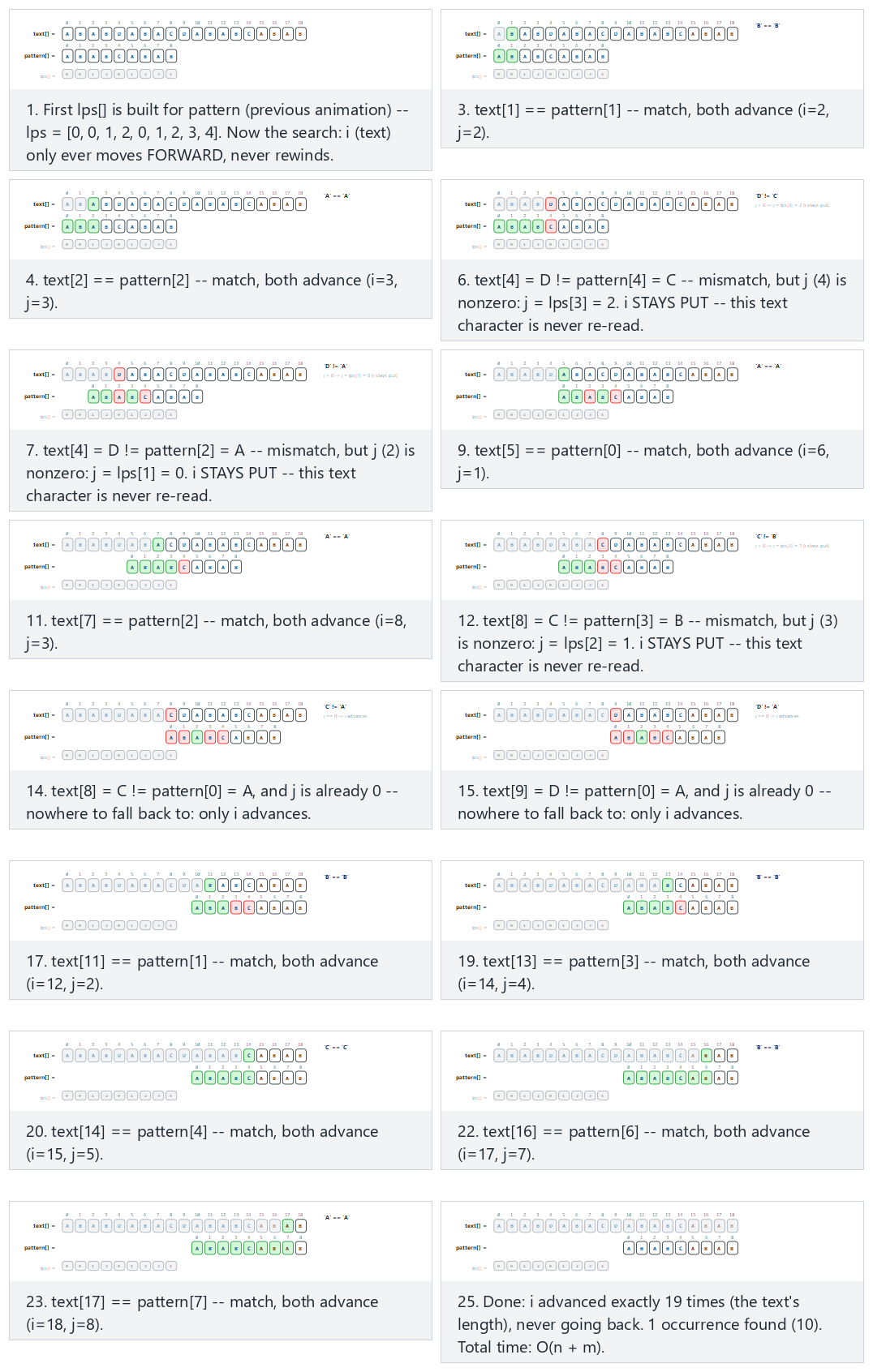
In the picker, also try text="AAAAAAAAAAAAAAAB", pattern="AAAAB": many lps fallbacks (hard) and the edge cases never found, overlapping matches, and text == pattern, one match, no fallback at all — or press 🎲 for random data at four difficulty levels, or type your own text and pattern.
8.3 Try it
Full program: kmp_search.c / KmpSearch.java
/* Week 12 -- Strings: Structures and Algorithms
 * KMP search: uses the lps[] failure-function table so the text pointer i never moves backward. O(n + m).
 * CEN207 Data Structures (formerly CE205)
 */
#include <stdio.h>
#include <string.h>

#define MAXOCC 32

static void compute_lps(const char *pattern, int m, int lps[]) {
    lps[0] = 0;
    int len = 0, i = 1;
    while (i < m) {
        if (pattern[i] == pattern[len]) {
            len++;
            lps[i] = len;
            i++;
        } else if (len != 0) {
            len = lps[len - 1];
        } else {
            lps[i] = 0;
            i++;
        }
    }
}

static int kmp_search(const char *text, int n, const char *pattern, int m, const int lps[], int occ[]) {
    if (m == 0) {                     /* the empty pattern matches at every position, including n */
        for (int s = 0; s <= n; s++) occ[s] = s;
        return n + 1;
    }
    int i = 0, j = 0, c = 0;
    while (i < n) {
        if (text[i] == pattern[j]) {
            i++; j++;
            if (j == m) {
                occ[c++] = i - m;        /* occurrence found; keep scanning */
                j = lps[j - 1];
            }
        } else if (j > 0) {
            j = lps[j - 1];              /* fall back in the PATTERN; i never moves back */
        } else {
            i++;
        }
    }
    return c;
}

static void print_occ(const int occ[], int count) {
    if (count == 0) { printf("(none)"); return; }
    for (int i = 0; i < count; i++) printf("%s%d", i ? ", " : "", occ[i]);
}

static void run_scenario(const char *label, const char *text, const char *pattern) {
    printf("-- %s --\n", label);
    int n = (int) strlen(text), m = (int) strlen(pattern);
    printf("text = \"%s\" (%d letters), pattern = \"%s\" (%d letters)\n", text, n, pattern, m);
    int lps[64];
    compute_lps(pattern, m, lps);
    int occ[MAXOCC];
    int count = kmp_search(text, n, pattern, m, lps, occ);
    printf("occurrences (%d): ", count);
    print_occ(occ, count);
    printf("\n\n");
}

int main(void) {
    run_scenario("normal: the classic CLRS-style example", "ABABDABACDABABCABAB", "ABABCABAB");
    run_scenario("hard: many lps fallbacks", "AAAAAAAAAAAAAAAB", "AAAAB");
    run_scenario("edge: never found", "THEQUICKBROWNFOX", "ZEBRA");
    run_scenario("edge: overlapping matches", "AAAAAAAAAA", "AAA");
    run_scenario("edge: text == pattern, one match, no fallback at all", "ALGORITHMS", "ALGORITHMS");
    return 0;
}
/* Week 12 -- Strings: Structures and Algorithms
 * KMP search: uses the lps[] failure-function table so the text pointer i never moves backward. O(n + m).
 * CEN207 Data Structures (formerly CE205)
 */
import java.util.ArrayList;
import java.util.List;

public class KmpSearch {
    static int[] computeLps(String pattern) {
        int m = pattern.length();
        int[] lps = new int[m];
        int len = 0, i = 1;
        while (i < m) {
            if (pattern.charAt(i) == pattern.charAt(len)) {
                len++;
                lps[i] = len;
                i++;
            } else if (len != 0) {
                len = lps[len - 1];
            } else {
                lps[i] = 0;
                i++;
            }
        }
        return lps;
    }

    static List<Integer> kmpSearch(String text, String pattern, int[] lps) {
        int n = text.length(), m = pattern.length(), i = 0, j = 0;
        List<Integer> occ = new ArrayList<>();
        if (m == 0) {                 // the empty pattern matches at every position, including n
            for (int s = 0; s <= n; s++) occ.add(s);
            return occ;
        }
        while (i < n) {
            if (text.charAt(i) == pattern.charAt(j)) {
                i++; j++;
                if (j == m) {
                    occ.add(i - m);              // occurrence found; keep scanning
                    j = lps[j - 1];
                }
            } else if (j > 0) {
                j = lps[j - 1];                  // fall back in the PATTERN; i never moves back
            } else {
                i++;
            }
        }
        return occ;
    }

    static void runScenario(String label, String text, String pattern) {
        System.out.println("-- " + label + " --");
        System.out.println("text = \"" + text + "\" (" + text.length() + " letters), pattern = \"" + pattern + "\" (" + pattern.length() + " letters)");
        int[] lps = computeLps(pattern);
        List<Integer> occ = kmpSearch(text, pattern, lps);
        System.out.print("occurrences (" + occ.size() + "): ");
        if (occ.isEmpty()) System.out.print("(none)");
        else {
            for (int i = 0; i < occ.size(); i++) System.out.print((i > 0 ? ", " : "") + occ.get(i));
        }
        System.out.println();
        System.out.println();
    }

    public static void main(String[] args) {
        runScenario("normal: the classic CLRS-style example", "ABABDABACDABABCABAB", "ABABCABAB");
        runScenario("hard: many lps fallbacks", "AAAAAAAAAAAAAAAB", "AAAAB");
        runScenario("edge: never found", "THEQUICKBROWNFOX", "ZEBRA");
        runScenario("edge: overlapping matches", "AAAAAAAAAA", "AAA");
        runScenario("edge: text == pattern, one match, no fallback at all", "ALGORITHMS", "ALGORITHMS");
    }
}
Expected output:
-- normal: the classic CLRS-style example --
text = "ABABDABACDABABCABAB" (19 letters), pattern = "ABABCABAB" (9 letters)
occurrences (1): 10

-- hard: many lps fallbacks --
text = "AAAAAAAAAAAAAAAB" (16 letters), pattern = "AAAAB" (5 letters)
occurrences (1): 11

-- edge: never found --
text = "THEQUICKBROWNFOX" (16 letters), pattern = "ZEBRA" (5 letters)
occurrences (0): (none)

-- edge: overlapping matches --
text = "AAAAAAAAAA" (10 letters), pattern = "AAA" (3 letters)
occurrences (8): 0, 1, 2, 3, 4, 5, 6, 7

-- edge: text == pattern, one match, no fallback at all --
text = "ALGORITHMS" (10 letters), pattern = "ALGORITHMS" (10 letters)
occurrences (1): 0
8.4 Complexity, mistakes, self-check
Complexity. O(n + m): O(m) to build lps[] (section 7), O(n) for the search itself — i advances at most n times total (it never goes backward), and j's fallbacks are bounded by the same amortized argument used for building the table. This holds regardless of the text or pattern's content — unlike naive search's O(n*m) worst case, KMP has no bad input at all.
Common mistakes
- Advancing
ion a fallback. The whole point oflpsis thatistays put whilejfalls back — advancingitoo would silently skip text characters that still need to be compared against the pattern's new (shorter) alignment. - Forgetting to fall back again after a full match (
j = lps[j-1]after recording an occurrence). Without it, the next comparison would incorrectly restart fromj = minstead of resuming from the pattern's own self-overlap, missing overlapping occurrences. - Reusing a stale
lps[]table for a different pattern. The table is specific to the exact pattern it was built from — searching with the wrong table produces silently wrong skip amounts, not a crash, which makes this bug easy to miss.
Self-check: why is O(n + m) achievable here but not for naive search?
Naive search's O(n*m) worst case comes from re-examining the same text characters across different shifts — after a mismatch, the next shift starts comparing from the text position right after where the previous shift started, re-reading characters already looked at. KMP's lps table guarantees i never moves backward, so no text character is ever compared more than a small, bounded number of times — the total number of comparisons is proportional to n (for i) plus m (for building the table), never their product.
9. Rabin-Karp: rolling hash and spurious hits
9.1 A question to start
KMP fixes naive search's worst case by being smarter about where to look next. Michael O. Rabin and Richard M. Karp, in a 1987 paper, took an entirely different approach: instead of comparing characters at all in the common case, compare a cheap hash of each window against the pattern's hash. Two different pieces of text essentially never hash to the same value (with a well-chosen hash), so a hash mismatch rules out a window instantly, with no character comparison whatsoever. The one subtlety — and it is important — is that a hash match is only a candidate: two different substrings can, in principle, hash to the same value (a collision, exactly as in Week 6's hash tables), so before reporting an occurrence, the characters must still be verified. A hash match that fails verification is called a spurious hit.
9.2 The idea: roll the hash instead of recomputing it
Treat each character as a digit in a fixed base (this note uses base = 31, treating 'A' as digit 0), and hash a window the way you would compute a number's value: h = c0*base^(m-1) + c1*base^(m-2) + ... + c(m-1), all taken mod some modulus. Computed from scratch, that is O(m) per window — no better than naive search. The trick is rolling: sliding the window forward by one position only removes the outgoing character's contribution, shifts every remaining term up by one power of base, and adds the incoming character — an O(1) update, ((oldHash - outChar*base^(m-1)) * base + inChar) mod mod, computed without ever looking at the m-2 characters in the middle of the window again. This is the same "avoid redoing work" spirit as KMP's lps table, applied to hashing instead of character comparison.
9.3 In memory, and the code
long long window_hash(const char *s, int m, long long base, long long mod) {
    long long h = 0;
    for (int k = 0; k < m; k++) h = (h * base + (s[k] - 'A')) % mod;
    return h;
}

void rabin_karp(const char *text, int n, const char *pattern, int m, long long base, long long mod, int occ[], int *count) {
    long long pHash = window_hash(pattern, m, base, mod);
    long long hPow = 1;
    for (int k = 0; k < m - 1; k++) hPow = (hPow * base) % mod;
    long long tHash = window_hash(text, m, base, mod);      /* first window, computed directly */
    int c = 0;
    for (int s = 0; s <= n - m; s++) {
        if (s > 0)
            tHash = ((tHash - (text[s - 1] - 'A') * hPow % mod + mod) * base + (text[s + m - 1] - 'A')) % mod;
        if (tHash == pHash && strncmp(text + s, pattern, m) == 0)   /* VERIFY: hash match is only a candidate */
            occ[c++] = s;
    }
    *count = c;
}
static long windowHash(String s, int m, long base, long mod) {
    long h = 0;
    for (int k = 0; k < m; k++) h = (h * base + (s.charAt(k) - 'A')) % mod;
    return h;
}

static int[] rabinKarp(String text, String pattern, long base, long mod) {
    int n = text.length(), m = pattern.length(), c = 0;
    long pHash = windowHash(pattern, m, base, mod);
    long hPow = 1;
    for (int k = 0; k < m - 1; k++) hPow = (hPow * base) % mod;
    long tHash = windowHash(text, m, base, mod);        // first window, computed directly
    int[] occ = new int[n];
    for (int s = 0; s <= n - m; s++) {
        if (s > 0)
            tHash = ((tHash - (text.charAt(s - 1) - 'A') * hPow % mod + mod) * base + (text.charAt(s + m - 1) - 'A')) % mod;
        if (tHash == pHash && text.regionMatches(s, pattern, 0, m))   // VERIFY: hash match is only a candidate
            occ[c++] = s;
    }
    return Arrays.copyOf(occ, c);
}
A real bug caught while building this note
The first draft of the C program above declared the hash variables long instead of long long. On this course's Windows/MinGW toolchain, long is only 32 bits, and mod = 1000000007 combined with base = 31 produces intermediate products (h * base) up to about 3.1 * 10^10 — larger than a 32-bit long can hold, causing silent signed-integer overflow (undefined behavior) and a wrong answer with no compiler warning. Comparing the C and Java output caught it immediately (Java's long is always 64 bits, so the Java version was correct from the start). The lesson generalizes: never assume long means 64 bits in C — its size is platform-defined; use long long (guaranteed at least 64 bits since C99) or int64_t (from <stdint.h>) whenever you truly need 64 bits.
Play the animation to watch each window's hash computed by rolling the previous one forward, and — in the "hard" and "no genuine match" examples — a hash match that still fails character-by-character verification, a spurious hit.
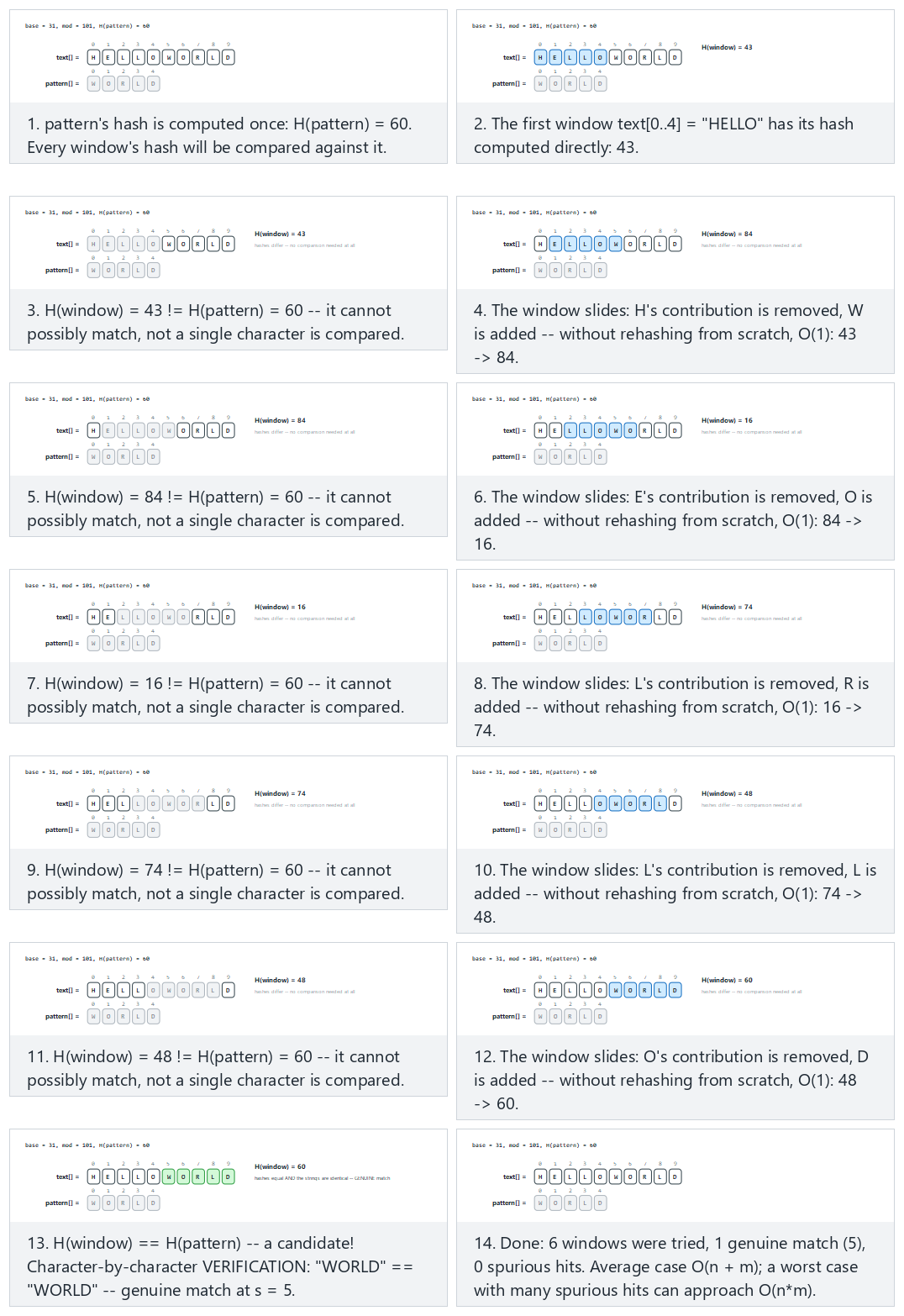
In the picker, also try mod=7 (small): 1 genuine + 2 spurious hits (hard) and the edge cases mod=7: no genuine match at all, but 3 spurious hash collisions, a genuine overlapping match everywhere, and mod = 1,000,000,007 (large prime): a spurious hit is practically impossible — or press 🎲 for random data at four difficulty levels, or type your own text, pattern, and modulus.
9.4 Try it
Full program: rabin_karp.c / RabinKarp.java
/* Week 12 -- Strings: Structures and Algorithms
 * Rabin-Karp search: compare a rolling hash of each window against the pattern's hash; a hash match is only
 * a candidate and must be VERIFIED character by character (a "spurious hit" is a hash match that fails
 * verification).
 * CEN207 Data Structures (formerly CE205)
 */
#include <stdio.h>
#include <string.h>

#define MAXOCC 32

static long long window_hash(const char *s, int m, long long base, long long mod) {
    long long h = 0;
    for (int k = 0; k < m; k++) h = (h * base + (s[k] - 'A')) % mod;
    return h;
}

static int rabin_karp(const char *text, int n, const char *pattern, int m, long long base, long long mod, int occ[], int *spurious) {
    int c = 0;
    *spurious = 0;
    if (m == 0) {                     /* the empty pattern matches at every position, including n */
        for (int s = 0; s <= n; s++) occ[s] = s;
        return n + 1;
    }
    if (n < m) return 0;              /* pattern longer than the text: no window fits, nothing to hash */
    long long p_hash = window_hash(pattern, m, base, mod);
    long long h_pow = 1;
    for (int k = 0; k < m - 1; k++) h_pow = (h_pow * base) % mod;
    long long t_hash = window_hash(text, m, base, mod);      /* first window, computed directly */
    for (int s = 0; s <= n - m; s++) {
        if (s > 0)
            t_hash = ((t_hash - (text[s - 1] - 'A') * h_pow % mod + mod) * base + (text[s + m - 1] - 'A')) % mod;
        if (t_hash == p_hash) {                          /* candidate: VERIFY before counting it */
            if (strncmp(text + s, pattern, (size_t) m) == 0)
                occ[c++] = s;
            else
                (*spurious)++;
        }
    }
    return c;
}

static void print_occ(const int occ[], int count) {
    if (count == 0) { printf("(none)"); return; }
    for (int i = 0; i < count; i++) printf("%s%d", i ? ", " : "", occ[i]);
}

static void run_scenario(const char *label, const char *text, const char *pattern, long long base, long long mod) {
    printf("-- %s --\n", label);
    int n = (int) strlen(text), m = (int) strlen(pattern);
    printf("text = \"%s\" (%d letters), pattern = \"%s\" (%d letters), base=%lld, mod=%lld\n", text, n, pattern, m, base, mod);
    int occ[MAXOCC], spurious;
    int count = rabin_karp(text, n, pattern, m, base, mod, occ, &spurious);
    printf("occurrences (%d): ", count);
    print_occ(occ, count);
    printf(", spurious hits: %d\n\n", spurious);
}

int main(void) {
    run_scenario("normal: mod=101, no spurious hits", "HELLOWORLD", "WORLD", 31, 101);
    run_scenario("hard: mod=7 (small), 1 genuine + 2 spurious hits", "AADBDDBCDBB", "AAD", 4, 7);
    run_scenario("edge: mod=7, no genuine match but 3 spurious collisions", "DBCADADABDC", "BAD", 4, 7);
    run_scenario("edge: a genuine overlapping match everywhere", "AAAAAAAAAA", "AAA", 31, 101);
    run_scenario("edge: mod=1000000007 (large prime), a spurious hit is practically impossible", "ALGORITHMS", "RITHM", 31, 1000000007);
    return 0;
}
/* Week 12 -- Strings: Structures and Algorithms
 * Rabin-Karp search: compare a rolling hash of each window against the pattern's hash; a hash match is only
 * a candidate and must be VERIFIED character by character (a "spurious hit" is a hash match that fails
 * verification).
 * CEN207 Data Structures (formerly CE205)
 */
import java.util.ArrayList;
import java.util.List;

public class RabinKarp {
    static long windowHash(String s, int m, long base, long mod) {
        long h = 0;
        for (int k = 0; k < m; k++) h = (h * base + (s.charAt(k) - 'A')) % mod;
        return h;
    }

    static class Result {
        List<Integer> occurrences = new ArrayList<>();
        int spurious = 0;
    }

    static Result rabinKarp(String text, String pattern, long base, long mod) {
        int n = text.length(), m = pattern.length();
        Result r = new Result();
        if (m == 0) {                 // the empty pattern matches at every position, including n
            for (int s = 0; s <= n; s++) r.occurrences.add(s);
            return r;
        }
        if (n < m) return r;          // pattern longer than the text: no window fits, nothing to hash
        long pHash = windowHash(pattern, m, base, mod);
        long hPow = 1;
        for (int k = 0; k < m - 1; k++) hPow = (hPow * base) % mod;
        long tHash = windowHash(text, m, base, mod);        // first window, computed directly
        for (int s = 0; s <= n - m; s++) {
            if (s > 0)
                tHash = ((tHash - (text.charAt(s - 1) - 'A') * hPow % mod + mod) * base + (text.charAt(s + m - 1) - 'A')) % mod;
            if (tHash == pHash) {                            // candidate: VERIFY before counting it
                if (text.regionMatches(s, pattern, 0, m)) r.occurrences.add(s);
                else r.spurious++;
            }
        }
        return r;
    }

    static void runScenario(String label, String text, String pattern, long base, long mod) {
        System.out.println("-- " + label + " --");
        System.out.println("text = \"" + text + "\" (" + text.length() + " letters), pattern = \"" + pattern + "\" (" + pattern.length() + " letters), base=" + base + ", mod=" + mod);
        Result r = rabinKarp(text, pattern, base, mod);
        System.out.print("occurrences (" + r.occurrences.size() + "): ");
        if (r.occurrences.isEmpty()) System.out.print("(none)");
        else {
            for (int i = 0; i < r.occurrences.size(); i++) System.out.print((i > 0 ? ", " : "") + r.occurrences.get(i));
        }
        System.out.println(", spurious hits: " + r.spurious);
        System.out.println();
    }

    public static void main(String[] args) {
        runScenario("normal: mod=101, no spurious hits", "HELLOWORLD", "WORLD", 31, 101);
        runScenario("hard: mod=7 (small), 1 genuine + 2 spurious hits", "AADBDDBCDBB", "AAD", 4, 7);
        runScenario("edge: mod=7, no genuine match but 3 spurious collisions", "DBCADADABDC", "BAD", 4, 7);
        runScenario("edge: a genuine overlapping match everywhere", "AAAAAAAAAA", "AAA", 31, 101);
        runScenario("edge: mod=1000000007 (large prime), a spurious hit is practically impossible", "ALGORITHMS", "RITHM", 31, 1000000007L);
    }
}
Expected output:
-- normal: mod=101, no spurious hits --
text = "HELLOWORLD" (10 letters), pattern = "WORLD" (5 letters), base=31, mod=101
occurrences (1): 5, spurious hits: 0

-- hard: mod=7 (small), 1 genuine + 2 spurious hits --
text = "AADBDDBCDBB" (11 letters), pattern = "AAD" (3 letters), base=4, mod=7
occurrences (1): 0, spurious hits: 2

-- edge: mod=7, no genuine match but 3 spurious collisions --
text = "DBCADADABDC" (11 letters), pattern = "BAD" (3 letters), base=4, mod=7
occurrences (0): (none), spurious hits: 3

-- edge: a genuine overlapping match everywhere --
text = "AAAAAAAAAA" (10 letters), pattern = "AAA" (3 letters), base=31, mod=101
occurrences (8): 0, 1, 2, 3, 4, 5, 6, 7, spurious hits: 0

-- edge: mod=1000000007 (large prime), a spurious hit is practically impossible --
text = "ALGORITHMS" (10 letters), pattern = "RITHM" (5 letters), base=31, mod=1000000007
occurrences (1): 4, spurious hits: 0
9.5 Complexity, mistakes, self-check
Complexity. Average case O(n + m): O(m) to hash the pattern and the first window, O(1) per subsequent window (the rolling update), plus O(m) only for the rare windows whose hash actually matches (a well-chosen large prime modulus makes spurious hits vanishingly rare in practice). Worst case degrades toward O(n*m) if the modulus is small or poorly chosen and every window collides — exactly the "hard" and "no genuine match" scenarios above, deliberately using mod = 7 to make that worst case visible.
Common mistakes
- Skipping verification. Reporting a match on hash equality alone, without confirming with
strncmporregionMatches, silently reports spurious hits as real occurrences — correctness, not just efficiency, depends on verifying every candidate. - Using too small a modulus "for simplicity." A small
mod(as this section deliberately demonstrates) causes frequent spurious hits, degrading Rabin-Karp's average-case advantage away; production code uses a large prime, often combined with a randomized base to defend against adversarial inputs. - Using a fixed-width type too narrow for the arithmetic, exactly the
longvslong longbug boxed above — always verify a hash implementation's intermediate values cannot overflow the chosen type, especially in C where integer width is platform-dependent.
Self-check: why must a hash match always be verified?
A hash function maps a (usually huge) space of possible substrings down to a small set of mod possible hash values, by the pigeonhole principle guaranteeing that some distinct substrings must share a hash value once there are more possible substrings than mod allows for. Two different substrings hashing to the same value — a collision — is therefore not a bug, but a mathematical certainty for some inputs; the only way to distinguish a genuine match from a spurious one is to compare the actual characters.
10. Boyer-Moore: the bad-character rule
10.1 A question to start
Every algorithm so far compares the pattern against each window left to right. Robert S. Boyer and J Strother Moore, in a 1977 paper, noticed something that seems almost backward at first: comparing right to left instead lets a single mismatch throw away information about a potentially large stretch of the text at once, enabling jumps larger than one position — sometimes as large as the whole pattern's length. This note covers only the simpler of Boyer-Moore's two rules, the bad-character rule (the full algorithm adds a second "good suffix" rule on top of it, beyond this course's scope).
10.2 The idea: scan backward, then jump using what you just saw
Compare pattern[m-1] against text[s+m-1] first, then pattern[m-2] against text[s+m-2], and so on, right to left. On a mismatch at pattern position j against text character ch, look up ch's last occurrence in the pattern (precomputed once, before the search starts): if ch never appears in the pattern at all, the entire pattern can safely jump past it — the biggest possible jump, j + 1 positions. If ch appears in the pattern but only to the left of position j, the pattern shifts just far enough to line that occurrence up under ch. The shift is never allowed to be less than 1 (a shift of 0 or negative would mean standing still or going backward).
10.3 In memory, and the code
void bad_char_table(const char *pattern, int m, int last[256]) {
    for (int c = 0; c < 256; c++) last[c] = -1;
    for (int j = 0; j < m; j++) last[(unsigned char) pattern[j]] = j;
}

void boyer_moore_bad_char(const char *text, int n, const char *pattern, int m, const int last[256], int occ[], int *count) {
    int s = 0, c = 0;
    while (s <= n - m) {
        int j = m - 1;
        while (j >= 0 && pattern[j] == text[s + j]) j--;     /* compare RIGHT to LEFT */
        if (j < 0) {
            occ[c++] = s;                 /* full match at shift s */
            s += 1;
        } else {
            int lo = last[(unsigned char) text[s + j]];
            int shift = j - lo;
            s += shift > 1 ? shift : 1;   /* always advance by at least 1 */
        }
    }
    *count = c;
}
static Map<Character, Integer> badCharTable(String pattern) {
    Map<Character, Integer> last = new HashMap<>();
    for (int j = 0; j < pattern.length(); j++) last.put(pattern.charAt(j), j);
    return last;
}

static int[] boyerMooreBadChar(String text, String pattern, Map<Character, Integer> last) {
    int n = text.length(), m = pattern.length(), s = 0, c = 0;
    int[] occ = new int[n];
    while (s <= n - m) {
        int j = m - 1;
        while (j >= 0 && pattern.charAt(j) == text.charAt(s + j)) j--;   // compare RIGHT to LEFT
        if (j < 0) {
            occ[c++] = s;                 // full match at shift s
            s += 1;
        } else {
            int lo = last.getOrDefault(text.charAt(s + j), -1);
            int shift = j - lo;
            s += shift > 1 ? shift : 1;   // always advance by at least 1
        }
    }
    return Arrays.copyOf(occ, c);
}
Play the animation to watch the comparison run from the pattern's right end backward, and the pattern jump forward by more than one position whenever the mismatched text character is rare or absent from the pattern.
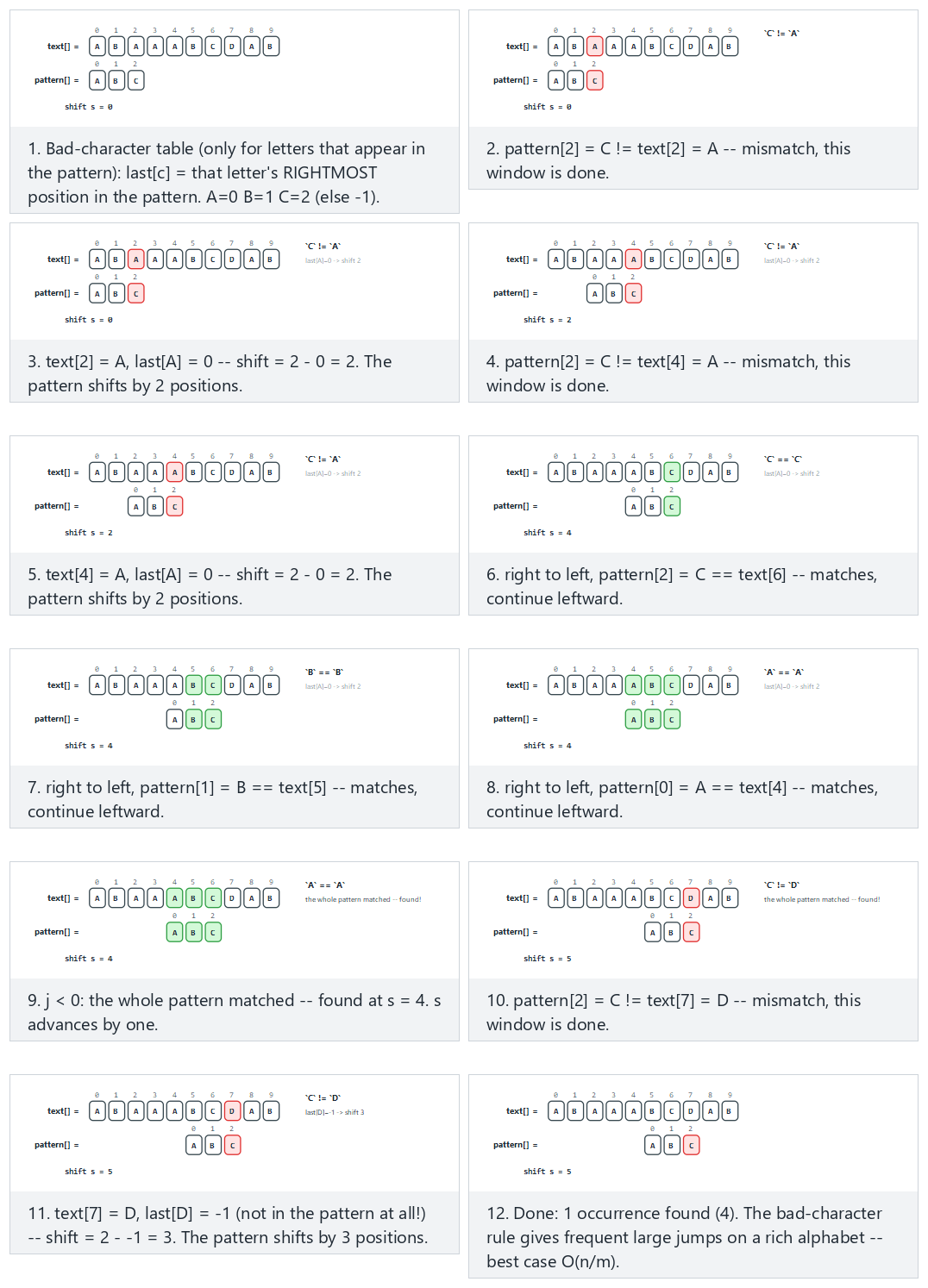
In the picker, also try low diversity, weak jumps (hard) and the edge cases never found, Z is not in the pattern — the biggest possible jump every time, and the match is near the end — or press 🎲 for random data at four difficulty levels, or type your own text and pattern.
10.4 Try it
Full program: boyer_moore_bad_character.c / BoyerMooreBadCharacter.java
/* Week 12 -- Strings: Structures and Algorithms
 * Boyer-Moore, bad-character rule only: compare the pattern to each window RIGHT to LEFT; on a mismatch, use
 * the mismatched character's last occurrence in the pattern to jump forward as far as safely possible.
 * CEN207 Data Structures (formerly CE205)
 */
#include <stdio.h>
#include <string.h>

#define MAXOCC 32

static void bad_char_table(const char *pattern, int m, int last[256]) {
    for (int c = 0; c < 256; c++) last[c] = -1;
    for (int j = 0; j < m; j++) last[(unsigned char) pattern[j]] = j;
}

static int boyer_moore_bad_char(const char *text, int n, const char *pattern, int m, const int last[256], int occ[]) {
    int s = 0, c = 0;
    while (s <= n - m) {
        int j = m - 1;
        while (j >= 0 && pattern[j] == text[s + j]) j--;     /* compare RIGHT to LEFT */
        if (j < 0) {
            occ[c++] = s;                 /* full match at shift s */
            s += 1;
        } else {
            int lo = last[(unsigned char) text[s + j]];
            int shift = j - lo;
            s += shift > 1 ? shift : 1;   /* always advance by at least 1 */
        }
    }
    return c;
}

static void print_occ(const int occ[], int count) {
    if (count == 0) { printf("(none)"); return; }
    for (int i = 0; i < count; i++) printf("%s%d", i ? ", " : "", occ[i]);
}

static void run_scenario(const char *label, const char *text, const char *pattern) {
    printf("-- %s --\n", label);
    int n = (int) strlen(text), m = (int) strlen(pattern);
    printf("text = \"%s\" (%d letters), pattern = \"%s\" (%d letters)\n", text, n, pattern, m);
    int last[256];
    bad_char_table(pattern, m, last);
    int occ[MAXOCC];
    int count = boyer_moore_bad_char(text, n, pattern, m, last, occ);
    printf("occurrences (%d): ", count);
    print_occ(occ, count);
    printf("\n\n");
}

int main(void) {
    run_scenario("normal: mixed-size jumps", "ABAAABCDAB", "ABC");
    run_scenario("hard: low diversity, weak jumps", "AAAAAAAAAA", "AAAB");
    run_scenario("edge: never found", "THEQUICKBROWNFOX", "ZEBRA");
    run_scenario("edge: Z is not in the pattern -- the biggest possible jump every time", "ZZZZZZZZZZ", "ABC");
    run_scenario("edge: the match is near the end", "XXXXXXXABC", "ABC");
    return 0;
}
/* Week 12 -- Strings: Structures and Algorithms
 * Boyer-Moore, bad-character rule only: compare the pattern to each window RIGHT to LEFT; on a mismatch, use
 * the mismatched character's last occurrence in the pattern to jump forward as far as safely possible.
 * CEN207 Data Structures (formerly CE205)
 */
import java.util.ArrayList;
import java.util.HashMap;
import java.util.List;
import java.util.Map;

public class BoyerMooreBadCharacter {
    static Map<Character, Integer> badCharTable(String pattern) {
        Map<Character, Integer> last = new HashMap<>();
        for (int j = 0; j < pattern.length(); j++) last.put(pattern.charAt(j), j);
        return last;
    }

    static List<Integer> boyerMooreBadChar(String text, String pattern, Map<Character, Integer> last) {
        int n = text.length(), m = pattern.length(), s = 0;
        List<Integer> occ = new ArrayList<>();
        while (s <= n - m) {
            int j = m - 1;
            while (j >= 0 && pattern.charAt(j) == text.charAt(s + j)) j--;   // compare RIGHT to LEFT
            if (j < 0) {
                occ.add(s);                 // full match at shift s
                s += 1;
            } else {
                int lo = last.getOrDefault(text.charAt(s + j), -1);
                int shift = j - lo;
                s += shift > 1 ? shift : 1; // always advance by at least 1
            }
        }
        return occ;
    }

    static void runScenario(String label, String text, String pattern) {
        System.out.println("-- " + label + " --");
        System.out.println("text = \"" + text + "\" (" + text.length() + " letters), pattern = \"" + pattern + "\" (" + pattern.length() + " letters)");
        Map<Character, Integer> last = badCharTable(pattern);
        List<Integer> occ = boyerMooreBadChar(text, pattern, last);
        System.out.print("occurrences (" + occ.size() + "): ");
        if (occ.isEmpty()) System.out.print("(none)");
        else {
            for (int i = 0; i < occ.size(); i++) System.out.print((i > 0 ? ", " : "") + occ.get(i));
        }
        System.out.println();
        System.out.println();
    }

    public static void main(String[] args) {
        runScenario("normal: mixed-size jumps", "ABAAABCDAB", "ABC");
        runScenario("hard: low diversity, weak jumps", "AAAAAAAAAA", "AAAB");
        runScenario("edge: never found", "THEQUICKBROWNFOX", "ZEBRA");
        runScenario("edge: Z is not in the pattern -- the biggest possible jump every time", "ZZZZZZZZZZ", "ABC");
        runScenario("edge: the match is near the end", "XXXXXXXABC", "ABC");
    }
}
Expected output:
-- normal: mixed-size jumps --
text = "ABAAABCDAB" (10 letters), pattern = "ABC" (3 letters)
occurrences (1): 4

-- hard: low diversity, weak jumps --
text = "AAAAAAAAAA" (10 letters), pattern = "AAAB" (4 letters)
occurrences (0): (none)

-- edge: never found --
text = "THEQUICKBROWNFOX" (16 letters), pattern = "ZEBRA" (5 letters)
occurrences (0): (none)

-- edge: Z is not in the pattern -- the biggest possible jump every time --
text = "ZZZZZZZZZZ" (10 letters), pattern = "ABC" (3 letters)
occurrences (0): (none)

-- edge: the match is near the end --
text = "XXXXXXXABC" (10 letters), pattern = "ABC" (3 letters)
occurrences (1): 7
10.5 Complexity, mistakes, self-check
Complexity. Best case O(n/m) — when the alphabet is rich and mismatches happen immediately on characters absent from the pattern, each window can jump the full pattern length. Worst case O(n*m) (the bad-character rule alone, without the good-suffix rule, can degrade on low-diversity text — the "hard" scenario above shows the jump amounts shrinking toward 1 when the alphabet has only two distinct letters). Boyer-Moore variants are, in practice, among the fastest string-search algorithms for natural-language text and large alphabets, precisely because real text rarely triggers the worst case.
Common mistakes
- Forgetting the
shift >= 1guard. If the bad character's last occurrence is to the right of the current mismatch positionj(possible when the pattern contains repeated characters),j - locan be zero or negative — without clamping to at least 1, the pattern would stand still or move backward, looping forever. - Building the bad-character table from the text instead of the pattern. The table answers "where does this character last occur in the pattern?" — it is built once, from the pattern alone, exactly like KMP's
lpstable, and reused unchanged across every window. - Comparing left to right by habit. Boyer-Moore's entire advantage comes from comparing right to left — scanning left to right instead still produces correct matches but throws away the large-jump benefit that is the whole point of the algorithm.
Self-check: why can Boyer-Moore skip characters naive search must examine?
Because a single right-to-left comparison, on a mismatch, reveals a text character that the algorithm can reason about immediately: "wherever this character last appears in the pattern (if at all), the pattern must be repositioned to align with it — anywhere closer cannot possibly produce a match." That one piece of information lets the algorithm skip past several text positions it can prove cannot contain a match, without ever examining the characters at those skipped positions at all — something naive search's left-to-right, one-position-at-a-time approach has no way to do.
11. The Z-algorithm
11.1 A question to start
Every algorithm so far builds its own bespoke bookkeeping — lps[] for KMP, a rolling hash for Rabin-Karp, a bad-character table for Boyer-Moore. The Z-algorithm takes a different, almost sleight-of-hand approach: reduce the entire search problem to a single self-comparison of one combined string, and read the answer straight off the result.
11.2 The idea: Z[i] is "how much does S[i..] match S itself?"
For any string S, define Z[i] (for i >= 1) as the length of the longest substring starting at S[i] that is also a prefix of S — in other words, "how many characters does S[i..] share with S itself, counted from the start?" Now let S = pattern + '#' + text, where '#' is a separator character guaranteed to appear nowhere else in either string. Any position i in the text part of S with Z[i] >= |pattern| means the text starting there shares at least |pattern| characters with S's own start — which is exactly pattern itself — so that is an occurrence. Computing the whole Z[] array in O(n + m) uses a running window [l, r) that remembers the rightmost match found so far: when i falls inside that window, Z[i] can reuse the already-known value Z[i-l] instead of comparing from scratch, and only the part that might stick out past r is ever checked character by character — the same "remember what you already know" spirit that made KMP and Rabin-Karp fast.
11.3 In memory, and the code
int *z_array(const char *s, int n) {
    int *z = calloc(n, sizeof(int));
    int l = 0, r = 0;
    for (int i = 1; i < n; i++) {
        if (i < r)
            z[i] = (r - i < z[i - l]) ? r - i : z[i - l];   /* reuse the [l,r) window */
        while (i + z[i] < n && s[z[i]] == s[i + z[i]])
            z[i]++;                                          /* extend by direct comparison */
        if (i + z[i] > r) { l = i; r = i + z[i]; }            /* window grew: remember it */
    }
    return z;
}
static int[] zArray(String s) {
    int n = s.length();
    int[] z = new int[n];
    int l = 0, r = 0;
    for (int i = 1; i < n; i++) {
        if (i < r)
            z[i] = Math.min(r - i, z[i - l]);   // reuse the [l,r) window
        while (i + z[i] < n && s.charAt(z[i]) == s.charAt(i + z[i]))
            z[i]++;                              // extend by direct comparison
        if (i + z[i] > r) { l = i; r = i + z[i]; }   // window grew: remember it
    }
    return z;
}
Play the animation to watch the [l, r) window grow, get reused for later positions that fall inside it, and produce the same occurrences that KMP and Rabin-Karp found — by a completely different route.
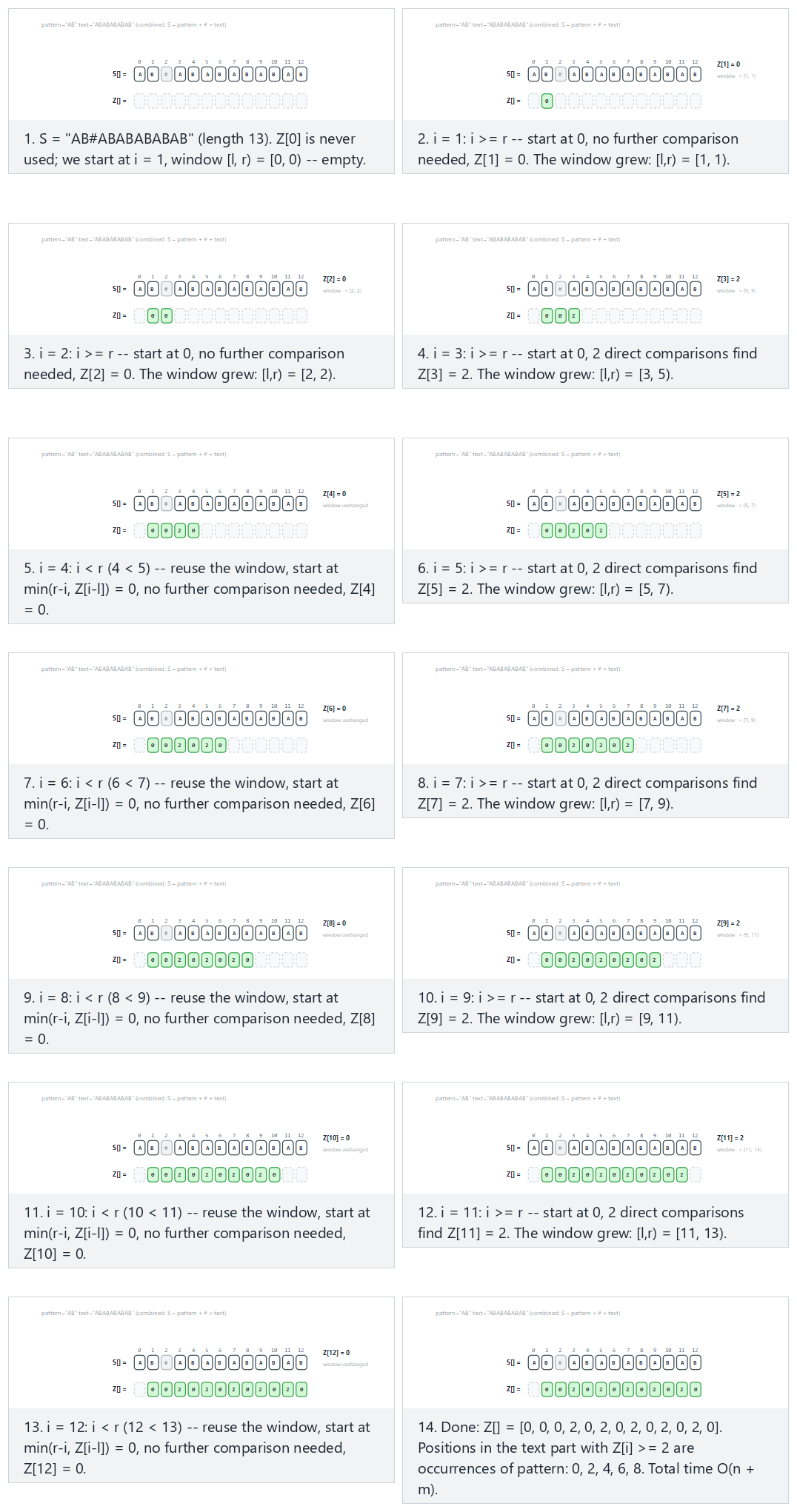
In the picker, also try "AAA" against "AAAAAAAAAA": the window is reused constantly (hard) and the edge cases no match at all, matches only at the very first position, and a single-character pattern (the m=1 boundary case) — or press 🎲 for random data at four difficulty levels, or type your own pattern and text.
11.4 Try it
Full program: z_algorithm.c / ZAlgorithm.java
/* Week 12 -- Strings: Structures and Algorithms
 * The Z-algorithm: Z[i] is how many characters S[i..] shares with S itself from the start. For
 * S = pattern + '#' + text, positions in the text part with Z[i] >= |pattern| mark occurrences. O(n + m).
 * CEN207 Data Structures (formerly CE205)
 */
#include <stdio.h>
#include <string.h>

#define MAXN 64
#define MAXOCC 32

static void z_array(const char *s, int n, int z[]) {
    for (int i = 0; i < n; i++) z[i] = 0;
    int l = 0, r = 0;
    for (int i = 1; i < n; i++) {
        if (i < r)
            z[i] = (r - i < z[i - l]) ? r - i : z[i - l];   /* reuse the [l,r) window */
        while (i + z[i] < n && s[z[i]] == s[i + z[i]])
            z[i]++;                                          /* extend by direct comparison */
        if (i + z[i] > r) { l = i; r = i + z[i]; }            /* window grew: remember it */
    }
}

static int z_search(const char *pattern, int m, const char *text, int n, int occ[]) {
    int c = 0;
    if (m == 0) {                     /* the empty pattern matches at every position, including n */
        for (int s = 0; s <= n; s++) occ[s] = s;
        return n + 1;
    }
    char s[MAXN];
    snprintf(s, sizeof(s), "%s#%s", pattern, text);         /* combined string */
    int total = m + 1 + n;
    int z[MAXN];
    z_array(s, total, z);
    for (int i = m + 1; i < total; i++)
        if (z[i] >= m) occ[c++] = i - (m + 1);               /* Z[i] >= m: a full match */
    return c;
}

static void print_occ(const int occ[], int count) {
    if (count == 0) { printf("(none)"); return; }
    for (int i = 0; i < count; i++) printf("%s%d", i ? ", " : "", occ[i]);
}

static void run_scenario(const char *label, const char *pattern, const char *text) {
    printf("-- %s --\n", label);
    int m = (int) strlen(pattern), n = (int) strlen(text);
    printf("pattern = \"%s\" (%d letters), text = \"%s\" (%d letters)\n", pattern, m, text, n);
    int occ[MAXOCC];
    int count = z_search(pattern, m, text, n, occ);
    printf("occurrences (%d): ", count);
    print_occ(occ, count);
    printf("\n\n");
}

int main(void) {
    run_scenario("normal: a periodic Z array", "AB", "ABABABABAB");
    run_scenario("hard: the window is reused constantly", "AAA", "AAAAAAAAAA");
    run_scenario("edge: no match at all, Z stays small", "XYZ", "ABCDEFGHIJ");
    run_scenario("edge: matches only at the very first position", "ABC", "ABCDEFGHIJ");
    run_scenario("edge: the m=1 boundary case, many matches", "A", "BABABABABA");
    return 0;
}
/* Week 12 -- Strings: Structures and Algorithms
 * The Z-algorithm: Z[i] is how many characters S[i..] shares with S itself from the start. For
 * S = pattern + '#' + text, positions in the text part with Z[i] >= |pattern| mark occurrences. O(n + m).
 * CEN207 Data Structures (formerly CE205)
 */
import java.util.ArrayList;
import java.util.List;

public class ZAlgorithm {
    static int[] zArray(String s) {
        int n = s.length();
        int[] z = new int[n];
        int l = 0, r = 0;
        for (int i = 1; i < n; i++) {
            if (i < r)
                z[i] = Math.min(r - i, z[i - l]);   // reuse the [l,r) window
            while (i + z[i] < n && s.charAt(z[i]) == s.charAt(i + z[i]))
                z[i]++;                              // extend by direct comparison
            if (i + z[i] > r) { l = i; r = i + z[i]; }   // window grew: remember it
        }
        return z;
    }

    static List<Integer> zSearch(String pattern, String text) {
        int m = pattern.length(), n = text.length();
        List<Integer> occ = new ArrayList<>();
        if (m == 0) {                 // the empty pattern matches at every position, including n
            for (int s = 0; s <= n; s++) occ.add(s);
            return occ;
        }
        String s = pattern + "#" + text;                          // combined string
        int[] z = zArray(s);
        for (int i = m + 1; i < m + 1 + n; i++)
            if (z[i] >= m) occ.add(i - (m + 1));                    // Z[i] >= m: a full match
        return occ;
    }

    static void runScenario(String label, String pattern, String text) {
        System.out.println("-- " + label + " --");
        System.out.println("pattern = \"" + pattern + "\" (" + pattern.length() + " letters), text = \"" + text + "\" (" + text.length() + " letters)");
        List<Integer> occ = zSearch(pattern, text);
        System.out.print("occurrences (" + occ.size() + "): ");
        if (occ.isEmpty()) System.out.print("(none)");
        else {
            for (int i = 0; i < occ.size(); i++) System.out.print((i > 0 ? ", " : "") + occ.get(i));
        }
        System.out.println();
        System.out.println();
    }

    public static void main(String[] args) {
        runScenario("normal: a periodic Z array", "AB", "ABABABABAB");
        runScenario("hard: the window is reused constantly", "AAA", "AAAAAAAAAA");
        runScenario("edge: no match at all, Z stays small", "XYZ", "ABCDEFGHIJ");
        runScenario("edge: matches only at the very first position", "ABC", "ABCDEFGHIJ");
        runScenario("edge: the m=1 boundary case, many matches", "A", "BABABABABA");
    }
}
Expected output:
-- normal: a periodic Z array --
pattern = "AB" (2 letters), text = "ABABABABAB" (10 letters)
occurrences (5): 0, 2, 4, 6, 8

-- hard: the window is reused constantly --
pattern = "AAA" (3 letters), text = "AAAAAAAAAA" (10 letters)
occurrences (8): 0, 1, 2, 3, 4, 5, 6, 7

-- edge: no match at all, Z stays small --
pattern = "XYZ" (3 letters), text = "ABCDEFGHIJ" (10 letters)
occurrences (0): (none)

-- edge: matches only at the very first position --
pattern = "ABC" (3 letters), text = "ABCDEFGHIJ" (10 letters)
occurrences (1): 0

-- edge: the m=1 boundary case, many matches --
pattern = "A" (1 letters), text = "BABABABABA" (10 letters)
occurrences (5): 1, 3, 5, 7, 9
11.5 Complexity, mistakes, self-check
Complexity. O(n + m) for the whole combined-string Z[] array (the same amortized argument as KMP's lps construction: the window [l, r) only ever grows, so the total work done extending past r is bounded by the combined string's length), plus O(1) per position to check whether it marks an occurrence.
Common mistakes
- Forgetting the separator, or picking one that can appear in the text. Without a separator absent from both strings,
Z[]could report a match that actually straddles the boundary betweenpatternandtext— a false positive.'#'is safe here because this note's examples only ever use lettersA–Z. - Using
Z[i] == minstead ofZ[i] >= m. AZvalue can legitimately exceedm(the shared prefix can keep extending into the text well past the pattern's own length, if the text itself repeats); the correct match test is "at leastm," not "exactlym." - Treating
Z[0]as meaningful. By this definition, comparingSagainst itself starting at its own first character is a degenerate case (trivially the whole string);Z[0]is conventionally left unused (0, or simply skipped), and the loop always starts fromi = 1.
Self-check: how does the Z-algorithm avoid building a separate table like lps?
It does not avoid building a table — Z[] is the table, and it plays a role directly analogous to KMP's lps[]. The difference is what each table describes: lps[i] describes prefix-suffix overlap within the pattern alone; Z[i] describes how much any position in the combined string overlaps with the combined string's start. By gluing the pattern onto the front of the text, the Z-algorithm turns "does the pattern occur here?" into "does the text at this position overlap with the very beginning of S by at least |pattern| characters?" — a single, uniform question answered by one array, instead of two separate mechanisms (a table plus a second pass using it).
12. Comparison table of string-search algorithms
| Algorithm | Preprocessing | Worst case | Best/typical case | Extra idea |
|---|---|---|---|---|
| Naive search | None | O(n*m) | O(n) | None — the baseline every other algorithm improves on |
| KMP | O(m), from the pattern | O(n + m) | O(n + m) | The text pointer never rewinds; failure function lps[] |
| Rabin-Karp | O(m), hash the pattern | O(n*m) (many collisions) | O(n + m) average | Rolling hash; every candidate must be verified |
| Boyer-Moore (bad character) | O(alphabet), last-occurrence table | O(n*m) (low diversity) | O(n/m) | Right-to-left scan; jumps by more than one position |
| Z-algorithm | O(n + m), builds Z[] for the whole combined string | O(n + m) | O(n + m) | One self-comparison array answers the whole search |
No single algorithm dominates every other one on every axis. KMP is the only one with a guaranteed O(n + m) worst case and no configuration to get wrong, which makes it the safe default when correctness under adversarial input matters. Rabin-Karp shines when you need to search for many different patterns of the same length against the same text (compute every pattern's hash once, then scan the text's rolling hash just once). Boyer-Moore variants are frequently the fastest in practice on natural-language text with a large alphabet, because real text triggers large bad-character jumps far more often than its worst case. The Z-algorithm is prized for its conceptual simplicity — one array, one pass, no separate preprocessing routine — and shows up as a building block inside other, more advanced string algorithms.
13. A new strategy: dynamic programming, and edit distance
13.1 A question to start: how "different" are two strings?
Spell checkers suggest corrections by finding dictionary words close to what you typed. Version control tools like git diff show the minimal set of changes between two versions of a file. DNA analysis software measures how many mutations separate two gene sequences. All three ask a version of the same question: given two strings a and b, what is the fewest single-character edits — insertions, deletions, or substitutions — needed to transform a into b? This is the edit distance (or Levenshtein distance, after Vladimir Levenshtein, who defined it in a 1965 paper). Answering it needs a genuinely new tool: every technique in this course so far either walks a structure once or narrows a search space, and neither approach, by itself, handles a problem where the "right" choice at one position depends on choices made at every other position too.
13.2 Why brute force is too slow, and what dynamic programming does instead
A direct, recursive definition falls out naturally: to turn a[0..i) into b[0..j), either the last characters match (no cost, recurse on the rest), or they do not, and you pick the cheapest of three options — substitute the last character (recurse on a[0..i-1) vs b[0..j-1), cost 1 + that), delete a's last character (recurse on a[0..i-1) vs b[0..j), cost 1 + that), or insert b's last character (recurse on a[0..i) vs b[0..j-1), cost 1 + that). Coded directly, this recursion is correct but catastrophically slow — it branches into three recursive calls at nearly every step, and the same sub-problem (say, "edit distance between a's first 3 characters and b's first 4") gets recomputed from scratch every single time it is reached again through a different path, which happens exponentially often. Dynamic programming fixes exactly this waste with one idea: solve every distinct sub-problem once, store its answer in a table, and whenever that sub-problem is needed again, look it up instead of recomputing it. This works whenever a problem has two properties: optimal substructure (the best answer to the whole problem is built from the best answers to its sub-problems — true here, since the recursion above already shows that) and overlapping sub-problems (the same sub-problem really does recur many times — also true here, since a[0..i) vs b[0..j) is reachable from several different earlier (i, j) pairs). Edit distance is one of the cleanest possible first examples of the technique, which is why it is this course's introduction to it.
13.3 The table: dp[i][j] = edit distance between a's first i characters and b's first j characters
Build a table dp with n+1 rows and m+1 columns (n = |a|, m = |b|). Row 0 and column 0 are the base cases: turning an empty string into b's first j characters costs j insertions (dp[0][j] = j); turning a's first i characters into an empty string costs i deletions (dp[i][0] = i). Every other cell looks at just three already-computed neighbors — diagonal (substitute, or free if the two characters being considered already match), above (delete from a), left (insert from b) — and takes the cheapest option, plus one (except the free match, which costs nothing extra). Because every cell only ever depends on cells above, to the left, or diagonally above-left of it, filling the table row by row, left to right, guarantees every value a cell needs is already computed by the time that cell is reached — the table can be filled in a single pass, no recursion needed at all. Once the whole table is filled, dp[n][m] (the bottom-right corner) holds the answer, and walking backward from that corner — always toward whichever neighbor actually produced the stored value — reconstructs one actual shortest sequence of edits.
13.4 In memory, and the code
int edit_distance(const char *a, int n, const char *b, int m, int dp[MAXN][MAXM]) {
    for (int i = 0; i <= n; i++) dp[i][0] = i;            /* delete all of a[0..i) */
    for (int j = 0; j <= m; j++) dp[0][j] = j;            /* insert all of b[0..j) */
    for (int i = 1; i <= n; i++) {
        for (int j = 1; j <= m; j++) {
            if (a[i - 1] == b[j - 1])
                dp[i][j] = dp[i - 1][j - 1];               /* match: no cost */
            else {
                int sub = dp[i - 1][j - 1], del = dp[i - 1][j], ins = dp[i][j - 1];
                int best = sub < del ? sub : del;
                best = best < ins ? best : ins;
                dp[i][j] = 1 + best;                        /* substitute, delete or insert */
            }
        }
    }
    return dp[n][m];
}

void traceback(const char *a, int n, const char *b, int m, int dp[MAXN][MAXM]) {
    int i = n, j = m;
    while (i > 0 || j > 0) {
        if (i > 0 && j > 0 && a[i-1] == b[j-1] && dp[i][j] == dp[i-1][j-1]) { i--; j--; }   /* match */
        else if (i > 0 && j > 0 && dp[i][j] == dp[i-1][j-1] + 1) { i--; j--; }               /* substitute */
        else if (i > 0 && dp[i][j] == dp[i-1][j] + 1) { i--; }                               /* delete */
        else { j--; }                                                                         /* insert */
    }
}
static int editDistance(String a, String b, int[][] dp) {
    int n = a.length(), m = b.length();
    for (int i = 0; i <= n; i++) dp[i][0] = i;            // delete all of a[0..i)
    for (int j = 0; j <= m; j++) dp[0][j] = j;            // insert all of b[0..j)
    for (int i = 1; i <= n; i++) {
        for (int j = 1; j <= m; j++) {
            if (a.charAt(i - 1) == b.charAt(j - 1))
                dp[i][j] = dp[i - 1][j - 1];               // match: no cost
            else {
                int sub = dp[i - 1][j - 1], del = dp[i - 1][j], ins = dp[i][j - 1];
                int best = Math.min(sub, Math.min(del, ins));
                dp[i][j] = 1 + best;                        // substitute, delete or insert
            }
        }
    }
    return dp[n][m];
}
Play the animation to watch the table fill in row by row — each cell's three neighbors highlighted, the cheapest one chosen — and then a traceback path walk backward from the bottom-right corner, reconstructing one actual sequence of matches, substitutions, deletions, and insertions.
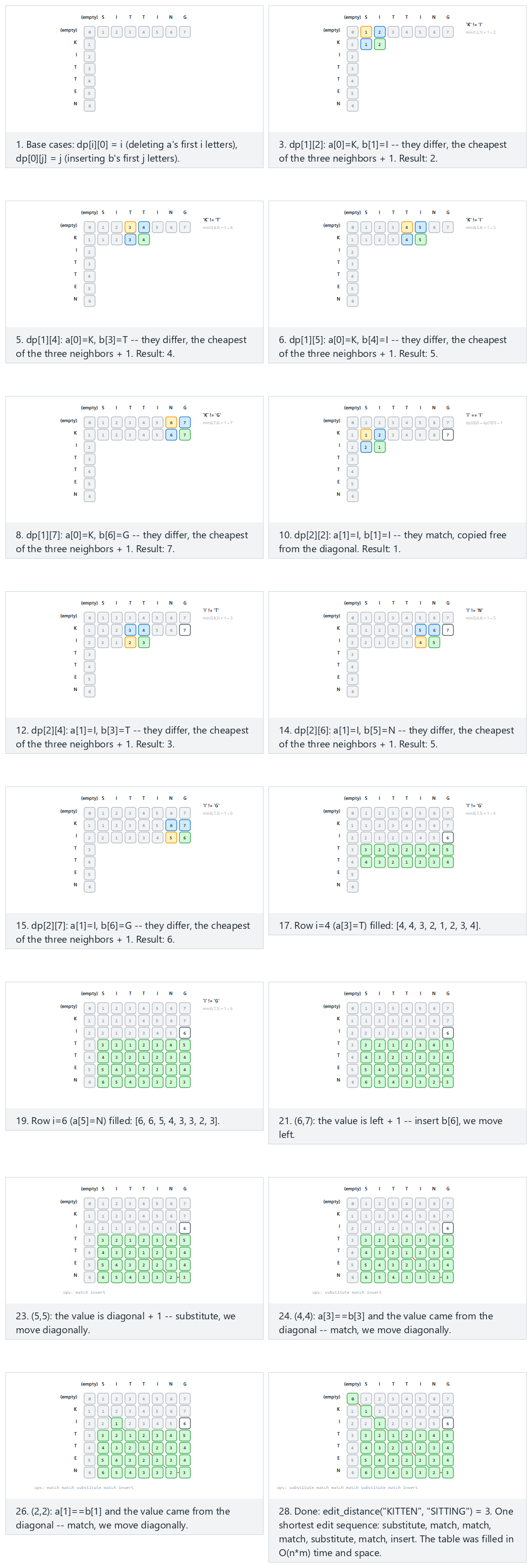
In the picker, also try "INTENTION" -> "EXECUTION": a big table, distance 5 (hard) and the edge cases identical strings, distance 0, no shared letters at all, every position a substitution, and "CAT" -> "CATERPILLAR": pure insertion — or press 🎲 for random data at four difficulty levels, or type your own two strings.
13.5 Try it
Full program: edit_distance.c / EditDistance.java
/* Week 12 -- Strings: Structures and Algorithms
 * Edit distance (Levenshtein distance): the fewest insertions, deletions and substitutions to turn a into b,
 * a DP table plus a traceback that reconstructs one shortest edit sequence.
 * CEN207 Data Structures (formerly CE205)
 */
#include <stdio.h>
#include <string.h>

#define MAXN 16
#define MAXM 16
#define MAXOPS 32

static int edit_distance(const char *a, int n, const char *b, int m, int dp[MAXN][MAXM]) {
    for (int i = 0; i <= n; i++) dp[i][0] = i;            /* delete all of a[0..i) */
    for (int j = 0; j <= m; j++) dp[0][j] = j;            /* insert all of b[0..j) */
    for (int i = 1; i <= n; i++) {
        for (int j = 1; j <= m; j++) {
            if (a[i - 1] == b[j - 1])
                dp[i][j] = dp[i - 1][j - 1];               /* match: no cost */
            else {
                int sub = dp[i - 1][j - 1], del = dp[i - 1][j], ins = dp[i][j - 1];
                int best = sub < del ? sub : del;
                best = best < ins ? best : ins;
                dp[i][j] = 1 + best;                        /* substitute, delete or insert */
            }
        }
    }
    return dp[n][m];
}

static int traceback(const char *a, int n, const char *b, int m, int dp[MAXN][MAXM], char ops[][12]) {
    int i = n, j = m, k = 0;
    char tmp[MAXOPS][12];
    while (i > 0 || j > 0) {
        if (i > 0 && j > 0 && a[i - 1] == b[j - 1] && dp[i][j] == dp[i - 1][j - 1]) {
            snprintf(tmp[k++], 12, "match");
            i--; j--;
        } else if (i > 0 && j > 0 && dp[i][j] == dp[i - 1][j - 1] + 1) {
            snprintf(tmp[k++], 12, "substitute");
            i--; j--;
        } else if (i > 0 && dp[i][j] == dp[i - 1][j] + 1) {
            snprintf(tmp[k++], 12, "delete");
            i--;
        } else {
            snprintf(tmp[k++], 12, "insert");
            j--;
        }
    }
    for (int t = 0; t < k; t++) snprintf(ops[t], 12, "%s", tmp[k - 1 - t]);   /* reverse into order */
    return k;
}

static void run_scenario(const char *label, const char *a, const char *b) {
    printf("-- %s --\n", label);
    int n = (int) strlen(a), m = (int) strlen(b);
    printf("a = \"%s\" (%d letters), b = \"%s\" (%d letters)\n", a, n, b, m);
    static int dp[MAXN][MAXM];
    int distance = edit_distance(a, n, b, m, dp);
    char ops[MAXOPS][12];
    int k = traceback(a, n, b, m, dp, ops);
    printf("edit_distance = %d\nops:", distance);
    for (int t = 0; t < k; t++) printf(" %s", ops[t]);
    printf("\n\n");
}

int main(void) {
    run_scenario("normal: the classic example, distance 3", "KITTEN", "SITTING");
    run_scenario("hard: a big table, distance 5", "INTENTION", "EXECUTION");
    run_scenario("edge: identical strings, distance 0", "ALGORITHM", "ALGORITHM");
    run_scenario("edge: no shared letters, every position a substitution", "ABCDE", "FGHIJ");
    run_scenario("edge: pure insertion", "CAT", "CATERPILLAR");
    return 0;
}
/* Week 12 -- Strings: Structures and Algorithms
 * Edit distance (Levenshtein distance): the fewest insertions, deletions and substitutions to turn a into b,
 * a DP table plus a traceback that reconstructs one shortest edit sequence.
 * CEN207 Data Structures (formerly CE205)
 */
import java.util.ArrayList;
import java.util.Collections;
import java.util.List;

public class EditDistance {
    static int editDistance(String a, String b, int[][] dp) {
        int n = a.length(), m = b.length();
        for (int i = 0; i <= n; i++) dp[i][0] = i;            // delete all of a[0..i)
        for (int j = 0; j <= m; j++) dp[0][j] = j;            // insert all of b[0..j)
        for (int i = 1; i <= n; i++) {
            for (int j = 1; j <= m; j++) {
                if (a.charAt(i - 1) == b.charAt(j - 1))
                    dp[i][j] = dp[i - 1][j - 1];               // match: no cost
                else {
                    int sub = dp[i - 1][j - 1], del = dp[i - 1][j], ins = dp[i][j - 1];
                    int best = Math.min(sub, Math.min(del, ins));
                    dp[i][j] = 1 + best;                        // substitute, delete or insert
                }
            }
        }
        return dp[n][m];
    }

    static List<String> traceback(String a, String b, int[][] dp) {
        int i = a.length(), j = b.length();
        List<String> ops = new ArrayList<>();
        while (i > 0 || j > 0) {
            if (i > 0 && j > 0 && a.charAt(i - 1) == b.charAt(j - 1) && dp[i][j] == dp[i - 1][j - 1]) {
                ops.add("match");
                i--; j--;
            } else if (i > 0 && j > 0 && dp[i][j] == dp[i - 1][j - 1] + 1) {
                ops.add("substitute");
                i--; j--;
            } else if (i > 0 && dp[i][j] == dp[i - 1][j] + 1) {
                ops.add("delete");
                i--;
            } else {
                ops.add("insert");
                j--;
            }
        }
        Collections.reverse(ops);
        return ops;
    }

    static void runScenario(String label, String a, String b) {
        System.out.println("-- " + label + " --");
        System.out.println("a = \"" + a + "\" (" + a.length() + " letters), b = \"" + b + "\" (" + b.length() + " letters)");
        int[][] dp = new int[a.length() + 1][b.length() + 1];
        int distance = editDistance(a, b, dp);
        List<String> ops = traceback(a, b, dp);
        System.out.println("edit_distance = " + distance);
        StringBuilder line = new StringBuilder("ops:");
        for (String op : ops) line.append(' ').append(op);
        System.out.println(line);
        System.out.println();
    }

    public static void main(String[] args) {
        runScenario("normal: the classic example, distance 3", "KITTEN", "SITTING");
        runScenario("hard: a big table, distance 5", "INTENTION", "EXECUTION");
        runScenario("edge: identical strings, distance 0", "ALGORITHM", "ALGORITHM");
        runScenario("edge: no shared letters, every position a substitution", "ABCDE", "FGHIJ");
        runScenario("edge: pure insertion", "CAT", "CATERPILLAR");
    }
}
Expected output:
-- normal: the classic example, distance 3 --
a = "KITTEN" (6 letters), b = "SITTING" (7 letters)
edit_distance = 3
ops: substitute match match match substitute match insert

-- hard: a big table, distance 5 --
a = "INTENTION" (9 letters), b = "EXECUTION" (9 letters)
edit_distance = 5
ops: substitute substitute substitute substitute substitute match match match match

-- edge: identical strings, distance 0 --
a = "ALGORITHM" (9 letters), b = "ALGORITHM" (9 letters)
edit_distance = 0
ops: match match match match match match match match match

-- edge: no shared letters, every position a substitution --
a = "ABCDE" (5 letters), b = "FGHIJ" (5 letters)
edit_distance = 5
ops: substitute substitute substitute substitute substitute

-- edge: pure insertion --
a = "CAT" (3 letters), b = "CATERPILLAR" (11 letters)
edit_distance = 8
ops: match match match insert insert insert insert insert insert insert insert
13.6 Complexity, mistakes, self-check
Complexity. O(n*m) time (every one of (n+1)*(m+1) cells is computed once, in O(1)) and O(n*m) space for the table as shown — a dramatic improvement over the naive recursion's exponential time, at the cost of O(n*m) memory instead of the recursion's O(n+m) call-stack depth. (A further optimization, keeping only the previous row instead of the whole table, brings the space down to O(m) when only the distance itself, not the edit sequence, is needed — but the full table is required to run the traceback shown here.)
Common mistakes
- Off-by-one between string index and table index.
dp[i][j]refers toa's firsticharacters, so the character actually being compared isa[i-1], nota[i]— a one-character shift that is easy to get backward. - Forgetting the base cases are not
0.dp[i][0]anddp[0][j]areiandjrespectively (the cost of turning one side into an empty string), not zero — zeroing them by mistake silently makes every "compare against an empty prefix" case look free. - Filling the table in the wrong order. Every cell needs its diagonal, top, and left neighbors already computed; filling column by column instead of row by row (or vice versa) still works as long as it is consistent, but filling in a genuinely wrong order (say, bottom-right to top-left) reads uninitialized values.
Self-check: why does dynamic programming need BOTH optimal substructure and overlapping sub-problems?
Optimal substructure alone (the best whole-problem answer is built from the best sub-problem answers) is what makes the recursive definition correct — without it, memoizing sub-answers would not even produce the right final answer. Overlapping sub-problems alone is what makes memoizing worthwhile efficiency-wise — if every sub-problem were reached by only one path (no overlap), memoizing would save nothing, since nothing would ever be recomputed anyway. Edit distance has both: the recursive definition in section 13.2 is provably correct (optimal substructure), and the same (i, j) pair is reachable through many different edit sequences (overlapping sub-problems) — which is exactly why the naive recursion is exponential and the table-based version is not.
14. Longest common subsequence
14.1 A question to start
git diff and DNA comparison tools do not only want a single number (the edit distance); they often want to know which parts of the two versions actually correspond to each other — what stayed the same, in order, even if not contiguously. A subsequence of a string is what remains after deleting zero or more characters without reordering what is left — "BCA" is a subsequence of "ABCBDAB" (delete the first A, the second B, and the final B), but "ACB" is not (that would require reordering). The longest common subsequence (LCS) of two strings a and b is the longest sequence of characters that is a subsequence of both — the longest thread of "these characters appear in the same relative order in both strings," which is exactly the notion of "what did not change" that a diff tool displays.
14.2 The idea: almost the same table, a different recurrence
LCS uses the identical dynamic-programming shape as edit distance — a table dp[i][j], filled row by row, each cell depending only on its diagonal, top, and left neighbors — but a different meaning for each cell and a different recurrence. Here, dp[i][j] is the length of the longest common subsequence of a's first i characters and b's first j characters. The base cases are dp[i][0] = dp[0][j] = 0 (an empty string shares no common subsequence, of any length, with anything). For every other cell: if the two characters being considered match, the LCS can be extended by one — dp[i][j] = dp[i-1][j-1] + 1 — because that matching character can always be appended to whatever the best common subsequence of the two shorter prefixes was. If they do not match, no new character can be added this step, so the cell simply carries forward the better of its two neighbors — dp[i][j] = max(dp[i-1][j], dp[i][j-1]) — dropping one character from whichever side does not help. Unlike edit distance, mismatched characters here cost nothing to "skip"; there is no substitution, insertion, or deletion penalty at all, only the question of which characters to keep.
14.3 In memory, and the code
int lcs_length(const char *a, int n, const char *b, int m, int dp[MAXN][MAXM]) {
    for (int i = 0; i <= n; i++) dp[i][0] = 0;
    for (int j = 0; j <= m; j++) dp[0][j] = 0;
    for (int i = 1; i <= n; i++) {
        for (int j = 1; j <= m; j++) {
            if (a[i - 1] == b[j - 1])
                dp[i][j] = dp[i - 1][j - 1] + 1;         /* extend the diagonal by one */
            else
                dp[i][j] = dp[i-1][j] >= dp[i][j-1] ? dp[i-1][j] : dp[i][j-1];   /* better neighbor */
        }
    }
    return dp[n][m];
}

void traceback(const char *a, int n, const char *b, int m, int dp[MAXN][MAXM], char out[]) {
    int i = n, j = m, k = dp[n][m];
    out[k] = '\0';
    while (i > 0 && j > 0) {
        if (a[i - 1] == b[j - 1]) { out[--k] = a[i - 1]; i--; j--; }     /* part of the LCS */
        else if (dp[i - 1][j] >= dp[i][j - 1]) i--;                      /* came from above */
        else j--;                                                        /* came from the left */
    }
}
static int lcsLength(String a, String b, int[][] dp) {
    int n = a.length(), m = b.length();
    for (int i = 0; i <= n; i++) dp[i][0] = 0;
    for (int j = 0; j <= m; j++) dp[0][j] = 0;
    for (int i = 1; i <= n; i++) {
        for (int j = 1; j <= m; j++) {
            if (a.charAt(i - 1) == b.charAt(j - 1))
                dp[i][j] = dp[i - 1][j - 1] + 1;         // extend the diagonal by one
            else
                dp[i][j] = Math.max(dp[i - 1][j], dp[i][j - 1]);   // better neighbor
        }
    }
    return dp[n][m];
}
Play the animation to watch the table fill exactly like edit distance's, but with the diagonal-extend-on-match rule instead of substitution, and a traceback that reconstructs the actual shared characters, not a sequence of edit operations.
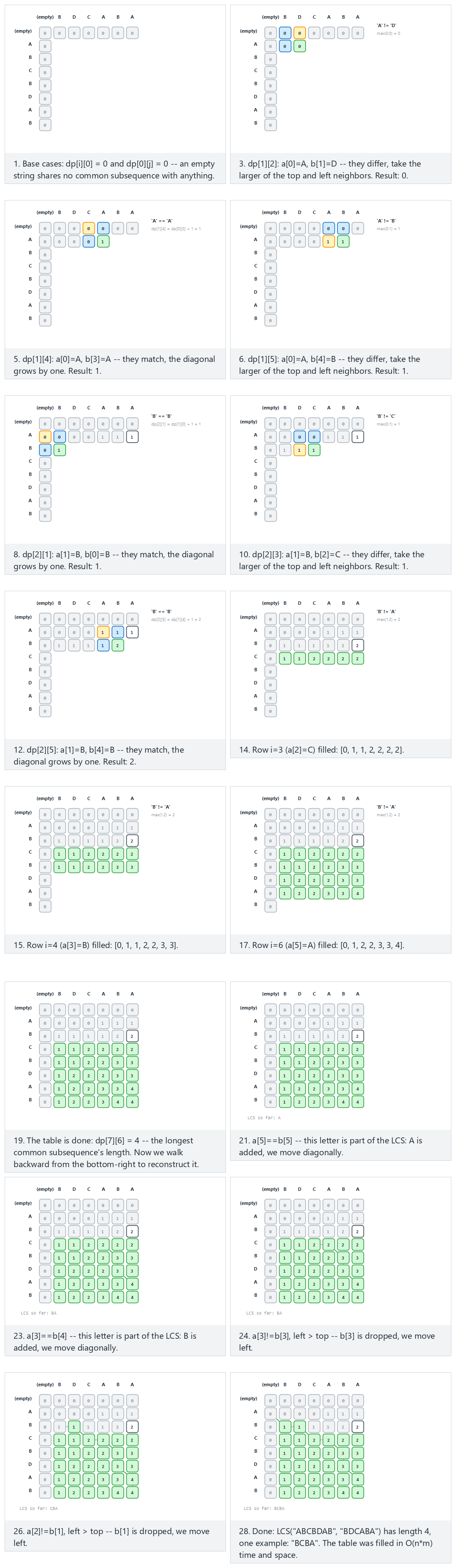
In the picker, also try "AGGTAB" and "GXTXAYB": the bioinformatics classic, length 4 (hard) and the edge cases no shared letters at all, length 0, identical strings, the LCS is the whole string, and "ACEG" is entirely a subsequence of "ABCDEFGH" — or press 🎲 for random data at four difficulty levels, or type your own two strings.
14.4 Try it
Full program: longest_common_subsequence.c / LongestCommonSubsequence.java
/* Week 12 -- Strings: Structures and Algorithms
 * Longest common subsequence (LCS): the longest sequence of characters appearing, in order, in both a and b.
 * A DP table plus a traceback that reconstructs one actual longest common subsequence.
 * CEN207 Data Structures (formerly CE205)
 */
#include <stdio.h>
#include <string.h>

#define MAXN 16
#define MAXM 16

static int lcs_length(const char *a, int n, const char *b, int m, int dp[MAXN][MAXM]) {
    for (int i = 0; i <= n; i++) dp[i][0] = 0;
    for (int j = 0; j <= m; j++) dp[0][j] = 0;
    for (int i = 1; i <= n; i++) {
        for (int j = 1; j <= m; j++) {
            if (a[i - 1] == b[j - 1])
                dp[i][j] = dp[i - 1][j - 1] + 1;         /* extend the diagonal by one */
            else
                dp[i][j] = dp[i-1][j] >= dp[i][j-1] ? dp[i-1][j] : dp[i][j-1];   /* better neighbor */
        }
    }
    return dp[n][m];
}

static void traceback(const char *a, int n, const char *b, int m, int dp[MAXN][MAXM], char out[]) {
    int i = n, j = m, k = dp[n][m];
    out[k] = '\0';
    while (i > 0 && j > 0) {
        if (a[i - 1] == b[j - 1]) { out[--k] = a[i - 1]; i--; j--; }     /* part of the LCS */
        else if (dp[i - 1][j] >= dp[i][j - 1]) i--;                      /* came from above */
        else j--;                                                        /* came from the left */
    }
}

static void run_scenario(const char *label, const char *a, const char *b) {
    printf("-- %s --\n", label);
    int n = (int) strlen(a), m = (int) strlen(b);
    printf("a = \"%s\" (%d letters), b = \"%s\" (%d letters)\n", a, n, b, m);
    static int dp[MAXN][MAXM];
    int length = lcs_length(a, n, b, m, dp);
    char out[MAXN];
    traceback(a, n, b, m, dp, out);
    printf("lcs_length = %d, one LCS = \"%s\"\n\n", length, out);
}

int main(void) {
    run_scenario("normal: the classic example, length 4", "ABCBDAB", "BDCABA");
    run_scenario("hard: the bioinformatics classic, length 4", "AGGTAB", "GXTXAYB");
    run_scenario("edge: no shared letters at all, length 0", "ABCDE", "FGHIJ");
    run_scenario("edge: identical strings, the LCS is the whole string", "ALGORITHM", "ALGORITHM");
    run_scenario("edge: ACEG is entirely a subsequence of ABCDEFGH", "ACEG", "ABCDEFGH");
    return 0;
}
/* Week 12 -- Strings: Structures and Algorithms
 * Longest common subsequence (LCS): the longest sequence of characters appearing, in order, in both a and b.
 * A DP table plus a traceback that reconstructs one actual longest common subsequence.
 * CEN207 Data Structures (formerly CE205)
 */
public class LongestCommonSubsequence {
    static int lcsLength(String a, String b, int[][] dp) {
        int n = a.length(), m = b.length();
        for (int i = 0; i <= n; i++) dp[i][0] = 0;
        for (int j = 0; j <= m; j++) dp[0][j] = 0;
        for (int i = 1; i <= n; i++) {
            for (int j = 1; j <= m; j++) {
                if (a.charAt(i - 1) == b.charAt(j - 1))
                    dp[i][j] = dp[i - 1][j - 1] + 1;         // extend the diagonal by one
                else
                    dp[i][j] = Math.max(dp[i - 1][j], dp[i][j - 1]);   // better neighbor
            }
        }
        return dp[n][m];
    }

    static String traceback(String a, String b, int[][] dp) {
        int i = a.length(), j = b.length(), k = dp[i][j];
        char[] out = new char[k];
        while (i > 0 && j > 0) {
            if (a.charAt(i - 1) == b.charAt(j - 1)) { out[--k] = a.charAt(i - 1); i--; j--; }   // part of the LCS
            else if (dp[i - 1][j] >= dp[i][j - 1]) i--;                                          // came from above
            else j--;                                                                             // came from the left
        }
        return new String(out);
    }

    static void runScenario(String label, String a, String b) {
        System.out.println("-- " + label + " --");
        System.out.println("a = \"" + a + "\" (" + a.length() + " letters), b = \"" + b + "\" (" + b.length() + " letters)");
        int[][] dp = new int[a.length() + 1][b.length() + 1];
        int length = lcsLength(a, b, dp);
        String out = traceback(a, b, dp);
        System.out.println("lcs_length = " + length + ", one LCS = \"" + out + "\"");
        System.out.println();
    }

    public static void main(String[] args) {
        runScenario("normal: the classic example, length 4", "ABCBDAB", "BDCABA");
        runScenario("hard: the bioinformatics classic, length 4", "AGGTAB", "GXTXAYB");
        runScenario("edge: no shared letters at all, length 0", "ABCDE", "FGHIJ");
        runScenario("edge: identical strings, the LCS is the whole string", "ALGORITHM", "ALGORITHM");
        runScenario("edge: ACEG is entirely a subsequence of ABCDEFGH", "ACEG", "ABCDEFGH");
    }
}
Expected output:
-- normal: the classic example, length 4 --
a = "ABCBDAB" (7 letters), b = "BDCABA" (6 letters)
lcs_length = 4, one LCS = "BCBA"

-- hard: the bioinformatics classic, length 4 --
a = "AGGTAB" (6 letters), b = "GXTXAYB" (7 letters)
lcs_length = 4, one LCS = "GTAB"

-- edge: no shared letters at all, length 0 --
a = "ABCDE" (5 letters), b = "FGHIJ" (5 letters)
lcs_length = 0, one LCS = ""

-- edge: identical strings, the LCS is the whole string --
a = "ALGORITHM" (9 letters), b = "ALGORITHM" (9 letters)
lcs_length = 9, one LCS = "ALGORITHM"

-- edge: ACEG is entirely a subsequence of ABCDEFGH --
a = "ACEG" (4 letters), b = "ABCDEFGH" (8 letters)
lcs_length = 4, one LCS = "ACEG"
14.5 Complexity, mistakes, self-check
Complexity. O(n*m) time and space, exactly like edit distance — the same table shape, filled the same way, just with a different recurrence at each cell.
Common mistakes
- Confusing "subsequence" with "substring." A substring must be contiguous; a subsequence need not be.
"ACE"is a subsequence of"ABCDE"but not a substring of it — mixing the two up is the single most common conceptual error with this problem. - Reusing edit distance's recurrence by accident. It is tempting to write
dp[i][j] = dp[i-1][j-1] + 1unconditionally, or to add a "cost" for mismatches — but LCS has no penalty for skipping a character on either side; only matches ever increase the value, and themaxof the two neighbors is what carries a mismatch's best-so-far answer forward. - Reporting only the length when the actual subsequence is wanted, or vice versa.
dp[n][m]alone only answers "how long is it?" — recovering the actual characters requires the traceback, walking backward from the bottom-right corner exactly as shown above.
Self-check: why does LCS's recurrence use max instead of min+1 like edit distance?
Edit distance counts the cost of the cheapest way to transform one string into another, so every non-matching step adds 1 and the recurrence takes the cheapest (min) option. LCS counts the length of the best shared subsequence, so every matching step adds 1 (a genuine gain), while a non-matching step adds nothing but must still carry forward whichever side's sub-problem already achieved the longer shared subsequence — hence max, not min, and +1 only ever happens on an actual character match, never as a flat penalty for a mismatch.
Summary
This week covered two families of string algorithms. Structures: a C string is a char array plus the '\0' convention (and the buffer-overflow bug that convention enables, always guarded against here with an explicit bound check); a growable buffer doubles its capacity to give amortized O(1) append; a trie stores a whole set of words with one edge per character, O(L) per operation regardless of how many words are stored; a compressed trie (radix tree) collapses long unbranching chains into single substring-labeled edges, trading a little extra bookkeeping for real space savings — a genuinely different compression idea from Week 4's Huffman coding, which instead exploits skewed symbol frequencies; a suffix array lists every suffix of a text in sorted order, turning repeated pattern searches into O(m log n) binary searches. Search: naive search tries every shift, O(n*m) worst case; KMP precomputes a failure function lps[] from the pattern so its text pointer never rewinds, O(n + m) guaranteed; Rabin-Karp compares a rolling hash of each window, O(n + m) average, always verifying a hash match to catch spurious hits; Boyer-Moore's bad-character rule scans right to left and jumps using what it just saw; the Z-algorithm reduces the whole problem to one self-comparison array. Finally, this week introduced dynamic programming for the first time in this course — solving overlapping sub-problems exactly once, storing each answer in a table — through edit distance (the fewest edits to transform one string into another) and the longest common subsequence (the longest shared, in-order sequence of characters), both O(n*m) via the same table shape with two different recurrences.
Exercises
- Modify
c_string_memory.c'ssafe_storeso that, instead of silently flagging an overflow, it also reports how many characters were left uncopied (strlen(src) - written). Test it against the "edge: cap=8, overflow" scenario from section 1 and confirm the count matches. - Using
string_builder.c'sBuilder, trace by hand how many growths occur when appending a 100-character string starting frominitCap = 3. What is the final capacity, and how much of it is unused? - Modify
trie_insert_search.cto add acount_words(TrieNode *root)function that returns the total number of complete words stored (nodes withis_end == true). Test it against the "hard" scenario (the TRIE word family) and confirm it returns 6. - Using
compressed_trie.c's "edge: ANT, ARM, ART, AXE" scenario, draw the final tree by hand (nodes, edge labels, which nodes are markedisEnd) before running the program, then check your drawing against the program's structure by adding a small debug-print function that walks and prints every edge label. suffix_array.cbuilds the array withO(n^2)-worst-case insertion sort. Trace by hand how many character comparisonscompare_suffixperforms in total while sorting"AAAAAAAAAA"(10 A's) — the maximal-tie edge case — and explain in one sentence why every comparison in this case runs all the way to the shorter suffix's end.- Using
naive_search.c, construct a text and pattern (different from the "hard" scenario in section 6) of length 10 and 4 respectively that also forces every shift to compare all 4 pattern characters, but where the pattern is found at least once. Verify your construction by running the program. - Trace
kmp_failure_function.c'scompute_lpsby hand forpattern = "AABAABAAA"(9 letters), writing out the fulllps[]array, then verify your answer by running the program. - Using
rabin_karp.c's "hard" scenario (mod = 7), find a different modulus between 5 and 20 (not 7) that also produces at least one spurious hit for the sametextandpattern. Explain in one sentence why a small modulus makes this more likely than a large one. boyer_moore_bad_character.c's bad-character rule alone (without the good-suffix rule this course does not cover) can sometimes produce a smaller jump than is actually safe. Using the "hard" scenario (text="AAAAAAAAAA",pattern="AAAB"), trace the shift amount computed at each step by hand and explain, in one or two sentences, why low-alphabet-diversity text is the bad-character rule's weak case.- Using
edit_distance.c's "hard" scenario ("INTENTION"to"EXECUTION", distance 5), andlongest_common_subsequence.c's recurrence, compute the LCS length of the same two strings by hand (or by adding a call tolcs_lengthin a scratch program). Is there a general relationship between a pair of equal-length strings' edit distance and their LCS length? (Hint: every matched character in the LCS is a "free" step in an edit sequence too.)
Self-check quiz
1. Why does a C string need no separate length field, and what does that cost every operation that needs the length?
Because the language defines a C string's length implicitly, as "wherever the first '\0' byte happens to be" in the underlying char array — no length is ever stored anywhere else. The cost: every operation that needs the length (strlen, strcpy, strcmp, …) must walk the array byte by byte until it finds '\0', making even asking "how long is this string?" an O(L) operation, recomputed from scratch on every call.
2. Why does doubling a buffer's capacity (rather than growing it by a fixed amount) give amortized O(1) append?
With doubling, the total number of bytes ever copied across all growths forms a geometric series (1 + 2 + 4 + ... + n/2) bounded by roughly n, the final size — so n appends do O(n) total copying work, O(1) amortized per append. A fixed growth amount k instead requires n/k growths, each copying up to n bytes, giving O(n^2/k) total copying — quadratic, not linear, for any constant k.
3. In a trie, why is reaching the end of a query string by following real edges not, by itself, proof that the query is a stored word?
Because following real edges only proves the query is a prefix of something the trie holds — the trie might continue past that point toward a longer stored word. The query is a complete, previously-inserted word only if the final node reached is also explicitly marked isEnd; a node can be on the path to a longer word and simultaneously be the end of a shorter one (as "CAR"'s node is, when "CARD" is also stored).
4. What specifically does a compressed trie save compared to a plain trie, and under what condition is that saving largest?
It saves nodes (and the pointers/memory each node costs) by collapsing every maximal run of non-branching single-child nodes into one edge holding the whole substring. The saving is largest for long words that share little with anything else already stored — a plain trie needs one node per character along such a word's entire unbranching path, while a compressed trie needs only one leaf node for the whole run.
5. How does a compressed trie's compression differ fundamentally from Week 4's Huffman coding, even though both make a tree smaller?
Huffman coding compresses by exploiting a skewed probability distribution over symbols — frequent symbols get short codes (short root-to-leaf paths), independent of what the symbols actually are. A compressed trie compresses by eliminating structural redundancy — long chains of nodes with only one child, determined entirely by the actual character sequences stored, regardless of how often any particular word occurs. One is a frequency-driven compression; the other is a shape-driven one.
6. Why does comparing two suffixes of the same text never need a special end-of-string sentinel character to break ties?
Because two distinct suffixes of one finite string always have different lengths — they can never be byte-for-byte identical. When one is a prefix of the other, ordinary lexicographic comparison already ranks the shorter one first (exactly as "CAR" sorts before "CARD" in a dictionary), so the comparison rule alone, with no extra marker, correctly and totally orders every pair of suffixes.
7. Why is naive search's O(n*m) worst case impossible for KMP to hit, no matter what the text and pattern are?
Naive search's worst case comes from re-examining the same text characters across different shifts — each new shift restarts comparing from scratch. KMP's lps table guarantees the text pointer i never moves backward, so every text character is compared only a small, bounded number of times in total, independent of the pattern's content — the total work is proportional to n + m, never their product, for any input at all.
8. Why must every Rabin-Karp hash match still be verified character by character before being reported as a real occurrence?
Because a hash function maps a much larger space of possible substrings down onto a small set of mod possible values — by the pigeonhole principle, distinct substrings sharing a hash value (a collision) is a mathematical certainty for some inputs, not a bug to be coded around. The only way to tell a genuine match from a coincidental hash collision (a "spurious hit") is to compare the actual characters.
9. What is the core idea that makes dynamic programming faster than the naive recursive definition of edit distance, and what two properties does a problem need for it to apply?
The core idea: solve every distinct sub-problem exactly once, store its answer, and look it up instead of recomputing it whenever it recurs. It requires optimal substructure (the best whole-problem answer is built from the best sub-problem answers, making the recursive definition correct in the first place) and overlapping sub-problems (the same sub-problem really does recur many times through different paths, making memoization actually save work rather than nothing).
10. Edit distance and longest common subsequence use the identical table shape. What is the one genuine difference between them, and why does it change min+1 into max?
Edit distance counts a cost — every non-matching step is an edit that must be paid for, so the recurrence takes the cheapest neighbor and adds 1. LCS counts a length of shared characters — a non-matching step costs nothing and simply carries forward whichever neighbor already achieved the longer shared subsequence, so the recurrence takes the neighbors' maximum, and +1 happens only on an actual character match, never as a flat penalty.
Looking ahead
Weeks 13 and 14 continue with new material before the course returns to project demonstrations and a second quiz in weeks 15 and 16, per the course's exam-week policy. The dynamic-programming strategy introduced here through edit distance and the longest common subsequence is not specific to strings — the same "table of overlapping sub-problems, filled once, read back via traceback" pattern reappears throughout algorithm design wherever a problem can be broken into smaller versions of itself whose answers get reused, so keep this week's dp[i][j] table shape in mind as a template you will recognize again.
References
- Course syllabus, Week 12:
CEN207-2026-2027-Guz-Izlence.en.md. - T. H. Cormen, C. E. Leiserson, R. L. Rivest, C. Stein. Introduction to Algorithms. MIT Press — the chapters on string matching (naive search, Rabin-Karp, KMP) and on dynamic programming (edit distance and the longest common subsequence as worked examples), in either the 3rd or 4th edition.
- D. E. Knuth, J. H. Morris, V. R. Pratt, "Fast Pattern Matching in Strings," SIAM Journal on Computing, 6(2), 1977 — the original KMP paper.
- R. S. Boyer, J S. Moore, "A Fast String Searching Algorithm," Communications of the ACM, 20(10), 1977 — the original Boyer-Moore paper.
- R. M. Karp, M. O. Rabin, "Efficient Randomized Pattern-Matching Algorithms," IBM Journal of Research and Development, 31(2), 1987 — the original Rabin-Karp paper.
- E. Fredkin, "Trie Memory," Communications of the ACM, 3(9), 1960 — the original trie paper.
- D. R. Morrison, "PATRICIA — Practical Algorithm To Retrieve Information Coded In Alphanumeric," Journal of the ACM, 15(4), 1968 — the classic compressed trie / radix tree.
- V. I. Levenshtein, "Binary Codes Capable of Correcting Deletions, Insertions, and Reversals," Soviet Physics Doklady, 10(8), 1966 (Russian original 1965) — the origin of edit distance.
- R. Sedgewick, K. Wayne. Algorithms, 4th ed. Addison-Wesley, 2011 — the Strings chapter (tries, substring search, KMP, Boyer-Moore, Rabin-Karp).
- williamfiset/Algorithms (https://github.com/williamfiset/Algorithms, MIT License) — Java reference implementations of trie, KMP, and dynamic-programming algorithms.
- Programiz DSA (https://www.programiz.com/dsa) — step-by-step introductions to tries, the KMP algorithm, and dynamic programming.